Plant Based Milk
Milk Substitute
Primary Information Services
www.primaryinfo.com
mailto:primaryinfo@gmail.com
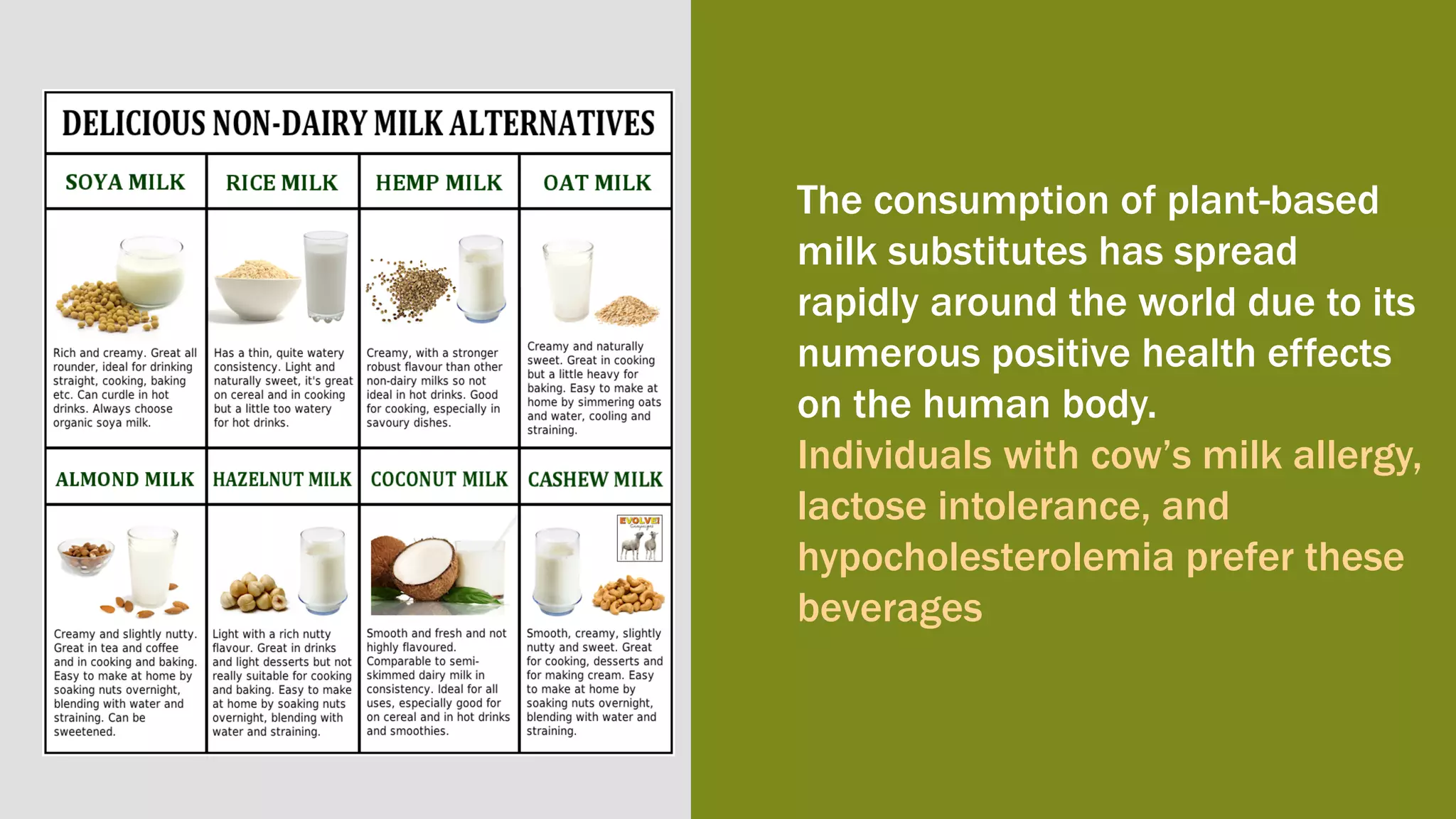
The consumption of plant-based
milk substitutes has spread
rapidly around the world due to its
numerous positive health effects
on the human body.
Individuals with cow’s milk allergy,
lactose intolerance, and
hypocholesterolemia prefer these
beverages
Substitutes
The Non-dairy Milk Products/ Plant
Based Beverages are gaining the
market demand, and the acceptance
as an alternative to dairy products will
lead the massive market for Non-Dairy
Milk/ Plant Based Beverages in the
future.
The global Plant Based Beverages
market is expected to reach US$ 22.67
billion by the year 2024, with a CAGR
of 12.4%. It shows that there is a
tremendous potential for plant-based
food & beverages, which gives the
opportunity for new manufacturers in
the market.
The Plant based Beverages are processed
and manufactured by extracting the plant
material, separating the essentials and the
solid matter, and producing the final product
with the homogenization and pasteurization
process.
Here a variety of plant-based ingredients are
used to produce alternatives to Dairy-Milk,
Viz. Soybean, Chia, Hazelnuts, Oat, Rice,
Coconut, Almond, Cashew, Peanuts, Potato,
Flax, Hemp, Tigernut, Lupin, Sesame, and
Quinoa, etc.
As compared to nutritional composition of
Dairy-Milk, all these Plant Based Beverages/
Non-Dairy Milk Products aren’t naturally high
in nutrients, specifically in calcium, and to
solve this the Plant Based Beverages needs
to be fortified during the process.
Which (Plant) Milk Is the Most
Sustainable?
Every liter of cow’s milk produced uses
up 628 liters of water and generates 3.2
kgs of CO₂. Even the most water hungry
among the plant milks, almond milk,
reaches only 60 percent of that water
use and the biggest polluter among
them, rice milk, causes not even 40
percent of the emissions generated by
cow’s milk. Soy and oat milk are even
more sustainable options when it comes
to water use, only requiring a fraction of
the water used in the production of
cow’s milk.
Potato Milk
Allergic to milk
proteins? Time to opt
for potato milk!
Benefits
Plant based Milk

Plant based Milk

  • 1.
    Plant Based Milk MilkSubstitute Primary Information Services www.primaryinfo.com mailto:primaryinfo@gmail.com
  • 2.
    The consumption ofplant-based milk substitutes has spread rapidly around the world due to its numerous positive health effects on the human body. Individuals with cow’s milk allergy, lactose intolerance, and hypocholesterolemia prefer these beverages
  • 3.
  • 4.
    The Non-dairy MilkProducts/ Plant Based Beverages are gaining the market demand, and the acceptance as an alternative to dairy products will lead the massive market for Non-Dairy Milk/ Plant Based Beverages in the future. The global Plant Based Beverages market is expected to reach US$ 22.67 billion by the year 2024, with a CAGR of 12.4%. It shows that there is a tremendous potential for plant-based food & beverages, which gives the opportunity for new manufacturers in the market.
  • 5.
    The Plant basedBeverages are processed and manufactured by extracting the plant material, separating the essentials and the solid matter, and producing the final product with the homogenization and pasteurization process. Here a variety of plant-based ingredients are used to produce alternatives to Dairy-Milk, Viz. Soybean, Chia, Hazelnuts, Oat, Rice, Coconut, Almond, Cashew, Peanuts, Potato, Flax, Hemp, Tigernut, Lupin, Sesame, and Quinoa, etc. As compared to nutritional composition of Dairy-Milk, all these Plant Based Beverages/ Non-Dairy Milk Products aren’t naturally high in nutrients, specifically in calcium, and to solve this the Plant Based Beverages needs to be fortified during the process.
  • 7.
    Which (Plant) MilkIs the Most Sustainable? Every liter of cow’s milk produced uses up 628 liters of water and generates 3.2 kgs of CO₂. Even the most water hungry among the plant milks, almond milk, reaches only 60 percent of that water use and the biggest polluter among them, rice milk, causes not even 40 percent of the emissions generated by cow’s milk. Soy and oat milk are even more sustainable options when it comes to water use, only requiring a fraction of the water used in the production of cow’s milk.
  • 8.
    Potato Milk Allergic tomilk proteins? Time to opt for potato milk!
  • 9.