PREPARED BY
PREMUJA M. NAIR
MBA
UCC
Consumerism is an organized movement of
citizens and government to strengthen the
rights and power of buyers in relation to the
sellers.
 Consumer movement in the present form
came into being only in the 1930's in the
West and only in the 60's in India.
The basic objectives of consumer movement
world wide are as follows :
 Recognition of reasonable consumer requests
 Protection against fraud, misrepresentation,
unsanitary and unjust products
 Management of aspects affecting
consumers
 Promoting consumers interests
In India, the basic reasons for the consumer movement are:-
 Shortage of consumer products;
 Inflation of early 1970′s.
 Adulteration and the Black Market.
 Lack of product choices due to lack of
development in technology.
 On availability, purity and prices.
Consumerism as an ideology appeared for
the first time in Western Europe.
Consumerism gave rise to certain
conditions:-
• Economic progress.
• Expanding trade
• The rise of small shops
• The rise of individualism.
• Growth of cities.
• The breakdown of traditional status
boundaries.
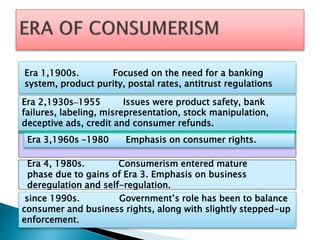
Era 1,1900s. Focused on the need for a banking
system, product purity, postal rates, antitrust regulations
Era 2,1930s–1955 Issues were product safety, bank
failures, labeling, misrepresentation, stock manipulation,
deceptive ads, credit and consumer refunds.
Era 3,1960s –1980 Emphasis on consumer rights.
Era 4, 1980s. Consumerism entered mature
phase due to gains of Era 3. Emphasis on business
deregulation and self-regulation.
since 1990s. Government’s role has been to balance
consumer and business rights, along with slightly stepped-up
enforcement.
In 1962, President John F. Kennedy presented a
the following fundamental rights of the
consumer.
 The right to safety
 The right to be informed
 The right to choose
 The right to be heard
 India has an ancient history of consumer
protection.
 Kautilya's 'Arthasasthra was the basic law.
 In 1960 an all India seminar on consumer co-
operatives was held
 From the Third Five Year plan onwards,
development of consumer co-operatives
andPDS by the governments to make them
viable
 Act is the milestone to the socio-economic
legislation in the country.
 The very first act made in India to know the
unfair trade practices done to the customers.
 Main objective to provide better consumer
protection.
 Speedy and in expensive procedures
 As under section -6 of The Consumer Protection
Act,1986 the customer has the following rights:
1) Right to Basic Needs;
2) Right to Safety;
3) Right to Choice;
4) Right to Information;
5) Right to Consumer Education;
6) Right to Redressed;
7) Right to Healthy Environment
Consumers have the right to be
protected against products and
services that are hazardous to health
and life
 Deontological – irrespective of the costs, if
life is endangered, those costs should be
incurred
 Teleological – by incurring additional costs
lower income consumers get priced out of the
market. Is that desirable?
The consumer has the right to be
protected against
• Fraudulent
• Deceitful or grossly misleading
Information,
• Advertising,
• Labeling, or other practices,
Consumers have the right to assured
access, to a variety of products and
services at competitive prices.
• Color
• Brand
• Quantity
• Rates
Consumers have the right to be
assured that consumer interests will
receive full and sympathetic
consideration in the formulation of
Government policy and fair and
expeditious treatment in its
administrative tribunals
 Environmental issues
 Pollution issues
 Short supply of many goods and services.
 Lack of effective or workable competition.
 Many products in advanced countries are
still new to a very large segment of the Indian
consumers
 Consumerism in India is not well organized
and developed.
 Laws to safeguard the interests of consumers
are not effectively implemented.
 CERC (Consumer Education and Research Centre), Ahmedabad
 FEDCOT (Federation of Consumer Organisations in Tamil Nadu)
 Consumer Guidance Society of India, Mumbai
 CUTS (Consumer Unity of Trust Society), Jaipur
 CONCERT (Centre for Consumer Education Research, Teaching,
Training and Testing), Chennai
 Bureau of Indian Standards, Chennai
What is consumerism

What is consumerism

  • 1.
  • 2.
    Consumerism is anorganized movement of citizens and government to strengthen the rights and power of buyers in relation to the sellers.  Consumer movement in the present form came into being only in the 1930's in the West and only in the 60's in India.
  • 3.
    The basic objectivesof consumer movement world wide are as follows :  Recognition of reasonable consumer requests  Protection against fraud, misrepresentation, unsanitary and unjust products  Management of aspects affecting consumers  Promoting consumers interests
  • 4.
    In India, thebasic reasons for the consumer movement are:-  Shortage of consumer products;  Inflation of early 1970′s.  Adulteration and the Black Market.  Lack of product choices due to lack of development in technology.  On availability, purity and prices.
  • 5.
    Consumerism as anideology appeared for the first time in Western Europe. Consumerism gave rise to certain conditions:- • Economic progress. • Expanding trade • The rise of small shops • The rise of individualism. • Growth of cities. • The breakdown of traditional status boundaries.
  • 6.
    Era 1,1900s. Focusedon the need for a banking system, product purity, postal rates, antitrust regulations Era 2,1930s–1955 Issues were product safety, bank failures, labeling, misrepresentation, stock manipulation, deceptive ads, credit and consumer refunds. Era 3,1960s –1980 Emphasis on consumer rights. Era 4, 1980s. Consumerism entered mature phase due to gains of Era 3. Emphasis on business deregulation and self-regulation. since 1990s. Government’s role has been to balance consumer and business rights, along with slightly stepped-up enforcement.
  • 7.
    In 1962, PresidentJohn F. Kennedy presented a the following fundamental rights of the consumer.  The right to safety  The right to be informed  The right to choose  The right to be heard
  • 8.
     India hasan ancient history of consumer protection.  Kautilya's 'Arthasasthra was the basic law.  In 1960 an all India seminar on consumer co- operatives was held  From the Third Five Year plan onwards, development of consumer co-operatives andPDS by the governments to make them viable
  • 9.
     Act isthe milestone to the socio-economic legislation in the country.  The very first act made in India to know the unfair trade practices done to the customers.  Main objective to provide better consumer protection.  Speedy and in expensive procedures
  • 10.
     As undersection -6 of The Consumer Protection Act,1986 the customer has the following rights: 1) Right to Basic Needs; 2) Right to Safety; 3) Right to Choice; 4) Right to Information; 5) Right to Consumer Education; 6) Right to Redressed; 7) Right to Healthy Environment
  • 11.
    Consumers have theright to be protected against products and services that are hazardous to health and life
  • 12.
     Deontological –irrespective of the costs, if life is endangered, those costs should be incurred  Teleological – by incurring additional costs lower income consumers get priced out of the market. Is that desirable?
  • 13.
    The consumer hasthe right to be protected against • Fraudulent • Deceitful or grossly misleading Information, • Advertising, • Labeling, or other practices,
  • 14.
    Consumers have theright to assured access, to a variety of products and services at competitive prices. • Color • Brand • Quantity • Rates
  • 15.
    Consumers have theright to be assured that consumer interests will receive full and sympathetic consideration in the formulation of Government policy and fair and expeditious treatment in its administrative tribunals
  • 16.
  • 17.
     Short supplyof many goods and services.  Lack of effective or workable competition.  Many products in advanced countries are still new to a very large segment of the Indian consumers  Consumerism in India is not well organized and developed.  Laws to safeguard the interests of consumers are not effectively implemented.
  • 18.
     CERC (ConsumerEducation and Research Centre), Ahmedabad  FEDCOT (Federation of Consumer Organisations in Tamil Nadu)  Consumer Guidance Society of India, Mumbai  CUTS (Consumer Unity of Trust Society), Jaipur  CONCERT (Centre for Consumer Education Research, Teaching, Training and Testing), Chennai  Bureau of Indian Standards, Chennai