SOCIO ECONOMIC
TRENDS
MACRO ENVIRONMENT
Forces that shape opportunities and pose
threats to a company
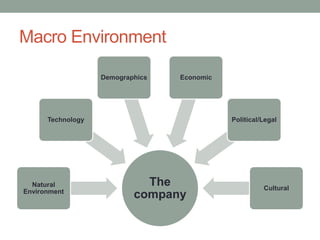
Macro Environment

                   Demographics   Economic


      Technology                             Political/Legal


  Natural                    The                       Cultural
Environment
                           company
Natural Environment
• Natural resources that are needed as inputs by marketers or
 that are affected by marketing activities
  • water, forests, oil, coal, minerals
• As resources become more scarce, costs increase
Natural Environment
 Changes in response to environment:
   biodegradable packs, charges for packets, Wellness Warehouse,
    Backsberg wine/carbon-neutral, PET bottle


 Major drivers that affect Marketing
   Consumer driven e.g. lobby groups, blogs, esp overseas
   Formal media, e,g, Carte Blanche, newspapers, Al Gore’s
    “Inconvenient Truth”
   Government intervention e.g. pollution laws, legislation for
    environmental reviews for new developments
   Note : Corporations CAN be proactive, but tend to be reactive;
    change is costly
Technological environment
• Forces that create new technologies, create new product
 and marketing opportunities
 • And change the way we market and communicate with customers
Internet changes the way consumers…
• …engage with each other and brands
    • Facebook, twitter

• ... communicate
   • Led by consumers, not marketers!
• …make purchasing decisions
  • Research
  • Peer reviews
Technological environment: issues
 Rapid pace of change
 High R&D cost/High Risk
   Invest in human resources or fall behind
   Invest in infrastructure or massive repercussions
      ▪ SA and internet
   Marketing often partnered with R&D to ensure commercial value
     (flying pigs, space colonies)
 Not always needs-driven
   Often create the need – iphone, ipad
 Government regulation? (privacy?)
 Well managed, technology can offer huge competitive
  advantage – SCM, POS
 Focus increasingly on on-going adaptation rather than
  macro change .. Apple iphone/ipad
POLITICAL/LEGAL
ENVIRONMENT
Political Environment
• Laws, governments, agencies and pressure groups that
 influence and limit various organisations and individuals in
 a given society.
Political environment
• South Africa has stable political environment
• Rule of law is respected and upheld
• Many countries do not have this benefit
• Corruption may drive marketing successes/failures
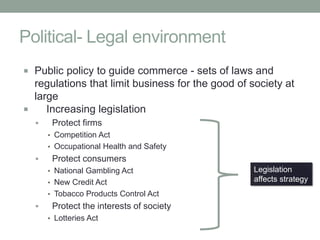
Political- Legal environment
 Public policy to guide commerce - sets of laws and
  regulations that limit business for the good of society at
  large
    Increasing legislation
      Protect firms
      ▪ Competition Act
      ▪ Occupational Health and Safety
      Protect consumers
      ▪ National Gambling Act                      Legislation
      ▪ New Credit Act                             affects strategy
      ▪ Tobacco Products Control Act
      Protect the interests of society
      ▪ Lotteries Act
Legal environment
• Not all laws are written
• Social codes and professional ethics
• Socially Responsible Behaviour
  • Do the right thing
• Cause related marketing
  • Corporate Social Responsibility CSR
    • Doing well by doing good
Legal Environment
• Advertising Standards
 • The Advertising Standards Authority of South Africa (also
   known as the ASA) is an independent body to ensure that its
   system of self-regulation works in the public interest.
 • Protect children from certain forms of advertising
 • Protect companies from unfair competition
 • Body to maintain fair business
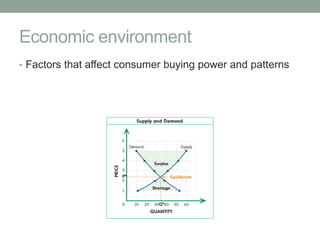
Economic environment
• Factors that affect consumer buying power and patterns
Economic Environment
 GDP growth (6.0% in 2006; now 3.5%),
 GINI coefficient
 ESKOM!!
   increasing costs for everyone, declining productivity
 Increase in fuel price
 Disposable income, Currency strength, cost of imported
  goods vs local manufacture; impact of oil price:
       food, airfares, car usage, car sales, taxi industry, food inflation
       variations
 Recession
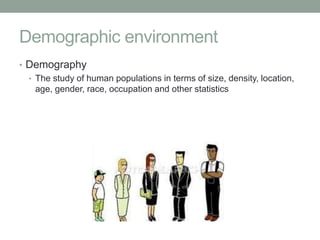
Demographic environment
• Demography
  • The study of human populations in terms of size, density, location,
    age, gender, race, occupation and other statistics
Demographic Environmental Factors
• South Africa COMPLEX! Characterised by
  • Young age profile (pyramid) but note the importance of Prime
    Timers (over 40’s)
  • Prevalence of single-parent households/ extended families
  • High mortality rates
  • HIV
  • Rural                Urban
  • Income diversity (Gini Coefficient)
Changing Demographics
• On the subject of Marriage
  • Divorcing or separating
  • Choosing not to marry
  • Choosing to marrying later
  • Marrying without intending to have children
  • Having children and not marrying
Cultural environment
• Consists of institutions and other forces that affect a
 society’s basic values, perceptions and behaviours
  • Culture of working, getting married, abiding by the rule of law,
    being a good person, caring about others
  • Arabic, Indian, China, Europe, Africa
    • Marriage (who?when?how?multiple?roles?)

• RSA is a multi cultural country
  • often segmentation also coincides with cultural differences
    • Language/religion/age/gender

• Culture is hard to define
    • Kalk Bay versus Seapoint vs Durbanville vs Blouberg
    • Soccer fans vs Rugby fans
    • Teenagers versus over 35’s
How do we incorporate Macro issues into
marketing strategy?
 We need to know and understand them and appreciate
  their immediate and long term impact
   recession and buyer behaviour
 We need to use them to our advantage
   refocusing on needs and character of new Black Middle Class
 We need to find ways of turning changes to our
  advantage
   Dubai world Crisis – rise of Second hand sales
 We need to identify trends which are Macro
  environmentally driven
   consumer attitudes towards ecology as Woolworths has done.
Examples of Macro trends
   Faith Popcorn http://www.faithpopcorn.com/
   99 Lives – wearing different hats/taking on lots of roles
   Anchoring
   Atmosfear
   Being alive
   Cashing out –opting for simpler more meaningful lives
   Clanning
   Cocooning: creating a safe environment at home/preferring home than
    going out
   Downaging
   Egonomics – crave recognition as individuals
   Eve-olution –more relational society
   Fanatsy adventure
   Icon toppling
   Pleasure revenge
   Small indulgences – wanting to reward ourselves
   Vigilante consumer
   SOS (Save our Society)
RISE OF THE INFORMAL
SECTOR
Rise of the informal sector in RSA
 Macro Factors
   Exclusive, discriminatory laws e.g. Group Areas Act, Job
    Reservation Act, Education policies
   Political Reaction .. Unrest in 1986; stayaways, boycott of white-
    owned businesses, withdrawal of traditional retailers from”black
    areas”, disenchantment with white owned businesses (no
    opportunities) Lot of red tape to start a formal business
   Limited access to capital and credit
   High unemployment
   Massive urbanisation as influx laws are scrapped
   Limited education opportunities
Growth of informal sector
• Consumer needs
• Societal support
• Evolution of unique structure
  • Stokvels/burial societies/investment clubs, shebeens, spaza’s
What is a spaza?
 It’s an informal retail outlet, usually selling essential,
    often perishable groceries
   Stay open for long, appropriate hours, staffed by
    owner’s family
   Located in townships
   Usually offer informal credit
   Typically sell top-up, replenishments
   Strong child customer base
   Sell top brands, often in small packs
   Now under pressure .. Having to compete with formal
    retailers who are now moving into townships, but still
    are relevant, particularly in very poor areas
What is a stokvel?
 A group of people – usually 12… Who come together to
  save, invest for common purpose
 Requires commitment.. Monthly.. Which is then
  redistributed
   Either on a full payout monthly rotation
   Or split at end of year (or biannually)
 Have a strong social context
 Types
   Investment cartels
     ▪ Often increase savings by 30% by loaning out stokvel funds
   Saving schemes
     ▪ Burial societies
     ▪ Christmas, back-to-school savings schemes

Marketing- Macroenvironment

  • 1.
    SOCIO ECONOMIC TRENDS MACRO ENVIRONMENT Forcesthat shape opportunities and pose threats to a company
  • 2.
    Macro Environment Demographics Economic Technology Political/Legal Natural The Cultural Environment company
  • 3.
    Natural Environment • Naturalresources that are needed as inputs by marketers or that are affected by marketing activities • water, forests, oil, coal, minerals • As resources become more scarce, costs increase
  • 4.
    Natural Environment  Changesin response to environment:  biodegradable packs, charges for packets, Wellness Warehouse, Backsberg wine/carbon-neutral, PET bottle  Major drivers that affect Marketing  Consumer driven e.g. lobby groups, blogs, esp overseas  Formal media, e,g, Carte Blanche, newspapers, Al Gore’s “Inconvenient Truth”  Government intervention e.g. pollution laws, legislation for environmental reviews for new developments  Note : Corporations CAN be proactive, but tend to be reactive; change is costly
  • 5.
    Technological environment • Forcesthat create new technologies, create new product and marketing opportunities • And change the way we market and communicate with customers
  • 6.
    Internet changes theway consumers… • …engage with each other and brands • Facebook, twitter • ... communicate • Led by consumers, not marketers! • …make purchasing decisions • Research • Peer reviews
  • 7.
    Technological environment: issues Rapid pace of change  High R&D cost/High Risk  Invest in human resources or fall behind  Invest in infrastructure or massive repercussions ▪ SA and internet  Marketing often partnered with R&D to ensure commercial value (flying pigs, space colonies)  Not always needs-driven  Often create the need – iphone, ipad  Government regulation? (privacy?)  Well managed, technology can offer huge competitive advantage – SCM, POS  Focus increasingly on on-going adaptation rather than macro change .. Apple iphone/ipad
  • 8.
  • 9.
    Political Environment • Laws,governments, agencies and pressure groups that influence and limit various organisations and individuals in a given society.
  • 10.
    Political environment • SouthAfrica has stable political environment • Rule of law is respected and upheld • Many countries do not have this benefit • Corruption may drive marketing successes/failures
  • 11.
    Political- Legal environment Public policy to guide commerce - sets of laws and regulations that limit business for the good of society at large  Increasing legislation  Protect firms ▪ Competition Act ▪ Occupational Health and Safety  Protect consumers ▪ National Gambling Act Legislation ▪ New Credit Act affects strategy ▪ Tobacco Products Control Act  Protect the interests of society ▪ Lotteries Act
  • 12.
    Legal environment • Notall laws are written • Social codes and professional ethics • Socially Responsible Behaviour • Do the right thing • Cause related marketing • Corporate Social Responsibility CSR • Doing well by doing good
  • 13.
    Legal Environment • AdvertisingStandards • The Advertising Standards Authority of South Africa (also known as the ASA) is an independent body to ensure that its system of self-regulation works in the public interest. • Protect children from certain forms of advertising • Protect companies from unfair competition • Body to maintain fair business
  • 14.
    Economic environment • Factorsthat affect consumer buying power and patterns
  • 15.
    Economic Environment  GDPgrowth (6.0% in 2006; now 3.5%),  GINI coefficient  ESKOM!!  increasing costs for everyone, declining productivity  Increase in fuel price  Disposable income, Currency strength, cost of imported goods vs local manufacture; impact of oil price:  food, airfares, car usage, car sales, taxi industry, food inflation variations  Recession
  • 16.
    Demographic environment • Demography • The study of human populations in terms of size, density, location, age, gender, race, occupation and other statistics
  • 17.
    Demographic Environmental Factors •South Africa COMPLEX! Characterised by • Young age profile (pyramid) but note the importance of Prime Timers (over 40’s) • Prevalence of single-parent households/ extended families • High mortality rates • HIV • Rural Urban • Income diversity (Gini Coefficient)
  • 18.
    Changing Demographics • Onthe subject of Marriage • Divorcing or separating • Choosing not to marry • Choosing to marrying later • Marrying without intending to have children • Having children and not marrying
  • 19.
    Cultural environment • Consistsof institutions and other forces that affect a society’s basic values, perceptions and behaviours • Culture of working, getting married, abiding by the rule of law, being a good person, caring about others • Arabic, Indian, China, Europe, Africa • Marriage (who?when?how?multiple?roles?) • RSA is a multi cultural country • often segmentation also coincides with cultural differences • Language/religion/age/gender • Culture is hard to define • Kalk Bay versus Seapoint vs Durbanville vs Blouberg • Soccer fans vs Rugby fans • Teenagers versus over 35’s
  • 20.
    How do weincorporate Macro issues into marketing strategy?  We need to know and understand them and appreciate their immediate and long term impact  recession and buyer behaviour  We need to use them to our advantage  refocusing on needs and character of new Black Middle Class  We need to find ways of turning changes to our advantage  Dubai world Crisis – rise of Second hand sales  We need to identify trends which are Macro environmentally driven  consumer attitudes towards ecology as Woolworths has done.
  • 21.
    Examples of Macrotrends  Faith Popcorn http://www.faithpopcorn.com/  99 Lives – wearing different hats/taking on lots of roles  Anchoring  Atmosfear  Being alive  Cashing out –opting for simpler more meaningful lives  Clanning  Cocooning: creating a safe environment at home/preferring home than going out  Downaging  Egonomics – crave recognition as individuals  Eve-olution –more relational society  Fanatsy adventure  Icon toppling  Pleasure revenge  Small indulgences – wanting to reward ourselves  Vigilante consumer  SOS (Save our Society)
  • 22.
    RISE OF THEINFORMAL SECTOR
  • 23.
    Rise of theinformal sector in RSA  Macro Factors  Exclusive, discriminatory laws e.g. Group Areas Act, Job Reservation Act, Education policies  Political Reaction .. Unrest in 1986; stayaways, boycott of white- owned businesses, withdrawal of traditional retailers from”black areas”, disenchantment with white owned businesses (no opportunities) Lot of red tape to start a formal business  Limited access to capital and credit  High unemployment  Massive urbanisation as influx laws are scrapped  Limited education opportunities
  • 24.
    Growth of informalsector • Consumer needs • Societal support • Evolution of unique structure • Stokvels/burial societies/investment clubs, shebeens, spaza’s
  • 25.
    What is aspaza?  It’s an informal retail outlet, usually selling essential, often perishable groceries  Stay open for long, appropriate hours, staffed by owner’s family  Located in townships  Usually offer informal credit  Typically sell top-up, replenishments  Strong child customer base  Sell top brands, often in small packs  Now under pressure .. Having to compete with formal retailers who are now moving into townships, but still are relevant, particularly in very poor areas
  • 26.
    What is astokvel?  A group of people – usually 12… Who come together to save, invest for common purpose  Requires commitment.. Monthly.. Which is then redistributed  Either on a full payout monthly rotation  Or split at end of year (or biannually)  Have a strong social context  Types  Investment cartels ▪ Often increase savings by 30% by loaning out stokvel funds  Saving schemes ▪ Burial societies ▪ Christmas, back-to-school savings schemes