Global Marketing Foreign Entry Local Marketing Global Management
Why go Global? Emergence of WTO Creation of Free Trade Areas Benefits of Foreign Trade Revolution in Global Communications Fast and Efficient Transportation Opening of Previously Closed Markets
Means to go Global Exports to foreign Countries Strategic Alliances Licensing Franchising Contract Manufacturing Joint Ventures Wholly Owned Subsidiaries
Multinational Phase After WW-II, MNC’s from US & Europe expanded into Asia, Europe and Latin America. Parent company maintained nominal control over subsidiaries Manufacturing & marketing of products were localized to meet local demands Foreign markets  needs are subordinate to the home markets
Global Phase Theodore Levitt’s “Globalization of markets” highlighted the merits of standardization – Noted the convergence of world markets Selling standardized products in  standardized methods all over the world Centralized core competence activities R&D, Manufacturing, Management, etc E.g.: Semiconductors, Software, Boeing etc.
Transnational Phase Sumantra Ghoshal, Christopher Bartlett etc developed a Transnational business idea Decentralized but Coordinated operations Products are tailored to suit local needs Central marketing plan but Local execution Subsidiaries network with each other and share knowledge.  Head Quarters manages and coordinates activities
Global Products People all over have similar needs This implies that some products have Global demand E.g. Industrial products Steel, Chemicals etc. Semiconductors, Internet services, Software Global products are usually impersonal products. People have no personal preference and decision is made on price or technical merits.
Global –Local Products People in different cultures have different styles and different tastes E.g: Food, Clothes, Housing etc. Cell Phones, Software – Different languages Government Regulations force Local Modifications  Electrical Appliances, Cars, Automobiles etc. Regional Economic Differences Purchasing power, economic development etc.
Global Marketing Defined Marketing activities that are coordinated and integrated across multiple markets Integration can involve Standardized products, Identical Brand names, Uniform packaging, Synchronized product introductions, Similar advertising messages etc. Coordination can involve competitive pricing, sales campaigns, market promotions etc.
Other Terms Used International Marketing or Foreign Marketing Primarily for exports to selective countries Multi-domestic marketing Different Products sold in different countries. Driven to localize and adapt to local markets E.g: HLL and Unilever
Global Markets Increasingly Common Consumer requirements and preferences as lifestyles, tastes and behavior narrow. Disappearing National trade boundaries with new Free Trade Agreements Global Brand Recognition E.g: Nike, Reebok, Coke, Nikon, Honda, Sony Global Communication Revolution
Global Competition Competitors are expanding globally Home market is challenged by a Global competitor Global Raw Material procurement will drive down costs Can also be Man power, finished products etc. Saturated home market is slowing down growth
Global Channels Global Distribution, Transportation, Marketing Channels Walmart, Metro, Costco – Global retailers Global Channels CNN, Star TV, Zee etc. Transferable Marketing I.e.: Similar marketing strategies all over Leading markets Need to learn from the leading markets. E.g. Scooters in Italy, Cars in Germany
Cost Drivers Economies of Scale E.g. Reliance Petroleum  Economies of Scope E.g. Infosys, Wipro, TCS Global Sourcing Advantages E.g TELCO in Italy, Cisco in Bangalore Avoid Duplication – Capitalize on spillover effects E.g P&G with Pantene Shampoo
Government Drivers Favorable Trade policies Export promotion, Foreign Investments Common Technical Standards ISO 9000 Free Trade Agreements NAFTA, ASEAN, EU etc. Active Government Promotion E.g Halliburton
Limits to Globalization Internal Resources Capital, Labor, Experience etc. Industry Factors – Not All industries can go global  e.g Medical services, Defense etc. Global Turmoil Recession, Political coup, war etc. Product Mixes Culturally sensitive products cannot be Globalized
Global Localization Products that need large scale customization Strategy formulation is Globalized Execution is Localized Examples McDonalds, Pizza Hut  HLL soaps Resource limitations force Local Execution E.g MTR
Developing Knowledge Assets Knowledge from Global operation can be a powerful competitive advantage E.g Fiat learnt a lot about emerging markets in Brazil and applied the same concepts in India Knowledge is build through exposure to new competition, customers, government rules, technology and business methods Learning Organizations can apply their newly acquired skills in other regions
Skill Benefits Transferring competitive information and new products to other markets (including home market) Capitalizing on the knowledge of foreign markets Offer distribution service to other companies Stretching and Building the firm’s capability New markets need new skills. Going Global helps
Global Marketing Objectives Exploit Market Potential and Growth Gain Economies of Scale and Scope Learn from the Leading Market Pressuring Competitors Diversifying Markets Learning How to do Business Abroad
Roles of a Global Manager Select & Implement Foreign Market Entry Select Countries, Mode of Entry etc Perform Local Marketing Abroad Promote Products and Services Conduct Market Research Manage Advertising Campaign Manage Global Operations
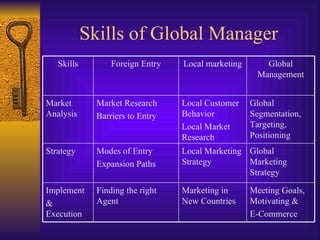
Skills of Global Manager Meeting Goals, Motivating &  E-Commerce Marketing in New Countries Finding the right Agent Implement &  Execution Global Marketing Strategy Local Marketing Strategy Modes of Entry Expansion Paths Strategy Global Segmentation, Targeting, Positioning Local Customer Behavior Local Market Research Market Research Barriers to Entry Market Analysis Global Management Local marketing Foreign Entry Skills
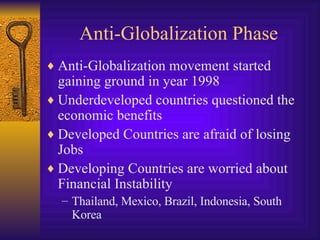
Anti-Globalization Phase Anti-Globalization movement started gaining ground in year 1998 Underdeveloped countries questioned the economic benefits Developed Countries are afraid of losing Jobs Developing Countries are worried about Financial Instability Thailand, Mexico, Brazil, Indonesia, South Korea
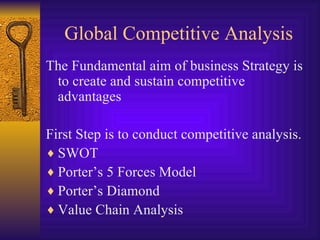
Global Competitive Analysis The Fundamental aim of business Strategy is to create and sustain competitive advantages First Step is to conduct competitive analysis. SWOT Porter’s 5 Forces Model  Porter’s Diamond Value Chain Analysis
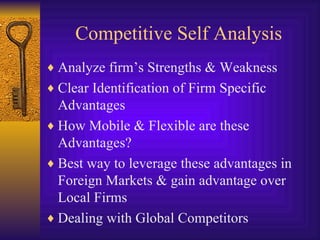
Competitive Self Analysis Analyze firm’s Strengths & Weakness Clear Identification of Firm Specific Advantages How Mobile & Flexible are these Advantages? Best way to leverage these advantages in Foreign Markets & gain advantage over Local Firms Dealing with Global Competitors
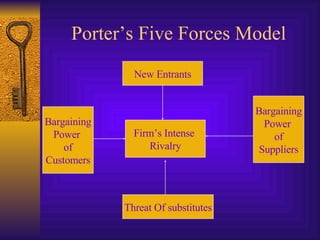
Porter’s Five Forces Model New Entrants Firm’s Intense  Rivalry Bargaining Power  of Customers Threat Of substitutes Bargaining Power  of Suppliers
Strategic Groups A Strategic Group consists of competitors who offer similar products or service in that Segment E.g: IBM, Accenture, EDS for Infosys but  NOT Bian, McKinsey, BCG Strategic Group can consist of competitors who offer Substitute Products E.g: Nestlé's water for Pepsi and Coca Cola
Country Specific Advantages A Firm possesses some advantages because of the country from where it Operates. E.g: Infosys, Wipro have a cost advantage by operating in India E.g: Cosco, a Chinese furniture manufacturer has a cost advantage when competing in US E.g: IBM has a cost advantage by operating in India, has famous Brand Name & Recognition
National Competitive Advantage A country might provide an absolute advantage by the virtue of having certain resources Oil in Saudi Arabia, Labor in China High Technology in USA Comparative Advantage : When one country is better in producing a certain type of product Coffee in Brazil Software & Garments in India
New Trade Theory Man made Locational Advantages has a big impact on the Trade Patterns Certain Areas have a huge concentration of certain Industries Software firms in Bangalore, Silicon Valley Garments in Delhi, Financial services in Mumbai
Country of Origin Effects Customers give a value for “Made-in-XXX” label.  Products or services from a country with a positive image tend to be favorably evaluated, while  products from less positively perceived countries tend to be downgraded Chocolates from Belgium, Watches from Switzerland, Computers from USA : Positively Perceived Cars from Kenya, Brazil : Negatively Perceived
Domestic Competitors Domestic Competitors : They have the same Country Specific Advantages as you. E.g: Wipro & Infosys  Country Specific Advantages are derived from Government Rules, Regulations, Tax benefits,  Availability of Raw materials, Human Resources etc A large Home Market also helps domestic competitors. E.g: IBM, DELL & EDS Also called Demand Conditions
Foreign Competitors Foreign Competitors : Foreign Firms are the most direct competitors of a Globalizing firm.  Foreign Competitors from the same country can be analyzed as a separate Strategic Group.  E.g: Samsung, LG, Daewoo Firms from the same country follow similar strategy Regional Trade Blocs also help Foreign Competitors E.g: Electrolux from EU
New Entrants & Substitutes Potential New Entrants & Substitutes are another competitive threat to a Firm Banks face a threat of more competition with new entrants from Japan, US, Europe Banks face a threat from substitutes like Web-Bank, Investment companies like Charles Schwab, E-Trade etc. Banks face threat from Chit-Funds, Mutual Funds etc.
First Mover Advantages An Emerging market offers an opportunity to be a first mover and create demand. Emerging Market can be a Country or Introducing a new Product/Services Higher Brand Recognition Positive Brand Image More Customer Loyalty Longer Market Experience Wider Distribution
Pioneering Costs Customer Tastes & Preferences are unknown New Distribution Channel may have to be set up Customers have to be educated Advertising Expenses, Promotion expenses will be high Few Firms tend to be Followers – “Second Mover Advantage”
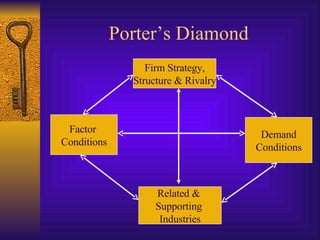
Porter’s Diamond Firm Strategy, Structure & Rivalry Demand Conditions Factor  Conditions Related &  Supporting  Industries
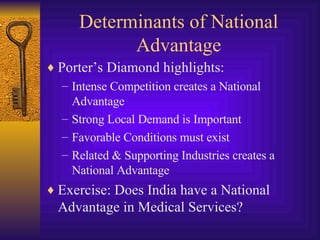
Determinants of National Advantage Porter’s Diamond highlights: Intense Competition creates a National Advantage Strong Local Demand is Important Favorable Conditions must exist Related & Supporting Industries creates a National Advantage Exercise: Does India have a National Advantage in Medical Services?
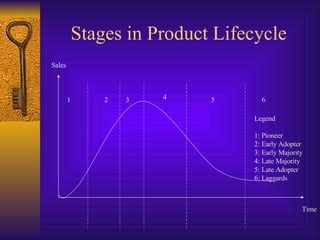
Stages in Product Lifecycle Sales 1 2 3 4 5 6 Legend 1: Pioneer 2: Early Adopter 3: Early Majority 4: Late Majority 5: Late Adopter 6: Laggards Time
Trade & Product Lifecycle International Product Lifecycle theory is based on past trends. New Products will be first introduced in developed markets & exported worldwide, As the product matures, it will be manufactured in developing countries at a lower cost and imported to developed countries E.g: It is advantageous for US to TV & concentrate on Computers
Firm Specific Advantages Firms develop competitive advantages which is unique to them E.g: Patents, Distribution Network, Manufacturing techniques, Access to Raw materials etc Knowledge Based FSA: Soft skills such as marketing, brand management etc. Skills reside in employees and experience of the Firms Resource Based FSA: Resources such as products, technology, know-how & Services Firms have to build both Knowledge based & Resource based advantages
Taking FSA Abroad FSA cannot always be transferred abroad. The degree of transferability depends on FSA itself Intangible “skills” are toughest to transfer FSA tied to home country infrastructure cannot be transferred. E.g: Distribution Budweiser Beer, Henkel detergents etc
Externalization of FSA There are several ways to enter a country’s Market. The mode of entry depends on FSA If a firm choose to License or Franchise abroad, then it has to transfer its FSA to another partner abroad – Called Externalization of FSA E.g: Coca-Cola, McDonalds, FedEx Problem with licensing – Unable to learn from the new market, Loss of FSA Outsourcing parts in Value chain is Externalization of FSA
Internalization of FSA If a firm chooses to maintain a tight control over its FSA & internal advantages, it can: Export or FDI Both Cases, company can maintain tight control over its FSA Choice between Export or FDI depends on trade barriers, market size, transaction costs, CSA etc. Retaining the firm’s value chain when going abroad is Internalization of FSA
Transaction Costs Transaction Costs are costs incurred when completing a transaction between a buyer and a seller. Includes hidden costs such as negotiation costs, finding partners, communication overheads etc. In addition to obvious costs such as transportation, taxes, brokerage fees etc. Banks & middlemen lower transaction costs by performing “Market Making” functions
Hypercompetition The intense rivalry between global firms and domestic competitors  is common in Global business.  Competitive advantages are increasingly difficult to sustain is face of Hypercompetition Bench Marking reduces competitive advantages of the competitors Lack of sustainable competitive advantages is forcing companies to develop intangible skills like customer service, quality, Brand image etc
Winning in Hypercompetition Firms can win in a hypercompetitive environment by continuously moving to new grounds, I.e raising standards, improving product/Service quality etc. Hypercompetition forces firms to concentrate on: Cost & Quality: Lower cost, improve quality Timing & Know-how: Market Knowledge Defending Strongholds Financial Resources: Financial strength is necessary to keep competitive edge; R&D, M&A, Advertising etc.
Closing Thoughts Going global will stretch and mold company resources into a globally effective marketing organization. Global Managers will have to select the right entry strategies, decide on trade-offs between localization or global standardization to achieve the optimal local responsiveness and global scale of economies. When Going global, it is better to take help from experts for market entry, market research & international Financing
 

Global Marketing

  • 1.
    Global Marketing ForeignEntry Local Marketing Global Management
  • 2.
    Why go Global?Emergence of WTO Creation of Free Trade Areas Benefits of Foreign Trade Revolution in Global Communications Fast and Efficient Transportation Opening of Previously Closed Markets
  • 3.
    Means to goGlobal Exports to foreign Countries Strategic Alliances Licensing Franchising Contract Manufacturing Joint Ventures Wholly Owned Subsidiaries
  • 4.
    Multinational Phase AfterWW-II, MNC’s from US & Europe expanded into Asia, Europe and Latin America. Parent company maintained nominal control over subsidiaries Manufacturing & marketing of products were localized to meet local demands Foreign markets needs are subordinate to the home markets
  • 5.
    Global Phase TheodoreLevitt’s “Globalization of markets” highlighted the merits of standardization – Noted the convergence of world markets Selling standardized products in standardized methods all over the world Centralized core competence activities R&D, Manufacturing, Management, etc E.g.: Semiconductors, Software, Boeing etc.
  • 6.
    Transnational Phase SumantraGhoshal, Christopher Bartlett etc developed a Transnational business idea Decentralized but Coordinated operations Products are tailored to suit local needs Central marketing plan but Local execution Subsidiaries network with each other and share knowledge. Head Quarters manages and coordinates activities
  • 7.
    Global Products Peopleall over have similar needs This implies that some products have Global demand E.g. Industrial products Steel, Chemicals etc. Semiconductors, Internet services, Software Global products are usually impersonal products. People have no personal preference and decision is made on price or technical merits.
  • 8.
    Global –Local ProductsPeople in different cultures have different styles and different tastes E.g: Food, Clothes, Housing etc. Cell Phones, Software – Different languages Government Regulations force Local Modifications Electrical Appliances, Cars, Automobiles etc. Regional Economic Differences Purchasing power, economic development etc.
  • 9.
    Global Marketing DefinedMarketing activities that are coordinated and integrated across multiple markets Integration can involve Standardized products, Identical Brand names, Uniform packaging, Synchronized product introductions, Similar advertising messages etc. Coordination can involve competitive pricing, sales campaigns, market promotions etc.
  • 10.
    Other Terms UsedInternational Marketing or Foreign Marketing Primarily for exports to selective countries Multi-domestic marketing Different Products sold in different countries. Driven to localize and adapt to local markets E.g: HLL and Unilever
  • 11.
    Global Markets IncreasinglyCommon Consumer requirements and preferences as lifestyles, tastes and behavior narrow. Disappearing National trade boundaries with new Free Trade Agreements Global Brand Recognition E.g: Nike, Reebok, Coke, Nikon, Honda, Sony Global Communication Revolution
  • 12.
    Global Competition Competitorsare expanding globally Home market is challenged by a Global competitor Global Raw Material procurement will drive down costs Can also be Man power, finished products etc. Saturated home market is slowing down growth
  • 13.
    Global Channels GlobalDistribution, Transportation, Marketing Channels Walmart, Metro, Costco – Global retailers Global Channels CNN, Star TV, Zee etc. Transferable Marketing I.e.: Similar marketing strategies all over Leading markets Need to learn from the leading markets. E.g. Scooters in Italy, Cars in Germany
  • 14.
    Cost Drivers Economiesof Scale E.g. Reliance Petroleum Economies of Scope E.g. Infosys, Wipro, TCS Global Sourcing Advantages E.g TELCO in Italy, Cisco in Bangalore Avoid Duplication – Capitalize on spillover effects E.g P&G with Pantene Shampoo
  • 15.
    Government Drivers FavorableTrade policies Export promotion, Foreign Investments Common Technical Standards ISO 9000 Free Trade Agreements NAFTA, ASEAN, EU etc. Active Government Promotion E.g Halliburton
  • 16.
    Limits to GlobalizationInternal Resources Capital, Labor, Experience etc. Industry Factors – Not All industries can go global e.g Medical services, Defense etc. Global Turmoil Recession, Political coup, war etc. Product Mixes Culturally sensitive products cannot be Globalized
  • 17.
    Global Localization Productsthat need large scale customization Strategy formulation is Globalized Execution is Localized Examples McDonalds, Pizza Hut HLL soaps Resource limitations force Local Execution E.g MTR
  • 18.
    Developing Knowledge AssetsKnowledge from Global operation can be a powerful competitive advantage E.g Fiat learnt a lot about emerging markets in Brazil and applied the same concepts in India Knowledge is build through exposure to new competition, customers, government rules, technology and business methods Learning Organizations can apply their newly acquired skills in other regions
  • 19.
    Skill Benefits Transferringcompetitive information and new products to other markets (including home market) Capitalizing on the knowledge of foreign markets Offer distribution service to other companies Stretching and Building the firm’s capability New markets need new skills. Going Global helps
  • 20.
    Global Marketing ObjectivesExploit Market Potential and Growth Gain Economies of Scale and Scope Learn from the Leading Market Pressuring Competitors Diversifying Markets Learning How to do Business Abroad
  • 21.
    Roles of aGlobal Manager Select & Implement Foreign Market Entry Select Countries, Mode of Entry etc Perform Local Marketing Abroad Promote Products and Services Conduct Market Research Manage Advertising Campaign Manage Global Operations
  • 22.
    Skills of GlobalManager Meeting Goals, Motivating & E-Commerce Marketing in New Countries Finding the right Agent Implement & Execution Global Marketing Strategy Local Marketing Strategy Modes of Entry Expansion Paths Strategy Global Segmentation, Targeting, Positioning Local Customer Behavior Local Market Research Market Research Barriers to Entry Market Analysis Global Management Local marketing Foreign Entry Skills
  • 23.
    Anti-Globalization Phase Anti-Globalizationmovement started gaining ground in year 1998 Underdeveloped countries questioned the economic benefits Developed Countries are afraid of losing Jobs Developing Countries are worried about Financial Instability Thailand, Mexico, Brazil, Indonesia, South Korea
  • 24.
    Global Competitive AnalysisThe Fundamental aim of business Strategy is to create and sustain competitive advantages First Step is to conduct competitive analysis. SWOT Porter’s 5 Forces Model Porter’s Diamond Value Chain Analysis
  • 25.
    Competitive Self AnalysisAnalyze firm’s Strengths & Weakness Clear Identification of Firm Specific Advantages How Mobile & Flexible are these Advantages? Best way to leverage these advantages in Foreign Markets & gain advantage over Local Firms Dealing with Global Competitors
  • 26.
    Porter’s Five ForcesModel New Entrants Firm’s Intense Rivalry Bargaining Power of Customers Threat Of substitutes Bargaining Power of Suppliers
  • 27.
    Strategic Groups AStrategic Group consists of competitors who offer similar products or service in that Segment E.g: IBM, Accenture, EDS for Infosys but NOT Bian, McKinsey, BCG Strategic Group can consist of competitors who offer Substitute Products E.g: Nestlé's water for Pepsi and Coca Cola
  • 28.
    Country Specific AdvantagesA Firm possesses some advantages because of the country from where it Operates. E.g: Infosys, Wipro have a cost advantage by operating in India E.g: Cosco, a Chinese furniture manufacturer has a cost advantage when competing in US E.g: IBM has a cost advantage by operating in India, has famous Brand Name & Recognition
  • 29.
    National Competitive AdvantageA country might provide an absolute advantage by the virtue of having certain resources Oil in Saudi Arabia, Labor in China High Technology in USA Comparative Advantage : When one country is better in producing a certain type of product Coffee in Brazil Software & Garments in India
  • 30.
    New Trade TheoryMan made Locational Advantages has a big impact on the Trade Patterns Certain Areas have a huge concentration of certain Industries Software firms in Bangalore, Silicon Valley Garments in Delhi, Financial services in Mumbai
  • 31.
    Country of OriginEffects Customers give a value for “Made-in-XXX” label. Products or services from a country with a positive image tend to be favorably evaluated, while products from less positively perceived countries tend to be downgraded Chocolates from Belgium, Watches from Switzerland, Computers from USA : Positively Perceived Cars from Kenya, Brazil : Negatively Perceived
  • 32.
    Domestic Competitors DomesticCompetitors : They have the same Country Specific Advantages as you. E.g: Wipro & Infosys Country Specific Advantages are derived from Government Rules, Regulations, Tax benefits, Availability of Raw materials, Human Resources etc A large Home Market also helps domestic competitors. E.g: IBM, DELL & EDS Also called Demand Conditions
  • 33.
    Foreign Competitors ForeignCompetitors : Foreign Firms are the most direct competitors of a Globalizing firm. Foreign Competitors from the same country can be analyzed as a separate Strategic Group. E.g: Samsung, LG, Daewoo Firms from the same country follow similar strategy Regional Trade Blocs also help Foreign Competitors E.g: Electrolux from EU
  • 34.
    New Entrants &Substitutes Potential New Entrants & Substitutes are another competitive threat to a Firm Banks face a threat of more competition with new entrants from Japan, US, Europe Banks face a threat from substitutes like Web-Bank, Investment companies like Charles Schwab, E-Trade etc. Banks face threat from Chit-Funds, Mutual Funds etc.
  • 35.
    First Mover AdvantagesAn Emerging market offers an opportunity to be a first mover and create demand. Emerging Market can be a Country or Introducing a new Product/Services Higher Brand Recognition Positive Brand Image More Customer Loyalty Longer Market Experience Wider Distribution
  • 36.
    Pioneering Costs CustomerTastes & Preferences are unknown New Distribution Channel may have to be set up Customers have to be educated Advertising Expenses, Promotion expenses will be high Few Firms tend to be Followers – “Second Mover Advantage”
  • 37.
    Porter’s Diamond FirmStrategy, Structure & Rivalry Demand Conditions Factor Conditions Related & Supporting Industries
  • 38.
    Determinants of NationalAdvantage Porter’s Diamond highlights: Intense Competition creates a National Advantage Strong Local Demand is Important Favorable Conditions must exist Related & Supporting Industries creates a National Advantage Exercise: Does India have a National Advantage in Medical Services?
  • 39.
    Stages in ProductLifecycle Sales 1 2 3 4 5 6 Legend 1: Pioneer 2: Early Adopter 3: Early Majority 4: Late Majority 5: Late Adopter 6: Laggards Time
  • 40.
    Trade & ProductLifecycle International Product Lifecycle theory is based on past trends. New Products will be first introduced in developed markets & exported worldwide, As the product matures, it will be manufactured in developing countries at a lower cost and imported to developed countries E.g: It is advantageous for US to TV & concentrate on Computers
  • 41.
    Firm Specific AdvantagesFirms develop competitive advantages which is unique to them E.g: Patents, Distribution Network, Manufacturing techniques, Access to Raw materials etc Knowledge Based FSA: Soft skills such as marketing, brand management etc. Skills reside in employees and experience of the Firms Resource Based FSA: Resources such as products, technology, know-how & Services Firms have to build both Knowledge based & Resource based advantages
  • 42.
    Taking FSA AbroadFSA cannot always be transferred abroad. The degree of transferability depends on FSA itself Intangible “skills” are toughest to transfer FSA tied to home country infrastructure cannot be transferred. E.g: Distribution Budweiser Beer, Henkel detergents etc
  • 43.
    Externalization of FSAThere are several ways to enter a country’s Market. The mode of entry depends on FSA If a firm choose to License or Franchise abroad, then it has to transfer its FSA to another partner abroad – Called Externalization of FSA E.g: Coca-Cola, McDonalds, FedEx Problem with licensing – Unable to learn from the new market, Loss of FSA Outsourcing parts in Value chain is Externalization of FSA
  • 44.
    Internalization of FSAIf a firm chooses to maintain a tight control over its FSA & internal advantages, it can: Export or FDI Both Cases, company can maintain tight control over its FSA Choice between Export or FDI depends on trade barriers, market size, transaction costs, CSA etc. Retaining the firm’s value chain when going abroad is Internalization of FSA
  • 45.
    Transaction Costs TransactionCosts are costs incurred when completing a transaction between a buyer and a seller. Includes hidden costs such as negotiation costs, finding partners, communication overheads etc. In addition to obvious costs such as transportation, taxes, brokerage fees etc. Banks & middlemen lower transaction costs by performing “Market Making” functions
  • 46.
    Hypercompetition The intenserivalry between global firms and domestic competitors is common in Global business. Competitive advantages are increasingly difficult to sustain is face of Hypercompetition Bench Marking reduces competitive advantages of the competitors Lack of sustainable competitive advantages is forcing companies to develop intangible skills like customer service, quality, Brand image etc
  • 47.
    Winning in HypercompetitionFirms can win in a hypercompetitive environment by continuously moving to new grounds, I.e raising standards, improving product/Service quality etc. Hypercompetition forces firms to concentrate on: Cost & Quality: Lower cost, improve quality Timing & Know-how: Market Knowledge Defending Strongholds Financial Resources: Financial strength is necessary to keep competitive edge; R&D, M&A, Advertising etc.
  • 48.
    Closing Thoughts Goingglobal will stretch and mold company resources into a globally effective marketing organization. Global Managers will have to select the right entry strategies, decide on trade-offs between localization or global standardization to achieve the optimal local responsiveness and global scale of economies. When Going global, it is better to take help from experts for market entry, market research & international Financing
  • 49.