Basics of Marketing – MBA I
1MBA-I MIBM
2
Why a product like radio declined
and now once again emerging as an
entertainment medium?
MBA-I MIBM
3
What Were the Drivers of This Change ?
 Technology ?
 Government policy ?
 Other media substitutes ?
 Change in Consumers’ Preferences ?
 Change in Economic Conditions ?
MBA-I MIBM
4
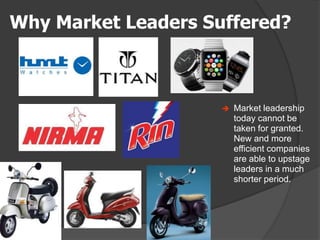
Why Market Leaders Suffered?
 Market leadership
today cannot be
taken for granted.
New and more
efficient companies
are able to upstage
leaders in a much
shorter period.
MBA-I MIBM
Marketing Environment
 The marketing environment consists of
actors and forces outside the organization
that affect management’s ability to build and
maintain relationships with target customers.
 Environment offers both opportunities and
threats.
 Marketing intelligence and research used
to collect information about the environment.
5MBA-I MIBM
Marketing Environment
 Includes:
 Microenvironment: actors close to the
company that affect its ability to serve its
customers.
 Macro environment: larger societal forces
that affect the microenvironment.
○ Considered to be beyond the control of the
organization.
6MBA-I MIBM
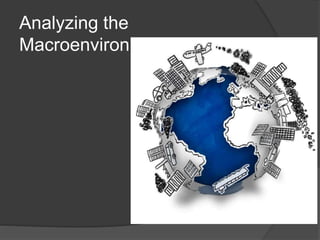
Analyzing the
Macroenvironment
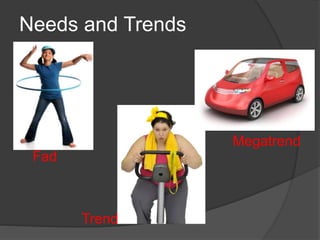
Needs and Trends
Fad
Megatrend
Trend
Marketing Environment
 Analyzing the Macroenvironment
 Needs and Trends
○ Fads – “unpredictable, short-lived, and
without social, economic and political
significance”
○ Trend – “direction or sequence of events that
has some momentum & durability”
○ Megatrends – “ large social, economic,
political and technological changes that are
slow to form and once in place, they
influence us for some time between 7-10
years or longer”
9MBA-I MIBM
Marketing Environment
 Analyzing the Macroenvironment
 Identifying Major Forces
○ Suppliers, intermediaries, customers,
competitors, and public – Is their behaviour
controllable?
○ A steep decline of stock market affects
savings, investment, retirement funds etc,
increasing unemployment, corporate
scandals, rise of terrorism.
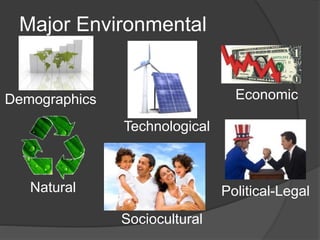
○ Six major forces – Demographic, economic,
social-cultural, natural, technological, political
& legal.
10MBA-I MIBM
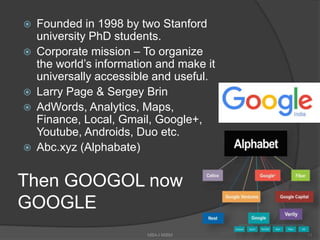
Then GOOGOL now
GOOGLE
 Founded in 1998 by two Stanford
university PhD students.
 Corporate mission – To organize
the world’s information and make it
universally accessible and useful.
 Larry Page & Sergey Brin
 AdWords, Analytics, Maps,
Finance, Local, Gmail, Google+,
Youtube, Androids, Duo etc.
 Abc.xyz (Alphabate)
11MBA-I MIBM
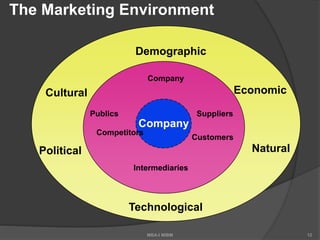
The Marketing Environment
Company
Demographic
Economic
Natural
Technological
Political
Cultural
Company
Customers
Intermediaries
Suppliers
Competitors
Publics
12MBA-I MIBM
Major Environmental
Forces
Economic
Sociocultural
Natural
Technological
Political-Legal
Demographics
Demographic Environment
Worldwide population growth
Population age mix
Ethnic and other markets
Educational Groups
Household patterns
The World as a Village
If the world were a village of 100 people:
61 – Asian (20 Chinese, 17 Indian)
18 – Unable to read (33 have cell phones)
18 – Under 10 years of age (11 over 60
years old)
18 – Cars in the village
63 – Inadequate sanitation
67 – Non-Christian
30 – Unemployed or underemployed
53 – Live on less than $2 a day
26 – Smoke
14 – Obese
01 – Have AIDS
Source: David J. Smith and Shelagh Armstrong, If the World Were a
Village: A Book About the World’s People, 2nd ed. (Tonawanda, NY: Kids
Can Press, 2002)
17MBA-I MIBM
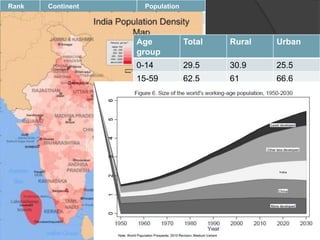
Rank Continent Population
1 Asia 4,140,000,000
2 Africa 1,033,000,000
3 Europe 739,000,000
4 North America 529,000,000
5 South America 386,000,000
6 Oceania (Australia) 36,000,000
7 Antarctica 4,000
Age
group
Total Rural Urban
0-14 29.5 30.9 25.5
15-59 62.5 61 66.6
60+ 8 8.1 7.9
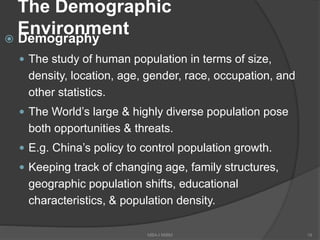
The Demographic
Environment Demography
 The study of human population in terms of size,
density, location, age, gender, race, occupation, and
other statistics.
 The World’s large & highly diverse population pose
both opportunities & threats.
 E.g. China’s policy to control population growth.
 Keeping track of changing age, family structures,
geographic population shifts, educational
characteristics, & population density.
18MBA-I MIBM
The Demographic
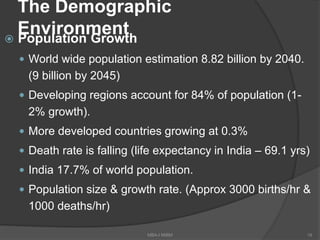
Environment Population Growth
 World wide population estimation 8.82 billion by 2040.
(9 billion by 2045)
 Developing regions account for 84% of population (1-
2% growth).
 More developed countries growing at 0.3%
 Death rate is falling (life expectancy in India – 69.1 yrs)
 India 17.7% of world population.
 Population size & growth rate. (Approx 3000 births/hr &
1000 deaths/hr)
19MBA-I MIBM
The Demographic
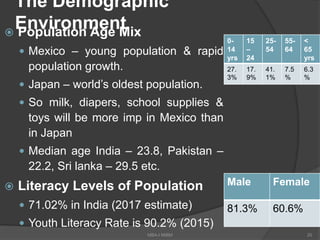
Environment Population Age Mix
 Mexico – young population & rapid
population growth.
 Japan – world’s oldest population.
 So milk, diapers, school supplies &
toys will be more imp in Mexico than
in Japan
 Median age India – 23.8, Pakistan –
22.2, Sri lanka – 29.5 etc.
 Literacy Levels of Population
 71.02% in India (2017 estimate)
 Youth Literacy Rate is 90.2% (2015)
0-
14
yrs
15
–
24
25-
54
55-
64
<
65
yrs
27.
3%
17.
9%
41.
1%
7.5
%
6.3
%
Male Female
81.3% 60.6%
20MBA-I MIBM
The Demographic
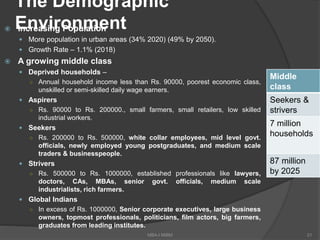
Environment Increasing Population
 More population in urban areas (34% 2020) (49% by 2050).
 Growth Rate – 1.1% (2018)
 A growing middle class
 Deprived households –
○ Annual household income less than Rs. 90000, poorest economic class,
unskilled or semi-skilled daily wage earners.
 Aspirers
○ Rs. 90000 to Rs. 200000., small farmers, small retailers, low skilled
industrial workers.
 Seekers
○ Rs. 200000 to Rs. 500000, white collar employees, mid level govt.
officials, newly employed young postgraduates, and medium scale
traders & businesspeople.
 Strivers
○ Rs. 500000 to Rs. 1000000, established professionals like lawyers,
doctors, CAs, MBAs, senior govt. officials, medium scale
industrialists, rich farmers.
 Global Indians
○ In excess of Rs. 1000000, Senior corporate executives, large business
owners, topmost professionals, politicians, film actors, big farmers,
graduates from leading institutes.
Middle
class
Seekers &
strivers
7 million
households
87 million
by 2025
21MBA-I MIBM
Demographic
Environment
 Increasing Population
 A Growing Middle class
 Population in Rural India
 Generational Marketing
 The changing family system
 The changing role of women
 A Better-Educated, More White-Collar, More
Professional Population
 Increasing Diversity
MBA-I MIBM 22
The Demographic
Environment Growth in rural population
 By 2050 rural population will be 50% of total population.
 Some problems like, purchasing power, lack of proper infrastructure, reliable
supply of electricity etc.
 A Changing Family System
 Joint family system – able bodied men will be bread earners, women looks after
kitchen, elderly look for cultural norms & preach value to kids.
 Dual income single kid (DISK)
 The changing role of women
 Education, more ambitious, earning more, more active member of family.
 A better educated, more white-collared, more professional population
 789 universities and 37,234 colleges
 More educated people will demand more quality product, books, magazines,
travel, personal computers, & internet services.
 Increasing Diversity
 Inner state diversities are increasing
23MBA-I MIBM
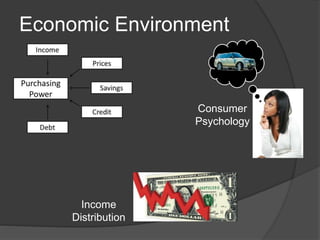
Economic Environment
Consumer
Psychology
Income
Distribution
Economic Environment
 Factors that affect consumer purchasing power & spending
patterns.
 Industrial economy, Developing economy, Subsistence economy,
 The Global Financial Crisis
 Subprime housing loans issued in US (2007-09), most stock markets in world
crashed, severe lending crunch, inflation, less exports, less FDI, less GDP
growth.
 In India demand for housing, construction, consumer durables & IT sector were
affected most.
 Changing Income distribution & Consumer spending pattern
 Rich have grown richer.
 Growing urban middle class.
 Purchase of consumer items increasing.
 Mercedez – Benz targets affluent; Tata Motors – modest means, Maruti-Suzuki
 Current income, prices, savings, debt & credit availability.
25MBA-I MIBM
Economic Environment
 India GDP per capita – $ 1997 and growing at 7.74% $FY
2017-18
 Healthy foreign exchange reserves (US$ 387 billion approx),
Inflation (CPI / WPI); (inflation 3.69%); (3.3%YTD) in Aug 18
 Income Distribution –
 Lower income households declining continuously.
 Destitute – annual income of Rs. 16000
 Aspirants – 16000 – 22000
 Climbers – 22000 – 45000
 Consuming class – 45000 – 215000
 Rich – more than 1000000 lakhs annual income
 Demand is likely to increase, additional opportunities for new
products & services, Business expansion etc.
26MBA-I MIBM
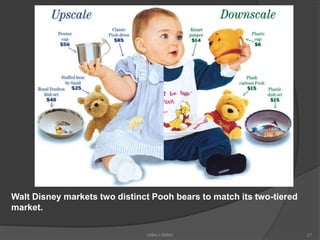
Walt Disney markets two distinct Pooh bears to match its two-tiered
market.
27MBA-I MIBM
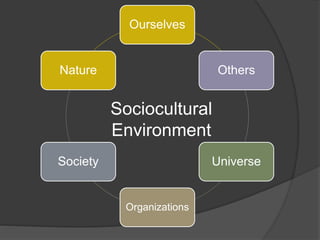
Ourselves
Others
Universe
Organizations
Society
Nature
Sociocultural
Environment
Social-Cultural
Environment Society shapes the beliefs, values, & norms that largely define
consumer tastes & preferences.
 Ethnic Diversity – one fifth of the world
 Major religions – Hinduism, Islam, Sikhism, Christianity, Buddhism & Jainism
 Different languages & thousands of dialects.
 Customs, social systems, Values, habits, Religions & Caste
Systems.
 E.g. Dress codes, food habits, local advertising, regional biases for brand
preferences,
 Progression from traditionalism & self sacrifice to westernization &
individualism.
 Increased Emphasis on Ethics & Socially Responsible Actions
 Socially responsible behaviour – business scandals, environment issues, online
privacy issues, transfer of digital data etc.
 Cause-related marketing – linking to a worthwhile cause, selling strategy than
giving strategy. But may give company good image.
 E.g. CRY greeting cards.
29MBA-I MIBM
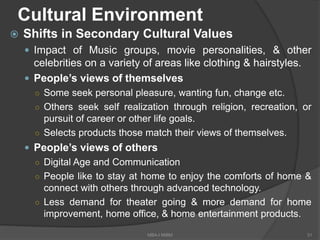
Cultural Environment
 Made up of institutions & other forces that affect
society’s basic values, perceptions, preferences, &
behaviors.
 Persistence of Cultural Values
 Most Asians believe in working, getting married & giving
to charity and have strong faith in religion.
 Core beliefs & values passed on from parents to
children & are reinforced by schools, religious institutions,
business, & government.
 Secondary beliefs are more open to change.
 E.g. Getting married is core belief but getting married
early in life is secondary belief.
30MBA-I MIBM
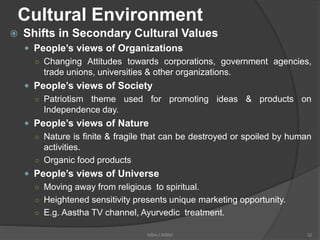
Cultural Environment
 Shifts in Secondary Cultural Values
 Impact of Music groups, movie personalities, & other
celebrities on a variety of areas like clothing & hairstyles.
 People’s views of themselves
○ Some seek personal pleasure, wanting fun, change etc.
○ Others seek self realization through religion, recreation, or
pursuit of career or other life goals.
○ Selects products those match their views of themselves.
 People’s views of others
○ Digital Age and Communication
○ People like to stay at home to enjoy the comforts of home &
connect with others through advanced technology.
○ Less demand for theater going & more demand for home
improvement, home office, & home entertainment products.
31MBA-I MIBM
Cultural Environment
 Shifts in Secondary Cultural Values
 People’s views of Organizations
○ Changing Attitudes towards corporations, government agencies,
trade unions, universities & other organizations.
 People’s views of Society
○ Patriotism theme used for promoting ideas & products on
Independence day.
 People’s views of Nature
○ Nature is finite & fragile that can be destroyed or spoiled by human
activities.
○ Organic food products
 People’s views of Universe
○ Moving away from religious to spiritual.
○ Heightened sensitivity presents unique marketing opportunity.
○ E.g. Aastha TV channel, Ayurvedic treatment.
32MBA-I MIBM
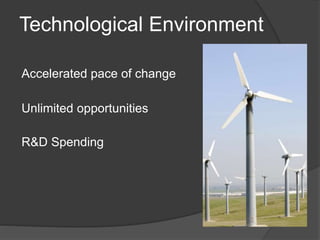
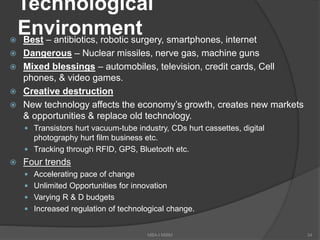
Technological Environment
Accelerated pace of change
Unlimited opportunities
R&D Spending
Technological
Environment Best – antibiotics, robotic surgery, smartphones, internet
 Dangerous – Nuclear missiles, nerve gas, machine guns
 Mixed blessings – automobiles, television, credit cards, Cell
phones, & video games.
 Creative destruction
 New technology affects the economy’s growth, creates new markets
& opportunities & replace old technology.
 Transistors hurt vacuum-tube industry, CDs hurt cassettes, digital
photography hurt film business etc.
 Tracking through RFID, GPS, Bluetooth etc.
 Four trends
 Accelerating pace of change
 Unlimited Opportunities for innovation
 Varying R & D budgets
 Increased regulation of technological change.
34MBA-I MIBM
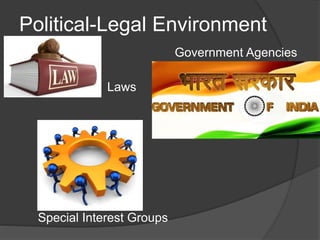
Political-Legal Environment
Special Interest Groups
Government Agencies
Laws
Political-Legal
Environment Laws, government agencies, & pressure groups.
 Increase in Business Legislation (Public Policy)
 To protect companies & consumers from unfair
competition, to protect interest of society from unfair
activities, to charge business with social costs.
 Laws to cover competition, fair-trade practices,
environment protection, product safety, truth in
advertising, consumer privacy, packaging and labeling,
pricing etc.
 At National, State & local level.
 Legal review procedures & guide business according to
ethical standards
36MBA-I MIBM
Political Environment
 The growth of special interest groups
 Consumerist movement
 Consumer protection act – Safety, Information, Choice,
Representation, Redressal & consumer education.
 Increased Emphasis on Ethics & Socially
Responsible Actions
 Socially Responsible Behaviour
 Cause Related Marketing
 Includes Laws, Government Agencies, and
Pressure Groups that Influence or Limit Various
Organizations and Individuals In a Given Society.
 Changes in tariff & quota regimes may have direct
impact on the profitability, survival of business.
37MBA-I MIBM
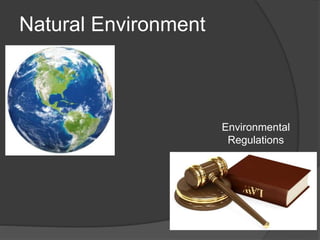
Natural Environment
Environmental
Regulations
Natural Environment
 Involves the Physical environment & natural resources
that are needed inputs by marketers or that are affected by
marketing activities.
 Floods in Kerala
 Auto Dealers, restaurants, airlines, tourist destinations
 Packaged drinking water, mosquito repellent, auto repair centers
 FedEx & UPS – employs meteorologists
 Greenhouse gases, Global warming, Shortage of drinking
water, Garbage issue in Urban India
 Deterioration of natural environment – shortage of raw
materials.
 Increased pollution – disposal of chemical & nuclear waste,
dangerous mercury levels in sea, quantity of chemicals in soil
& food, plastic & other packaging materials.
 Conserving natural resources
39MBA-I MIBM
Natural Environment
 Increased Govt. Interventions - New
regulations, environment protection agency,
NGOs etc.
 CPCB, Ministry of Environment, Forest & Climate
Change
 Environment Sustainability – an effort to create
a world economy that planet can support
indefinitely.
 Companies are developing recyclable & biodegradable
packaging, recycled materials & components, better
pollution controls, & more energy efficient operations.
40MBA-I MIBM
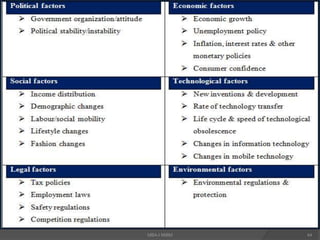
MBA-I MIBM 43
MBA-I MIBM 44
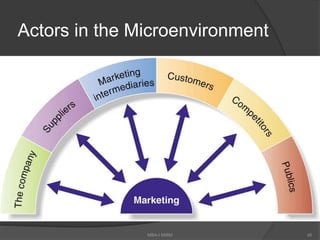
Actors in the Microenvironment
45MBA-I MIBM
The Company’s Microenvironment
 Company’s Internal Environment:
 Areas inside a company.
 Affects the marketing department’s
planning strategies.
 All departments must “think consumer” and
work together to provide superior customer
value and satisfaction.
46MBA-I MIBM
 The Company – top management, finance, R & D, purchasing,
operations, & accounting.
 Suppliers –
 Provide resources needed to produce goods and services.
 Important link in the “value delivery system.”
 Most marketers treat suppliers like partners
 Marketing Intermediaries
 Help the company to promote, sell, and distribute its goods to final buyers
○ Resellers – wholesalers, retailers
○ Physical distribution firms – to stock & move goods from their point of origin to
destination
○ Marketing services agencies – marketing research firms, advertising agencies,
media firms, & marketing consultancy firms.
○ Financial intermediaries – banks, credit companies, insurance companies.
○ E.g. Coca cola signs on as exclusive beverage provider for fast food chains.
47MBA-I MIBM
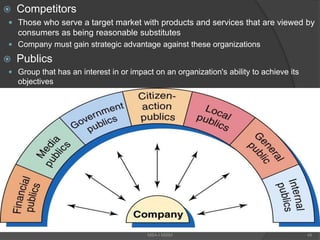
 Competitors
 Those who serve a target market with products and services that are viewed by
consumers as being reasonable substitutes
 Company must gain strategic advantage against these organizations
 Publics
 Group that has an interest in or impact on an organization's ability to achieve its
objectives
 Customers
 Five types of consumers – consumer markets, business markets, reseller markets,
government markets, international markets
48MBA-I MIBM
Responding to the Marketing
Environment
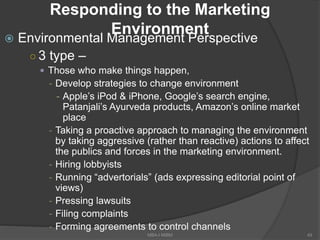
 Environmental Management Perspective
○ 3 type –
 Those who make things happen,
- Develop strategies to change environment
- Apple’s iPod & iPhone, Google’s search engine,
Patanjali’s Ayurveda products, Amazon’s online market
place
- Taking a proactive approach to managing the environment
by taking aggressive (rather than reactive) actions to affect
the publics and forces in the marketing environment.
- Hiring lobbyists
- Running “advertorials” (ads expressing editorial point of
views)
- Pressing lawsuits
- Filing complaints
- Forming agreements to control channels
49MBA-I MIBM
Responding to the Marketing
Environment
 Environmental Management Perspective
○ This can be done by:
 Those who watch things happen,
- Passively accept marketing environment & don not try
to change it
- Must react and adapt
 Those who wonder what’s happened
50MBA-I MIBM
Marketing & Other business
Functions
 Finance & Marketing
 Financial Dimensions – Cost & Profit history of
business, financial statements, budgets, ROI,
ROE, ROS etc.,
 Marketing decisions as investment decisions.
 Financial tools & criteria to evaluate investment.
 Capital allocation based on expected returns.
 Evaluation of M&A – both marketing & financial
view
MBA-I MIBM 51
Accounting & Marketing
 Firms' cost allocation procedure
 Use fully allocated costs rather than
variable costs depicts distorted picture
of product profitability.
 Responsibility accounting.
 Evaluation of marketing performance –
selling or advertising costs as a % of
sales.
 Forecast data.
MBA-I MIBM 53
Production & Marketing
 Production capabilities determine no &
types of products which can be
marketed.
 Marketing – accurate sales forecast.
 Change in production capacities.
 Size of new plants depends on market
research based estimation of demand.
 Conflicts.
MBA-I MIBM 54
Customer Service &
Marketing
 Customer complaints – solved or not.
 No of complaints
 Type of complaints
 Regular line of communication between
customer service & marketing
MBA-I MIBM 55
Procurement & Marketing
 Many firms modifying products to
substitute scarce raw material with more
available, cheaper or legally available
ones.
 Shortage of coffee – increase in price of
coffee beans – changes in the brand’s
strategies.
MBA-I MIBM 56
R & D - Marketing
 R & D – New product Development
 Product design – market research
 Marketing research may provide
important insights into customer’s
unsolved problem & needs.
 Realistic Expectations.
 R&D may decide the future of new
products.
MBA-I MIBM 57
HRM & Marketing
 HRM – hiring, training & management
 Develop job description, screen
candidates, design training programs &
incentives.
 Value of human capital
MBA-I MIBM 58
Legal & Marketing
 Government interventions
 Advertising claims
 Legal function of firm, brand name
requires legal clearance, new product
approvals, pricing policies etc.
 Legal dept – risk avoidance
 Marketing – Risk taking
MBA-I MIBM 59
Top Management & Marketing
 Provide guidance, inspiration,
encouragement & control of firms
marketing & non marketing efforts.
MBA-I MIBM 60
Market Potential
 Consists of the set of consumers who profess a
sufficient level of interest in a market offer.
 Total amount of possible sales in the market.
 Total Market potential – The maximum
amount of sales that might be available to all
the firms in an industry during given period,
under a given level of industry marketing effort
& environmental conditions.
 Total Market potential = potential no of
buyers * Average quantity purchased by
buyer * The price.
MBA-I MIBM 61
Market Potential
 Well defined geographic area
 Entry / Exit decisions
 Resource Allocation decisions.
 Forecast
MBA-I MIBM 62
Estimation of market
potential
 Estimation by analogy
 Comparing data from similar countries
 Problems: geography, culture, tradition and Historical reasons
 Income elasticity of demand
 Market’s level of development
 Regression Analysis
 Demand for any product = f(income, price, competition, etc.)
 Input-output tables
 provides a summary of the structure of an economy by showing
the impact of changes in the demand for one industry’s product
on other industries product
 Relationship between economic sectors
 Published by UNCTAD/GATT/WTO
MBA-I MIBM 63
Market Share
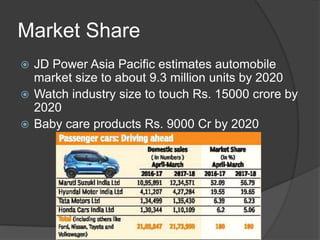
 JD Power Asia Pacific estimates automobile
market size to about 9.3 million units by 2020
 Watch industry size to touch Rs. 15000 crore by
2020
 Baby care products Rs. 9000 Cr by 2020
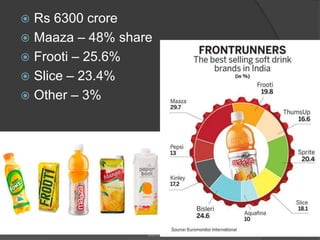
 Rs 6300 crore
 Maaza – 48% share
 Frooti – 25.6%
 Slice – 23.4%
 Other – 3%
MBA-I MIBM 65
Market share
 Market share is the portion or percentage
of sales of a particular product or service in
a given region that are controlled by a
company.
 example, there are 100 products sold in a
country and company A sells 43 of them, then
company A has a 43% market share
Market Share
 Or – you sold a product for a total cost
of Rs. 1000 and the people in the
country spend a total of Rs. 2,000 on the
same widgets, then the market share is
1000/2,000 or 50%
 The two different methods of calculating
market share won't always provide the same
answer,
Market Share
 Market share is used by businesses to
determine their competitive strength in
a sector as compared to other
companies in the same sector
 Methods
 No of buyers
 Percentage of sales
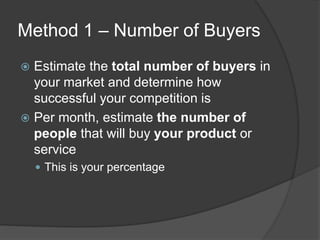
Method 1 – Number of Buyers
 Estimate the total number of buyers in
your market and determine how
successful your competition is
 Per month, estimate the number of
people that will buy your product or
service
 This is your percentage
Method 1 – Number of Buyers
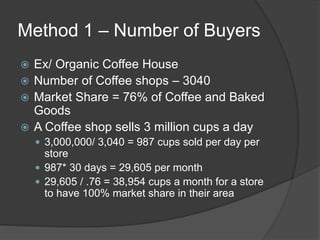
 Ex/ Organic Coffee House
 Number of Coffee shops – 3040
 Market Share = 76% of Coffee and Baked
Goods
 A Coffee shop sells 3 million cups a day
 3,000,000/ 3,040 = 987 cups sold per day per
store
 987* 30 days = 29,605 per month
 29,605 / .76 = 38,954 cups a month for a store
to have 100% market share in their area
Method 1 – Number of Buyers
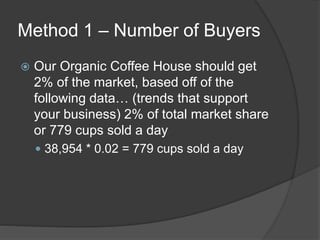
 Our Organic Coffee House should get
2% of the market, based off of the
following data… (trends that support
your business) 2% of total market share
or 779 cups sold a day
 38,954 * 0.02 = 779 cups sold a day
Method 2 – Percent of Sales
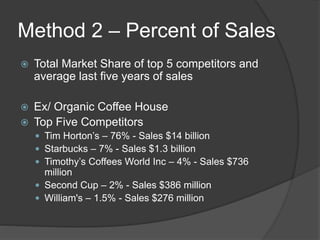
 Total Market Share of top 5 competitors and
average last five years of sales
 Ex/ Organic Coffee House
 Top Five Competitors
 Tim Horton’s – 76% - Sales $14 billion
 Starbucks – 7% - Sales $1.3 billion
 Timothy’s Coffees World Inc – 4% - Sales $736
million
 Second Cup – 2% - Sales $386 million
 William's – 1.5% - Sales $276 million
Home Assignment
 Find out the market potential for
Wooden toys in India.
 Demonstrate the market share for
Internet Service providers in India.
MBA-I MIBM 73
74MBA-I MIBM

Marketing Environment

  • 1.
    Basics of Marketing– MBA I 1MBA-I MIBM
  • 2.
    2 Why a productlike radio declined and now once again emerging as an entertainment medium? MBA-I MIBM
  • 3.
    3 What Were theDrivers of This Change ?  Technology ?  Government policy ?  Other media substitutes ?  Change in Consumers’ Preferences ?  Change in Economic Conditions ? MBA-I MIBM
  • 4.
    4 Why Market LeadersSuffered?  Market leadership today cannot be taken for granted. New and more efficient companies are able to upstage leaders in a much shorter period. MBA-I MIBM
  • 5.
    Marketing Environment  Themarketing environment consists of actors and forces outside the organization that affect management’s ability to build and maintain relationships with target customers.  Environment offers both opportunities and threats.  Marketing intelligence and research used to collect information about the environment. 5MBA-I MIBM
  • 6.
    Marketing Environment  Includes: Microenvironment: actors close to the company that affect its ability to serve its customers.  Macro environment: larger societal forces that affect the microenvironment. ○ Considered to be beyond the control of the organization. 6MBA-I MIBM
  • 7.
  • 8.
  • 9.
    Marketing Environment  Analyzingthe Macroenvironment  Needs and Trends ○ Fads – “unpredictable, short-lived, and without social, economic and political significance” ○ Trend – “direction or sequence of events that has some momentum & durability” ○ Megatrends – “ large social, economic, political and technological changes that are slow to form and once in place, they influence us for some time between 7-10 years or longer” 9MBA-I MIBM
  • 10.
    Marketing Environment  Analyzingthe Macroenvironment  Identifying Major Forces ○ Suppliers, intermediaries, customers, competitors, and public – Is their behaviour controllable? ○ A steep decline of stock market affects savings, investment, retirement funds etc, increasing unemployment, corporate scandals, rise of terrorism. ○ Six major forces – Demographic, economic, social-cultural, natural, technological, political & legal. 10MBA-I MIBM
  • 11.
    Then GOOGOL now GOOGLE Founded in 1998 by two Stanford university PhD students.  Corporate mission – To organize the world’s information and make it universally accessible and useful.  Larry Page & Sergey Brin  AdWords, Analytics, Maps, Finance, Local, Gmail, Google+, Youtube, Androids, Duo etc.  Abc.xyz (Alphabate) 11MBA-I MIBM
  • 12.
  • 13.
  • 14.
    Demographic Environment Worldwide populationgrowth Population age mix Ethnic and other markets Educational Groups Household patterns
  • 15.
    The World asa Village If the world were a village of 100 people: 61 – Asian (20 Chinese, 17 Indian) 18 – Unable to read (33 have cell phones) 18 – Under 10 years of age (11 over 60 years old) 18 – Cars in the village 63 – Inadequate sanitation 67 – Non-Christian 30 – Unemployed or underemployed 53 – Live on less than $2 a day 26 – Smoke 14 – Obese 01 – Have AIDS Source: David J. Smith and Shelagh Armstrong, If the World Were a Village: A Book About the World’s People, 2nd ed. (Tonawanda, NY: Kids Can Press, 2002)
  • 16.
    17MBA-I MIBM Rank ContinentPopulation 1 Asia 4,140,000,000 2 Africa 1,033,000,000 3 Europe 739,000,000 4 North America 529,000,000 5 South America 386,000,000 6 Oceania (Australia) 36,000,000 7 Antarctica 4,000 Age group Total Rural Urban 0-14 29.5 30.9 25.5 15-59 62.5 61 66.6 60+ 8 8.1 7.9
  • 17.
    The Demographic Environment Demography The study of human population in terms of size, density, location, age, gender, race, occupation, and other statistics.  The World’s large & highly diverse population pose both opportunities & threats.  E.g. China’s policy to control population growth.  Keeping track of changing age, family structures, geographic population shifts, educational characteristics, & population density. 18MBA-I MIBM
  • 18.
    The Demographic Environment PopulationGrowth  World wide population estimation 8.82 billion by 2040. (9 billion by 2045)  Developing regions account for 84% of population (1- 2% growth).  More developed countries growing at 0.3%  Death rate is falling (life expectancy in India – 69.1 yrs)  India 17.7% of world population.  Population size & growth rate. (Approx 3000 births/hr & 1000 deaths/hr) 19MBA-I MIBM
  • 19.
    The Demographic Environment PopulationAge Mix  Mexico – young population & rapid population growth.  Japan – world’s oldest population.  So milk, diapers, school supplies & toys will be more imp in Mexico than in Japan  Median age India – 23.8, Pakistan – 22.2, Sri lanka – 29.5 etc.  Literacy Levels of Population  71.02% in India (2017 estimate)  Youth Literacy Rate is 90.2% (2015) 0- 14 yrs 15 – 24 25- 54 55- 64 < 65 yrs 27. 3% 17. 9% 41. 1% 7.5 % 6.3 % Male Female 81.3% 60.6% 20MBA-I MIBM
  • 20.
    The Demographic Environment IncreasingPopulation  More population in urban areas (34% 2020) (49% by 2050).  Growth Rate – 1.1% (2018)  A growing middle class  Deprived households – ○ Annual household income less than Rs. 90000, poorest economic class, unskilled or semi-skilled daily wage earners.  Aspirers ○ Rs. 90000 to Rs. 200000., small farmers, small retailers, low skilled industrial workers.  Seekers ○ Rs. 200000 to Rs. 500000, white collar employees, mid level govt. officials, newly employed young postgraduates, and medium scale traders & businesspeople.  Strivers ○ Rs. 500000 to Rs. 1000000, established professionals like lawyers, doctors, CAs, MBAs, senior govt. officials, medium scale industrialists, rich farmers.  Global Indians ○ In excess of Rs. 1000000, Senior corporate executives, large business owners, topmost professionals, politicians, film actors, big farmers, graduates from leading institutes. Middle class Seekers & strivers 7 million households 87 million by 2025 21MBA-I MIBM
  • 21.
    Demographic Environment  Increasing Population A Growing Middle class  Population in Rural India  Generational Marketing  The changing family system  The changing role of women  A Better-Educated, More White-Collar, More Professional Population  Increasing Diversity MBA-I MIBM 22
  • 22.
    The Demographic Environment Growthin rural population  By 2050 rural population will be 50% of total population.  Some problems like, purchasing power, lack of proper infrastructure, reliable supply of electricity etc.  A Changing Family System  Joint family system – able bodied men will be bread earners, women looks after kitchen, elderly look for cultural norms & preach value to kids.  Dual income single kid (DISK)  The changing role of women  Education, more ambitious, earning more, more active member of family.  A better educated, more white-collared, more professional population  789 universities and 37,234 colleges  More educated people will demand more quality product, books, magazines, travel, personal computers, & internet services.  Increasing Diversity  Inner state diversities are increasing 23MBA-I MIBM
  • 23.
  • 24.
    Economic Environment  Factorsthat affect consumer purchasing power & spending patterns.  Industrial economy, Developing economy, Subsistence economy,  The Global Financial Crisis  Subprime housing loans issued in US (2007-09), most stock markets in world crashed, severe lending crunch, inflation, less exports, less FDI, less GDP growth.  In India demand for housing, construction, consumer durables & IT sector were affected most.  Changing Income distribution & Consumer spending pattern  Rich have grown richer.  Growing urban middle class.  Purchase of consumer items increasing.  Mercedez – Benz targets affluent; Tata Motors – modest means, Maruti-Suzuki  Current income, prices, savings, debt & credit availability. 25MBA-I MIBM
  • 25.
    Economic Environment  IndiaGDP per capita – $ 1997 and growing at 7.74% $FY 2017-18  Healthy foreign exchange reserves (US$ 387 billion approx), Inflation (CPI / WPI); (inflation 3.69%); (3.3%YTD) in Aug 18  Income Distribution –  Lower income households declining continuously.  Destitute – annual income of Rs. 16000  Aspirants – 16000 – 22000  Climbers – 22000 – 45000  Consuming class – 45000 – 215000  Rich – more than 1000000 lakhs annual income  Demand is likely to increase, additional opportunities for new products & services, Business expansion etc. 26MBA-I MIBM
  • 26.
    Walt Disney marketstwo distinct Pooh bears to match its two-tiered market. 27MBA-I MIBM
  • 27.
  • 28.
    Social-Cultural Environment Society shapesthe beliefs, values, & norms that largely define consumer tastes & preferences.  Ethnic Diversity – one fifth of the world  Major religions – Hinduism, Islam, Sikhism, Christianity, Buddhism & Jainism  Different languages & thousands of dialects.  Customs, social systems, Values, habits, Religions & Caste Systems.  E.g. Dress codes, food habits, local advertising, regional biases for brand preferences,  Progression from traditionalism & self sacrifice to westernization & individualism.  Increased Emphasis on Ethics & Socially Responsible Actions  Socially responsible behaviour – business scandals, environment issues, online privacy issues, transfer of digital data etc.  Cause-related marketing – linking to a worthwhile cause, selling strategy than giving strategy. But may give company good image.  E.g. CRY greeting cards. 29MBA-I MIBM
  • 29.
    Cultural Environment  Madeup of institutions & other forces that affect society’s basic values, perceptions, preferences, & behaviors.  Persistence of Cultural Values  Most Asians believe in working, getting married & giving to charity and have strong faith in religion.  Core beliefs & values passed on from parents to children & are reinforced by schools, religious institutions, business, & government.  Secondary beliefs are more open to change.  E.g. Getting married is core belief but getting married early in life is secondary belief. 30MBA-I MIBM
  • 30.
    Cultural Environment  Shiftsin Secondary Cultural Values  Impact of Music groups, movie personalities, & other celebrities on a variety of areas like clothing & hairstyles.  People’s views of themselves ○ Some seek personal pleasure, wanting fun, change etc. ○ Others seek self realization through religion, recreation, or pursuit of career or other life goals. ○ Selects products those match their views of themselves.  People’s views of others ○ Digital Age and Communication ○ People like to stay at home to enjoy the comforts of home & connect with others through advanced technology. ○ Less demand for theater going & more demand for home improvement, home office, & home entertainment products. 31MBA-I MIBM
  • 31.
    Cultural Environment  Shiftsin Secondary Cultural Values  People’s views of Organizations ○ Changing Attitudes towards corporations, government agencies, trade unions, universities & other organizations.  People’s views of Society ○ Patriotism theme used for promoting ideas & products on Independence day.  People’s views of Nature ○ Nature is finite & fragile that can be destroyed or spoiled by human activities. ○ Organic food products  People’s views of Universe ○ Moving away from religious to spiritual. ○ Heightened sensitivity presents unique marketing opportunity. ○ E.g. Aastha TV channel, Ayurvedic treatment. 32MBA-I MIBM
  • 32.
    Technological Environment Accelerated paceof change Unlimited opportunities R&D Spending
  • 33.
    Technological Environment Best –antibiotics, robotic surgery, smartphones, internet  Dangerous – Nuclear missiles, nerve gas, machine guns  Mixed blessings – automobiles, television, credit cards, Cell phones, & video games.  Creative destruction  New technology affects the economy’s growth, creates new markets & opportunities & replace old technology.  Transistors hurt vacuum-tube industry, CDs hurt cassettes, digital photography hurt film business etc.  Tracking through RFID, GPS, Bluetooth etc.  Four trends  Accelerating pace of change  Unlimited Opportunities for innovation  Varying R & D budgets  Increased regulation of technological change. 34MBA-I MIBM
  • 34.
    Political-Legal Environment Special InterestGroups Government Agencies Laws
  • 35.
    Political-Legal Environment Laws, governmentagencies, & pressure groups.  Increase in Business Legislation (Public Policy)  To protect companies & consumers from unfair competition, to protect interest of society from unfair activities, to charge business with social costs.  Laws to cover competition, fair-trade practices, environment protection, product safety, truth in advertising, consumer privacy, packaging and labeling, pricing etc.  At National, State & local level.  Legal review procedures & guide business according to ethical standards 36MBA-I MIBM
  • 36.
    Political Environment  Thegrowth of special interest groups  Consumerist movement  Consumer protection act – Safety, Information, Choice, Representation, Redressal & consumer education.  Increased Emphasis on Ethics & Socially Responsible Actions  Socially Responsible Behaviour  Cause Related Marketing  Includes Laws, Government Agencies, and Pressure Groups that Influence or Limit Various Organizations and Individuals In a Given Society.  Changes in tariff & quota regimes may have direct impact on the profitability, survival of business. 37MBA-I MIBM
  • 37.
  • 38.
    Natural Environment  Involvesthe Physical environment & natural resources that are needed inputs by marketers or that are affected by marketing activities.  Floods in Kerala  Auto Dealers, restaurants, airlines, tourist destinations  Packaged drinking water, mosquito repellent, auto repair centers  FedEx & UPS – employs meteorologists  Greenhouse gases, Global warming, Shortage of drinking water, Garbage issue in Urban India  Deterioration of natural environment – shortage of raw materials.  Increased pollution – disposal of chemical & nuclear waste, dangerous mercury levels in sea, quantity of chemicals in soil & food, plastic & other packaging materials.  Conserving natural resources 39MBA-I MIBM
  • 39.
    Natural Environment  IncreasedGovt. Interventions - New regulations, environment protection agency, NGOs etc.  CPCB, Ministry of Environment, Forest & Climate Change  Environment Sustainability – an effort to create a world economy that planet can support indefinitely.  Companies are developing recyclable & biodegradable packaging, recycled materials & components, better pollution controls, & more energy efficient operations. 40MBA-I MIBM
  • 40.
  • 41.
  • 42.
    Actors in theMicroenvironment 45MBA-I MIBM
  • 43.
    The Company’s Microenvironment Company’s Internal Environment:  Areas inside a company.  Affects the marketing department’s planning strategies.  All departments must “think consumer” and work together to provide superior customer value and satisfaction. 46MBA-I MIBM
  • 44.
     The Company– top management, finance, R & D, purchasing, operations, & accounting.  Suppliers –  Provide resources needed to produce goods and services.  Important link in the “value delivery system.”  Most marketers treat suppliers like partners  Marketing Intermediaries  Help the company to promote, sell, and distribute its goods to final buyers ○ Resellers – wholesalers, retailers ○ Physical distribution firms – to stock & move goods from their point of origin to destination ○ Marketing services agencies – marketing research firms, advertising agencies, media firms, & marketing consultancy firms. ○ Financial intermediaries – banks, credit companies, insurance companies. ○ E.g. Coca cola signs on as exclusive beverage provider for fast food chains. 47MBA-I MIBM
  • 45.
     Competitors  Thosewho serve a target market with products and services that are viewed by consumers as being reasonable substitutes  Company must gain strategic advantage against these organizations  Publics  Group that has an interest in or impact on an organization's ability to achieve its objectives  Customers  Five types of consumers – consumer markets, business markets, reseller markets, government markets, international markets 48MBA-I MIBM
  • 46.
    Responding to theMarketing Environment  Environmental Management Perspective ○ 3 type –  Those who make things happen, - Develop strategies to change environment - Apple’s iPod & iPhone, Google’s search engine, Patanjali’s Ayurveda products, Amazon’s online market place - Taking a proactive approach to managing the environment by taking aggressive (rather than reactive) actions to affect the publics and forces in the marketing environment. - Hiring lobbyists - Running “advertorials” (ads expressing editorial point of views) - Pressing lawsuits - Filing complaints - Forming agreements to control channels 49MBA-I MIBM
  • 47.
    Responding to theMarketing Environment  Environmental Management Perspective ○ This can be done by:  Those who watch things happen, - Passively accept marketing environment & don not try to change it - Must react and adapt  Those who wonder what’s happened 50MBA-I MIBM
  • 48.
    Marketing & Otherbusiness Functions  Finance & Marketing  Financial Dimensions – Cost & Profit history of business, financial statements, budgets, ROI, ROE, ROS etc.,  Marketing decisions as investment decisions.  Financial tools & criteria to evaluate investment.  Capital allocation based on expected returns.  Evaluation of M&A – both marketing & financial view MBA-I MIBM 51
  • 49.
    Accounting & Marketing Firms' cost allocation procedure  Use fully allocated costs rather than variable costs depicts distorted picture of product profitability.  Responsibility accounting.  Evaluation of marketing performance – selling or advertising costs as a % of sales.  Forecast data. MBA-I MIBM 53
  • 50.
    Production & Marketing Production capabilities determine no & types of products which can be marketed.  Marketing – accurate sales forecast.  Change in production capacities.  Size of new plants depends on market research based estimation of demand.  Conflicts. MBA-I MIBM 54
  • 51.
    Customer Service & Marketing Customer complaints – solved or not.  No of complaints  Type of complaints  Regular line of communication between customer service & marketing MBA-I MIBM 55
  • 52.
    Procurement & Marketing Many firms modifying products to substitute scarce raw material with more available, cheaper or legally available ones.  Shortage of coffee – increase in price of coffee beans – changes in the brand’s strategies. MBA-I MIBM 56
  • 53.
    R & D- Marketing  R & D – New product Development  Product design – market research  Marketing research may provide important insights into customer’s unsolved problem & needs.  Realistic Expectations.  R&D may decide the future of new products. MBA-I MIBM 57
  • 54.
    HRM & Marketing HRM – hiring, training & management  Develop job description, screen candidates, design training programs & incentives.  Value of human capital MBA-I MIBM 58
  • 55.
    Legal & Marketing Government interventions  Advertising claims  Legal function of firm, brand name requires legal clearance, new product approvals, pricing policies etc.  Legal dept – risk avoidance  Marketing – Risk taking MBA-I MIBM 59
  • 56.
    Top Management &Marketing  Provide guidance, inspiration, encouragement & control of firms marketing & non marketing efforts. MBA-I MIBM 60
  • 57.
    Market Potential  Consistsof the set of consumers who profess a sufficient level of interest in a market offer.  Total amount of possible sales in the market.  Total Market potential – The maximum amount of sales that might be available to all the firms in an industry during given period, under a given level of industry marketing effort & environmental conditions.  Total Market potential = potential no of buyers * Average quantity purchased by buyer * The price. MBA-I MIBM 61
  • 58.
    Market Potential  Welldefined geographic area  Entry / Exit decisions  Resource Allocation decisions.  Forecast MBA-I MIBM 62
  • 59.
    Estimation of market potential Estimation by analogy  Comparing data from similar countries  Problems: geography, culture, tradition and Historical reasons  Income elasticity of demand  Market’s level of development  Regression Analysis  Demand for any product = f(income, price, competition, etc.)  Input-output tables  provides a summary of the structure of an economy by showing the impact of changes in the demand for one industry’s product on other industries product  Relationship between economic sectors  Published by UNCTAD/GATT/WTO MBA-I MIBM 63
  • 60.
    Market Share  JDPower Asia Pacific estimates automobile market size to about 9.3 million units by 2020  Watch industry size to touch Rs. 15000 crore by 2020  Baby care products Rs. 9000 Cr by 2020
  • 61.
     Rs 6300crore  Maaza – 48% share  Frooti – 25.6%  Slice – 23.4%  Other – 3% MBA-I MIBM 65
  • 62.
    Market share  Marketshare is the portion or percentage of sales of a particular product or service in a given region that are controlled by a company.  example, there are 100 products sold in a country and company A sells 43 of them, then company A has a 43% market share
  • 63.
    Market Share  Or– you sold a product for a total cost of Rs. 1000 and the people in the country spend a total of Rs. 2,000 on the same widgets, then the market share is 1000/2,000 or 50%  The two different methods of calculating market share won't always provide the same answer,
  • 64.
    Market Share  Marketshare is used by businesses to determine their competitive strength in a sector as compared to other companies in the same sector  Methods  No of buyers  Percentage of sales
  • 65.
    Method 1 –Number of Buyers  Estimate the total number of buyers in your market and determine how successful your competition is  Per month, estimate the number of people that will buy your product or service  This is your percentage
  • 66.
    Method 1 –Number of Buyers  Ex/ Organic Coffee House  Number of Coffee shops – 3040  Market Share = 76% of Coffee and Baked Goods  A Coffee shop sells 3 million cups a day  3,000,000/ 3,040 = 987 cups sold per day per store  987* 30 days = 29,605 per month  29,605 / .76 = 38,954 cups a month for a store to have 100% market share in their area
  • 67.
    Method 1 –Number of Buyers  Our Organic Coffee House should get 2% of the market, based off of the following data… (trends that support your business) 2% of total market share or 779 cups sold a day  38,954 * 0.02 = 779 cups sold a day
  • 68.
    Method 2 –Percent of Sales  Total Market Share of top 5 competitors and average last five years of sales  Ex/ Organic Coffee House  Top Five Competitors  Tim Horton’s – 76% - Sales $14 billion  Starbucks – 7% - Sales $1.3 billion  Timothy’s Coffees World Inc – 4% - Sales $736 million  Second Cup – 2% - Sales $386 million  William's – 1.5% - Sales $276 million
  • 69.
    Home Assignment  Findout the market potential for Wooden toys in India.  Demonstrate the market share for Internet Service providers in India. MBA-I MIBM 73
  • 70.