

MARKETING
ENVIRONMENT
PRESENTED BY :- APURV KUMAR MAURYA
MONIRBA (ALLAHABAD)
:-
What is Marketing Environment:
• Marketing Environment concerns the influences or variables of
the external and internal environment of a firm that controls the
marketing management’s capability to construct and preserve
the flourishing relationships with the consumer.
According to Philip Kotler,
“A company’s marketing environment consists of the internal
factors & forces, which affect the company’s ability to develop &
maintain successful transactions & relationships with the
company’s target customers.”
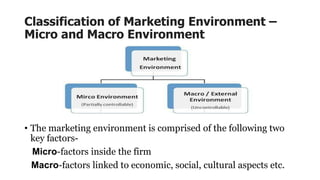
Classification of Marketing Environment –
Micro and Macro Environment
• The marketing environment is comprised of the following two
key factors-
Micro-factors inside the firm
Macro-factors linked to economic, social, cultural aspects etc.
• Micro-environment elements are close to the firm and
incorporate the suppliers, showcasing delegates,
consumer markets, public, competition and marketing
intermediaries.
• Micro-environment likewise concerns the inward
environment of the organization and influences
marketing as well as all the departments like
management, R&D, finance, Human assets, purchasing,
operations and bookkeeping.
Micro Environment in Marketing:
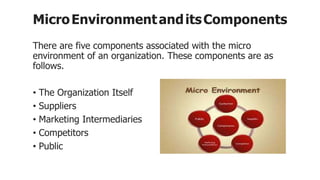
MicroEnvironmentanditsComponents
There are five components associated with the micro
environment of an organization. These components are as
follows.
• The Organization Itself
• Suppliers
• Marketing Intermediaries
• Competitors
• Public
The Organization Itself:
• The organization itself is the first micro environmental
component which focuses on the role of the organization that it
performs in the micro environment.
• Broader organizational goals are common for all the
departments of the organization like purchasing
department, Research and Developement department,
production department etc.
• The main focus of all the departments must be the customer
oriented behavior that ensures the delivery of superior value to
customers and this is made possible through the efforts of the
marketing department.
Suppliers:
• Suppliers are the second micro environments component, which
are those organizations that deliver the required resources to all
the competing organizations for the production of goods or
services.
• The delivery of superior value to the customers is made
possible through the useful linkage of the suppliers. The
availability of the supplies is permanently watched by the
organization to ensure the smooth working of its operations.
Marketing Intermediaries:
• The organizations that assist in promoting, selling & distribution
of products to final customers of specific organization are called
marketing intermediaries and are considered the utmost factors
the micro environments. Marketing intermediaries include the
following:-
1. Resellers
2. Physical Distribution Firms
3. Marketing Service Agencies
4. Financial Intermediaries
5. Customers
6. Consumer Market
7. Business Market
Competitors
• Every organization faces the competition with certain
competitors. So the competing organization should develop
such effective strategies that can influentially position its
products in the competing market.
• An organization must understand, what value added services
their competitor is providing or the unique selling point of their
competitors.
• The organization must know how to do a competitive analysis of
competitors and have a competitive advantage.
Public
• The last component of micro environment is a public, which
include a group of individuals that can influence the ability of
the organization to accomplish it objectives.
• So the organization should develop an effective marketing plan
for both the public as well as customers.
• Although companies will never sell to each and every people in
a given region, their existence will, however, depend on the
overall perception of these people regarding the brand or
company’s image or the product itself.
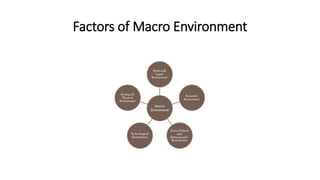
Macro Environment in Marketing
“The Macro environment is the
uncontrollable factor of the company. For
this reason, it has to structure its policies in
the limits set by these factors. Macro-
environment on the whole deals with the
demographic, economic, technological,
natural, socio-cultural and politico-legal
environment aspects of the markets.”
Factors of Macro Environment
Demography
• An organization ought to study the populace, its
conveyance, age structure, and so forth before
choosing its strategy of marketing.
• Each faction of populace acts in a different way,
relying on a range of factors, for example, age,
status, and so on. If these variables are measured,
a company can manufacture only those products
which suit the necessity of the buyers.
Economic Environment
• Economic components are general monetary value, investment
rates, exchange rates, inflation rate, fiscal strategies, balance of
payments and so forth.
• An organization can effectively offer its products just when
individuals have enough cash to spend. The financial
environment influences a customer’s buying behavior either by
expanding his disposable income or by decreasing it.
• For example, During inflation, the money value decreases. Thus,
it is troublesome for them to buy more products. The income of
the customer should likewise be considered.
Physical Environment
• These components incorporate the climate, atmosphere,
environmental change, accessibility of water, accessibility of raw
materials and so on.
• A company has to implement its policies contained by the
restrictions set by nature. A man can enhance the nature,
however, can’t find an option for it. Nature offers resources,
however, in a restricted way.
• Companies must discover the best mix of production for the
purpose of productive usage of the accessible assets.
Technological Factors
• Technological variables incorporate the innovative work,
robotization, development of web and other communication
innovations, innovation inducements and barriers to
technology. From the consumer’s perspective, change in
innovation implies change in the living standard.
• Each new innovation creates another business & another group
of clients. Another innovation enhances our way of life & in the
meantime creates numerous issues.
• Eg: Invention of different purchaser comforts like washing
machines, blenders, and so forth have brought about
enhancement in our way of lifestyle yet it has made serious
issues like shortage of power.
Social & Cultural Factors
• Those actors & forces that affect the basic values, preferences,
perceptions & behaviors of the society are included in the cultural
factor of the macro environment.There are certain cultural
characteristics that influence the decision of the marketers.
• There are certain basic beliefs & perceptions that remain constant
throughout several generations of the society.
• There are certain secondary beliefs that can be altered through the
effective strategies developed by the marketing department of the
organization. These secondary concepts should be identified by the
marketer in order to get advantage through these concepts.
THANK YOU

Marketing environment

  • 1.
    MARKETING ENVIRONMENT PRESENTED BY :-APURV KUMAR MAURYA MONIRBA (ALLAHABAD) :-
  • 2.
    What is MarketingEnvironment: • Marketing Environment concerns the influences or variables of the external and internal environment of a firm that controls the marketing management’s capability to construct and preserve the flourishing relationships with the consumer. According to Philip Kotler, “A company’s marketing environment consists of the internal factors & forces, which affect the company’s ability to develop & maintain successful transactions & relationships with the company’s target customers.”
  • 3.
    Classification of MarketingEnvironment – Micro and Macro Environment • The marketing environment is comprised of the following two key factors- Micro-factors inside the firm Macro-factors linked to economic, social, cultural aspects etc.
  • 4.
    • Micro-environment elementsare close to the firm and incorporate the suppliers, showcasing delegates, consumer markets, public, competition and marketing intermediaries. • Micro-environment likewise concerns the inward environment of the organization and influences marketing as well as all the departments like management, R&D, finance, Human assets, purchasing, operations and bookkeeping. Micro Environment in Marketing:
  • 5.
    MicroEnvironmentanditsComponents There are fivecomponents associated with the micro environment of an organization. These components are as follows. • The Organization Itself • Suppliers • Marketing Intermediaries • Competitors • Public
  • 6.
    The Organization Itself: •The organization itself is the first micro environmental component which focuses on the role of the organization that it performs in the micro environment. • Broader organizational goals are common for all the departments of the organization like purchasing department, Research and Developement department, production department etc. • The main focus of all the departments must be the customer oriented behavior that ensures the delivery of superior value to customers and this is made possible through the efforts of the marketing department.
  • 7.
    Suppliers: • Suppliers arethe second micro environments component, which are those organizations that deliver the required resources to all the competing organizations for the production of goods or services. • The delivery of superior value to the customers is made possible through the useful linkage of the suppliers. The availability of the supplies is permanently watched by the organization to ensure the smooth working of its operations.
  • 8.
    Marketing Intermediaries: • Theorganizations that assist in promoting, selling & distribution of products to final customers of specific organization are called marketing intermediaries and are considered the utmost factors the micro environments. Marketing intermediaries include the following:- 1. Resellers 2. Physical Distribution Firms 3. Marketing Service Agencies 4. Financial Intermediaries 5. Customers 6. Consumer Market 7. Business Market
  • 9.
    Competitors • Every organizationfaces the competition with certain competitors. So the competing organization should develop such effective strategies that can influentially position its products in the competing market. • An organization must understand, what value added services their competitor is providing or the unique selling point of their competitors. • The organization must know how to do a competitive analysis of competitors and have a competitive advantage.
  • 10.
    Public • The lastcomponent of micro environment is a public, which include a group of individuals that can influence the ability of the organization to accomplish it objectives. • So the organization should develop an effective marketing plan for both the public as well as customers. • Although companies will never sell to each and every people in a given region, their existence will, however, depend on the overall perception of these people regarding the brand or company’s image or the product itself.
  • 12.
    Macro Environment inMarketing “The Macro environment is the uncontrollable factor of the company. For this reason, it has to structure its policies in the limits set by these factors. Macro- environment on the whole deals with the demographic, economic, technological, natural, socio-cultural and politico-legal environment aspects of the markets.”
  • 13.
    Factors of MacroEnvironment
  • 14.
    Demography • An organizationought to study the populace, its conveyance, age structure, and so forth before choosing its strategy of marketing. • Each faction of populace acts in a different way, relying on a range of factors, for example, age, status, and so on. If these variables are measured, a company can manufacture only those products which suit the necessity of the buyers.
  • 15.
    Economic Environment • Economiccomponents are general monetary value, investment rates, exchange rates, inflation rate, fiscal strategies, balance of payments and so forth. • An organization can effectively offer its products just when individuals have enough cash to spend. The financial environment influences a customer’s buying behavior either by expanding his disposable income or by decreasing it. • For example, During inflation, the money value decreases. Thus, it is troublesome for them to buy more products. The income of the customer should likewise be considered.
  • 16.
    Physical Environment • Thesecomponents incorporate the climate, atmosphere, environmental change, accessibility of water, accessibility of raw materials and so on. • A company has to implement its policies contained by the restrictions set by nature. A man can enhance the nature, however, can’t find an option for it. Nature offers resources, however, in a restricted way. • Companies must discover the best mix of production for the purpose of productive usage of the accessible assets.
  • 17.
    Technological Factors • Technologicalvariables incorporate the innovative work, robotization, development of web and other communication innovations, innovation inducements and barriers to technology. From the consumer’s perspective, change in innovation implies change in the living standard. • Each new innovation creates another business & another group of clients. Another innovation enhances our way of life & in the meantime creates numerous issues. • Eg: Invention of different purchaser comforts like washing machines, blenders, and so forth have brought about enhancement in our way of lifestyle yet it has made serious issues like shortage of power.
  • 18.
    Social & CulturalFactors • Those actors & forces that affect the basic values, preferences, perceptions & behaviors of the society are included in the cultural factor of the macro environment.There are certain cultural characteristics that influence the decision of the marketers. • There are certain basic beliefs & perceptions that remain constant throughout several generations of the society. • There are certain secondary beliefs that can be altered through the effective strategies developed by the marketing department of the organization. These secondary concepts should be identified by the marketer in order to get advantage through these concepts.
  • 19.