Understanding Cash Flow
Statements:
A Comprehensive Guide
Introduction
In this presentation, we
will explore the essentials of
cash flow statements and
their importance in financial
analysis. We will cover
the components of a cash
flow statement and how to
interpret its insights.
2 / 2 / 2 0 X X U n d e r s t a n d i n g C a s h F l ow S t a t e m e n t s 2
Subtitle
Necessity of Cash
Flow statement
2 / 2 / 2 0 X X U n d e r s t a n d i n g C a s h F l ow S t a t e m e n t s 4
For a corporation to function economically, cash is
essential.
A business requires cash to pay its suppliers, cover
ongoing costs, and pay for dividends, interest, and
salaries, among other things.
2 / 2 / 2 0 X X U n d e r s t a n d i n g C a s h F l ow S t a t e m e n t s 5
In actuality, capital is to a commercial firm what blood is
to a human.
Thus, keeping a sufficient cash level is crucial for a firm.
What message does a company send to its shareholders and
the public at large, for instance, if it is profitable but lacks the
cash on hand to pay dividends?
Cash management is therefore crucial.
Subtitle
Necessity of Cash
Flow statement
2 / 2 / 2 0 X X U n d e r s t a n d i n g C a s h F l ow S t a t e m e n t s 7
A cash flow statement gives details about a
company's inflows and expenditures of cash over a
certain time period.
It is a statement that shows how the cash situation
has changed over time.
It provides an explanation of the causes of these
monetary inflows and outflows.
It supports management's immediate future
2 / 2 / 2 0 X X U n d e r s t a n d i n g C a s h F l ow S t a t e m e n t s 8
Consider a scenario in which the
business's cash balance is $20,000 on its
balance sheet as of December 31, 2012,
but it is $30,000 on its balance sheet as
of December 31, 2013. In comparison to
2012, there was a $10,000 increase in
cash inflow in 2013.
Subtitle
A Brief on Cash Flow
statement
Purpose of Cash Flow Statement
Inform: To Answer:
The statement responds to the
following questions:
1. Where did the funds come
from?
2. What was the cash utilized
for?
3. What is the change in the
cash balance?
2 / 2 / 2 0 X X U n d e r s t a n d i n g C a s h F l ow S t a t e m e n t s 1 0
To offer useful information
about an enterprise's cash
receipts and payments
during a certain time
period.
Cash Flow Analysis
Brief
It is a significant analytical
instrument for creditors,
investors, and other users of
financial statement
information.
What does it tell about
1. The firm's ability to create cash flows
in the future and satisfy its cash
obligations.
2. The firm's anticipated external
funding demands
3. The firm's success in successfully
managing investment activities
4. The firm's competence in adopting
financing and investing strategies.
2 / 2 / 2 0 X X U n d e r s t a n d i n g C a s h F l ow S t a t e m e n t s 1 1
Objectives of Cash Flow Statement
2 / 2 / 2 0 X X U n d e r s t a n d i n g C a s h F l ow S t a t e m e n t s 1 2
Highlighting cash flow from different activities
Short-term Planning
Cash Flow information helps to understand liquidity
Efficient cash management
Prediction of sickness
Comparison with budget Cash position
2 / 2 / 2 0 X X U n d e r s t a n d i n g C a s h F l ow S t a t e m e n t s 1 3
Limitations Of Cash Flow Statement
1. The income statement includes both
cash and non-cash elements, therefore
it does not reflect the firm's liquidity
status.
2. It is not a substitute for income
statements.
3. Does not reveal the financial status of
the company in complete.
Cash Flow Statement V/S Funds Flow Statement
2 / 2 / 2 0 X X U n d e r s t a n d i n g C a s h F l ow S t a t e m e n t s 1 4
Basis of Difference
• Basis of
Accounting
• Significance
• Schedule of
Changes in
Working Capital
• Causes of
Variation
Cash Flow
• It Recognizes
Cash Basis of
Accounting
• It is useful for
Short Term
financial planning
• Such a schedule is
not prepared for
preparing Cash
flow statement
• It studies only the
Causes of cash
Variation.
Funds Flow
• It is bases upon
accrual basis of
accounting i.e.
Working capital
• It is useful for
Long term
financial planning
• Schedule of
Changes in
Working Capital is
Prepared
separately.
• It studies causes
of change in
working capital
Where from? Where to?
2 / 2 / 2 0 X X U n d e r s t a n d i n g C a s h F l ow S t a t e m e n t s 1 5
Cash
comes
from
Cash
Resources
Cash Goes
to
Profits In Out Losses
Sales of Fixed assets In Out Purchase of fixed Asset
Decrease in stock In Out Increase in stock
Decrease in Debtors In Out Increase in Debtors
Capital Introduced In Out Drawings/Dividends
Loans Received In Out Loans Repaid
Increase in creditors In Out Decrease in creditors
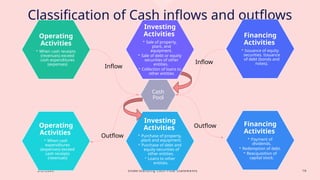
Classification of Cash inflows and outflows
2 / 2 / 2 0 X X U n d e r s t a n d i n g C a s h F l ow S t a t e m e n t s 1 6
Cash
Pool
Investing
Activities
• Sale of property,
plant, and
equipment.
• Sale of debt or equity
securities of other
entities.
• Collection of loans to
other entities
Financing
Activities
• Issuance of equity
securities. Issuance
of debt (bonds and
notes).
Financing
Activities
• Payment of
dividends.
• Redemption of debt.
• Reacquisition of
capital stock.
Investing
Activities
• Purchase of property,
plant and equipment.
• Purchase of debt and
equity securities of
other entities.
• Loans to other
entities.
Operating
Activities
• When cash
expenditures
(expenses) exceed
cash receipts
(revenues)
Operating
Activities
• When cash receipts
(revenues) exceed
cash expenditures
(expenses)
Inflow
Outflow
Inflow
Outflow
Subtitle
Types Of Activities
2 / 2 / 2 0 X X U n d e r s t a n d i n g C a s h F l ow S t a t e m e n t s 1 8
Operating activities:
It entails accepting cash from clients for the sale of products and services, getting interest
and income on loans and investments, and making cash payments for wages, goods and
services purchased, interest, and taxes.
Operating Activities
Cash Inflow
• Cash Sales
• Received From Debtor
• Commission and Fees
• Royalty
Cash Outflow
• Cash Purchases
• Payments to Creditors
• Cash Operating Expenses
• Payment of Wages
• Income Tax
• Manufacturing Expenses
2 / 2 / 2 0 X X U n d e r s t a n d i n g C a s h F l ow S t a t e m e n t s 1 9
Investing activities:
It covers making and collecting loans, maintaining securities (apart from cash equivalents),
and buying and selling long-term assets.
Investing Activities
Cash Inflow
• Sale of Fixed Assets
• Sale of investments
• Interest Received
• Dividend Received
• Working Capital Recovery
Cash Outflow
• Purchase of Fixed Assets
• Purchase of Investments
• Working Capital.
2 / 2 / 2 0 X X U n d e r s t a n d i n g C a s h F l ow S t a t e m e n t s 2 0
Financing activities:
It covers the issuance and repurchase of capital stock, as well as the issuance and repayment
of short- or long-term loans. Dividend payments are also included in this category.
Financing Activities
Cash Inflow
• Issue of Shares in cash
• Issue of Debentures in cash
• Proceeds from long-term
borrowings
Cash Outflow
• Payments of loans
• Redemption of Preference
Shares
• Payment of Dividends
• Interest Paid
• Repayment of Finance/ Lease
Liability
Summary
Importance of Cash Flow Statements
Crucial for evaluating financial health
Essential for economic functioning Covers costs, dividends, interest, and salaries
Purpose and Objectives
Provides insights into cash situation
Details inflows and expenditures
Offers information on cash receipts and payments
Limitations
Does not reflect complete financial status
Not a substitute for income statements
Comparison with Funds Flow Statements
Different information on financial activities
Classification of Cash Flows
Understanding cash inflows and outflows
Types of activities: operating, investing, financing
2 / 2 / 2 0 X X U n d e r s t a n d i n g C a s h F l ow S t a t e m e n t s 2 1
Thank you
Presenter Name
Email
Website
2 / 2 / 2 0 X X U n d e r s t a n d i n g C a s h F l ow S t a t e m e n t s 2 2

Understanding Cash Flow Statements presentation

  • 1.
  • 2.
    Introduction In this presentation,we will explore the essentials of cash flow statements and their importance in financial analysis. We will cover the components of a cash flow statement and how to interpret its insights. 2 / 2 / 2 0 X X U n d e r s t a n d i n g C a s h F l ow S t a t e m e n t s 2
  • 3.
  • 4.
    2 / 2/ 2 0 X X U n d e r s t a n d i n g C a s h F l ow S t a t e m e n t s 4 For a corporation to function economically, cash is essential. A business requires cash to pay its suppliers, cover ongoing costs, and pay for dividends, interest, and salaries, among other things.
  • 5.
    2 / 2/ 2 0 X X U n d e r s t a n d i n g C a s h F l ow S t a t e m e n t s 5 In actuality, capital is to a commercial firm what blood is to a human. Thus, keeping a sufficient cash level is crucial for a firm. What message does a company send to its shareholders and the public at large, for instance, if it is profitable but lacks the cash on hand to pay dividends? Cash management is therefore crucial.
  • 6.
  • 7.
    2 / 2/ 2 0 X X U n d e r s t a n d i n g C a s h F l ow S t a t e m e n t s 7 A cash flow statement gives details about a company's inflows and expenditures of cash over a certain time period. It is a statement that shows how the cash situation has changed over time. It provides an explanation of the causes of these monetary inflows and outflows. It supports management's immediate future
  • 8.
    2 / 2/ 2 0 X X U n d e r s t a n d i n g C a s h F l ow S t a t e m e n t s 8 Consider a scenario in which the business's cash balance is $20,000 on its balance sheet as of December 31, 2012, but it is $30,000 on its balance sheet as of December 31, 2013. In comparison to 2012, there was a $10,000 increase in cash inflow in 2013.
  • 9.
    Subtitle A Brief onCash Flow statement
  • 10.
    Purpose of CashFlow Statement Inform: To Answer: The statement responds to the following questions: 1. Where did the funds come from? 2. What was the cash utilized for? 3. What is the change in the cash balance? 2 / 2 / 2 0 X X U n d e r s t a n d i n g C a s h F l ow S t a t e m e n t s 1 0 To offer useful information about an enterprise's cash receipts and payments during a certain time period.
  • 11.
    Cash Flow Analysis Brief Itis a significant analytical instrument for creditors, investors, and other users of financial statement information. What does it tell about 1. The firm's ability to create cash flows in the future and satisfy its cash obligations. 2. The firm's anticipated external funding demands 3. The firm's success in successfully managing investment activities 4. The firm's competence in adopting financing and investing strategies. 2 / 2 / 2 0 X X U n d e r s t a n d i n g C a s h F l ow S t a t e m e n t s 1 1
  • 12.
    Objectives of CashFlow Statement 2 / 2 / 2 0 X X U n d e r s t a n d i n g C a s h F l ow S t a t e m e n t s 1 2 Highlighting cash flow from different activities Short-term Planning Cash Flow information helps to understand liquidity Efficient cash management Prediction of sickness Comparison with budget Cash position
  • 13.
    2 / 2/ 2 0 X X U n d e r s t a n d i n g C a s h F l ow S t a t e m e n t s 1 3 Limitations Of Cash Flow Statement 1. The income statement includes both cash and non-cash elements, therefore it does not reflect the firm's liquidity status. 2. It is not a substitute for income statements. 3. Does not reveal the financial status of the company in complete.
  • 14.
    Cash Flow StatementV/S Funds Flow Statement 2 / 2 / 2 0 X X U n d e r s t a n d i n g C a s h F l ow S t a t e m e n t s 1 4 Basis of Difference • Basis of Accounting • Significance • Schedule of Changes in Working Capital • Causes of Variation Cash Flow • It Recognizes Cash Basis of Accounting • It is useful for Short Term financial planning • Such a schedule is not prepared for preparing Cash flow statement • It studies only the Causes of cash Variation. Funds Flow • It is bases upon accrual basis of accounting i.e. Working capital • It is useful for Long term financial planning • Schedule of Changes in Working Capital is Prepared separately. • It studies causes of change in working capital
  • 15.
    Where from? Whereto? 2 / 2 / 2 0 X X U n d e r s t a n d i n g C a s h F l ow S t a t e m e n t s 1 5 Cash comes from Cash Resources Cash Goes to Profits In Out Losses Sales of Fixed assets In Out Purchase of fixed Asset Decrease in stock In Out Increase in stock Decrease in Debtors In Out Increase in Debtors Capital Introduced In Out Drawings/Dividends Loans Received In Out Loans Repaid Increase in creditors In Out Decrease in creditors
  • 16.
    Classification of Cashinflows and outflows 2 / 2 / 2 0 X X U n d e r s t a n d i n g C a s h F l ow S t a t e m e n t s 1 6 Cash Pool Investing Activities • Sale of property, plant, and equipment. • Sale of debt or equity securities of other entities. • Collection of loans to other entities Financing Activities • Issuance of equity securities. Issuance of debt (bonds and notes). Financing Activities • Payment of dividends. • Redemption of debt. • Reacquisition of capital stock. Investing Activities • Purchase of property, plant and equipment. • Purchase of debt and equity securities of other entities. • Loans to other entities. Operating Activities • When cash expenditures (expenses) exceed cash receipts (revenues) Operating Activities • When cash receipts (revenues) exceed cash expenditures (expenses) Inflow Outflow Inflow Outflow
  • 17.
  • 18.
    2 / 2/ 2 0 X X U n d e r s t a n d i n g C a s h F l ow S t a t e m e n t s 1 8 Operating activities: It entails accepting cash from clients for the sale of products and services, getting interest and income on loans and investments, and making cash payments for wages, goods and services purchased, interest, and taxes. Operating Activities Cash Inflow • Cash Sales • Received From Debtor • Commission and Fees • Royalty Cash Outflow • Cash Purchases • Payments to Creditors • Cash Operating Expenses • Payment of Wages • Income Tax • Manufacturing Expenses
  • 19.
    2 / 2/ 2 0 X X U n d e r s t a n d i n g C a s h F l ow S t a t e m e n t s 1 9 Investing activities: It covers making and collecting loans, maintaining securities (apart from cash equivalents), and buying and selling long-term assets. Investing Activities Cash Inflow • Sale of Fixed Assets • Sale of investments • Interest Received • Dividend Received • Working Capital Recovery Cash Outflow • Purchase of Fixed Assets • Purchase of Investments • Working Capital.
  • 20.
    2 / 2/ 2 0 X X U n d e r s t a n d i n g C a s h F l ow S t a t e m e n t s 2 0 Financing activities: It covers the issuance and repurchase of capital stock, as well as the issuance and repayment of short- or long-term loans. Dividend payments are also included in this category. Financing Activities Cash Inflow • Issue of Shares in cash • Issue of Debentures in cash • Proceeds from long-term borrowings Cash Outflow • Payments of loans • Redemption of Preference Shares • Payment of Dividends • Interest Paid • Repayment of Finance/ Lease Liability
  • 21.
    Summary Importance of CashFlow Statements Crucial for evaluating financial health Essential for economic functioning Covers costs, dividends, interest, and salaries Purpose and Objectives Provides insights into cash situation Details inflows and expenditures Offers information on cash receipts and payments Limitations Does not reflect complete financial status Not a substitute for income statements Comparison with Funds Flow Statements Different information on financial activities Classification of Cash Flows Understanding cash inflows and outflows Types of activities: operating, investing, financing 2 / 2 / 2 0 X X U n d e r s t a n d i n g C a s h F l ow S t a t e m e n t s 2 1
  • 22.
    Thank you Presenter Name Email Website 2/ 2 / 2 0 X X U n d e r s t a n d i n g C a s h F l ow S t a t e m e n t s 2 2