We believe theseproducts will be a great fit for you. Click
the link to download now, or visit testbankfan.com
to discover even more!
Financial Statement Analysis 11th Edition Subramanyam
Test Bank
https://testbankfan.com/product/financial-statement-
analysis-11th-edition-subramanyam-test-bank/
Financial Statement Analysis 10th Edition Subramanyam
Test Bank
https://testbankfan.com/product/financial-statement-
analysis-10th-edition-subramanyam-test-bank/
Financial Statement Analysis International Edition 13th
Edition Gibson Solutions Manual
https://testbankfan.com/product/financial-statement-analysis-
international-edition-13th-edition-gibson-solutions-manual/
Corporate Finance Core Principles and Applications 4th
Edition Ross Solutions Manual
https://testbankfan.com/product/corporate-finance-core-
principles-and-applications-4th-edition-ross-solutions-manual/
3.
ACCT Managerial AsiaPacific 1st Edition Sivabalan Test
Bank
https://testbankfan.com/product/acct-managerial-asia-pacific-1st-
edition-sivabalan-test-bank/
M Finance 2nd Edition Millon Solutions Manual
https://testbankfan.com/product/m-finance-2nd-edition-millon-
solutions-manual/
Financial Markets and Institutions Global 8th Edition
Mishkin Solutions Manual
https://testbankfan.com/product/financial-markets-and-
institutions-global-8th-edition-mishkin-solutions-manual/
Economics Canadian 15th Edition Ragan Test Bank
https://testbankfan.com/product/economics-canadian-15th-edition-
ragan-test-bank/
Art Across Time Combined 4th Edition Laurie Test Bank
https://testbankfan.com/product/art-across-time-combined-4th-
edition-laurie-test-bank/
4.
State and LocalGovernment 9th Edition Bowman Test Bank
https://testbankfan.com/product/state-and-local-government-9th-
edition-bowman-test-bank/
[362-363 a.d.]
was blendedwith the hereditary softness of the Syrians. Fashion was
the only law, pleasure the only pursuit, and the splendour of dress
and furniture was the only distinction of the citizens of Antioch. The
arts of luxury were honoured; the serious and manly virtues were
the subject of ridicule; and the contempt for female modesty and
reverend age, announced the universal corruption of the capital of
the East. The love of spectacles was the taste, or rather passion, of
the Syrians: the most skilful artists were procured from the adjacent
cities; a considerable share of the revenue was devoted to the public
amusements; and the magnificence of the games of the theatre and
circus was considered as the happiness and as the glory of Antioch.
The rustic manners of a prince who disdained such glory, and was
insensible of such happiness, soon disgusted the delicacy of his
subjects; and the effeminate Orientals could neither imitate nor
admire the severe simplicity which Julian always maintained, and
sometimes affected. The days of festivity, consecrated by ancient
custom to the honour of the gods, were the only occasions on which
Julian relaxed his philosophic severity; and those festivals were the
only days in which the Syrians of Antioch could reject the
allurements of pleasure. The majority of the people supported the
glory of the Christian name, which had been first invented by their
ancestors; they contented themselves with disobeying the moral
precepts, but they were scrupulously attached to the speculative
doctrines of their religion. The church of Antioch was distracted by
heresy and schism; but the Arians and the Athanasians, the
followers of Meletius and those of Paulinus, were actuated by the
same pious hatred of their common adversary.
The martial impatience of Julian urged him to take the field in the
beginning of the spring; and he dismissed, with contempt and
reproach, the senate of Antioch, who accompanied the emperor
beyond the limits of their own territory, to which he was resolved
never to return.
As the warlike emperor, instead of
Constantius, had chosen Alexander for his
model, he advanced without delay to Carrhæ, a
32.
very ancient cityof Mesopotamia, at the distance of fourscore miles
from Hierapolis. The temple of the Moon attracted the devotion of
Julian; but the halt of a few days was principally employed in
completing the immense preparations of the Persian War. The secret
of the expedition had hitherto remained in his own breast; but as
Carrhæ is the point of separation of the two great roads, he could
no longer conceal, whether it was his design to attack the dominions
of Sapor on the side of the Tigris, or on that of the Euphrates. The
emperor detached an army of thirty thousand men, under the
command of his kinsman Procopius, and of Sebastian, who had been
duke of Egypt. They were ordered to direct their march towards
Nisibis, and to secure the frontier from the desultory incursions of
the enemy, before they attempted the passage of the Tigris. Their
subsequent operations were left to the discretion of the generals;
but Julian expected, that after wasting with fire and sword the fertile
districts of Media and Adiabene, they might arrive under the walls of
Ctesiphon about the same time that he himself, advancing with
equal steps along the banks of the Euphrates, should besiege the
capital of the Persian monarchy. The success of this well-concerted
plan depended, in a great measure, on the powerful and ready
assistance of the king of Armenia, who, without exposing the safety
of his own dominions, might detach an army of four thousand horse,
and twenty thousand foot, to the assistance of the Romans. But the
feeble Arsaces Tiranus, king of Armenia, had degenerated still more
shamefully than his father Chosroes, from the manly virtues of the
great Tiridates; and as the pusillanimous monarch was averse to any
enterprise of danger and glory, he could disguise his timid indolence
by the more decent excuses of religion and gratitude.
The military dispositions of Julian were skilfully contrived to
deceive the spies, and to divert the attention of Sapor. The legions
appeared to direct their march towards Nisibis and the Tigris. On a
sudden they wheeled to the right; traversed the level and naked
plain of Carrhæ; and reached, on the third day, the banks of the
Euphrates, where the strong town of Nicephorium, or Callinicum,
had been founded by the Macedonian kings. From thence the
33.
[363 a.d.]
emperor pursuedhis march, above ninety miles, along the winding
stream of the Euphrates, till, at length, about one month after his
departure from Antioch, he discovered the towers of Circesium, the
extreme limit of the Roman dominions. The river Chaboras falls into
the Euphrates at Circesium, and as soon as the trumpet gave the
signal of march, the Romans passed the little stream which
separated two mighty and hostile empires.
Two cities of Assyria presumed to resist the
arms of a Roman emperor; and they both paid
the severe penalty of their rashness. At the
distance of fifty miles from the royal residence of Ctesiphon,
Perisabor, or Anbar, held the second rank in the province: a city,
large, populous, and well-fortified, surrounded with a double wall,
almost encompassed by a branch of the Euphrates, and defended by
the valour of a numerous garrison. The exhortations of Hormisdas
were repulsed with contempt; and the ears of the Persian prince
were wounded by a just reproach, that, unmindful of his royal birth,
he conducted an army of strangers against his king and country. The
Assyrians maintained their loyalty by a skilful, as well as vigorous,
defence; till the lucky stroke of a battering-ram having opened a
large breach, by shattering one of the angles of the wall, they hastily
retired into the fortifications of the interior citadel. The soldiers of
Julian rushed impetuously into the town, and after the full
gratification of every military appetite, Perisabor was reduced to
ashes; and the engines which assaulted the citadel were planted on
the ruins of the smoking houses. The contest was continued by an
incessant and mutual discharge of missile weapons; and the
superiority which the Romans might derive from the mechanical
powers of their ballistæ and catapultæ was counterbalanced by the
advantage of the ground on the side of the besieged. But as soon as
an helepolis had been constructed, which could engage on equal
terms with the loftiest ramparts, the tremendous aspect of a moving
turret, that would leave no hope of resistance or of mercy, terrified
the defenders of the citadel into an humble submission; and the
place was surrendered only two days after Julian first appeared
34.
under the wallsof Perisabor. Twenty-five hundred persons, of both
sexes, the feeble remnant of a flourishing people, were permitted to
retire; the plentiful magazines of corn, of arms, and of splendid
furniture were partly distributed among the troops, and partly
reserved for the public service; the useless stores were destroyed by
fire, or thrown into the stream of the Euphrates; and the fate of
Amida was revenged by the total ruin of Perisabor.
The city, or rather the fortress, of Maogamalcha, which was
defended by sixteen large towers, a deep ditch, and two strong and
solid walls of brick and bitumen, appears to have been constructed
at the distance of eleven miles, as the safeguard of the capital of
Persia. The emperor, apprehensive of leaving such an important
fortress in his rear, immediately formed the siege of Maogamalcha;
and the Roman army was distributed for that purpose into three
divisions. Victor, at the head of the cavalry, and of a detachment of
heavy-armed foot, was ordered to clear the country, as far as the
banks of the Tigris, and the suburbs of Ctesiphon. The conduct of
the attack was assumed by Julian himself, who seemed to place his
whole dependence in the military engines which he erected against
the walls, while he secretly contrived a more efficacious method of
introducing his troops into the heart of the city. Under the direction
of Nevitta and Dagalaiphus, the trenches were opened at a
considerable distance, and gradually prolonged as far as the edge of
the ditch. The ditch was speedily filled with earth; and, by the
incessant labour of the troops, a mine was carried under the
foundations of the walls, and sustained, at sufficient intervals, by
props of timber. Three chosen cohorts, advancing in a single file,
silently explored the dark and dangerous passage, till their intrepid
leader whispered back the intelligence, that he was ready to issue
from his confinement into the streets of the hostile city. Julian
checked their ardour, that he might insure their success; and
immediately diverted the attention of the garrison by the tumult and
clamour of a general assault. The Persians, who, from their walls,
contemptuously beheld the progress of an impotent attack,
celebrated, with songs of triumph, the glory of Sapor; and ventured
35.
to assure theemperor, that he might ascend the starry mansion of
Ormuzd, before he could hope to take the impregnable city of
Maogamalcha. The city was already taken. History has recorded the
name of a private soldier, the first who ascended from the mine into
a deserted tower. The passage was widened by his companions, who
pressed forward with impatient valour. Fifteen hundred enemies
were already in the midst of the city. The astonished garrison
abandoned the walls, and their only hope of safety; the gates were
instantly burst open; and the revenge of the soldier, unless it were
suspended by lust or avarice, was satiated by an undistinguishing
massacre. The governor, who had yielded on a promise of mercy,
was burned alive a few days afterwards, on a charge of having
uttered some disrespectful words against the honour of Prince
Hormisdas. The fortifications were razed to the ground; and not a
vestige was left to indicate that the city of Maogamalcha had ever
existed.
The successful valour of Julian had triumphed over all the
obstacles that opposed his march to the gates of Ctesiphon. But the
reduction, or even the siege, of the capital of Persia, was still at a
distance; nor can the military conduct of the emperor be clearly
apprehended, without a knowledge of the country which was the
theatre of his bold and skilful operations. Twenty miles to the south
of Baghdad, and on the eastern bank of the Tigris, the curiosity of
travellers has observed some ruins of the palaces of Ctesiphon,
which, in the time of Julian, was a great and populous city. The
name and glory of the adjacent Seleucia were forever extinguished;
and the only remaining quarter of that Greek colony had resumed,
with the Assyrian language and manners, the primitive appellation of
Coche.
Coche was situated on the western side of the Tigris; but it was
naturally considered as a suburb of Ctesiphon, being supposedly
connected with it by a permanent bridge of boats. The united parts
contributed to form the common epithet of Al Modain, “the cities,”
which the Orientals have bestowed on the winter residence of the
Sassanids; and the whole circumference of the Persian capital was
36.
strongly fortified bythe waters of the river, by lofty walls, and by
impracticable morasses. Near the ruins of Seleucia the camp of
Julian was fixed, and secured by a ditch and rampart against the
sallies of the numerous and enterprising garrison of Coche. In this
fruitful and pleasant country the Romans were plentifully supplied
with water and forage; and several forts which might have
embarrassed the motions of the army submitted, after some
resistance, to the efforts of their valour. The fleet passed from the
Euphrates into an artificial derivation of that river, which pours a
copious and navigable stream into the Tigris, at a small distance
below the great city. If they had followed this royal canal, which bore
the name of Nahar-Malcha, the intermediate situation of Coche
would have separated the fleet and army of Julian; and the rash
attempt of steering against the current of the Tigris, and forcing
their way through the midst of a hostile capital, must have been
attended with the total destruction of the Roman navy. The
prudence of the emperor foresaw the danger, and provided the
remedy. As he had minutely studied the operations of Trajan in the
same country, he soon recollected that his warlike predecessor had
dug a new and navigable canal, which, leaving Coche on the right
hand, conveyed the waters of the Nahar-Malcha into the river Tigris,
at some distance above the cities. From the information of the
peasants Julian ascertained the vestiges of this ancient work, which
were almost obliterated by design or accident. By the indefatigable
labour of the soldiers, a broad and deep channel was speedily
prepared for the reception of the Euphrates. A strong dike was
constructed to interrupt the ordinary current of the Nahar-Malcha: a
flood of waters rushed impetuously into their new bed; and the
Roman fleet, steering their triumphant course into the Tigris, derided
the vain and ineffectual barriers which the Persians of Ctesiphon had
erected to oppose their passage.
A BATTLE BY THE TIGRIS
37.
As it becamenecessary to transport the Roman army over the
Tigris, another labour presented itself, of less toil, but of more
danger, than the preceding expedition. The stream was broad and
rapid; the ascent steep and difficult; and the entrenchments, which
had been formed on the ridge of the opposite bank, were lined with
a numerous army of heavy cuirassiers, dexterous archers, and huge
elephants, which (according to the extravagant hyperbole of
Libanius) could trample, with the same ease, a field of corn or a
legion of Romans. In the presence of such an enemy, the
construction of a bridge was impracticable; and the intrepid prince,
who instantly seized the only possible expedient, concealed his
design till the moment of execution from the knowledge of the
barbarians, of his own troops, and even of his generals themselves.
Under the specious pretence of examining the state of the
magazines, fourscore vessels were gradually unladen; and a select
detachment, apparently destined for some secret expedition, was
ordered to stand to their arms on the first signal. Julian disguised
the silent anxiety of his own mind with smiles of confidence and joy;
and amused the hostile nations with the spectacle of military games,
which he insultingly celebrated under the walls of Coche. The day
was consecrated to pleasure; but, as soon as the hour of supper was
past, the emperor summoned his generals to his tent, and
acquainted them that he had fixed that night for the passage of the
Tigris. They stood in silent and respectful astonishment; but, when
the venerable Sallust assumed the privilege of his age and
experience, the rest of the chiefs supported with freedom the weight
of his prudent remonstrances.
Julian however contented himself with observing that conquest
and safety depended on the attempt; that, instead of diminishing,
the number of their enemies would certainly be increased, by
successive reinforcements; and that a longer delay would neither
contract the breadth of the stream nor level the height of the bank.
The signal was instantly given and obeyed: the most impatient of
the legionaries leaped into five vessels that lay nearest to the bank;
and as they plied their oars with intrepid diligence, they were lost,
38.
after a fewmoments, in the darkness of the night. A flame arose on
the opposite side, and Julian, who too clearly understood that his
foremost vessels, in attempting to land, had been fired by the
enemy, dexterously converted their extreme danger into a presage
of victory. “Our fellow-soldiers,” he eagerly exclaimed, “are already
masters of the bank; see, they make the appointed signal. Let us
hasten to emulate and assist their courage.” The united and rapid
motion of a great fleet broke the violence of the current, and they
reached the eastern shore of the Tigris with sufficient speed to
extinguish the flames and rescue their adventurous companions. The
difficulties of a steep and lofty ascent were increased by the weight
of armour and the darkness of the night. A shower of stones, darts,
and fire was incessantly discharged on the heads of the assailants,
who, after an arduous struggle, climbed the bank and stood
victorious upon the rampart.
As soon as they were possessed of a more equal field, Julian,
who, with his light infantry, had led the attack, darted through the
ranks a skilful and experienced eye; his bravest soldiers, according
to the precepts of Homer, were distributed in the front and rear; and
all the trumpets of the imperial army sounded to battle. The
Romans, after sending up a military shout, advanced in measured
steps to the animating notes of martial music, launched their
formidable javelins, and rushed forwards with drawn swords, to
deprive the barbarians, by a closer onset, of the advantage of their
missile weapons. The whole engagement lasted above twelve hours;
till the gradual retreat of the Persians was changed into a disorderly
flight, of which the shameful example was given by the principal
leader, and the Surenas himself. They were pursued to the gates of
Ctesiphon; and the conquerors might have entered the dismayed
city if their general, Victor, who was dangerously wounded with an
arrow, had not conjured them to desist from a rash attempt, which
must be fatal if it were not successful. On their side, the Romans
acknowledged the loss of only seventy-five men; while they affirmed
that the barbarians had left on the field of battle twenty-five
hundred, or even six thousand, of their bravest soldiers. The spoil
39.
was such asmight be expected from the riches and luxury of an
oriental camp: large quantities of silver and gold, splendid arms and
trappings, and beds and tables of massy silver. The victorious
emperor distributed, as the rewards of valour, some honourable
gifts, civic, and mural, and naval crowns; which he, and perhaps he
alone, esteemed more precious than the wealth of Asia. A solemn
sacrifice was offered to the god of war, but the appearances of the
victims threatened the most inauspicious events; and Julian soon
discovered, by less ambiguous signs, that he had now reached the
term of his prosperity.
On the second day after the battle, the domestic guards, the
Jovians and Herculians, and the remaining troops, which composed
near two-thirds of the whole army, were securely wafted over the
Tigris. While the Persians beheld from Ctesiphon the desolation of
the adjacent country, Julian cast many an anxious look towards the
north, in full expectation that, as he himself had victoriously
penetrated to the capital of Sapor, the march and junction of his
lieutenants, Sebastian and Procopius, would be executed with the
same courage and diligence. His expectations were disappointed by
the treachery of the Armenian king, who permitted, and most
probably directed, the desertion of his auxiliary troops from the
camp of the Romans; and by the dissensions of the two generals,
who were incapable of forming or executing any plan for the public
service. When the emperor had relinquished the hope of this
important reinforcement, he condescended to hold a council of war,
and approved, after a full debate, the sentiment of those generals
who dissuaded him from the siege of Ctesiphon as being a fruitless
and pernicious undertaking. It is not easy for us to conceive by what
arts of fortification a city thrice besieged and taken by the
predecessors of Julian could be rendered impregnable against an
army of sixty thousand Romans, commanded by a brave and
experienced general, and abundantly supplied with ships, provisions,
battering engines, and military stores. But we may rest assured,
from the love of glory and contempt of danger which formed the
character of Julian, that he was not discouraged by any trivial or
40.
imaginary obstacles. Atthe very time when he declined the siege of
Ctesiphon, he rejected, with obstinacy and disdain, the most
flattering offers of a negotiation of peace.
Sapor, who had been so long accustomed to the negligence and
tardy ostentation of Constantius, was surprised by the intrepid
diligence of his successor. As far as the confines of India and
Scythia, the satraps of the distant provinces were ordered to
assemble their troops, and to march, without delay, to the assistance
of their monarch. But their preparations were dilatory, their motions
slow; and before Sapor could lead an army into the field, he received
the melancholy intelligence of the devastation of Assyria, the ruin of
his palaces, and the slaughter of his bravest troops, who defended
the passage of the Tigris. The pride of royalty was humbled in the
dust; he took his repasts on the ground; and the disorder of his hair
expressed the grief and anxiety of his mind. Perhaps he would not
have refused to purchase, with one-half of his kingdom, the safety of
the remainder; and he would have gladly subscribed himself, in a
treaty of peace, the faithful and dependent ally of the Roman
conqueror. Under the pretence of private business, a minister of rank
and confidence was despatched secretly to embrace the knees of
Hormisdas, and to request, in the language of a suppliant, that he
might be introduced into the presence of the emperor. The
Sassanian prince, whether he listened to the voice of pride or
humanity, whether he consulted the sentiments of his birth or the
duties of his situation, was equally inclined to promote a salutary
measure which would terminate the calamities of Persia and secure
the triumph of Rome. He was astonished by the inflexible firmness of
a hero who remembered, most unfortunately for himself and for his
country, that Alexander had uniformly rejected the propositions of
Darius. But as Julian was sensible that the hope of a safe and
honourable peace might cool the ardour of his troops, he earnestly
requested that Hormisdas would privately dismiss the minister of
Sapor, and conceal this dangerous temptation from the knowledge of
the camp.
41.
THE PURSUIT OFSAPOR
The honour, as well as interest, of Julian forbade him to consume
his time under the impregnable walls of Ctesiphon; and as often as
he defied the barbarians who defended the city to meet him on the
open plain, they prudently replied that, if he desired to exercise his
valour, he might seek the army of the Great King. He felt the insult,
and he accepted the advice. Instead of confining his servile march to
the banks of the Euphrates and Tigris, he resolved to imitate the
adventurous spirit of Alexander, and boldly to advance into the
inland provinces, till he forced his rival to contend with him, perhaps
in the plains of Arbela, for the empire of Asia. The magnanimity of
Julian was applauded and betrayed by the arts of a noble Persian,
who, in the cause of his country, had generously submitted to act a
part full of danger, of falsehood, and of shame. With a train of
faithful followers, he deserted to the imperial camp, exposed, in a
specious tale, the injuries which he had sustained; exaggerated the
cruelty of Sapor, the discontent of the people, and the weakness of
the monarchy; and confidently offered himself as the hostage and
guide of the Roman march. The most rational grounds of suspicion
were urged, without effect, by the wisdom and experience of
Hormisdas; and the credulous Julian, receiving the traitor into his
bosom, was persuaded to issue a hasty order which, in the opinion
of mankind, appeared to arraign his prudence and to endanger his
safety.
He destroyed in a single hour the whole navy, which had been
transported above five hundred miles, at such expense of toil, of
treasure, and of blood. Twelve or, at the most, twenty-two small
vessels were saved, to accompany on carriages the march of the
army, and to form occasional bridges for the passage of the rivers. A
supply of twenty days’ provisions was reserved for the use of the
soldiers; and the rest of the magazines, with a fleet of eleven
hundred vessels which rode at anchor in the Tigris, were abandoned
to the flames, by the absolute command of the emperor. The
Christian bishops, Gregory and Augustine, insult the madness of the
42.
apostate, who executed,with his own hands, the sentence of divine
justice. Their authority, of less weight, perhaps, in a military
question, is confirmed by the cool judgment of an experienced
soldier, who was himself spectator of the conflagration, and who
could not disapprove the reluctant murmurs of the troops.
Yet there are not wanting some specious and perhaps solid
reasons which might appear to justify the resolution of Julian. The
navigation of the Euphrates never ascended above Babylon, nor that
of the Tigris above Opis. The distance of the last-mentioned city
from the Roman camp was not very considerable; and Julian must
soon have renounced the vain and impracticable attempt of forcing
upwards a great fleet against the stream of a rapid river, which in
several places was embarrassed by natural or artificial cataracts. The
power of sails and oars was insufficient; it became necessary to tow
the ships against the current of the river; the strength of twenty
thousand soldiers was exhausted in this tedious and servile labour;
and if the Romans continued to march along the banks of the Tigris,
they could only expect to return home without achieving any
enterprise worthy of the genius or fortune of their leader. If, on the
contrary, it was advisable to advance into the inland country, the
destruction of the fleet and magazines was the only measure which
could save that valuable prize from the hands of the numerous and
active troops which might suddenly be poured from the gates of
Ctesiphon. Had the arms of Julian been victorious, we should now
admire the conduct as well as the courage of a hero who, by
depriving his soldiers of the hopes of a retreat, left them only the
alternative of death or conquest.
The cumbersome train of artillery and wagons, which retards the
operations of a modern army, was in a great measure unknown in
the camps of the Romans. Yet, in every age, the subsistence of sixty
thousand men must have been one of the most important cares of a
prudent general; and that subsistence could only be drawn from his
own or from the enemy’s country. Had it been possible for Julian to
maintain a bridge of communication on the Tigris, and to preserve
the conquered places of Assyria, a desolated province could not
43.
afford any largeor regular supplies, in a season of the year when
the lands were covered by the inundation of the Euphrates and the
unwholesome air was darkened with swarms of innumerable insects.
The appearance of the hostile country was far more inviting. The
extensive region lying between the river Tigris and the mountains of
Media was filled with villages and towns; and the fertile soil, for the
most part, was in a very improved state of cultivation. Julian might
expect that a conqueror who possessed the two forcible instruments
of persuasion, steel and gold, would easily procure a plentiful
subsistence from the fears or avarice of the natives. But on the
approach of the Romans this rich and smiling prospect was instantly
blasted. Wherever they moved, the inhabitants deserted the open
villages and took shelter in the fortified towns; the cattle were driven
away; the grass and ripe corn were consumed with fire; and as soon
as the flames had subsided which interrupted the march of Julian,
he beheld the melancholy face of a smoking and naked desert. This
desperate and effectual method of defence can only be executed by
the enthusiasm of a people who prefer their independence to their
property; or by the rigour of an arbitrary government which consults
the public safety, without submitting to their inclinations the liberty
of choice. On the present occasion, the zeal and obedience of the
Persians seconded the commands of Sapor; and the emperor was
soon reduced to the scanty stock of provisions, which continually
wasted in his hands. Before they were entirely consumed, he might
still have reached the wealthy and unwarlike cities of Ecbatana or
Susa, by the effort of a rapid and well-directed march; but he was
deprived of this last resource by his ignorance of the roads and by
the perfidy of his guides.
The Romans wandered several days in the country east of
Baghdad; the Persian deserter, who had artfully led them into the
snare, escaped from their resentment; and his followers, as soon as
they were put to the torture, confessed the secret of the conspiracy.
The visionary conquests of Hyrcania and India, which had so long
amused, now tormented the mind of Julian. Conscious that his own
imprudence was the cause of the public distress, he anxiously
44.
balanced the hopesof safety or success, without obtaining a
satisfactory answer either from gods or men. At length, as the only
practicable measure, he embraced the resolution of directing his
steps towards the banks of the Tigris, with the design of saving the
army by a hasty march to the confines of Gordyene, a fertile and
friendly province, which acknowledged the sovereignty of Rome. The
desponding troops obeyed the signal of retreat, only seventy days
after they had passed the Chaboras with the sanguine expectation of
subverting the throne of Persia.
As long as the Romans seemed to advance into the country, their
march was observed and insulted from a distance by several bodies
of Persian cavalry; who, showing themselves sometimes in loose,
and sometimes in closer order, faintly skirmished with the advanced
guards. These detachments were however supported by a much
greater force; and the heads of the columns were no sooner pointed
towards the Tigris, than a cloud of dust arose on the plain. The
Romans, who now aspired only to the permission of a safe and
speedy retreat, endeavoured to persuade themselves that this
formidable appearance was occasioned by a troop of wild asses, or
perhaps by the approach of some friendly Arabs. They halted,
pitched their tents, fortified their camp, passed the whole night in
continual alarms; and discovered at the dawn of day that they were
surrounded by an army of Persians. This army, which might be
considered only as the van of the barbarians, was soon followed by
the main body of cuirassiers, archers, and elephants, commanded by
Nermanes, a general of rank and reputation. He was accompanied
by two of the king’s sons, and many of the principal satraps; and
fame and expectation exaggerated the strength of the remaining
powers, which slowly advanced under the conduct of Sapor himself.
As the Romans continued their march, their long array, which was
forced to bend, or divide, according to the varieties of the ground,
afforded frequent and favourable opportunities to their vigilant
enemies. The Persians repeatedly charged with fury, they were
repeatedly repulsed with firmness; and the action at Maronga, which
almost deserved the name of a battle, was marked by a considerable
45.
loss of satrapsand elephants, perhaps of equal value in the eyes of
their monarch.
JULIAN’S DEATH
These splendid advantages were not obtained without
considerable slaughter on the Roman side; several officers of
distinction were either killed or wounded; the emperor himself, who,
on all occasions of danger, inspired and guided the valour of his
troops, was obliged to expose his person and exert his abilities. The
weight of offensive and defensive arms, which still constituted the
strength and safety of the Romans, disabled them from making any
long or effectual pursuit; and as the horsemen of the East were
trained to dart their javelins and shoot their arrows at full speed, and
in every possible direction, the cavalry of Persia was never more
formidable than in the moment of a rapid and disorderly flight. But
the most certain and irreparable loss of the Romans was that of
time. The hardy veterans, accustomed to the cold climate of Gaul
and Germany, fainted under the sultry heat of an Assyrian summer;
their vigour was exhausted by the incessant repetition of march and
combat; and the progress of the army was suspended by the
precautions of a slow and dangerous retreat, in the presence of an
active enemy. Every day, every hour, as the supply diminished, the
value and price of subsistence increased in the Roman camp. Julian,
who always contented himself with such food as a hungry soldier
would have disdained, distributed, for the use of the troops, the
provisions of the imperial household, and whatever could be spared
from the sumpter-horses of the tribunes and generals. But this
feeble relief served only to aggravate the sense of the public
distress; and the Romans began to entertain the most gloomy
apprehensions that before they could reach the frontiers of the
empire they should all perish, either by famine or by the sword of
the barbarians.b
In the early hours of the 26th of June the army advanced and was
immediately followed by the Persians, who marched on the wings,
46.
on the hillyground at either side of the way, watching to seize a
favourable opportunity for attack. This soon offered itself, for whilst
Julian had ridden a little in advance, unarmed, to reconnoitre, he
was suddenly informed that the army had been attacked in the rear.
He went there immediately to render assistance, seizing a shield, but
in his haste forgetting to put on the coat of mail which he had taken
off on account of its weight and the oppressive heat. No sooner had
he reached the rear than the news came that the army was also
engaged with the enemy in the van. The emperor was promptly on
the spot, and the Roman light infantry, encouraged by his splendid
example, succeeded in repulsing the Persians.
The Romans immediately started in pursuit, the emperor himself
giving the signal, and, transported with ardour and eager desire for
combat, himself taking part in it. Unarmed as he was, and without
any thought of himself, he was carried away in the throng of the
fugitives. He no longer heard the warning cries of his companions,
who had been parted from him in the general confusion; evil fate
had already overtaken him, for the spear of a horseman, coming
suddenly from an unknown quarter, grazed his arm and pierced his
ribs, where it remained. He tried to extract it with his right hand, but
it was useless; he only wounded his fingers with the sharp iron. He
then fell from his horse, but was soon brought into camp.
Meanwhile the fighting continued; the Romans, amongst whom
the news of the fall of the emperor had soon spread, advanced, full
of rage and without thought of their own safety, on the Persians who
were again closing their ranks. A protracted struggle ensued and the
air was filled with the cries of the dying, the neighing of horses, and
the whir of arrows. At last night put an end to the bloodshed. The
loss on both sides was considerable.
Let us return to the emperor. He lay dying in his tent, surrounded
by his faithful followers, who could not suppress their anguish. He
tried to console them by long speeches, in which he alluded to the
honourable death granted him by favour of the gods; death was
made easy to him, since he had nothing to repent of in the actions
47.
of his life,for he had always considered the happiness and welfare
of his subjects as the object of his government, and had had them in
view in all his undertakings.
He would not express any desire as to his successor, lest he
should pass over anyone worthy. Who does not recall the death of
Alexander, his great model? All that he desired was the best possible
ruler for the empire. After thus speaking in a tranquil tone, the
emperor gave some directions concerning his private property; he
also inquired for the chancellor Anatolius, whose absence he had
noticed. When he heard from Sallust that he was dead, he lamented
him bitterly, he who shortly before had considered his own death as
a favour of the gods. He soon recovered himself and reproached
those around him who had burst into tears, as he considered it
unseemly to lament a prince who was so soon to become united to
the gods. He then engaged in conversation with the philosophers,
Maximus and Priscus, on the immortal destiny of the soul. This
continual conversation was not favourable to his condition, for the
wound suddenly began to bleed again, his breath became laboured,
and after taking a drink of fresh water, he expired quietly about
midnight.
Such was the end of the last emperor of the house of Constantine,
on whom the pagans had set such great hopes, at the early age of
barely thirty-two years, and after a reign of barely twenty months.c
FOOTNOTES
48.
[59] His namewas Clematius of Alexandria, and his only crime
was a refusal to gratify the desires of his mother-in-law; who
solicited his death because she had been disappointed of his love.
Ammianus,d l. 14, c. l.
[60] [Colonia Agrippina.]
[61] [Tres Tabernæ.]
CHAPTER XLIII. JOVIAN TO THEODOSIUS
(363-395 a.d.)
ELECTION OF JOVIAN (FLAVIUS CLAUDIUS JOVIANUS)
Three or four hours of the night had not passed away without
some secret cabals; and when the election of an emperor was
proposed, the spirit of faction began to agitate the assembly. Victor
and Arinthæus collected the remains of the court of Constantius; the
friends of Julian attached themselves to the Gallic chiefs,
Dagalaiphus and Nevitta; and the most fatal consequences might be
apprehended from the discord of two factions, so opposite in their
character and interest, in their maxims of government, and perhaps
in their religious principles. The superior virtues of Sallust could
alone reconcile their divisions, and unite their suffrages; and the
venerable prefect would immediately have been declared the
successor of Julian if he himself, with sincere and modest firmness,
49.
had not allegedhis age and infirmities, so unequal to the weight of
the diadem.
The generals, perplexed by his refusal, showed a disposition to
adopt the salutary advice of an inferior officer, that they should act
as they would have acted in the absence of the emperor; that they
should exert their abilities to extricate the army from the present
distress; and, if they were fortunate enough to reach the confines of
Mesopotamia, they should proceed with united and deliberate
counsels in the election of a lawful sovereign. While they debated, a
few voices saluted Jovian, who was no more than first of the
domestics, with the names of emperor and augustus. The
tumultuary acclamation was instantly repeated by the guards who
surrounded the tent, and passed, in a few minutes, to the
extremities of the line. The new prince, astonished with his own
fortune, was hastily invested with the imperial ornaments, and
received an oath of fidelity from the generals, whose favour and
protection he so lately solicited. The strongest recommendation of
Jovian was the merit of his father, Count Varronian, who enjoyed in
honourable retirement the fruit of his long services. In the obscure
freedom of a private station, the son indulged his taste for wine and
women; yet he supported, with credit, the character of a Christian
and a soldier. Without being conspicuous for any of the ambitious
qualifications which excite the admiration and envy of mankind, the
comely person of Jovian, his cheerful temper and familiar wit, had
gained the affection of his fellow-soldiers; and the generals of both
parties acquiesced in a popular election, which had not been
conducted by the arts of their enemies. The pride of this unexpected
elevation was moderated by the just apprehension that the same
day might terminate the life and reign of the new emperor. The
pressing voice of necessity was obeyed without delay; and the first
orders issued by Jovian, a few hours after his predecessor had
expired, were to prosecute a march, which could alone extricate the
Romans from their actual distress.
SAPOR ASSAILS THE ROMANS
50.
The welcome newsof the death of Julian, which a deserter
revealed to the camp of Sapor, inspired the desponding monarch
with a sudden confidence of victory. He immediately detached the
royal cavalry, perhaps the ten thousand Immortals, to second and
support the pursuit; and discharged the whole weight of his united
forces on the rear-guard of the Romans. The rear-guard was thrown
into disorder; the renowned legions, which derived their titles from
Diocletian and his warlike colleague, were broken and trampled
down by the elephants; and three tribunes lost their lives in
attempting to stop the flight of their soldiers. The battle was at
length restored by the persevering valour of the Romans; the
Persians were repulsed with a great slaughter of men and elephants;
and the army, after marching and fighting a long summer’s day,
arrived, in the evening, at Samara on the banks of the Tigris, about
one hundred miles above Ctesiphon. On the ensuing day, the
barbarians, instead of harassing the march, attacked the camp of
Jovian, which had been seated in a deep and sequestered valley.
From the hills, the archers of Persia insulted and annoyed the weary
legionaries, and a body of cavalry, which had penetrated with
desperate courage through the prætorian gate, was cut in pieces,
after a doubtful conflict, near the imperial tent. In the succeeding
night the camp at Carche was protected by the lofty dikes of the
river; and the Roman army, though incessantly exposed to the
vexatious pursuit of the Saracens, pitched their tents near the city of
Dura, four days after the death of Julian. The Tigris was still on their
left; their hopes and provisions were almost consumed; and the
impatient soldiers who had fondly persuaded themselves that the
frontiers of the empire were not far distant, requested their new
sovereign, that they might be permitted to hazard the passage of
the river. With the assistance of his wisest officers, Jovian
endeavoured to check their rashness, by representing that if they
possessed sufficient skill and vigour to stem the torrent of a deep
and rapid stream, they would only deliver themselves naked and
defenceless to the barbarians who had occupied the opposite banks.
51.
Yielding at lengthto their clamorous importunities, he consented
that five hundred Gauls and Germans, accustomed from their infancy
to the waters of the Rhine and Danube, should attempt the bold
adventure, which might serve either as an encouragement, or as a
warning, for the rest of the army. In the silence of the night they
swam the Tigris, surprised an unguarded post of the enemy, and
displayed at the dawn of day the signal of their resolution and
fortune. The success of this trial disposed the emperor to listen to
the promises of his architects, who proposed to construct a floating
bridge of the inflated skins of sheep, oxen, and goats, covered with
a floor of earth and fascines. Two important days were spent in the
ineffectual labour; and the Romans, who already endured the
miseries of famine, cast a look of despair on the Tigris, and upon the
barbarians, whose numbers and obstinacy increased with the
distress of the imperial army.
THE HUMILIATION OF THE ROMANS
In this hopeless situation, the fainting spirits of the Romans were
revived by the sound of peace. The transient presumption of Sapor
had vanished: he observed with serious concern, that in the
repetition of doubtful combats, he had lost his most faithful and
intrepid nobles, his bravest troops, and the greatest part of his train
of elephants; and the experienced monarch feared to provoke the
resistance of despair, the vicissitudes of fortune, and the
unexhausted powers of the Roman Empire; which might soon
advance to relieve, or to revenge, the successor of Julian. The
Surenas himself, accompanied by another satrap, appeared in the
camp of Jovian; and declared that the clemency of his sovereign was
not averse to signify the conditions on which he would consent to
spare and to dismiss the cæsar, with the relics of his captive army.
The hopes of safety subdued the firmness of the Romans; the
emperor was compelled, by the advice of his council, and the cries
of his soldiers, to embrace the offer of peace; and the prefect Sallust
was immediately sent, with the general Arinthæus, to understand
52.
the pleasure ofthe Great King. The crafty Persian delayed, under
various pretences, the conclusion of the agreement; started
difficulties, required explanations, suggested expedients, receded
from his concessions, increased his demands, and wasted four days
in the arts of negotiation, till he had consumed the stock of
provisions which yet remained in the camp of the Romans. Had
Jovian been capable of executing a bold and prudent measure, he
would have continued his march with unremitting diligence; the
progress of the treaty would have suspended the attacks of the
barbarians; and, before the expiration of the fourth day, he might
have safely reached the fruitful province of Gordyene, at the
distance of only one hundred miles. The irresolute emperor, instead
of breaking through the toils of the enemy, expected his fate with
patient resignation; and accepted the humiliating conditions of
peace, which it was no longer in his power to refuse.
As the price of his disgraceful concessions, the emperor might
perhaps have stipulated, that the camp of the hungry Romans
should be plentifully supplied; and that they should be permitted to
pass the Tigris on the bridge which was constructed by the hands of
the Persians. But if Jovian presumed to solicit those equitable terms,
they were sternly refused by the haughty tyrant of the East whose
clemency had pardoned the invaders of his country. The Saracens
sometimes intercepted the stragglers of the march; but the generals
and troops of Sapor respected the cessation of arms, and Jovian was
suffered to explore the most convenient place for the passage of the
river.b
“But when the trumpets openly gave the signal for crossing the
river,” says Ammianus, “it was dreadful to see with what ardour
every individual hastened to rush into this danger, preferring himself
to all his comrades in the desire of avoiding the many dangers and
distresses behind him. Some tried to guide the beasts who were
swimming about at random, with hurdles hurriedly put together;
others, seated on bladders, and others, being driven by necessity to
all kinds of expedients, sought to pass through the opposing waves
53.
by crossing themobliquely. The emperor himself with a few others
crossed over in the small boats, which we said were saved when the
fleet was burnt, and then sent the same vessels backwards and
forwards till our whole body was brought across. And at length all of
us, except such as were drowned, reached the opposite bank of the
river, being saved amid our difficulties by the favour of the Supreme
Deity.”d
As soon as the Romans had landed on the western bank, they
were delivered from the hostile pursuit of the barbarians; but, in a
laborious march of two hundred miles over the plains of
Mesopotamia, they endured the last extremities of thirst and hunger.
At Thilsaphata, the emperor most graciously received the generals of
Mesopotamia; and the remains of a once flourishing army at length
reposed themselves under the walls of Nisibis. The messengers of
Jovian had proclaimed, in the language of flattery, his election, his
treaty, and his return; and the new prince had taken the most
effectual measures to secure the allegiance of the armies and
provinces of Europe, by placing the military command in the hands
of those officers who, from motives of interest or inclination, would
firmly support the cause of their benefactor.
The minds of the people were filled with astonishment and grief,
with indignation and terror, when they were informed that the
unworthy successor of Julian relinquished the five provinces which
had been acquired by the victory of Galerius, and shamefully
surrendered to the barbarians the important city of Nisibis, the
firmest bulwark of the provinces of the East. The deep and
dangerous question, how far the public faith should be observed,
when it becomes incompatible with the public safety, was freely
agitated in popular conversation; and some hopes were entertained,
that the emperor would redeem his pusillanimous behaviour by a
splendid act of patriotic perfidy. The inflexible spirit of the Roman
senate had always disclaimed the unequal conditions which were
extorted from the distress of her captive armies; and, if it were
necessary to satisfy the national honour by delivering the guilty
54.
general into thehands of the barbarians, the greatest part of the
subjects of Jovian would have cheerfully acquiesced in the precedent
of ancient times.
But the emperor, whatever might be the limits of his constitutional
authority, was the absolute master of the laws and arms of the
state; and the same motives which had forced him to subscribe, now
pressed him to execute, the treaty of peace. He was impatient to
secure an empire at the expense of a few provinces; and the
respectable names of religion and honour concealed the personal
fears and ambition of Jovian. Notwithstanding the dutiful solicitations
of the inhabitants, decency, as well as prudence, forbade the
emperor to lodge in the palace of Nisibis; but the next morning after
his arrival, Bineses, the ambassador of Persia, entered the place,
displayed from the citadel the standard of the Great King, and
proclaimed, in his name, the cruel alternative of exile or servitude.
The principal citizens of Nisibis, who till that fatal moment had
confided in the protection of their sovereign, threw themselves at his
feet. They conjured him not to abandon, or at least not to deliver, a
faithful colony to the rage of a barbarian tyrant, exasperated by the
three successive defeats which he had experienced under the walls
of Nisibis. They still possessed arms and courage to repel the
invaders of their country; they requested only the permission of
using them in their own defence; and as soon as they had asserted
their independence, they should implore the favour of being again
admitted into the ranks of his subjects. Their arguments, their
eloquence, their tears, were ineffectual. Jovian alleged, with some
confusion, the sanctity of oaths; and, as the reluctance with which
he accepted the present of a crown of gold convinced the citizens of
their hopeless condition, the advocate Sylvanus was provoked to
exclaim, “O emperor! may you thus be crowned by all the cities of
your dominions!”
Jovian, who in a few weeks had easily learned to assume the
habits of a prince, was displeased with freedom and offended with
truth; and as he reasonably supposed that the discontent of the
people might incline them to submit to the Persian government, he
55.
published an edict,under pain of death, that they should leave the
city within the term of three days. The savage insensibility of Jovian
appears to have aggravated the hardships of these unhappy
fugitives. They were seated, however, in a new-built quarter of
Amida; and that rising city, with the reinforcement of a very
considerable colony, soon recovered its former splendour, and
became the capital of Mesopotamia. Similar orders were despatched
by the emperor for the evacuation of Singara and the castle of the
Moors; and for the restitution of the five provinces beyond the Tigris.
Sapor enjoyed the glory and the fruits of his victory; and this
ignominious peace has justly been considered as a memorable era in
the decline and fall of the Roman Empire.
After Jovian had performed those engagements, which the voice
of his people might have tempted him to violate, he hastened away
from the scene of his disgrace, and proceeded with his whole court
to enjoy the luxury of Antioch.b
Ammianus has left us a terse description of the personal traits of
the emperor. “Jovian,” he says, “was slow in his movements, of a
cheerful countenance, with blue eyes, very tall, so much so that it
was long before any of the royal robes could be found to fit him. He
was anxious to imitate Constantius, often occupying himself with
serious business till after midday, and being fond of jesting with his
friends in public. He was given to the study of the Christian law,
sometimes doing it marked honour; he was tolerably learned in it,
very well inclined to its professors, and disposed to promote them to
be judges, as was seen in some of his appointments. He was fond of
eating and addicted to wine and women.”d
Jovian was educated in the profession of Christianity; and as he
marched from Nisibis to Antioch, the banner of the cross, the
Labarum of Constantine, which was again displayed at the head of
the legions, announced to the people the faith of their new emperor.
As soon as he ascended the throne, he transmitted a circular epistle
to all the governors of provinces; in which he confessed the divine
truth, and secured the legal establishment, of the Christian religion.
56.
The insidious edictsof Julian were abolished; the ecclesiastical
immunities were restored and enlarged; and Jovian condescended to
lament, that the distress of the times obliged him to diminish the
measure of charitable contributions. The Christians were unanimous
in the loud and sincere applause which they bestowed on the pious
successor of Julian. But they were still ignorant what creed, or what
synod, he would choose for the standard of orthodoxy; and the
peace of the church immediately revived those eager disputes which
had been suspended during the season of persecution. The
episcopal leaders of the contending sects, convinced from
experience how much their fate would depend on the earliest
impressions that were made on the mind of an untutored soldier,
hastened to the court of Edessa, or Antioch. The highways of the
East were crowded with Homoöusian, and Arian, and semi-Arian,
and Eunomian bishops, who struggled to outstrip each other in the
holy race; the apartments of the palace resounded with their
clamours; and the ears of their prince were assaulted, and perhaps
astonished, by the singular mixture of metaphysical argument and
passionate invective. The moderation of Jovian, who recommended
concord and charity, and referred the disputants to the sentence of a
future council, was interpreted as a symptom of indifference; but his
attachment to the Nicene creed was at length discovered and
declared, by the reverence which he expressed for the celestial
virtues of the great Athanasius. The intrepid veteran of the faith, at
the age of seventy, had issued from his retreat on the first
intelligence of the tyrant’s death. The acclamations of the people
seated him once more on the archiepiscopal throne; and he wisely
accepted, or anticipated, the invitation of Jovian. Before his
departure from Antioch, he assured Jovian that his orthodox
devotion would be rewarded by a long and peaceful reign.
Athanasius had reason to hope, that he should be allowed either the
merit of a successful prediction, or the excuse of a grateful, though
ineffectual, prayer.
The slightest force, when it is applied to assist and guide the
natural descent of its object, operates with irresistible weight; and





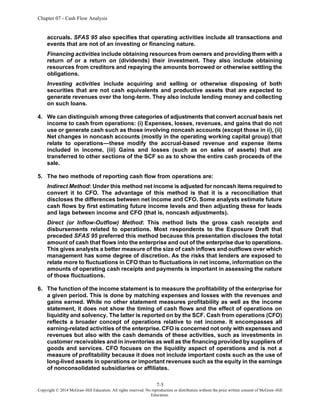
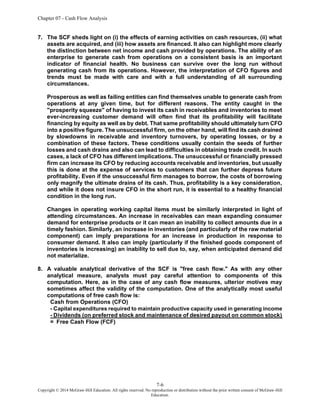
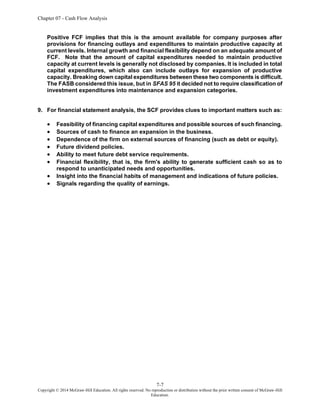
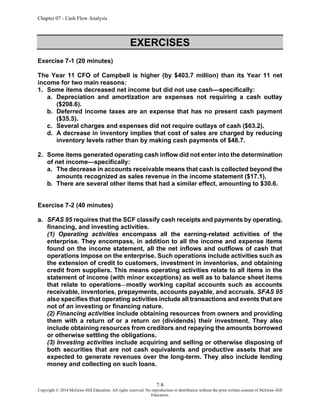
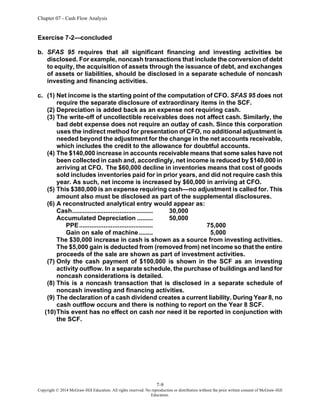
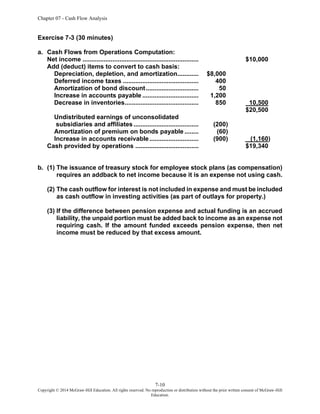
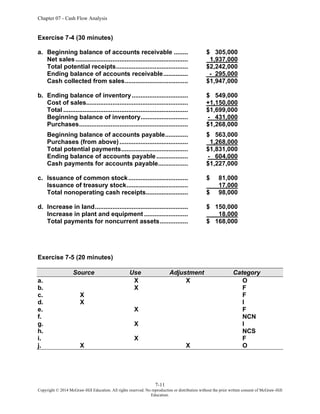
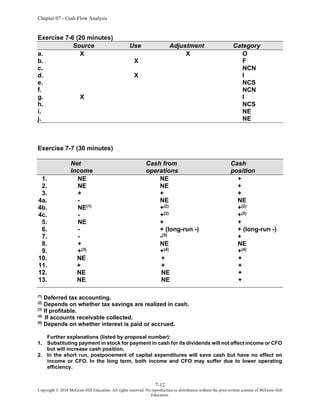
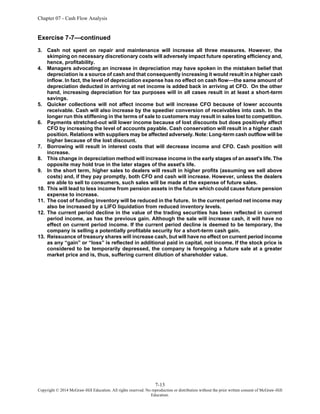
![Chapter 07 - Cash Flow Analysis
7-15
Copyright © 2014 McGraw-Hill Education. All rights reserved. No reproduction or distribution without the prior written consent of McGraw-Hill
Education.
Exercise 7-9 (60 minutes)
a. Cash Collections Computation:
Accounts Receivable (Net)
Beg [a] 564.1
Sales [13] 6205.8 6145.4 Cash collections [b]
End [33] 624.5
Notes:
[a] Balance at 7/29/Year 10............................................ $624.5 [33]
Less: increase in Year 10......................................... (60.4) [61]
$564.1
[b]This amount is overstated by the provision for doubtful accounts expense that is included in
another expense category.
b. Cash Dividends Paid Computation:
Dividends Payable
Dividend paid [77] 137.5 32.3 Beg [43]
142.2 Dividend declared [a] [89]
37.0 End [43]
Note [a]: Item [89] represents dividends declared, not dividends paid (see also Item [77]).
c. Cost of Goods and Services Produced Computation:
Inventories
Beg [34] 819.8
Amount to balance 3982.4
4095.5 Cost of products sold [14]
End [34] 706.7
d. The entry for the income tax provision for Year 11 is:
Income tax expense [27] ...................................... 265.9
Deferred income tax (current) plug.................. 12.1
Income tax payable............................................. 230.4
Deferred income tax (noncurrent) [a] ............... 23.4
Notes:
(1) The entry increases current liabilities by $12.1 since deferred income tax (current) is credited
by this amount. It also increases current liabilities by $230.4 [124A], the amount of income taxes
payable.
(2) The [a] is the difference in the balance of the noncurrent deferred income tax item [176] =
$258.5 - $235.1 = $23.4.
(3) Also, $23.4 + $12.1 = $35.5, which is total deferred tax [59] or [127A]](https://image.slidesharecdn.com/14601-250330191456-7aedc216/85/Financial-Statement-Analysis-11th-Edition-Subramanyam-Solutions-Manual-19-320.jpg)
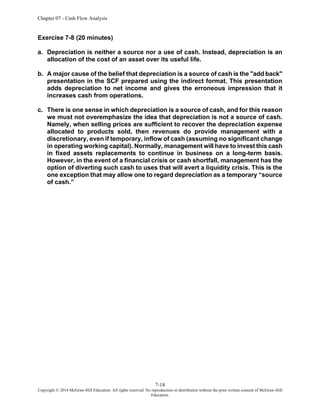
![Chapter 07 - Cash Flow Analysis
7-16
Copyright © 2014 McGraw-Hill Education. All rights reserved. No reproduction or distribution without the prior written consent of McGraw-Hill
Education.
Exercise 7-9—continued
e. Depreciation expense has no effect on cash from operations. The credit, when
recording the depreciation expense, goes to accumulated depreciation, a
noncash account.
f. These provisions are added back because they affect only noncash accounts, the
charge to earnings must be removed in converting it to the cash basis.
g. The “Effect of exchange rate changes on cash” represents translation
adjustments (differences) arising from the translation of cash from foreign
currencies to the U.S. dollar.
h. Any gain or loss is reported under "other, net"—Item [60].
i. Free cash flows =
Cash flow from operations – Cash used for capital additions – Dividends paid
Year 11: $805.2 – $361.1 – $137.5 = $306.6
Year 10: $448.4 – $387.6 – $124.3 = $(63.5)
Year 9: $357.3 – $284.1 – $86.7 = $(13.5)
j. Start-up companies usually have greater capital addition requirements and lower
cash inflows from operations. Also, start-ups rarely pay cash dividends. Free
cash flow earned by start-up companies is usually used to fund the growth of the
company, especially if successful.
k. During the launch of a new product line, the statement of cash flows can be
affected in several ways. First, cash flow from operations is lower because
substantial advertising and promotion is required and sales growth has not yet
been maximized. Second, substantial capital additions are usually necessary to
provide the infrastructure for the new product line. Third, cash flow from
financing can be affected if financing is obtained to launch this new product line.](https://image.slidesharecdn.com/14601-250330191456-7aedc216/85/Financial-Statement-Analysis-11th-Edition-Subramanyam-Solutions-Manual-20-320.jpg)
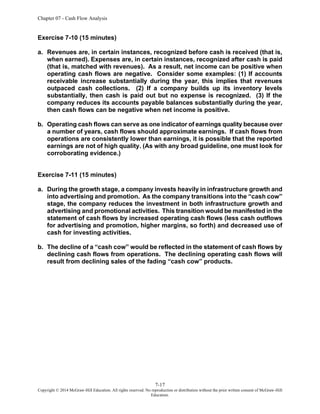
![Chapter 07 - Cash Flow Analysis
7-18
Copyright © 2014 McGraw-Hill Education. All rights reserved. No reproduction or distribution without the prior written consent of McGraw-Hill
Education.
PROBLEMS
Problem 7-1 (60 minutes)
WORKSHEET TO COMPUTE CASH FLOW FROM OPERATIONS (IN MILLIONS)
DIRECT (INFLOW-OUTFLOW) PRESENTATION
CAMPBELL SOUP — YEAR ENDED JULY 28, YEAR 11
Ref. Reported Adjust. Revised
Cash Receipts from Operations
Net Sales ........................................................... 13 $6,204.1 $7.5 $6,211.6
Other revenue and income ............................. 19 26.0 C 26.0
(I) D in current receivables ............................. 61 17.1 C 17.1
(I) D in noncurrent receivables.......................
= CASH COLLECTIONS................................. $6,247.2 $7.5 $6,254.7
Cash Disbursements for Operations
Total expenses (include min. int. & taxes) a
$5,831.0 $7.5 $5,838.5
Less: Expenses & losses not using cash:
- Depreciation and amortization..................... 57 (208.6) (208.6)
- Noncurrent deferred income taxes.............. 59 (35.5) (35.5)
- Other, net........................................................ 60 (63.2) (63.2)
Change in Current Assets and Liabilities
related to Operations
I (D) in inventories ......................................... 62 $ (48.7) $ (48.7)
I (D) in prepaid expenses .............................. 35 (25.3) (25.3)
(I) D in accounts payable .............................. 41 42.8 42.8
(I) D in taxes payable ..................................... 44 (21.3) (21.3)
(I) D in accruals, payrolls, etc. b
................... 175 (26.8) (26.8)
I or D in noncurrent accounts c
.................... 5.8 0.0 5.8
= CASH DISBURSEMENTS ............................. $5,450.2 $7.5 $5,457.7
Dividends Received
Equity in income of
unconsolidated affiliates............................... 24 2.4 2.4
Distributions beyond equity
in income of affiliates c
.................................. 5.8 0.0 5.8
= Dividends from unconsol. affiliates ........... 169A $ 8.2 $0.0 $ 8.2
CASH FLOW FROM OPERATIONS ............... $ 805.2 $0.0 $ 805.2
a
Total costs and expenses [22A] + Taxes on earnings [27] + Minority interests [25] +
Interest income [19] = $5,531.9 + $265.9 + $7.2 + $26.0 = $5,831
b
It is assumed that accruals, payrolls, etc., are part of item [175].
c
A reconciling amount to tie in with the $8.2 dividends from affiliates (item 169A) versus
equity in earnings of affiliates (item 24).](https://image.slidesharecdn.com/14601-250330191456-7aedc216/85/Financial-Statement-Analysis-11th-Edition-Subramanyam-Solutions-Manual-22-320.jpg)
![Chapter 07 - Cash Flow Analysis
7-19
Copyright © 2014 McGraw-Hill Education. All rights reserved. No reproduction or distribution without the prior written consent of McGraw-Hill
Education.
Problem 7-2 (75 minutes)
a.
WORKSHEET TO COMPUTE CASH FLOW FROM OPERATIONS (IN MILLIONS)
DIRECT (INFLOW-OUTFLOW) PRESENTATION
CAMPBELL SOUP YEAR ENDED JULY 29, YEAR 10
Ref. Reported Adjust. Revised
Cash Receipts from Operations
Net Sales ........................................................... 13 $6,205.8 $7.5 $6,213.3
Other revenue and income:
(I) D in current receivables ............................. 61 (60.4) (60.4)
(I) D in noncurrent receivables
Effect of translation adjustments ............... 0.0 0.0 0.0
= Cash Collections........................................... $6,145.4 $7.5 $6,152.9
Cash Disbursements for Operations
Total expenses (include interest &
taxes) [22A] + [27] + [25] ............................... $6,214.9 $7.5 $6,222.4
Less: Expenses & Losses not using cash
- Depreciation & amortization......................... 57 (200.9) (200.9)
- Noncurrent deferred income taxes.............. 59 (3.9) (3.9)
- Other provision for restructuring
and writedowns.............................................. 58 (339.1) (339.1)
- Other * ............................................................. 60 (24.7) (24.7)
- Other
Changes in Current Assets and Liabilities
related to operations
I (D) in inventories ......................................... 62 (10.7) (10.7)
I (D) in prepaid expense ................................
(I) D in accounts payable ..............................
(I) D in taxes payable .....................................
(I) D in accruals, payrolls, etc.......................
(I) D in dividends payable .............................
I or D other ** .................................................. 63 68.8 68.8
I or D in noncurrent amounts ....................... 0.0 0.0 0.0
= Cash Disbursements............................. $5,704.4 $7.5 $5,711.9
Dividends Received
Equity in income of unconsolidated
affiliates........................................................... 24 13.5 13.5
- Undistributed equity in income of
affiliates........................................................... 169A (6.1) 0.0 (6.1)
= Dividends from unconsol. affils.................. 7.4 7.4
Cash Flow From Operations........................... $ 448.4 $ 448.4
*
Other, net [60] $18.6 + [169A] $6.1 = $24.7
**
Campbell shows a combined figure instead of details of operating assets and liabilities.](https://image.slidesharecdn.com/14601-250330191456-7aedc216/85/Financial-Statement-Analysis-11th-Edition-Subramanyam-Solutions-Manual-23-320.jpg)
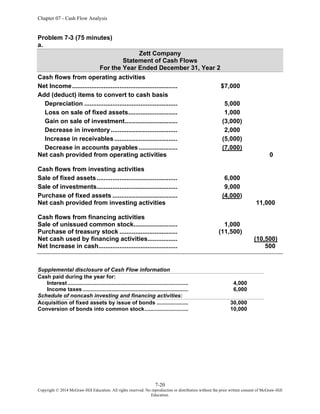

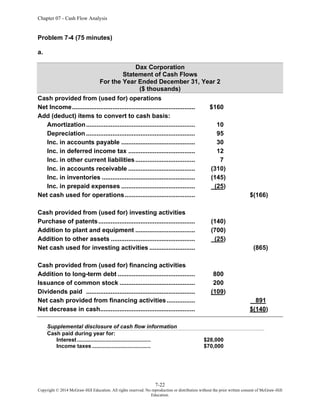

![Chapter 07 - Cash Flow Analysis
7-24
Copyright © 2014 McGraw-Hill Education. All rights reserved. No reproduction or distribution without the prior written consent of McGraw-Hill
Education.
Problem 7-5 (40 minutes)
Niagara Company
Statement of Cash Flows
For Year Ended December 31, Year 9
Cash flows from operating activities
Cash receipts from operations
Sales [a]................................................................... $980
Cash payments for operations
Purchases of inventory [b]..................................... (645)
Selling and general expenses ............................... (100)
Interest expense [c] ................................................ (40)
Income tax expense [d] .......................................... (30)
Cash flows from operations ........................................ $165
Cash flows from investing activities
Purchase of fixed assets........................................ (150)
Cash flows from financing activities
Repayment of notes payable ................................. (25)
Issuance of long-term debt .................................... 50
Cash dividends paid............................................... (30)
Cash flows used in financing...................................... (5)
Net increase in cash..................................................... $ 10
Beginning cash balance .............................................. 50
Ending cash balance.................................................... $ 60
Notes:
[a] Sales ................................................................................ $1,000
Less increase in receivables......................................... (20)
Cash collections ............................................................. $980
[b] Cost of goods sold ......................................................... $ (650)
Add increase in inventories........................................... (20)
Less increase in payables ............................................. 25
(645)
[c] Interest expense ............................................................. $ (50)
Less increase in interest payable ................................. 10
(40)
[d] Income tax expense ....................................................... $ (40)
Less increase in deferred income tax .......................... 10
(30)
Note: Purchase of fixed assets is computed from depreciation expense plus change in fixed
assets ($100+$50). Dividends paid is computed from net income and change in retained earnings
($60-$30).
Supporting schedule for CFO:
Net income ..................................................................................................... $ 60
Add depreciation ........................................................................................... 100
Increase in deferred tax ................................................................................ 10
Increase in receivables ................................................................................. (20)
Increase in inventory..................................................................................... (20)
Increase in accounts payable....................................................................... 25
Increase in interest payable ......................................................................... 10
Cash flows from operations ......................................................................... $165](https://image.slidesharecdn.com/14601-250330191456-7aedc216/85/Financial-Statement-Analysis-11th-Edition-Subramanyam-Solutions-Manual-28-320.jpg)
![Chapter 07 - Cash Flow Analysis
7-25
Copyright © 2014 McGraw-Hill Education. All rights reserved. No reproduction or distribution without the prior written consent of McGraw-Hill
Education.
Problem 7-6 (35 minutes)
Effects Analytical Entries (Optional)
a. [-Y, 11,000] Bad Debt Expense ........................ 11,000
[CC, 11,000] Allowance for Bad Debt ......... 11,000
b. [-Y, 16,000] Depreciation .................................. 16,000
[YA, 16,000] Accumulated Depreciation .... 16,000
c. [NAA, 100,000] Building ......................................... 100,000
[NDE, 100,000] Long-Term Note Payable ....... 100,000
d. None
e. None
f. [+C, 10,000] Cash............................................... 10,000
[-Y, 2,000] Loss ............................................... 2,000
[CC, 12,000] Inventory ................................. 12,000
g. [+C, 35,000] Cash............................................... 35,000
[DC, 5,000] Accounts Receivable.................... 5,000
[CC, 25,000] Inventory ................................. 25,000
[+Y, 15,000] Gain.......................................... 15,000
h. [CC, 3,000] Allowance...................................... 5,000
[-Y, 3,000] Bad Debt Expense ........................ 3,000
Accounts Receivable.............. 8,000
i. [AA, 100,000] Assets............................................ 100,000
[-C, 100,000] Cash......................................... 100,000
[-Y, 20,000] Depreciation expense................... 20,000
[YA, 20,000] Accumulated Depreciation .... 20,000
j. [+C, 8,000] Cash............................................... 8,000
[AD, 8,000] Loss on Sale.................................. 1,000
[YA, 1,000] Machinery (net) ....................... 9,000
[-Y, 1,000]](https://image.slidesharecdn.com/14601-250330191456-7aedc216/85/Financial-Statement-Analysis-11th-Edition-Subramanyam-Solutions-Manual-29-320.jpg)

![[362-363 a.d.]
was blended with the hereditary softness of the Syrians. Fashion was
the only law, pleasure the only pursuit, and the splendour of dress
and furniture was the only distinction of the citizens of Antioch. The
arts of luxury were honoured; the serious and manly virtues were
the subject of ridicule; and the contempt for female modesty and
reverend age, announced the universal corruption of the capital of
the East. The love of spectacles was the taste, or rather passion, of
the Syrians: the most skilful artists were procured from the adjacent
cities; a considerable share of the revenue was devoted to the public
amusements; and the magnificence of the games of the theatre and
circus was considered as the happiness and as the glory of Antioch.
The rustic manners of a prince who disdained such glory, and was
insensible of such happiness, soon disgusted the delicacy of his
subjects; and the effeminate Orientals could neither imitate nor
admire the severe simplicity which Julian always maintained, and
sometimes affected. The days of festivity, consecrated by ancient
custom to the honour of the gods, were the only occasions on which
Julian relaxed his philosophic severity; and those festivals were the
only days in which the Syrians of Antioch could reject the
allurements of pleasure. The majority of the people supported the
glory of the Christian name, which had been first invented by their
ancestors; they contented themselves with disobeying the moral
precepts, but they were scrupulously attached to the speculative
doctrines of their religion. The church of Antioch was distracted by
heresy and schism; but the Arians and the Athanasians, the
followers of Meletius and those of Paulinus, were actuated by the
same pious hatred of their common adversary.
The martial impatience of Julian urged him to take the field in the
beginning of the spring; and he dismissed, with contempt and
reproach, the senate of Antioch, who accompanied the emperor
beyond the limits of their own territory, to which he was resolved
never to return.
As the warlike emperor, instead of
Constantius, had chosen Alexander for his
model, he advanced without delay to Carrhæ, a](https://image.slidesharecdn.com/14601-250330191456-7aedc216/85/Financial-Statement-Analysis-11th-Edition-Subramanyam-Solutions-Manual-31-320.jpg)
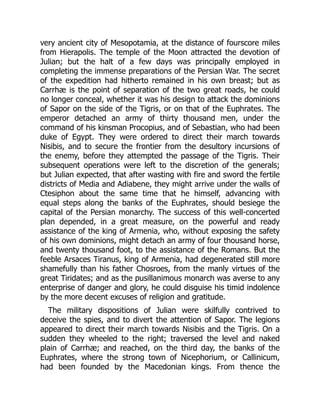
![[363 a.d.]
emperor pursued his march, above ninety miles, along the winding
stream of the Euphrates, till, at length, about one month after his
departure from Antioch, he discovered the towers of Circesium, the
extreme limit of the Roman dominions. The river Chaboras falls into
the Euphrates at Circesium, and as soon as the trumpet gave the
signal of march, the Romans passed the little stream which
separated two mighty and hostile empires.
Two cities of Assyria presumed to resist the
arms of a Roman emperor; and they both paid
the severe penalty of their rashness. At the
distance of fifty miles from the royal residence of Ctesiphon,
Perisabor, or Anbar, held the second rank in the province: a city,
large, populous, and well-fortified, surrounded with a double wall,
almost encompassed by a branch of the Euphrates, and defended by
the valour of a numerous garrison. The exhortations of Hormisdas
were repulsed with contempt; and the ears of the Persian prince
were wounded by a just reproach, that, unmindful of his royal birth,
he conducted an army of strangers against his king and country. The
Assyrians maintained their loyalty by a skilful, as well as vigorous,
defence; till the lucky stroke of a battering-ram having opened a
large breach, by shattering one of the angles of the wall, they hastily
retired into the fortifications of the interior citadel. The soldiers of
Julian rushed impetuously into the town, and after the full
gratification of every military appetite, Perisabor was reduced to
ashes; and the engines which assaulted the citadel were planted on
the ruins of the smoking houses. The contest was continued by an
incessant and mutual discharge of missile weapons; and the
superiority which the Romans might derive from the mechanical
powers of their ballistæ and catapultæ was counterbalanced by the
advantage of the ground on the side of the besieged. But as soon as
an helepolis had been constructed, which could engage on equal
terms with the loftiest ramparts, the tremendous aspect of a moving
turret, that would leave no hope of resistance or of mercy, terrified
the defenders of the citadel into an humble submission; and the
place was surrendered only two days after Julian first appeared](https://image.slidesharecdn.com/14601-250330191456-7aedc216/85/Financial-Statement-Analysis-11th-Edition-Subramanyam-Solutions-Manual-33-320.jpg)
![[59] His name was Clematius of Alexandria, and his only crime
was a refusal to gratify the desires of his mother-in-law; who
solicited his death because she had been disappointed of his love.
Ammianus,d l. 14, c. l.
[60] [Colonia Agrippina.]
[61] [Tres Tabernæ.]
CHAPTER XLIII. JOVIAN TO THEODOSIUS
(363-395 a.d.)
ELECTION OF JOVIAN (FLAVIUS CLAUDIUS JOVIANUS)
Three or four hours of the night had not passed away without
some secret cabals; and when the election of an emperor was
proposed, the spirit of faction began to agitate the assembly. Victor
and Arinthæus collected the remains of the court of Constantius; the
friends of Julian attached themselves to the Gallic chiefs,
Dagalaiphus and Nevitta; and the most fatal consequences might be
apprehended from the discord of two factions, so opposite in their
character and interest, in their maxims of government, and perhaps
in their religious principles. The superior virtues of Sallust could
alone reconcile their divisions, and unite their suffrages; and the
venerable prefect would immediately have been declared the
successor of Julian if he himself, with sincere and modest firmness,](https://image.slidesharecdn.com/14601-250330191456-7aedc216/85/Financial-Statement-Analysis-11th-Edition-Subramanyam-Solutions-Manual-48-320.jpg)