Payments & Transaction Processing SystemsGlobal and Indian Overview
AGENDAIntroductionGlobal regulatory frameworkRegulatory framework in IndiaHow banks transact?How customers transact?Specialized companies operating in each areaMarket shareCritical success factorsRisks
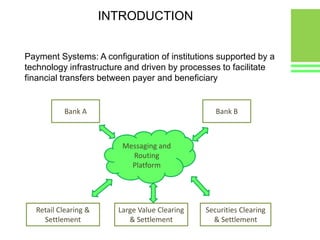
INTRODUCTIONPayment Systems: A configuration of institutions supported by a technology infrastructure and driven by processes to facilitate financial transfers between payer and beneficiaryBank BBank AMessaging and Routing PlatformSecurities Clearing & SettlementLarge Value Clearing & SettlementRetail Clearing & Settlement
AGENDAIntroductionGlobal regulatory frameworkRegulatory framework in IndiaHow banks transact?How customers transact?Specialized companies operating in each areaMarket shareCritical success factorsRisks
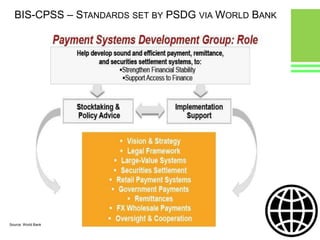
BIS-CPSS – Standards set by PSDG via World BankSource: World Bank
Global Regulatory FrameworkPayment, Remittances & Securities settlement systems represent a basic infrastructure for the functioning of market economiesSound PRSS are Essential for Financial System Stability & Development
Large value payments in a year  - more than 50 times global GDP
Growth in total amounts settled  by RTGS - 86% between 2002 and 2006 and 82% of the value of total payments
Safe PRSS Mitigate Risks in Financial Markets
Financial market crises reflect first in payment systems
Interbank money market relies heavily on ability to transmit funds
Efficient PRSS Lead Countries to Huge Savings
Progressive shift from paper-based to electronic payments can produce a potential saving to the  country of 0.7% of the GDP per year
PRSS are Key in Developing More Inclusive Financial Systems
Enhances access to financial services
Retail payments services first entry point of underserved into financial sectorSource: World Bank
AGENDAIntroductionGlobal regulatory frameworkRegulatory framework in IndiaHow banks transact?How customers transact?Specialized companies operating in each areaMarket shareCritical success factorsRisks
Regulatory Framework in IndiaRegulatory Acts & Provisions:The Payment and Settlement Systems Act, 2007 – (PSS)
Board for Regulation and Supervision of Payments and Settlement Systems Regulations, 2008
Payment and Settlement Systems Regulations, 2008 The PSS Act stipulates that no person other than the Reserve Bank of India shall commence or operate a payment system, except under and in accordance with an authorisation issued by the Reserve Bank of India as per the provisions of the PSS ActRBI is empowered to prescribe:Format of payment instructions
Size and shape of instructions
Timings to be maintained by payment systems
Manner of funds transfer
Criteria for membership Source: Reserve Bank of India
AGENDAIntroductionGlobal regulatory frameworkRegulatory framework in IndiaHow banks transact?How customers transact?Specialized companies operating in each areaMarket shareCritical success factorsRisks
How Banks Transact and Settle with Each other? Interbank funds transfer systems are arrangements through which funds transfers are made between banks for their own account or on behalf of their customers Different systems for different purposes:Fund transfer systems for Large Value transactions
Fund transfer systems for Large Volume of low value payments Key elements of fund transfers:Transfer of messages (information) between the banks
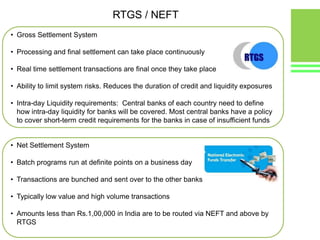
Settlement – Actual transfer of funds between the payer’s bank and payee’s bankRTGS / NEFT Gross Settlement System
Processing and final settlement can take place continuously

Payments and transaction processing systems - Global and Indian Overview

Editor's Notes

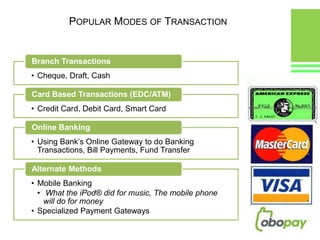
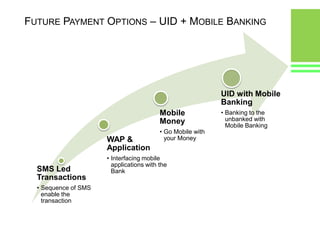
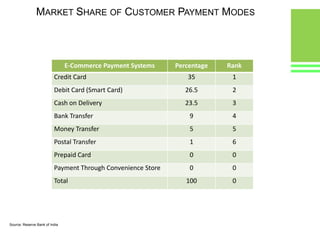
  • #5 A payment system is a configuration of institutions supported by a technology infrastructure and driven by processes to facilitate financial transfers between payer and beneficiary. Payment systems have increasingly come into the fore with the advent of global business transactions and increasing consumerism. The gamut of payment systems ranges from traditional payment instruments such as Cheques and Bank Drafts to the relatively contemporary Credit/Debit Cards, RTGS, SWIFT and finally the latest Mobile Payments.The purpose of this study is to deep-dive into select payment and transaction processing systems to understand how these systems deliver value for the global business community and the consumer with a network of interdependencies and complex business models. Additionally, the study shall focus on the new & upcoming game changers in the payment systems arena.
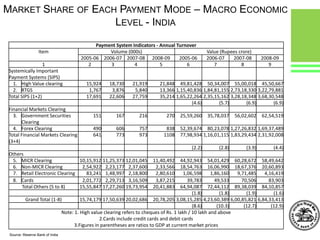
  • #25 The table gives an idea about the preferentialusage pattern of financial products powered by modern payments systems