Fund Flow Analysis and Cash Flow Analysis - Unit - 3.pptx
1.
02/20/2025 B Com- PA, SRCAS 1
Dr. P. PIRAKATHEESWARI
Associate Professor of B Com – PA,
Sri Ramakrishna College of Arts &
Science (Autonomous),
Nava India, Coimbatore – 6.
Fund Flow and Cash Flow
Analysis
2.
MEANING
A fund flowanalysis is a financial document
which you can create and use to analyse and
understand the financial position of your business. More
importantly, it sets out where funds are coming into
your business and how they are being used.
Fund flow focuses on the movement of cash only
and reflects the net flow after measuring inflows and
outflows. Inflows can include the money retail investors
put into mutual funds. Outflows can include payments
to investors or payments made to a company in
exchange for goods and services.
3.
FUND FLOW STATEMENTS
Afund flow statement discloses the types
of inflows and outflows a company
experiences.
The fund flow statement can highlight
fund flow that might be out of the ordinary,
such as a higher-than-expected outflow due to
an irregular expense. Further, it often
categorizes the various transaction types and
sources to help track any fund flow activity
changes.
4.
OBJECTIVES OF FUNDFLOW
ANALYSIS
1. Understanding Sources and Uses
of Funds
2. Assessing Financial Health and
Stability
3. Monitoring Capital Structure
Changes
4. Identifying Financial Trends and
Patterns
5. Facilitating Financial Planning and
Decision Making
5.
IMPORTANCE OF FUNDFLOW
ANALYSIS
1. Assessing Financial Health and
Solvency
2. Monitoring Cash Flow Trends and
Patterns
3. Supporting Strategic Decision Making
4. Detecting Financial Mismanagement or
Irregularities
5. Facilitating Budgeting and Financial
Planning
6.
USES OF FUNDFLOW ANALYSIS
1. Assessing Sources and Uses of
Funds
2. Evaluating Financial Health and
Liquidity
3. Supporting Strategic Decision
Making
4. Detecting Financial Irregularities or
Mismanagement
5. Facilitating Budgeting and
Forecasting
7.
LIMITATIONS OF FUNDFLOW
ANALYSIS
1. Focus on Non-Cash Items
2. Timing Differences
3. Limited Historical Context
4. Complexity in Interpretation
5. Lack of Standardization
6. Inability to Reflect Future
Prospects
8.
ADVANTAGES OF FUNDFLOW ANALYSIS
1. Understanding Fund Sources and Uses
2. Assessing Financial Health and Stability
3. Supporting Strategic Decision Making
4. Detecting Financial Irregularities and
Fraud
5. Facilitating Budgeting and Forecasting
DISADVANTAGES OF FUND FLOW ANALYSIS
6. Focus on Historical Data
7. Complexity and Interpretation
8. Limited Focus on Non-Cash Transactions
9. Inability to Predict Future Performance
10.Lack of Standardization
9.
KEY BENEFITS OFFUND FLOW
ANALYSIS
1. Understanding Cash Flow Dynamics
2. Assessing Financial Health and
Stability
3. Supporting Strategic Decision
Making
4. Detecting Financial Irregularities and
Fraud
5. Facilitating Budgeting and
Forecasting
10.
CASH FLOW DEFINITION
Cashflow refers to the inflow and outflow of the
amount of cash or its equivalents in business. It
determines the amount of cash consumed or generated
for a specified period. Its analysis also identifies the
existing sources of the flow of cash along with a
possible scope of inflows.
The current flow of cash for a given period is
identified by reducing the opening balance of a given
period from its closing balance. Once calculated, cash
flows can result in a negative or positive balance. A
positive balance implies that the company has
sufficient cash to fulfil its immediate liquidity
requirements, while a negative balance indicates a
constricted liquidity.
11.
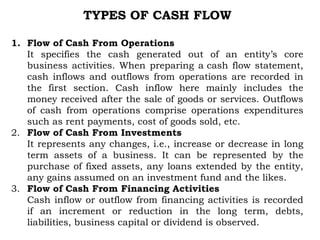
TYPES OF CASHFLOW
1. Flow of Cash From Operations
It specifies the cash generated out of an entity’s core
business activities. When preparing a cash flow statement,
cash inflows and outflows from operations are recorded in
the first section. Cash inflow here mainly includes the
money received after the sale of goods or services. Outflows
of cash from operations comprise operations expenditures
such as rent payments, cost of goods sold, etc.
2. Flow of Cash From Investments
It represents any changes, i.e., increase or decrease in long
term assets of a business. It can be represented by the
purchase of fixed assets, any loans extended by the entity,
any gains assumed on an investment fund and the likes.
3. Flow of Cash From Financing Activities
Cash inflow or outflow from financing activities is recorded
if an increment or reduction in the long term, debts,
liabilities, business capital or dividend is observed.
12.
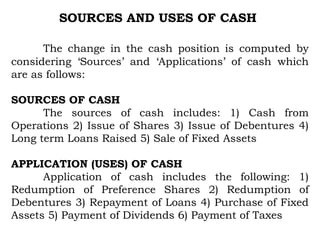
SOURCES AND USESOF CASH
The change in the cash position is computed by
considering ‘Sources’ and ‘Applications’ of cash which
are as follows:
SOURCES OF CASH
The sources of cash includes: 1) Cash from
Operations 2) Issue of Shares 3) Issue of Debentures 4)
Long term Loans Raised 5) Sale of Fixed Assets
APPLICATION (USES) OF CASH
Application of cash includes the following: 1)
Redumption of Preference Shares 2) Redumption of
Debentures 3) Repayment of Loans 4) Purchase of Fixed
Assets 5) Payment of Dividends 6) Payment of Taxes