March 9, 2017
CECL Methodology Series
Forecasting
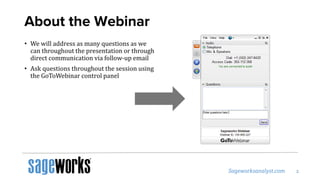
About the Webinar
• We will address as many questions as we
can throughout the presentation or through
direct communication via follow-up email
• Ask questions throughout the session using
the GoToWebinar control panel
• Risk management thought leader
for institutions and examiners
• Regularly featured in national and
trade media
• Loan portfolio and risk
management solutions
• More than 1,000 financial
institution clients
• Founded in 1998
Disclaimer
This presentation may include statements that constitute “forward-looking statements” relative to publicly
available industry data. Forward-looking statements often contain words such as “believe,” “expect,”
“plans,” “project,” “target,” “anticipate,” “will,” “should,” “see,” “guidance,” “confident” and similar terms.
There can be no assurance that any of the future events discussed will occur as anticipated, if at all, or that
actual results on the industry will be as expected. Sageworks is not responsible for the accuracy or validity
of this publicly available industry data, or the outcome of the use of this data relative to business or
investment decisions made by the recipients of this data. Sageworks disclaims all representations and
warranties, express or implied. Risks and uncertainties include risks related to the effect of economic
conditions and financial market conditions; fluctuation in commodity prices, interest rates and foreign
currency exchange rates. No Sageworks employee is authorized to make recommendations or give advice
as to any course of action that should be made as an outcome of this data. The forward-looking statements
and data speak only as of the date of this presentation and we undertake no obligation to update or revise
this information as of a later date.
Rob Ashbaugh
Senior Risk Management Consultant
About Today’s Presenters
Garver Moore
Principal - Advisory Services
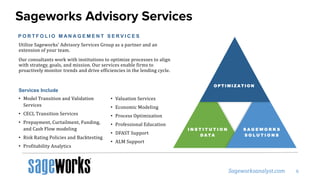
Sageworks Advisory Services
Utilize Sageworks’ Advisory Services Group as a partner and an
extension of your team.
Our consultants work with institutions to optimize processes to align
with strategy, goals, and mission. Our services enable firms to
proactively monitor trends and drive efficiencies in the lending cycle.
P O R T F O L I O M A N A G E M E N T S E R V I C E S
Services Include
• Model Transition and Validation
Services
• CECL Transition Services
• Prepayment, Curtailment, Funding,
and Cash Flow modeling
• Risk Rating Policies and Backtesting
• Profitability Analytics
O P T I M I Z A T I O N
I N S T I T U T I O N
D A T A
S A G E W O R K S
S O L U T I O N S
• Valuation Services
• Economic Modeling
• Process Optimization
• Professional Education
• DFAST Support
• ALM Support
Agenda
• Series Overview
• Forecasting Concepts:
• “Reasonable and Supportable”
• The Economic Cycle
• Sources
• Regional Versus National
• Indicator Selection
• The Future is Now!
• Applications – Data-intensive (Periodic exclusion)
• Applications – Analysis-intensive (Regression)
• Reversion
Series Overview
• Thursday, March 9, 2017, 2-3 p.m. Forecasting with CECL
• Thursday, March 16th, 2017, 2-3 p.m. CECL Calculations in a Software Environment
• Thursday, March 23, 2017, 2-3 p.m. Disclosures with CECL
Sign up at: web.sageworks.com/cecl-methodology-webinar-series/
Agenda
• Series Overview
• Forecasting Concepts:
• “Reasonable and Supportable”
• The Economic Cycle
• Sources
• Regional Versus National
• Indicator Selection
• The Future is Now!
• Applications – Data-intensive (Periodic exclusion)
• Applications – Analysis-intensive (Regression)
• Reversion
Poll Question 1
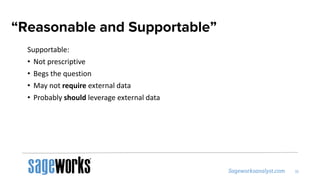
“Reasonable and Supportable”
Supportable:
• Not prescriptive
• Begs the question
• May not require external data
• Probably should leverage external data
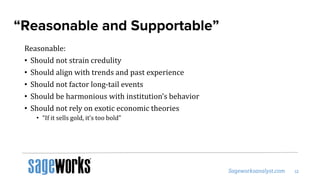
“Reasonable and Supportable”
Reasonable:
• Should not strain credulity
• Should align with trends and past experience
• Should not factor long-tail events
• Should be harmonious with institution’s behavior
• Should not rely on exotic economic theories
• “If it sells gold, it’s too bold”
Agenda
• Series Overview
• Forecasting Concepts:
• “Reasonable and Supportable”
• The Economic Cycle
• Sources
• Regional Versus National
• Indicator Selection
• The Future is Now!
• Applications – Data-intensive (Periodic exclusion)
• Applications – Analysis-intensive (Regression)
• Reversion
The Economic Cycle
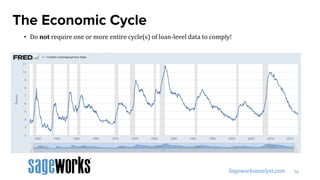
• Do not require one or more entire cycle(s) of loan-level data to comply!
The Economic Cycle
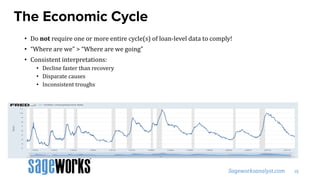
• Do not require one or more entire cycle(s) of loan-level data to comply!
• “Where are we” > “Where are we going”
• Consistent interpretations:
• Decline faster than recovery
• Disparate causes
• Inconsistent troughs
The Economic Cycle
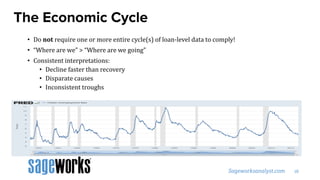
• Do not require one or more entire cycle(s) of loan-level data to comply!
• “Where are we” > “Where are we going”
• Consistent interpretations:
• Decline faster than recovery
• Disparate causes
• Inconsistent troughs
The Economic Cycle
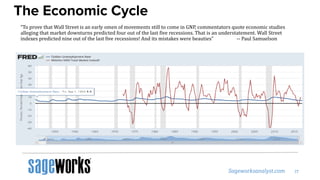
“To prove that Wall Street is an early omen of movements still to come in GNP, commentators quote economic studies
alleging that market downturns predicted four out of the last five recessions. That is an understatement. Wall Street
indexes predicted nine out of the last five recessions! And its mistakes were beauties” -- Paul Samuelson
Agenda
• Series Overview
• Forecasting Concepts:
• “Reasonable and Supportable”
• The Economic Cycle
• Sources
• Regional Versus National
• Indicator Selection
• The Future is Now!
• Applications – Data-intensive (Periodic exclusion)
• Applications – Analysis-intensive (Regression)
• Reversion
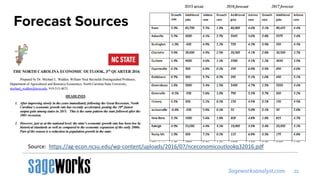
Forecast Sources
• National: Public bodies (Governmental and NGO)
• Some of them might regulate you!
• State and local institutions
• Universities
• Chambers of commerce
• Internal analysis
• Harmony with bank’s operations
• Harmony with stress testing, etc.
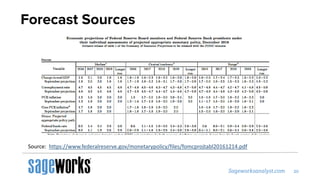
Forecast Sources
Source: https://www.federalreserve.gov/monetarypolicy/files/fomcprojtabl20161214.pdf
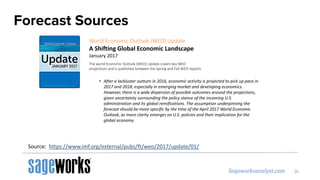
Forecast Sources
Source: https://www.imf.org/external/pubs/ft/weo/2017/update/01/
• After a lackluster outturn in 2016, economic activity is projected to pick up pace in
2017 and 2018, especially in emerging market and developing economics.
However, there is a wide dispersion of possible outcomes around the projections,
given uncertainty surrounding the policy stance of the incoming U.S.
administration and its global remifications. The assumption underpinning the
forecast should be more specific by the time of the April 2017 World Economic
Outlook, as more clarity emerges on U.S. policies and their implication for the
global economy.
World Economic Outlook (WEO) Update
A Shifting Global Economic Landscape
January 2017
The world Economic Outlook (WEO) Update covers key WEO
projections and is published between the Spring and Fall WEO reports
Forecast Sources
Source: https://ag-econ.ncsu.edu/wp-content/uploads/2016/07/nceconomicoutlookq32016.pdf
Agenda
• Series Overview
• Forecasting Concepts:
• “Reasonable and Supportable”
• The Economic Cycle
• Sources
• Regional Versus National
• Indicator Selection
• The Future is Now!
• Applications – Data-intensive (Periodic exclusion)
• Applications – Analysis-intensive (Regression)
• Reversion
Poll Question 2
Regional vs. National
• Use regional figures where they do not track
• Regional historical data available through Federal Reserve Economic
Database (FRED)
• Regional performance can be correlated / regressed to national performance
• A regional or local bank may be nationally exposed
• (Very) loosely: Macro trends will drive PDs, regional trends will drive LGDs
Agenda
• Series Overview
• Forecasting Concepts:
• “Reasonable and Supportable”
• The Economic Cycle
• Sources
• Regional Versus National
• Indicator Selection
• The Future is Now!
• Applications – Data-intensive (Periodic exclusion)
• Applications – Analysis-intensive (Regression)
• Reversion
Indicators
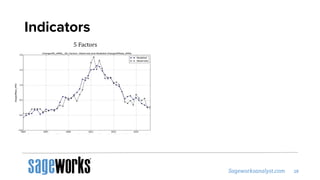
• Unemployment, volatility, rates, commodities, asset prices, etc.
Indicators
5 Factors
Indicators
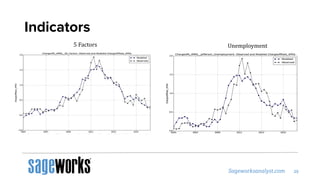
5 Factors Unemployment
Indicators
• Unemployment, volatility, rates, commodities, asset prices, etc.
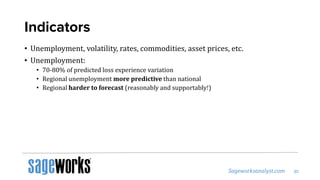
• Unemployment:
• 70-80% of predicted loss experience variation
• Regional unemployment more predictive than national
• Regional harder to forecast (reasonably and supportably!)
Indicators
“Frustra fit per plura quod potest fieri per pauciora"
Indicators
“Frustra fit per plura quod potest fieri per pauciora"
• Law of Parsimony:
• Occam’s Razor
• More is less
• 42-50 observations, mind p-values
• Don’t “correlate-mine”
Indicators
Source: http://www.cbsnews.com/news/what-colors-give-your-car-the-best-resale-value/
Indicators
Source: http://www.cbsnews.com/news/what-colors-give-your-car-the-best-resale-value/
People with exotic cars must really take care of them!
Indicators
Source: http://www.cbsnews.com/news/what-colors-give-your-car-the-best-resale-value/
People with exotic cars must really take care of them!
It must be hard for used-buyers to find cars in
odd colors, thus driving up price!
Indicators
Source: http://www.cbsnews.com/news/what-colors-give-your-car-the-best-resale-value/
People with exotic cars must really take care of them!
It must be hard for used-buyers to find cars in
odd colors, thus driving up price!
The iSeeCars.com study included 700 factors
At a p-value of 0.05, thus we would expect ~35 false
positives like this!
Indicators
Source: http://www.cbsnews.com/news/what-colors-give-your-car-the-best-resale-value/
People with exotic cars must really take care of them!
It must be hard for used-buyers to find cars in
odd colors, thus driving up price!
The iSeeCars.com study included 700 factors
At a p-value of 0.05, thus we would expect ~35 false
positives like this!
Agenda
• Series Overview
• Forecasting Concepts:
• “Reasonable and Supportable”
• The Economic Cycle
• Sources
• Regional Versus National
• Indicator Selection
• The Future is Now!
• Applications – Data-intensive (Periodic exclusion)
• Applications – Analysis-intensive (Regression)
• Reversion
Poll Question 3
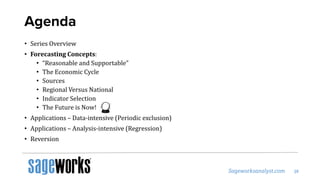
The future is now
Tomorrow, and tomorrow, and tomorrow,
Creeps in this petty pace from day to day,
To the last syllable of recorded time;
And all our yesterdays have lighted fools
The way to dusty death.
The future is now
Tomorrow, and tomorrow, and tomorrow…
…Will likely be very much like today
Baseline Expectations  Current Conditions  Reasonable and Supportable Forecasts  Baseline Expectations
The future is now
Tomorrow, and tomorrow, and tomorrow…
…Will likely be very much like today
Baseline Expectations  Current Conditions  Reasonable and Supportable Forecasts  Baseline Expectations
These may be the same!
The future is now
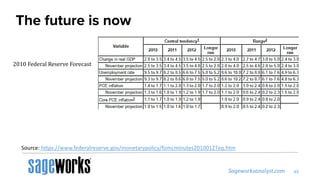
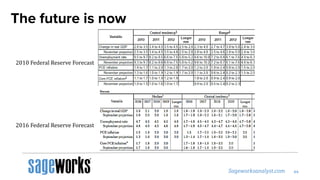
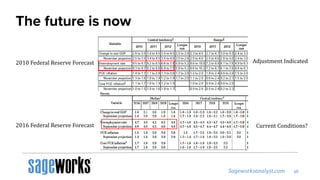
2010 Federal Reserve Forecast
Source: https://www.federalreserve.gov/monetarypolicy/fomcminutes20100127ep.htm
The future is now
2010 Federal Reserve Forecast
2016 Federal Reserve Forecast
The future is now
2010 Federal Reserve Forecast
2016 Federal Reserve Forecast
The future is now
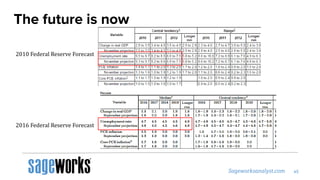
2010 Federal Reserve Forecast
2016 Federal Reserve Forecast
Adjustment Indicated
Current Conditions?
Questions on concepts?
Agenda
• Series Overview
• Forecasting Concepts:
• “Reasonable and Supportable”
• The Economic Cycle
• Sources
• Regional Versus National
• Indicator Selection
• The Future is Now!
• Applications – Data-intensive (Periodic exclusion)
• Applications – Analysis-intensive (Regression)
• Reversion
Forecasting – Application (Migration)
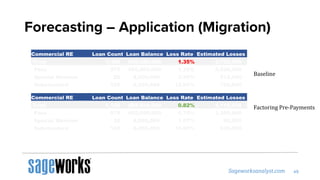
Commercial RE Loan Count Loan Balance Loss Rate Estimated Losses
Total 1,150 499,500,000 1.35% 6,752,500
Pass 975 485,000,000 1.20% 5,820,000
Special Mention 25 8,500,000 2.50% 212,500
Substandard 150 6,000,000 12.00% 720,000
Commercial RE Loan Count Loan Balance Loss Rate Estimated Losses
Total 1,150 499,500,000 0.82% 4,115,950
Pass 975 485,000,000 0.70% 3,395,000
Special Mention 25 8,500,000 1.07% 90,950
Substandard 150 6,000,000 10.50% 630,000
Baseline
Factoring Pre-Payments
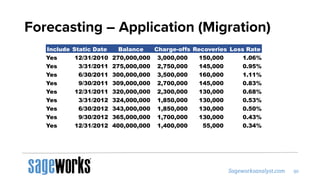
Forecasting – Application (Migration)
Include Static Date Balance Charge-offs Recoveries Loss Rate
Yes 12/31/2010 270,000,000 3,000,000 150,000 1.06%
Yes 3/31/2011 275,000,000 2,750,000 145,000 0.95%
Yes 6/30/2011 300,000,000 3,500,000 160,000 1.11%
Yes 9/30/2011 309,000,000 2,700,000 145,000 0.83%
Yes 12/31/2011 320,000,000 2,300,000 130,000 0.68%
Yes 3/31/2012 324,000,000 1,850,000 130,000 0.53%
Yes 6/30/2012 343,000,000 1,850,000 130,000 0.50%
Yes 9/30/2012 365,000,000 1,700,000 130,000 0.43%
Yes 12/31/2012 400,000,000 1,400,000 55,000 0.34%
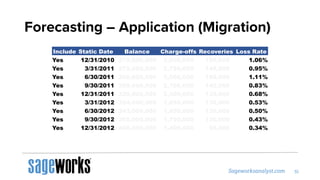
Forecasting – Application (Migration)
Include Static Date Balance Charge-offs Recoveries Loss Rate
Yes 12/31/2010 270,000,000 3,000,000 150,000 1.06%
Yes 3/31/2011 275,000,000 2,750,000 145,000 0.95%
Yes 6/30/2011 300,000,000 3,500,000 160,000 1.11%
Yes 9/30/2011 309,000,000 2,700,000 145,000 0.83%
Yes 12/31/2011 320,000,000 2,300,000 130,000 0.68%
Yes 3/31/2012 324,000,000 1,850,000 130,000 0.53%
Yes 6/30/2012 343,000,000 1,850,000 130,000 0.50%
Yes 9/30/2012 365,000,000 1,700,000 130,000 0.43%
Yes 12/31/2012 400,000,000 1,400,000 55,000 0.34%
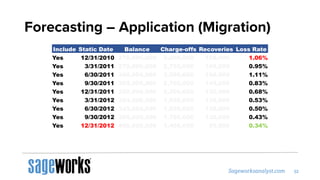
Forecasting – Application (Migration)
Include Static Date Balance Charge-offs Recoveries Loss Rate
Yes 12/31/2010 270,000,000 3,000,000 150,000 1.06%
Yes 3/31/2011 275,000,000 2,750,000 145,000 0.95%
Yes 6/30/2011 300,000,000 3,500,000 160,000 1.11%
Yes 9/30/2011 309,000,000 2,700,000 145,000 0.83%
Yes 12/31/2011 320,000,000 2,300,000 130,000 0.68%
Yes 3/31/2012 324,000,000 1,850,000 130,000 0.53%
Yes 6/30/2012 343,000,000 1,850,000 130,000 0.50%
Yes 9/30/2012 365,000,000 1,700,000 130,000 0.43%
Yes 12/31/2012 400,000,000 1,400,000 55,000 0.34%
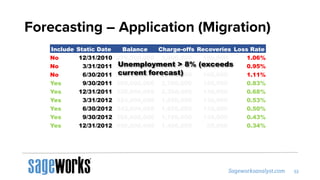
Forecasting – Application (Migration)
Include Static Date Balance Charge-offs Recoveries Loss Rate
No 12/31/2010 270,000,000 3,000,000 150,000 1.06%
No 3/31/2011 275,000,000 2,750,000 145,000 0.95%
No 6/30/2011 300,000,000 3,500,000 160,000 1.11%
Yes 9/30/2011 309,000,000 2,700,000 145,000 0.83%
Yes 12/31/2011 320,000,000 2,300,000 130,000 0.68%
Yes 3/31/2012 324,000,000 1,850,000 130,000 0.53%
Yes 6/30/2012 343,000,000 1,850,000 130,000 0.50%
Yes 9/30/2012 365,000,000 1,700,000 130,000 0.43%
Yes 12/31/2012 400,000,000 1,400,000 55,000 0.34%
Unemployment > 8% (exceeds
current forecast)
Forecasting – Application (Migration)
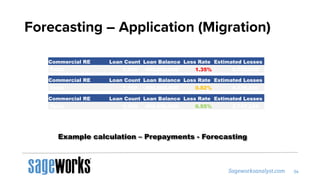
Commercial RE Loan Count Loan Balance Loss Rate Estimated Losses
Total 1,150 499,500,000 1.35% 6,752,500
Commercial RE Loan Count Loan Balance Loss Rate Estimated Losses
Total 1,150 499,500,000 0.82% 4,115,950
Commercial RE Loan Count Loan Balance Loss Rate Estimated Losses
Total 1,150 499,500,000 0.55% 2,747,250
Example calculation – Prepayments - Forecasting
Agenda
• Series Overview
• Forecasting Concepts:
• “Reasonable and Supportable”
• The Economic Cycle
• Sources
• Regional Versus National
• Indicator Selection
• The Future is Now!
• Applications – Data-intensive (Periodic exclusion)
• Applications – Analysis-intensive (Regression)
• Reversion
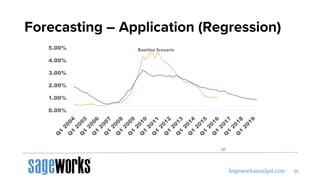
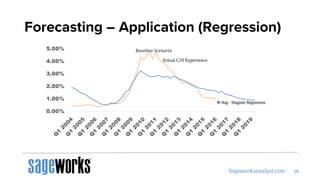
Forecasting – Application (Regression)
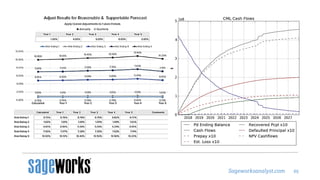
0.00%
1.00%
2.00%
3.00%
4.00%
5.00% Baseline Scenario
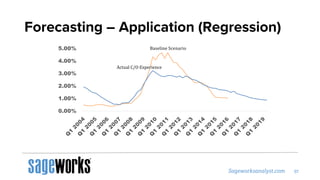
Forecasting – Application (Regression)
0.00%
1.00%
2.00%
3.00%
4.00%
5.00% Baseline Scenario
Actual C/O Experience
Forecasting – Application (Regression)
0.00%
1.00%
2.00%
3.00%
4.00%
5.00% Baseline Scenario
W Avg. - Singular Regression
Actual C/O Experience
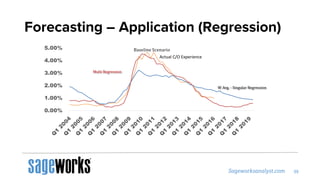
Forecasting – Application (Regression)
0.00%
1.00%
2.00%
3.00%
4.00%
5.00% Baseline Scenario
W Avg. - Singular Regression
Multi Regression
Actual C/O Experience
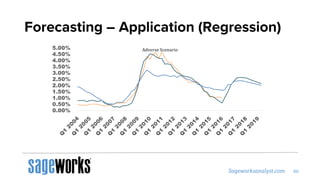
Forecasting – Application (Regression)
0.00%
0.50%
1.00%
1.50%
2.00%
2.50%
3.00%
3.50%
4.00%
4.50%
5.00% Adverse Scenario
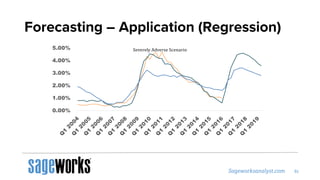
Forecasting – Application (Regression)
0.00%
1.00%
2.00%
3.00%
4.00%
5.00% Severely Adverse Scenario
Forecasting – Application (Regression)
• 18 month economic forecast predicting a spike and then fall in negative indicators
Forecasting – Application (Regression)
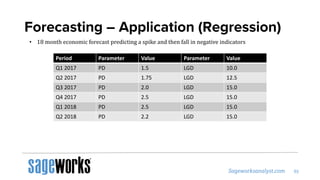
• 18 month economic forecast predicting a spike and then fall in negative indicators
Period Parameter Value Parameter Value
Q1 2017 PD 1.5 LGD 10.0
Q2 2017 PD 1.75 LGD 12.5
Q3 2017 PD 2.0 LGD 15.0
Q4 2017 PD 2.5 LGD 15.0
Q1 2018 PD 2.5 LGD 15.0
Q2 2018 PD 2.2 LGD 15.0
Forecasting – Application (Regression)
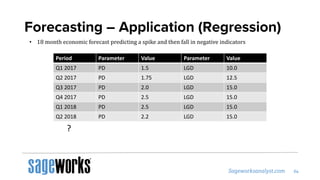
• 18 month economic forecast predicting a spike and then fall in negative indicators
Period Parameter Value Parameter Value
Q1 2017 PD 1.5 LGD 10.0
Q2 2017 PD 1.75 LGD 12.5
Q3 2017 PD 2.0 LGD 15.0
Q4 2017 PD 2.5 LGD 15.0
Q1 2018 PD 2.5 LGD 15.0
Q2 2018 PD 2.2 LGD 15.0
?
Questions on regression?
Agenda
• Series Overview
• Forecasting Concepts:
• “Reasonable and Supportable”
• The Economic Cycle
• Sources
• Regional Versus National
• Indicator Selection
• The Future is Now!
• Applications – Data-intensive (Periodic exclusion)
• Applications – Analysis-intensive (Regression)
• Reversion
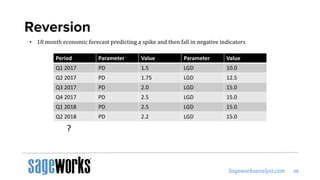
Reversion
• 18 month economic forecast predicting a spike and then fall in negative indicators
Period Parameter Value Parameter Value
Q1 2017 PD 1.5 LGD 10.0
Q2 2017 PD 1.75 LGD 12.5
Q3 2017 PD 2.0 LGD 15.0
Q4 2017 PD 2.5 LGD 15.0
Q1 2018 PD 2.5 LGD 15.0
Q2 2018 PD 2.2 LGD 15.0
?
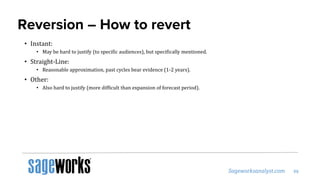
Reversion – How to revert
• Instant:
• May be hard to justify (to specific audiences), but specifically mentioned.
• Straight-Line:
• Reasonable approximation, past cycles bear evidence (1-2 years).
• Other:
• Also hard to justify (more difficult than expansion of forecast period).
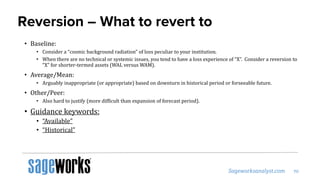
Reversion – What to revert to
• Baseline:
• Consider a “cosmic background radiation” of loss peculiar to your institution.
• When there are no technical or systemic issues, you tend to have a loss experience of “X”. Consider a reversion to
“X” for shorter-termed assets (WAL versus WAM).
• Average/Mean:
• Arguably inappropriate (or appropriate) based on downturn in historical period or forseeable future.
• Other/Peer:
• Also hard to justify (more difficult than expansion of forecast period).
• Guidance keywords:
• “Available”
• “Historical”
Q & A
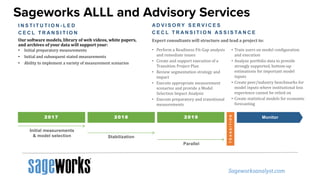
Sageworks ALLL and Advisory Services
Our software models, library of web videos, white papers,
and archives of your data will support your:
• Initial preparatory measurements
• Initial and subsequent stated measurements
• Ability to implement a variety of measurement scenarios
I N S T I T U T I O N - L E D
C E C L T R A N S I T I O N
Expert consultants will structure and lead a project to:
• Perform a Readiness Fit-Gap analysis
and remediate issues
• Create and support execution of a
Transition Project Plan
• Review segmentation strategy and
impact
• Execute appropriate measurement
scenarios and provide a Model
Selection Impact Analysis
• Execute preparatory and transitional
measurements
• Train users on model configuration
and execution
• Analyze portfolio data to provide
strongly supported, bottom-up
estimations for important model
inputs
• Create peer/industry benchmarks for
model inputs where institutional loss
experience cannot be relied on
• Create statistical models for economic
forecasting
2 0 1 7 2 0 1 8 2 0 1 9
Initial measurements
& model selection Stabilization
Parallel
Monitor
TRANSITION
A D V I S O R Y S E R V I C E S
C E C L T R A N S I T I O N A S S I S TA N C E
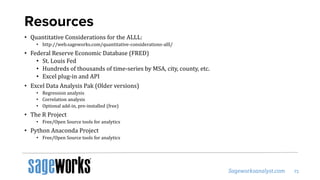
Resources
• Quantitative Considerations for the ALLL:
• http://web.sageworks.com/quantitative-considerations-alll/
• Federal Reserve Economic Database (FRED)
• St. Louis Fed
• Hundreds of thousands of time-series by MSA, city, county, etc.
• Excel plug-in and API
• Excel Data Analysis Pak (Older versions)
• Regression analysis
• Correlation analysis
• Optional add-in, pre-installed (free)
• The R Project
• Free/Open Source tools for analytics
• Python Anaconda Project
• Free/Open Source tools for analytics
Poll Question
2017 Risk Management Summit
The premier conference for lending and risk
• Learn:
» Sessions dedicated to lending, credit risk
and portfolio risk
» Led by industry experts to address your
challenges around growth and risk
• Network:
» More than 200 bankers from 130
institutions attend
• Apply:
» 98% of attendees recommend the RMS to
community bankers
» Offers actionable insights to help banks
grow profitably and mitigate risk
Denver, Colorado | September 25-27

CECL Methodology - Forecasting

  • 1.
    March 9, 2017 CECLMethodology Series Forecasting
  • 2.
    About the Webinar •We will address as many questions as we can throughout the presentation or through direct communication via follow-up email • Ask questions throughout the session using the GoToWebinar control panel
  • 3.
    • Risk managementthought leader for institutions and examiners • Regularly featured in national and trade media • Loan portfolio and risk management solutions • More than 1,000 financial institution clients • Founded in 1998
  • 4.
    Disclaimer This presentation mayinclude statements that constitute “forward-looking statements” relative to publicly available industry data. Forward-looking statements often contain words such as “believe,” “expect,” “plans,” “project,” “target,” “anticipate,” “will,” “should,” “see,” “guidance,” “confident” and similar terms. There can be no assurance that any of the future events discussed will occur as anticipated, if at all, or that actual results on the industry will be as expected. Sageworks is not responsible for the accuracy or validity of this publicly available industry data, or the outcome of the use of this data relative to business or investment decisions made by the recipients of this data. Sageworks disclaims all representations and warranties, express or implied. Risks and uncertainties include risks related to the effect of economic conditions and financial market conditions; fluctuation in commodity prices, interest rates and foreign currency exchange rates. No Sageworks employee is authorized to make recommendations or give advice as to any course of action that should be made as an outcome of this data. The forward-looking statements and data speak only as of the date of this presentation and we undertake no obligation to update or revise this information as of a later date.
  • 5.
    Rob Ashbaugh Senior RiskManagement Consultant About Today’s Presenters Garver Moore Principal - Advisory Services
  • 6.
    Sageworks Advisory Services UtilizeSageworks’ Advisory Services Group as a partner and an extension of your team. Our consultants work with institutions to optimize processes to align with strategy, goals, and mission. Our services enable firms to proactively monitor trends and drive efficiencies in the lending cycle. P O R T F O L I O M A N A G E M E N T S E R V I C E S Services Include • Model Transition and Validation Services • CECL Transition Services • Prepayment, Curtailment, Funding, and Cash Flow modeling • Risk Rating Policies and Backtesting • Profitability Analytics O P T I M I Z A T I O N I N S T I T U T I O N D A T A S A G E W O R K S S O L U T I O N S • Valuation Services • Economic Modeling • Process Optimization • Professional Education • DFAST Support • ALM Support
  • 7.
    Agenda • Series Overview •Forecasting Concepts: • “Reasonable and Supportable” • The Economic Cycle • Sources • Regional Versus National • Indicator Selection • The Future is Now! • Applications – Data-intensive (Periodic exclusion) • Applications – Analysis-intensive (Regression) • Reversion
  • 8.
    Series Overview • Thursday,March 9, 2017, 2-3 p.m. Forecasting with CECL • Thursday, March 16th, 2017, 2-3 p.m. CECL Calculations in a Software Environment • Thursday, March 23, 2017, 2-3 p.m. Disclosures with CECL Sign up at: web.sageworks.com/cecl-methodology-webinar-series/
  • 9.
    Agenda • Series Overview •Forecasting Concepts: • “Reasonable and Supportable” • The Economic Cycle • Sources • Regional Versus National • Indicator Selection • The Future is Now! • Applications – Data-intensive (Periodic exclusion) • Applications – Analysis-intensive (Regression) • Reversion
  • 10.
  • 11.
    “Reasonable and Supportable” Supportable: •Not prescriptive • Begs the question • May not require external data • Probably should leverage external data
  • 12.
    “Reasonable and Supportable” Reasonable: •Should not strain credulity • Should align with trends and past experience • Should not factor long-tail events • Should be harmonious with institution’s behavior • Should not rely on exotic economic theories • “If it sells gold, it’s too bold”
  • 13.
    Agenda • Series Overview •Forecasting Concepts: • “Reasonable and Supportable” • The Economic Cycle • Sources • Regional Versus National • Indicator Selection • The Future is Now! • Applications – Data-intensive (Periodic exclusion) • Applications – Analysis-intensive (Regression) • Reversion
  • 14.
    The Economic Cycle •Do not require one or more entire cycle(s) of loan-level data to comply!
  • 15.
    The Economic Cycle •Do not require one or more entire cycle(s) of loan-level data to comply! • “Where are we” > “Where are we going” • Consistent interpretations: • Decline faster than recovery • Disparate causes • Inconsistent troughs
  • 16.
    The Economic Cycle •Do not require one or more entire cycle(s) of loan-level data to comply! • “Where are we” > “Where are we going” • Consistent interpretations: • Decline faster than recovery • Disparate causes • Inconsistent troughs
  • 17.
    The Economic Cycle “Toprove that Wall Street is an early omen of movements still to come in GNP, commentators quote economic studies alleging that market downturns predicted four out of the last five recessions. That is an understatement. Wall Street indexes predicted nine out of the last five recessions! And its mistakes were beauties” -- Paul Samuelson
  • 18.
    Agenda • Series Overview •Forecasting Concepts: • “Reasonable and Supportable” • The Economic Cycle • Sources • Regional Versus National • Indicator Selection • The Future is Now! • Applications – Data-intensive (Periodic exclusion) • Applications – Analysis-intensive (Regression) • Reversion
  • 19.
    Forecast Sources • National:Public bodies (Governmental and NGO) • Some of them might regulate you! • State and local institutions • Universities • Chambers of commerce • Internal analysis • Harmony with bank’s operations • Harmony with stress testing, etc.
  • 20.
  • 21.
    Forecast Sources Source: https://www.imf.org/external/pubs/ft/weo/2017/update/01/ •After a lackluster outturn in 2016, economic activity is projected to pick up pace in 2017 and 2018, especially in emerging market and developing economics. However, there is a wide dispersion of possible outcomes around the projections, given uncertainty surrounding the policy stance of the incoming U.S. administration and its global remifications. The assumption underpinning the forecast should be more specific by the time of the April 2017 World Economic Outlook, as more clarity emerges on U.S. policies and their implication for the global economy. World Economic Outlook (WEO) Update A Shifting Global Economic Landscape January 2017 The world Economic Outlook (WEO) Update covers key WEO projections and is published between the Spring and Fall WEO reports
  • 22.
  • 23.
    Agenda • Series Overview •Forecasting Concepts: • “Reasonable and Supportable” • The Economic Cycle • Sources • Regional Versus National • Indicator Selection • The Future is Now! • Applications – Data-intensive (Periodic exclusion) • Applications – Analysis-intensive (Regression) • Reversion
  • 24.
  • 25.
    Regional vs. National •Use regional figures where they do not track • Regional historical data available through Federal Reserve Economic Database (FRED) • Regional performance can be correlated / regressed to national performance • A regional or local bank may be nationally exposed • (Very) loosely: Macro trends will drive PDs, regional trends will drive LGDs
  • 26.
    Agenda • Series Overview •Forecasting Concepts: • “Reasonable and Supportable” • The Economic Cycle • Sources • Regional Versus National • Indicator Selection • The Future is Now! • Applications – Data-intensive (Periodic exclusion) • Applications – Analysis-intensive (Regression) • Reversion
  • 27.
    Indicators • Unemployment, volatility,rates, commodities, asset prices, etc.
  • 28.
  • 29.
  • 30.
    Indicators • Unemployment, volatility,rates, commodities, asset prices, etc. • Unemployment: • 70-80% of predicted loss experience variation • Regional unemployment more predictive than national • Regional harder to forecast (reasonably and supportably!)
  • 31.
    Indicators “Frustra fit perplura quod potest fieri per pauciora"
  • 32.
    Indicators “Frustra fit perplura quod potest fieri per pauciora" • Law of Parsimony: • Occam’s Razor • More is less • 42-50 observations, mind p-values • Don’t “correlate-mine”
  • 33.
  • 34.
  • 35.
    Indicators Source: http://www.cbsnews.com/news/what-colors-give-your-car-the-best-resale-value/ People withexotic cars must really take care of them! It must be hard for used-buyers to find cars in odd colors, thus driving up price!
  • 36.
    Indicators Source: http://www.cbsnews.com/news/what-colors-give-your-car-the-best-resale-value/ People withexotic cars must really take care of them! It must be hard for used-buyers to find cars in odd colors, thus driving up price! The iSeeCars.com study included 700 factors At a p-value of 0.05, thus we would expect ~35 false positives like this!
  • 37.
    Indicators Source: http://www.cbsnews.com/news/what-colors-give-your-car-the-best-resale-value/ People withexotic cars must really take care of them! It must be hard for used-buyers to find cars in odd colors, thus driving up price! The iSeeCars.com study included 700 factors At a p-value of 0.05, thus we would expect ~35 false positives like this!
  • 38.
    Agenda • Series Overview •Forecasting Concepts: • “Reasonable and Supportable” • The Economic Cycle • Sources • Regional Versus National • Indicator Selection • The Future is Now! • Applications – Data-intensive (Periodic exclusion) • Applications – Analysis-intensive (Regression) • Reversion
  • 39.
  • 40.
    The future isnow Tomorrow, and tomorrow, and tomorrow, Creeps in this petty pace from day to day, To the last syllable of recorded time; And all our yesterdays have lighted fools The way to dusty death.
  • 41.
    The future isnow Tomorrow, and tomorrow, and tomorrow… …Will likely be very much like today Baseline Expectations  Current Conditions  Reasonable and Supportable Forecasts  Baseline Expectations
  • 42.
    The future isnow Tomorrow, and tomorrow, and tomorrow… …Will likely be very much like today Baseline Expectations  Current Conditions  Reasonable and Supportable Forecasts  Baseline Expectations These may be the same!
  • 43.
    The future isnow 2010 Federal Reserve Forecast Source: https://www.federalreserve.gov/monetarypolicy/fomcminutes20100127ep.htm
  • 44.
    The future isnow 2010 Federal Reserve Forecast 2016 Federal Reserve Forecast
  • 45.
    The future isnow 2010 Federal Reserve Forecast 2016 Federal Reserve Forecast
  • 46.
    The future isnow 2010 Federal Reserve Forecast 2016 Federal Reserve Forecast Adjustment Indicated Current Conditions?
  • 47.
  • 48.
    Agenda • Series Overview •Forecasting Concepts: • “Reasonable and Supportable” • The Economic Cycle • Sources • Regional Versus National • Indicator Selection • The Future is Now! • Applications – Data-intensive (Periodic exclusion) • Applications – Analysis-intensive (Regression) • Reversion
  • 49.
    Forecasting – Application(Migration) Commercial RE Loan Count Loan Balance Loss Rate Estimated Losses Total 1,150 499,500,000 1.35% 6,752,500 Pass 975 485,000,000 1.20% 5,820,000 Special Mention 25 8,500,000 2.50% 212,500 Substandard 150 6,000,000 12.00% 720,000 Commercial RE Loan Count Loan Balance Loss Rate Estimated Losses Total 1,150 499,500,000 0.82% 4,115,950 Pass 975 485,000,000 0.70% 3,395,000 Special Mention 25 8,500,000 1.07% 90,950 Substandard 150 6,000,000 10.50% 630,000 Baseline Factoring Pre-Payments
  • 50.
    Forecasting – Application(Migration) Include Static Date Balance Charge-offs Recoveries Loss Rate Yes 12/31/2010 270,000,000 3,000,000 150,000 1.06% Yes 3/31/2011 275,000,000 2,750,000 145,000 0.95% Yes 6/30/2011 300,000,000 3,500,000 160,000 1.11% Yes 9/30/2011 309,000,000 2,700,000 145,000 0.83% Yes 12/31/2011 320,000,000 2,300,000 130,000 0.68% Yes 3/31/2012 324,000,000 1,850,000 130,000 0.53% Yes 6/30/2012 343,000,000 1,850,000 130,000 0.50% Yes 9/30/2012 365,000,000 1,700,000 130,000 0.43% Yes 12/31/2012 400,000,000 1,400,000 55,000 0.34%
  • 51.
    Forecasting – Application(Migration) Include Static Date Balance Charge-offs Recoveries Loss Rate Yes 12/31/2010 270,000,000 3,000,000 150,000 1.06% Yes 3/31/2011 275,000,000 2,750,000 145,000 0.95% Yes 6/30/2011 300,000,000 3,500,000 160,000 1.11% Yes 9/30/2011 309,000,000 2,700,000 145,000 0.83% Yes 12/31/2011 320,000,000 2,300,000 130,000 0.68% Yes 3/31/2012 324,000,000 1,850,000 130,000 0.53% Yes 6/30/2012 343,000,000 1,850,000 130,000 0.50% Yes 9/30/2012 365,000,000 1,700,000 130,000 0.43% Yes 12/31/2012 400,000,000 1,400,000 55,000 0.34%
  • 52.
    Forecasting – Application(Migration) Include Static Date Balance Charge-offs Recoveries Loss Rate Yes 12/31/2010 270,000,000 3,000,000 150,000 1.06% Yes 3/31/2011 275,000,000 2,750,000 145,000 0.95% Yes 6/30/2011 300,000,000 3,500,000 160,000 1.11% Yes 9/30/2011 309,000,000 2,700,000 145,000 0.83% Yes 12/31/2011 320,000,000 2,300,000 130,000 0.68% Yes 3/31/2012 324,000,000 1,850,000 130,000 0.53% Yes 6/30/2012 343,000,000 1,850,000 130,000 0.50% Yes 9/30/2012 365,000,000 1,700,000 130,000 0.43% Yes 12/31/2012 400,000,000 1,400,000 55,000 0.34%
  • 53.
    Forecasting – Application(Migration) Include Static Date Balance Charge-offs Recoveries Loss Rate No 12/31/2010 270,000,000 3,000,000 150,000 1.06% No 3/31/2011 275,000,000 2,750,000 145,000 0.95% No 6/30/2011 300,000,000 3,500,000 160,000 1.11% Yes 9/30/2011 309,000,000 2,700,000 145,000 0.83% Yes 12/31/2011 320,000,000 2,300,000 130,000 0.68% Yes 3/31/2012 324,000,000 1,850,000 130,000 0.53% Yes 6/30/2012 343,000,000 1,850,000 130,000 0.50% Yes 9/30/2012 365,000,000 1,700,000 130,000 0.43% Yes 12/31/2012 400,000,000 1,400,000 55,000 0.34% Unemployment > 8% (exceeds current forecast)
  • 54.
    Forecasting – Application(Migration) Commercial RE Loan Count Loan Balance Loss Rate Estimated Losses Total 1,150 499,500,000 1.35% 6,752,500 Commercial RE Loan Count Loan Balance Loss Rate Estimated Losses Total 1,150 499,500,000 0.82% 4,115,950 Commercial RE Loan Count Loan Balance Loss Rate Estimated Losses Total 1,150 499,500,000 0.55% 2,747,250 Example calculation – Prepayments - Forecasting
  • 55.
    Agenda • Series Overview •Forecasting Concepts: • “Reasonable and Supportable” • The Economic Cycle • Sources • Regional Versus National • Indicator Selection • The Future is Now! • Applications – Data-intensive (Periodic exclusion) • Applications – Analysis-intensive (Regression) • Reversion
  • 56.
    Forecasting – Application(Regression) 0.00% 1.00% 2.00% 3.00% 4.00% 5.00% Baseline Scenario
  • 57.
    Forecasting – Application(Regression) 0.00% 1.00% 2.00% 3.00% 4.00% 5.00% Baseline Scenario Actual C/O Experience
  • 58.
    Forecasting – Application(Regression) 0.00% 1.00% 2.00% 3.00% 4.00% 5.00% Baseline Scenario W Avg. - Singular Regression Actual C/O Experience
  • 59.
    Forecasting – Application(Regression) 0.00% 1.00% 2.00% 3.00% 4.00% 5.00% Baseline Scenario W Avg. - Singular Regression Multi Regression Actual C/O Experience
  • 60.
    Forecasting – Application(Regression) 0.00% 0.50% 1.00% 1.50% 2.00% 2.50% 3.00% 3.50% 4.00% 4.50% 5.00% Adverse Scenario
  • 61.
    Forecasting – Application(Regression) 0.00% 1.00% 2.00% 3.00% 4.00% 5.00% Severely Adverse Scenario
  • 62.
    Forecasting – Application(Regression) • 18 month economic forecast predicting a spike and then fall in negative indicators
  • 63.
    Forecasting – Application(Regression) • 18 month economic forecast predicting a spike and then fall in negative indicators Period Parameter Value Parameter Value Q1 2017 PD 1.5 LGD 10.0 Q2 2017 PD 1.75 LGD 12.5 Q3 2017 PD 2.0 LGD 15.0 Q4 2017 PD 2.5 LGD 15.0 Q1 2018 PD 2.5 LGD 15.0 Q2 2018 PD 2.2 LGD 15.0
  • 64.
    Forecasting – Application(Regression) • 18 month economic forecast predicting a spike and then fall in negative indicators Period Parameter Value Parameter Value Q1 2017 PD 1.5 LGD 10.0 Q2 2017 PD 1.75 LGD 12.5 Q3 2017 PD 2.0 LGD 15.0 Q4 2017 PD 2.5 LGD 15.0 Q1 2018 PD 2.5 LGD 15.0 Q2 2018 PD 2.2 LGD 15.0 ?
  • 66.
  • 67.
    Agenda • Series Overview •Forecasting Concepts: • “Reasonable and Supportable” • The Economic Cycle • Sources • Regional Versus National • Indicator Selection • The Future is Now! • Applications – Data-intensive (Periodic exclusion) • Applications – Analysis-intensive (Regression) • Reversion
  • 68.
    Reversion • 18 montheconomic forecast predicting a spike and then fall in negative indicators Period Parameter Value Parameter Value Q1 2017 PD 1.5 LGD 10.0 Q2 2017 PD 1.75 LGD 12.5 Q3 2017 PD 2.0 LGD 15.0 Q4 2017 PD 2.5 LGD 15.0 Q1 2018 PD 2.5 LGD 15.0 Q2 2018 PD 2.2 LGD 15.0 ?
  • 69.
    Reversion – Howto revert • Instant: • May be hard to justify (to specific audiences), but specifically mentioned. • Straight-Line: • Reasonable approximation, past cycles bear evidence (1-2 years). • Other: • Also hard to justify (more difficult than expansion of forecast period).
  • 70.
    Reversion – Whatto revert to • Baseline: • Consider a “cosmic background radiation” of loss peculiar to your institution. • When there are no technical or systemic issues, you tend to have a loss experience of “X”. Consider a reversion to “X” for shorter-termed assets (WAL versus WAM). • Average/Mean: • Arguably inappropriate (or appropriate) based on downturn in historical period or forseeable future. • Other/Peer: • Also hard to justify (more difficult than expansion of forecast period). • Guidance keywords: • “Available” • “Historical”
  • 71.
  • 72.
    Sageworks ALLL andAdvisory Services Our software models, library of web videos, white papers, and archives of your data will support your: • Initial preparatory measurements • Initial and subsequent stated measurements • Ability to implement a variety of measurement scenarios I N S T I T U T I O N - L E D C E C L T R A N S I T I O N Expert consultants will structure and lead a project to: • Perform a Readiness Fit-Gap analysis and remediate issues • Create and support execution of a Transition Project Plan • Review segmentation strategy and impact • Execute appropriate measurement scenarios and provide a Model Selection Impact Analysis • Execute preparatory and transitional measurements • Train users on model configuration and execution • Analyze portfolio data to provide strongly supported, bottom-up estimations for important model inputs • Create peer/industry benchmarks for model inputs where institutional loss experience cannot be relied on • Create statistical models for economic forecasting 2 0 1 7 2 0 1 8 2 0 1 9 Initial measurements & model selection Stabilization Parallel Monitor TRANSITION A D V I S O R Y S E R V I C E S C E C L T R A N S I T I O N A S S I S TA N C E
  • 73.
    Resources • Quantitative Considerationsfor the ALLL: • http://web.sageworks.com/quantitative-considerations-alll/ • Federal Reserve Economic Database (FRED) • St. Louis Fed • Hundreds of thousands of time-series by MSA, city, county, etc. • Excel plug-in and API • Excel Data Analysis Pak (Older versions) • Regression analysis • Correlation analysis • Optional add-in, pre-installed (free) • The R Project • Free/Open Source tools for analytics • Python Anaconda Project • Free/Open Source tools for analytics
  • 74.
  • 75.
    2017 Risk ManagementSummit The premier conference for lending and risk • Learn: » Sessions dedicated to lending, credit risk and portfolio risk » Led by industry experts to address your challenges around growth and risk • Network: » More than 200 bankers from 130 institutions attend • Apply: » 98% of attendees recommend the RMS to community bankers » Offers actionable insights to help banks grow profitably and mitigate risk Denver, Colorado | September 25-27