





CASH FLOW Statement and its ANALYSIS
By
AsHra ReHmat
CASH FLOW Statement
• Provides information about cash inflows and
outflows during an accounting period
• Is developed from Balance Sheet and Income
Statement data
• Important as an analytical tool
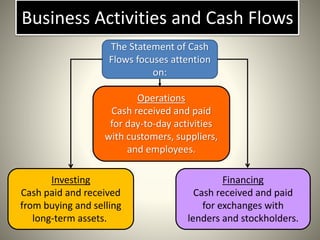
Operations
Cash received and paid
for day-to-day activities
with customers, suppliers,
and employees.
Investing
Cash paid and received
from buying and selling
long-term assets.
Financing
Cash received and paid
for exchanges with
lenders and stockholders.
Business Activities and Cash Flows
The Statement of Cash
Flows focuses attention
on:
 Operating Activities
• Cash flows related to selling goods and services; that
is, the principle business of the firm.
• The cash effects of transactions and other events that
enter into the determination of income
Examples of Operating Activities
• Cash received from customers through sale of goods
or services performed;
• Cash payments to suppliers or employees
• Cash payments for taxes and other expenses
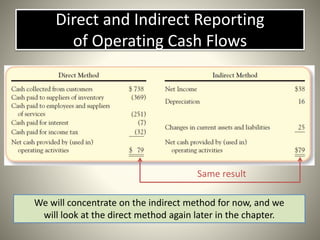
Direct and Indirect Reporting
of Operating Cash Flows
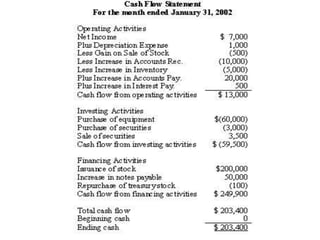
We will concentrate on the indirect method for now, and we
will look at the direct method again later in the chapter.
Same result
 Investing Activities
• Acquiring/disposing of securities that are not cash equivalents
• Cash flows related to the acquisition or sale of non-current assets.
• Lending money/collecting on loans
Examples of Investing Activities
 Cash received from sales of assets that are not held for the regular trading purposes
such as sale of building; marketable securities such as trading and available for sale
securities, and investments
 Cash payments to acquire property, plant, and equipment (PPE), other tangible or
intangible assets, and other long-term assets
 Cash received from sale of, and paid for purchases of derivative instruments
 Loans extended to other companies and collection of such loans
 Financing Activities
• Borrowing from creditors/repaying the principal
• Obtaining resources from owners
• Providing owners with a return on investment
Examples of financing activities
 Cash received from issuing share capital
 Cash proceeds from issuing bonds, loans, notes, mortgages and other
short or long-term borrowings
 Cash payments to shareholders to redeem existing shares- treasury stock
• Cash repayment of loans and other borrowings; and
• Cash payments to shareholders as dividends.
Uses Of cash flow analysis
External Uses
• To assess the ability of a firm to manage cash flows
• To assess the ability of a firm to generate cash through its operations
• To assess the company’s ability to meet its obligations and its
dividend policy
• To provide information about the effectiveness of the firm to convert
its revenues to cash
• To provide information to estimate or anticipate the company’s need
for additional financing
(contd)….
Internal uses
• Along side with cash budget Cash Flow Statement is
used:
– To assess liquidity
• Determine if short-term financing is necessary
– To determine dividend policy
• Decide to distribute; or increase or decrease
– To evaluate the investment and financing decisions
Why cash flow Analysis ???
• Its an important analytical tool for creditors, investors and
other users of financial statement data.
 Firm’s ability to generate cash flows in the future
 Firm’s capacity to meet cash obligations
 Firm’s future external financing needs
 Firm’s success in productively managing investing
activities
 Firm’s effectiveness in implementing financing and
investing strategies
Analysis of Cash Inflows
Generating cash from operations is the preferred
method for obtaining excess cash to finance:
• Capital expenditures and expansion
• Repayment of debt
• Payment of dividends
Analysis of Cash Outflows
When analyzing the cash outflows, the
analyst should consider the necessity of
the outflow and how the outflow was
financed
Generally, it is best to finance short-term
assets with short-term debt and long-term
assets with long-term debt or issuance of
stock
THANK YOU!

Cash flow statement

  • 1.
    CASH FLOW Statementand its ANALYSIS By AsHra ReHmat
  • 2.
    CASH FLOW Statement •Provides information about cash inflows and outflows during an accounting period • Is developed from Balance Sheet and Income Statement data • Important as an analytical tool
  • 3.
    Operations Cash received andpaid for day-to-day activities with customers, suppliers, and employees. Investing Cash paid and received from buying and selling long-term assets. Financing Cash received and paid for exchanges with lenders and stockholders. Business Activities and Cash Flows The Statement of Cash Flows focuses attention on:
  • 4.
     Operating Activities •Cash flows related to selling goods and services; that is, the principle business of the firm. • The cash effects of transactions and other events that enter into the determination of income Examples of Operating Activities • Cash received from customers through sale of goods or services performed; • Cash payments to suppliers or employees • Cash payments for taxes and other expenses
  • 5.
    Direct and IndirectReporting of Operating Cash Flows We will concentrate on the indirect method for now, and we will look at the direct method again later in the chapter. Same result
  • 6.
     Investing Activities •Acquiring/disposing of securities that are not cash equivalents • Cash flows related to the acquisition or sale of non-current assets. • Lending money/collecting on loans Examples of Investing Activities  Cash received from sales of assets that are not held for the regular trading purposes such as sale of building; marketable securities such as trading and available for sale securities, and investments  Cash payments to acquire property, plant, and equipment (PPE), other tangible or intangible assets, and other long-term assets  Cash received from sale of, and paid for purchases of derivative instruments  Loans extended to other companies and collection of such loans
  • 7.
     Financing Activities •Borrowing from creditors/repaying the principal • Obtaining resources from owners • Providing owners with a return on investment Examples of financing activities  Cash received from issuing share capital  Cash proceeds from issuing bonds, loans, notes, mortgages and other short or long-term borrowings  Cash payments to shareholders to redeem existing shares- treasury stock • Cash repayment of loans and other borrowings; and • Cash payments to shareholders as dividends.
  • 9.
    Uses Of cashflow analysis External Uses • To assess the ability of a firm to manage cash flows • To assess the ability of a firm to generate cash through its operations • To assess the company’s ability to meet its obligations and its dividend policy • To provide information about the effectiveness of the firm to convert its revenues to cash • To provide information to estimate or anticipate the company’s need for additional financing
  • 10.
    (contd)…. Internal uses • Alongside with cash budget Cash Flow Statement is used: – To assess liquidity • Determine if short-term financing is necessary – To determine dividend policy • Decide to distribute; or increase or decrease – To evaluate the investment and financing decisions
  • 11.
    Why cash flowAnalysis ??? • Its an important analytical tool for creditors, investors and other users of financial statement data.  Firm’s ability to generate cash flows in the future  Firm’s capacity to meet cash obligations  Firm’s future external financing needs  Firm’s success in productively managing investing activities  Firm’s effectiveness in implementing financing and investing strategies
  • 12.
    Analysis of CashInflows Generating cash from operations is the preferred method for obtaining excess cash to finance: • Capital expenditures and expansion • Repayment of debt • Payment of dividends
  • 13.
    Analysis of CashOutflows When analyzing the cash outflows, the analyst should consider the necessity of the outflow and how the outflow was financed Generally, it is best to finance short-term assets with short-term debt and long-term assets with long-term debt or issuance of stock
  • 14.

Editor's Notes

  • #4 The Statement of Cash Flows shows each major type of business activity that caused a company’s cash to increase or decrease during the accounting period. The major types of business activities are: Operations – The Statement of Cash Flows shows the cash received and paid for day-to-day activities with customers, suppliers, and employees. Investing – The Statement of Cash Flows shows cash paid and received from buying and selling long-term assets. Financing – The Statement of Cash Flows shows cash received and paid for exchanges with lenders and stockholders.
  • #6 Two alternative methods may be used when presenting the operating activities section of the statement of cash flows: The direct method reports the total cash inflow or outflow from each main type of transaction (that is, transactions with customers, suppliers, employees, etc.). The difference between these cash inflows and outflows equals the Net Cash Provided by (Used for) Operating Activities. The indirect method starts with net income from the income statement and adjusts it by eliminating the effects of items that do not involve cash (for example, depreciation) and including items that do have cash effects. Adjusting net income for these items yields the amount of Net Cash Provided by (Used for) Operating Activities. The point to remember about these two methods is that they are simply different ways to arrive at the same number. Net cash flows provided by (used for) operating activities is always the same under the direct and indirect methods. Also, the choice between the two methods affects only the operating activities section of the statement of cash flows, not the investing and financing sections. We will concentrate on the indirect method for now, and we will look at the direct method in a little more detail later in the chapter.