Download the full version and explore a variety of test banks
or solution manuals at https://testbankdeal.com
Financial Statement Analysis 11th Edition
Subramanyam Solutions Manual
_____ Tap the link below to start your download _____
https://testbankdeal.com/product/financial-statement-
analysis-11th-edition-subramanyam-solutions-manual/
Find test banks or solution manuals at testbankdeal.com today!
We believe these products will be a great fit for you. Click
the link to download now, or visit testbankdeal.com
to discover even more!
Financial Statement Analysis 11th Edition Subramanyam Test
Bank
https://testbankdeal.com/product/financial-statement-analysis-11th-
edition-subramanyam-test-bank/
Financial Statement Analysis 10th Edition Subramanyam Test
Bank
https://testbankdeal.com/product/financial-statement-analysis-10th-
edition-subramanyam-test-bank/
Financial Statement Analysis International Edition 13th
Edition Gibson Solutions Manual
https://testbankdeal.com/product/financial-statement-analysis-
international-edition-13th-edition-gibson-solutions-manual/
Andersons Business Law and the Legal Environment Standard
Volume 22nd Edition Twomey Test Bank
https://testbankdeal.com/product/andersons-business-law-and-the-legal-
environment-standard-volume-22nd-edition-twomey-test-bank/
Principles of Environmental Science Inquiry and
Applications 7th Edition Cunningham Test Bank
https://testbankdeal.com/product/principles-of-environmental-science-
inquiry-and-applications-7th-edition-cunningham-test-bank/
Understanding American Government 14th Edition Welch Test
Bank
https://testbankdeal.com/product/understanding-american-
government-14th-edition-welch-test-bank/
Physics for Scientists and Engineers 9th Edition Serway
Solutions Manual
https://testbankdeal.com/product/physics-for-scientists-and-
engineers-9th-edition-serway-solutions-manual/
Business Communication Building Critical Skills 6th
Edition Locker Test Bank
https://testbankdeal.com/product/business-communication-building-
critical-skills-6th-edition-locker-test-bank/
Sexuality Now Embracing Diversity 5th Edition Carroll Test
Bank
https://testbankdeal.com/product/sexuality-now-embracing-
diversity-5th-edition-carroll-test-bank/
Organizational Behavior Key Concepts Skills and Best
Practices 5th Edition Kinicki Solutions Manual
https://testbankdeal.com/product/organizational-behavior-key-concepts-
skills-and-best-practices-5th-edition-kinicki-solutions-manual/
Chapter 07 - Cash Flow Analysis
7-1
Copyright Š 2014 McGraw-Hill Education. All rights reserved. No reproduction or distribution without the prior written consent of McGraw-Hill
Education.
Chapter 7
Cash Flow Analysis
REVIEW
Cash is the residual of cash inflows less cash outflows for all prior periods of a company.
Net cash flows, or simply cash flows, refer to the current period's cash inflows less cash
outflows. Cash flows are different from accrual measures of performance. Cash flow
measures recognize inflows when cash is received not necessarily earned, and outflows
when cash is paid not necessarily incurred. The statement of cash flows reports cash flow
measures for three primary business activities: operating, investing, and financing.
Operating cash flows, or cash flows from operations, is the cash basis counterpart to
accrual net income. Information on cash flows helps us assess a company's ability to meet
obligations, pay dividends, increase capacity, and raise financing. It also helps us assess
the quality of earnings and the dependence of income on estimates and assumptions
regarding future cash flows. This chapter describes cash flows and their relevance to our
analysis of financial statements. We describe current reporting requirements and their
implications for our analysis of cash flows. We explain useful analytical adjustments to cash
flows using financial data to improve our analysis. We direct special attention to transaction
reconstruction, T-account, and conversion analyses.
Chapter 07 - Cash Flow Analysis
7-2
Copyright Š 2014 McGraw-Hill Education. All rights reserved. No reproduction or distribution without the prior written consent of McGraw-Hill
Education.
OUTLINE
• Statement of Cash Flows
Relevance of Cash
Reporting by Activities
Constructing the Cash Flow Statement
Special Topics
• Reporting Cash Flows from Operations
Indirect Method
Direct Method
Converting from Indirect to Direct Method
Adjustments to Cash Flow Components
Additional Disclosures and Adjustments
• Analysis Implications of Cash Flows
Limitations in Cash Flow Reporting
Interpreting Cash Flows and Net Income
Alternative Cash Flow Measures
Company and Economic Conditions
Free Cash Flow
Cash Flows as Validators
• Specialized Cash Flow Ratios
Cash Flow Adequacy Ratio
Cash Reinvestment Ratio
• Appendix 7A Analytical Cash Flow Worksheets
Chapter 07 - Cash Flow Analysis
7-3
Copyright Š 2014 McGraw-Hill Education. All rights reserved. No reproduction or distribution without the prior written consent of McGraw-Hill
Education.
ANALYSIS OBJECTIVES
• Explain the relevance of cash flows in analyzing business activities.
• Describe reporting of cash flows by business activities.
• Describe the preparation and analysis of the statement of cash flows.
• Interpret cash flows from operating activities.
• Analyze cash flows under alternative company and business conditions.
• Describe alternative measures of cash flows and their usefulness.
• Illustrate an analytical tool in evaluating cash flows (Appendix 7A).
Chapter 07 - Cash Flow Analysis
7-4
Copyright Š 2014 McGraw-Hill Education. All rights reserved. No reproduction or distribution without the prior written consent of McGraw-Hill
Education.
QUESTIONS
1. The term cash flow was probably first coined by analysts. They recognized that the
accrual system of income measurement permits the introduction of a variety of
alternative accounting treatments and consequent distortions. The crude concept of
cash flow—net income plus major noncash expenses (such as depreciation)—was
derived to bypass these distortions and bring income measurement closer to the
discipline of actual cash flows. This cash flow measure, still a popular surrogate for cash
from operations (CFO), is crude because it falls short of reliably approximating in most
cases the correct measure of CFO.
Confusion with the term cash flow derives from several sources. One source of
confusion stems from the initial and incorrect computation of the crude measure of cash
flow as income plus major noncash expenses. The figure fails to reflect actual cash
flows. Another and more serious confusion arises from the assertion by some, and
particularly by managers dissatisfied by the level of their reported net income, that cash
flow is a measure of performance superior to or more valid than net income. This
assertion implicitly assumes that depreciation, and other noncash costs, are not genuine
expenses. Experience shows that only net income is properly regarded as a measure of
performance and can be related to the equity investment as an indicator of operating
performance. If we add back depreciation to net income and compute the resulting return
on investment, we are, in effect, confusing the return on investment with an element of
return on investment in fixed assets.
2. While fragmentary information on the sources and uses of cash can be obtained from
comparative balance sheets and from income statements, a comprehensive picture of
this important area of activity can be gained only from a statement of cash flows (SCF).
The SCF provides information to help answer questions such as:
• What amount of cash is generated by operations?
• What utilization is made of cash provided by operations?
• What is the source of cash invested in new plant and equipment?
• What use is made of cash from a new bond issue or the issuance of common stock?
• How is it possible to continue the regular dividend in the face of an operating loss?
• How is debt repayment achieved?
• What is the source of cash used to redeem the preferred stock?
• How is the increase in investments financed?
• Why, despite record profits, is the cash position lower than last year?
3. SFAS 95 requires that the statement of cash flows classify cash receipts and cash
payments by operating, financing and investing activities.
Operating activities encompass all the earning-related activities of the enterprise. They
encompass, in addition to all the income and expense items found on the income
statement, all the net inflows and outflows of cash that operations impose on the
enterprise. Such operations include activities such as the extension of credit to
customers, investment in inventories, and obtaining credit from suppliers. This means
operating activities relate to all items in the statement of income (with minor exceptions)
as well as to balance sheet items that relate to operations mostly working capital
accounts such as accounts receivable, inventories, prepayments, accounts payable, and
Chapter 07 - Cash Flow Analysis
7-5
Copyright Š 2014 McGraw-Hill Education. All rights reserved. No reproduction or distribution without the prior written consent of McGraw-Hill
Education.
accruals. SFAS 95 also specifies that operating activities include all transactions and
events that are not of an investing or financing nature.
Financing activities include obtaining resources from owners and providing them with a
return of or a return on (dividends) their investment. They also include obtaining
resources from creditors and repaying the amounts borrowed or otherwise settling the
obligations.
Investing activities include acquiring and selling or otherwise disposing of both
securities that are not cash equivalents and productive assets that are expected to
generate revenues over the long-term. They also include lending money and collecting
on such loans.
4. We can distinguish among three categories of adjustments that convert accrual basis net
income to cash from operations: (i) Expenses, losses, revenues, and gains that do not
use or generate cash such as those involving noncash accounts (except those in ii), (ii)
Net changes in noncash accounts (mostly in the operating working capital group) that
relate to operations—these modify the accrual-based revenue and expense items
included in income, (iii) Gains and losses (such as on sales of assets) that are
transferred to other sections of the SCF so as to show the entire cash proceeds of the
sale.
5. The two methods of reporting cash flow from operations are:
Indirect Method: Under this method net income is adjusted for noncash items required to
convert it to CFO. The advantage of this method is that it is a reconciliation that
discloses the differences between net income and CFO. Some analysts estimate future
cash flows by first estimating future income levels and then adjusting these for leads
and lags between income and CFO (that is, noncash adjustments).
Direct (or Inflow-Outflow) Method: This method lists the gross cash receipts and
disbursements related to operations. Most respondents to the Exposure Draft that
preceded SFAS 95 preferred this method because this presentation discloses the total
amount of cash that flows into the enterprise and out of the enterprise due to operations.
This gives analysts a better measure of the size of cash inflows and outflows over which
management has some degree of discretion. As the risks that lenders are exposed to
relate more to fluctuations in CFO than to fluctuations in net income, information on the
amounts of operating cash receipts and payments is important in assessing the nature
of those fluctuations.
6. The function of the income statement is to measure the profitability of the enterprise for
a given period. This is done by matching expenses and losses with the revenues and
gains earned. While no other statement measures profitability as well as the income
statement, it does not show the timing of cash flows and the effect of operations on
liquidity and solvency. The latter is reported on by the SCF. Cash from operations (CFO)
reflects a broader concept of operations relative to net income. It encompasses all
earning-related activities of the enterprise. CFO is concerned not only with expenses and
revenues but also with the cash demands of these activities, such as investments in
customer receivables and in inventories as well as the financing provided by suppliers of
goods and services. CFO focuses on the liquidity aspect of operations and is not a
measure of profitability because it does not include important costs such as the use of
long-lived assets in operations or important revenues such as the equity in the earnings
of nonconsolidated subsidiaries or affiliates.
Chapter 07 - Cash Flow Analysis
7-6
Copyright Š 2014 McGraw-Hill Education. All rights reserved. No reproduction or distribution without the prior written consent of McGraw-Hill
Education.
7. The SCF sheds light on (i) the effects of earning activities on cash resources, (ii) what
assets are acquired, and (iii) how assets are financed. It also can highlight more clearly
the distinction between net income and cash provided by operations. The ability of an
enterprise to generate cash from operations on a consistent basis is an important
indicator of financial health. No business can survive over the long run without
generating cash from its operations. However, the interpretation of CFO figures and
trends must be made with care and with a full understanding of all surrounding
circumstances.
Prosperous as well as failing entities can find themselves unable to generate cash from
operations at any given time, but for different reasons. The entity caught in the
"prosperity squeeze" of having to invest its cash in receivables and inventories to meet
ever-increasing customer demand will often find that its profitability will facilitate
financing by equity as well as by debt. That same profitability should ultimately turn CFO
into a positive figure. The unsuccessful firm, on the other hand, will find its cash drained
by slowdowns in receivable and inventory turnovers, by operating losses, or by a
combination of these factors. These conditions usually contain the seeds of further
losses and cash drains and also can lead to difficulties in obtaining trade credit. In such
cases, a lack of CFO has different implications. The unsuccessful or financially pressed
firm can increase its CFO by reducing accounts receivable and inventories, but usually
this is done at the expense of services to customers that can further depress future
profitability. Even if the unsuccessful firm manages to borrow, the costs of borrowing
only magnify the ultimate drains of its cash. Thus, profitability is a key consideration,
and while it does not insure CFO in the short run, it is essential to a healthy financial
condition in the long run.
Changes in operating working capital items must be similarly interpreted in light of
attending circumstances. An increase in receivables can mean expanding consumer
demand for enterprise products or it can mean an inability to collect amounts due in a
timely fashion. Similarly, an increase in inventories (and particularly of the raw material
component) can imply preparations for an increase in production in response to
consumer demand. It also can imply (particularly if the finished goods component of
inventories is increasing) an inability to sell due to, say, when anticipated demand did
not materialize.
8. A valuable analytical derivative of the SCF is "free cash flow." As with any other
analytical measure, analysts must pay careful attention to components of this
computation. Here, as in the case of any cash flow measures, ulterior motives may
sometimes affect the validity of the computation. One of the analytically most useful
computations of free cash flow is:
Cash from Operations (CFO)
- Capital expenditures required to maintain productive capacity used in generating income
- Dividends (on preferred stock and maintenance of desired payout on common stock)
= Free Cash Flow (FCF)
Chapter 07 - Cash Flow Analysis
7-7
Copyright Š 2014 McGraw-Hill Education. All rights reserved. No reproduction or distribution without the prior written consent of McGraw-Hill
Education.
Positive FCF implies that this is the amount available for company purposes after
provisions for financing outlays and expenditures to maintain productive capacity at
current levels. Internal growth and financial flexibility depend on an adequate amount of
FCF. Note that the amount of capital expenditures needed to maintain productive
capacity at current levels is generally not disclosed by companies. It is included in total
capital expenditures, which also can include outlays for expansion of productive
capacity. Breaking down capital expenditures between these two components is difficult.
The FASB considered this issue, but in SFAS 95 it decided not to require classification of
investment expenditures into maintenance and expansion categories.
9. For financial statement analysis, the SCF provides clues to important matters such as:
• Feasibility of financing capital expenditures and possible sources of such financing.
• Sources of cash to finance an expansion in the business.
• Dependence of the firm on external sources of financing (such as debt or equity).
• Future dividend policies.
• Ability to meet future debt service requirements.
• Financial flexibility, that is, the firm's ability to generate sufficient cash so as to
respond to unanticipated needs and opportunities.
• Insight into the financial habits of management and indications of future policies.
• Signals regarding the quality of earnings.
Chapter 07 - Cash Flow Analysis
7-8
Copyright Š 2014 McGraw-Hill Education. All rights reserved. No reproduction or distribution without the prior written consent of McGraw-Hill
Education.
EXERCISES
Exercise 7-1 (20 minutes)
The Year 11 CFO of Campbell is higher (by $403.7 million) than its Year 11 net
income for two main reasons:
1. Some items decreased net income but did not use cash—specifically:
a. Depreciation and amortization are expenses not requiring a cash outlay
($208.6).
b. Deferred income taxes are an expense that has no present cash payment
($35.5).
c. Several charges and expenses did not require outlays of cash ($63.2).
d. A decrease in inventory implies that cost of sales are charged by reducing
inventory levels rather than by making cash payments of $48.7.
2. Some items generated operating cash inflow did not enter into the determination
of net income—specifically:
a. The decrease in accounts receivable means that cash is collected beyond the
amounts recognized as sales revenue in the income statement ($17.1).
b. There are several other items that had a similar effect, amounting to $30.6.
Exercise 7-2 (40 minutes)
a. SFAS 95 requires that the SCF classify cash receipts and payments by operating,
financing, and investing activities.
(1) Operating activities encompass all the earning-related activities of the
enterprise. They encompass, in addition to all the income and expense items
found on the income statement, all the net inflows and outflows of cash that
operations impose on the enterprise. Such operations include activities such as
the extension of credit to customers, investment in inventories, and obtaining
credit from suppliers. This means operating activities relate to all items in the
statement of income (with minor exceptions) as well as to balance sheet items
that relate to operations mostly working capital accounts such as accounts
receivable, inventories, prepayments, accounts payable, and accruals. SFAS 95
also specifies that operating activities include all transactions and events that are
not of an investing or financing nature.
(2) Financing activities include obtaining resources from owners and providing
them with a return of or a return on (dividends) their investment. They also
include obtaining resources from creditors and repaying the amounts borrowed
or otherwise settling the obligations.
(3) Investing activities include acquiring and selling or otherwise disposing of
both securities that are not cash equivalents and productive assets that are
expected to generate revenues over the long-term. They also include lending
money and collecting on such loans.
Chapter 07 - Cash Flow Analysis
7-9
Copyright Š 2014 McGraw-Hill Education. All rights reserved. No reproduction or distribution without the prior written consent of McGraw-Hill
Education.
Exercise 7-2—concluded
b. SFAS 95 requires that all significant financing and investing activities be
disclosed. For example, noncash transactions that include the conversion of debt
to equity, the acquisition of assets through the issuance of debt, and exchanges
of assets or liabilities, should be disclosed in a separate schedule of noncash
investing and financing activities.
c. (1) Net income is the starting point of the computation of CFO. SFAS 95 does not
require the separate disclosure of extraordinary items in the SCF.
(2) Depreciation is added back as an expense not requiring cash.
(3) The write-off of uncollectible receivables does not affect cash. Similarly, the
bad debt expense does not require an outlay of cash. Since this corporation
uses the indirect method for presentation of CFO, no additional adjustment is
needed beyond the adjustment for the change in the net accounts receivable,
which includes the credit to the allowance for doubtful accounts.
(4) The $140,000 increase in accounts receivable means that some sales have not
been collected in cash and, accordingly, net income is reduced by $140,000 in
arriving at CFO. The $60,000 decline in inventories means that cost of goods
sold includes inventories paid for in prior years, and did not require cash this
year. As such, net income is increased by $60,000 in arriving at CFO.
(5) This $380,000 is an expense requiring cash—no adjustment is called for. This
amount also must be disclosed as part of the supplemental disclosures.
(6) A reconstructed analytical entry would appear as:
Cash.............................................. 30,000
Accumulated Depreciation ......... 50,000
PPE.......................................... 75,000
Gain on sale of machine........ 5,000
The $30,000 increase in cash is shown as a source from investing activities.
The $5,000 gain is deducted from (removed from) net income so that the entire
proceeds of the sale are shown as part of investment activities.
(7) Only the cash payment of $100,000 is shown in the SCF as an investing
activity outflow. In a separate schedule, the purchase of buildings and land for
noncash considerations is detailed.
(8) This is a noncash transaction that is disclosed in a separate schedule of
noncash investing and financing activities.
(9) The declaration of a cash dividend creates a current liability. During Year 8, no
cash outflow occurs and there is nothing to report on the Year 8 SCF.
(10)This event has no effect on cash nor need it be reported in conjunction with
the SCF.
Chapter 07 - Cash Flow Analysis
7-10
Copyright Š 2014 McGraw-Hill Education. All rights reserved. No reproduction or distribution without the prior written consent of McGraw-Hill
Education.
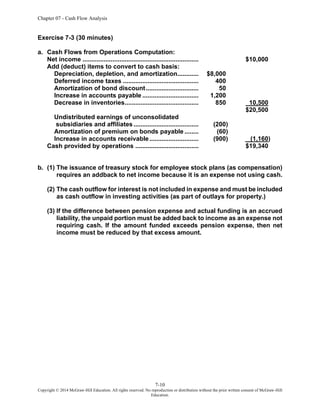
Exercise 7-3 (30 minutes)
a. Cash Flows from Operations Computation:
Net income .................................................................. $10,000
Add (deduct) items to convert to cash basis:
Depreciation, depletion, and amortization............ $8,000
Deferred income taxes ........................................... 400
Amortization of bond discount.............................. 50
Increase in accounts payable ................................ 1,200
Decrease in inventories.......................................... 850 10,500
$20,500
Undistributed earnings of unconsolidated
subsidiaries and affiliates..................................... (200)
Amortization of premium on bonds payable ........ (60)
Increase in accounts receivable............................ (900) (1,160)
Cash provided by operations .................................... $19,340
b. (1) The issuance of treasury stock for employee stock plans (as compensation)
requires an addback to net income because it is an expense not using cash.
(2) The cash outflow for interest is not included in expense and must be included
as cash outflow in investing activities (as part of outlays for property.)
(3) If the difference between pension expense and actual funding is an accrued
liability, the unpaid portion must be added back to income as an expense not
requiring cash. If the amount funded exceeds pension expense, then net
income must be reduced by that excess amount.
Chapter 07 - Cash Flow Analysis
7-11
Copyright Š 2014 McGraw-Hill Education. All rights reserved. No reproduction or distribution without the prior written consent of McGraw-Hill
Education.
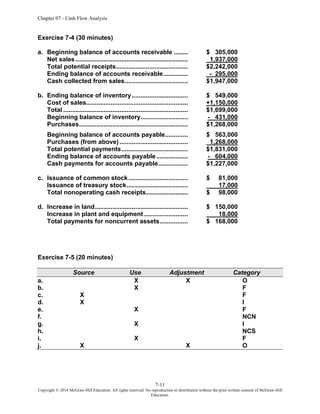
Exercise 7-4 (30 minutes)
a. Beginning balance of accounts receivable ........ $ 305,000
Net sales................................................................ 1,937,000
Total potential receipts......................................... $2,242,000
Ending balance of accounts receivable.............. - 295,000
Cash collected from sales.................................... $1,947,000
b. Ending balance of inventory................................ $ 549,000
Cost of sales.......................................................... +1,150,000
Total ....................................................................... $1,699,000
Beginning balance of inventory........................... - 431,000
Purchases.............................................................. $1,268,000
Beginning balance of accounts payable............. $ 563,000
Purchases (from above)....................................... 1,268,000
Total potential payments...................................... $1,831,000
Ending balance of accounts payable.................. - 604,000
Cash payments for accounts payable................. $1,227,000
c. Issuance of common stock.................................. $ 81,000
Issuance of treasury stock................................... 17,000
Total nonoperating cash receipts........................ $ 98,000
d. Increase in land..................................................... $ 150,000
Increase in plant and equipment ......................... 18,000
Total payments for noncurrent assets................ $ 168,000
Exercise 7-5 (20 minutes)
Source Use Adjustment Category
a. X X O
b. X F
c. X F
d. X I
e. X F
f. NCN
g. X I
h. NCS
i. X F
j. X X O
Chapter 07 - Cash Flow Analysis
7-12
Copyright Š 2014 McGraw-Hill Education. All rights reserved. No reproduction or distribution without the prior written consent of McGraw-Hill
Education.
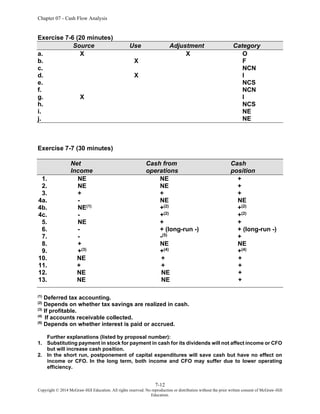
Exercise 7-6 (20 minutes)
Source Use Adjustment Category
a. X X O
b. X F
c. NCN
d. X I
e. NCS
f. NCN
g. X I
h. NCS
i. NE
j. NE
Exercise 7-7 (30 minutes)
Net Cash from Cash
Income operations position
1. NE NE +
2. NE NE +
3. + + +
4a. - NE NE
4b. NE(1) +(2) +(2)
4c. - +(2)
+(2)
5. NE + +
6. - + (long-run -) + (long-run -)
7. - -(5) +
8. + NE NE
9. +(3)
+(4)
+(4)
10. NE + +
11. + + +
12. NE NE +
13. NE NE +
(1)
Deferred tax accounting.
(2)
Depends on whether tax savings are realized in cash.
(3)
If profitable.
(4)
If accounts receivable collected.
(5)
Depends on whether interest is paid or accrued.
Further explanations (listed by proposal number):
1. Substituting payment in stock for payment in cash for its dividends will not affect income or CFO
but will increase cash position.
2. In the short run, postponement of capital expenditures will save cash but have no effect on
income or CFO. In the long term, both income and CFO may suffer due to lower operating
efficiency.
Chapter 07 - Cash Flow Analysis
7-13
Copyright Š 2014 McGraw-Hill Education. All rights reserved. No reproduction or distribution without the prior written consent of McGraw-Hill
Education.
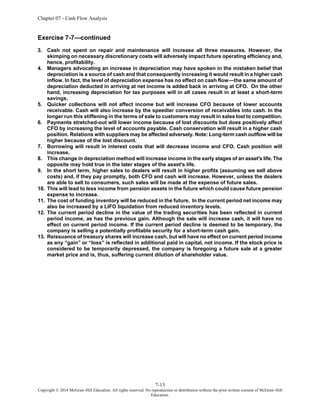
Exercise 7-7—continued
3. Cash not spent on repair and maintenance will increase all three measures. However, the
skimping on necessary discretionary costs will adversely impact future operating efficiency and,
hence, profitability.
4. Managers advocating an increase in depreciation may have spoken in the mistaken belief that
depreciation is a source of cash and that consequently increasing it would result in a higher cash
inflow. In fact, the level of depreciation expense has no effect on cash flow—the same amount of
depreciation deducted in arriving at net income is added back in arriving at CFO. On the other
hand, increasing depreciation for tax purposes will in all cases result in at least a short-term
savings.
5. Quicker collections will not affect income but will increase CFO because of lower accounts
receivable. Cash will also increase by the speedier conversion of receivables into cash. In the
longer run this stiffening in the terms of sale to customers may result in sales lost to competition.
6. Payments stretched-out will lower income because of lost discounts but does positively affect
CFO by increasing the level of accounts payable. Cash conservation will result in a higher cash
position. Relations with suppliers may be affected adversely. Note: Long-term cash outflow will be
higher because of the lost discount.
7. Borrowing will result in interest costs that will decrease income and CFO. Cash position will
increase.
8. This change in depreciation method will increase income in the early stages of an asset's life. The
opposite may hold true in the later stages of the asset's life.
9. In the short term, higher sales to dealers will result in higher profits (assuming we sell above
costs) and, if they pay promptly, both CFO and cash will increase. However, unless the dealers
are able to sell to consumers, such sales will be made at the expense of future sales.
10. This will lead to less income from pension assets in the future which could cause future pension
expense to increase.
11. The cost of funding inventory will be reduced in the future. In the current period net income may
also be increased by a LIFO liquidation from reduced inventory levels.
12. The current period decline in the value of the trading securities has been reflected in current
period income, as has the previous gain. Although the sale will increase cash, it will have no
effect on current period income. If the current period decline is deemed to be temporary, the
company is selling a potentially profitable security for a short-term cash gain.
13. Reissuance of treasury shares will increase cash, but will have no effect on current period income
as any “gain” or “loss” is reflected in additional paid in capital, not income. If the stock price is
considered to be temporarily depressed, the company is foregoing a future sale at a greater
market price and is, thus, suffering current dilution of shareholder value.
Chapter 07 - Cash Flow Analysis
7-14
Copyright Š 2014 McGraw-Hill Education. All rights reserved. No reproduction or distribution without the prior written consent of McGraw-Hill
Education.
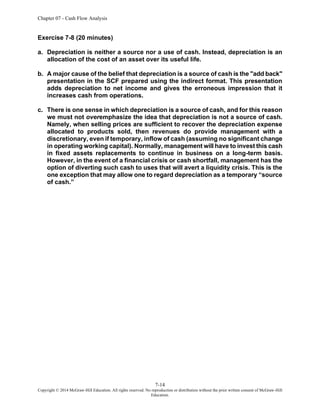
Exercise 7-8 (20 minutes)
a. Depreciation is neither a source nor a use of cash. Instead, depreciation is an
allocation of the cost of an asset over its useful life.
b. A major cause of the belief that depreciation is a source of cash is the "add back"
presentation in the SCF prepared using the indirect format. This presentation
adds depreciation to net income and gives the erroneous impression that it
increases cash from operations.
c. There is one sense in which depreciation is a source of cash, and for this reason
we must not overemphasize the idea that depreciation is not a source of cash.
Namely, when selling prices are sufficient to recover the depreciation expense
allocated to products sold, then revenues do provide management with a
discretionary, even if temporary, inflow of cash (assuming no significant change
in operating working capital). Normally, management will have to invest this cash
in fixed assets replacements to continue in business on a long-term basis.
However, in the event of a financial crisis or cash shortfall, management has the
option of diverting such cash to uses that will avert a liquidity crisis. This is the
one exception that may allow one to regard depreciation as a temporary “source
of cash.”
Chapter 07 - Cash Flow Analysis
7-15
Copyright Š 2014 McGraw-Hill Education. All rights reserved. No reproduction or distribution without the prior written consent of McGraw-Hill
Education.
Exercise 7-9 (60 minutes)
a. Cash Collections Computation:
Accounts Receivable (Net)
Beg [a] 564.1
Sales [13] 6205.8 6145.4 Cash collections [b]
End [33] 624.5
Notes:
[a] Balance at 7/29/Year 10............................................ $624.5 [33]
Less: increase in Year 10......................................... (60.4) [61]
$564.1
[b]This amount is overstated by the provision for doubtful accounts expense that is included in
another expense category.
b. Cash Dividends Paid Computation:
Dividends Payable
Dividend paid [77] 137.5 32.3 Beg [43]
142.2 Dividend declared [a] [89]
37.0 End [43]
Note [a]: Item [89] represents dividends declared, not dividends paid (see also Item [77]).
c. Cost of Goods and Services Produced Computation:
Inventories
Beg [34] 819.8
Amount to balance 3982.4
4095.5 Cost of products sold [14]
End [34] 706.7
d. The entry for the income tax provision for Year 11 is:
Income tax expense [27] ...................................... 265.9
Deferred income tax (current) plug.................. 12.1
Income tax payable............................................. 230.4
Deferred income tax (noncurrent) [a] ............... 23.4
Notes:
(1) The entry increases current liabilities by $12.1 since deferred income tax (current) is credited
by this amount. It also increases current liabilities by $230.4 [124A], the amount of income taxes
payable.
(2) The [a] is the difference in the balance of the noncurrent deferred income tax item [176] =
$258.5 - $235.1 = $23.4.
(3) Also, $23.4 + $12.1 = $35.5, which is total deferred tax [59] or [127A]
Chapter 07 - Cash Flow Analysis
7-16
Copyright Š 2014 McGraw-Hill Education. All rights reserved. No reproduction or distribution without the prior written consent of McGraw-Hill
Education.
Exercise 7-9—continued
e. Depreciation expense has no effect on cash from operations. The credit, when
recording the depreciation expense, goes to accumulated depreciation, a
noncash account.
f. These provisions are added back because they affect only noncash accounts, the
charge to earnings must be removed in converting it to the cash basis.
g. The “Effect of exchange rate changes on cash” represents translation
adjustments (differences) arising from the translation of cash from foreign
currencies to the U.S. dollar.
h. Any gain or loss is reported under "other, net"—Item [60].
i. Free cash flows =
Cash flow from operations – Cash used for capital additions – Dividends paid
Year 11: $805.2 – $361.1 – $137.5 = $306.6
Year 10: $448.4 – $387.6 – $124.3 = $(63.5)
Year 9: $357.3 – $284.1 – $86.7 = $(13.5)
j. Start-up companies usually have greater capital addition requirements and lower
cash inflows from operations. Also, start-ups rarely pay cash dividends. Free
cash flow earned by start-up companies is usually used to fund the growth of the
company, especially if successful.
k. During the launch of a new product line, the statement of cash flows can be
affected in several ways. First, cash flow from operations is lower because
substantial advertising and promotion is required and sales growth has not yet
been maximized. Second, substantial capital additions are usually necessary to
provide the infrastructure for the new product line. Third, cash flow from
financing can be affected if financing is obtained to launch this new product line.
Chapter 07 - Cash Flow Analysis
7-17
Copyright Š 2014 McGraw-Hill Education. All rights reserved. No reproduction or distribution without the prior written consent of McGraw-Hill
Education.
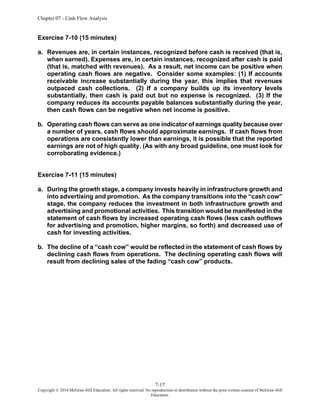
Exercise 7-10 (15 minutes)
a. Revenues are, in certain instances, recognized before cash is received (that is,
when earned). Expenses are, in certain instances, recognized after cash is paid
(that is, matched with revenues). As a result, net income can be positive when
operating cash flows are negative. Consider some examples: (1) If accounts
receivable increase substantially during the year, this implies that revenues
outpaced cash collections. (2) If a company builds up its inventory levels
substantially, then cash is paid out but no expense is recognized. (3) If the
company reduces its accounts payable balances substantially during the year,
then cash flows can be negative when net income is positive.
b. Operating cash flows can serve as one indicator of earnings quality because over
a number of years, cash flows should approximate earnings. If cash flows from
operations are consistently lower than earnings, it is possible that the reported
earnings are not of high quality. (As with any broad guideline, one must look for
corroborating evidence.)
Exercise 7-11 (15 minutes)
a. During the growth stage, a company invests heavily in infrastructure growth and
into advertising and promotion. As the company transitions into the “cash cow”
stage, the company reduces the investment in both infrastructure growth and
advertising and promotional activities. This transition would be manifested in the
statement of cash flows by increased operating cash flows (less cash outflows
for advertising and promotion, higher margins, so forth) and decreased use of
cash for investing activities.
b. The decline of a “cash cow” would be reflected in the statement of cash flows by
declining cash flows from operations. The declining operating cash flows will
result from declining sales of the fading “cash cow” products.
Chapter 07 - Cash Flow Analysis
7-18
Copyright Š 2014 McGraw-Hill Education. All rights reserved. No reproduction or distribution without the prior written consent of McGraw-Hill
Education.
PROBLEMS
Problem 7-1 (60 minutes)
WORKSHEET TO COMPUTE CASH FLOW FROM OPERATIONS (IN MILLIONS)
DIRECT (INFLOW-OUTFLOW) PRESENTATION
CAMPBELL SOUP — YEAR ENDED JULY 28, YEAR 11
Ref. Reported Adjust. Revised
Cash Receipts from Operations
Net Sales ........................................................... 13 $6,204.1 $7.5 $6,211.6
Other revenue and income ............................. 19 26.0 C 26.0
(I) D in current receivables ............................. 61 17.1 C 17.1
(I) D in noncurrent receivables.......................
= CASH COLLECTIONS................................. $6,247.2 $7.5 $6,254.7
Cash Disbursements for Operations
Total expenses (include min. int. & taxes) a
$5,831.0 $7.5 $5,838.5
Less: Expenses & losses not using cash:
- Depreciation and amortization..................... 57 (208.6) (208.6)
- Noncurrent deferred income taxes.............. 59 (35.5) (35.5)
- Other, net........................................................ 60 (63.2) (63.2)
Change in Current Assets and Liabilities
related to Operations
I (D) in inventories ......................................... 62 $ (48.7) $ (48.7)
I (D) in prepaid expenses .............................. 35 (25.3) (25.3)
(I) D in accounts payable .............................. 41 42.8 42.8
(I) D in taxes payable ..................................... 44 (21.3) (21.3)
(I) D in accruals, payrolls, etc. b
................... 175 (26.8) (26.8)
I or D in noncurrent accounts c
.................... 5.8 0.0 5.8
= CASH DISBURSEMENTS ............................. $5,450.2 $7.5 $5,457.7
Dividends Received
Equity in income of
unconsolidated affiliates............................... 24 2.4 2.4
Distributions beyond equity
in income of affiliates c
.................................. 5.8 0.0 5.8
= Dividends from unconsol. affiliates ........... 169A $ 8.2 $0.0 $ 8.2
CASH FLOW FROM OPERATIONS ............... $ 805.2 $0.0 $ 805.2
a
Total costs and expenses [22A] + Taxes on earnings [27] + Minority interests [25] +
Interest income [19] = $5,531.9 + $265.9 + $7.2 + $26.0 = $5,831
b
It is assumed that accruals, payrolls, etc., are part of item [175].
c
A reconciling amount to tie in with the $8.2 dividends from affiliates (item 169A) versus
equity in earnings of affiliates (item 24).
Chapter 07 - Cash Flow Analysis
7-19
Copyright Š 2014 McGraw-Hill Education. All rights reserved. No reproduction or distribution without the prior written consent of McGraw-Hill
Education.
Problem 7-2 (75 minutes)
a.
WORKSHEET TO COMPUTE CASH FLOW FROM OPERATIONS (IN MILLIONS)
DIRECT (INFLOW-OUTFLOW) PRESENTATION
CAMPBELL SOUP YEAR ENDED JULY 29, YEAR 10
Ref. Reported Adjust. Revised
Cash Receipts from Operations
Net Sales ........................................................... 13 $6,205.8 $7.5 $6,213.3
Other revenue and income:
(I) D in current receivables ............................. 61 (60.4) (60.4)
(I) D in noncurrent receivables
Effect of translation adjustments ............... 0.0 0.0 0.0
= Cash Collections........................................... $6,145.4 $7.5 $6,152.9
Cash Disbursements for Operations
Total expenses (include interest &
taxes) [22A] + [27] + [25] ............................... $6,214.9 $7.5 $6,222.4
Less: Expenses & Losses not using cash
- Depreciation & amortization......................... 57 (200.9) (200.9)
- Noncurrent deferred income taxes.............. 59 (3.9) (3.9)
- Other provision for restructuring
and writedowns.............................................. 58 (339.1) (339.1)
- Other * ............................................................. 60 (24.7) (24.7)
- Other
Changes in Current Assets and Liabilities
related to operations
I (D) in inventories ......................................... 62 (10.7) (10.7)
I (D) in prepaid expense ................................
(I) D in accounts payable ..............................
(I) D in taxes payable .....................................
(I) D in accruals, payrolls, etc.......................
(I) D in dividends payable .............................
I or D other ** .................................................. 63 68.8 68.8
I or D in noncurrent amounts ....................... 0.0 0.0 0.0
= Cash Disbursements............................. $5,704.4 $7.5 $5,711.9
Dividends Received
Equity in income of unconsolidated
affiliates........................................................... 24 13.5 13.5
- Undistributed equity in income of
affiliates........................................................... 169A (6.1) 0.0 (6.1)
= Dividends from unconsol. affils.................. 7.4 7.4
Cash Flow From Operations........................... $ 448.4 $ 448.4
*
Other, net [60] $18.6 + [169A] $6.1 = $24.7
**
Campbell shows a combined figure instead of details of operating assets and liabilities.
Chapter 07 - Cash Flow Analysis
7-20
Copyright Š 2014 McGraw-Hill Education. All rights reserved. No reproduction or distribution without the prior written consent of McGraw-Hill
Education.
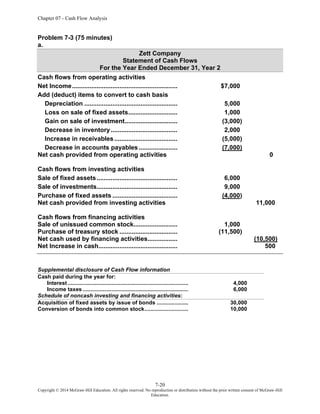
Problem 7-3 (75 minutes)
a.
Zett Company
Statement of Cash Flows
For the Year Ended December 31, Year 2
Cash flows from operating activities
Net Income............................................................ $7,000
Add (deduct) items to convert to cash basis
Depreciation ..................................................... 5,000
Loss on sale of fixed assets............................ 1,000
Gain on sale of investment.............................. (3,000)
Decrease in inventory...................................... 2,000
Increase in receivables.................................... (5,000)
Decrease in accounts payables ...................... (7,000)
Net cash provided from operating activities 0
Cash flows from investing activities
Sale of fixed assets.............................................. 6,000
Sale of investments.............................................. 9,000
Purchase of fixed assets ..................................... (4,000)
Net cash provided from investing activities 11,000
Cash flows from financing activities
Sale of unissued common stock......................... 1,000
Purchase of treasury stock ................................. (11,500)
Net cash used by financing activities................. (10,500)
Net Increase in cash............................................. 500
Supplemental disclosure of Cash Flow information
Cash paid during the year for:
Interest ................................................................................ 4,000
Income taxes ...................................................................... 6,000
Schedule of noncash investing and financing activities:
Acquisition of fixed assets by issue of bonds ..................... 30,000
Conversion of bonds into common stock............................. 10,000
Chapter 07 - Cash Flow Analysis
7-21
Copyright Š 2014 McGraw-Hill Education. All rights reserved. No reproduction or distribution without the prior written consent of McGraw-Hill
Education.
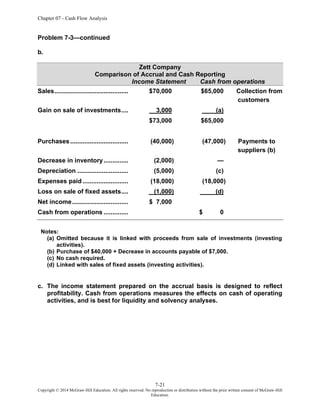
Problem 7-3—continued
b.
Zett Company
Comparison of Accrual and Cash Reporting
Income Statement Cash from operations
Sales.......................................... $70,000 $65,000 Collection from
customers
Gain on sale of investments.... 3,000 (a)
$73,000 $65,000
Purchases................................. (40,000) (47,000) Payments to
suppliers (b)
Decrease in inventory.............. (2,000) —
Depreciation ............................. (5,000) (c)
Expenses paid .......................... (18,000) (18,000)
Loss on sale of fixed assets.... (1,000) (d)
Net income................................ $ 7,000
Cash from operations .............. $ 0
Notes:
(a) Omitted because it is linked with proceeds from sale of investments (investing
activities).
(b) Purchase of $40,000 + Decrease in accounts payable of $7,000.
(c) No cash required.
(d) Linked with sales of fixed assets (investing activities).
c. The income statement prepared on the accrual basis is designed to reflect
profitability. Cash from operations measures the effects on cash of operating
activities, and is best for liquidity and solvency analyses.
Chapter 07 - Cash Flow Analysis
7-22
Copyright Š 2014 McGraw-Hill Education. All rights reserved. No reproduction or distribution without the prior written consent of McGraw-Hill
Education.
Problem 7-4 (75 minutes)
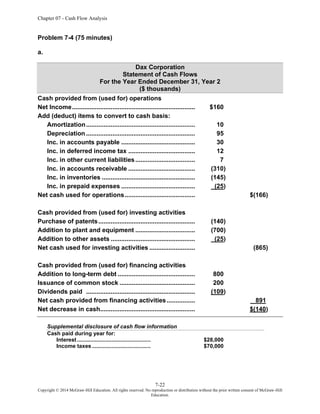
a.
Dax Corporation
Statement of Cash Flows
For the Year Ended December 31, Year 2
($ thousands)
Cash provided from (used for) operations
Net Income...................................................................... $160
Add (deduct) items to convert to cash basis:
Amortization.............................................................. 10
Depreciation .............................................................. 95
Inc. in accounts payable .......................................... 30
Inc. in deferred income tax ...................................... 12
Inc. in other current liabilities.................................. 7
Inc. in accounts receivable ...................................... (310)
Inc. in inventories ..................................................... (145)
Inc. in prepaid expenses .......................................... (25)
Net cash used for operations........................................ $(166)
Cash provided from (used for) investing activities
Purchase of patents....................................................... (140)
Addition to plant and equipment .................................. (700)
Addition to other assets ................................................ (25)
Net cash used for investing activities .......................... (865)
Cash provided from (used for) financing activities
Addition to long-term debt ............................................ 800
Issuance of common stock ........................................... 200
Dividends paid .............................................................. (109)
Net cash provided from financing activities ................ 891
Net decrease in cash...................................................... $(140)
Supplemental disclosure of cash flow information
Cash paid during year for:
Interest................................................. $28,000
Income taxes....................................... $70,000
Chapter 07 - Cash Flow Analysis
7-23
Copyright Š 2014 McGraw-Hill Education. All rights reserved. No reproduction or distribution without the prior written consent of McGraw-Hill
Education.
Problem 7-4—continued
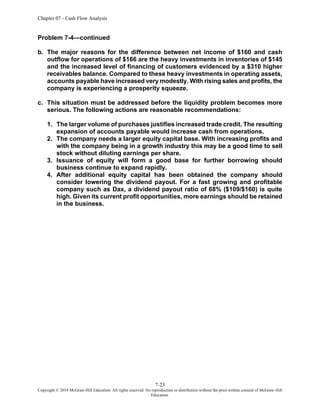
b. The major reasons for the difference between net income of $160 and cash
outflow for operations of $166 are the heavy investments in inventories of $145
and the increased level of financing of customers evidenced by a $310 higher
receivables balance. Compared to these heavy investments in operating assets,
accounts payable have increased very modestly. With rising sales and profits, the
company is experiencing a prosperity squeeze.
c. This situation must be addressed before the liquidity problem becomes more
serious. The following actions are reasonable recommendations:
1. The larger volume of purchases justifies increased trade credit. The resulting
expansion of accounts payable would increase cash from operations.
2. The company needs a larger equity capital base. With increasing profits and
with the company being in a growth industry this may be a good time to sell
stock without diluting earnings per share.
3. Issuance of equity will form a good base for further borrowing should
business continue to expand rapidly.
4. After additional equity capital has been obtained the company should
consider lowering the dividend payout. For a fast growing and profitable
company such as Dax, a dividend payout ratio of 68% ($109/$160) is quite
high. Given its current profit opportunities, more earnings should be retained
in the business.
Chapter 07 - Cash Flow Analysis
7-24
Copyright Š 2014 McGraw-Hill Education. All rights reserved. No reproduction or distribution without the prior written consent of McGraw-Hill
Education.
Problem 7-5 (40 minutes)
Niagara Company
Statement of Cash Flows
For Year Ended December 31, Year 9
Cash flows from operating activities
Cash receipts from operations
Sales [a]................................................................... $980
Cash payments for operations
Purchases of inventory [b]..................................... (645)
Selling and general expenses ............................... (100)
Interest expense [c] ................................................ (40)
Income tax expense [d] .......................................... (30)
Cash flows from operations ........................................ $165
Cash flows from investing activities
Purchase of fixed assets........................................ (150)
Cash flows from financing activities
Repayment of notes payable ................................. (25)
Issuance of long-term debt .................................... 50
Cash dividends paid............................................... (30)
Cash flows used in financing...................................... (5)
Net increase in cash..................................................... $ 10
Beginning cash balance .............................................. 50
Ending cash balance.................................................... $ 60
Notes:
[a] Sales ................................................................................ $1,000
Less increase in receivables......................................... (20)
Cash collections ............................................................. $980
[b] Cost of goods sold ......................................................... $ (650)
Add increase in inventories........................................... (20)
Less increase in payables ............................................. 25
(645)
[c] Interest expense ............................................................. $ (50)
Less increase in interest payable ................................. 10
(40)
[d] Income tax expense ....................................................... $ (40)
Less increase in deferred income tax .......................... 10
(30)
Note: Purchase of fixed assets is computed from depreciation expense plus change in fixed
assets ($100+$50). Dividends paid is computed from net income and change in retained earnings
($60-$30).
Supporting schedule for CFO:
Net income ..................................................................................................... $ 60
Add depreciation ........................................................................................... 100
Increase in deferred tax ................................................................................ 10
Increase in receivables ................................................................................. (20)
Increase in inventory..................................................................................... (20)
Increase in accounts payable....................................................................... 25
Increase in interest payable ......................................................................... 10
Cash flows from operations ......................................................................... $165
Chapter 07 - Cash Flow Analysis
7-25
Copyright Š 2014 McGraw-Hill Education. All rights reserved. No reproduction or distribution without the prior written consent of McGraw-Hill
Education.
Problem 7-6 (35 minutes)
Effects Analytical Entries (Optional)
a. [-Y, 11,000] Bad Debt Expense ........................ 11,000
[CC, 11,000] Allowance for Bad Debt ......... 11,000
b. [-Y, 16,000] Depreciation .................................. 16,000
[YA, 16,000] Accumulated Depreciation .... 16,000
c. [NAA, 100,000] Building ......................................... 100,000
[NDE, 100,000] Long-Term Note Payable ....... 100,000
d. None
e. None
f. [+C, 10,000] Cash............................................... 10,000
[-Y, 2,000] Loss ............................................... 2,000
[CC, 12,000] Inventory ................................. 12,000
g. [+C, 35,000] Cash............................................... 35,000
[DC, 5,000] Accounts Receivable.................... 5,000
[CC, 25,000] Inventory ................................. 25,000
[+Y, 15,000] Gain.......................................... 15,000
h. [CC, 3,000] Allowance...................................... 5,000
[-Y, 3,000] Bad Debt Expense ........................ 3,000
Accounts Receivable.............. 8,000
i. [AA, 100,000] Assets............................................ 100,000
[-C, 100,000] Cash......................................... 100,000
[-Y, 20,000] Depreciation expense................... 20,000
[YA, 20,000] Accumulated Depreciation .... 20,000
j. [+C, 8,000] Cash............................................... 8,000
[AD, 8,000] Loss on Sale.................................. 1,000
[YA, 1,000] Machinery (net) ....................... 9,000
[-Y, 1,000]
Chapter 07 - Cash Flow Analysis
7-26
Copyright Š 2014 McGraw-Hill Education. All rights reserved. No reproduction or distribution without the prior written consent of McGraw-Hill
Education.
Problem 7-7 (60 minutes)
Part I.
Effects Analytical Entries (Optional)
a. [DL, 100,000] Current Portion of L-T Debt.......... 100,000
[-C, 100,000] Cash......................................... 100,000
b. [+C, 4,000] Cash............................................... 4,000
[AD, 4,000] Loss ............................................... 1,000
[YA, 1,000] Equipment ............................... 5,000
[-Y, 1,000]
c. [-Y, 75,000] Loss ............................................... 75,000
[CC, 75,000] Inventory ................................. 75,000
d. [+C, 28,000] Cash............................................... 28,000
[DE, 28,000] Paid-In Capital............................... 2,000
Treasury stock ........................ 30,000
e. [NAA, 300,000] Plant Assets .................................. 300,000
[NDE, 300,000] Mortgage Payable................... 250,000
Mortgage Payable—Current... 50,000
f. [+C, 6,000] Investment..................................... 30,000
[+Y, 30,000] Equity in NI of Subsidiary ...... 30,000
[YS, 24,000] Cash............................................... 6,000
Investment 6,000
g. [+C, 10,000] Cash............................................... 10,000
[+Y, 40,000] Accounts Receivable, current...... 10,000
[DC, 10,000] Accounts Receivable, noncurrent 20,000
[NC, 20,000] Sales ........................................ 40,000
h. [DC, 9,000] Inventory........................................ 9,000
[+Y, 9,000] Cost of Goods Sold ................ 9,000
i. [DC, 260,000] Current Assets .............................. 260,000
[CC, 160,000] Plant and Equipment .................... 670,000
[DE, 410,000] Current Liabilities. .................. 160,000
[-C, 360,000] Long-Term Debt...................... 410,000
Cash ($400-$40) ...................... 360,000
j. [-Y, 60,000] Expense......................................... 60,000
[CC, 60,000] Allowance for doubtful accounts 60,000
Chapter 07 - Cash Flow Analysis
7-27
Copyright Š 2014 McGraw-Hill Education. All rights reserved. No reproduction or distribution without the prior written consent of McGraw-Hill
Education.
Problem 7-7—continued
Part II.
Effects Analytical Entries (Optional)
a. [AA, 120,000] Investment..................................... 120,000
[-C, 120,000] Cash......................................... 120,000
b. [YS, 7,500] Investment..................................... 7,500
[+Y, 7,500] Equity in Earnings .................. 7,500
c. [+C, 3,000] Investment..................................... 9,000
[+Y, 9,000] Equity in Earnings…………….. 9,000
[YS, 6,000] Cash............................................... 3,000
Investment............................... 3,000
d. [+C, 4,000] Cash............................................... 4,000
[AD, 4,000] Equipment (net) ...................... 3,000
[YS, 1,000] Gain on Sale ........................... 1,000
[+Y, 1,000]
e. [+C, 60,000] Cash............................................... 60,000
[IL, 60,000] Note Payable (current) ........... 60,000
f. [NDR, 9,000] Bonds Payable .............................. 9,000
[NDE, 9,000] Common stock........................ 2,000
Paid-In Capital......................... 7,000
g. [+C, 6,000] Cash............................................... 6,000
[DE, 6,000] Treasury stock ........................ 4,000
Paid-In Capital......................... 2,000
h1.[AA, 200,000] Investment..................................... 200,000
[DE, 100,000] Common stock........................ 100,000
[-C, 100,000] Cash......................................... 100,000
h2.[DC, 80,000] Current Assets ($120-$40)............ 80,000
[AA, 180,000] Plant and Equipment .................... 180,000
[DE, 140,000] Current Liabilities ................... 60,000
[-C, 60,000] Long-Term Debt...................... 40,000
Common stock........................ 100,000
Cash ($100-$40) ...................... 60,000
i. [-Y, 4,000] Minority Interest Expense ............ 4,000
[YA, 4,000] Minority Interest...................... 4,000
Chapter 07 - Cash Flow Analysis
7-28
Copyright Š 2014 McGraw-Hill Education. All rights reserved. No reproduction or distribution without the prior written consent of McGraw-Hill
Education.
Problem 7-7—continued
Part II.
Effects Analytical Entries (Optional)
j. [-Y, 50,000] Inventory Loss .............................. 50,000
[CC, 50,000] Inventory ................................. 50,000
k. None Allow. for doubtful accounts........ 1,200
Accounts receivable 1,200
l. [NAA, 120,000] Leased Equipment........................ 120,000
[NDE, 120,000] Long-Term debt ...................... 120,000
m. None Retained Earnings ........................ 180,000
Common stock ....................... 120,000
Paid-in Capital......................... 60,000
n. [-Y, 27,000] Bad Debts Expense ...................... 27,000
[CC, 27,000] Allow for Doubtful Accounts . 27,000
Chapter 07 - Cash Flow Analysis
7-29
Copyright Š 2014 McGraw-Hill Education. All rights reserved. No reproduction or distribution without the prior written consent of McGraw-Hill
Education.
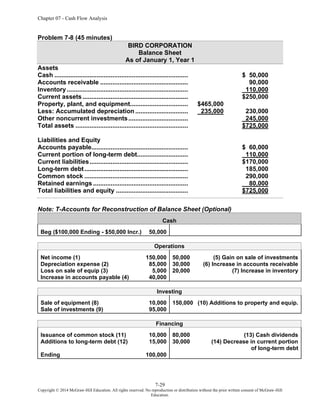
Problem 7-8 (45 minutes)
BIRD CORPORATION
Balance Sheet
As of January 1, Year 1
Assets
Cash ............................................................................ $ 50,000
Accounts receivable .................................................. 90,000
Inventory..................................................................... 110,000
Current assets ............................................................ $250,000
Property, plant, and equipment................................. $465,000
Less: Accumulated depreciation .............................. 235,000 230,000
Other noncurrent investments.................................. 245,000
Total assets ................................................................ $725,000
Liabilities and Equity
Accounts payable....................................................... $ 60,000
Current portion of long-term debt............................. 110,000
Current liabilities........................................................ $170,000
Long-term debt........................................................... 185,000
Common stock ........................................................... 290,000
Retained earnings ...................................................... 80,000
Total liabilities and equity ......................................... $725,000
Note: T-Accounts for Reconstruction of Balance Sheet (Optional)
Cash
Beg ($100,000 Ending - $50,000 Incr.) 50,000
Operations
Net income (1) 150,000
Depreciation expense (2) 85,000
Loss on sale of equip (3) 5,000
Increase in accounts payable (4) 40,000
50,000 (5) Gain on sale of investments
30,000 (6) Increase in accounts receivable
20,000 (7) Increase in inventory
Investing
Sale of equipment (8) 10,000
Sale of investments (9) 95,000
150,000 (10) Additions to property and equip.
Financing
Issuance of common stock (11) 10,000
Additions to long-term debt (12) 15,000
Ending 100,000
80,000 (13) Cash dividends
30,000 (14) Decrease in current portion
of long-term debt
Chapter 07 - Cash Flow Analysis
7-30
Copyright Š 2014 McGraw-Hill Education. All rights reserved. No reproduction or distribution without the prior written consent of McGraw-Hill
Education.
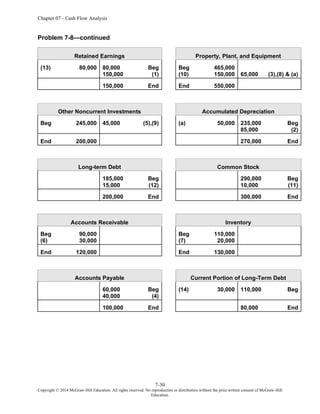
Problem 7-8—continued
Retained Earnings Property, Plant, and Equipment
(13) 80,000 80,000 Beg
150,000 (1)
Beg 465,000
(10) 150,000 65,000 (3),(8) & (a)
150,000 End End 550,000
Other Noncurrent Investments Accumulated Depreciation
Beg 245,000 45,000 (5),(9) (a) 50,000 235,000 Beg
85,000 (2)
End 200,000 270,000 End
Long-term Debt Common Stock
185,000 Beg
15,000 (12)
290,000 Beg
10,000 (11)
200,000 End 300,000 End
Accounts Receivable Inventory
Beg 90,000
(6) 30,000
Beg 110,000
(7) 20,000
End 120,000 End 130,000
Accounts Payable Current Portion of Long-Term Debt
60,000 Beg
40,000 (4)
(14) 30,000 110,000 Beg
100,000 End 80,000 End
Other documents randomly have
different content
112
[that both the light and dark markings are of planetary scale]
suggests that they must be related.”
Ed Stone speculated about the other two Galilean satellites.
Ganymede and Callisto are essentially identical in size, mass, and
probably composition. By examining them, we can perhaps learn
what happens when bodies with very similar chemistry have different
“life histories” and different surface properties (there are indications
that Ganymede’s crust may not have been as rigid as Callisto’s).
Going further, he added that Callisto and Mercury, the least dense
and the most dense, respectively, of the terrestrial-style planets,
although totally different in composition and density, seem to have
similar surfaces and similar histories. What would have happened to
Mercury if it had been made of ice, water, and rock as Callisto is?
Would it have evolved as Callisto did?
One of the most spectacular of the Voyager 2 images was obtained from
inside the shadow of Jupiter. Looking back toward the planet and the
rings with its wide-angle camera, the spacecraft took these photos on
July 10 from a distance of 1.5 million kilometers. The ribbon-like nature
of the rings is clearly shown. The planet is outlined by sunlight scattered
from a haze layer high in the atmosphere. On each side, the arms of the
ring curving back toward the spacecraft are cut off by the planet’s
shadow as they approach the brightly outlined disk. [P-21774B/W]
The rings of Jupiter proved to be unexpectedly bright when seen with the
Sun nearly behind them. Strong forward scattering of sunlight is
characteristic of small particles. These two views were obtained by
Voyager 2 on July 10 from a perspective inside the shadow of Jupiter.
The distance of the spacecraft from the rings was about 1.5 million
kilometers. Although the resolution has been degraded by camera motion
during the time exposures, these images reveal that the rings have some
radial structure. [260-610B/W and 260-674]
HIGHLIGHTS OF THE VOYAGER 2 SCIENTIFIC FINDINGS
[3]
Atmosphere
The main atmospheric jet streams were present during both
Voyager encounters, with some changes in velocity.
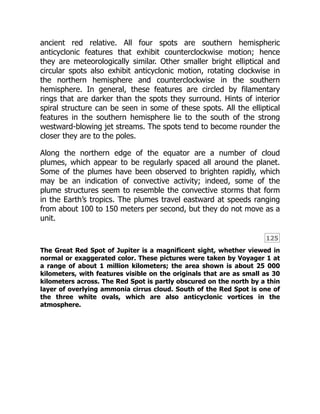
The Great Red Spot, the white ovals, and the smaller white
spots at 41°S, appear to be meteorologically similar.
The formation of a structure east of the Great Red Spot
created a barrier to the flow of small spots which earlier were
circulating about the Great Red Spot.
The ethane to acetylene abundance ratio in the upper
atmosphere appears to be larger in the polar regions than at
lower latitudes and appears to be 1.7 times higher on Voyager
2 than on Voyager 1.
An ultraviolet map of Jupiter shows the distribution of
absorbing haze. The polar regions are surprisingly dark,
suggesting that the absorbing material must be at high
altitudes.
Equatorial ultraviolet emissions indicate planet-wide
precipitation of charged particles into the atmosphere from the
magnetosphere.
The high-latitude ultraviolet auroral activity is due to charged
particles that originate in the Io torus.
Satellites and Ring System
The ring consists of a bright, narrow segment surrounded by a
broader, dimmer segment, with a total width of about 5800
kilometers.
The interior of the ring is filled with much fainter material that
may extend down to the top of the atmosphere.
Images of Amalthea in silhouette against Jupiter indicate that
the satellite may be faceted or diamond shaped.
Volcanic activity on Io changed somewhat, with six of the
plumes observed by Voyager 1 still erupting.
The largest Voyager 1 plume (Pele) had ceased, while the
dimensions of another plume (Loki) had increased by 50
percent.
Several large-scale changes in Io’s appearance had occurred,
consistent with surface deposition rates calculated for the large
eruptions.
Europa is remarkably smooth with very few craters. The
surface consists primarily of uniformly bright terrain crossed by
linear markings and very low ridges.
There are four basic terrain types on Ganymede, including
younger, smooth terrain and a rugged impact basin first
observed by Voyager 2.
Callisto’s entire surface is densely cratered and is likely to be
several billion years old.
Equatorial surface temperatures on the Galilean satellites range
from 80 K (night) to 155 K (the subsolar point on Callisto).
Magnetosphere
The outer region of the magnetosphere contains a hot plasma
consisting primarily of hydrogen, oxygen, and sulfur ions.
The hot plasma generally flows in the corotation direction out
to the boundary of the magnetosphere.
Beyond about 160 RJ, the hot plasma streams nearly
antisunward.
Outbound the spacecraft experienced multiple magnetopause
crossings between 204 RJ and 215 RJ.
114
The abundance of oxygen and sulfur relative to helium at high
energy increases with decreasing distance from Jupiter.
Measurements of high energy oxygen suggest that these nuclei
are diffusing inward toward Jupiter.
The ultraviolet emission from the Io plasma torus was twice as
bright as four months earlier and the temperature had
decreased by 30 percent to 60 000 K.
The low-frequency (kilometric) radio emissions from Jupiter
have a strong latitude dependence and often contain
narrowband emissions that drift to lower or higher frequencies
with time.
A complex magnetospheric interaction with Ganymede was
observed in the magnetic field, plasma, and energetic particles
up to about 200 000 kilometers from the satellite.
[3]
Adapted from a summary prepared by E. C. Stone and A. L.
Lane for the Voyager 2 Thirty-Day Report.
A new inner satellite of Jupiter, provisionally designated 1979J1, was
discovered by David Jewitt and Ed Danielson of Caltech in these Voyager
2 ring photographs.
In a 15-second exposure with the wide-angle camera, the edge-on ring
shows as a faint line, and the satellite is the dot indicated by the arrow.
[260-807]
In a narrow angle 96-second exposure, the motion of the satellite can be
seen. Again, the faint band is the ring, blurred by camera motion, and the
arrow indicates the streak due to the satellite. A star streak is located
above and to the left of the satellite; note that the length and angle of
the two trails are different, owing to satellite motion. [P-22172]
115
A New Satellite
One of the most fascinating discoveries of Voyager 2 was not
recognized at first. Graduate student David Jewitt of the California
Institute of Technology, working with Imaging Team member Ed
Danielson, began a detailed analysis of all the ring photos in late
summer. In early October he determined that a short streak
on a photo taken July 8, previously presumed to be an image
of a star trailed by the time exposure, did not correspond to any
known star position. Perhaps this was a new satellite! Additional
sleuthing turned up a second image of the same part of the ring that
also showed the anomalous object, together with trails due to known
stars. The differing angles and lengths of the trails of the object and
the stars confirmed that this was indeed a 14th satellite of Jupiter.
Following the guidelines of the International Astronomical Union, it
was designated 1979J1, pending later assignment of a mythological
name. The proposed name is Adrastea, a nymph who nursed the
infant Zeus in Greek legend.
The newly discovered satellite orbits Jupiter at a distance of 58 000
kilometers above the equatorial cloud tops, placing it just at the outer
edge of the ring and much closer to the planet than is Amalthea,
previously thought to be the innermost satellite. It travels at 30
kilometers per second (nearly 70 000 miles per hour), circling Jupiter
in just seven hours and eight minutes. From its brightness, scientists
guessed that it might be 30-40 kilometers in diameter.
The proximity of Adrastea to the ring suggests a relationship between
the two. When the discovery was announced to the press in mid-
October, it was speculated that the ring material might originate on
the satellite, perhaps eroded away by the energetic charged particles
in the inner Jovian magnetosphere. Once again, Voyager had added
to our perspective on planetary processes, suggesting that
undiscovered but similar small satellites might also be associated with
the rings of Saturn and Uranus.
Voyager 2 had certainly added a few years’ of data of its own to
Voyager 1’s “ten years’ worth of data.” It had given a different view of
the Jovian system, helping to solve some of the mystery surrounding
Jupiter and its satellites, and creating new mysteries. As Voyager 2
sped out away from Jupiter, riding along the giant planet’s huge
magnetotail, attention turned to Saturn: What would Pioneer 11, the
Pathfinder, discover in September 1979? What would the Voyagers
learn in November 1980 and August 1981? Would all go well? Would
Voyager 2 fly on to Uranus?
There was also a yearning to examine more closely, with the Galileo
Project, what had been unknown for so long, yet had become so
familiar in only a few months’ time—the little dark, red “potato”
Amalthea, the volcano-covered world Io, the mysterious “cracked
billiard ball” Europa, cratered and groovy Ganymede, ancient Callisto,
and the king of the planets itself, a colorful, banded world of stable
climate and ever-changing weather patterns.
A fifteenth satellite of Jupiter was discovered in the spring of 1980 by
Steven Synnott of JPL. It was first seen on this Voyager 1 image taken
March 5, 1979, in which the 75-kilometer-diameter satellite shows as a
dark oval against the planet. Also visible is the shadow of the satellite,
116
designated 1979J2. This satellite orbits between Io and Amalthea with a
period of 16 hours and 11 minutes. [P-22580B/W]
117
The Jupiter seen by the Voyager cameras is a cloud-belted world of rapid
jet streams and complex cloud forms. Prominent in this Voyager 1 image,
taken February 5 at a range of 28.4 million kilometers, is the alternating
structure of light zones and dark belts, and the Great Red Spot and
numerous smaller spots. Also easily visible are the two inner Galilean
satellites, Io and Europa. The resolution in this picture is 500 kilometers,
about five times better than can be obtained from Earth-based
telescopes. Callisto can be faintly seen at the lower left. [P-21083C]
CHAPTER 8
JUPITER—KING OF THE PLANETS
A Star That Failed
More massive than all the other planets combined, Jupiter dominates
the planetary system. The giant revealed by Voyager is a gas planet
of great complexity; its atmosphere is in constant motion, driven by
heat escaping from a glowing interior as well as by sunlight absorbed
from above. Energetic atomic particles stream around it, caught in a
magnetic field that reaches out nearly 10 million kilometers into the
surrounding space, embracing the seven inner satellites. From its
deep interior through its seething clouds out to its pulsating
magnetosphere, Jupiter is a place where forces of incredible energy
contend.
At its birth, Jupiter shone like a star. The energy released by infalling
material from the solar nebula heated its interior, and the larger it
grew the hotter it became. Theorists calculate that when the nebular
material was finally exhausted, Jupiter had a diameter more than ten
times its present one, a central temperature of about 50 000 K, and a
luminosity about one percent as great as that of the Sun today.
At this early stage, Jupiter rivaled the Sun. Had it been perhaps 70
times more massive than it was, it would have continued to contract
and increase in temperature, until self-sustaining nuclear reactions
could ignite in its interior. If this had happened, the Sun would have
been a double star, and the Earth and the other planets might not
have formed. However, Jupiter did not make it as a star; after a brief
flash of glory, it began to cool.
118
At first Jupiter continued to collapse. Within the first ten million years
of its life, the planet was reduced to nearly its present size, with only
a few percent additional shrinkage during the past 4.5 billion years.
The luminosity also dropped as internal heat was carried to the
surface by convection and radiated away to space. After a million
years Jupiter emitted only one-hundred thousandth as much radiation
as the Sun, and today its luminosity is only one-ten billionth of the
Sun’s.
Jupiter’s internal energy, although small by stellar standards, has
important effects on the planet. About 10š⁡ watts of power,
comparable to that received by Jupiter from the Sun, reach the
surface from the still-luminous interior. The central temperature is still
thought to be about 30 000 K, sufficient to maintain the interior in a
molten state. Scientists generally agree that Jupiter is an entirely fluid
planet, with no solid core whatever.
Composition and Atmospheric Structure
Because of its great mass, Jupiter has been undiscriminating in its
composition. All gases and solids available in the early solar nebula
were attracted and held by its powerful gravity. Thus it is expected
that Jupiter has the same basic composition as the Sun, with both
bodies preserving a sample of the original cosmic material from which
the solar system formed.
Jupiter is a gas giant, composed of the same elements as the Sun and
stars—primarily hydrogen and helium. Its internal structure is dominated
by the properties of hydrogen, its most abundant constituent and by the
high temperatures in the deep interior that remain from its luminous
youth. Most of the interior is liquid: metallic hydrogen at great depths
and high pressures, and normal hydrogen nearer the surface. In the
upper few thousand kilometers, the hydrogen is a gas. The primary
known or suspected cloud layers are, from the top down, thin
119
hydrocarbon “smog”; ammonia; ammonium hydrosulfide; water-ice, and
liquid water. [260-828]
Cloud top-aerosols
Ammonia crystals
Ammonium hydrosulfide clouds
Ice crystal clouds
Water droplets
Trace compounds
Fluid molecular hydrogen
Transition Zone
Fluid metallic hydrogen
Possible core
The primary constituents of Jupiter have long been suspected
to be hydrogen and helium, the two simplest and lightest
atoms. However, it has proved impossible to derive accurate
measurements of the abundance of these two elements from
astronomical observations. On the basis of a rather simple infrared
measurement, Pioneer investigators found He/H₂ = 0.14 ± 0.08. On
Voyager, IRIS was able to obtain much improved infrared spectra,
yielding an initial value of He/H₂ = 0.11 ± 0.3. Voyager scientists
expect that further analysis will reduce the uncertainty to about Âą
0.01. The ratio of 0.11 is in excellent agreement with the solar value
of about 0.12, supporting the idea that Jupiter and the Sun have
similar elemental compositions.
Astronomers have known for a long time that, in addition to
hydrogen and helium, the compounds methane (CH₄) and ammonia
(NH₃) are present in the visible atmosphere of Jupiter. In the 1970s,
additional spectra in the infrared resulted in the discovery of water
(H₂O), ethane (C₂H₆), germane (GeH₄), acetylene (C₂H₂), phosphine
(PH₃), carbon monoxide (CO), hydrogen cyanide (HCN), and carbon
dioxide (CO₂). All these are trace constituents, with two of them,
ethane and acetylene, apparently formed at high altitudes by the
action of sunlight on methane.
A total of approximately 100 000 infrared spectra, many of small
regions on the disk, were obtained by IRIS. These spectra generally
show hydrogen, helium, methane, ammonia, phosphine, ethane, and
acetylene. In addition, excellent spectra were obtained in “hot spots,”
regions in which breaks in the upper clouds permit radiation from
deeper layers to escape. (The hot spots generally correspond to dark
brown regions on photographs of the planet.) IRIS measured
temperatures in the hot spots up to -13° C but no higher; apparently
this temperature corresponds to the top of a deeper cloud deck.
Spectral features indicative of the presence of water vapor and
germane were clearly seen in the hot spots.
Further analysis of the IRIS spectra will be required to derive the
abundances of the gases detected. However, even the preliminary
data showed how variable Jupiter can be, especially in its upper
atmosphere. The two hydrocarbons, ethane and acetylene, vary in
relative abundance with latitude; there is less acetylene near the
poles. In addition to this planetwide trend, smaller variations were
seen from place to place and between the observations in March and
July. All the variations will eventually provide information on the
processes of formation, transportation, and destruction of
hydrocarbons in the upper atmosphere.
ELEMENTS DETECTED IN THE JOVIAN MAGNETOSPHERE
Element Atomic Number Instruments
Hydrogen (H) 1 UVS, Plasma, LECP, CRS
Helium (He) 2 Plasma, LECP
Carbon (C) 6 LECP
Nitrogen (N) 7 CRS
Oxygen (O) 8 UVS, Plasma, LECP, CRS
Neon (Ne) 10 CRS
Sodium (Na) 11 LECP, CRS
Magnesium (Mg) 12 CRS
Silicon (Si) 14 CRS
120
Sulfur (S) 16 UVS, Plasma, LECP, CRS
Iron (Fe) 26 CRS
Voyager did not make any direct measurements of the chemical
composition of the clouds, but theorists generally agree that the
uppermost clouds are ammonia cirrus, and that layers of ammonium
hydrosulfide (NH₄SH) and water exist at deeper levels. All these
clouds are formed in the troposphere, the layer of the atmosphere in
which convection takes place. The top of the ammonia cloud deck is
thought to have a pressure of about 1 atmosphere and a temperature
of about -113° C.
Ammonia cirrus is white, yet Jupiter’s clouds display a spectacular
range of colors. Voyager did not determine the nature of the coloring
agents; they may be minor constituents—trace impurities in a sea of
white clouds. Perhaps organic polymers, formed from atmospheric
chemicals such as methane and ammonia that have reacted with
lightning, are responsible for the oranges and yellows. The color of
the Red Spot could be caused by red phosphorus (P₄). According to
this theory, phosphine (PH₃) from deep in Jupiter’s atmosphere is
brought to high altitudes by the upwelling of the Great Red Spot.
Ultraviolet light, penetrating the upper reaches of the Red Spot, splits
the phosphine molecules, and, through a series of chemical reactions,
converts the phosphine into pure phosphorus. However, this theory
fails to explain the existence of the smaller red spots on Jupiter;
these spots are not at such high altitudes as the Great Red Spot
(which is the highest and coldest of Jupiter’s visible clouds), so it is
unlikely that ultraviolet light could react with any phosphine in these
areas to produce red phosphorus.
Although the Voyager spacecraft never flew over the poles of Jupiter, it is
possible to reconstruct from several images the View that would be seen
from directly above or below the planet. Note the absence of a strong
banded structure near both poles. The regular spacing of cloud features
is obvious. In the Southern hemisphere, the three white ovals are 90
degrees apart in longitude, but a fourth oval at the other quadrant is
missing. The irregular black areas at each pole are places for which no
Voyager data exist. The resolution of the original pictures from which
these polar projections were made was about 600 kilometers.
North pole. [P-21638C]
121
122
South pole. [P-21639C]
Various forms of elemental sulfur might be responsible for the
riot of color we see on Jupiter. Sulfur forms polymers (S₃, S₄,
S₅, S₈,) that are yellow, red, and brown, but no sulfur in any form
has been detected on Jupiter. “We never promised you we were
going to identify the colors on Jupiter with this mission,” one of the
atmospheric scientists remarked, “but we will have a probe that is
going into the atmosphere in the mid-1980s—Galileo.” Perhaps the
mystery of the Jovian clouds will have to wait till then.
Temperature maps of Jupiter were obtained by IRIS in radiation
arising at different levels above the clouds. Maps show temperatures
at pressures of 0.8 atmosphere near the clouds, and 0.2 atmosphere
near the top of the troposphere. In addition to the low temperatures
over the bright zones and the higher temperatures over dark belts,
there is a great deal of smaller scale structure. It is interesting that a
cold area corresponding to the Great Red Spot is clearly visible even
near the top of the troposphere, indicating that this feature disturbs
the atmosphere to very high altitudes.
The structure of the atmosphere of Jupiter above the troposphere
was investigated through the radio occultation experiment as well as
by IRIS. The level in which the minimum temperature of about -173°
C occurs has a pressure of 0.1 atmosphere. Above this point lies the
stratosphere, in which temperatures increase with altitude as a result
of sunlight absorbed by the gas or by aerosol particles resembling
smog. At 70 kilometers above the ammonia clouds, the temperature
is about -113° C. Above this level, the temperature stays
approximately constant, although at extreme altitudes the
temperature again rises in the ionosphere.
If one could “unwrap” Jupiter like a map, views such as these would be
obtained. The comparison between the pictures shows the relative
motions of features in Jupiter’s atmosphere. It can be seen, for example,
that the Great Red Spot moved westward and the white ovals eastward
during the time between the acquisition of these pictures. Regular plume
patterns are equidistant around the northern edge of the equator, while a
train of small spots moved eastward at approximately latitude 80° S. In
addition to these relative motions, significant changes are evident in the
recirculating flow east of the Great Red Spot, in the disturbed region
west of the Great Red Spot, and as seen in the brightening of material
spreading into the equatorial region from the more southerly latitudes.
[P-21771C]
123
The planet as it appeared about March 1.
As it was in early July.
Weather on Jupiter
The Voyager pictures reveal a planet of complex atmospheric
motions. Spots chase after each other, meet, whirl around, mingle,
and then split up again; filamentary structures curl into spirals that
open outward; feathery cloud systems reach out toward neighboring
regions; cumulus clouds that look like ostrich plumes may brighten
suddenly as they float toward the east; spots stream around the Red
Spot or get caught up in its vortical motion—all in an incredible
interplay of color, texture, and eastward and westward flows. Such
changes can be noticed in the space of only a few Jovian days.
Differing characteristics of Jupiter’s meteorology are apparent in high-
resolution images, such as this one taken by Voyager 1 on March 2 at a
range of 4 million kilometers. The well-defined pale orange line running
from southwest to northeast (north is at the top) marks the high-speed
north temperate current with wind speeds of about 120 meters per
second. Toward the top of the picture, a weaker jet of approximately 30
meters per second is characterized by wave patterns and cloud features
which have been observed to rotate in a clockwise manner at these
latitudes of about 35°N. These clouds have been observed to have
lifetimes of one to two years. [P-21193C]
On a broader time scale, greater changes on the face of Jupiter can
be seen. Features drift around the planet; even the large white ovals
and the Great Red Spot slide along in their respective latitudes. Belts
124
or zones intrude upon each other, resulting in one of the banded
structures splitting up or seeming to squeeze together and eventually
disappear. Small structures form, then die. The largest spots may
slowly shrink in size, and the Red Spot itself changes its size and
color.
The Jupiter of Pioneers 10 and 11 was quite unlike the planet seen by
Voyager 1. At the time of the Pioneer exploration, the Great Red
Spot, embedded in a huge white zone, was more uniformly colored,
and pale brown bands circled the northern hemisphere. In the
intervening years, the south temperate latitudes have changed
completely, developing the complex turbulent clouds seen around the
Red Spot by Voyager 1. Yet, even between the two Voyagers, Jupiter
appeared to be undergoing a dynamic “facelift.” At a quick glance,
Voyager 2 photographs showed the visage that had been familiar
since early in 1979, but a closer look showed that it is not quite the
same. The white band below the Great Red Spot, fairly broad
during the first flyby, had become a thin white ribbon where it
rims the southern edge of the Spot. The turbulence to the west of
the Red Spot had stretched out and become “blander” than it was
before. Small rotating clouds seemed to be forming out of the waves
in this region. The cloud structure that had been east of the Red Spot
during the Voyager 1 flyby spread out, covering the northern
boundary and preventing small clouds from circling the huge red
oval. The Red Spot itself also changed. Its northern boundary
seemed—at least visually—to be more set off from the clouds that
surround it, and the feature appeared to be more uniform in color,
perhaps reverting back to the personality it had in Pioneer days.
Jupiter’s cloud patterns changed significantly in the few months between
the two Voyager flybys. Most of the changes are the result of differential
rotation, in which the prevailing winds at different latitudes shift long-
lived features with respect to those north or south. Thus, for example,
the three large white ovals shifted nearly 90 degrees in longitude,
relative to the Great Red Spot, between March and July. [P-21599]
The most obvious features in the atmosphere of Jupiter, after the
banded belts and zones, are the Great Red Spot and the three white
ovals. These have often been described as “storms” in Jupiter’s
atmosphere. The ovals are about the size of the Moon, and the Red
Spot is larger than the Earth. Voyager has revealed that in many
respects the white ovals, which formed in 1939, resemble their
125
ancient red relative. All four spots are southern hemispheric
anticyclonic features that exhibit counterclockwise motion; hence
they are meteorologically similar. Other smaller bright elliptical and
circular spots also exhibit anticyclonic motion, rotating clockwise in
the northern hemisphere and counterclockwise in the southern
hemisphere. In general, these features are circled by filamentary
rings that are darker than the spots they surround. Hints of interior
spiral structure can be seen in some of these spots. All the elliptical
features in the southern hemisphere lie to the south of the strong
westward-blowing jet streams. The spots tend to become rounder the
closer they are to the poles.
Along the northern edge of the equator are a number of cloud
plumes, which appear to be regularly spaced all around the planet.
Some of the plumes have been observed to brighten rapidly, which
may be an indication of convective activity; indeed, some of the
plume structures seem to resemble the convective storms that form
in the Earth’s tropics. The plumes travel eastward at speeds ranging
from about 100 to 150 meters per second, but they do not move as a
unit.
The Great Red Spot of Jupiter is a magnificent sight, whether viewed in
normal or exaggerated color. These pictures were taken by Voyager 1 at
a range of about 1 million kilometers; the area shown is about 25 000
kilometers, with features visible on the originals that are as small as 30
kilometers across. The Red Spot is partly obscured on the north by a thin
layer of overlying ammonia cirrus cloud. South of the Red Spot is one of
the three white ovals, which are also anticyclonic vortices in the
atmosphere.
This frame is in natural color. [P-21430C]
126
The red and blue have been greatly exaggerated in this frame to bring
out fine detail in the cloud structure. [P-21431C]
The most visible cloud interactions take place in the region of
the Great Red Spot. Material within the Red Spot rotates
about once every six days. Infrared measurements show that the Red
Spot is a region of atmospheric upwelling, which extends to very high
altitudes; however, the divergent flow suggested by this upwelling
seems to be very small—one bright feature was observed to circle the
Red Spot for sixty days without appreciably changing its distance
from the spot’s center. During the Voyager 1 flyby, spots were seen to
move toward the Red Spot from the east, flow along its northern
border, then either flow on to the west past the Red Spot or into the
outer regions of its vortex. A spot caught on the outer edge of the
Red Spot flow might break in two as it reached the eastern edge of
the spot, with one piece remaining in the vortex and the other
moving off to the east. Alternatively, a spot floating toward the Red
Welcome to our website – the perfect destination for book lovers and
knowledge seekers. We believe that every book holds a new world,
offering opportunities for learning, discovery, and personal growth.
That’s why we are dedicated to bringing you a diverse collection of
books, ranging from classic literature and specialized publications to
self-development guides and children's books.
More than just a book-buying platform, we strive to be a bridge
connecting you with timeless cultural and intellectual values. With an
elegant, user-friendly interface and a smart search system, you can
quickly find the books that best suit your interests. Additionally,
our special promotions and home delivery services help you save time
and fully enjoy the joy of reading.
Join us on a journey of knowledge exploration, passion nurturing, and
personal growth every day!
testbankdeal.com


Financial Statement Analysis 11th Edition Subramanyam Solutions Manual

  • 1.
    Download the fullversion and explore a variety of test banks or solution manuals at https://testbankdeal.com Financial Statement Analysis 11th Edition Subramanyam Solutions Manual _____ Tap the link below to start your download _____ https://testbankdeal.com/product/financial-statement- analysis-11th-edition-subramanyam-solutions-manual/ Find test banks or solution manuals at testbankdeal.com today!
  • 2.
    We believe theseproducts will be a great fit for you. Click the link to download now, or visit testbankdeal.com to discover even more! Financial Statement Analysis 11th Edition Subramanyam Test Bank https://testbankdeal.com/product/financial-statement-analysis-11th- edition-subramanyam-test-bank/ Financial Statement Analysis 10th Edition Subramanyam Test Bank https://testbankdeal.com/product/financial-statement-analysis-10th- edition-subramanyam-test-bank/ Financial Statement Analysis International Edition 13th Edition Gibson Solutions Manual https://testbankdeal.com/product/financial-statement-analysis- international-edition-13th-edition-gibson-solutions-manual/ Andersons Business Law and the Legal Environment Standard Volume 22nd Edition Twomey Test Bank https://testbankdeal.com/product/andersons-business-law-and-the-legal- environment-standard-volume-22nd-edition-twomey-test-bank/
  • 3.
    Principles of EnvironmentalScience Inquiry and Applications 7th Edition Cunningham Test Bank https://testbankdeal.com/product/principles-of-environmental-science- inquiry-and-applications-7th-edition-cunningham-test-bank/ Understanding American Government 14th Edition Welch Test Bank https://testbankdeal.com/product/understanding-american- government-14th-edition-welch-test-bank/ Physics for Scientists and Engineers 9th Edition Serway Solutions Manual https://testbankdeal.com/product/physics-for-scientists-and- engineers-9th-edition-serway-solutions-manual/ Business Communication Building Critical Skills 6th Edition Locker Test Bank https://testbankdeal.com/product/business-communication-building- critical-skills-6th-edition-locker-test-bank/ Sexuality Now Embracing Diversity 5th Edition Carroll Test Bank https://testbankdeal.com/product/sexuality-now-embracing- diversity-5th-edition-carroll-test-bank/
  • 4.
    Organizational Behavior KeyConcepts Skills and Best Practices 5th Edition Kinicki Solutions Manual https://testbankdeal.com/product/organizational-behavior-key-concepts- skills-and-best-practices-5th-edition-kinicki-solutions-manual/
  • 5.
    Chapter 07 -Cash Flow Analysis 7-1 Copyright Š 2014 McGraw-Hill Education. All rights reserved. No reproduction or distribution without the prior written consent of McGraw-Hill Education. Chapter 7 Cash Flow Analysis REVIEW Cash is the residual of cash inflows less cash outflows for all prior periods of a company. Net cash flows, or simply cash flows, refer to the current period's cash inflows less cash outflows. Cash flows are different from accrual measures of performance. Cash flow measures recognize inflows when cash is received not necessarily earned, and outflows when cash is paid not necessarily incurred. The statement of cash flows reports cash flow measures for three primary business activities: operating, investing, and financing. Operating cash flows, or cash flows from operations, is the cash basis counterpart to accrual net income. Information on cash flows helps us assess a company's ability to meet obligations, pay dividends, increase capacity, and raise financing. It also helps us assess the quality of earnings and the dependence of income on estimates and assumptions regarding future cash flows. This chapter describes cash flows and their relevance to our analysis of financial statements. We describe current reporting requirements and their implications for our analysis of cash flows. We explain useful analytical adjustments to cash flows using financial data to improve our analysis. We direct special attention to transaction reconstruction, T-account, and conversion analyses.
  • 6.
    Chapter 07 -Cash Flow Analysis 7-2 Copyright © 2014 McGraw-Hill Education. All rights reserved. No reproduction or distribution without the prior written consent of McGraw-Hill Education. OUTLINE • Statement of Cash Flows Relevance of Cash Reporting by Activities Constructing the Cash Flow Statement Special Topics • Reporting Cash Flows from Operations Indirect Method Direct Method Converting from Indirect to Direct Method Adjustments to Cash Flow Components Additional Disclosures and Adjustments • Analysis Implications of Cash Flows Limitations in Cash Flow Reporting Interpreting Cash Flows and Net Income Alternative Cash Flow Measures Company and Economic Conditions Free Cash Flow Cash Flows as Validators • Specialized Cash Flow Ratios Cash Flow Adequacy Ratio Cash Reinvestment Ratio • Appendix 7A Analytical Cash Flow Worksheets
  • 7.
    Chapter 07 -Cash Flow Analysis 7-3 Copyright © 2014 McGraw-Hill Education. All rights reserved. No reproduction or distribution without the prior written consent of McGraw-Hill Education. ANALYSIS OBJECTIVES • Explain the relevance of cash flows in analyzing business activities. • Describe reporting of cash flows by business activities. • Describe the preparation and analysis of the statement of cash flows. • Interpret cash flows from operating activities. • Analyze cash flows under alternative company and business conditions. • Describe alternative measures of cash flows and their usefulness. • Illustrate an analytical tool in evaluating cash flows (Appendix 7A).
  • 8.
    Chapter 07 -Cash Flow Analysis 7-4 Copyright © 2014 McGraw-Hill Education. All rights reserved. No reproduction or distribution without the prior written consent of McGraw-Hill Education. QUESTIONS 1. The term cash flow was probably first coined by analysts. They recognized that the accrual system of income measurement permits the introduction of a variety of alternative accounting treatments and consequent distortions. The crude concept of cash flow—net income plus major noncash expenses (such as depreciation)—was derived to bypass these distortions and bring income measurement closer to the discipline of actual cash flows. This cash flow measure, still a popular surrogate for cash from operations (CFO), is crude because it falls short of reliably approximating in most cases the correct measure of CFO. Confusion with the term cash flow derives from several sources. One source of confusion stems from the initial and incorrect computation of the crude measure of cash flow as income plus major noncash expenses. The figure fails to reflect actual cash flows. Another and more serious confusion arises from the assertion by some, and particularly by managers dissatisfied by the level of their reported net income, that cash flow is a measure of performance superior to or more valid than net income. This assertion implicitly assumes that depreciation, and other noncash costs, are not genuine expenses. Experience shows that only net income is properly regarded as a measure of performance and can be related to the equity investment as an indicator of operating performance. If we add back depreciation to net income and compute the resulting return on investment, we are, in effect, confusing the return on investment with an element of return on investment in fixed assets. 2. While fragmentary information on the sources and uses of cash can be obtained from comparative balance sheets and from income statements, a comprehensive picture of this important area of activity can be gained only from a statement of cash flows (SCF). The SCF provides information to help answer questions such as: • What amount of cash is generated by operations? • What utilization is made of cash provided by operations? • What is the source of cash invested in new plant and equipment? • What use is made of cash from a new bond issue or the issuance of common stock? • How is it possible to continue the regular dividend in the face of an operating loss? • How is debt repayment achieved? • What is the source of cash used to redeem the preferred stock? • How is the increase in investments financed? • Why, despite record profits, is the cash position lower than last year? 3. SFAS 95 requires that the statement of cash flows classify cash receipts and cash payments by operating, financing and investing activities. Operating activities encompass all the earning-related activities of the enterprise. They encompass, in addition to all the income and expense items found on the income statement, all the net inflows and outflows of cash that operations impose on the enterprise. Such operations include activities such as the extension of credit to customers, investment in inventories, and obtaining credit from suppliers. This means operating activities relate to all items in the statement of income (with minor exceptions) as well as to balance sheet items that relate to operations mostly working capital accounts such as accounts receivable, inventories, prepayments, accounts payable, and
  • 9.
    Chapter 07 -Cash Flow Analysis 7-5 Copyright © 2014 McGraw-Hill Education. All rights reserved. No reproduction or distribution without the prior written consent of McGraw-Hill Education. accruals. SFAS 95 also specifies that operating activities include all transactions and events that are not of an investing or financing nature. Financing activities include obtaining resources from owners and providing them with a return of or a return on (dividends) their investment. They also include obtaining resources from creditors and repaying the amounts borrowed or otherwise settling the obligations. Investing activities include acquiring and selling or otherwise disposing of both securities that are not cash equivalents and productive assets that are expected to generate revenues over the long-term. They also include lending money and collecting on such loans. 4. We can distinguish among three categories of adjustments that convert accrual basis net income to cash from operations: (i) Expenses, losses, revenues, and gains that do not use or generate cash such as those involving noncash accounts (except those in ii), (ii) Net changes in noncash accounts (mostly in the operating working capital group) that relate to operations—these modify the accrual-based revenue and expense items included in income, (iii) Gains and losses (such as on sales of assets) that are transferred to other sections of the SCF so as to show the entire cash proceeds of the sale. 5. The two methods of reporting cash flow from operations are: Indirect Method: Under this method net income is adjusted for noncash items required to convert it to CFO. The advantage of this method is that it is a reconciliation that discloses the differences between net income and CFO. Some analysts estimate future cash flows by first estimating future income levels and then adjusting these for leads and lags between income and CFO (that is, noncash adjustments). Direct (or Inflow-Outflow) Method: This method lists the gross cash receipts and disbursements related to operations. Most respondents to the Exposure Draft that preceded SFAS 95 preferred this method because this presentation discloses the total amount of cash that flows into the enterprise and out of the enterprise due to operations. This gives analysts a better measure of the size of cash inflows and outflows over which management has some degree of discretion. As the risks that lenders are exposed to relate more to fluctuations in CFO than to fluctuations in net income, information on the amounts of operating cash receipts and payments is important in assessing the nature of those fluctuations. 6. The function of the income statement is to measure the profitability of the enterprise for a given period. This is done by matching expenses and losses with the revenues and gains earned. While no other statement measures profitability as well as the income statement, it does not show the timing of cash flows and the effect of operations on liquidity and solvency. The latter is reported on by the SCF. Cash from operations (CFO) reflects a broader concept of operations relative to net income. It encompasses all earning-related activities of the enterprise. CFO is concerned not only with expenses and revenues but also with the cash demands of these activities, such as investments in customer receivables and in inventories as well as the financing provided by suppliers of goods and services. CFO focuses on the liquidity aspect of operations and is not a measure of profitability because it does not include important costs such as the use of long-lived assets in operations or important revenues such as the equity in the earnings of nonconsolidated subsidiaries or affiliates.
  • 10.
    Chapter 07 -Cash Flow Analysis 7-6 Copyright Š 2014 McGraw-Hill Education. All rights reserved. No reproduction or distribution without the prior written consent of McGraw-Hill Education. 7. The SCF sheds light on (i) the effects of earning activities on cash resources, (ii) what assets are acquired, and (iii) how assets are financed. It also can highlight more clearly the distinction between net income and cash provided by operations. The ability of an enterprise to generate cash from operations on a consistent basis is an important indicator of financial health. No business can survive over the long run without generating cash from its operations. However, the interpretation of CFO figures and trends must be made with care and with a full understanding of all surrounding circumstances. Prosperous as well as failing entities can find themselves unable to generate cash from operations at any given time, but for different reasons. The entity caught in the "prosperity squeeze" of having to invest its cash in receivables and inventories to meet ever-increasing customer demand will often find that its profitability will facilitate financing by equity as well as by debt. That same profitability should ultimately turn CFO into a positive figure. The unsuccessful firm, on the other hand, will find its cash drained by slowdowns in receivable and inventory turnovers, by operating losses, or by a combination of these factors. These conditions usually contain the seeds of further losses and cash drains and also can lead to difficulties in obtaining trade credit. In such cases, a lack of CFO has different implications. The unsuccessful or financially pressed firm can increase its CFO by reducing accounts receivable and inventories, but usually this is done at the expense of services to customers that can further depress future profitability. Even if the unsuccessful firm manages to borrow, the costs of borrowing only magnify the ultimate drains of its cash. Thus, profitability is a key consideration, and while it does not insure CFO in the short run, it is essential to a healthy financial condition in the long run. Changes in operating working capital items must be similarly interpreted in light of attending circumstances. An increase in receivables can mean expanding consumer demand for enterprise products or it can mean an inability to collect amounts due in a timely fashion. Similarly, an increase in inventories (and particularly of the raw material component) can imply preparations for an increase in production in response to consumer demand. It also can imply (particularly if the finished goods component of inventories is increasing) an inability to sell due to, say, when anticipated demand did not materialize. 8. A valuable analytical derivative of the SCF is "free cash flow." As with any other analytical measure, analysts must pay careful attention to components of this computation. Here, as in the case of any cash flow measures, ulterior motives may sometimes affect the validity of the computation. One of the analytically most useful computations of free cash flow is: Cash from Operations (CFO) - Capital expenditures required to maintain productive capacity used in generating income - Dividends (on preferred stock and maintenance of desired payout on common stock) = Free Cash Flow (FCF)
  • 11.
    Chapter 07 -Cash Flow Analysis 7-7 Copyright © 2014 McGraw-Hill Education. All rights reserved. No reproduction or distribution without the prior written consent of McGraw-Hill Education. Positive FCF implies that this is the amount available for company purposes after provisions for financing outlays and expenditures to maintain productive capacity at current levels. Internal growth and financial flexibility depend on an adequate amount of FCF. Note that the amount of capital expenditures needed to maintain productive capacity at current levels is generally not disclosed by companies. It is included in total capital expenditures, which also can include outlays for expansion of productive capacity. Breaking down capital expenditures between these two components is difficult. The FASB considered this issue, but in SFAS 95 it decided not to require classification of investment expenditures into maintenance and expansion categories. 9. For financial statement analysis, the SCF provides clues to important matters such as: • Feasibility of financing capital expenditures and possible sources of such financing. • Sources of cash to finance an expansion in the business. • Dependence of the firm on external sources of financing (such as debt or equity). • Future dividend policies. • Ability to meet future debt service requirements. • Financial flexibility, that is, the firm's ability to generate sufficient cash so as to respond to unanticipated needs and opportunities. • Insight into the financial habits of management and indications of future policies. • Signals regarding the quality of earnings.
  • 12.
    Chapter 07 -Cash Flow Analysis 7-8 Copyright © 2014 McGraw-Hill Education. All rights reserved. No reproduction or distribution without the prior written consent of McGraw-Hill Education. EXERCISES Exercise 7-1 (20 minutes) The Year 11 CFO of Campbell is higher (by $403.7 million) than its Year 11 net income for two main reasons: 1. Some items decreased net income but did not use cash—specifically: a. Depreciation and amortization are expenses not requiring a cash outlay ($208.6). b. Deferred income taxes are an expense that has no present cash payment ($35.5). c. Several charges and expenses did not require outlays of cash ($63.2). d. A decrease in inventory implies that cost of sales are charged by reducing inventory levels rather than by making cash payments of $48.7. 2. Some items generated operating cash inflow did not enter into the determination of net income—specifically: a. The decrease in accounts receivable means that cash is collected beyond the amounts recognized as sales revenue in the income statement ($17.1). b. There are several other items that had a similar effect, amounting to $30.6. Exercise 7-2 (40 minutes) a. SFAS 95 requires that the SCF classify cash receipts and payments by operating, financing, and investing activities. (1) Operating activities encompass all the earning-related activities of the enterprise. They encompass, in addition to all the income and expense items found on the income statement, all the net inflows and outflows of cash that operations impose on the enterprise. Such operations include activities such as the extension of credit to customers, investment in inventories, and obtaining credit from suppliers. This means operating activities relate to all items in the statement of income (with minor exceptions) as well as to balance sheet items that relate to operations mostly working capital accounts such as accounts receivable, inventories, prepayments, accounts payable, and accruals. SFAS 95 also specifies that operating activities include all transactions and events that are not of an investing or financing nature. (2) Financing activities include obtaining resources from owners and providing them with a return of or a return on (dividends) their investment. They also include obtaining resources from creditors and repaying the amounts borrowed or otherwise settling the obligations. (3) Investing activities include acquiring and selling or otherwise disposing of both securities that are not cash equivalents and productive assets that are expected to generate revenues over the long-term. They also include lending money and collecting on such loans.
  • 13.
    Chapter 07 -Cash Flow Analysis 7-9 Copyright © 2014 McGraw-Hill Education. All rights reserved. No reproduction or distribution without the prior written consent of McGraw-Hill Education. Exercise 7-2—concluded b. SFAS 95 requires that all significant financing and investing activities be disclosed. For example, noncash transactions that include the conversion of debt to equity, the acquisition of assets through the issuance of debt, and exchanges of assets or liabilities, should be disclosed in a separate schedule of noncash investing and financing activities. c. (1) Net income is the starting point of the computation of CFO. SFAS 95 does not require the separate disclosure of extraordinary items in the SCF. (2) Depreciation is added back as an expense not requiring cash. (3) The write-off of uncollectible receivables does not affect cash. Similarly, the bad debt expense does not require an outlay of cash. Since this corporation uses the indirect method for presentation of CFO, no additional adjustment is needed beyond the adjustment for the change in the net accounts receivable, which includes the credit to the allowance for doubtful accounts. (4) The $140,000 increase in accounts receivable means that some sales have not been collected in cash and, accordingly, net income is reduced by $140,000 in arriving at CFO. The $60,000 decline in inventories means that cost of goods sold includes inventories paid for in prior years, and did not require cash this year. As such, net income is increased by $60,000 in arriving at CFO. (5) This $380,000 is an expense requiring cash—no adjustment is called for. This amount also must be disclosed as part of the supplemental disclosures. (6) A reconstructed analytical entry would appear as: Cash.............................................. 30,000 Accumulated Depreciation ......... 50,000 PPE.......................................... 75,000 Gain on sale of machine........ 5,000 The $30,000 increase in cash is shown as a source from investing activities. The $5,000 gain is deducted from (removed from) net income so that the entire proceeds of the sale are shown as part of investment activities. (7) Only the cash payment of $100,000 is shown in the SCF as an investing activity outflow. In a separate schedule, the purchase of buildings and land for noncash considerations is detailed. (8) This is a noncash transaction that is disclosed in a separate schedule of noncash investing and financing activities. (9) The declaration of a cash dividend creates a current liability. During Year 8, no cash outflow occurs and there is nothing to report on the Year 8 SCF. (10)This event has no effect on cash nor need it be reported in conjunction with the SCF.
  • 14.
    Chapter 07 -Cash Flow Analysis 7-10 Copyright Š 2014 McGraw-Hill Education. All rights reserved. No reproduction or distribution without the prior written consent of McGraw-Hill Education. Exercise 7-3 (30 minutes) a. Cash Flows from Operations Computation: Net income .................................................................. $10,000 Add (deduct) items to convert to cash basis: Depreciation, depletion, and amortization............ $8,000 Deferred income taxes ........................................... 400 Amortization of bond discount.............................. 50 Increase in accounts payable ................................ 1,200 Decrease in inventories.......................................... 850 10,500 $20,500 Undistributed earnings of unconsolidated subsidiaries and affiliates..................................... (200) Amortization of premium on bonds payable ........ (60) Increase in accounts receivable............................ (900) (1,160) Cash provided by operations .................................... $19,340 b. (1) The issuance of treasury stock for employee stock plans (as compensation) requires an addback to net income because it is an expense not using cash. (2) The cash outflow for interest is not included in expense and must be included as cash outflow in investing activities (as part of outlays for property.) (3) If the difference between pension expense and actual funding is an accrued liability, the unpaid portion must be added back to income as an expense not requiring cash. If the amount funded exceeds pension expense, then net income must be reduced by that excess amount.
  • 15.
    Chapter 07 -Cash Flow Analysis 7-11 Copyright Š 2014 McGraw-Hill Education. All rights reserved. No reproduction or distribution without the prior written consent of McGraw-Hill Education. Exercise 7-4 (30 minutes) a. Beginning balance of accounts receivable ........ $ 305,000 Net sales................................................................ 1,937,000 Total potential receipts......................................... $2,242,000 Ending balance of accounts receivable.............. - 295,000 Cash collected from sales.................................... $1,947,000 b. Ending balance of inventory................................ $ 549,000 Cost of sales.......................................................... +1,150,000 Total ....................................................................... $1,699,000 Beginning balance of inventory........................... - 431,000 Purchases.............................................................. $1,268,000 Beginning balance of accounts payable............. $ 563,000 Purchases (from above)....................................... 1,268,000 Total potential payments...................................... $1,831,000 Ending balance of accounts payable.................. - 604,000 Cash payments for accounts payable................. $1,227,000 c. Issuance of common stock.................................. $ 81,000 Issuance of treasury stock................................... 17,000 Total nonoperating cash receipts........................ $ 98,000 d. Increase in land..................................................... $ 150,000 Increase in plant and equipment ......................... 18,000 Total payments for noncurrent assets................ $ 168,000 Exercise 7-5 (20 minutes) Source Use Adjustment Category a. X X O b. X F c. X F d. X I e. X F f. NCN g. X I h. NCS i. X F j. X X O
  • 16.
    Chapter 07 -Cash Flow Analysis 7-12 Copyright Š 2014 McGraw-Hill Education. All rights reserved. No reproduction or distribution without the prior written consent of McGraw-Hill Education. Exercise 7-6 (20 minutes) Source Use Adjustment Category a. X X O b. X F c. NCN d. X I e. NCS f. NCN g. X I h. NCS i. NE j. NE Exercise 7-7 (30 minutes) Net Cash from Cash Income operations position 1. NE NE + 2. NE NE + 3. + + + 4a. - NE NE 4b. NE(1) +(2) +(2) 4c. - +(2) +(2) 5. NE + + 6. - + (long-run -) + (long-run -) 7. - -(5) + 8. + NE NE 9. +(3) +(4) +(4) 10. NE + + 11. + + + 12. NE NE + 13. NE NE + (1) Deferred tax accounting. (2) Depends on whether tax savings are realized in cash. (3) If profitable. (4) If accounts receivable collected. (5) Depends on whether interest is paid or accrued. Further explanations (listed by proposal number): 1. Substituting payment in stock for payment in cash for its dividends will not affect income or CFO but will increase cash position. 2. In the short run, postponement of capital expenditures will save cash but have no effect on income or CFO. In the long term, both income and CFO may suffer due to lower operating efficiency.
  • 17.
    Chapter 07 -Cash Flow Analysis 7-13 Copyright © 2014 McGraw-Hill Education. All rights reserved. No reproduction or distribution without the prior written consent of McGraw-Hill Education. Exercise 7-7—continued 3. Cash not spent on repair and maintenance will increase all three measures. However, the skimping on necessary discretionary costs will adversely impact future operating efficiency and, hence, profitability. 4. Managers advocating an increase in depreciation may have spoken in the mistaken belief that depreciation is a source of cash and that consequently increasing it would result in a higher cash inflow. In fact, the level of depreciation expense has no effect on cash flow—the same amount of depreciation deducted in arriving at net income is added back in arriving at CFO. On the other hand, increasing depreciation for tax purposes will in all cases result in at least a short-term savings. 5. Quicker collections will not affect income but will increase CFO because of lower accounts receivable. Cash will also increase by the speedier conversion of receivables into cash. In the longer run this stiffening in the terms of sale to customers may result in sales lost to competition. 6. Payments stretched-out will lower income because of lost discounts but does positively affect CFO by increasing the level of accounts payable. Cash conservation will result in a higher cash position. Relations with suppliers may be affected adversely. Note: Long-term cash outflow will be higher because of the lost discount. 7. Borrowing will result in interest costs that will decrease income and CFO. Cash position will increase. 8. This change in depreciation method will increase income in the early stages of an asset's life. The opposite may hold true in the later stages of the asset's life. 9. In the short term, higher sales to dealers will result in higher profits (assuming we sell above costs) and, if they pay promptly, both CFO and cash will increase. However, unless the dealers are able to sell to consumers, such sales will be made at the expense of future sales. 10. This will lead to less income from pension assets in the future which could cause future pension expense to increase. 11. The cost of funding inventory will be reduced in the future. In the current period net income may also be increased by a LIFO liquidation from reduced inventory levels. 12. The current period decline in the value of the trading securities has been reflected in current period income, as has the previous gain. Although the sale will increase cash, it will have no effect on current period income. If the current period decline is deemed to be temporary, the company is selling a potentially profitable security for a short-term cash gain. 13. Reissuance of treasury shares will increase cash, but will have no effect on current period income as any “gain” or “loss” is reflected in additional paid in capital, not income. If the stock price is considered to be temporarily depressed, the company is foregoing a future sale at a greater market price and is, thus, suffering current dilution of shareholder value.
  • 18.
    Chapter 07 -Cash Flow Analysis 7-14 Copyright © 2014 McGraw-Hill Education. All rights reserved. No reproduction or distribution without the prior written consent of McGraw-Hill Education. Exercise 7-8 (20 minutes) a. Depreciation is neither a source nor a use of cash. Instead, depreciation is an allocation of the cost of an asset over its useful life. b. A major cause of the belief that depreciation is a source of cash is the "add back" presentation in the SCF prepared using the indirect format. This presentation adds depreciation to net income and gives the erroneous impression that it increases cash from operations. c. There is one sense in which depreciation is a source of cash, and for this reason we must not overemphasize the idea that depreciation is not a source of cash. Namely, when selling prices are sufficient to recover the depreciation expense allocated to products sold, then revenues do provide management with a discretionary, even if temporary, inflow of cash (assuming no significant change in operating working capital). Normally, management will have to invest this cash in fixed assets replacements to continue in business on a long-term basis. However, in the event of a financial crisis or cash shortfall, management has the option of diverting such cash to uses that will avert a liquidity crisis. This is the one exception that may allow one to regard depreciation as a temporary “source of cash.”
  • 19.
    Chapter 07 -Cash Flow Analysis 7-15 Copyright Š 2014 McGraw-Hill Education. All rights reserved. No reproduction or distribution without the prior written consent of McGraw-Hill Education. Exercise 7-9 (60 minutes) a. Cash Collections Computation: Accounts Receivable (Net) Beg [a] 564.1 Sales [13] 6205.8 6145.4 Cash collections [b] End [33] 624.5 Notes: [a] Balance at 7/29/Year 10............................................ $624.5 [33] Less: increase in Year 10......................................... (60.4) [61] $564.1 [b]This amount is overstated by the provision for doubtful accounts expense that is included in another expense category. b. Cash Dividends Paid Computation: Dividends Payable Dividend paid [77] 137.5 32.3 Beg [43] 142.2 Dividend declared [a] [89] 37.0 End [43] Note [a]: Item [89] represents dividends declared, not dividends paid (see also Item [77]). c. Cost of Goods and Services Produced Computation: Inventories Beg [34] 819.8 Amount to balance 3982.4 4095.5 Cost of products sold [14] End [34] 706.7 d. The entry for the income tax provision for Year 11 is: Income tax expense [27] ...................................... 265.9 Deferred income tax (current) plug.................. 12.1 Income tax payable............................................. 230.4 Deferred income tax (noncurrent) [a] ............... 23.4 Notes: (1) The entry increases current liabilities by $12.1 since deferred income tax (current) is credited by this amount. It also increases current liabilities by $230.4 [124A], the amount of income taxes payable. (2) The [a] is the difference in the balance of the noncurrent deferred income tax item [176] = $258.5 - $235.1 = $23.4. (3) Also, $23.4 + $12.1 = $35.5, which is total deferred tax [59] or [127A]
  • 20.
    Chapter 07 -Cash Flow Analysis 7-16 Copyright © 2014 McGraw-Hill Education. All rights reserved. No reproduction or distribution without the prior written consent of McGraw-Hill Education. Exercise 7-9—continued e. Depreciation expense has no effect on cash from operations. The credit, when recording the depreciation expense, goes to accumulated depreciation, a noncash account. f. These provisions are added back because they affect only noncash accounts, the charge to earnings must be removed in converting it to the cash basis. g. The “Effect of exchange rate changes on cash” represents translation adjustments (differences) arising from the translation of cash from foreign currencies to the U.S. dollar. h. Any gain or loss is reported under "other, net"—Item [60]. i. Free cash flows = Cash flow from operations – Cash used for capital additions – Dividends paid Year 11: $805.2 – $361.1 – $137.5 = $306.6 Year 10: $448.4 – $387.6 – $124.3 = $(63.5) Year 9: $357.3 – $284.1 – $86.7 = $(13.5) j. Start-up companies usually have greater capital addition requirements and lower cash inflows from operations. Also, start-ups rarely pay cash dividends. Free cash flow earned by start-up companies is usually used to fund the growth of the company, especially if successful. k. During the launch of a new product line, the statement of cash flows can be affected in several ways. First, cash flow from operations is lower because substantial advertising and promotion is required and sales growth has not yet been maximized. Second, substantial capital additions are usually necessary to provide the infrastructure for the new product line. Third, cash flow from financing can be affected if financing is obtained to launch this new product line.
  • 21.
    Chapter 07 -Cash Flow Analysis 7-17 Copyright © 2014 McGraw-Hill Education. All rights reserved. No reproduction or distribution without the prior written consent of McGraw-Hill Education. Exercise 7-10 (15 minutes) a. Revenues are, in certain instances, recognized before cash is received (that is, when earned). Expenses are, in certain instances, recognized after cash is paid (that is, matched with revenues). As a result, net income can be positive when operating cash flows are negative. Consider some examples: (1) If accounts receivable increase substantially during the year, this implies that revenues outpaced cash collections. (2) If a company builds up its inventory levels substantially, then cash is paid out but no expense is recognized. (3) If the company reduces its accounts payable balances substantially during the year, then cash flows can be negative when net income is positive. b. Operating cash flows can serve as one indicator of earnings quality because over a number of years, cash flows should approximate earnings. If cash flows from operations are consistently lower than earnings, it is possible that the reported earnings are not of high quality. (As with any broad guideline, one must look for corroborating evidence.) Exercise 7-11 (15 minutes) a. During the growth stage, a company invests heavily in infrastructure growth and into advertising and promotion. As the company transitions into the “cash cow” stage, the company reduces the investment in both infrastructure growth and advertising and promotional activities. This transition would be manifested in the statement of cash flows by increased operating cash flows (less cash outflows for advertising and promotion, higher margins, so forth) and decreased use of cash for investing activities. b. The decline of a “cash cow” would be reflected in the statement of cash flows by declining cash flows from operations. The declining operating cash flows will result from declining sales of the fading “cash cow” products.
  • 22.
    Chapter 07 -Cash Flow Analysis 7-18 Copyright © 2014 McGraw-Hill Education. All rights reserved. No reproduction or distribution without the prior written consent of McGraw-Hill Education. PROBLEMS Problem 7-1 (60 minutes) WORKSHEET TO COMPUTE CASH FLOW FROM OPERATIONS (IN MILLIONS) DIRECT (INFLOW-OUTFLOW) PRESENTATION CAMPBELL SOUP — YEAR ENDED JULY 28, YEAR 11 Ref. Reported Adjust. Revised Cash Receipts from Operations Net Sales ........................................................... 13 $6,204.1 $7.5 $6,211.6 Other revenue and income ............................. 19 26.0 C 26.0 (I) D in current receivables ............................. 61 17.1 C 17.1 (I) D in noncurrent receivables....................... = CASH COLLECTIONS................................. $6,247.2 $7.5 $6,254.7 Cash Disbursements for Operations Total expenses (include min. int. & taxes) a $5,831.0 $7.5 $5,838.5 Less: Expenses & losses not using cash: - Depreciation and amortization..................... 57 (208.6) (208.6) - Noncurrent deferred income taxes.............. 59 (35.5) (35.5) - Other, net........................................................ 60 (63.2) (63.2) Change in Current Assets and Liabilities related to Operations I (D) in inventories ......................................... 62 $ (48.7) $ (48.7) I (D) in prepaid expenses .............................. 35 (25.3) (25.3) (I) D in accounts payable .............................. 41 42.8 42.8 (I) D in taxes payable ..................................... 44 (21.3) (21.3) (I) D in accruals, payrolls, etc. b ................... 175 (26.8) (26.8) I or D in noncurrent accounts c .................... 5.8 0.0 5.8 = CASH DISBURSEMENTS ............................. $5,450.2 $7.5 $5,457.7 Dividends Received Equity in income of unconsolidated affiliates............................... 24 2.4 2.4 Distributions beyond equity in income of affiliates c .................................. 5.8 0.0 5.8 = Dividends from unconsol. affiliates ........... 169A $ 8.2 $0.0 $ 8.2 CASH FLOW FROM OPERATIONS ............... $ 805.2 $0.0 $ 805.2 a Total costs and expenses [22A] + Taxes on earnings [27] + Minority interests [25] + Interest income [19] = $5,531.9 + $265.9 + $7.2 + $26.0 = $5,831 b It is assumed that accruals, payrolls, etc., are part of item [175]. c A reconciling amount to tie in with the $8.2 dividends from affiliates (item 169A) versus equity in earnings of affiliates (item 24).
  • 23.
    Chapter 07 -Cash Flow Analysis 7-19 Copyright Š 2014 McGraw-Hill Education. All rights reserved. No reproduction or distribution without the prior written consent of McGraw-Hill Education. Problem 7-2 (75 minutes) a. WORKSHEET TO COMPUTE CASH FLOW FROM OPERATIONS (IN MILLIONS) DIRECT (INFLOW-OUTFLOW) PRESENTATION CAMPBELL SOUP YEAR ENDED JULY 29, YEAR 10 Ref. Reported Adjust. Revised Cash Receipts from Operations Net Sales ........................................................... 13 $6,205.8 $7.5 $6,213.3 Other revenue and income: (I) D in current receivables ............................. 61 (60.4) (60.4) (I) D in noncurrent receivables Effect of translation adjustments ............... 0.0 0.0 0.0 = Cash Collections........................................... $6,145.4 $7.5 $6,152.9 Cash Disbursements for Operations Total expenses (include interest & taxes) [22A] + [27] + [25] ............................... $6,214.9 $7.5 $6,222.4 Less: Expenses & Losses not using cash - Depreciation & amortization......................... 57 (200.9) (200.9) - Noncurrent deferred income taxes.............. 59 (3.9) (3.9) - Other provision for restructuring and writedowns.............................................. 58 (339.1) (339.1) - Other * ............................................................. 60 (24.7) (24.7) - Other Changes in Current Assets and Liabilities related to operations I (D) in inventories ......................................... 62 (10.7) (10.7) I (D) in prepaid expense ................................ (I) D in accounts payable .............................. (I) D in taxes payable ..................................... (I) D in accruals, payrolls, etc....................... (I) D in dividends payable ............................. I or D other ** .................................................. 63 68.8 68.8 I or D in noncurrent amounts ....................... 0.0 0.0 0.0 = Cash Disbursements............................. $5,704.4 $7.5 $5,711.9 Dividends Received Equity in income of unconsolidated affiliates........................................................... 24 13.5 13.5 - Undistributed equity in income of affiliates........................................................... 169A (6.1) 0.0 (6.1) = Dividends from unconsol. affils.................. 7.4 7.4 Cash Flow From Operations........................... $ 448.4 $ 448.4 * Other, net [60] $18.6 + [169A] $6.1 = $24.7 ** Campbell shows a combined figure instead of details of operating assets and liabilities.
  • 24.
    Chapter 07 -Cash Flow Analysis 7-20 Copyright Š 2014 McGraw-Hill Education. All rights reserved. No reproduction or distribution without the prior written consent of McGraw-Hill Education. Problem 7-3 (75 minutes) a. Zett Company Statement of Cash Flows For the Year Ended December 31, Year 2 Cash flows from operating activities Net Income............................................................ $7,000 Add (deduct) items to convert to cash basis Depreciation ..................................................... 5,000 Loss on sale of fixed assets............................ 1,000 Gain on sale of investment.............................. (3,000) Decrease in inventory...................................... 2,000 Increase in receivables.................................... (5,000) Decrease in accounts payables ...................... (7,000) Net cash provided from operating activities 0 Cash flows from investing activities Sale of fixed assets.............................................. 6,000 Sale of investments.............................................. 9,000 Purchase of fixed assets ..................................... (4,000) Net cash provided from investing activities 11,000 Cash flows from financing activities Sale of unissued common stock......................... 1,000 Purchase of treasury stock ................................. (11,500) Net cash used by financing activities................. (10,500) Net Increase in cash............................................. 500 Supplemental disclosure of Cash Flow information Cash paid during the year for: Interest ................................................................................ 4,000 Income taxes ...................................................................... 6,000 Schedule of noncash investing and financing activities: Acquisition of fixed assets by issue of bonds ..................... 30,000 Conversion of bonds into common stock............................. 10,000
  • 25.
    Chapter 07 -Cash Flow Analysis 7-21 Copyright © 2014 McGraw-Hill Education. All rights reserved. No reproduction or distribution without the prior written consent of McGraw-Hill Education. Problem 7-3—continued b. Zett Company Comparison of Accrual and Cash Reporting Income Statement Cash from operations Sales.......................................... $70,000 $65,000 Collection from customers Gain on sale of investments.... 3,000 (a) $73,000 $65,000 Purchases................................. (40,000) (47,000) Payments to suppliers (b) Decrease in inventory.............. (2,000) — Depreciation ............................. (5,000) (c) Expenses paid .......................... (18,000) (18,000) Loss on sale of fixed assets.... (1,000) (d) Net income................................ $ 7,000 Cash from operations .............. $ 0 Notes: (a) Omitted because it is linked with proceeds from sale of investments (investing activities). (b) Purchase of $40,000 + Decrease in accounts payable of $7,000. (c) No cash required. (d) Linked with sales of fixed assets (investing activities). c. The income statement prepared on the accrual basis is designed to reflect profitability. Cash from operations measures the effects on cash of operating activities, and is best for liquidity and solvency analyses.
  • 26.
    Chapter 07 -Cash Flow Analysis 7-22 Copyright Š 2014 McGraw-Hill Education. All rights reserved. No reproduction or distribution without the prior written consent of McGraw-Hill Education. Problem 7-4 (75 minutes) a. Dax Corporation Statement of Cash Flows For the Year Ended December 31, Year 2 ($ thousands) Cash provided from (used for) operations Net Income...................................................................... $160 Add (deduct) items to convert to cash basis: Amortization.............................................................. 10 Depreciation .............................................................. 95 Inc. in accounts payable .......................................... 30 Inc. in deferred income tax ...................................... 12 Inc. in other current liabilities.................................. 7 Inc. in accounts receivable ...................................... (310) Inc. in inventories ..................................................... (145) Inc. in prepaid expenses .......................................... (25) Net cash used for operations........................................ $(166) Cash provided from (used for) investing activities Purchase of patents....................................................... (140) Addition to plant and equipment .................................. (700) Addition to other assets ................................................ (25) Net cash used for investing activities .......................... (865) Cash provided from (used for) financing activities Addition to long-term debt ............................................ 800 Issuance of common stock ........................................... 200 Dividends paid .............................................................. (109) Net cash provided from financing activities ................ 891 Net decrease in cash...................................................... $(140) Supplemental disclosure of cash flow information Cash paid during year for: Interest................................................. $28,000 Income taxes....................................... $70,000
  • 27.
    Chapter 07 -Cash Flow Analysis 7-23 Copyright © 2014 McGraw-Hill Education. All rights reserved. No reproduction or distribution without the prior written consent of McGraw-Hill Education. Problem 7-4—continued b. The major reasons for the difference between net income of $160 and cash outflow for operations of $166 are the heavy investments in inventories of $145 and the increased level of financing of customers evidenced by a $310 higher receivables balance. Compared to these heavy investments in operating assets, accounts payable have increased very modestly. With rising sales and profits, the company is experiencing a prosperity squeeze. c. This situation must be addressed before the liquidity problem becomes more serious. The following actions are reasonable recommendations: 1. The larger volume of purchases justifies increased trade credit. The resulting expansion of accounts payable would increase cash from operations. 2. The company needs a larger equity capital base. With increasing profits and with the company being in a growth industry this may be a good time to sell stock without diluting earnings per share. 3. Issuance of equity will form a good base for further borrowing should business continue to expand rapidly. 4. After additional equity capital has been obtained the company should consider lowering the dividend payout. For a fast growing and profitable company such as Dax, a dividend payout ratio of 68% ($109/$160) is quite high. Given its current profit opportunities, more earnings should be retained in the business.
  • 28.
    Chapter 07 -Cash Flow Analysis 7-24 Copyright Š 2014 McGraw-Hill Education. All rights reserved. No reproduction or distribution without the prior written consent of McGraw-Hill Education. Problem 7-5 (40 minutes) Niagara Company Statement of Cash Flows For Year Ended December 31, Year 9 Cash flows from operating activities Cash receipts from operations Sales [a]................................................................... $980 Cash payments for operations Purchases of inventory [b]..................................... (645) Selling and general expenses ............................... (100) Interest expense [c] ................................................ (40) Income tax expense [d] .......................................... (30) Cash flows from operations ........................................ $165 Cash flows from investing activities Purchase of fixed assets........................................ (150) Cash flows from financing activities Repayment of notes payable ................................. (25) Issuance of long-term debt .................................... 50 Cash dividends paid............................................... (30) Cash flows used in financing...................................... (5) Net increase in cash..................................................... $ 10 Beginning cash balance .............................................. 50 Ending cash balance.................................................... $ 60 Notes: [a] Sales ................................................................................ $1,000 Less increase in receivables......................................... (20) Cash collections ............................................................. $980 [b] Cost of goods sold ......................................................... $ (650) Add increase in inventories........................................... (20) Less increase in payables ............................................. 25 (645) [c] Interest expense ............................................................. $ (50) Less increase in interest payable ................................. 10 (40) [d] Income tax expense ....................................................... $ (40) Less increase in deferred income tax .......................... 10 (30) Note: Purchase of fixed assets is computed from depreciation expense plus change in fixed assets ($100+$50). Dividends paid is computed from net income and change in retained earnings ($60-$30). Supporting schedule for CFO: Net income ..................................................................................................... $ 60 Add depreciation ........................................................................................... 100 Increase in deferred tax ................................................................................ 10 Increase in receivables ................................................................................. (20) Increase in inventory..................................................................................... (20) Increase in accounts payable....................................................................... 25 Increase in interest payable ......................................................................... 10 Cash flows from operations ......................................................................... $165
  • 29.
    Chapter 07 -Cash Flow Analysis 7-25 Copyright Š 2014 McGraw-Hill Education. All rights reserved. No reproduction or distribution without the prior written consent of McGraw-Hill Education. Problem 7-6 (35 minutes) Effects Analytical Entries (Optional) a. [-Y, 11,000] Bad Debt Expense ........................ 11,000 [CC, 11,000] Allowance for Bad Debt ......... 11,000 b. [-Y, 16,000] Depreciation .................................. 16,000 [YA, 16,000] Accumulated Depreciation .... 16,000 c. [NAA, 100,000] Building ......................................... 100,000 [NDE, 100,000] Long-Term Note Payable ....... 100,000 d. None e. None f. [+C, 10,000] Cash............................................... 10,000 [-Y, 2,000] Loss ............................................... 2,000 [CC, 12,000] Inventory ................................. 12,000 g. [+C, 35,000] Cash............................................... 35,000 [DC, 5,000] Accounts Receivable.................... 5,000 [CC, 25,000] Inventory ................................. 25,000 [+Y, 15,000] Gain.......................................... 15,000 h. [CC, 3,000] Allowance...................................... 5,000 [-Y, 3,000] Bad Debt Expense ........................ 3,000 Accounts Receivable.............. 8,000 i. [AA, 100,000] Assets............................................ 100,000 [-C, 100,000] Cash......................................... 100,000 [-Y, 20,000] Depreciation expense................... 20,000 [YA, 20,000] Accumulated Depreciation .... 20,000 j. [+C, 8,000] Cash............................................... 8,000 [AD, 8,000] Loss on Sale.................................. 1,000 [YA, 1,000] Machinery (net) ....................... 9,000 [-Y, 1,000]
  • 30.
    Chapter 07 -Cash Flow Analysis 7-26 Copyright © 2014 McGraw-Hill Education. All rights reserved. No reproduction or distribution without the prior written consent of McGraw-Hill Education. Problem 7-7 (60 minutes) Part I. Effects Analytical Entries (Optional) a. [DL, 100,000] Current Portion of L-T Debt.......... 100,000 [-C, 100,000] Cash......................................... 100,000 b. [+C, 4,000] Cash............................................... 4,000 [AD, 4,000] Loss ............................................... 1,000 [YA, 1,000] Equipment ............................... 5,000 [-Y, 1,000] c. [-Y, 75,000] Loss ............................................... 75,000 [CC, 75,000] Inventory ................................. 75,000 d. [+C, 28,000] Cash............................................... 28,000 [DE, 28,000] Paid-In Capital............................... 2,000 Treasury stock ........................ 30,000 e. [NAA, 300,000] Plant Assets .................................. 300,000 [NDE, 300,000] Mortgage Payable................... 250,000 Mortgage Payable—Current... 50,000 f. [+C, 6,000] Investment..................................... 30,000 [+Y, 30,000] Equity in NI of Subsidiary ...... 30,000 [YS, 24,000] Cash............................................... 6,000 Investment 6,000 g. [+C, 10,000] Cash............................................... 10,000 [+Y, 40,000] Accounts Receivable, current...... 10,000 [DC, 10,000] Accounts Receivable, noncurrent 20,000 [NC, 20,000] Sales ........................................ 40,000 h. [DC, 9,000] Inventory........................................ 9,000 [+Y, 9,000] Cost of Goods Sold ................ 9,000 i. [DC, 260,000] Current Assets .............................. 260,000 [CC, 160,000] Plant and Equipment .................... 670,000 [DE, 410,000] Current Liabilities. .................. 160,000 [-C, 360,000] Long-Term Debt...................... 410,000 Cash ($400-$40) ...................... 360,000 j. [-Y, 60,000] Expense......................................... 60,000 [CC, 60,000] Allowance for doubtful accounts 60,000
  • 31.
    Chapter 07 -Cash Flow Analysis 7-27 Copyright © 2014 McGraw-Hill Education. All rights reserved. No reproduction or distribution without the prior written consent of McGraw-Hill Education. Problem 7-7—continued Part II. Effects Analytical Entries (Optional) a. [AA, 120,000] Investment..................................... 120,000 [-C, 120,000] Cash......................................... 120,000 b. [YS, 7,500] Investment..................................... 7,500 [+Y, 7,500] Equity in Earnings .................. 7,500 c. [+C, 3,000] Investment..................................... 9,000 [+Y, 9,000] Equity in Earnings…………….. 9,000 [YS, 6,000] Cash............................................... 3,000 Investment............................... 3,000 d. [+C, 4,000] Cash............................................... 4,000 [AD, 4,000] Equipment (net) ...................... 3,000 [YS, 1,000] Gain on Sale ........................... 1,000 [+Y, 1,000] e. [+C, 60,000] Cash............................................... 60,000 [IL, 60,000] Note Payable (current) ........... 60,000 f. [NDR, 9,000] Bonds Payable .............................. 9,000 [NDE, 9,000] Common stock........................ 2,000 Paid-In Capital......................... 7,000 g. [+C, 6,000] Cash............................................... 6,000 [DE, 6,000] Treasury stock ........................ 4,000 Paid-In Capital......................... 2,000 h1.[AA, 200,000] Investment..................................... 200,000 [DE, 100,000] Common stock........................ 100,000 [-C, 100,000] Cash......................................... 100,000 h2.[DC, 80,000] Current Assets ($120-$40)............ 80,000 [AA, 180,000] Plant and Equipment .................... 180,000 [DE, 140,000] Current Liabilities ................... 60,000 [-C, 60,000] Long-Term Debt...................... 40,000 Common stock........................ 100,000 Cash ($100-$40) ...................... 60,000 i. [-Y, 4,000] Minority Interest Expense ............ 4,000 [YA, 4,000] Minority Interest...................... 4,000
  • 32.
    Chapter 07 -Cash Flow Analysis 7-28 Copyright © 2014 McGraw-Hill Education. All rights reserved. No reproduction or distribution without the prior written consent of McGraw-Hill Education. Problem 7-7—continued Part II. Effects Analytical Entries (Optional) j. [-Y, 50,000] Inventory Loss .............................. 50,000 [CC, 50,000] Inventory ................................. 50,000 k. None Allow. for doubtful accounts........ 1,200 Accounts receivable 1,200 l. [NAA, 120,000] Leased Equipment........................ 120,000 [NDE, 120,000] Long-Term debt ...................... 120,000 m. None Retained Earnings ........................ 180,000 Common stock ....................... 120,000 Paid-in Capital......................... 60,000 n. [-Y, 27,000] Bad Debts Expense ...................... 27,000 [CC, 27,000] Allow for Doubtful Accounts . 27,000
  • 33.
    Chapter 07 -Cash Flow Analysis 7-29 Copyright Š 2014 McGraw-Hill Education. All rights reserved. No reproduction or distribution without the prior written consent of McGraw-Hill Education. Problem 7-8 (45 minutes) BIRD CORPORATION Balance Sheet As of January 1, Year 1 Assets Cash ............................................................................ $ 50,000 Accounts receivable .................................................. 90,000 Inventory..................................................................... 110,000 Current assets ............................................................ $250,000 Property, plant, and equipment................................. $465,000 Less: Accumulated depreciation .............................. 235,000 230,000 Other noncurrent investments.................................. 245,000 Total assets ................................................................ $725,000 Liabilities and Equity Accounts payable....................................................... $ 60,000 Current portion of long-term debt............................. 110,000 Current liabilities........................................................ $170,000 Long-term debt........................................................... 185,000 Common stock ........................................................... 290,000 Retained earnings ...................................................... 80,000 Total liabilities and equity ......................................... $725,000 Note: T-Accounts for Reconstruction of Balance Sheet (Optional) Cash Beg ($100,000 Ending - $50,000 Incr.) 50,000 Operations Net income (1) 150,000 Depreciation expense (2) 85,000 Loss on sale of equip (3) 5,000 Increase in accounts payable (4) 40,000 50,000 (5) Gain on sale of investments 30,000 (6) Increase in accounts receivable 20,000 (7) Increase in inventory Investing Sale of equipment (8) 10,000 Sale of investments (9) 95,000 150,000 (10) Additions to property and equip. Financing Issuance of common stock (11) 10,000 Additions to long-term debt (12) 15,000 Ending 100,000 80,000 (13) Cash dividends 30,000 (14) Decrease in current portion of long-term debt
  • 34.
    Chapter 07 -Cash Flow Analysis 7-30 Copyright © 2014 McGraw-Hill Education. All rights reserved. No reproduction or distribution without the prior written consent of McGraw-Hill Education. Problem 7-8—continued Retained Earnings Property, Plant, and Equipment (13) 80,000 80,000 Beg 150,000 (1) Beg 465,000 (10) 150,000 65,000 (3),(8) & (a) 150,000 End End 550,000 Other Noncurrent Investments Accumulated Depreciation Beg 245,000 45,000 (5),(9) (a) 50,000 235,000 Beg 85,000 (2) End 200,000 270,000 End Long-term Debt Common Stock 185,000 Beg 15,000 (12) 290,000 Beg 10,000 (11) 200,000 End 300,000 End Accounts Receivable Inventory Beg 90,000 (6) 30,000 Beg 110,000 (7) 20,000 End 120,000 End 130,000 Accounts Payable Current Portion of Long-Term Debt 60,000 Beg 40,000 (4) (14) 30,000 110,000 Beg 100,000 End 80,000 End
  • 35.
    Other documents randomlyhave different content
  • 36.
    112 [that both thelight and dark markings are of planetary scale] suggests that they must be related.” Ed Stone speculated about the other two Galilean satellites. Ganymede and Callisto are essentially identical in size, mass, and probably composition. By examining them, we can perhaps learn what happens when bodies with very similar chemistry have different “life histories” and different surface properties (there are indications that Ganymede’s crust may not have been as rigid as Callisto’s). Going further, he added that Callisto and Mercury, the least dense and the most dense, respectively, of the terrestrial-style planets, although totally different in composition and density, seem to have similar surfaces and similar histories. What would have happened to Mercury if it had been made of ice, water, and rock as Callisto is? Would it have evolved as Callisto did? One of the most spectacular of the Voyager 2 images was obtained from inside the shadow of Jupiter. Looking back toward the planet and the rings with its wide-angle camera, the spacecraft took these photos on July 10 from a distance of 1.5 million kilometers. The ribbon-like nature of the rings is clearly shown. The planet is outlined by sunlight scattered
  • 37.
    from a hazelayer high in the atmosphere. On each side, the arms of the ring curving back toward the spacecraft are cut off by the planet’s shadow as they approach the brightly outlined disk. [P-21774B/W] The rings of Jupiter proved to be unexpectedly bright when seen with the Sun nearly behind them. Strong forward scattering of sunlight is characteristic of small particles. These two views were obtained by Voyager 2 on July 10 from a perspective inside the shadow of Jupiter. The distance of the spacecraft from the rings was about 1.5 million kilometers. Although the resolution has been degraded by camera motion during the time exposures, these images reveal that the rings have some radial structure. [260-610B/W and 260-674]
  • 38.
    HIGHLIGHTS OF THEVOYAGER 2 SCIENTIFIC FINDINGS [3] Atmosphere The main atmospheric jet streams were present during both Voyager encounters, with some changes in velocity.
  • 39.
    The Great RedSpot, the white ovals, and the smaller white spots at 41°S, appear to be meteorologically similar. The formation of a structure east of the Great Red Spot created a barrier to the flow of small spots which earlier were circulating about the Great Red Spot. The ethane to acetylene abundance ratio in the upper atmosphere appears to be larger in the polar regions than at lower latitudes and appears to be 1.7 times higher on Voyager 2 than on Voyager 1. An ultraviolet map of Jupiter shows the distribution of absorbing haze. The polar regions are surprisingly dark, suggesting that the absorbing material must be at high altitudes. Equatorial ultraviolet emissions indicate planet-wide precipitation of charged particles into the atmosphere from the magnetosphere. The high-latitude ultraviolet auroral activity is due to charged particles that originate in the Io torus. Satellites and Ring System The ring consists of a bright, narrow segment surrounded by a broader, dimmer segment, with a total width of about 5800 kilometers. The interior of the ring is filled with much fainter material that may extend down to the top of the atmosphere. Images of Amalthea in silhouette against Jupiter indicate that the satellite may be faceted or diamond shaped. Volcanic activity on Io changed somewhat, with six of the plumes observed by Voyager 1 still erupting.
  • 40.
    The largest Voyager1 plume (Pele) had ceased, while the dimensions of another plume (Loki) had increased by 50 percent. Several large-scale changes in Io’s appearance had occurred, consistent with surface deposition rates calculated for the large eruptions. Europa is remarkably smooth with very few craters. The surface consists primarily of uniformly bright terrain crossed by linear markings and very low ridges. There are four basic terrain types on Ganymede, including younger, smooth terrain and a rugged impact basin first observed by Voyager 2. Callisto’s entire surface is densely cratered and is likely to be several billion years old. Equatorial surface temperatures on the Galilean satellites range from 80 K (night) to 155 K (the subsolar point on Callisto). Magnetosphere The outer region of the magnetosphere contains a hot plasma consisting primarily of hydrogen, oxygen, and sulfur ions. The hot plasma generally flows in the corotation direction out to the boundary of the magnetosphere. Beyond about 160 RJ, the hot plasma streams nearly antisunward. Outbound the spacecraft experienced multiple magnetopause crossings between 204 RJ and 215 RJ.
  • 41.
    114 The abundance ofoxygen and sulfur relative to helium at high energy increases with decreasing distance from Jupiter. Measurements of high energy oxygen suggest that these nuclei are diffusing inward toward Jupiter. The ultraviolet emission from the Io plasma torus was twice as bright as four months earlier and the temperature had decreased by 30 percent to 60 000 K. The low-frequency (kilometric) radio emissions from Jupiter have a strong latitude dependence and often contain narrowband emissions that drift to lower or higher frequencies with time. A complex magnetospheric interaction with Ganymede was observed in the magnetic field, plasma, and energetic particles up to about 200 000 kilometers from the satellite. [3] Adapted from a summary prepared by E. C. Stone and A. L. Lane for the Voyager 2 Thirty-Day Report. A new inner satellite of Jupiter, provisionally designated 1979J1, was discovered by David Jewitt and Ed Danielson of Caltech in these Voyager 2 ring photographs.
  • 42.
    In a 15-secondexposure with the wide-angle camera, the edge-on ring shows as a faint line, and the satellite is the dot indicated by the arrow. [260-807] In a narrow angle 96-second exposure, the motion of the satellite can be seen. Again, the faint band is the ring, blurred by camera motion, and the arrow indicates the streak due to the satellite. A star streak is located above and to the left of the satellite; note that the length and angle of the two trails are different, owing to satellite motion. [P-22172]
  • 43.
    115 A New Satellite Oneof the most fascinating discoveries of Voyager 2 was not recognized at first. Graduate student David Jewitt of the California Institute of Technology, working with Imaging Team member Ed Danielson, began a detailed analysis of all the ring photos in late summer. In early October he determined that a short streak on a photo taken July 8, previously presumed to be an image of a star trailed by the time exposure, did not correspond to any known star position. Perhaps this was a new satellite! Additional sleuthing turned up a second image of the same part of the ring that also showed the anomalous object, together with trails due to known stars. The differing angles and lengths of the trails of the object and the stars confirmed that this was indeed a 14th satellite of Jupiter. Following the guidelines of the International Astronomical Union, it was designated 1979J1, pending later assignment of a mythological name. The proposed name is Adrastea, a nymph who nursed the infant Zeus in Greek legend. The newly discovered satellite orbits Jupiter at a distance of 58 000 kilometers above the equatorial cloud tops, placing it just at the outer edge of the ring and much closer to the planet than is Amalthea, previously thought to be the innermost satellite. It travels at 30 kilometers per second (nearly 70 000 miles per hour), circling Jupiter in just seven hours and eight minutes. From its brightness, scientists guessed that it might be 30-40 kilometers in diameter. The proximity of Adrastea to the ring suggests a relationship between the two. When the discovery was announced to the press in mid- October, it was speculated that the ring material might originate on the satellite, perhaps eroded away by the energetic charged particles in the inner Jovian magnetosphere. Once again, Voyager had added to our perspective on planetary processes, suggesting that undiscovered but similar small satellites might also be associated with the rings of Saturn and Uranus.
  • 44.
    Voyager 2 hadcertainly added a few years’ of data of its own to Voyager 1’s “ten years’ worth of data.” It had given a different view of the Jovian system, helping to solve some of the mystery surrounding Jupiter and its satellites, and creating new mysteries. As Voyager 2 sped out away from Jupiter, riding along the giant planet’s huge magnetotail, attention turned to Saturn: What would Pioneer 11, the Pathfinder, discover in September 1979? What would the Voyagers learn in November 1980 and August 1981? Would all go well? Would Voyager 2 fly on to Uranus? There was also a yearning to examine more closely, with the Galileo Project, what had been unknown for so long, yet had become so familiar in only a few months’ time—the little dark, red “potato” Amalthea, the volcano-covered world Io, the mysterious “cracked billiard ball” Europa, cratered and groovy Ganymede, ancient Callisto, and the king of the planets itself, a colorful, banded world of stable climate and ever-changing weather patterns. A fifteenth satellite of Jupiter was discovered in the spring of 1980 by Steven Synnott of JPL. It was first seen on this Voyager 1 image taken March 5, 1979, in which the 75-kilometer-diameter satellite shows as a dark oval against the planet. Also visible is the shadow of the satellite,
  • 45.
    116 designated 1979J2. Thissatellite orbits between Io and Amalthea with a period of 16 hours and 11 minutes. [P-22580B/W]
  • 46.
    117 The Jupiter seenby the Voyager cameras is a cloud-belted world of rapid jet streams and complex cloud forms. Prominent in this Voyager 1 image, taken February 5 at a range of 28.4 million kilometers, is the alternating structure of light zones and dark belts, and the Great Red Spot and numerous smaller spots. Also easily visible are the two inner Galilean satellites, Io and Europa. The resolution in this picture is 500 kilometers, about five times better than can be obtained from Earth-based telescopes. Callisto can be faintly seen at the lower left. [P-21083C]
  • 47.
    CHAPTER 8 JUPITER—KING OFTHE PLANETS A Star That Failed More massive than all the other planets combined, Jupiter dominates the planetary system. The giant revealed by Voyager is a gas planet of great complexity; its atmosphere is in constant motion, driven by heat escaping from a glowing interior as well as by sunlight absorbed from above. Energetic atomic particles stream around it, caught in a magnetic field that reaches out nearly 10 million kilometers into the surrounding space, embracing the seven inner satellites. From its deep interior through its seething clouds out to its pulsating magnetosphere, Jupiter is a place where forces of incredible energy contend. At its birth, Jupiter shone like a star. The energy released by infalling material from the solar nebula heated its interior, and the larger it grew the hotter it became. Theorists calculate that when the nebular material was finally exhausted, Jupiter had a diameter more than ten times its present one, a central temperature of about 50 000 K, and a luminosity about one percent as great as that of the Sun today. At this early stage, Jupiter rivaled the Sun. Had it been perhaps 70 times more massive than it was, it would have continued to contract and increase in temperature, until self-sustaining nuclear reactions could ignite in its interior. If this had happened, the Sun would have been a double star, and the Earth and the other planets might not have formed. However, Jupiter did not make it as a star; after a brief flash of glory, it began to cool.
  • 48.
    118 At first Jupitercontinued to collapse. Within the first ten million years of its life, the planet was reduced to nearly its present size, with only a few percent additional shrinkage during the past 4.5 billion years. The luminosity also dropped as internal heat was carried to the surface by convection and radiated away to space. After a million years Jupiter emitted only one-hundred thousandth as much radiation as the Sun, and today its luminosity is only one-ten billionth of the Sun’s. Jupiter’s internal energy, although small by stellar standards, has important effects on the planet. About 10¹⁷ watts of power, comparable to that received by Jupiter from the Sun, reach the surface from the still-luminous interior. The central temperature is still thought to be about 30 000 K, sufficient to maintain the interior in a molten state. Scientists generally agree that Jupiter is an entirely fluid planet, with no solid core whatever. Composition and Atmospheric Structure Because of its great mass, Jupiter has been undiscriminating in its composition. All gases and solids available in the early solar nebula were attracted and held by its powerful gravity. Thus it is expected that Jupiter has the same basic composition as the Sun, with both bodies preserving a sample of the original cosmic material from which the solar system formed.
  • 49.
    Jupiter is agas giant, composed of the same elements as the Sun and stars—primarily hydrogen and helium. Its internal structure is dominated by the properties of hydrogen, its most abundant constituent and by the high temperatures in the deep interior that remain from its luminous youth. Most of the interior is liquid: metallic hydrogen at great depths and high pressures, and normal hydrogen nearer the surface. In the upper few thousand kilometers, the hydrogen is a gas. The primary known or suspected cloud layers are, from the top down, thin
  • 50.
    119 hydrocarbon “smog”; ammonia;ammonium hydrosulfide; water-ice, and liquid water. [260-828] Cloud top-aerosols Ammonia crystals Ammonium hydrosulfide clouds Ice crystal clouds Water droplets Trace compounds Fluid molecular hydrogen Transition Zone Fluid metallic hydrogen Possible core The primary constituents of Jupiter have long been suspected to be hydrogen and helium, the two simplest and lightest atoms. However, it has proved impossible to derive accurate measurements of the abundance of these two elements from astronomical observations. On the basis of a rather simple infrared measurement, Pioneer investigators found He/H₂ = 0.14 ± 0.08. On Voyager, IRIS was able to obtain much improved infrared spectra, yielding an initial value of He/H₂ = 0.11 ± 0.3. Voyager scientists expect that further analysis will reduce the uncertainty to about ± 0.01. The ratio of 0.11 is in excellent agreement with the solar value of about 0.12, supporting the idea that Jupiter and the Sun have similar elemental compositions. Astronomers have known for a long time that, in addition to hydrogen and helium, the compounds methane (CH₄) and ammonia (NH₃) are present in the visible atmosphere of Jupiter. In the 1970s, additional spectra in the infrared resulted in the discovery of water (H₂O), ethane (C₂H₆), germane (GeH₄), acetylene (C₂H₂), phosphine (PH₃), carbon monoxide (CO), hydrogen cyanide (HCN), and carbon dioxide (CO₂). All these are trace constituents, with two of them, ethane and acetylene, apparently formed at high altitudes by the action of sunlight on methane.
  • 51.
    A total ofapproximately 100 000 infrared spectra, many of small regions on the disk, were obtained by IRIS. These spectra generally show hydrogen, helium, methane, ammonia, phosphine, ethane, and acetylene. In addition, excellent spectra were obtained in “hot spots,” regions in which breaks in the upper clouds permit radiation from deeper layers to escape. (The hot spots generally correspond to dark brown regions on photographs of the planet.) IRIS measured temperatures in the hot spots up to -13° C but no higher; apparently this temperature corresponds to the top of a deeper cloud deck. Spectral features indicative of the presence of water vapor and germane were clearly seen in the hot spots. Further analysis of the IRIS spectra will be required to derive the abundances of the gases detected. However, even the preliminary data showed how variable Jupiter can be, especially in its upper atmosphere. The two hydrocarbons, ethane and acetylene, vary in relative abundance with latitude; there is less acetylene near the poles. In addition to this planetwide trend, smaller variations were seen from place to place and between the observations in March and July. All the variations will eventually provide information on the processes of formation, transportation, and destruction of hydrocarbons in the upper atmosphere. ELEMENTS DETECTED IN THE JOVIAN MAGNETOSPHERE Element Atomic Number Instruments Hydrogen (H) 1 UVS, Plasma, LECP, CRS Helium (He) 2 Plasma, LECP Carbon (C) 6 LECP Nitrogen (N) 7 CRS Oxygen (O) 8 UVS, Plasma, LECP, CRS Neon (Ne) 10 CRS Sodium (Na) 11 LECP, CRS Magnesium (Mg) 12 CRS Silicon (Si) 14 CRS
  • 52.
    120 Sulfur (S) 16UVS, Plasma, LECP, CRS Iron (Fe) 26 CRS Voyager did not make any direct measurements of the chemical composition of the clouds, but theorists generally agree that the uppermost clouds are ammonia cirrus, and that layers of ammonium hydrosulfide (NH₄SH) and water exist at deeper levels. All these clouds are formed in the troposphere, the layer of the atmosphere in which convection takes place. The top of the ammonia cloud deck is thought to have a pressure of about 1 atmosphere and a temperature of about -113° C. Ammonia cirrus is white, yet Jupiter’s clouds display a spectacular range of colors. Voyager did not determine the nature of the coloring agents; they may be minor constituents—trace impurities in a sea of white clouds. Perhaps organic polymers, formed from atmospheric chemicals such as methane and ammonia that have reacted with lightning, are responsible for the oranges and yellows. The color of the Red Spot could be caused by red phosphorus (P₄). According to this theory, phosphine (PH₃) from deep in Jupiter’s atmosphere is brought to high altitudes by the upwelling of the Great Red Spot. Ultraviolet light, penetrating the upper reaches of the Red Spot, splits the phosphine molecules, and, through a series of chemical reactions, converts the phosphine into pure phosphorus. However, this theory fails to explain the existence of the smaller red spots on Jupiter; these spots are not at such high altitudes as the Great Red Spot (which is the highest and coldest of Jupiter’s visible clouds), so it is unlikely that ultraviolet light could react with any phosphine in these areas to produce red phosphorus. Although the Voyager spacecraft never flew over the poles of Jupiter, it is possible to reconstruct from several images the View that would be seen from directly above or below the planet. Note the absence of a strong banded structure near both poles. The regular spacing of cloud features is obvious. In the Southern hemisphere, the three white ovals are 90
  • 53.
    degrees apart inlongitude, but a fourth oval at the other quadrant is missing. The irregular black areas at each pole are places for which no Voyager data exist. The resolution of the original pictures from which these polar projections were made was about 600 kilometers. North pole. [P-21638C]
  • 54.
    121 122 South pole. [P-21639C] Variousforms of elemental sulfur might be responsible for the riot of color we see on Jupiter. Sulfur forms polymers (S₃, S₄, S₅, S₈,) that are yellow, red, and brown, but no sulfur in any form has been detected on Jupiter. “We never promised you we were
  • 55.
    going to identifythe colors on Jupiter with this mission,” one of the atmospheric scientists remarked, “but we will have a probe that is going into the atmosphere in the mid-1980s—Galileo.” Perhaps the mystery of the Jovian clouds will have to wait till then. Temperature maps of Jupiter were obtained by IRIS in radiation arising at different levels above the clouds. Maps show temperatures at pressures of 0.8 atmosphere near the clouds, and 0.2 atmosphere near the top of the troposphere. In addition to the low temperatures over the bright zones and the higher temperatures over dark belts, there is a great deal of smaller scale structure. It is interesting that a cold area corresponding to the Great Red Spot is clearly visible even near the top of the troposphere, indicating that this feature disturbs the atmosphere to very high altitudes. The structure of the atmosphere of Jupiter above the troposphere was investigated through the radio occultation experiment as well as by IRIS. The level in which the minimum temperature of about -173° C occurs has a pressure of 0.1 atmosphere. Above this point lies the stratosphere, in which temperatures increase with altitude as a result of sunlight absorbed by the gas or by aerosol particles resembling smog. At 70 kilometers above the ammonia clouds, the temperature is about -113° C. Above this level, the temperature stays approximately constant, although at extreme altitudes the temperature again rises in the ionosphere. If one could “unwrap” Jupiter like a map, views such as these would be obtained. The comparison between the pictures shows the relative motions of features in Jupiter’s atmosphere. It can be seen, for example, that the Great Red Spot moved westward and the white ovals eastward during the time between the acquisition of these pictures. Regular plume patterns are equidistant around the northern edge of the equator, while a train of small spots moved eastward at approximately latitude 80° S. In addition to these relative motions, significant changes are evident in the recirculating flow east of the Great Red Spot, in the disturbed region west of the Great Red Spot, and as seen in the brightening of material spreading into the equatorial region from the more southerly latitudes. [P-21771C]
  • 56.
    123 The planet asit appeared about March 1. As it was in early July. Weather on Jupiter The Voyager pictures reveal a planet of complex atmospheric motions. Spots chase after each other, meet, whirl around, mingle, and then split up again; filamentary structures curl into spirals that open outward; feathery cloud systems reach out toward neighboring regions; cumulus clouds that look like ostrich plumes may brighten suddenly as they float toward the east; spots stream around the Red Spot or get caught up in its vortical motion—all in an incredible interplay of color, texture, and eastward and westward flows. Such changes can be noticed in the space of only a few Jovian days.
  • 57.
    Differing characteristics ofJupiter’s meteorology are apparent in high- resolution images, such as this one taken by Voyager 1 on March 2 at a range of 4 million kilometers. The well-defined pale orange line running from southwest to northeast (north is at the top) marks the high-speed north temperate current with wind speeds of about 120 meters per second. Toward the top of the picture, a weaker jet of approximately 30 meters per second is characterized by wave patterns and cloud features which have been observed to rotate in a clockwise manner at these latitudes of about 35°N. These clouds have been observed to have lifetimes of one to two years. [P-21193C] On a broader time scale, greater changes on the face of Jupiter can be seen. Features drift around the planet; even the large white ovals and the Great Red Spot slide along in their respective latitudes. Belts
  • 58.
    124 or zones intrudeupon each other, resulting in one of the banded structures splitting up or seeming to squeeze together and eventually disappear. Small structures form, then die. The largest spots may slowly shrink in size, and the Red Spot itself changes its size and color. The Jupiter of Pioneers 10 and 11 was quite unlike the planet seen by Voyager 1. At the time of the Pioneer exploration, the Great Red Spot, embedded in a huge white zone, was more uniformly colored, and pale brown bands circled the northern hemisphere. In the intervening years, the south temperate latitudes have changed completely, developing the complex turbulent clouds seen around the Red Spot by Voyager 1. Yet, even between the two Voyagers, Jupiter appeared to be undergoing a dynamic “facelift.” At a quick glance, Voyager 2 photographs showed the visage that had been familiar since early in 1979, but a closer look showed that it is not quite the same. The white band below the Great Red Spot, fairly broad during the first flyby, had become a thin white ribbon where it rims the southern edge of the Spot. The turbulence to the west of the Red Spot had stretched out and become “blander” than it was before. Small rotating clouds seemed to be forming out of the waves in this region. The cloud structure that had been east of the Red Spot during the Voyager 1 flyby spread out, covering the northern boundary and preventing small clouds from circling the huge red oval. The Red Spot itself also changed. Its northern boundary seemed—at least visually—to be more set off from the clouds that surround it, and the feature appeared to be more uniform in color, perhaps reverting back to the personality it had in Pioneer days.
  • 59.
    Jupiter’s cloud patternschanged significantly in the few months between the two Voyager flybys. Most of the changes are the result of differential rotation, in which the prevailing winds at different latitudes shift long- lived features with respect to those north or south. Thus, for example, the three large white ovals shifted nearly 90 degrees in longitude, relative to the Great Red Spot, between March and July. [P-21599]
  • 60.
    The most obviousfeatures in the atmosphere of Jupiter, after the banded belts and zones, are the Great Red Spot and the three white ovals. These have often been described as “storms” in Jupiter’s atmosphere. The ovals are about the size of the Moon, and the Red Spot is larger than the Earth. Voyager has revealed that in many respects the white ovals, which formed in 1939, resemble their
  • 61.
    125 ancient red relative.All four spots are southern hemispheric anticyclonic features that exhibit counterclockwise motion; hence they are meteorologically similar. Other smaller bright elliptical and circular spots also exhibit anticyclonic motion, rotating clockwise in the northern hemisphere and counterclockwise in the southern hemisphere. In general, these features are circled by filamentary rings that are darker than the spots they surround. Hints of interior spiral structure can be seen in some of these spots. All the elliptical features in the southern hemisphere lie to the south of the strong westward-blowing jet streams. The spots tend to become rounder the closer they are to the poles. Along the northern edge of the equator are a number of cloud plumes, which appear to be regularly spaced all around the planet. Some of the plumes have been observed to brighten rapidly, which may be an indication of convective activity; indeed, some of the plume structures seem to resemble the convective storms that form in the Earth’s tropics. The plumes travel eastward at speeds ranging from about 100 to 150 meters per second, but they do not move as a unit. The Great Red Spot of Jupiter is a magnificent sight, whether viewed in normal or exaggerated color. These pictures were taken by Voyager 1 at a range of about 1 million kilometers; the area shown is about 25 000 kilometers, with features visible on the originals that are as small as 30 kilometers across. The Red Spot is partly obscured on the north by a thin layer of overlying ammonia cirrus cloud. South of the Red Spot is one of the three white ovals, which are also anticyclonic vortices in the atmosphere.
  • 62.
    This frame isin natural color. [P-21430C]
  • 63.
    126 The red andblue have been greatly exaggerated in this frame to bring out fine detail in the cloud structure. [P-21431C] The most visible cloud interactions take place in the region of the Great Red Spot. Material within the Red Spot rotates about once every six days. Infrared measurements show that the Red Spot is a region of atmospheric upwelling, which extends to very high altitudes; however, the divergent flow suggested by this upwelling seems to be very small—one bright feature was observed to circle the Red Spot for sixty days without appreciably changing its distance from the spot’s center. During the Voyager 1 flyby, spots were seen to move toward the Red Spot from the east, flow along its northern border, then either flow on to the west past the Red Spot or into the outer regions of its vortex. A spot caught on the outer edge of the Red Spot flow might break in two as it reached the eastern edge of the spot, with one piece remaining in the vortex and the other moving off to the east. Alternatively, a spot floating toward the Red
  • 64.
    Welcome to ourwebsite – the perfect destination for book lovers and knowledge seekers. We believe that every book holds a new world, offering opportunities for learning, discovery, and personal growth. That’s why we are dedicated to bringing you a diverse collection of books, ranging from classic literature and specialized publications to self-development guides and children's books. More than just a book-buying platform, we strive to be a bridge connecting you with timeless cultural and intellectual values. With an elegant, user-friendly interface and a smart search system, you can quickly find the books that best suit your interests. Additionally, our special promotions and home delivery services help you save time and fully enjoy the joy of reading. Join us on a journey of knowledge exploration, passion nurturing, and personal growth every day! testbankdeal.com