“ We can, We will ”
Brand Management 9
Marketing Elements for Brand Equity / CSR
Shim, Jae hak
Cold Call
2015-05-04 Shim, Jaehak (jaehak_shim@cambridgejbs.net)
Brand Equity?
C.B.B.E.?
2
Contents
1
Strategic Brand Management2
Marketing Elements for brand equity
2015-05-04 Shim, Jaehak (jaehak_shim@cambridgejbs.net)
What we will discuss and achieve today ?
3
Sustainability of Brand and CSR
4
3
Key Imperatives for CSR
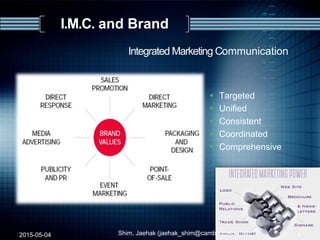
I.M.C. and Brand
2015-05-04 Shim, Jaehak (jaehak_shim@cambridgejbs.net)
Integrated Marketing Communication
 Targeted
 Unified
 Consistent
 Coordinated
 Comprehensive
4
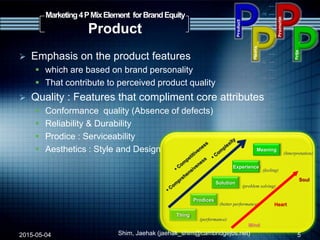
Thing
Experience
Prodices
Solution
Meaning
(performance)
(better performance)
(problem solving)
(feeling)
(Interpretation)
Heart
Mind
Soul
Marketing4PMixElement forBrandEquity
Product
 Emphasis on the product features
 which are based on brand personality
 That contribute to perceived product quality
 Quality : Features that compliment core attributes
 Conformance quality (Absence of defects)
 Reliability & Durability
 Prodice : Serviceability
 Aesthetics : Style and Design
2015-05-04 Shim, Jaehak (jaehak_shim@cambridgejbs.net) 5
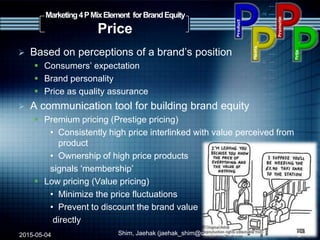
 Based on perceptions of a brand‟s position
 Consumers‟ expectation
 Brand personality
 Price as quality assurance
 A communication tool for building brand equity
 Premium pricing (Prestige pricing)
• Consistently high price interlinked with value perceived from
product
• Ownership of high price products
signals „membership‟
 Low pricing (Value pricing)
• Minimize the price fluctuations
• Prevent to discount the brand value
directly
2015-05-04 Shim, Jaehak (jaehak_shim@cambridgejbs.net)
Marketing4PMixElement forBrandEquity
Price
6
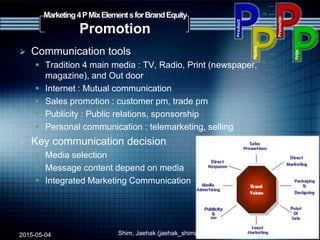
 Communication tools
 Tradition 4 main media : TV, Radio, Print (newspaper,
magazine), and Out door
 Internet : Mutual communication
 Sales promotion : customer pm, trade pm
 Publicity : Public relations, sponsorship
 Personal communication : telemarketing, selling
 Key communication decision
 Media selection
 Message content depend on media
 Integrated Marketing Communication
2015-05-04 Shim, Jaehak (jaehak_shim@cambridgejbs.net)
Marketing4PMixElementsforBrandEquity
Promotion
7
 Select the channel strategy based on the
positioning, PLC and market environment
 Strategy options
 Direct channel strategy when the product information, product
customization, quality assurance is relatively important
 Indirect channel strategy when availability (distribution), low scale
of sales
 Consideration from current market environment
 Shift in balance of power between manufacturer and channel
 Reduced brand loyalty
 Splintered mass market & reduced media effectiveness
 The role of retailer image
2015-05-04 Shim, Jaehak (jaehak_shim@cambridgejbs.net)
Marketing4PMixElement forBrandEquity
Place
8
Tell me….
2015-05-04 Shim, Jaehak (jaehak_shim@cambridgejbs.net) 9
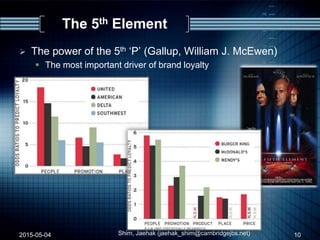
 The power of the 5th „P‟ (Gallup, William J. McEwen)
 The most important driver of brand loyalty
2015-05-04 Shim, Jaehak (jaehak_shim@cambridgejbs.net)
The 5th Element
10
The 5th P
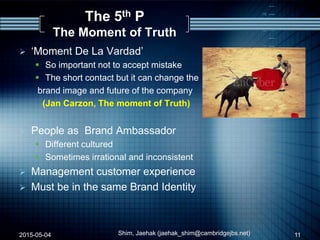
The Moment of Truth
 „Moment De La Vardad‟
 So important not to accept mistake
 The short contact but it can change the
brand image and future of the company
(Jan Carzon, The moment of Truth)
 People as Brand Ambassador
 Different cultured
 Sometimes irrational and inconsistent
 Management customer experience
 Must be in the same Brand Identity
2015-05-04 Shim, Jaehak (jaehak_shim@cambridgejbs.net) 11
Integrated Marketing
Communications
 The “voice” of the brand
 A means by which it can establish a dialogue and build
relationships with consumers
 Allow marketers to inform, persuade, provide incentives,
and remind consumers directly or indirectly
 Can contribute to brand equity by establishing the brand
in memory and linking strong, favorable, and unique
associations to it
2015-05-04 Shim, Jaehak (jaehak_shim@cambridgejbs.net) 12
Developing IMC
Programs
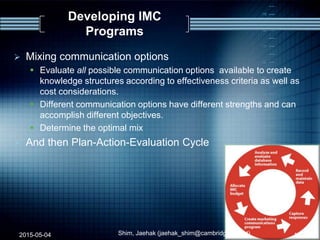
 Mixing communication options
 Evaluate all possible communication options available to create
knowledge structures according to effectiveness criteria as well as
cost considerations.
 Different communication options have different strengths and can
accomplish different objectives.
 Determine the optimal mix
 And then Plan-Action-Evaluation Cycle
2015-05-04 Shim, Jaehak (jaehak_shim@cambridgejbs.net) 13
Evaluating IMC
Programs
 Coverage: What proportion of the target audience is
reached by each communication option employed?
 Frequency: How many times target audience are
exposure to IMC ?How much overlap exists among
options?
 Cost: What is the per capita expense?
 Contribution: The collective effect on brand equity in
terms of
 enhancing depth and breadth of awareness
 improving strength, favorability, and
uniqueness of brand associations
2015-05-04 14Shim, Jaehak (jaehak_shim@cambridgejbs.net)
Evaluating IMC
Programs (cont.)
 Commonality: The extent to which information conveyed
by different communication options share meaning
 Complementarities: The extent to which different associations
and linkages are emphasized across communication options
 Versatility: The extent to which information contained in a
communication option works with different types of
consumers
 Different communications history
 Different market segments
2015-05-04 Shim, Jaehak (jaehak_shim@cambridgejbs.net) 15
Brand Communication
Guidelines
 Be analytical : Use frameworks of consumer behavior
and managerial decision making to develop well-reasoned
communication programs
 Be curious : Fully understand consumers by using all
forms of research and always be thinking of how you
can create added value for consumers
 Be single-minded : Focus message on well-defined targe
t markets (less can be more)
 Be integrative : Reinforce your
message through consistency and
cuing across all communications
2015-05-04 Shim, Jaehak (jaehak_shim@cambridgejbs.net) 16
Marketing Communication
Guidelines (Cont.)
 Be creative : State your message in a unique fashion;
use alternative promotions and media to create favorable,
strong, and unique brand associations
 Be observant : Monitor competition, customers, channel
members, and employees through tracking studies
 Be realistic : Understand the complexities involved in
marketing communications
 Be patient : Take a long-term view of communication
effectiveness to build and manage brand equity
2015-05-04 Shim, Jaehak (jaehak_shim@cambridgejbs.net) 17
Complete
Brand Guide Line
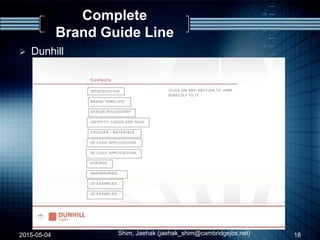
 Dunhill
2015-05-04 Shim, Jaehak (jaehak_shim@cambridgejbs.net) 18
Strategic Brand
Management
 Strategic brand management involves the design and
implementation of marketing programs and activities
to build, measure, and manage brand equity.

 The strategic brand management process is defined as
involving four main steps
 Identifying and establishing brand positioning and values
 Planning and implementing brand marketing programs
 Measuring and interpreting brand performance
 Growing and sustaining brand equity
2015-05-04 Shim, Jaehak (jaehak_shim@cambridgejbs.net) 19
Strategic Brand
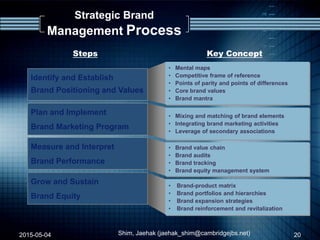
Management Process
• Mental maps
• Competitive frame of reference
• Points of parity and points of differences
• Core brand values
• Brand mantra
Identify and Establish
Brand Positioning and Values
• Mixing and matching of brand elements
• Integrating brand marketing activities
• Leverage of secondary associations
Plan and Implement
Brand Marketing Program
• Brand value chain
• Brand audits
• Brand tracking
• Brand equity management system
Measure and Interpret
Brand Performance
• Brand-product matrix
• Brand portfolios and hierarchies
• Brand expansion strategies
• Brand reinforcement and revitalization
Grow and Sustain
Brand Equity
Steps Key Concept
2015-05-04 Shim, Jaehak (jaehak_shim@cambridgejbs.net) 20
Managerial Assistance
for Brand Management
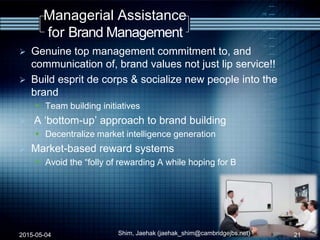
 Genuine top management commitment to, and
communication of, brand values not just lip service!!
 Build esprit de corps & socialize new people into the
brand
 Team building initiatives
 A „bottom-up‟ approach to brand building
 Decentralize market intelligence generation
 Market-based reward systems
 Avoid the “folly of rewarding A while hoping for B
2015-05-04 Shim, Jaehak (jaehak_shim@cambridgejbs.net) 21
Guide Lines for
Brand Management
1. Protect your brand
2. Honor your stakeholder
3. Treat your brand as an investment, not a cost
4. Exploit the financial potential of your brand
5. Understand that successful brand management
nowadays is a complex task
(Tom Blakett, The Economist)
2015-05-04 Shim, Jaehak (jaehak_shim@cambridgejbs.net) 22
“The world is unequal, unstable and unsustainable-
governments alone can’t move us where we need to
be”
Bill Clinton, 2006
2015-05-04 Shim, Jaehak (jaehak_shim@cambridgejbs.net) 23
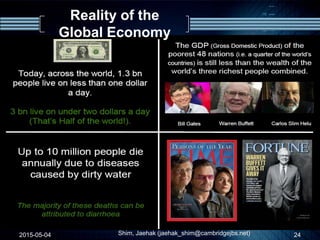
Reality of the
Global Economy
2015-05-04 24Shim, Jaehak (jaehak_shim@cambridgejbs.net)
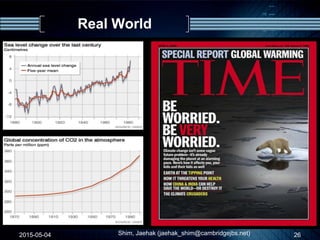
Real World
2015-05-04 25Shim, Jaehak (jaehak_shim@cambridgejbs.net)
Real World
2015-05-04 26Shim, Jaehak (jaehak_shim@cambridgejbs.net)
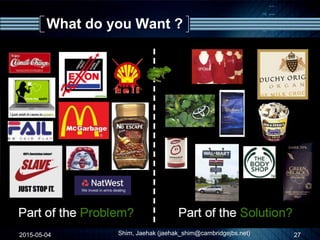
What do you Want ?
2015-05-04 27Shim, Jaehak (jaehak_shim@cambridgejbs.net)
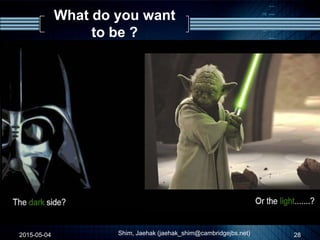
What do you want
to be ?
2015-05-04 28Shim, Jaehak (jaehak_shim@cambridgejbs.net)
Why be on the light
side ?
2015-05-04 Shim, Jaehak (jaehak_shim@cambridgejbs.net) 29
Answer is….
 Because we are good Christian ?
 Or we believe responsibility as a „Good Samaritan‟?
 Or due to the cost efficiency due to the tax reduction ?
However,
We are not charity non profit organization…..
The real justification is the fact that customers care
about social and environmental issues.
“ We want to make more sustainable profit in long
term “
2015-05-04 Shim, Jaehak (jaehak_shim@cambridgejbs.net) 30
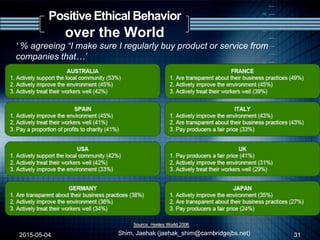
Positive Ethical Behavior
over the World
‘ % agreeing “I make sure I regularly buy product or service from
companies that…’
2015-05-04 Shim, Jaehak (jaehak_shim@cambridgejbs.net) 31
Understanding
Ethical Behavior
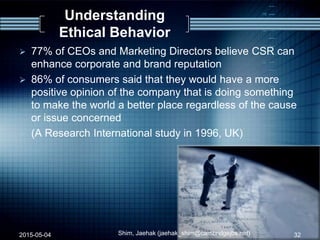
 77% of CEOs and Marketing Directors believe CSR can
enhance corporate and brand reputation
 86% of consumers said that they would have a more
positive opinion of the company that is doing something
to make the world a better place regardless of the cause
or issue concerned
 (A Research International study in 1996, UK)
2015-05-04 Shim, Jaehak (jaehak_shim@cambridgejbs.net) 32
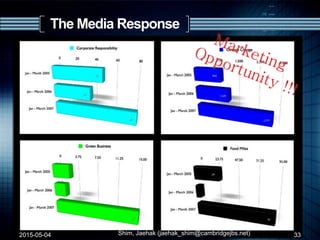
The Media Response
2015-05-04 Shim, Jaehak (jaehak_shim@cambridgejbs.net) 33
Corporate Social
Responsibility
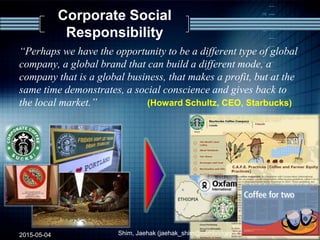
“Perhaps we have the opportunity to be a different type of global
company, a global brand that can build a different mode, a
company that is a global business, that makes a profit, but at the
same time demonstrates, a social conscience and gives back to
the local market.” (Howard Schultz, CEO, Starbucks)
2015-05-04 Shim, Jaehak (jaehak_shim@cambridgejbs.net) 34
CSR &
Brand Management
 If you can prove that your business is making a positive
contribution to the societal challenge then you can create
ADVANTAGE
 If others can prove that your business is making our societal
challenge more difficult then you are exposed to
REPUTAION RISK
(Freud Communication 2007)
A company's reputation can quickly be tarnished if activists
target its policies and practices
2015-05-04 35Shim, Jaehak (jaehak_shim@cambridgejbs.net)
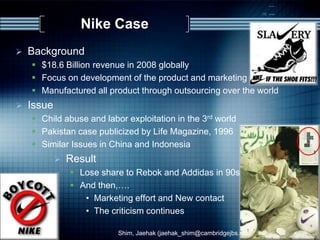
Nike Case
 Background
 $18.6 Billion revenue in 2008 globally
 Focus on development of the product and marketing
 Manufactured all product through outsourcing over the world
 Issue
 Child abuse and labor exploitation in the 3rd world
 Pakistan case publicized by Life Magazine, 1996
 Similar Issues in China and Indonesia
 Result
 Lose share to Rebok and Addidas in 90s
 And then,….
• Marketing effort and New contact
• The criticism continues
2015-05-04 Shim, Jaehak (jaehak_shim@cambridgejbs.net) 36
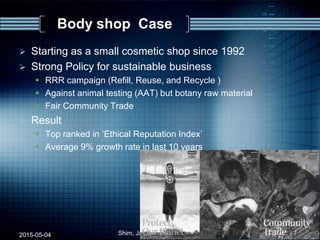
Body shop Case
 Starting as a small cosmetic shop since 1992
 Strong Policy for sustainable business
 RRR campaign (Refill, Reuse, and Recycle )
 Against animal testing (AAT) but botany raw material
 Fair Community Trade
 Result
 Top ranked in „Ethical Reputation Index‟
 Average 9% growth rate in last 10 years
2015-05-04 Shim, Jaehak (jaehak_shim@cambridgejbs.net) 37
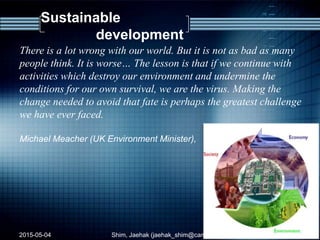
Sustainable
development
There is a lot wrong with our world. But it is not as bad as many
people think. It is worse… The lesson is that if we continue with
activities which destroy our environment and undermine the
conditions for our own survival, we are the virus. Making the
change needed to avoid that fate is perhaps the greatest challenge
we have ever faced.
Michael Meacher (UK Environment Minister),
2015-05-04 38Shim, Jaehak (jaehak_shim@cambridgejbs.net)
Definitions of
sustainable development
“…development that meets the needs of the present without
compromising the ability of future generations to meet their
own needs.”
Source: G H Brundtland, 1987, Our common future, report of the World
Commission on environment and development, Oxford University Press.
“The goal of sustainable development is to enable all
people throughout the world to satisfy their basic needs
and enjoy a better quality of life, without compromising
the quality of life of future generations…
Source: UK Sustainable Development Commission,
http://www.sd-commission.org.uk/pages/principles/definitions.html
2015-05-04 39Shim, Jaehak (jaehak_shim@cambridgejbs.net)
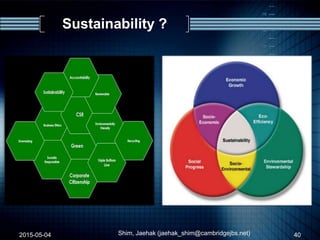
Sustainability ?
2015-05-04 Shim, Jaehak (jaehak_shim@cambridgejbs.net) 40
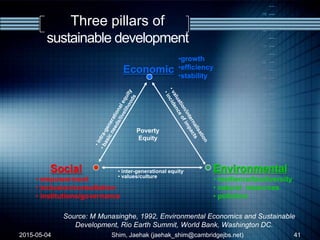
Social
• empowerment
• inclusion/consultation
• institutions/governance
Environmental
• resilience/biodiversity
• natural resources
• pollution
Economic
• inter-generational equity
• values/culture
Poverty
Equity
•growth
•efficiency
•stability
Source: M Munasinghe, 1992, Environmental Economics and Sustainable
Development, Rio Earth Summit, World Bank, Washington DC.
Three pillars of
sustainable development
2015-05-04 41Shim, Jaehak (jaehak_shim@cambridgejbs.net)
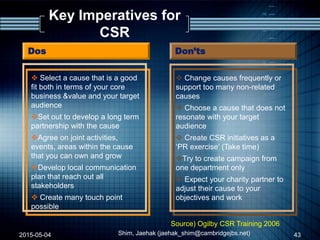
Key Imperatives for
CSR
Don’tsDos
 Select a cause that is a good
fit both in terms of your core
business &value and your target
audience
Set out to develop a long term
partnership with the cause
Agree on joint activities,
events, areas within the cause
that you can own and grow
Develop local communication
plan that reach out all
stakeholders
 Create many touch point
possible
 Change causes frequently or
support too many non-related
causes
 Choose a cause that does not
resonate with your target
audience
 Create CSR initiatives as a
„PR exercise‟ (Take time)
Try to create campaign from
one department only
 Expect your charity partner to
adjust their cause to your
objectives and work
2015-05-04 43Shim, Jaehak (jaehak_shim@cambridgejbs.net)
Source) Ogilby CSR Training 2006
Possible Global
Charity Partners
2015-05-04 Shim, Jaehak (jaehak_shim@cambridgejbs.net) 44
Wrap-up
 Marketing elements for brand equity
 4 P Mix & 5th P
 Strategic Brand Management
 Corporate Social Responsibility
 Concept
 Potential of CSR for Marketing
 The essence of CSR for Brand Management
 Sustainable Development
 Key imperatives for CSR activates

2015-05-04 Shim, Jaehak (jaehak_shim@cambridgejbs.net) 45

Bm 9 marketing element for be and csr

  • 1.
    “ We can,We will ” Brand Management 9 Marketing Elements for Brand Equity / CSR Shim, Jae hak
  • 2.
    Cold Call 2015-05-04 Shim,Jaehak (jaehak_shim@cambridgejbs.net) Brand Equity? C.B.B.E.? 2
  • 3.
    Contents 1 Strategic Brand Management2 MarketingElements for brand equity 2015-05-04 Shim, Jaehak (jaehak_shim@cambridgejbs.net) What we will discuss and achieve today ? 3 Sustainability of Brand and CSR 4 3 Key Imperatives for CSR
  • 4.
    I.M.C. and Brand 2015-05-04Shim, Jaehak (jaehak_shim@cambridgejbs.net) Integrated Marketing Communication  Targeted  Unified  Consistent  Coordinated  Comprehensive 4
  • 5.
    Thing Experience Prodices Solution Meaning (performance) (better performance) (problem solving) (feeling) (Interpretation) Heart Mind Soul Marketing4PMixElementforBrandEquity Product  Emphasis on the product features  which are based on brand personality  That contribute to perceived product quality  Quality : Features that compliment core attributes  Conformance quality (Absence of defects)  Reliability & Durability  Prodice : Serviceability  Aesthetics : Style and Design 2015-05-04 Shim, Jaehak (jaehak_shim@cambridgejbs.net) 5
  • 6.
     Based onperceptions of a brand‟s position  Consumers‟ expectation  Brand personality  Price as quality assurance  A communication tool for building brand equity  Premium pricing (Prestige pricing) • Consistently high price interlinked with value perceived from product • Ownership of high price products signals „membership‟  Low pricing (Value pricing) • Minimize the price fluctuations • Prevent to discount the brand value directly 2015-05-04 Shim, Jaehak (jaehak_shim@cambridgejbs.net) Marketing4PMixElement forBrandEquity Price 6
  • 7.
     Communication tools Tradition 4 main media : TV, Radio, Print (newspaper, magazine), and Out door  Internet : Mutual communication  Sales promotion : customer pm, trade pm  Publicity : Public relations, sponsorship  Personal communication : telemarketing, selling  Key communication decision  Media selection  Message content depend on media  Integrated Marketing Communication 2015-05-04 Shim, Jaehak (jaehak_shim@cambridgejbs.net) Marketing4PMixElementsforBrandEquity Promotion 7
  • 8.
     Select thechannel strategy based on the positioning, PLC and market environment  Strategy options  Direct channel strategy when the product information, product customization, quality assurance is relatively important  Indirect channel strategy when availability (distribution), low scale of sales  Consideration from current market environment  Shift in balance of power between manufacturer and channel  Reduced brand loyalty  Splintered mass market & reduced media effectiveness  The role of retailer image 2015-05-04 Shim, Jaehak (jaehak_shim@cambridgejbs.net) Marketing4PMixElement forBrandEquity Place 8
  • 9.
    Tell me…. 2015-05-04 Shim,Jaehak (jaehak_shim@cambridgejbs.net) 9
  • 10.
     The powerof the 5th „P‟ (Gallup, William J. McEwen)  The most important driver of brand loyalty 2015-05-04 Shim, Jaehak (jaehak_shim@cambridgejbs.net) The 5th Element 10
  • 11.
    The 5th P TheMoment of Truth  „Moment De La Vardad‟  So important not to accept mistake  The short contact but it can change the brand image and future of the company (Jan Carzon, The moment of Truth)  People as Brand Ambassador  Different cultured  Sometimes irrational and inconsistent  Management customer experience  Must be in the same Brand Identity 2015-05-04 Shim, Jaehak (jaehak_shim@cambridgejbs.net) 11
  • 12.
    Integrated Marketing Communications  The“voice” of the brand  A means by which it can establish a dialogue and build relationships with consumers  Allow marketers to inform, persuade, provide incentives, and remind consumers directly or indirectly  Can contribute to brand equity by establishing the brand in memory and linking strong, favorable, and unique associations to it 2015-05-04 Shim, Jaehak (jaehak_shim@cambridgejbs.net) 12
  • 13.
    Developing IMC Programs  Mixingcommunication options  Evaluate all possible communication options available to create knowledge structures according to effectiveness criteria as well as cost considerations.  Different communication options have different strengths and can accomplish different objectives.  Determine the optimal mix  And then Plan-Action-Evaluation Cycle 2015-05-04 Shim, Jaehak (jaehak_shim@cambridgejbs.net) 13
  • 14.
    Evaluating IMC Programs  Coverage:What proportion of the target audience is reached by each communication option employed?  Frequency: How many times target audience are exposure to IMC ?How much overlap exists among options?  Cost: What is the per capita expense?  Contribution: The collective effect on brand equity in terms of  enhancing depth and breadth of awareness  improving strength, favorability, and uniqueness of brand associations 2015-05-04 14Shim, Jaehak (jaehak_shim@cambridgejbs.net)
  • 15.
    Evaluating IMC Programs (cont.) Commonality: The extent to which information conveyed by different communication options share meaning  Complementarities: The extent to which different associations and linkages are emphasized across communication options  Versatility: The extent to which information contained in a communication option works with different types of consumers  Different communications history  Different market segments 2015-05-04 Shim, Jaehak (jaehak_shim@cambridgejbs.net) 15
  • 16.
    Brand Communication Guidelines  Beanalytical : Use frameworks of consumer behavior and managerial decision making to develop well-reasoned communication programs  Be curious : Fully understand consumers by using all forms of research and always be thinking of how you can create added value for consumers  Be single-minded : Focus message on well-defined targe t markets (less can be more)  Be integrative : Reinforce your message through consistency and cuing across all communications 2015-05-04 Shim, Jaehak (jaehak_shim@cambridgejbs.net) 16
  • 17.
    Marketing Communication Guidelines (Cont.) Be creative : State your message in a unique fashion; use alternative promotions and media to create favorable, strong, and unique brand associations  Be observant : Monitor competition, customers, channel members, and employees through tracking studies  Be realistic : Understand the complexities involved in marketing communications  Be patient : Take a long-term view of communication effectiveness to build and manage brand equity 2015-05-04 Shim, Jaehak (jaehak_shim@cambridgejbs.net) 17
  • 18.
    Complete Brand Guide Line Dunhill 2015-05-04 Shim, Jaehak (jaehak_shim@cambridgejbs.net) 18
  • 19.
    Strategic Brand Management  Strategicbrand management involves the design and implementation of marketing programs and activities to build, measure, and manage brand equity.  The strategic brand management process is defined as involving four main steps  Identifying and establishing brand positioning and values  Planning and implementing brand marketing programs  Measuring and interpreting brand performance  Growing and sustaining brand equity 2015-05-04 Shim, Jaehak (jaehak_shim@cambridgejbs.net) 19
  • 20.
    Strategic Brand Management Process •Mental maps • Competitive frame of reference • Points of parity and points of differences • Core brand values • Brand mantra Identify and Establish Brand Positioning and Values • Mixing and matching of brand elements • Integrating brand marketing activities • Leverage of secondary associations Plan and Implement Brand Marketing Program • Brand value chain • Brand audits • Brand tracking • Brand equity management system Measure and Interpret Brand Performance • Brand-product matrix • Brand portfolios and hierarchies • Brand expansion strategies • Brand reinforcement and revitalization Grow and Sustain Brand Equity Steps Key Concept 2015-05-04 Shim, Jaehak (jaehak_shim@cambridgejbs.net) 20
  • 21.
    Managerial Assistance for BrandManagement  Genuine top management commitment to, and communication of, brand values not just lip service!!  Build esprit de corps & socialize new people into the brand  Team building initiatives  A „bottom-up‟ approach to brand building  Decentralize market intelligence generation  Market-based reward systems  Avoid the “folly of rewarding A while hoping for B 2015-05-04 Shim, Jaehak (jaehak_shim@cambridgejbs.net) 21
  • 22.
    Guide Lines for BrandManagement 1. Protect your brand 2. Honor your stakeholder 3. Treat your brand as an investment, not a cost 4. Exploit the financial potential of your brand 5. Understand that successful brand management nowadays is a complex task (Tom Blakett, The Economist) 2015-05-04 Shim, Jaehak (jaehak_shim@cambridgejbs.net) 22
  • 23.
    “The world isunequal, unstable and unsustainable- governments alone can’t move us where we need to be” Bill Clinton, 2006 2015-05-04 Shim, Jaehak (jaehak_shim@cambridgejbs.net) 23
  • 24.
    Reality of the GlobalEconomy 2015-05-04 24Shim, Jaehak (jaehak_shim@cambridgejbs.net)
  • 25.
    Real World 2015-05-04 25Shim,Jaehak (jaehak_shim@cambridgejbs.net)
  • 26.
    Real World 2015-05-04 26Shim,Jaehak (jaehak_shim@cambridgejbs.net)
  • 27.
    What do youWant ? 2015-05-04 27Shim, Jaehak (jaehak_shim@cambridgejbs.net)
  • 28.
    What do youwant to be ? 2015-05-04 28Shim, Jaehak (jaehak_shim@cambridgejbs.net)
  • 29.
    Why be onthe light side ? 2015-05-04 Shim, Jaehak (jaehak_shim@cambridgejbs.net) 29
  • 30.
    Answer is….  Becausewe are good Christian ?  Or we believe responsibility as a „Good Samaritan‟?  Or due to the cost efficiency due to the tax reduction ? However, We are not charity non profit organization….. The real justification is the fact that customers care about social and environmental issues. “ We want to make more sustainable profit in long term “ 2015-05-04 Shim, Jaehak (jaehak_shim@cambridgejbs.net) 30
  • 31.
    Positive Ethical Behavior overthe World ‘ % agreeing “I make sure I regularly buy product or service from companies that…’ 2015-05-04 Shim, Jaehak (jaehak_shim@cambridgejbs.net) 31
  • 32.
    Understanding Ethical Behavior  77%of CEOs and Marketing Directors believe CSR can enhance corporate and brand reputation  86% of consumers said that they would have a more positive opinion of the company that is doing something to make the world a better place regardless of the cause or issue concerned  (A Research International study in 1996, UK) 2015-05-04 Shim, Jaehak (jaehak_shim@cambridgejbs.net) 32
  • 33.
    The Media Response 2015-05-04Shim, Jaehak (jaehak_shim@cambridgejbs.net) 33
  • 34.
    Corporate Social Responsibility “Perhaps wehave the opportunity to be a different type of global company, a global brand that can build a different mode, a company that is a global business, that makes a profit, but at the same time demonstrates, a social conscience and gives back to the local market.” (Howard Schultz, CEO, Starbucks) 2015-05-04 Shim, Jaehak (jaehak_shim@cambridgejbs.net) 34
  • 35.
    CSR & Brand Management If you can prove that your business is making a positive contribution to the societal challenge then you can create ADVANTAGE  If others can prove that your business is making our societal challenge more difficult then you are exposed to REPUTAION RISK (Freud Communication 2007) A company's reputation can quickly be tarnished if activists target its policies and practices 2015-05-04 35Shim, Jaehak (jaehak_shim@cambridgejbs.net)
  • 36.
    Nike Case  Background $18.6 Billion revenue in 2008 globally  Focus on development of the product and marketing  Manufactured all product through outsourcing over the world  Issue  Child abuse and labor exploitation in the 3rd world  Pakistan case publicized by Life Magazine, 1996  Similar Issues in China and Indonesia  Result  Lose share to Rebok and Addidas in 90s  And then,…. • Marketing effort and New contact • The criticism continues 2015-05-04 Shim, Jaehak (jaehak_shim@cambridgejbs.net) 36
  • 37.
    Body shop Case Starting as a small cosmetic shop since 1992  Strong Policy for sustainable business  RRR campaign (Refill, Reuse, and Recycle )  Against animal testing (AAT) but botany raw material  Fair Community Trade  Result  Top ranked in „Ethical Reputation Index‟  Average 9% growth rate in last 10 years 2015-05-04 Shim, Jaehak (jaehak_shim@cambridgejbs.net) 37
  • 38.
    Sustainable development There is alot wrong with our world. But it is not as bad as many people think. It is worse… The lesson is that if we continue with activities which destroy our environment and undermine the conditions for our own survival, we are the virus. Making the change needed to avoid that fate is perhaps the greatest challenge we have ever faced. Michael Meacher (UK Environment Minister), 2015-05-04 38Shim, Jaehak (jaehak_shim@cambridgejbs.net)
  • 39.
    Definitions of sustainable development “…developmentthat meets the needs of the present without compromising the ability of future generations to meet their own needs.” Source: G H Brundtland, 1987, Our common future, report of the World Commission on environment and development, Oxford University Press. “The goal of sustainable development is to enable all people throughout the world to satisfy their basic needs and enjoy a better quality of life, without compromising the quality of life of future generations… Source: UK Sustainable Development Commission, http://www.sd-commission.org.uk/pages/principles/definitions.html 2015-05-04 39Shim, Jaehak (jaehak_shim@cambridgejbs.net)
  • 40.
    Sustainability ? 2015-05-04 Shim,Jaehak (jaehak_shim@cambridgejbs.net) 40
  • 41.
    Social • empowerment • inclusion/consultation •institutions/governance Environmental • resilience/biodiversity • natural resources • pollution Economic • inter-generational equity • values/culture Poverty Equity •growth •efficiency •stability Source: M Munasinghe, 1992, Environmental Economics and Sustainable Development, Rio Earth Summit, World Bank, Washington DC. Three pillars of sustainable development 2015-05-04 41Shim, Jaehak (jaehak_shim@cambridgejbs.net)
  • 42.
    Key Imperatives for CSR Don’tsDos Select a cause that is a good fit both in terms of your core business &value and your target audience Set out to develop a long term partnership with the cause Agree on joint activities, events, areas within the cause that you can own and grow Develop local communication plan that reach out all stakeholders  Create many touch point possible  Change causes frequently or support too many non-related causes  Choose a cause that does not resonate with your target audience  Create CSR initiatives as a „PR exercise‟ (Take time) Try to create campaign from one department only  Expect your charity partner to adjust their cause to your objectives and work 2015-05-04 43Shim, Jaehak (jaehak_shim@cambridgejbs.net) Source) Ogilby CSR Training 2006
  • 43.
    Possible Global Charity Partners 2015-05-04Shim, Jaehak (jaehak_shim@cambridgejbs.net) 44
  • 44.
    Wrap-up  Marketing elementsfor brand equity  4 P Mix & 5th P  Strategic Brand Management  Corporate Social Responsibility  Concept  Potential of CSR for Marketing  The essence of CSR for Brand Management  Sustainable Development  Key imperatives for CSR activates  2015-05-04 Shim, Jaehak (jaehak_shim@cambridgejbs.net) 45