1


GEAR TRAINS
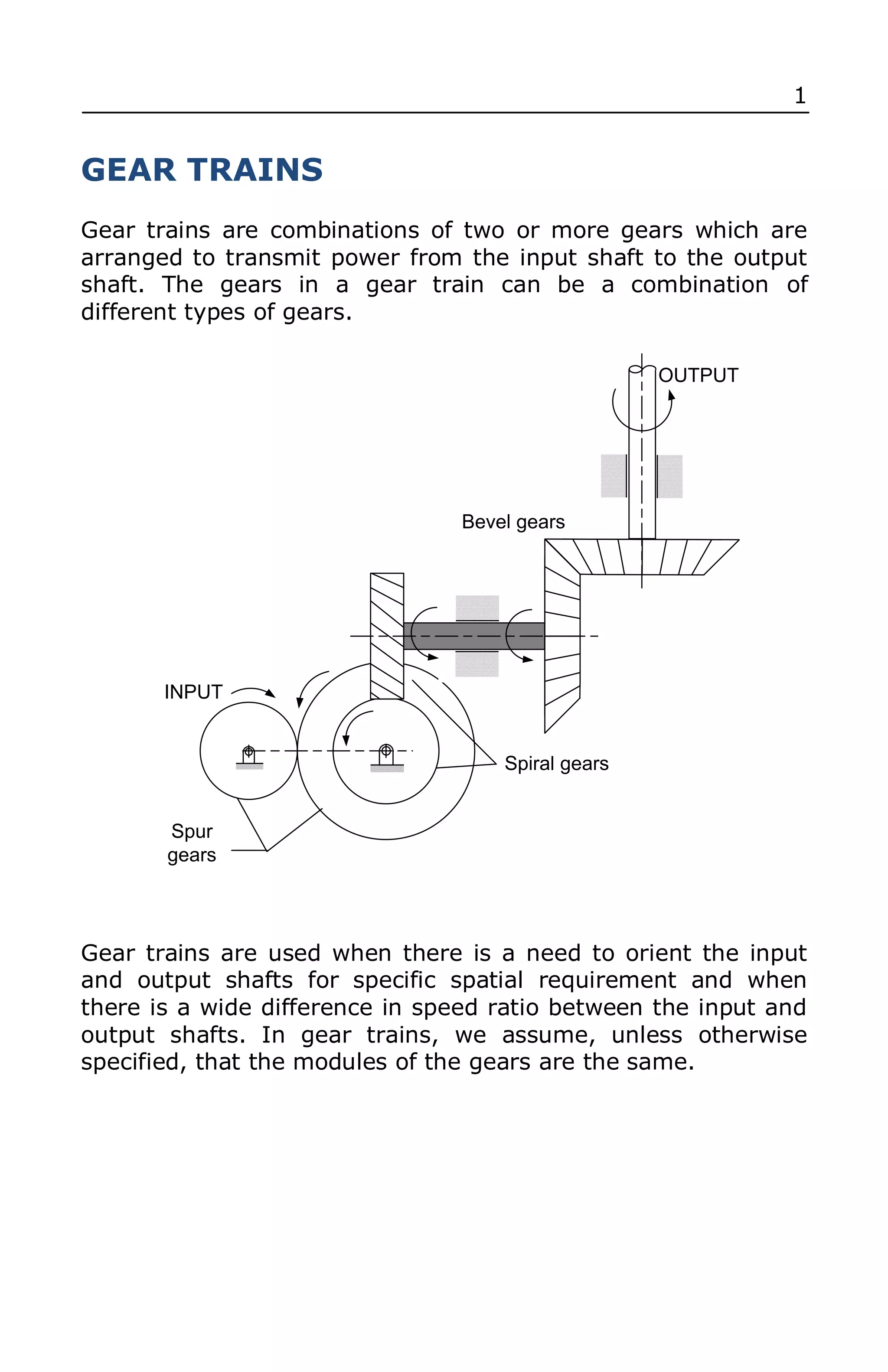
Gear trains are combinations of two or more gears which are
arranged to transmit power from the input shaft to the output
shaft. The gears in a gear train can be a combination of
different types of gears.

                                                    OUTPUT


                                 Bevel gears


       INPUT


                                     Spiral gears


       Spur
       gears


Gear trains are used when there is a need to orient the input
and output shafts for specific spatial requirement and when
there is a wide difference in speed ratio between the input and
output shafts. In gear trains, we assume, unless otherwise
specified, that the modules of the gears are the same.
2

Types of Gear Trains

   1. Simple gear train

             In a simple gear train, there is only one gear per
             shaft.

   2. Compound gear train

             In a compound gear train, there can be more
             than one gear per shaft.

   3. Epicyclic gear train

                                          Ring gear or
                                          Internal gear


                                                      Planet arm

                 Sun gear


                                Planet pinions


             In an epicyclic gear train, the gears are mounted
             in shafts that are moving relative to a fixed axis.
             In this gear train, at least one gear axis is on
             rotation relative to the frame.
3

SIMPLE GEAR TRAINS

                                        ω3
                             ω2
                 ω1


                      T1           T2        T3


Considering Gear 1 and 2, both rotates at opposite direction:

       1   T
           2
       2   T1

                 2 T2   1 T1                  (1)

Considering Gear 2 and 3, both rotates at opposite direction:

       2  3

                 2 T2   3 T3                  (2)

Substitute (1) to (2):

        1T1   3T3
4

Hence,

                1  T
         VR        3
                3  T1

We can see that the velocity ratio of between the input and the
output shaft of a simple gear train is independent of the
intermediate gear 2, the intermediate gear will just change the
direction of rotation of gear 3. The positive sign of the velocity
ratio signifies that both the input gear 1 and output gear 2 are
rotating at the same direction.

Different Types of Simple Gear Trains

(a)


                 1                                3


                                   2


                1  T
         VR        3
                3  T1
5

(b)


                       2


                               3
                  1


                                       4


             1   T
      VR        4
             4   T1

(c)


                                   1


                                       2
                           3

                                       4


             1  T
      VR        4
             4  T1
6


COMPOUND GEAR TRAINS


                                                           ω4
                                                ω2
                                    ω1

                                               ω3


                                                      T2

                                          T1
                                                      T3          T4


Considering Gear 1 and 2, both rotates at opposite direction:

       1   T
           2
       2   T1

               2 T2   1 T1                              (1)

Considering Gear 2 and 3:

       2  3                                      (2)

Considering Gear 3 and 4, both rotates at opposite direction:

       3   T
           4
       4   T3

                                  4 T4
               2  3                            (3)
                                  T3


Substitute (3) to (1):

         T     
        4 4
         T
                 T2   1 T1
                 
         3      
7


Hence,

                1  T T
         VR        2 4
                4  T1 T3


                Pr oduct of teeth on driven gears
         VR 
                Pr oduct of teeth on driving gears

For compound gear train, the speed ratio is decided by all the number of teeth in the gear.

MACHINE TOOL GEAR TRAIN APPLICATIONS

A gear box is an enclosed metal casing of gear assembly that is used to generate several
output speed from one input speed, such as in automobiles and machine tools.

                                                        T9d
                                                  T8c     T10e
                            Upper shifting gear
                                  block

                                                                       Spindle

                                      T3a    T4b T5c             T7e
                                                         T6d


                                      T1a   T2b

                     Electric Motor    Lower shifting gear
                                             block

Figure shows a layout of machine tool spindle with six speeds. In a machine tool gear box,
we use slide cluster to change the engagement of the gears. This is different with
automobile gear boxes because in a machine tool gear boxes, we have to stop first the
machine before we can change the gear engagement.

Gear trains

  • 1.
    1 GEAR TRAINS Gear trainsare combinations of two or more gears which are arranged to transmit power from the input shaft to the output shaft. The gears in a gear train can be a combination of different types of gears. OUTPUT Bevel gears INPUT Spiral gears Spur gears Gear trains are used when there is a need to orient the input and output shafts for specific spatial requirement and when there is a wide difference in speed ratio between the input and output shafts. In gear trains, we assume, unless otherwise specified, that the modules of the gears are the same.
  • 2.
    2 Types of GearTrains 1. Simple gear train In a simple gear train, there is only one gear per shaft. 2. Compound gear train In a compound gear train, there can be more than one gear per shaft. 3. Epicyclic gear train Ring gear or Internal gear Planet arm Sun gear Planet pinions In an epicyclic gear train, the gears are mounted in shafts that are moving relative to a fixed axis. In this gear train, at least one gear axis is on rotation relative to the frame.
  • 3.
    3 SIMPLE GEAR TRAINS ω3 ω2 ω1 T1 T2 T3 Considering Gear 1 and 2, both rotates at opposite direction: 1 T  2 2 T1 2 T2   1 T1 (1) Considering Gear 2 and 3, both rotates at opposite direction: 2  3 2 T2   3 T3 (2) Substitute (1) to (2):  1T1   3T3
  • 4.
    4 Hence, 1 T VR   3 3 T1 We can see that the velocity ratio of between the input and the output shaft of a simple gear train is independent of the intermediate gear 2, the intermediate gear will just change the direction of rotation of gear 3. The positive sign of the velocity ratio signifies that both the input gear 1 and output gear 2 are rotating at the same direction. Different Types of Simple Gear Trains (a) 1 3 2 1 T VR   3 3 T1
  • 5.
    5 (b) 2 3 1 4 1 T VR   4 4 T1 (c) 1 2 3 4 1 T VR   4 4 T1
  • 6.
    6 COMPOUND GEAR TRAINS ω4 ω2 ω1 ω3 T2 T1 T3 T4 Considering Gear 1 and 2, both rotates at opposite direction: 1 T  2 2 T1 2 T2   1 T1 (1) Considering Gear 2 and 3: 2  3 (2) Considering Gear 3 and 4, both rotates at opposite direction: 3 T  4 4 T3  4 T4 2  3   (3) T3 Substitute (3) to (1):  T   4 4  T T2   1 T1   3 
  • 7.
    7 Hence, 1 T T VR   2 4 4 T1 T3 Pr oduct of teeth on driven gears VR  Pr oduct of teeth on driving gears For compound gear train, the speed ratio is decided by all the number of teeth in the gear. MACHINE TOOL GEAR TRAIN APPLICATIONS A gear box is an enclosed metal casing of gear assembly that is used to generate several output speed from one input speed, such as in automobiles and machine tools. T9d T8c T10e Upper shifting gear block Spindle T3a T4b T5c T7e T6d T1a T2b Electric Motor Lower shifting gear block Figure shows a layout of machine tool spindle with six speeds. In a machine tool gear box, we use slide cluster to change the engagement of the gears. This is different with automobile gear boxes because in a machine tool gear boxes, we have to stop first the machine before we can change the gear engagement.