Shooting Down Ideas Without Turning  Students Off Heather Spell Arrington Assistant Director Student Leadership Development Programs
Why are you here?
What is Feedback? Feedback Sandwich Feedback Tips Why is this important ?
FEEDBACK It's not about force or demanding change It is supposed to "feed" or nourish the person who is receiving it.  My definition:  Feedback is nourishing another person directly so that they can grow professionally and personally.
Feedback can backfire if the information is delivered with force.  It can taste sour if the "feedback" is passed through someone else to the person for whom it is intended. People need to digest their own food; otherwise it's hard to stomach!
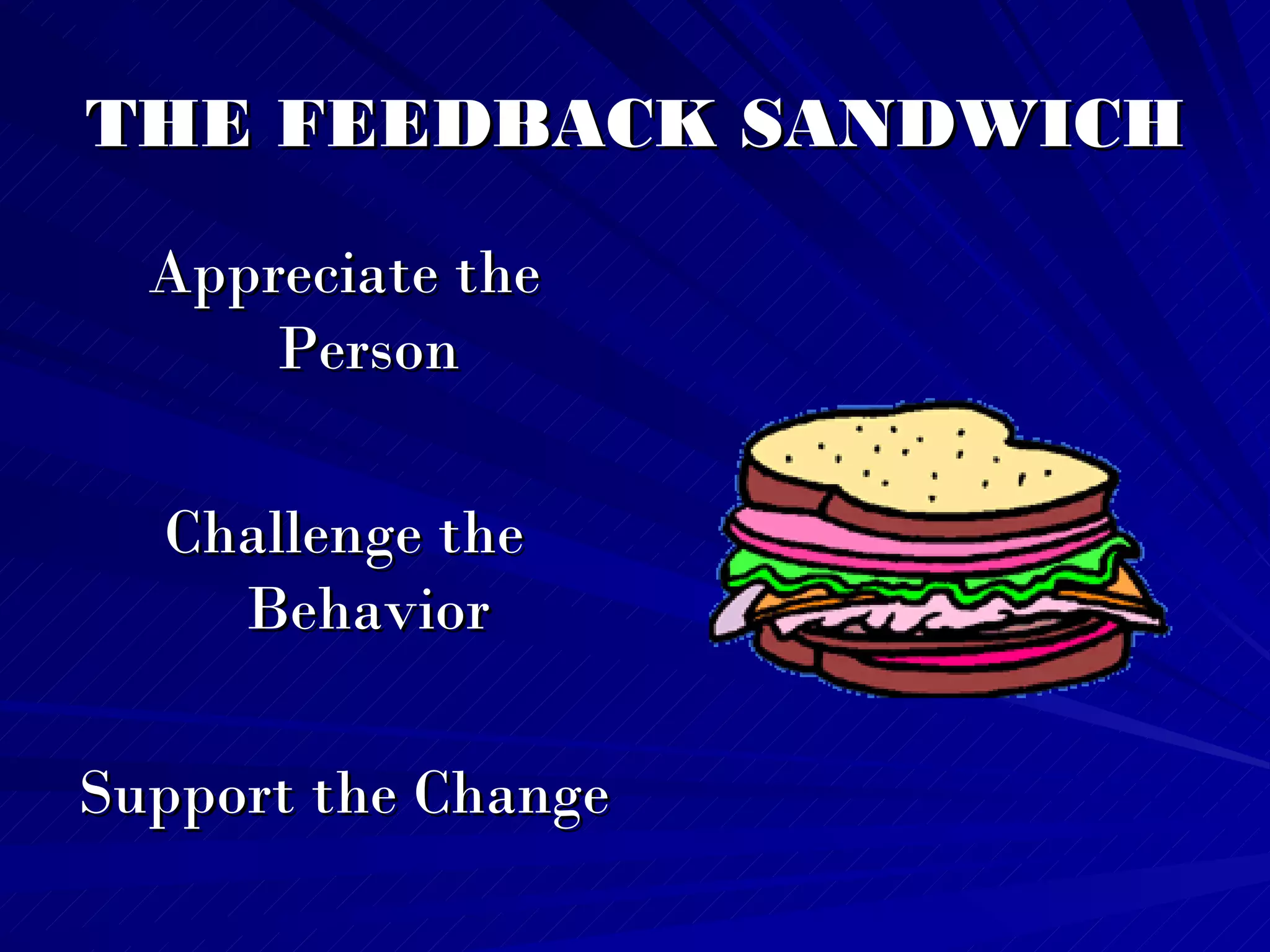
THE FEEDBACK SANDWICH Appreciate the Person Challenge the Behavior Support the Change
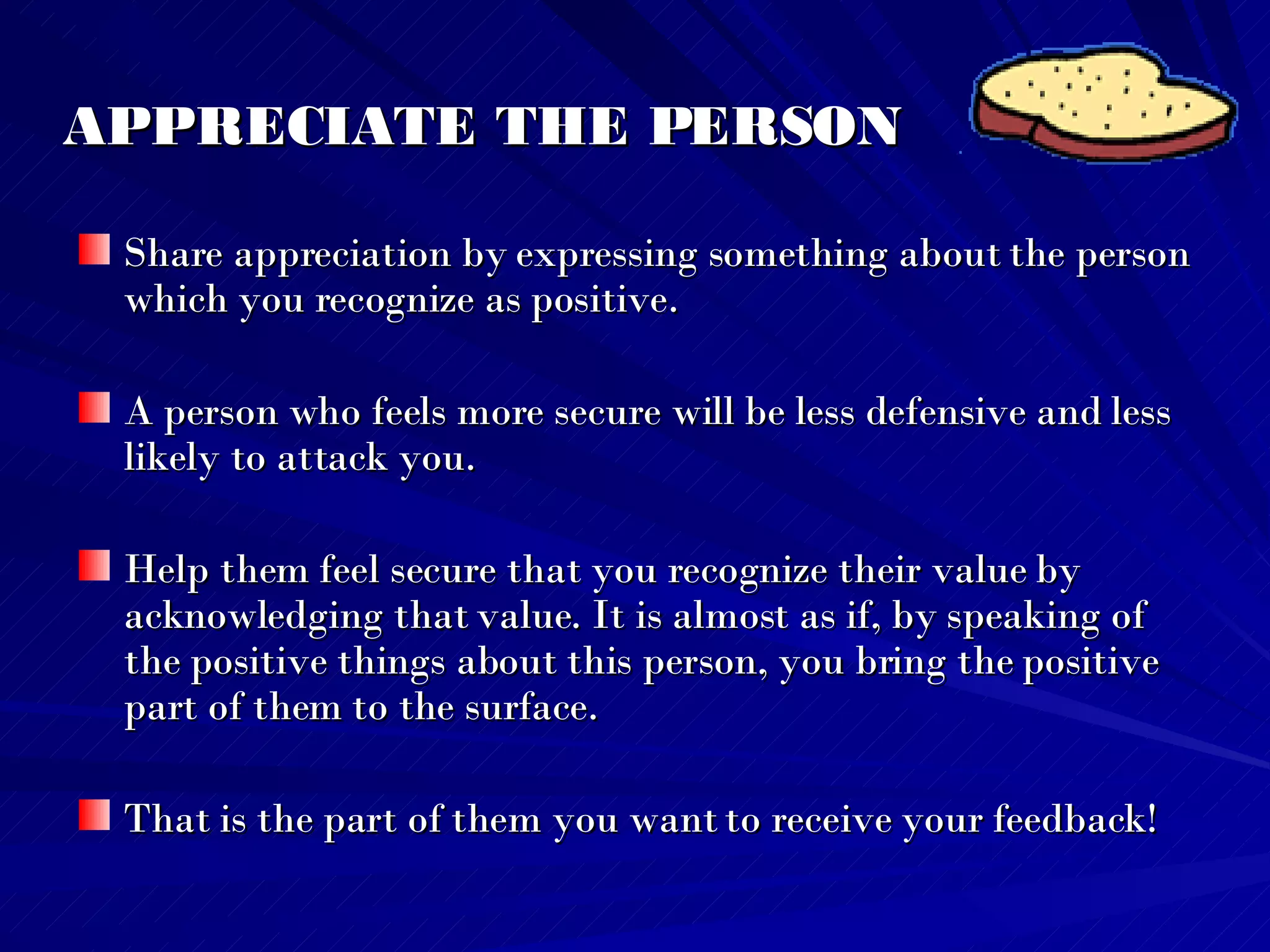
APPRECIATE THE PERSON Share appreciation by expressing something about the person which you recognize as positive.  A person who feels more secure will be less defensive and less likely to attack you.  Help them feel secure that you recognize their value by acknowledging that value. It is almost as if, by speaking of the positive things about this person, you bring the positive part of them to the surface.  That is the part of them you want to receive your feedback!
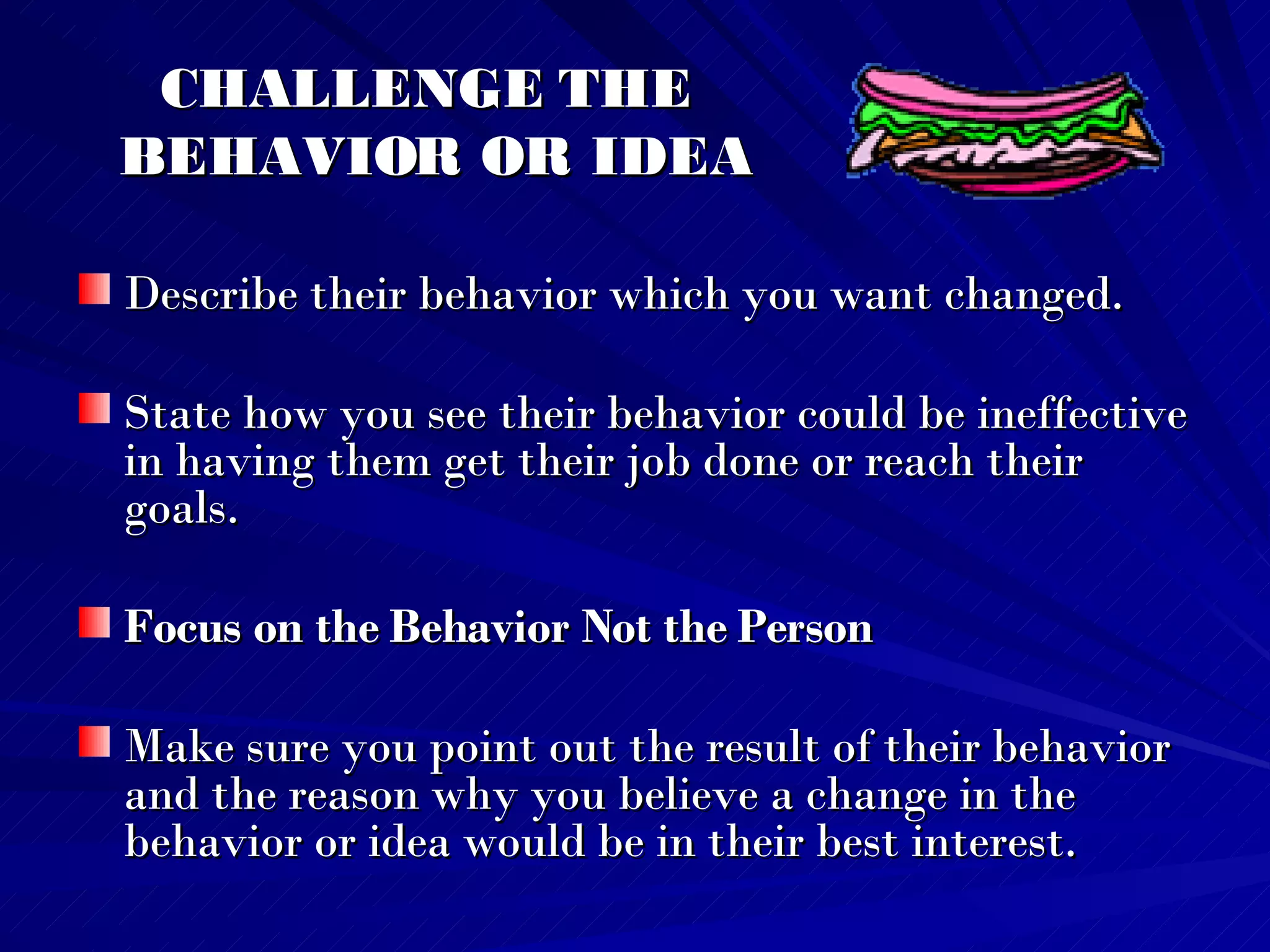
CHALLENGE THE  BEHAVIOR OR IDEA Describe their behavior which you want changed.  State how you see their behavior could be ineffective in having them get their job done or reach their goals.  Focus on the Behavior Not the Person Make sure you point out the result of their behavior and the reason why you believe a change in the behavior or idea would be in their best interest.
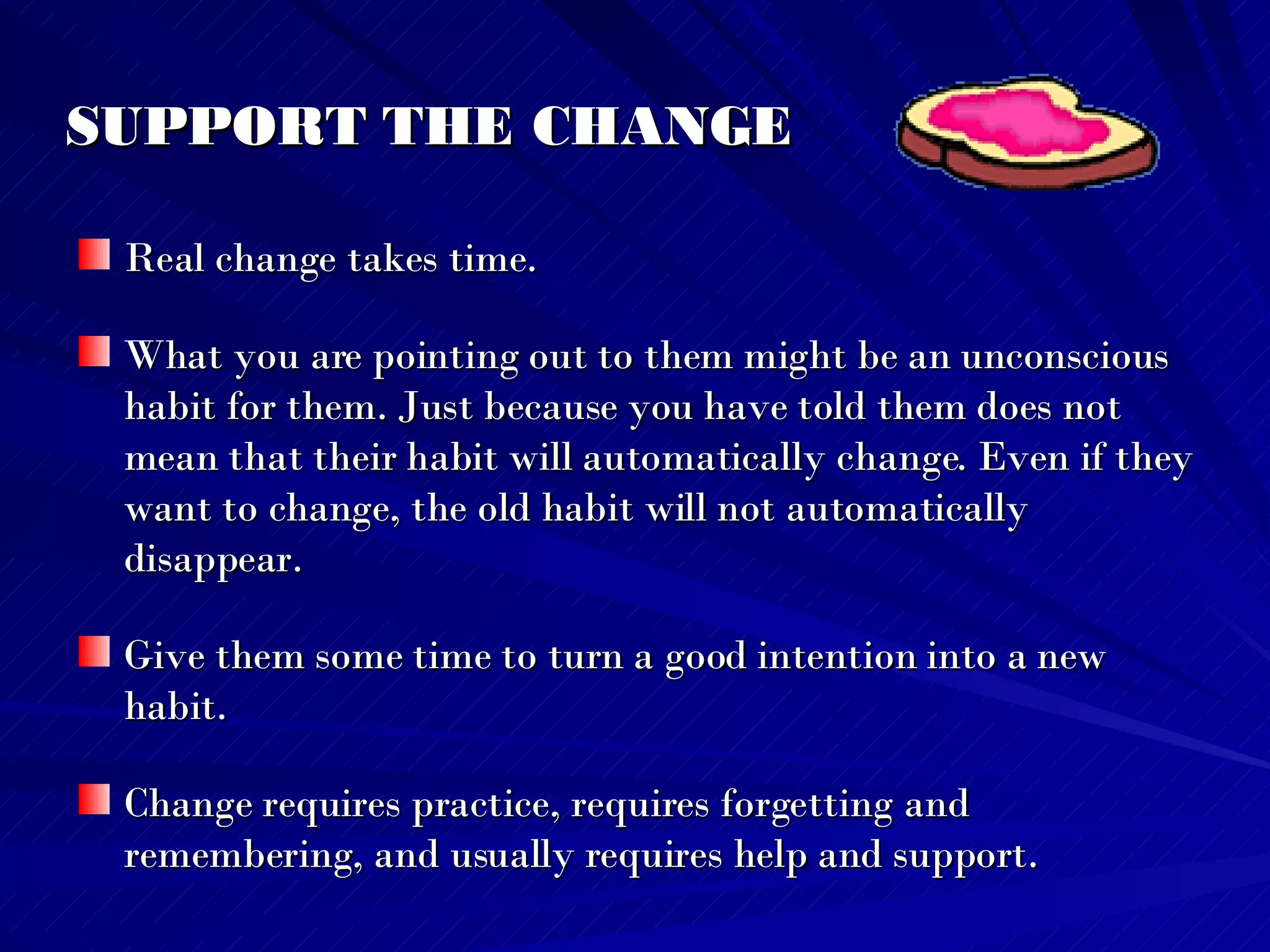
SUPPORT THE CHANGE Real change takes time.  What you are pointing out to them might be an unconscious habit for them. Just because you have told them does not mean that their habit will automatically change. Even if they want to change, the old habit will not automatically disappear.  Give them some time to turn a good intention into a new habit.  Change requires practice, requires forgetting and remembering, and usually requires help and support.
ONGOING SUPPORT Ask them what you can do or say to support the change.  Ask them what you can do or say to help them change in this more positive direction. Ask them how it would be appropriate for you to remind them if you see the old behavior happening again.  If possible have them suggest something you can do to help, when you see the old behavior happening again.
Golden Rules of Giving Feedback Give feedback in private Do not sound threatening Keep the feedback balanced Focus on the problem, not on the person's personality Don't overstate the problem by using words such as "always," "never" or "worst"  Stick to one subject Don't remind people of previous instances that were resolved.  Use the "I" statements
Robert is reading an article and Stephen is in the next room working intently on his computer. Robert notices something in his article that he feels is very important for Stephen to know. Robert knows it would make a big difference for Stephen if he only understood it. Robert gets excited, and immediately takes the article to show Stephen. He doesn't knock, he doesn't consider what Stephen is doing or whether Stephen is ready to hear anything new. Robert just comes right into Stephen's office and starts talking. He says, "Stephen, I think you need to see this. This is really important". Stephen is caught off guard. He's deep in his own thoughts about his own project. He isn't ready to see the article right now. He is in the middle of something he feels is important and finds it intrusive and disrespectful to be pulled away from his work to consider Robert's unscheduled interruption.
Feedback Tip #1 Allow for receiver readiness
Feedback Tip #2 Feedback needs to be descriptive NOT interpretive
Feedback Tip #3 Cover recent events  or  actions
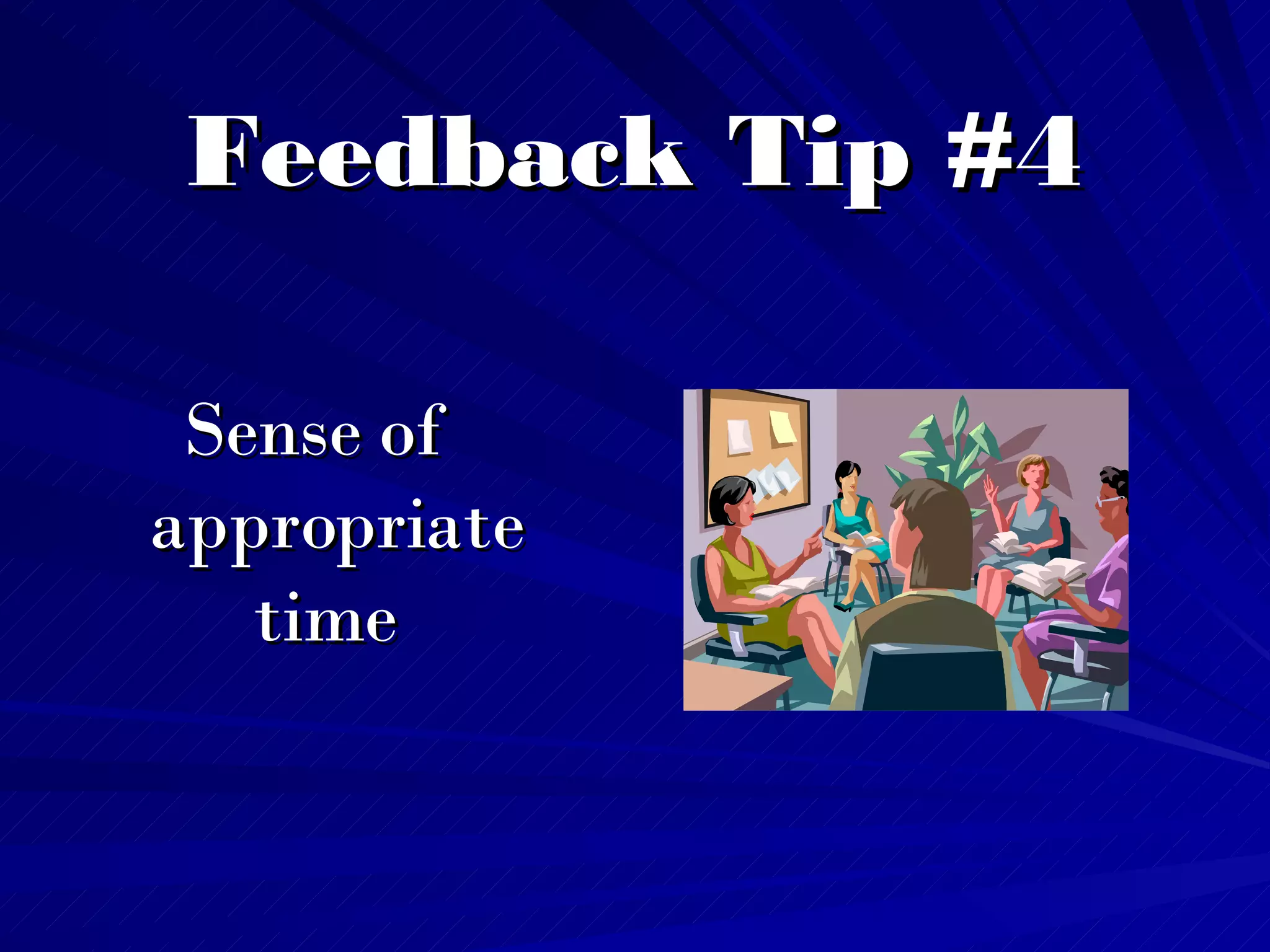
Feedback Tip #4 Sense of appropriate time
Feedback Tip #5 Feedback should be something valuable and new
Feedback Tip #6 Must be something changeable
Feedback Tip #7 Is given to be helpful
Feedback Tip #8 Do NOT demand a change
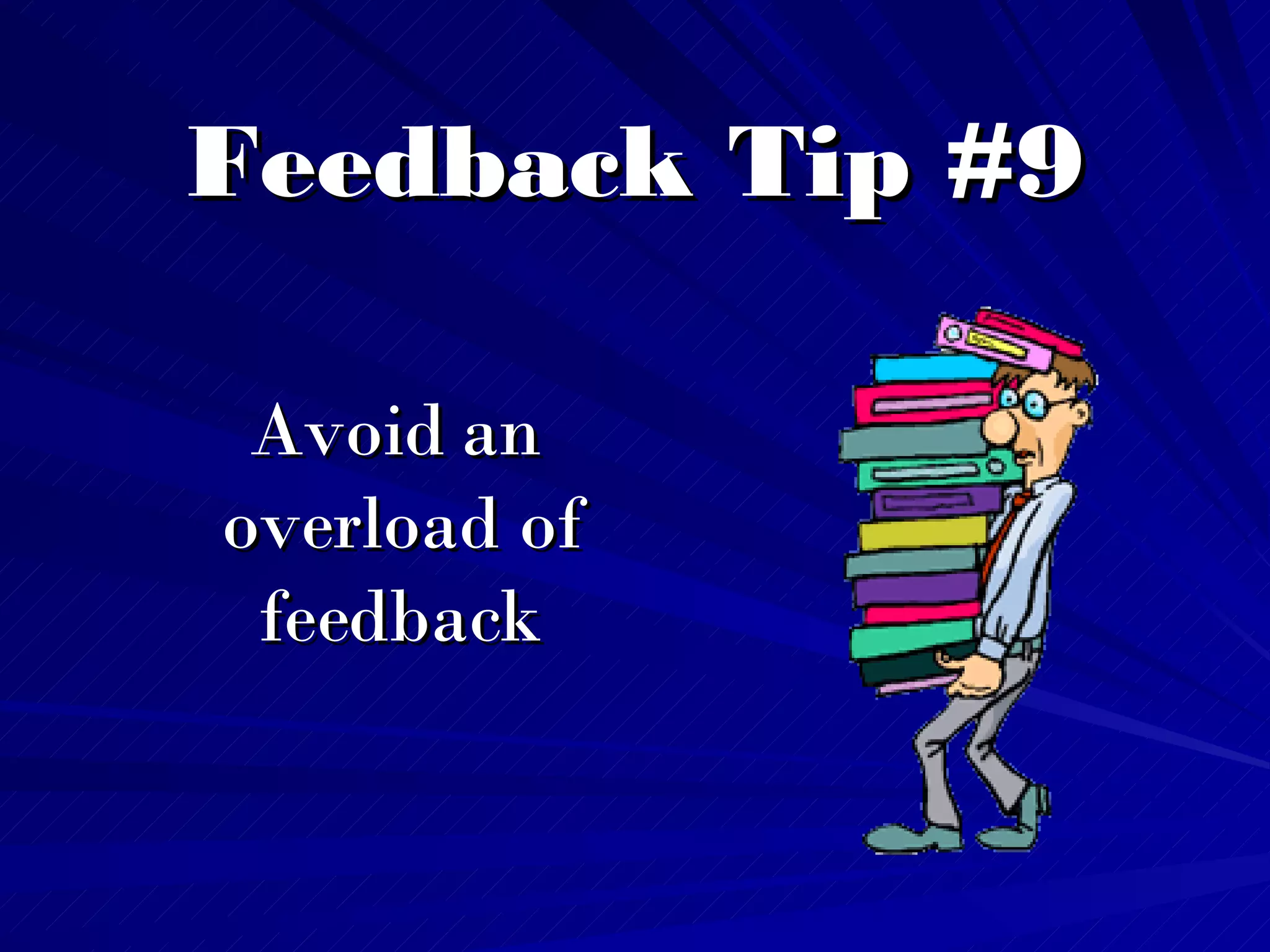
Feedback Tip #9 Avoid an overload of feedback
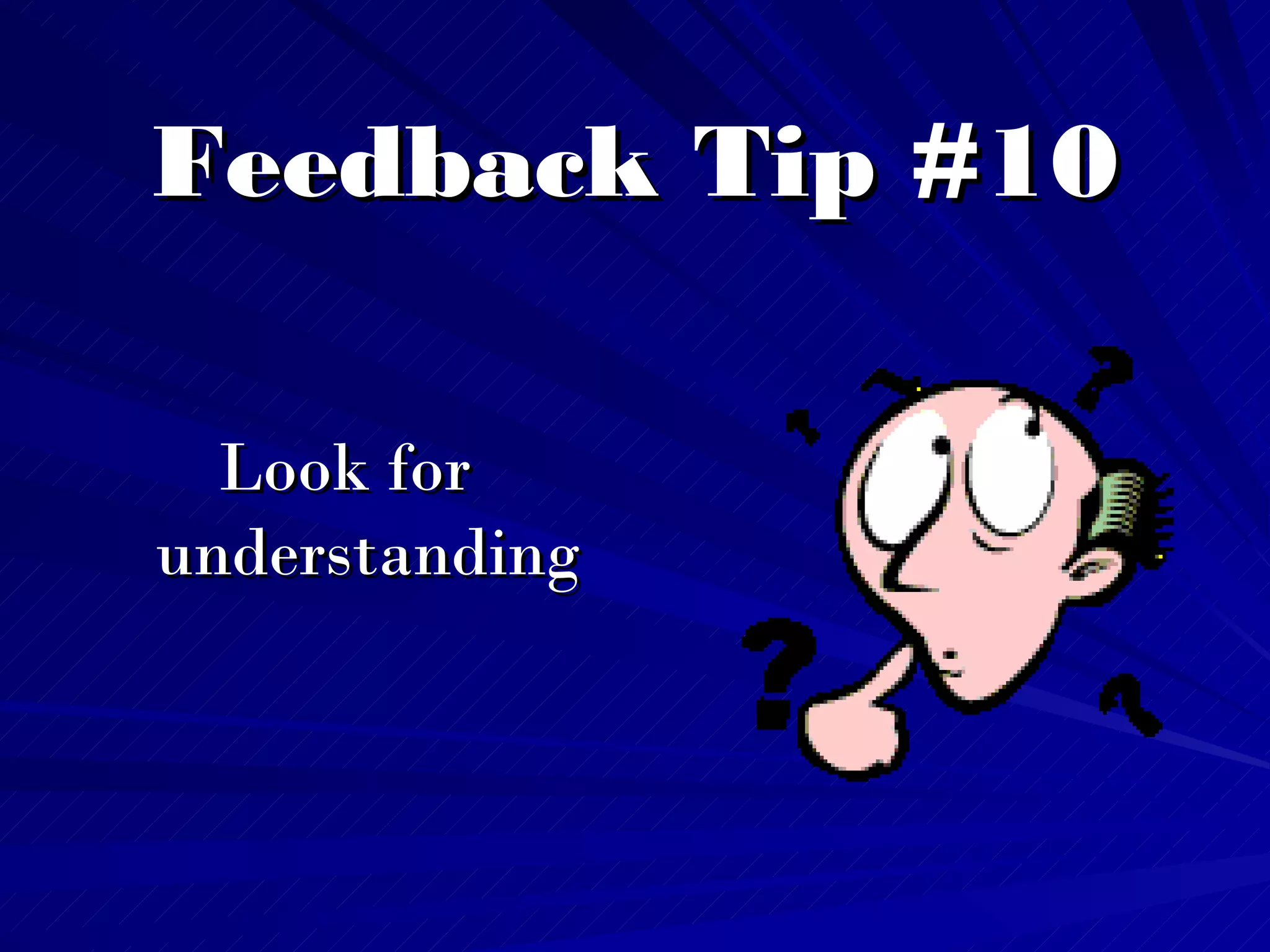
Feedback Tip #10 Look for understanding
Feedback Tip #11 Share personal experience
Feedback Tip #12 Be specific,  give the FACTS
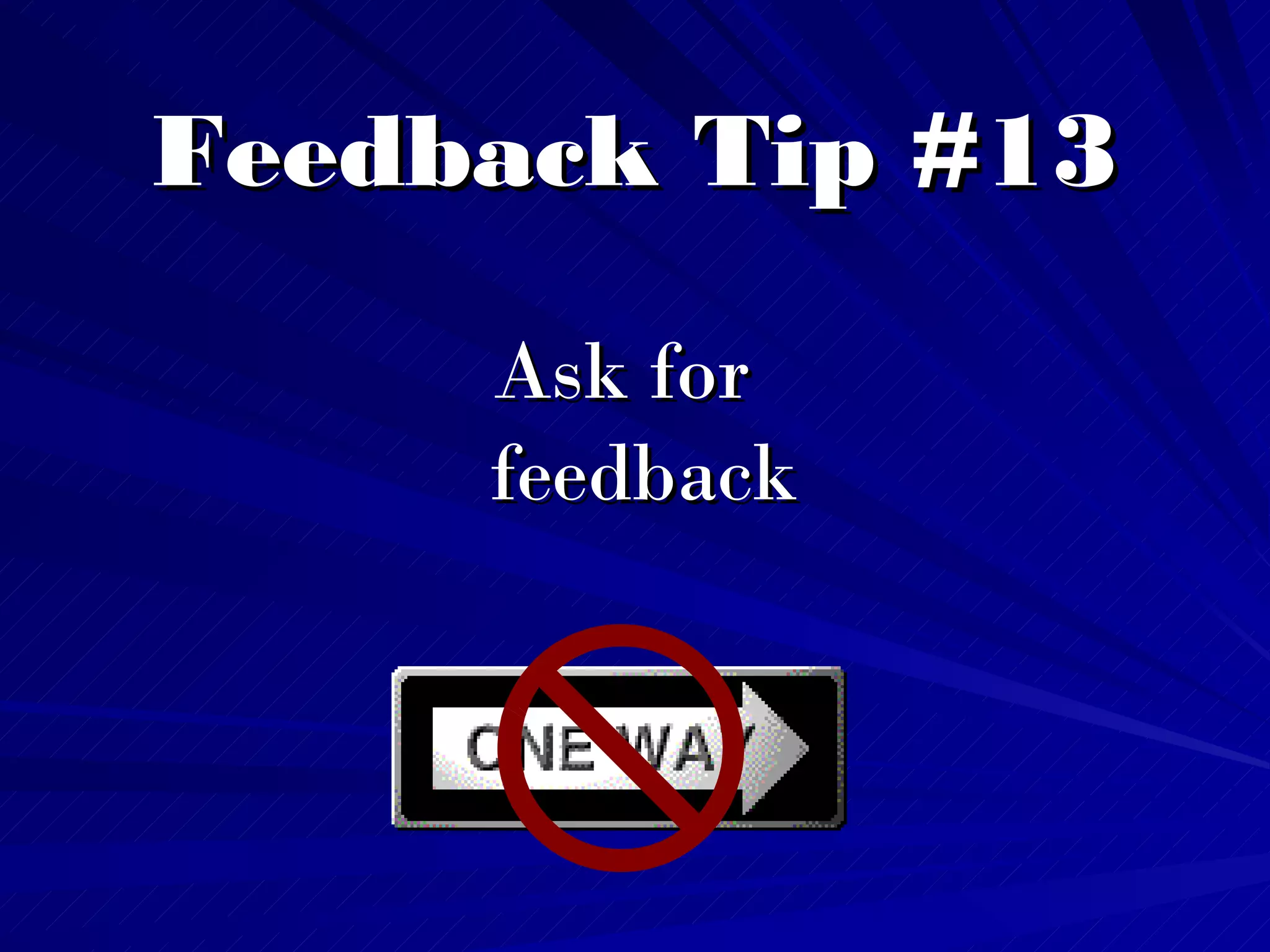
Feedback Tip #13 Ask for feedback
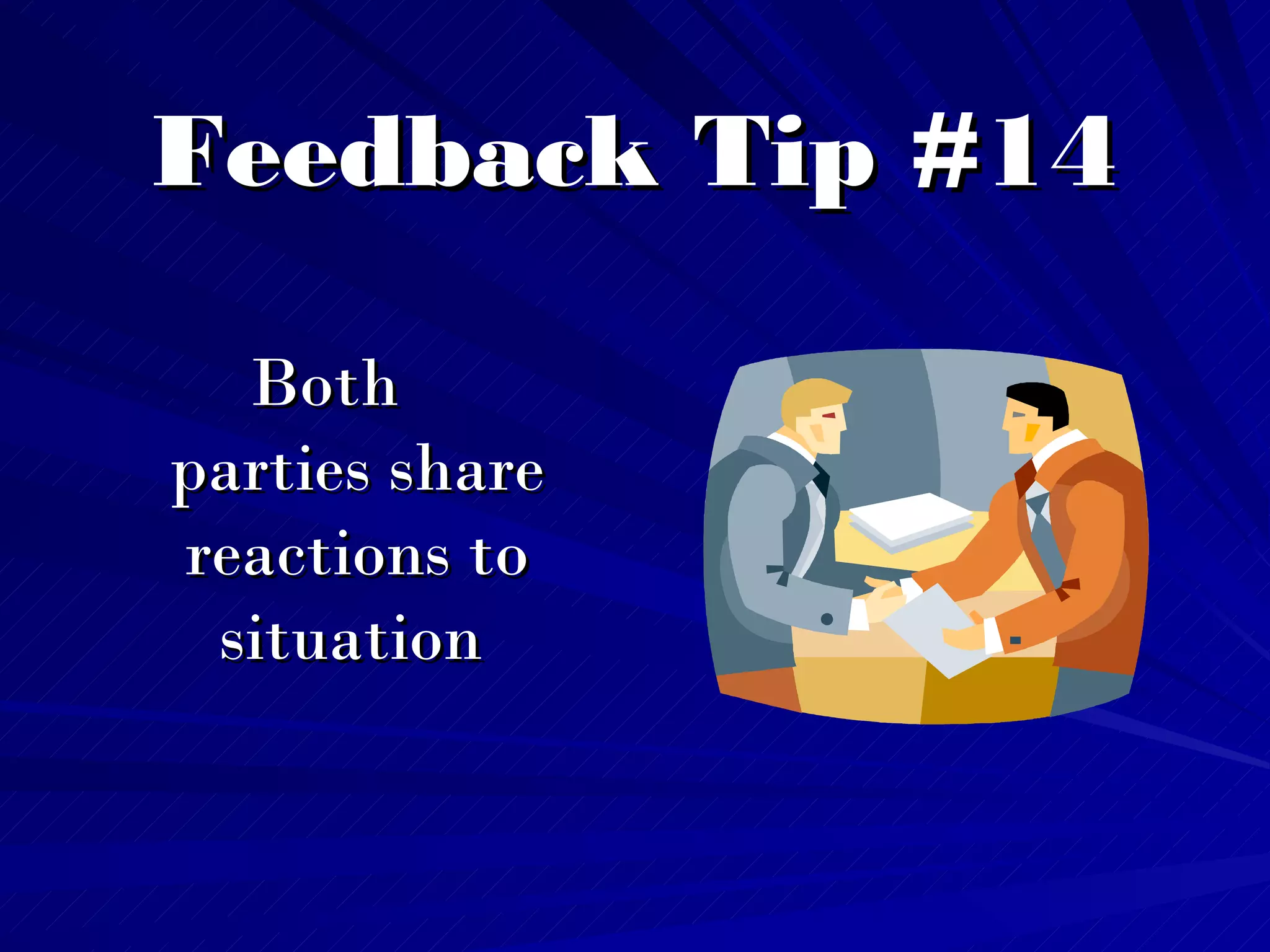
Feedback Tip #14 Both  parties share reactions to situation
Where do we go from here? How will you use this in your current role as Adviser? How will this make you more affective when working with students?
QUESTIONS?

Shooting Down Ideas Without Turning

  • 1.
    Shooting Down IdeasWithout Turning Students Off Heather Spell Arrington Assistant Director Student Leadership Development Programs
  • 2.
  • 3.
    What is Feedback?Feedback Sandwich Feedback Tips Why is this important ?
  • 4.
    FEEDBACK It's notabout force or demanding change It is supposed to "feed" or nourish the person who is receiving it. My definition: Feedback is nourishing another person directly so that they can grow professionally and personally.
  • 5.
    Feedback can backfireif the information is delivered with force. It can taste sour if the "feedback" is passed through someone else to the person for whom it is intended. People need to digest their own food; otherwise it's hard to stomach!
  • 6.
    THE FEEDBACK SANDWICHAppreciate the Person Challenge the Behavior Support the Change
  • 7.
    APPRECIATE THE PERSONShare appreciation by expressing something about the person which you recognize as positive. A person who feels more secure will be less defensive and less likely to attack you. Help them feel secure that you recognize their value by acknowledging that value. It is almost as if, by speaking of the positive things about this person, you bring the positive part of them to the surface. That is the part of them you want to receive your feedback!
  • 8.
    CHALLENGE THE BEHAVIOR OR IDEA Describe their behavior which you want changed. State how you see their behavior could be ineffective in having them get their job done or reach their goals. Focus on the Behavior Not the Person Make sure you point out the result of their behavior and the reason why you believe a change in the behavior or idea would be in their best interest.
  • 9.
    SUPPORT THE CHANGEReal change takes time. What you are pointing out to them might be an unconscious habit for them. Just because you have told them does not mean that their habit will automatically change. Even if they want to change, the old habit will not automatically disappear. Give them some time to turn a good intention into a new habit. Change requires practice, requires forgetting and remembering, and usually requires help and support.
  • 10.
    ONGOING SUPPORT Askthem what you can do or say to support the change. Ask them what you can do or say to help them change in this more positive direction. Ask them how it would be appropriate for you to remind them if you see the old behavior happening again. If possible have them suggest something you can do to help, when you see the old behavior happening again.
  • 11.
    Golden Rules ofGiving Feedback Give feedback in private Do not sound threatening Keep the feedback balanced Focus on the problem, not on the person's personality Don't overstate the problem by using words such as "always," "never" or "worst" Stick to one subject Don't remind people of previous instances that were resolved. Use the "I" statements
  • 12.
    Robert is readingan article and Stephen is in the next room working intently on his computer. Robert notices something in his article that he feels is very important for Stephen to know. Robert knows it would make a big difference for Stephen if he only understood it. Robert gets excited, and immediately takes the article to show Stephen. He doesn't knock, he doesn't consider what Stephen is doing or whether Stephen is ready to hear anything new. Robert just comes right into Stephen's office and starts talking. He says, "Stephen, I think you need to see this. This is really important". Stephen is caught off guard. He's deep in his own thoughts about his own project. He isn't ready to see the article right now. He is in the middle of something he feels is important and finds it intrusive and disrespectful to be pulled away from his work to consider Robert's unscheduled interruption.
  • 13.
    Feedback Tip #1Allow for receiver readiness
  • 14.
    Feedback Tip #2Feedback needs to be descriptive NOT interpretive
  • 15.
    Feedback Tip #3Cover recent events or actions
  • 16.
    Feedback Tip #4Sense of appropriate time
  • 17.
    Feedback Tip #5Feedback should be something valuable and new
  • 18.
    Feedback Tip #6Must be something changeable
  • 19.
    Feedback Tip #7Is given to be helpful
  • 20.
    Feedback Tip #8Do NOT demand a change
  • 21.
    Feedback Tip #9Avoid an overload of feedback
  • 22.
    Feedback Tip #10Look for understanding
  • 23.
    Feedback Tip #11Share personal experience
  • 24.
    Feedback Tip #12Be specific, give the FACTS
  • 25.
    Feedback Tip #13Ask for feedback
  • 26.
    Feedback Tip #14Both parties share reactions to situation
  • 27.
    Where do wego from here? How will you use this in your current role as Adviser? How will this make you more affective when working with students?
  • 28.