
1
Leadershi p
Trai ni ng:
Feedback t hat Works
2
What is Feedback and Why Give it?
Feedback can help people identify what they are doing
well and encourage good behaviors. It can also help
them correct problems and/or develop new abilities.
Feedback should enable the receiver to walk away
understanding exactly what they did (right or wrong)
and what impact it had on the organization.
Most people want to do a good job. Providing regular
feedback is a way to encourage positive behavior and
to open lines of communication.
3
Feedback that Works
Common mistakes when delivering feedback
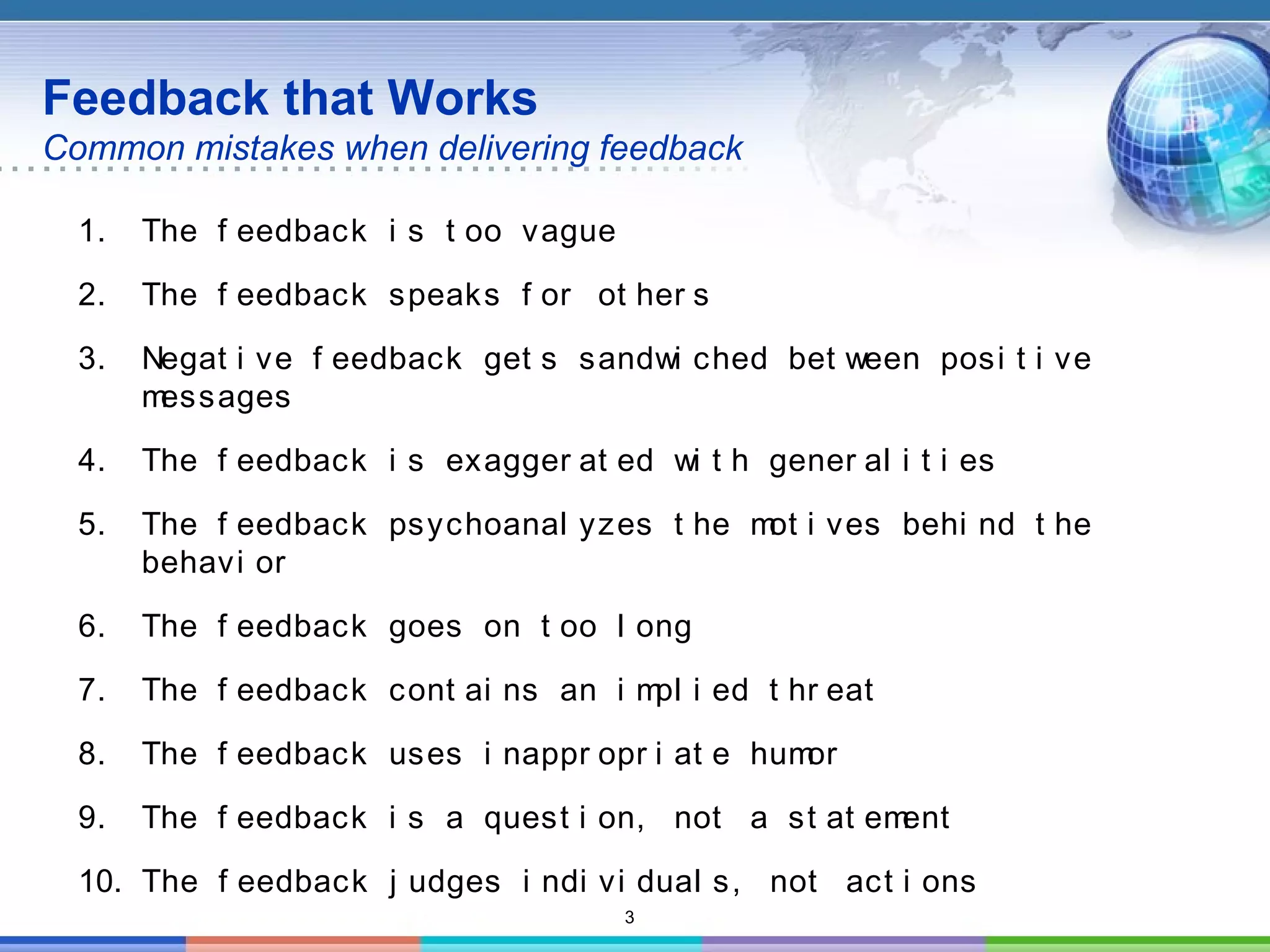
1. The f eedback i s t oo vague
2. The f eedback speaks f or ot her s
3. Negat i ve f eedback get s sandwi ched bet ween posi t i ve
messages
4. The f eedback i s exagger at ed wi t h gener al i t i es
5. The f eedback psychoanal yzes t he mot i ves behi nd t he
behavi or
6. The f eedback goes on t oo l ong
7. The f eedback cont ai ns an i mpl i ed t hr eat
8. The f eedback uses i nappr opr i at e humor
9. The f eedback i s a quest i on, not a st at ement
10. The f eedback j udges i ndi vi dual s, not act i ons
4
Feedback that Works
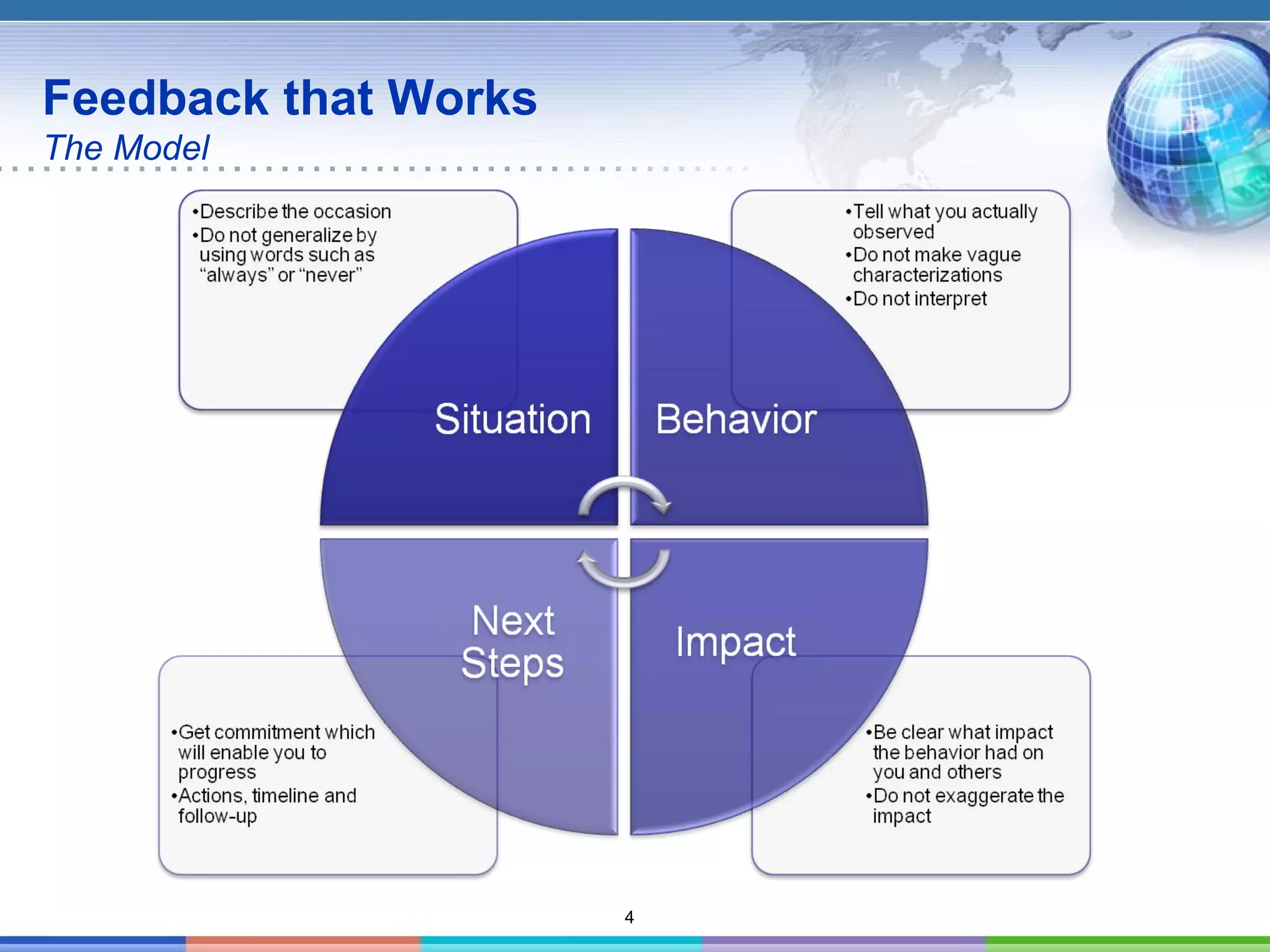
The Model
5
Feedback that Works
Keys to successful delivery
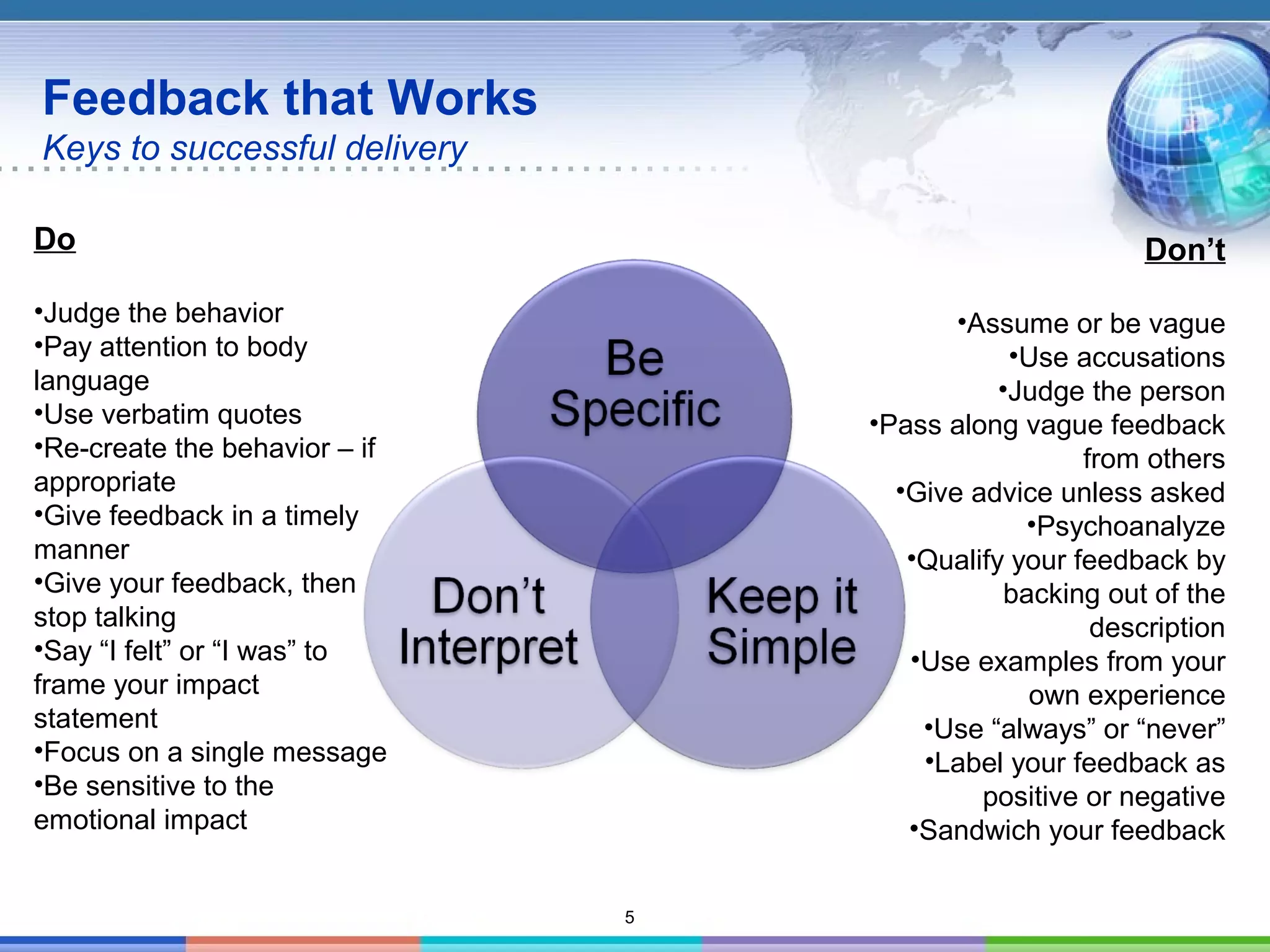
Do
•Judge the behavior
•Pay attention to body
language
•Use verbatim quotes
•Re-create the behavior – if
appropriate
•Give feedback in a timely
manner
•Give your feedback, then
stop talking
•Say “I felt” or “I was” to
frame your impact
statement
•Focus on a single message
•Be sensitive to the
emotional impact
Don’t
•Assume or be vague
•Use accusations
•Judge the person
•Pass along vague feedback
from others
•Give advice unless asked
•Psychoanalyze
•Qualify your feedback by
backing out of the
description
•Use examples from your
own experience
•Use “always” or “never”
•Label your feedback as
positive or negative
•Sandwich your feedback
6
Feedback that Works
Keys to delivery, continued…
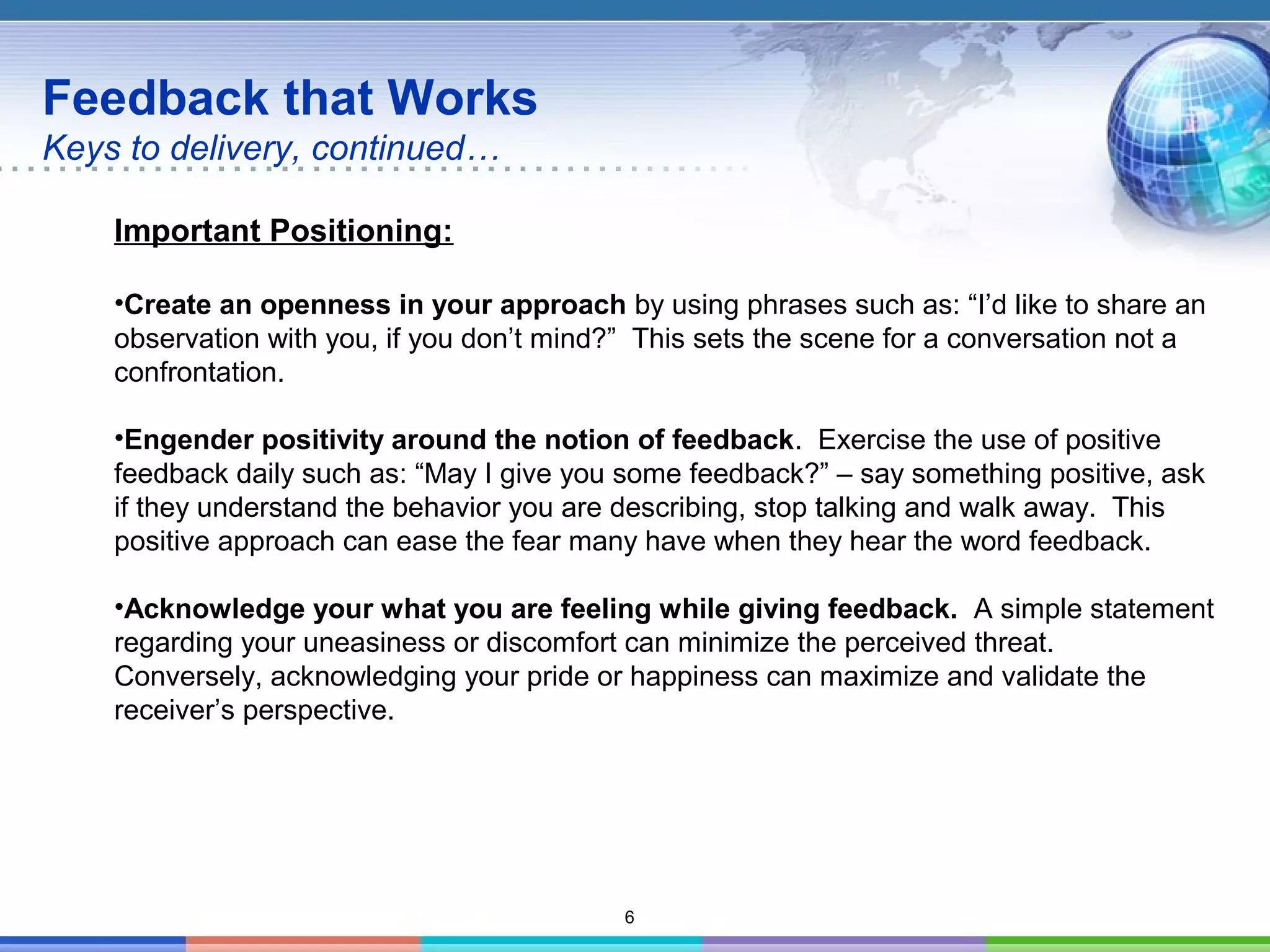
Important Positioning:
•Create an openness in your approach by using phrases such as: “I’d like to share an
observation with you, if you don’t mind?” This sets the scene for a conversation not a
confrontation.
•Engender positivity around the notion of feedback. Exercise the use of positive
feedback daily such as: “May I give you some feedback?” – say something positive, ask
if they understand the behavior you are describing, stop talking and walk away. This
positive approach can ease the fear many have when they hear the word feedback.
•Acknowledge your what you are feeling while giving feedback. A simple statement
regarding your uneasiness or discomfort can minimize the perceived threat.
Conversely, acknowledging your pride or happiness can maximize and validate the
receiver’s perspective.
7
Feedback that Works
Keys to delivering feedback to adults
8
Feedback that Works
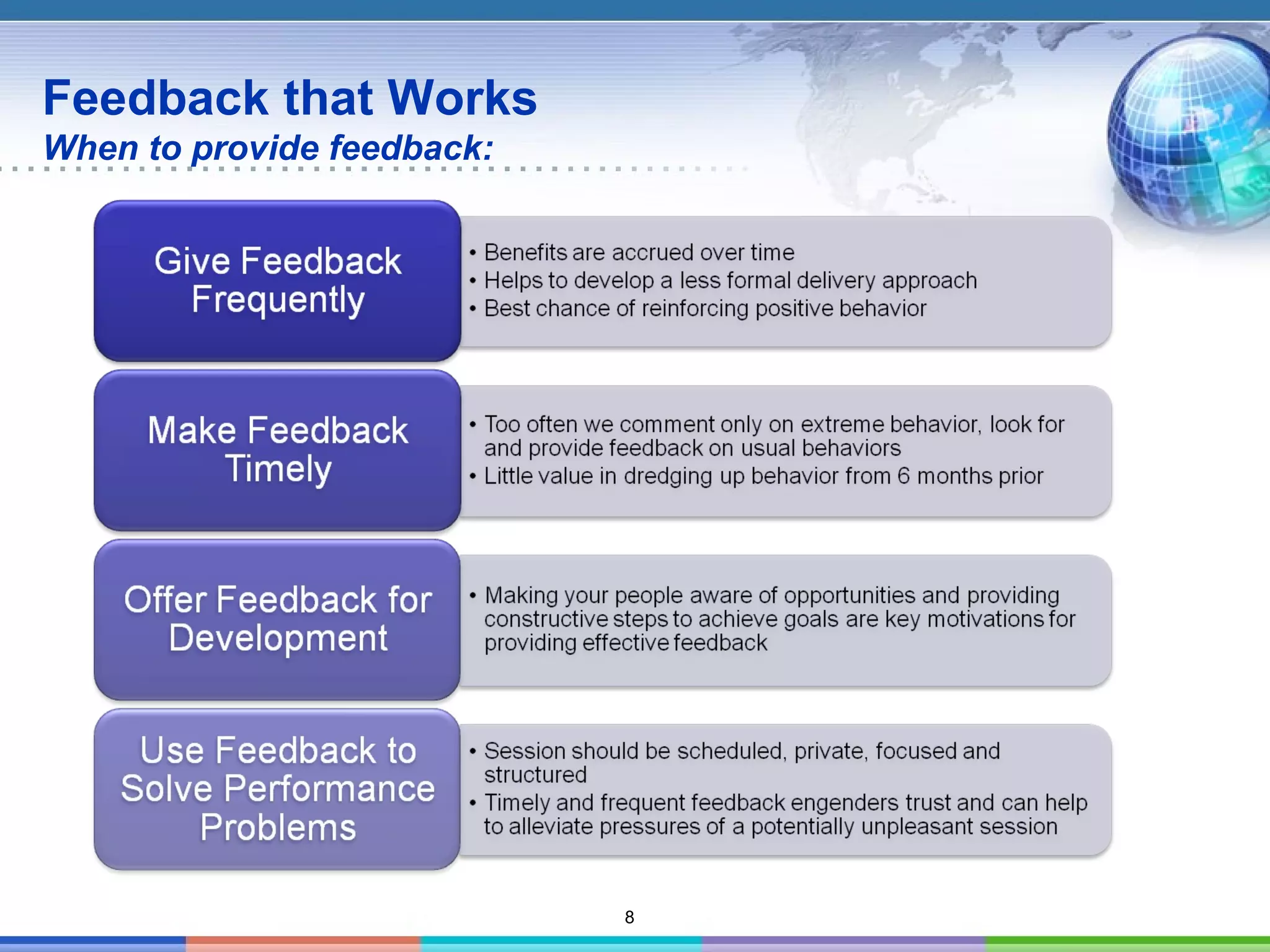
When to provide feedback:
9
Feedback that Works
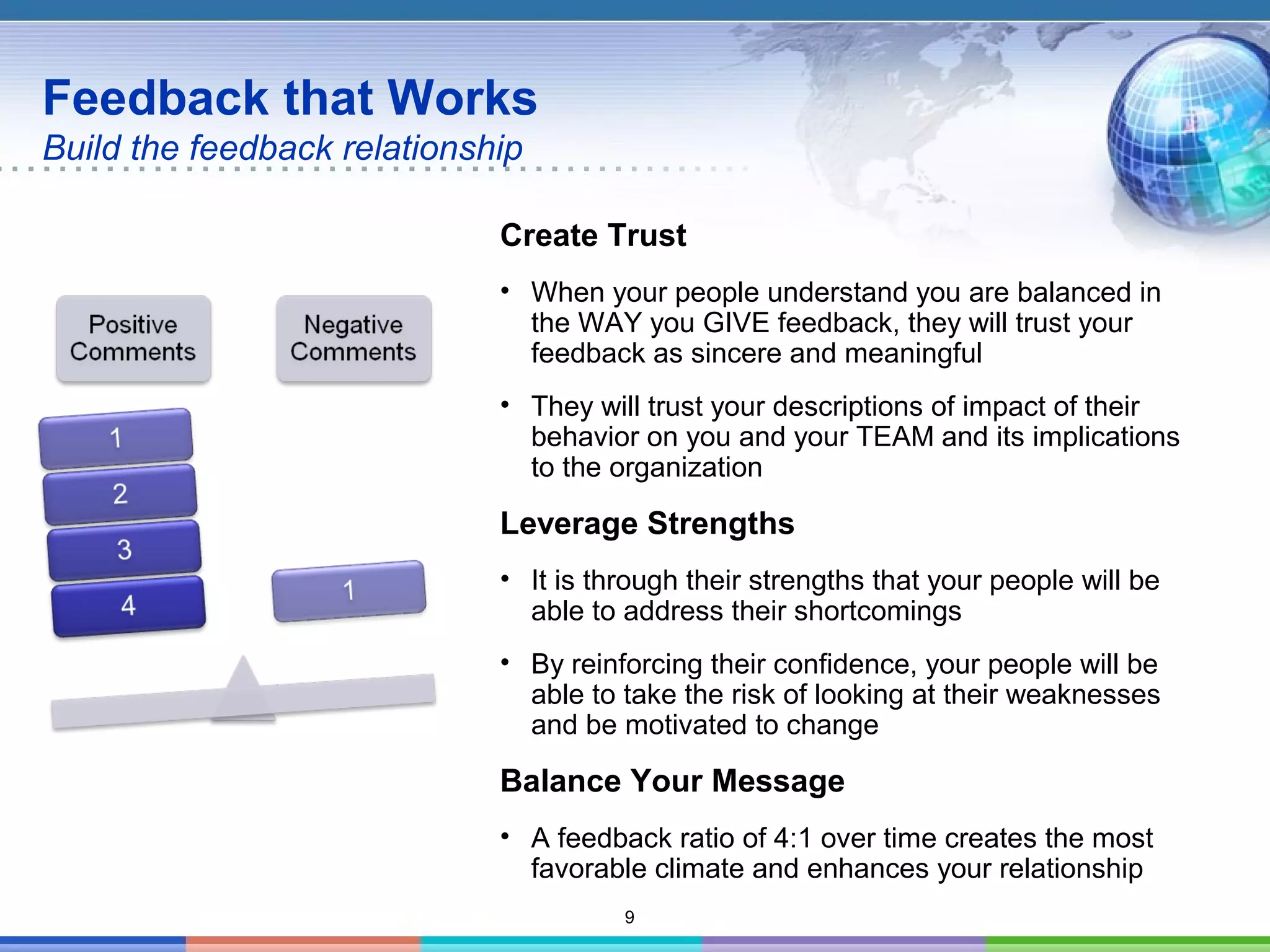
Build the feedback relationship
Create Trust
• When your people understand you are balanced in
the WAY you GIVE feedback, they will trust your
feedback as sincere and meaningful
• They will trust your descriptions of impact of their
behavior on you and your TEAM and its implications
to the organization
Leverage Strengths
• It is through their strengths that your people will be
able to address their shortcomings
• By reinforcing their confidence, your people will be
able to take the risk of looking at their weaknesses
and be motivated to change
Balance Your Message
• A feedback ratio of 4:1 over time creates the most
favorable climate and enhances your relationship
10
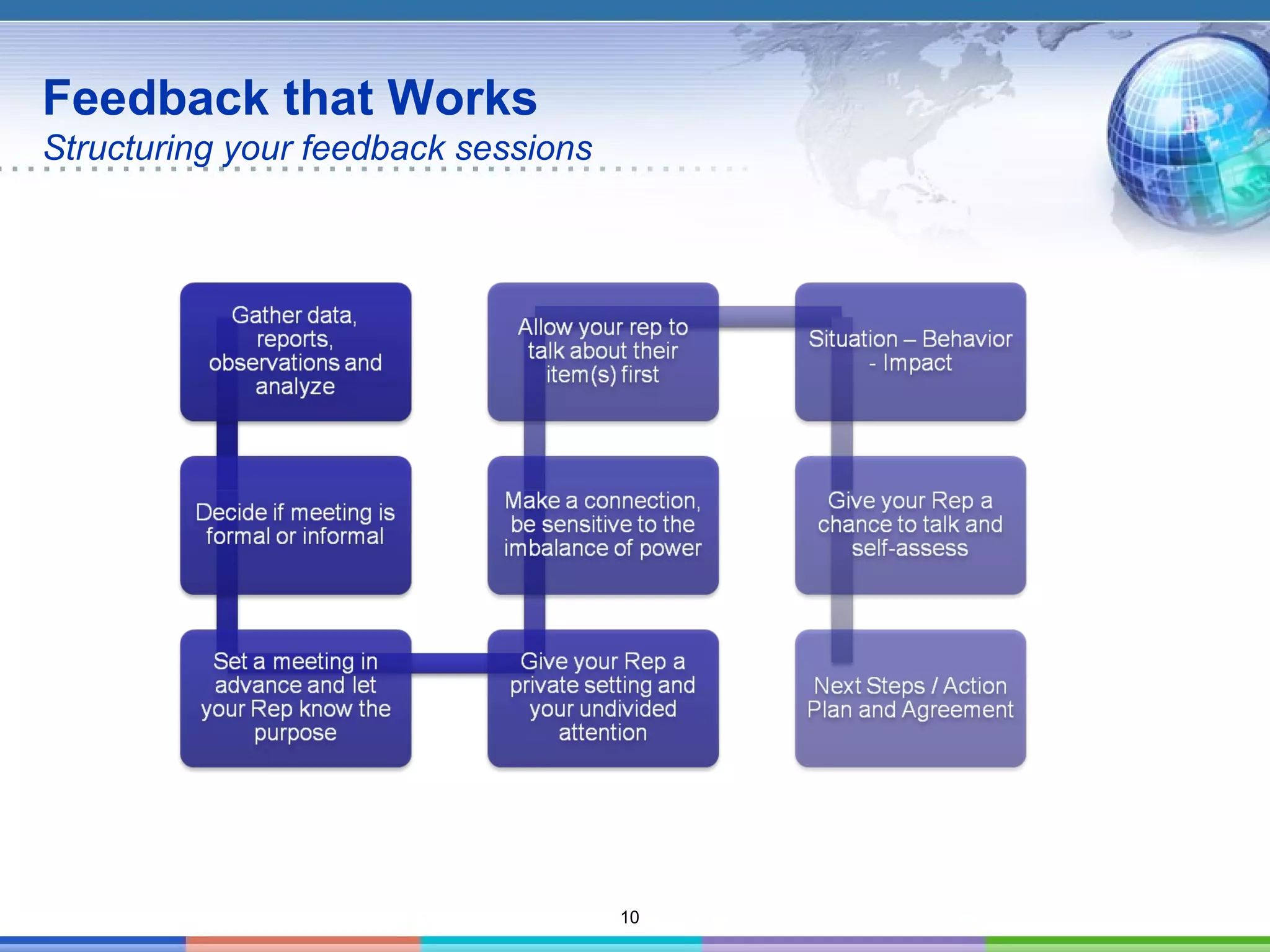
Feedback that Works
Structuring your feedback sessions
11
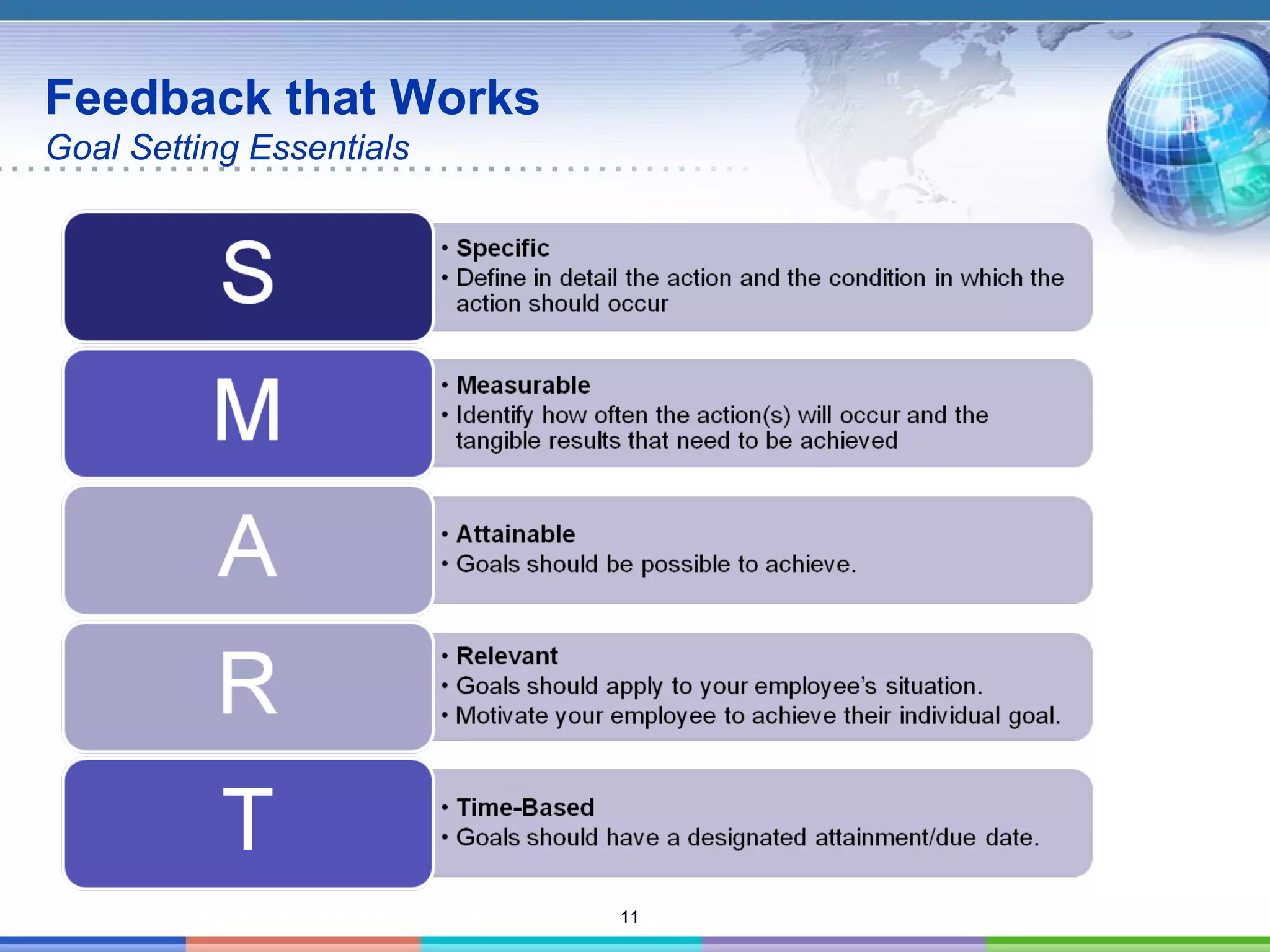
Feedback that Works
Goal Setting Essentials
12
Feedback that Works
SMART Checklist
SPECIFIC
Do I have1-3 goals/objectives?
Are they clear? Concise?
Do they detail the action/behavior that needs to occur?
MEASURABLE
Is it quantitative or qualitative?
Do I know when/how the goal will be achieved?
ATTAINABLE
Are the goals possible to achieve?
Does it require step goals?
Are the goals realistic given current performance?
RELEVANT
Can I motivate my agent to these goals?
Are these goals timely?
TIMEBASED
Do I have a definitive start and end date?
Have I given adequate time to achieve the goals?
13
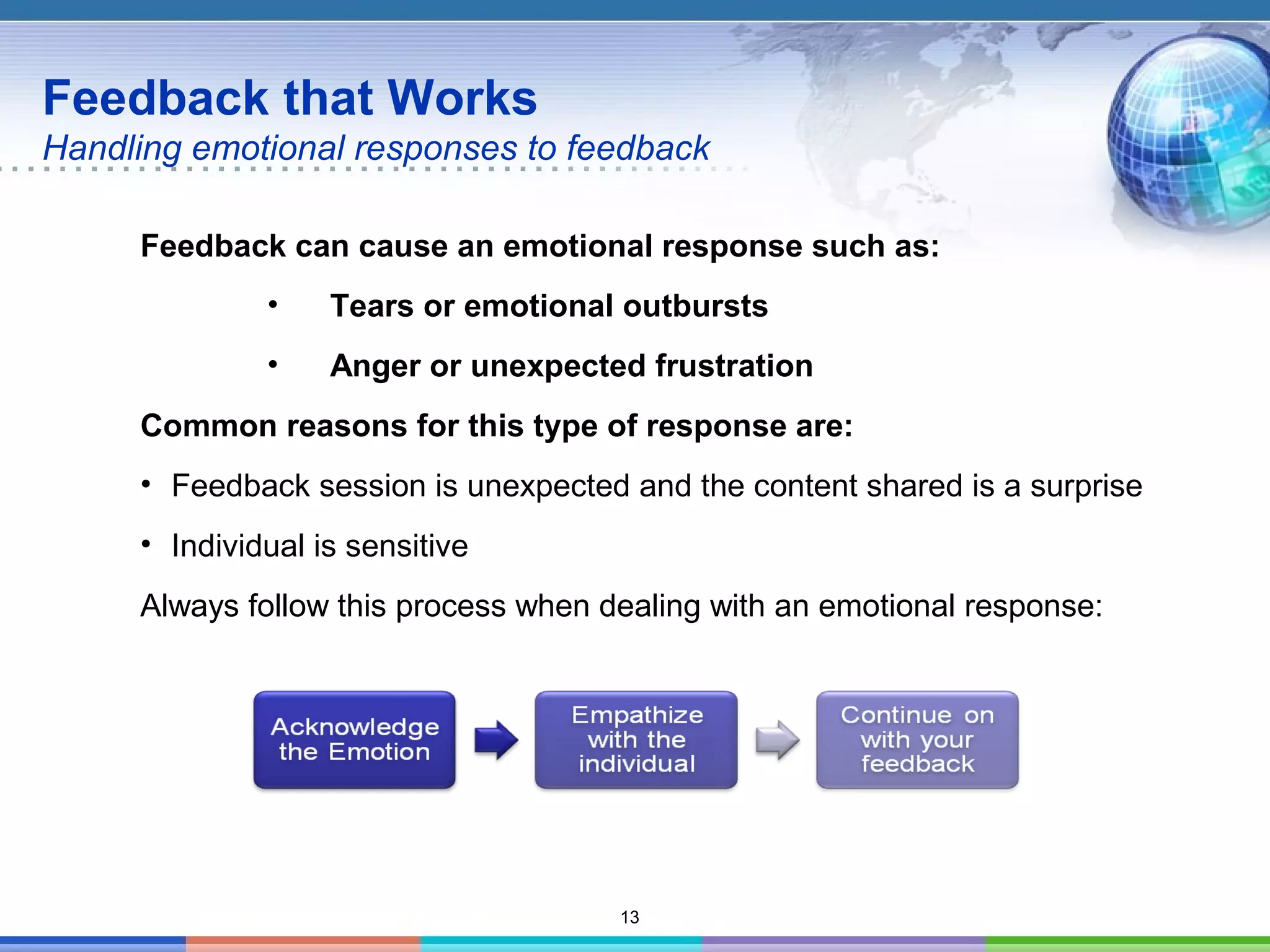
Feedback that Works
Handling emotional responses to feedback
Feedback can cause an emotional response such as:
• Tears or emotional outbursts
• Anger or unexpected frustration
Common reasons for this type of response are:
• Feedback session is unexpected and the content shared is a surprise
• Individual is sensitive
Always follow this process when dealing with an emotional response:
14
Feedback that Works
Handling emotional responses to feedback
Do not t ake i t per sonal l y.
Keep i n mi nd t he i ndi vi dual ’ s si t uat i on:
•New empl oyees t ake awhi l e t o l ear n new ski l l s
•Behavi or may have been pr evi ousl y addr essed by ot her s
Recogni ze t hat peopl e pr ocess i nf or mat i on di f f er ent l y
•Al l ow addi t i onal t i me t o pr ocess
•Some peopl e ar e mor e sensi t i ve t han ot her s
Fact or i n heal t h, per sonal and f ami l y pr obl ems
•Out si de i nf l uences ef f ect i ng behavi or ?
Dr aw on t he i ndi vi dual ’ s pr obl em sol vi ng abi l i t i es
•Some peopl e ar e ver y sel f cr i t i cal
•Cr eat e buy- i n/ agr eement bef or e endi ng t he sessi on
15
Feedback that Works
Handling emotional responses to feedback
The Uninterested Individual
• Feedback may not have been given by previous managers
• The individual may be bored with the work
• The individual may feel that his contribution is insignificant or not valued
Steps:
1. Employ a long-term strategy
2. Your strategy needs to encourage on-going dialog
3. Encourage them to come up with solutions
4. You must gain their commitment
5. Agree to follow-up meetings
6. Remain persistent in following up
The challenge of dealing with uninterested people is not just about giving effective feedback-it is
about turning them around so they become creative and involved employees again. With
patience, perseverance, and regular follow-up, you will encourage dialog and turn an
uninterested individual around!
16
Feedback that Works
Handling emotional responses to feedback
The Individual that just doesn’t agree
• The actions/behavior you observed
• The impact of the behavior can be open to interpretation
Steps:
1. Ask for the individual to explain their view of the situation
2. Provide several examples to establish a trend
3. Determine the area(s) of disagreement
Explore the differences
Whatever the level of disagreements, you must resolve
them before suggesting any actions. Be prepared to
change your mind, and to admit that you were wrong.
Don't continue giving feedback until you have resolved
your differences. It may damage your future credibility.
17
Thank you for your participation and I welcome your feedback.
www.linkedin.com/pub/joan-dembowski/b/14b/4b6/

Feedback that works

  • 1.
    1 Leadershi p Trai ning: Feedback t hat Works
  • 2.
    2 What is Feedbackand Why Give it? Feedback can help people identify what they are doing well and encourage good behaviors. It can also help them correct problems and/or develop new abilities. Feedback should enable the receiver to walk away understanding exactly what they did (right or wrong) and what impact it had on the organization. Most people want to do a good job. Providing regular feedback is a way to encourage positive behavior and to open lines of communication.
  • 3.
    3 Feedback that Works Commonmistakes when delivering feedback 1. The f eedback i s t oo vague 2. The f eedback speaks f or ot her s 3. Negat i ve f eedback get s sandwi ched bet ween posi t i ve messages 4. The f eedback i s exagger at ed wi t h gener al i t i es 5. The f eedback psychoanal yzes t he mot i ves behi nd t he behavi or 6. The f eedback goes on t oo l ong 7. The f eedback cont ai ns an i mpl i ed t hr eat 8. The f eedback uses i nappr opr i at e humor 9. The f eedback i s a quest i on, not a st at ement 10. The f eedback j udges i ndi vi dual s, not act i ons
  • 4.
  • 5.
    5 Feedback that Works Keysto successful delivery Do •Judge the behavior •Pay attention to body language •Use verbatim quotes •Re-create the behavior – if appropriate •Give feedback in a timely manner •Give your feedback, then stop talking •Say “I felt” or “I was” to frame your impact statement •Focus on a single message •Be sensitive to the emotional impact Don’t •Assume or be vague •Use accusations •Judge the person •Pass along vague feedback from others •Give advice unless asked •Psychoanalyze •Qualify your feedback by backing out of the description •Use examples from your own experience •Use “always” or “never” •Label your feedback as positive or negative •Sandwich your feedback
  • 6.
    6 Feedback that Works Keysto delivery, continued… Important Positioning: •Create an openness in your approach by using phrases such as: “I’d like to share an observation with you, if you don’t mind?” This sets the scene for a conversation not a confrontation. •Engender positivity around the notion of feedback. Exercise the use of positive feedback daily such as: “May I give you some feedback?” – say something positive, ask if they understand the behavior you are describing, stop talking and walk away. This positive approach can ease the fear many have when they hear the word feedback. •Acknowledge your what you are feeling while giving feedback. A simple statement regarding your uneasiness or discomfort can minimize the perceived threat. Conversely, acknowledging your pride or happiness can maximize and validate the receiver’s perspective.
  • 7.
    7 Feedback that Works Keysto delivering feedback to adults
  • 8.
    8 Feedback that Works Whento provide feedback:
  • 9.
    9 Feedback that Works Buildthe feedback relationship Create Trust • When your people understand you are balanced in the WAY you GIVE feedback, they will trust your feedback as sincere and meaningful • They will trust your descriptions of impact of their behavior on you and your TEAM and its implications to the organization Leverage Strengths • It is through their strengths that your people will be able to address their shortcomings • By reinforcing their confidence, your people will be able to take the risk of looking at their weaknesses and be motivated to change Balance Your Message • A feedback ratio of 4:1 over time creates the most favorable climate and enhances your relationship
  • 10.
    10 Feedback that Works Structuringyour feedback sessions
  • 11.
    11 Feedback that Works GoalSetting Essentials
  • 12.
    12 Feedback that Works SMARTChecklist SPECIFIC Do I have1-3 goals/objectives? Are they clear? Concise? Do they detail the action/behavior that needs to occur? MEASURABLE Is it quantitative or qualitative? Do I know when/how the goal will be achieved? ATTAINABLE Are the goals possible to achieve? Does it require step goals? Are the goals realistic given current performance? RELEVANT Can I motivate my agent to these goals? Are these goals timely? TIMEBASED Do I have a definitive start and end date? Have I given adequate time to achieve the goals?
  • 13.
    13 Feedback that Works Handlingemotional responses to feedback Feedback can cause an emotional response such as: • Tears or emotional outbursts • Anger or unexpected frustration Common reasons for this type of response are: • Feedback session is unexpected and the content shared is a surprise • Individual is sensitive Always follow this process when dealing with an emotional response:
  • 14.
    14 Feedback that Works Handlingemotional responses to feedback Do not t ake i t per sonal l y. Keep i n mi nd t he i ndi vi dual ’ s si t uat i on: •New empl oyees t ake awhi l e t o l ear n new ski l l s •Behavi or may have been pr evi ousl y addr essed by ot her s Recogni ze t hat peopl e pr ocess i nf or mat i on di f f er ent l y •Al l ow addi t i onal t i me t o pr ocess •Some peopl e ar e mor e sensi t i ve t han ot her s Fact or i n heal t h, per sonal and f ami l y pr obl ems •Out si de i nf l uences ef f ect i ng behavi or ? Dr aw on t he i ndi vi dual ’ s pr obl em sol vi ng abi l i t i es •Some peopl e ar e ver y sel f cr i t i cal •Cr eat e buy- i n/ agr eement bef or e endi ng t he sessi on
  • 15.
    15 Feedback that Works Handlingemotional responses to feedback The Uninterested Individual • Feedback may not have been given by previous managers • The individual may be bored with the work • The individual may feel that his contribution is insignificant or not valued Steps: 1. Employ a long-term strategy 2. Your strategy needs to encourage on-going dialog 3. Encourage them to come up with solutions 4. You must gain their commitment 5. Agree to follow-up meetings 6. Remain persistent in following up The challenge of dealing with uninterested people is not just about giving effective feedback-it is about turning them around so they become creative and involved employees again. With patience, perseverance, and regular follow-up, you will encourage dialog and turn an uninterested individual around!
  • 16.
    16 Feedback that Works Handlingemotional responses to feedback The Individual that just doesn’t agree • The actions/behavior you observed • The impact of the behavior can be open to interpretation Steps: 1. Ask for the individual to explain their view of the situation 2. Provide several examples to establish a trend 3. Determine the area(s) of disagreement Explore the differences Whatever the level of disagreements, you must resolve them before suggesting any actions. Be prepared to change your mind, and to admit that you were wrong. Don't continue giving feedback until you have resolved your differences. It may damage your future credibility.
  • 17.
    17 Thank you foryour participation and I welcome your feedback. www.linkedin.com/pub/joan-dembowski/b/14b/4b6/

Editor's Notes

  • #4 1. Remember, people make mistakes and this is ok. The true measure of an individual is not if they make mistakes and how many, but how to they bounce back? What is their resiliency factor? 2. “You look nice today” vs. “That shirt looks very good on you – the blue really brings out the color of your eyes”. “After monitoring a few of your calls I can really hear you trying to be more courteous to the customer.” “Since our last 1:1 session, I have monitored 5 of your conversations. Sounds like our new call approach to improve the customer experience is really working for you. I especially liked the call with Mrs. Brown – just by you saying Mrs. Brown 3 times during the beginning of the conversation you were able build a quick rapport AND she told you to call her Judy. This is exactly what we agreed to – I appreciate your follow through – it’s really working for you!” 3.
  • #6 If you back out of the feedback, they will lose the message – “you interrupted me, which made me feel angry, but the more I think about it, it was pretty hectic at the time”. If you pull on your own experiences, you take ownership away from the receiver – “I remember when I did that…” If you cushion your feedback, you can put the receiver on the defensive and they will be less open to your message – “you’re not going to like hearing this…” Don’t presume to know what the receiver is experiencing – “I used to have the same problem” Labeling your feedback can create undue anxiety – “I have some negative feedback to give you..” Giving personal advice may come across like you have a personal agenda – “Let me tell you what you need to do to have a successful team meeting…” If you label behavior as a problem, you put the receiver on the defensive and your message may not be heard – “You have a problem doing xxx….” Using insensitive language can cause unnecessary emotional reactions Judging the person and not the behavior can make people defensive Delaying your feedback can cause your message to be forgotten or diminish the impact
  • #7 Take the emotion out of it – if you are angry, do not approach the situation. Give it a few minutes before addressing Feedback should be the norm