Feedback and
Resilience Lab:
Ways to learn, grow and bounce
back as individuals and teams
JEFF DOERING
TWITTER/DRJ_DOERING
WWW.LINKEDIN.COM/IN/DRJ-DOERING
JDOERING@FORD.COM
1
Agile and Beyond – May 2019
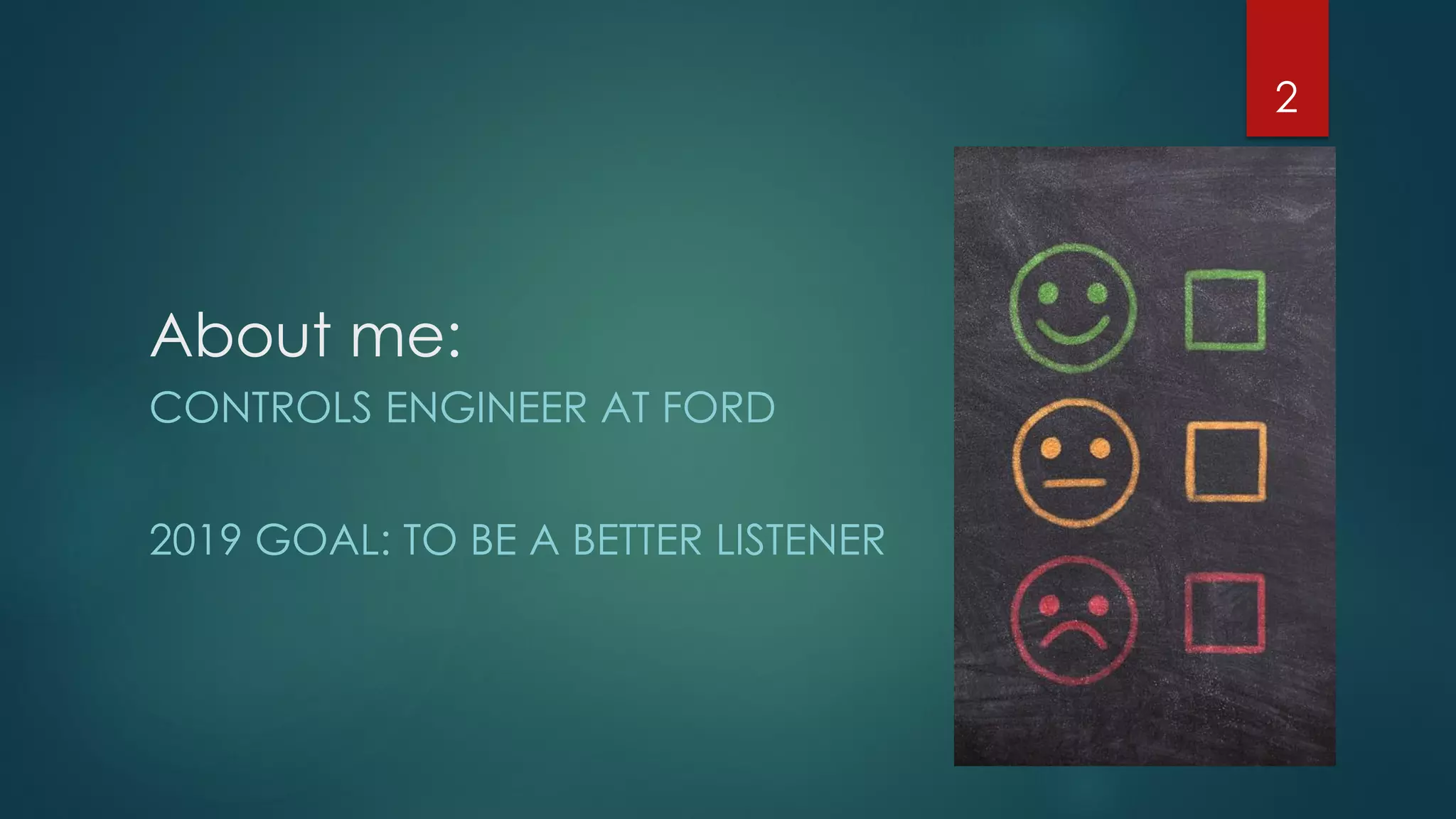
About me:
CONTROLS ENGINEER AT FORD
2019 GOAL: TO BE A BETTER LISTENER
2
Goals for this workshop
Understand the value of feedback, even
when it is poorly delivered (pro tip: it usually
is)
Learn something useful about how we ask
for, receive and use feedback
Understand models for receiving feedback
and a framework for self-improvement
3
Agenda
Why feedback?
A Model For Receiving Feedback
Mindset, Habits & The Story I’m Making
Up…
How to Receive Feedback Better
Closing
4
Ground Rules
Bring comments and questions!
Provide feedback as we go
5
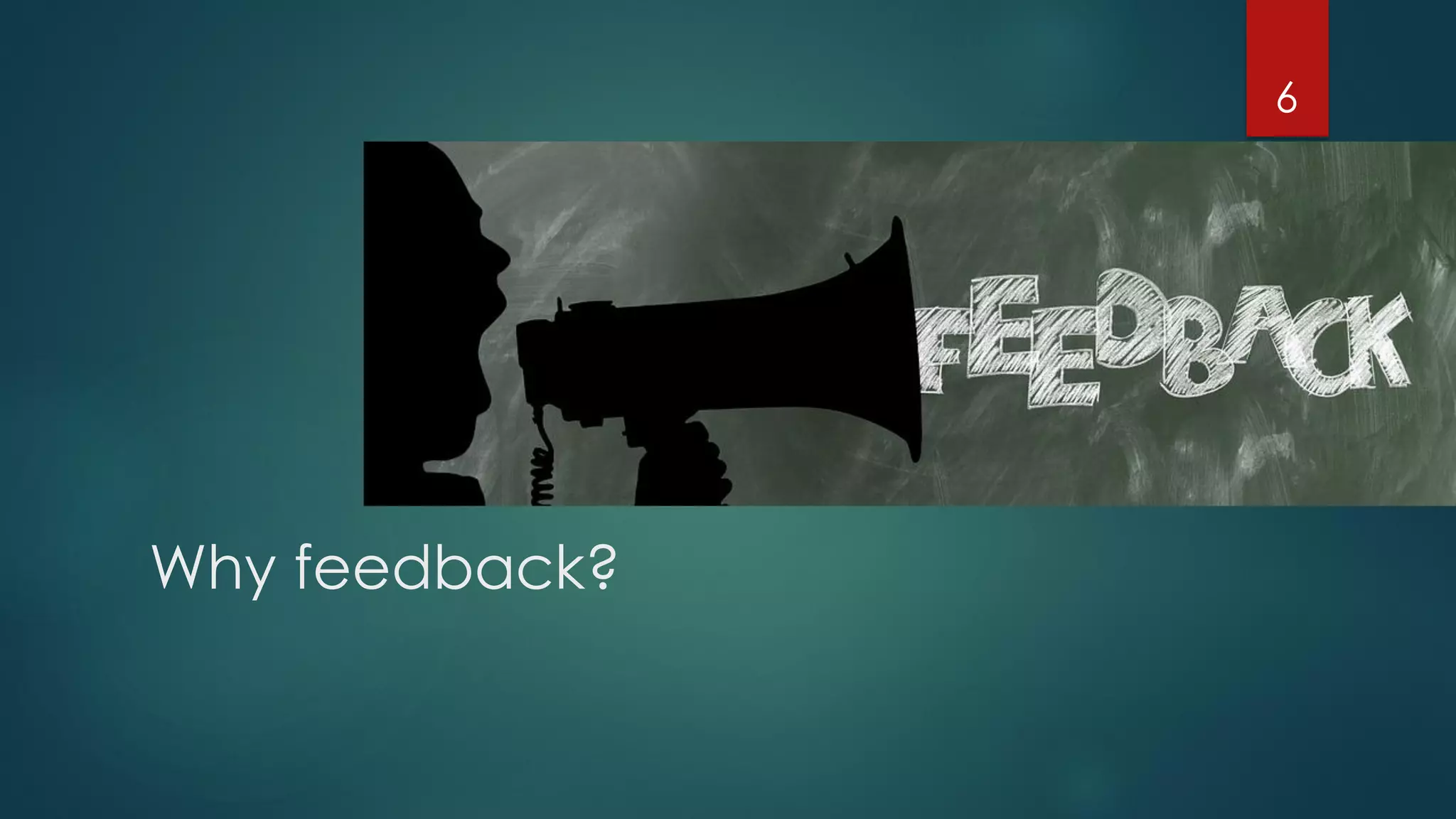
Why feedback?
6
True or False?
 Affirming, positive feedback is always helpful
 We have to trust someone to benefit from their
feedback
 The best teams and marriages have a 5:1 ratio
of positive-to-negative feedback
 The best feedback comes from people not
afraid to hurt my feelings
 The best way for me to get more from feedback
is for everyone else to get better at giving it
7
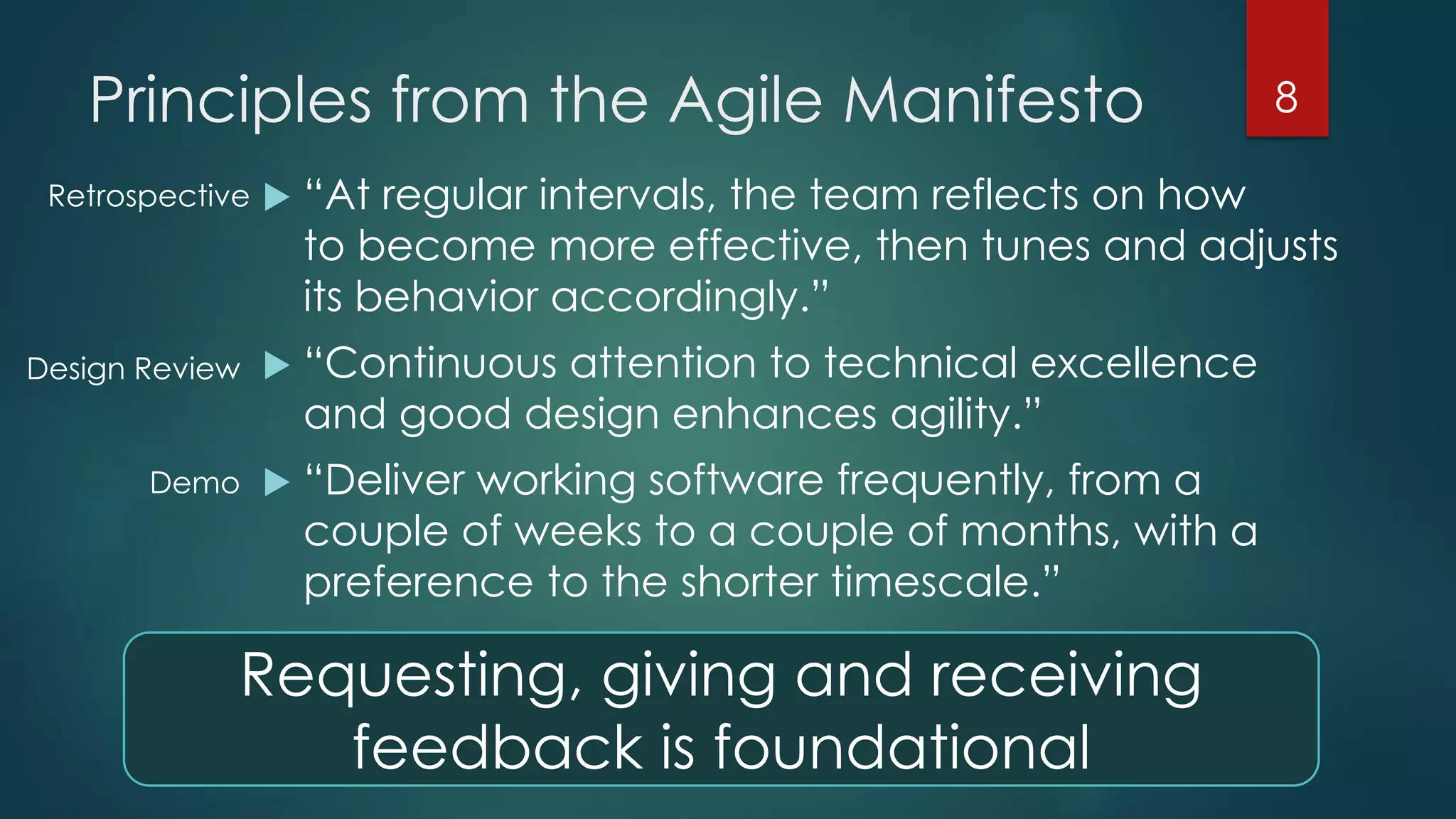
Principles from the Agile Manifesto
 “At regular intervals, the team reflects on how
to become more effective, then tunes and adjusts
its behavior accordingly.”
 “Continuous attention to technical excellence
and good design enhances agility.”
 “Deliver working software frequently, from a
couple of weeks to a couple of months, with a
preference to the shorter timescale.”
8
Retrospective
Design Review
Demo
Requesting, giving and receiving
feedback is foundational
Why do we need feedback? 9
Ellery [CC BY-SA 4.0
(https://creativecommons.org/licenses/by-sa/4.0)]
Effective teams are able to say
and hear what needs to be said
and needs to be heard
 without saying it perfectly
without waiting for the perfect
time
10
Do you hesitate to offer feedback
because of how it will be received?
Q
Your Values for Receiving Feedback
 By yourself, write down your values or mantras
about receiving feedback
 I take feedback like I eat my fish: eat the meat and spit
out the bones
 We are all doing the best we can
 I’m brave enough to take a risk
 I’m getting better at receiving feedback by practicing
 I will show up as if my niece or son was watching
 I am brave enough to listen
 Feedback is the breakfast of champions
 There’s something valuable here
11
E
2 min
one
post-it
to share
Types of interpersonal feedback
Appreciation
Evaluation and Labels
Anything that speaks about my identity, value,
worth, competence or potential
Coaching
Observation
12
Q
Feedback does not arrive on-demand,
nicely packaged or organized
How do you like your feedback? 13
One Thing
14
How to ask for better, more or less
feedback: “One Thing”
Ask for more: “What’s one thing you would like me
to do differently?”
Ask for less: “You are giving me a lot of
suggestions. I appreciate that. What’s the one
thing you want me to focus on right now?”
15
Who is one person you want to ask for one thing
in the next week?
E
Receiving Feedback
16
Deadly Threat? 17
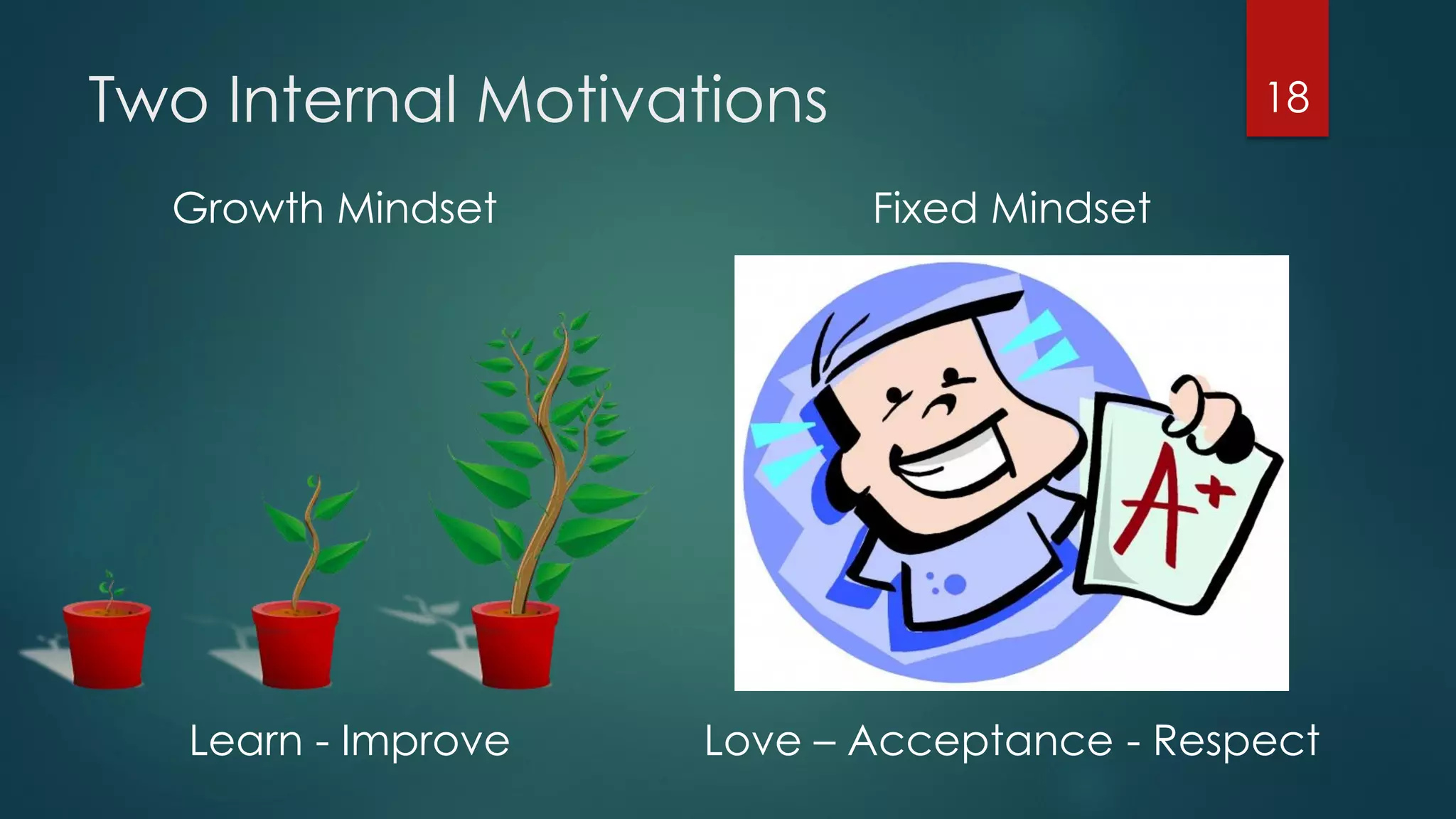
Two Internal Motivations
Love – Acceptance - RespectLearn - Improve
18
Fixed MindsetGrowth Mindset
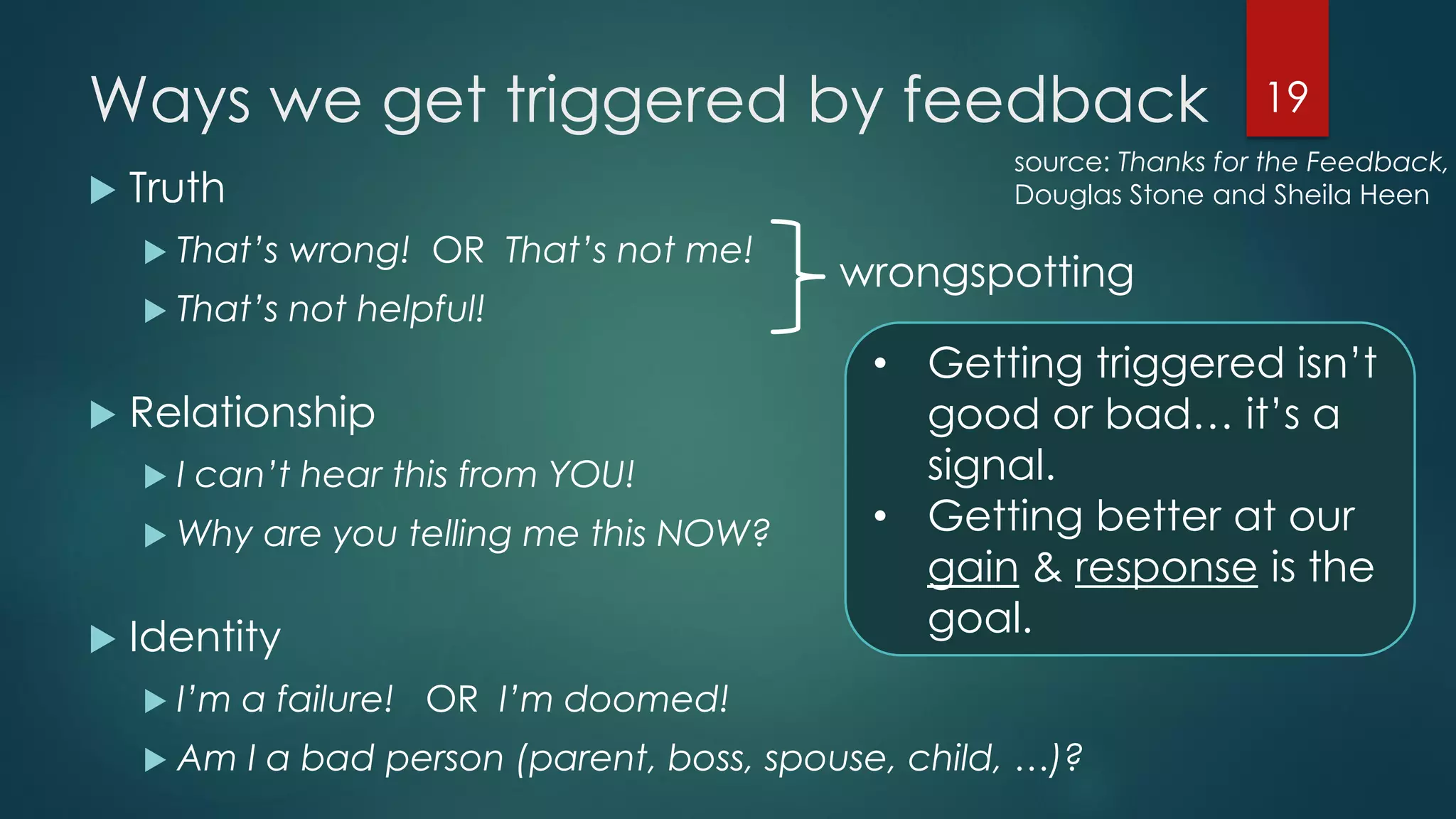
Ways we get triggered by feedback
 Truth
 That’s wrong! OR That’s not me!
 That’s not helpful!
 Relationship
 I can’t hear this from YOU!
 Why are you telling me this NOW?
 Identity
 I’m a failure! OR I’m doomed!
 Am I a bad person (parent, boss, spouse, child, …)?
19
wrongspotting
• Getting triggered isn’t
good or bad… it’s a
signal.
• Getting better at our
gain & response is the
goal.
source: Thanks for the Feedback,
Douglas Stone and Sheila Heen
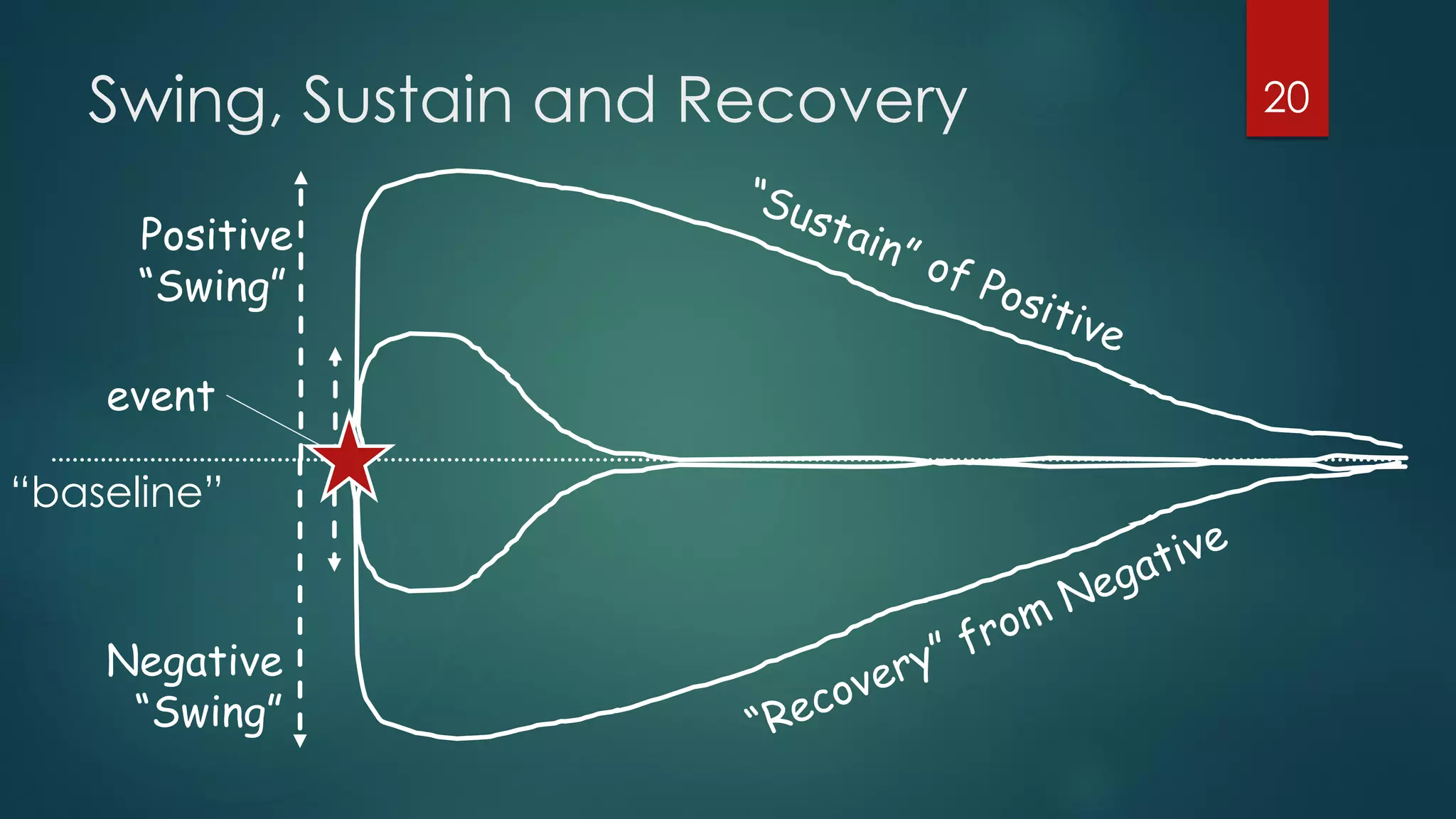
Swing, Sustain and Recovery 20
“baseline”
Positive
“Swing”
Negative
“Swing”
event
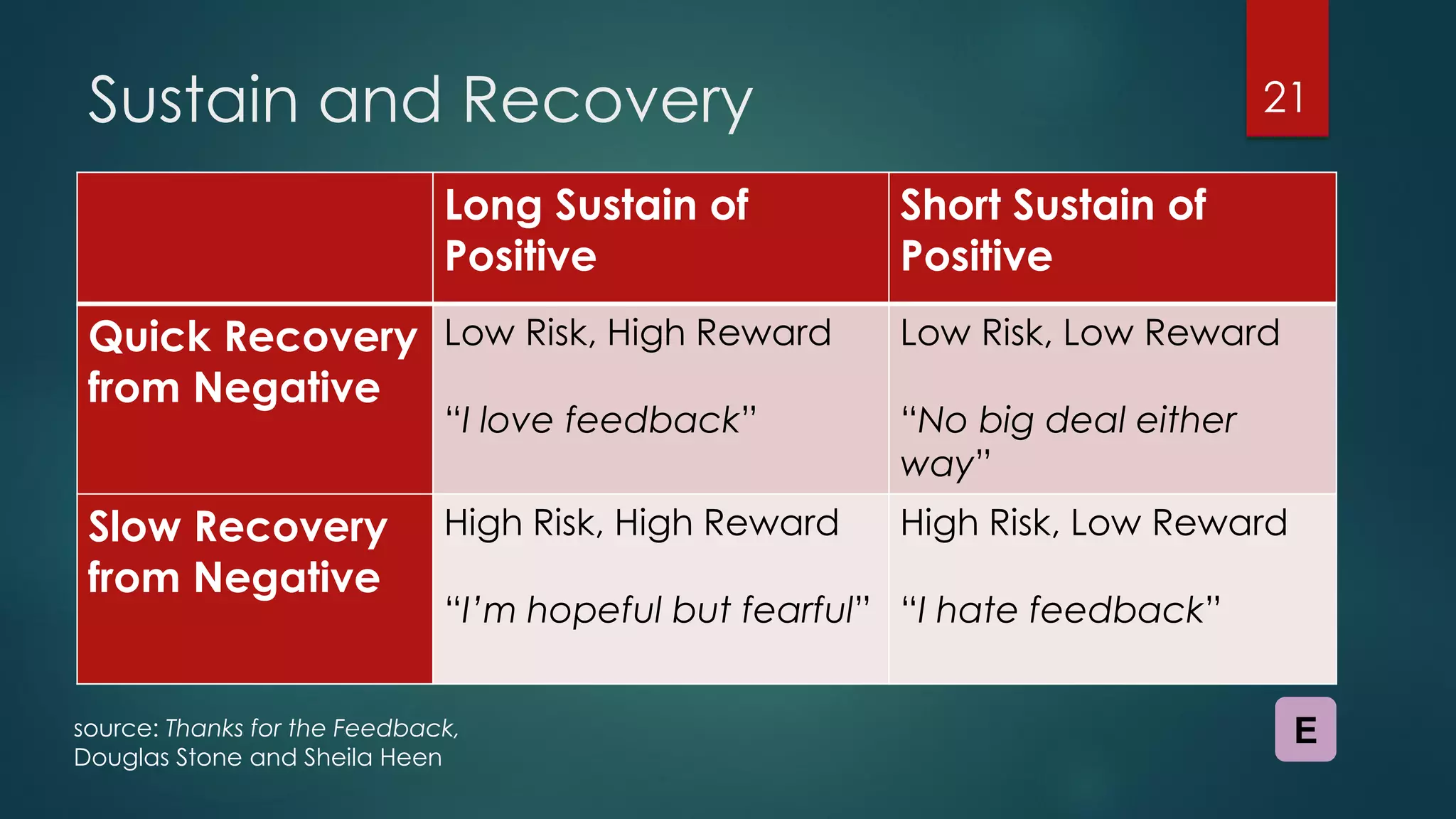
Sustain and Recovery
Long Sustain of
Positive
Short Sustain of
Positive
Quick Recovery
from Negative
Low Risk, High Reward
“I love feedback”
Low Risk, Low Reward
“No big deal either
way”
Slow Recovery
from Negative
High Risk, High Reward
“I’m hopeful but fearful”
High Risk, Low Reward
“I hate feedback”
21
source: Thanks for the Feedback,
Douglas Stone and Sheila Heen
E
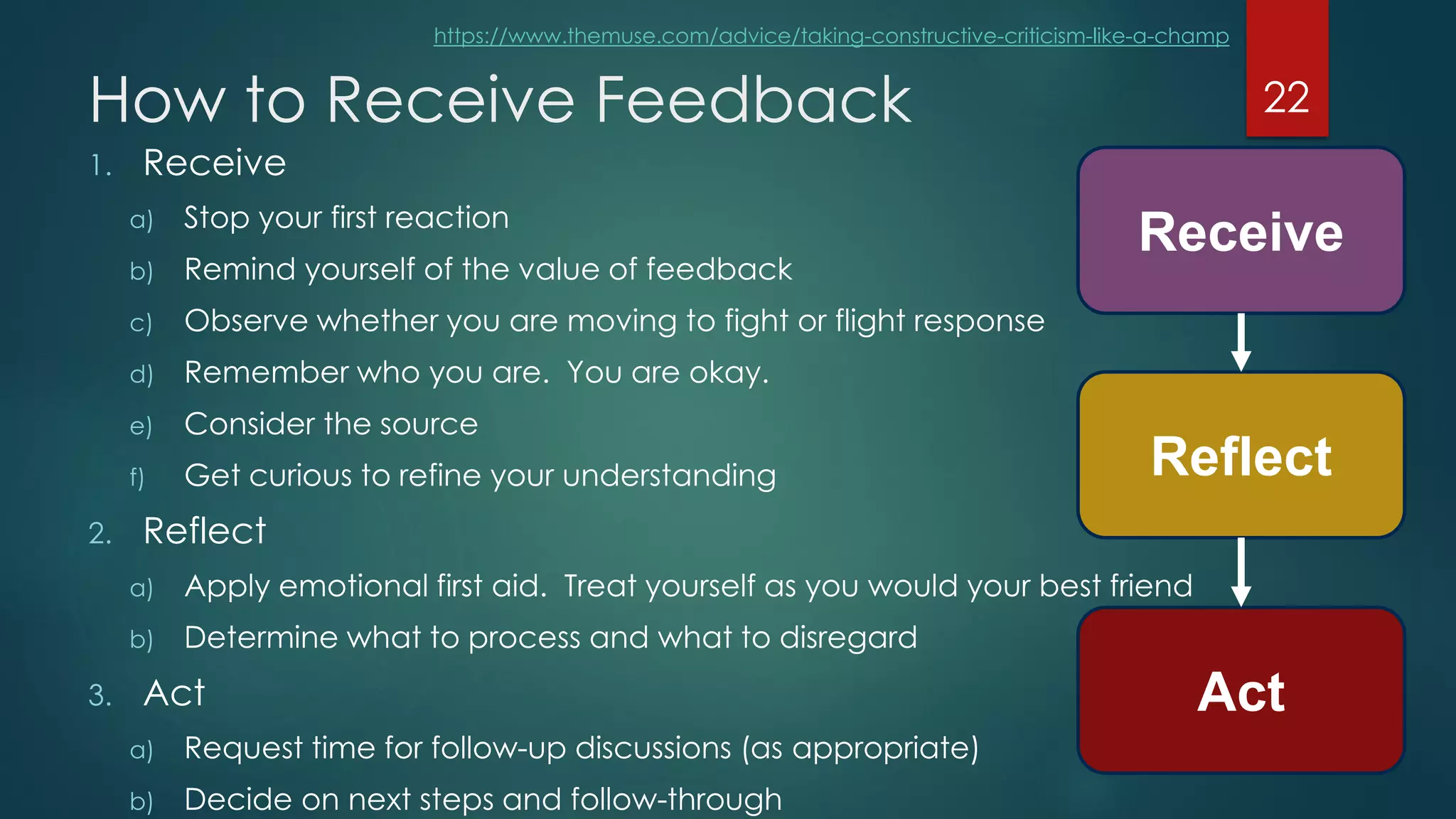
How to Receive Feedback
1. Receive
a) Stop your first reaction
b) Remind yourself of the value of feedback
c) Observe whether you are moving to fight or flight response
d) Remember who you are. You are okay.
e) Consider the source
f) Get curious to refine your understanding
2. Reflect
a) Apply emotional first aid. Treat yourself as you would your best friend
b) Determine what to process and what to disregard
3. Act
a) Request time for follow-up discussions (as appropriate)
b) Decide on next steps and follow-through
22
Receive
Reflect
Act
https://www.themuse.com/advice/taking-constructive-criticism-like-a-champ
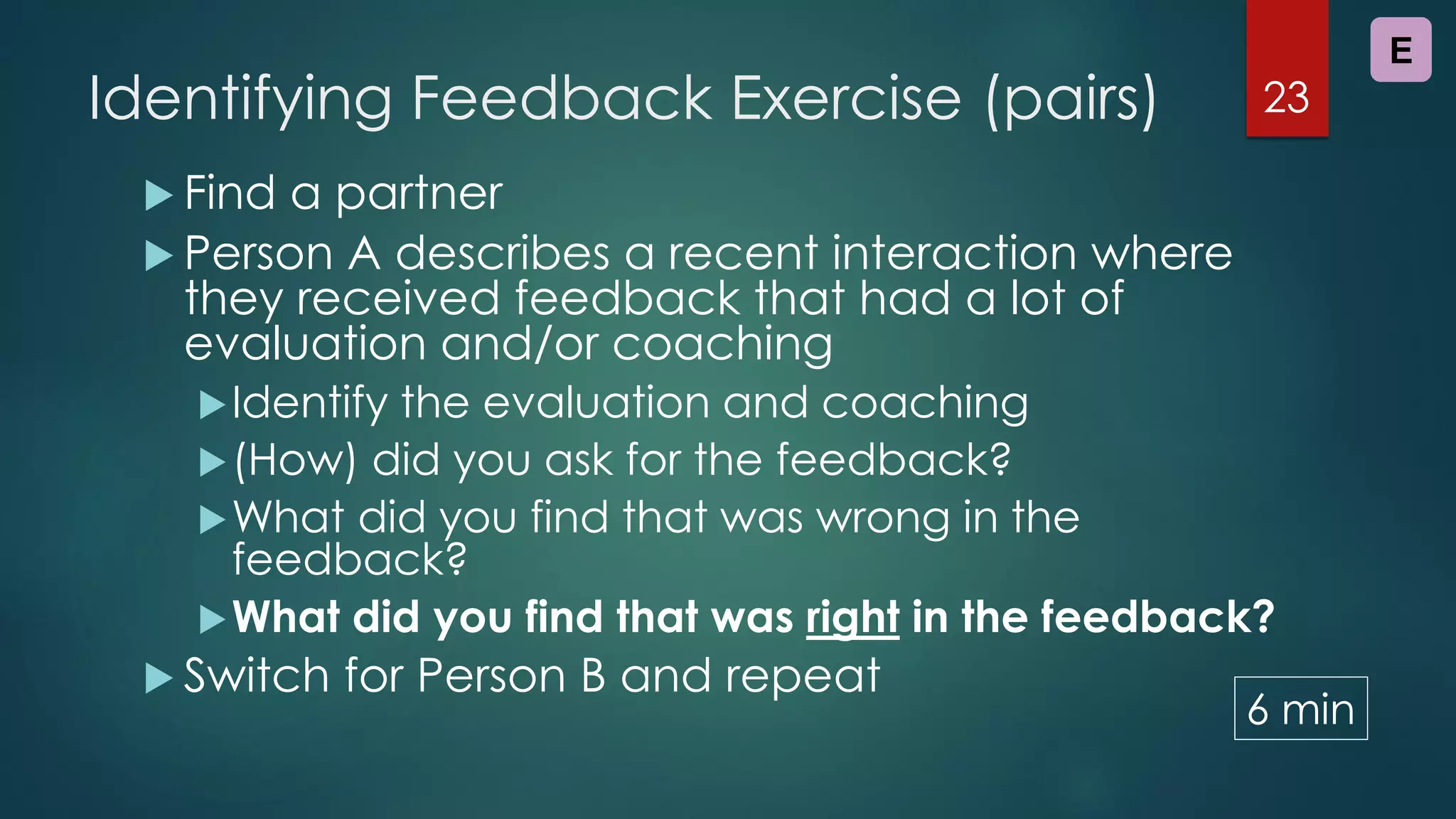
Identifying Feedback Exercise (pairs)
 Find a partner
 Person A describes a recent interaction where
they received feedback that had a lot of
evaluation and/or coaching
Identify the evaluation and coaching
(How) did you ask for the feedback?
What did you find that was wrong in the
feedback?
What did you find that was right in the feedback?
 Switch for Person B and repeat
23
E
6 min
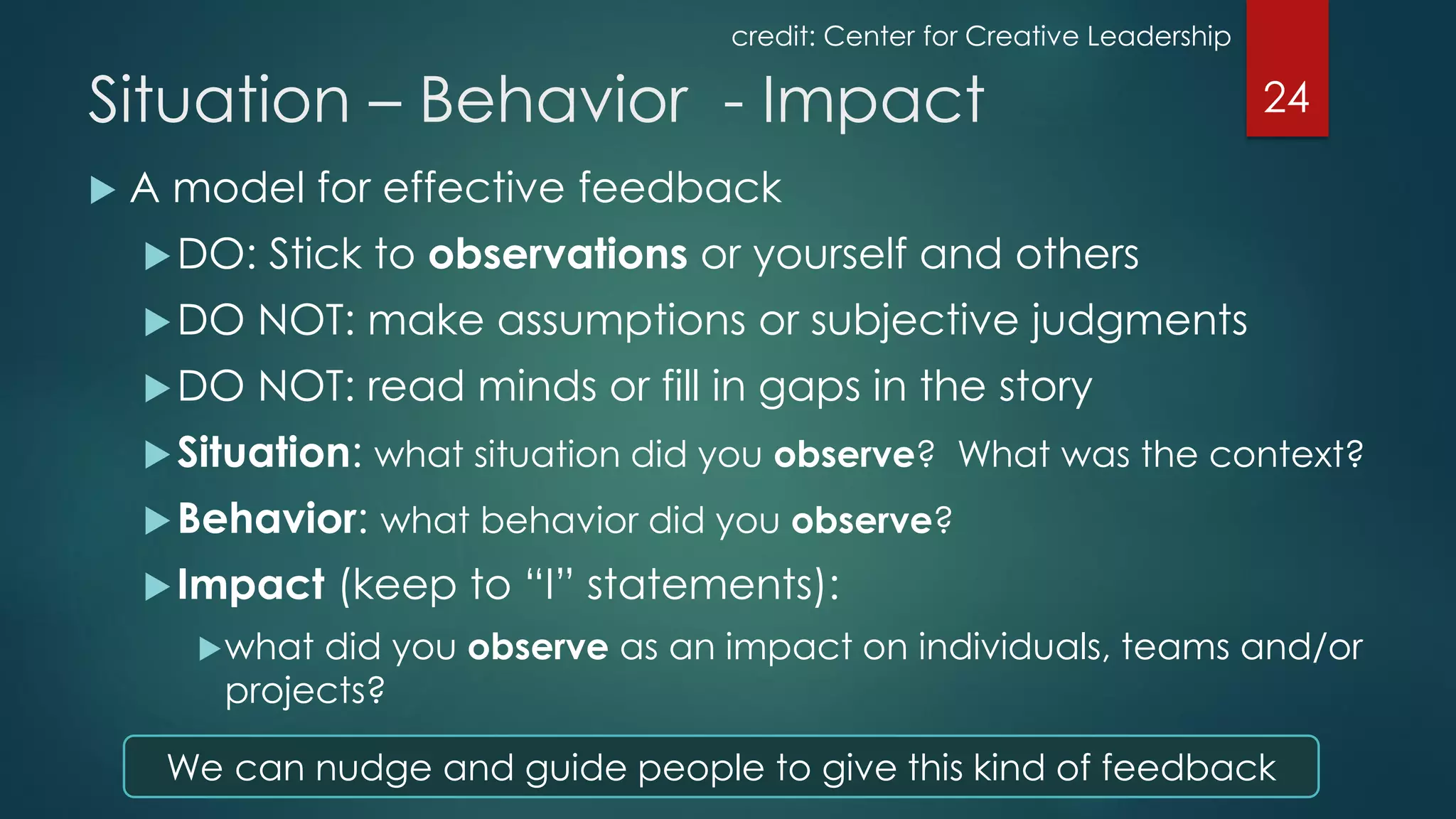
 A model for effective feedback
DO: Stick to observations or yourself and others
DO NOT: make assumptions or subjective judgments
DO NOT: read minds or fill in gaps in the story
Situation: what situation did you observe? What was the context?
Behavior: what behavior did you observe?
Impact (keep to “I” statements):
what did you observe as an impact on individuals, teams and/or
projects?
24Situation – Behavior - Impact
credit: Center for Creative Leadership
We can nudge and guide people to give this kind of feedback
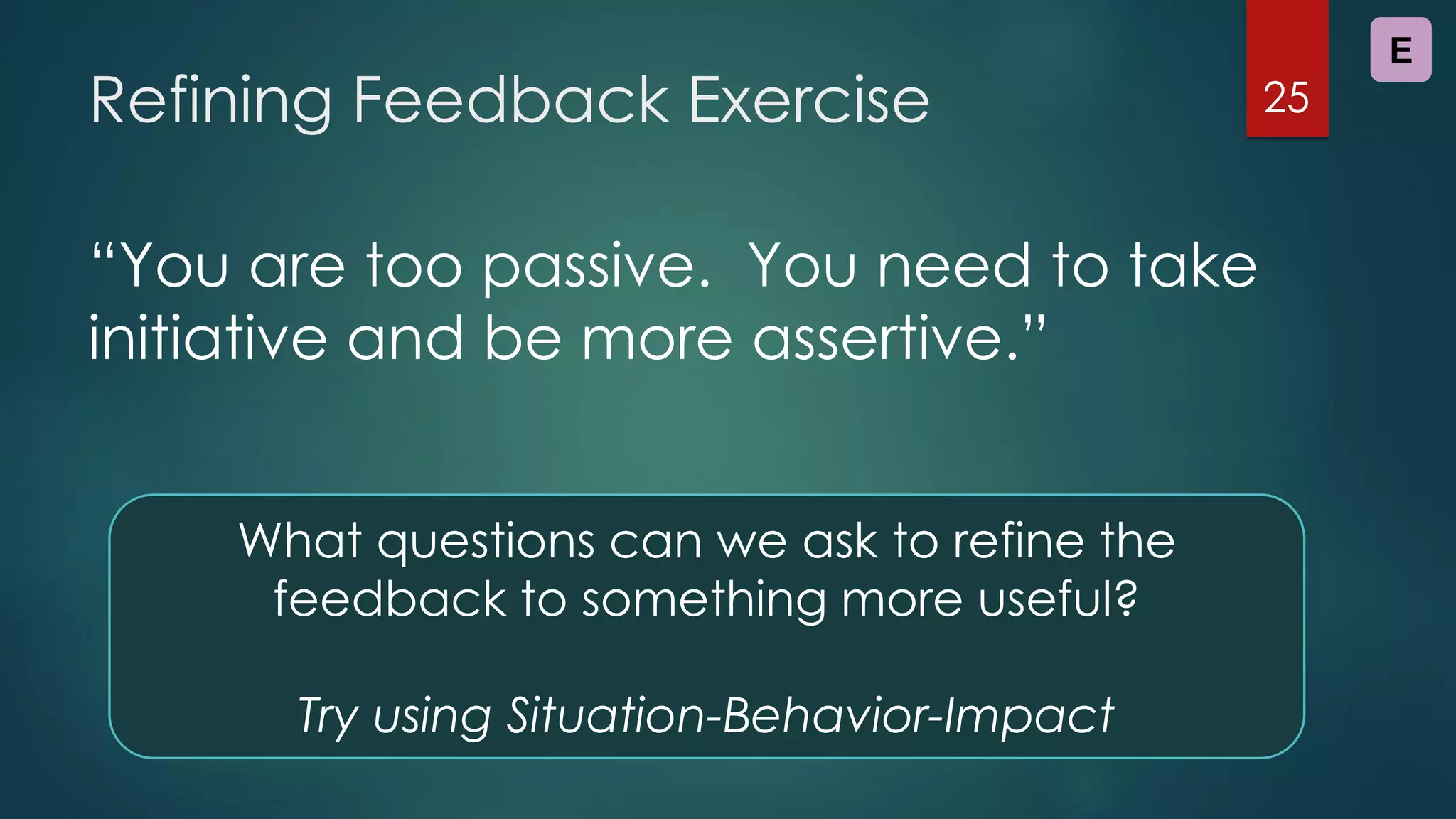
Refining Feedback Exercise
“You are too passive. You need to take
initiative and be more assertive.”
25
What questions can we ask to refine the
feedback to something more useful?
Try using Situation-Behavior-Impact
E
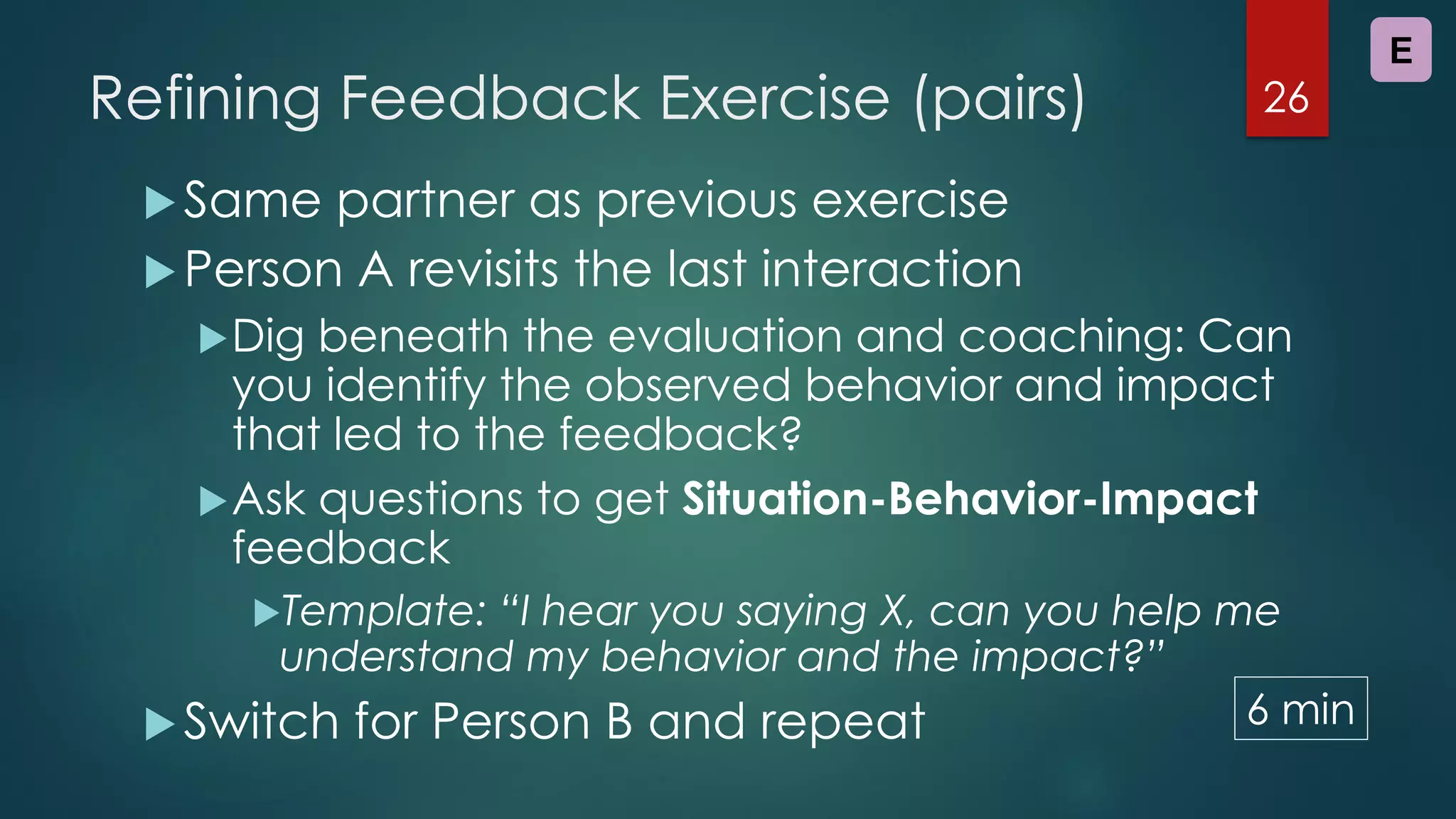
Refining Feedback Exercise (pairs)
Same partner as previous exercise
Person A revisits the last interaction
Dig beneath the evaluation and coaching: Can
you identify the observed behavior and impact
that led to the feedback?
Ask questions to get Situation-Behavior-Impact
feedback
Template: “I hear you saying X, can you help me
understand my behavior and the impact?”
Switch for Person B and repeat
26
E
6 min
Group Debrief:
Wrongspotting, Sifting
and Guiding Feedback
27
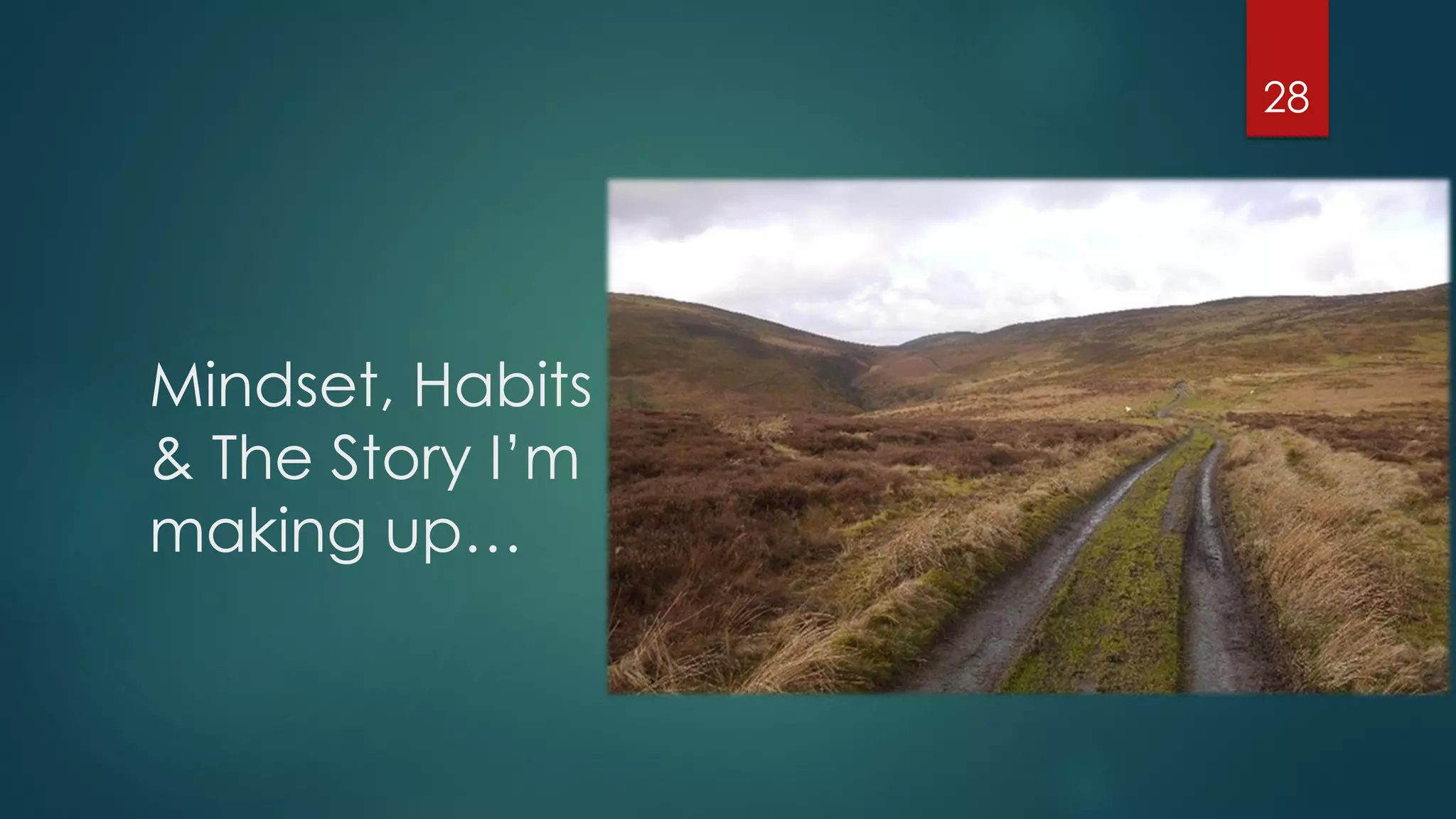
Mindset, Habits
& The Story I’m
making up…
28
29
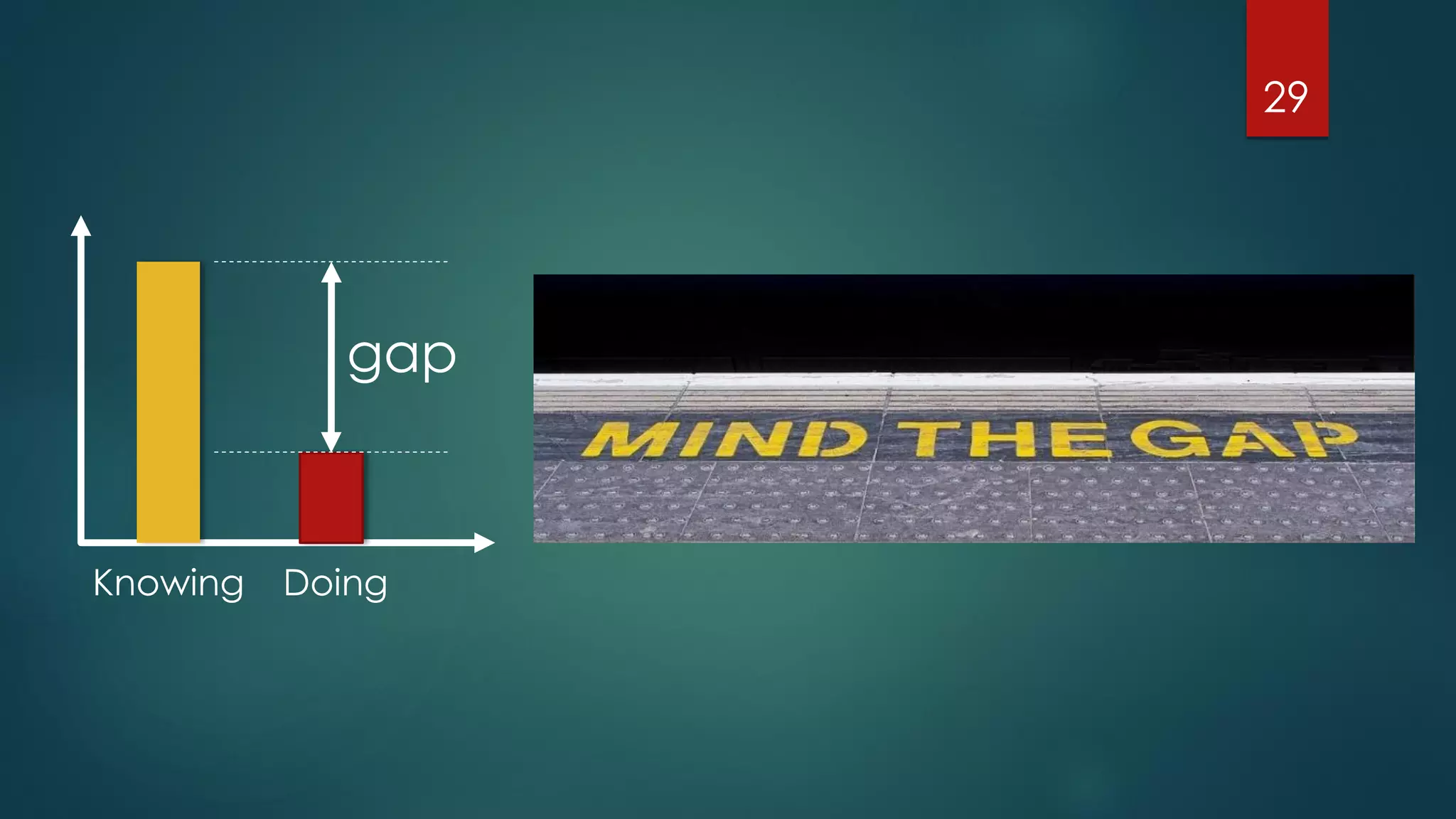
Knowing Doing
gap
The Secret to Resilience
“The story I’m making up is…”
30
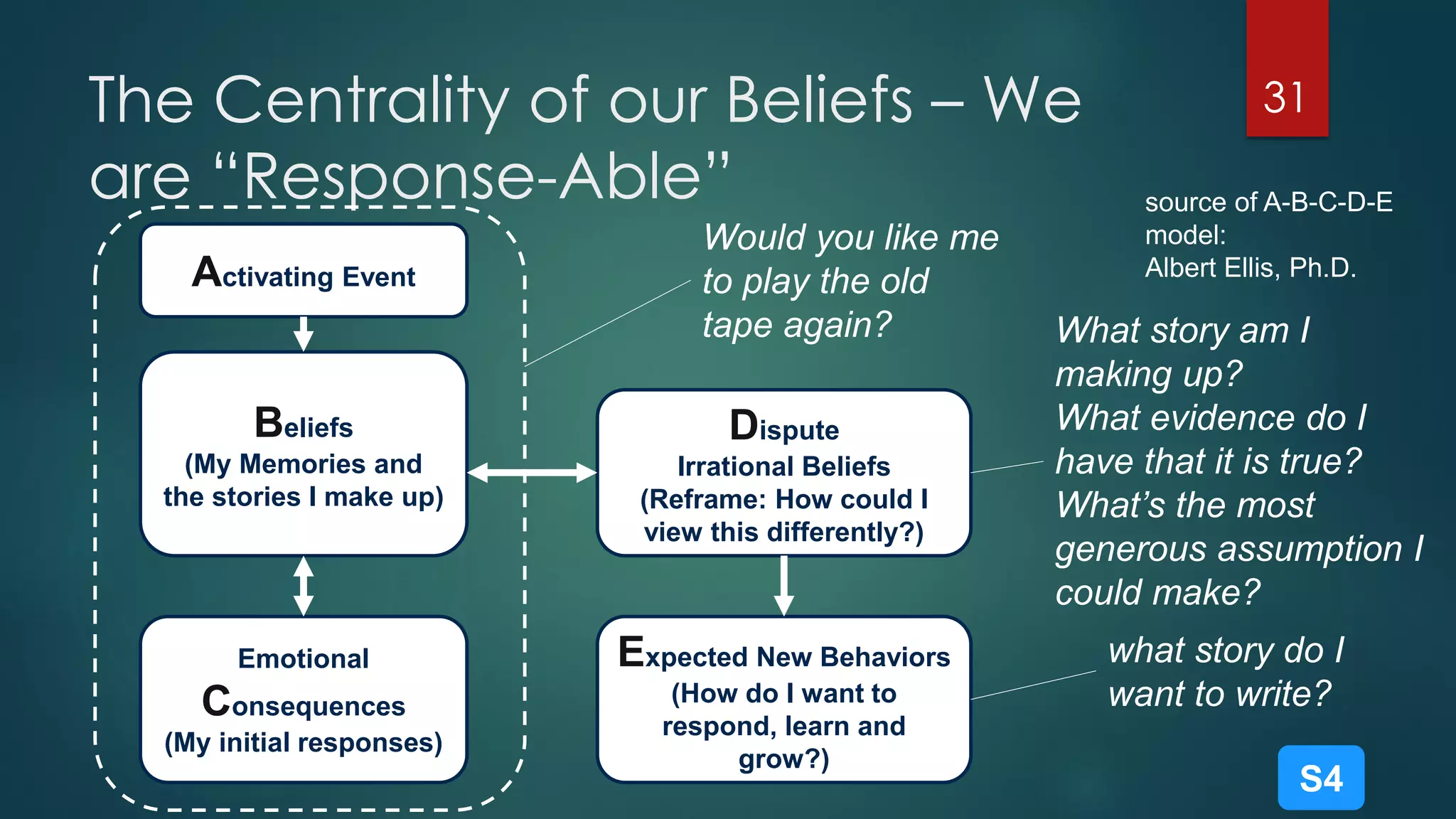
The Centrality of our Beliefs – We
are “Response-Able”
31
Activating Event
Beliefs
(My Memories and
the stories I make up)
Emotional
Consequences
(My initial responses)
Dispute
Irrational Beliefs
(Reframe: How could I
view this differently?)
Expected New Behaviors
(How do I want to
respond, learn and
grow?)
source of A-B-C-D-E
model:
Albert Ellis, Ph.D.
Would you like me
to play the old
tape again?
S4
what story do I
want to write?
What story am I
making up?
What evidence do I
have that it is true?
What’s the most
generous assumption I
could make?
Triggering and Stories Exercise (pairs)
Find a new partner
Person A describes an interaction where
they may have been triggered
How were you triggered?
What stories did you make up?
Switch and repeat
32
E
6 min
Table Debrief:
Triggering &
Stories
33
Switchtracking
34
Joel Bradshaw [Public domain]
“
”
[when] someone gives
you feedback, and your
reaction to that feedback
changes the subject.
SHEILA HEEN
Definition of Switchtracking
35
Signposting: The remedy for
switchtracking
1. Identify two topics running
simultaneously
2. Bring the switchtracking to everyone’s
attention, acknowledge both topics
are important and propose a way
forward to address them separately
36
Switchtracking Roleplay
Jose: “Hey Mark, we just found an issue on the test
stand. One of the system tests failed when it didn’t
respond to the command for almost 3 seconds.
Can we look through the data together?”
Mark: “I got the specification from James and I told
him the spec has some gaps. I coded to the spec.”
37
Where’s the switchtracking? E
How to Receive
Feedback Better
38
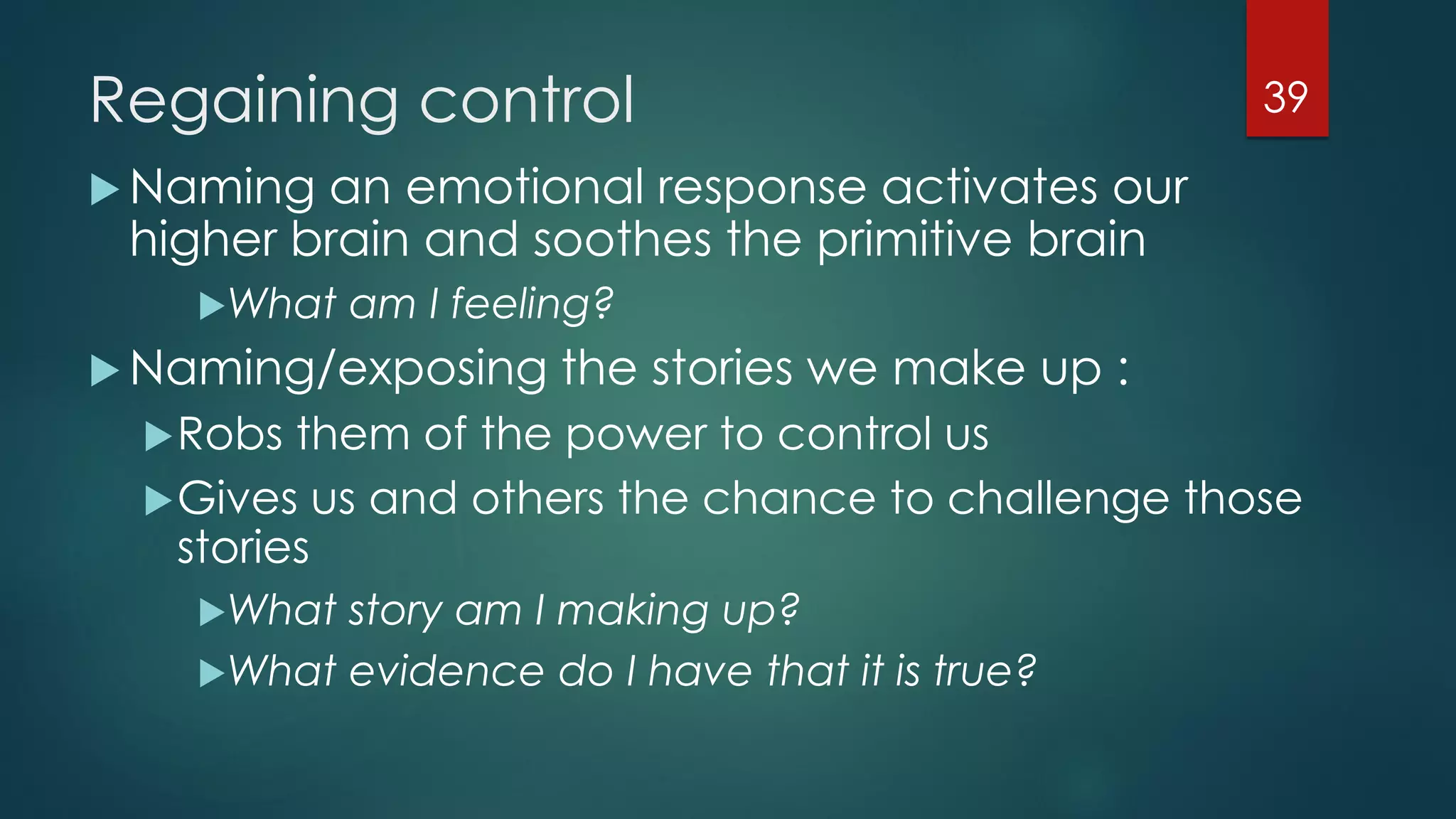
Regaining control
 Naming an emotional response activates our
higher brain and soothes the primitive brain
What am I feeling?
 Naming/exposing the stories we make up :
Robs them of the power to control us
Gives us and others the chance to challenge those
stories
What story am I making up?
What evidence do I have that it is true?
39
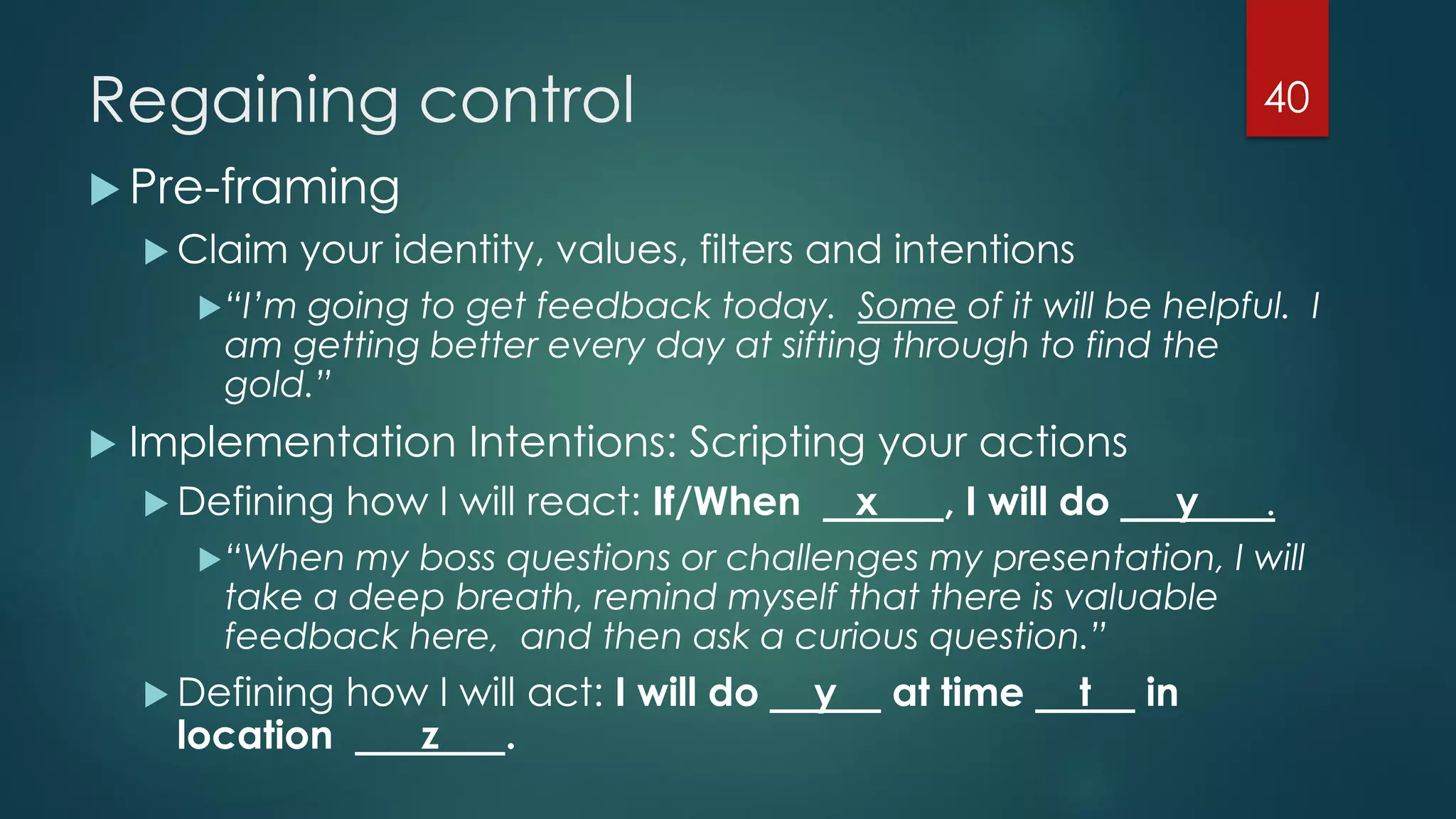
Regaining control
 Pre-framing
 Claim your identity, values, filters and intentions
“I’m going to get feedback today. Some of it will be helpful. I
am getting better every day at sifting through to find the
gold.”
 Implementation Intentions: Scripting your actions
 Defining how I will react: If/When x , I will do y .
“When my boss questions or challenges my presentation, I will
take a deep breath, remind myself that there is valuable
feedback here, and then ask a curious question.”
 Defining how I will act: I will do y at time t in
location z .
40
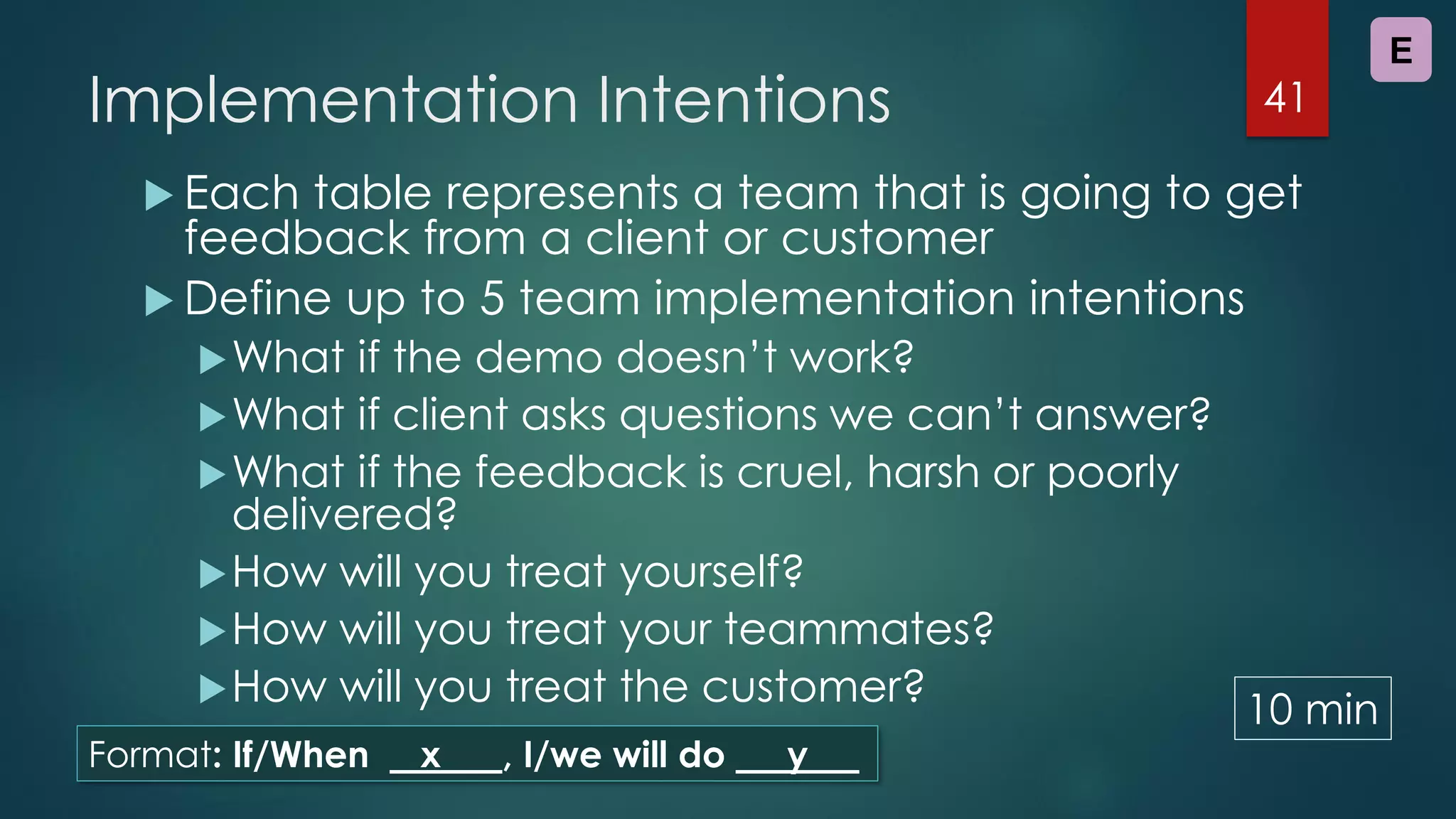
Implementation Intentions
 Each table represents a team that is going to get
feedback from a client or customer
 Define up to 5 team implementation intentions
What if the demo doesn’t work?
What if client asks questions we can’t answer?
What if the feedback is cruel, harsh or poorly
delivered?
How will you treat yourself?
How will you treat your teammates?
How will you treat the customer?
41
E
Format: If/When x , I/we will do y
10 min
Group Debrief:
Implementation
Intentions
42
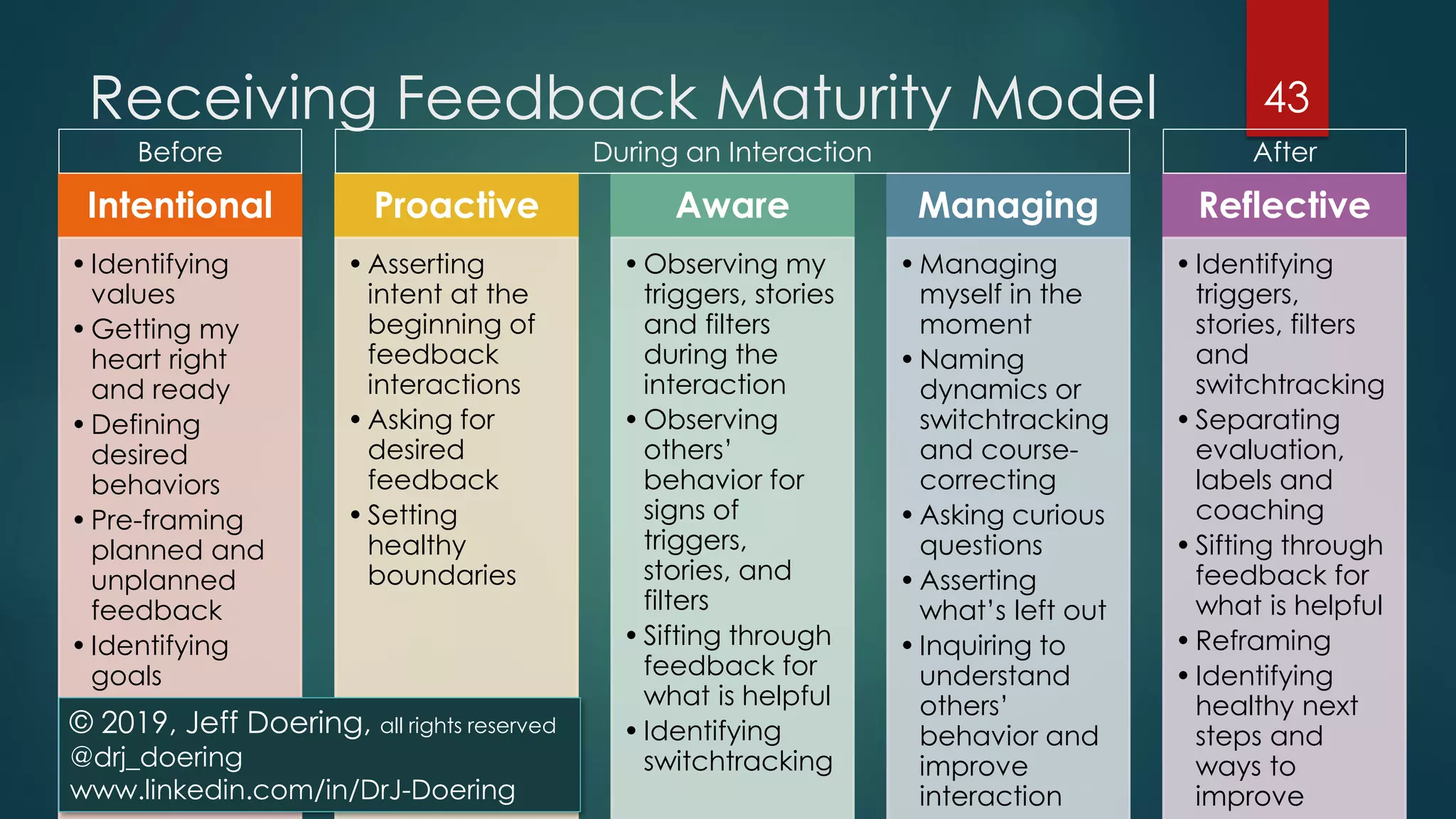
Intentional
•Identifying
values
•Getting my
heart right
and ready
•Defining
desired
behaviors
•Pre-framing
planned and
unplanned
feedback
•Identifying
goals
Proactive
•Asserting
intent at the
beginning of
feedback
interactions
•Asking for
desired
feedback
•Setting
healthy
boundaries
Aware
•Observing my
triggers, stories
and filters
during the
interaction
•Observing
others’
behavior for
signs of
triggers,
stories, and
filters
•Sifting through
feedback for
what is helpful
•Identifying
switchtracking
Managing
•Managing
myself in the
moment
•Naming
dynamics or
switchtracking
and course-
correcting
•Asking curious
questions
•Asserting
what’s left out
•Inquiring to
understand
others’
behavior and
improve
interaction
Reflective
•Identifying
triggers,
stories, filters
and
switchtracking
•Separating
evaluation,
labels and
coaching
•Sifting through
feedback for
what is helpful
•Reframing
•Identifying
healthy next
steps and
ways to
improve
Receiving Feedback Maturity Model 43
AfterBefore During an Interaction
© 2019, Jeff Doering, all rights reserved
@drj_doering
www.linkedin.com/in/DrJ-Doering
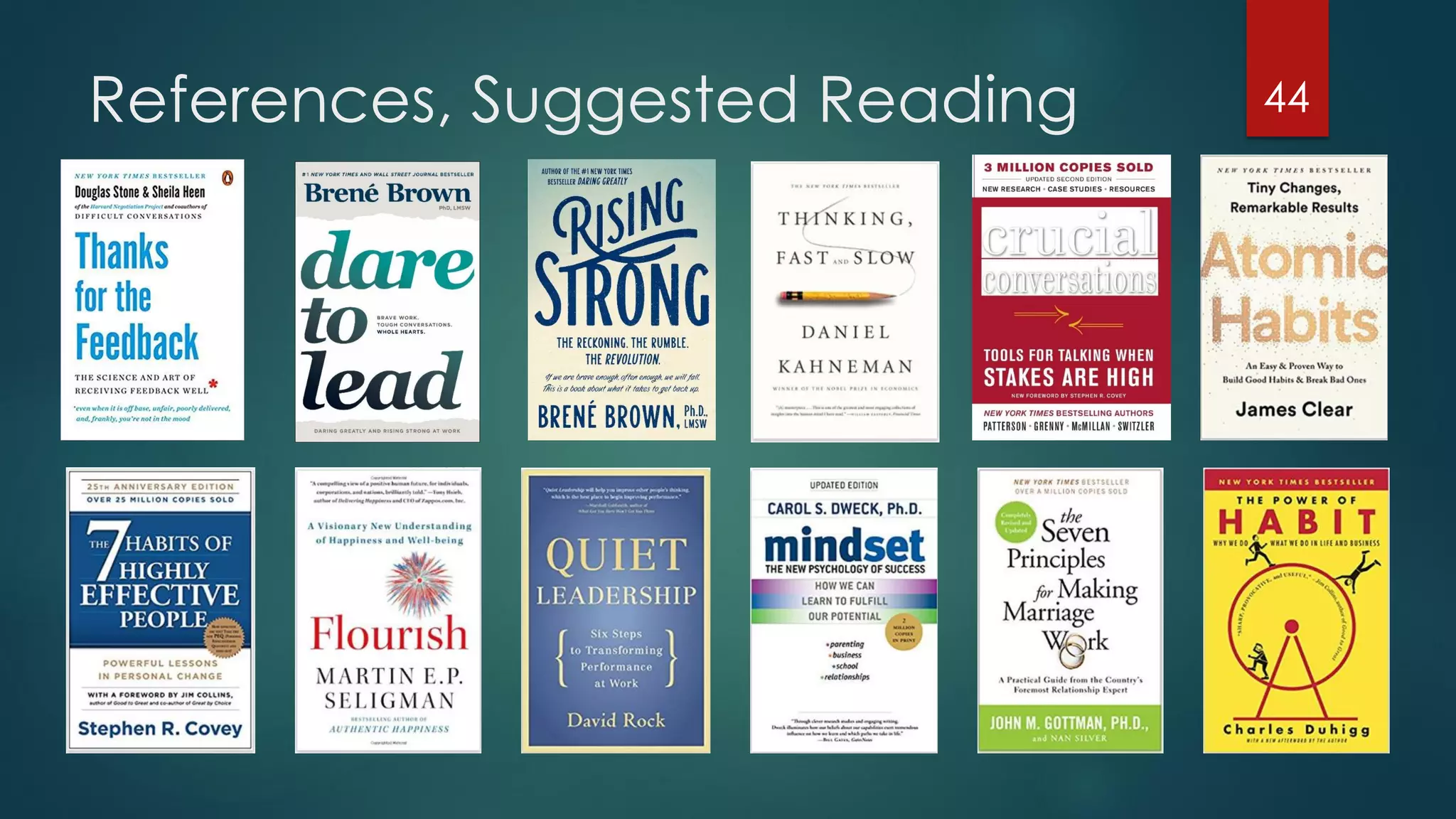
References, Suggested Reading 44
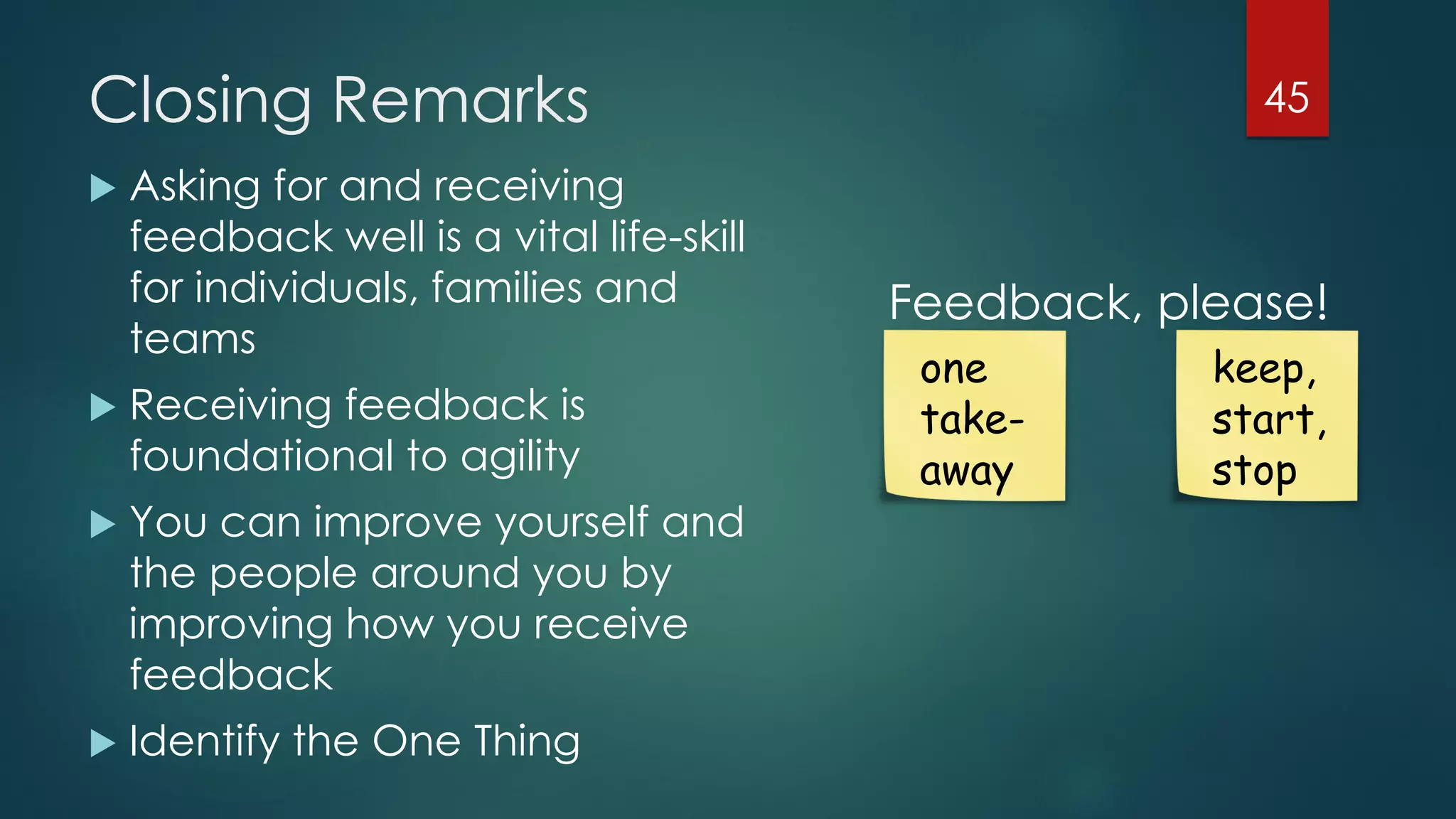
Closing Remarks
 Asking for and receiving
feedback well is a vital life-skill
for individuals, families and
teams
 Receiving feedback is
foundational to agility
 You can improve yourself and
the people around you by
improving how you receive
feedback
 Identify the One Thing
45
one
take-
away
keep,
start,
stop
Feedback, please!
Thank you!!
Questions?
46
JEFF DOERING
TWITTER/DRJ_DOERING
WWW.LINKEDIN.COM/IN/DRJ-DOERING
JDOERING@FORD.COM

2019 05-31 feedback and resilience lab - agile and beyond

  • 1.
    Feedback and Resilience Lab: Waysto learn, grow and bounce back as individuals and teams JEFF DOERING TWITTER/DRJ_DOERING WWW.LINKEDIN.COM/IN/DRJ-DOERING JDOERING@FORD.COM 1 Agile and Beyond – May 2019
  • 2.
    About me: CONTROLS ENGINEERAT FORD 2019 GOAL: TO BE A BETTER LISTENER 2
  • 3.
    Goals for thisworkshop Understand the value of feedback, even when it is poorly delivered (pro tip: it usually is) Learn something useful about how we ask for, receive and use feedback Understand models for receiving feedback and a framework for self-improvement 3
  • 4.
    Agenda Why feedback? A ModelFor Receiving Feedback Mindset, Habits & The Story I’m Making Up… How to Receive Feedback Better Closing 4
  • 5.
    Ground Rules Bring commentsand questions! Provide feedback as we go 5
  • 6.
  • 7.
    True or False? Affirming, positive feedback is always helpful  We have to trust someone to benefit from their feedback  The best teams and marriages have a 5:1 ratio of positive-to-negative feedback  The best feedback comes from people not afraid to hurt my feelings  The best way for me to get more from feedback is for everyone else to get better at giving it 7
  • 8.
    Principles from theAgile Manifesto  “At regular intervals, the team reflects on how to become more effective, then tunes and adjusts its behavior accordingly.”  “Continuous attention to technical excellence and good design enhances agility.”  “Deliver working software frequently, from a couple of weeks to a couple of months, with a preference to the shorter timescale.” 8 Retrospective Design Review Demo Requesting, giving and receiving feedback is foundational
  • 9.
    Why do weneed feedback? 9 Ellery [CC BY-SA 4.0 (https://creativecommons.org/licenses/by-sa/4.0)]
  • 10.
    Effective teams areable to say and hear what needs to be said and needs to be heard  without saying it perfectly without waiting for the perfect time 10 Do you hesitate to offer feedback because of how it will be received? Q
  • 11.
    Your Values forReceiving Feedback  By yourself, write down your values or mantras about receiving feedback  I take feedback like I eat my fish: eat the meat and spit out the bones  We are all doing the best we can  I’m brave enough to take a risk  I’m getting better at receiving feedback by practicing  I will show up as if my niece or son was watching  I am brave enough to listen  Feedback is the breakfast of champions  There’s something valuable here 11 E 2 min one post-it to share
  • 12.
    Types of interpersonalfeedback Appreciation Evaluation and Labels Anything that speaks about my identity, value, worth, competence or potential Coaching Observation 12 Q Feedback does not arrive on-demand, nicely packaged or organized
  • 13.
    How do youlike your feedback? 13
  • 14.
  • 15.
    How to askfor better, more or less feedback: “One Thing” Ask for more: “What’s one thing you would like me to do differently?” Ask for less: “You are giving me a lot of suggestions. I appreciate that. What’s the one thing you want me to focus on right now?” 15 Who is one person you want to ask for one thing in the next week? E
  • 16.
  • 17.
  • 18.
    Two Internal Motivations Love– Acceptance - RespectLearn - Improve 18 Fixed MindsetGrowth Mindset
  • 19.
    Ways we gettriggered by feedback  Truth  That’s wrong! OR That’s not me!  That’s not helpful!  Relationship  I can’t hear this from YOU!  Why are you telling me this NOW?  Identity  I’m a failure! OR I’m doomed!  Am I a bad person (parent, boss, spouse, child, …)? 19 wrongspotting • Getting triggered isn’t good or bad… it’s a signal. • Getting better at our gain & response is the goal. source: Thanks for the Feedback, Douglas Stone and Sheila Heen
  • 20.
    Swing, Sustain andRecovery 20 “baseline” Positive “Swing” Negative “Swing” event
  • 21.
    Sustain and Recovery LongSustain of Positive Short Sustain of Positive Quick Recovery from Negative Low Risk, High Reward “I love feedback” Low Risk, Low Reward “No big deal either way” Slow Recovery from Negative High Risk, High Reward “I’m hopeful but fearful” High Risk, Low Reward “I hate feedback” 21 source: Thanks for the Feedback, Douglas Stone and Sheila Heen E
  • 22.
    How to ReceiveFeedback 1. Receive a) Stop your first reaction b) Remind yourself of the value of feedback c) Observe whether you are moving to fight or flight response d) Remember who you are. You are okay. e) Consider the source f) Get curious to refine your understanding 2. Reflect a) Apply emotional first aid. Treat yourself as you would your best friend b) Determine what to process and what to disregard 3. Act a) Request time for follow-up discussions (as appropriate) b) Decide on next steps and follow-through 22 Receive Reflect Act https://www.themuse.com/advice/taking-constructive-criticism-like-a-champ
  • 23.
    Identifying Feedback Exercise(pairs)  Find a partner  Person A describes a recent interaction where they received feedback that had a lot of evaluation and/or coaching Identify the evaluation and coaching (How) did you ask for the feedback? What did you find that was wrong in the feedback? What did you find that was right in the feedback?  Switch for Person B and repeat 23 E 6 min
  • 24.
     A modelfor effective feedback DO: Stick to observations or yourself and others DO NOT: make assumptions or subjective judgments DO NOT: read minds or fill in gaps in the story Situation: what situation did you observe? What was the context? Behavior: what behavior did you observe? Impact (keep to “I” statements): what did you observe as an impact on individuals, teams and/or projects? 24Situation – Behavior - Impact credit: Center for Creative Leadership We can nudge and guide people to give this kind of feedback
  • 25.
    Refining Feedback Exercise “Youare too passive. You need to take initiative and be more assertive.” 25 What questions can we ask to refine the feedback to something more useful? Try using Situation-Behavior-Impact E
  • 26.
    Refining Feedback Exercise(pairs) Same partner as previous exercise Person A revisits the last interaction Dig beneath the evaluation and coaching: Can you identify the observed behavior and impact that led to the feedback? Ask questions to get Situation-Behavior-Impact feedback Template: “I hear you saying X, can you help me understand my behavior and the impact?” Switch for Person B and repeat 26 E 6 min
  • 27.
  • 28.
    Mindset, Habits & TheStory I’m making up… 28
  • 29.
  • 30.
    The Secret toResilience “The story I’m making up is…” 30
  • 31.
    The Centrality ofour Beliefs – We are “Response-Able” 31 Activating Event Beliefs (My Memories and the stories I make up) Emotional Consequences (My initial responses) Dispute Irrational Beliefs (Reframe: How could I view this differently?) Expected New Behaviors (How do I want to respond, learn and grow?) source of A-B-C-D-E model: Albert Ellis, Ph.D. Would you like me to play the old tape again? S4 what story do I want to write? What story am I making up? What evidence do I have that it is true? What’s the most generous assumption I could make?
  • 32.
    Triggering and StoriesExercise (pairs) Find a new partner Person A describes an interaction where they may have been triggered How were you triggered? What stories did you make up? Switch and repeat 32 E 6 min
  • 33.
  • 34.
  • 35.
    “ ” [when] someone gives youfeedback, and your reaction to that feedback changes the subject. SHEILA HEEN Definition of Switchtracking 35
  • 36.
    Signposting: The remedyfor switchtracking 1. Identify two topics running simultaneously 2. Bring the switchtracking to everyone’s attention, acknowledge both topics are important and propose a way forward to address them separately 36
  • 37.
    Switchtracking Roleplay Jose: “HeyMark, we just found an issue on the test stand. One of the system tests failed when it didn’t respond to the command for almost 3 seconds. Can we look through the data together?” Mark: “I got the specification from James and I told him the spec has some gaps. I coded to the spec.” 37 Where’s the switchtracking? E
  • 38.
  • 39.
    Regaining control  Namingan emotional response activates our higher brain and soothes the primitive brain What am I feeling?  Naming/exposing the stories we make up : Robs them of the power to control us Gives us and others the chance to challenge those stories What story am I making up? What evidence do I have that it is true? 39
  • 40.
    Regaining control  Pre-framing Claim your identity, values, filters and intentions “I’m going to get feedback today. Some of it will be helpful. I am getting better every day at sifting through to find the gold.”  Implementation Intentions: Scripting your actions  Defining how I will react: If/When x , I will do y . “When my boss questions or challenges my presentation, I will take a deep breath, remind myself that there is valuable feedback here, and then ask a curious question.”  Defining how I will act: I will do y at time t in location z . 40
  • 41.
    Implementation Intentions  Eachtable represents a team that is going to get feedback from a client or customer  Define up to 5 team implementation intentions What if the demo doesn’t work? What if client asks questions we can’t answer? What if the feedback is cruel, harsh or poorly delivered? How will you treat yourself? How will you treat your teammates? How will you treat the customer? 41 E Format: If/When x , I/we will do y 10 min
  • 42.
  • 43.
    Intentional •Identifying values •Getting my heart right andready •Defining desired behaviors •Pre-framing planned and unplanned feedback •Identifying goals Proactive •Asserting intent at the beginning of feedback interactions •Asking for desired feedback •Setting healthy boundaries Aware •Observing my triggers, stories and filters during the interaction •Observing others’ behavior for signs of triggers, stories, and filters •Sifting through feedback for what is helpful •Identifying switchtracking Managing •Managing myself in the moment •Naming dynamics or switchtracking and course- correcting •Asking curious questions •Asserting what’s left out •Inquiring to understand others’ behavior and improve interaction Reflective •Identifying triggers, stories, filters and switchtracking •Separating evaluation, labels and coaching •Sifting through feedback for what is helpful •Reframing •Identifying healthy next steps and ways to improve Receiving Feedback Maturity Model 43 AfterBefore During an Interaction © 2019, Jeff Doering, all rights reserved @drj_doering www.linkedin.com/in/DrJ-Doering
  • 44.
  • 45.
    Closing Remarks  Askingfor and receiving feedback well is a vital life-skill for individuals, families and teams  Receiving feedback is foundational to agility  You can improve yourself and the people around you by improving how you receive feedback  Identify the One Thing 45 one take- away keep, start, stop Feedback, please!
  • 46.