1
INSTITUTE OF CHEMICAL TECHNOLOGY
MUMBAI
TextilesRelated to Earth
Geotextile : A permeable geosynthetic comprised solely of
textiles. Geotextiles are used with foundation, soil, rock,
earth, or any other geotechnical engineering-related material
as an integral part of a human-made product structure, or
system.
2
 Separation
 Reinforcement
 Filtration
 Drainage
 Sealing Function
3
Separation is defined as, “The introduction of a flexible porous
textile placed between dissimilar materials so that the integrity
and the functioning of both the materials can remain intact or be
improved”.
4
It is defined as “the equilibrium geotextile-to-soil system that
allows for adequate liquid flow with limited soil loss across the
plane of the geotextile over a service lifetime compatible with the
application under consideration”.
5
This refers to the ability of thick nonwoven geotextile whose
three-dimensional structure provides an avenue for flow of water
through the plane of the geotextile. Here the geotextile promotes
a lateral flow thereby dissipating the kinetic energy of the
capillary rise of ground water.
6
This is the synergistic improvement in the total system strength
created by the introduction of a geotextile into a soil
In this method, the structural stability of the soil is greatly
improved by the tensile strength of the geosynthetic material.
This concept is similar to that of reinforcing concrete with steel.
Since concrete is weak in tension, reinforcing steel is used to
strengthen it. Geosynthetic materials function in a similar manner
as the reinforcing steel by providing strength that helps to hold
the soil in place. Reinforcement provided by geotextiles or
geogrids allow embankments and roads to be built over very
weak soils and allows for steeper embankments to be built.
7
A non-woven geotextile performs this function when impregnated
with asphalt or other polymeric mixes rendering it relatively
impermeable to both cross-plane and in-plane flow. The classic
application of a geotextile as a liquid barrier is paved road
rehabilitation. Here the non-woven geotextile is placed on the
existing pavement surface following the application of an asphalt
tack coat. The geotextile absorbs asphalt to become a
waterproofing membrane minimizing vertical flow of water into
the pavement structure.
8
9
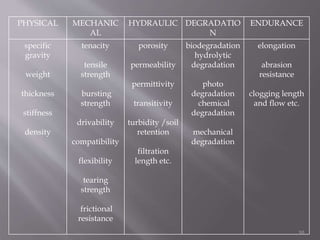
PHYSICAL MECHANIC
AL
HYDRAULIC DEGRADATIO
N
ENDURANCE
specific
gravity
weight
thickness
stiffness
density
tenacity
tensile
strength
bursting
strength
drivability
compatibility
flexibility
tearing
strength
frictional
resistance
porosity
permeability
permittivity
transitivity
turbidity /soil
retention
filtration
length etc.
biodegradation
hydrolytic
degradation
photo
degradation
chemical
degradation
mechanical
degradation
elongation
abrasion
resistance
clogging length
and flow etc.
10
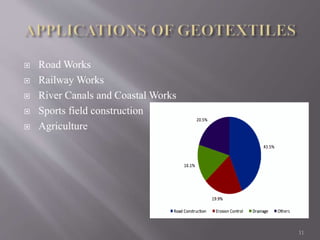
 Road Works
 Railway Works
 River Canals and Coastal Works
 Sports field construction
 Agriculture
11
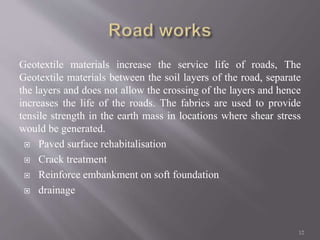
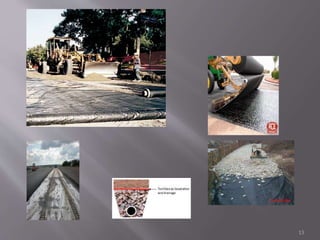
Geotextile materials increase the service life of roads, The
Geotextile materials between the soil layers of the road, separate
the layers and does not allow the crossing of the layers and hence
increases the life of the roads. The fabrics are used to provide
tensile strength in the earth mass in locations where shear stress
would be generated.
 Paved surface rehabitalisation
 Crack treatment
 Reinforce embankment on soft foundation
 drainage
12
13
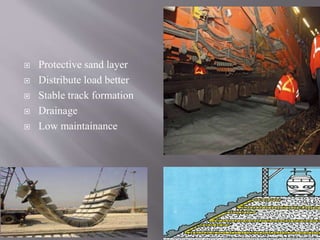
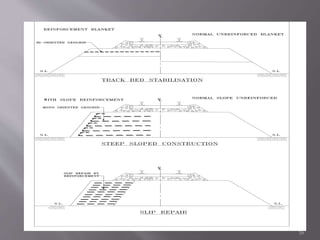
The use of geotextiles in a railroad track structure is dependent
upon many factors including the traffic, track structure, subgrade
conditions, drainage conditions, and maintenance requirements
woven geotextiles are not recommended for use in railroad track
applications. Test installations have shown that woven geotextiles
tend to clog with time and act almost as a plastic sheet preventing
water from draining out of the subgrade. Geotextiles selected for
use in the track structure of military railroads should be
nonwoven, needle-punched materials that meet the requirements
14
 Protective sand layer
 Distribute load better
 Stable track formation
 Drainage
 Low maintainance
15
16
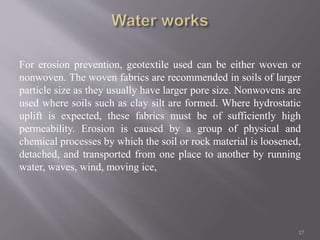
For erosion prevention, geotextile used can be either woven or
nonwoven. The woven fabrics are recommended in soils of larger
particle size as they usually have larger pore size. Nonwovens are
used where soils such as clay silt are formed. Where hydrostatic
uplift is expected, these fabrics must be of sufficiently high
permeability. Erosion is caused by a group of physical and
chemical processes by which the soil or rock material is loosened,
detached, and transported from one place to another by running
water, waves, wind, moving ice,
17
 Erosion control
 Sediment control
 Cover material
18
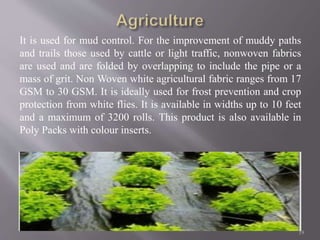
It is used for mud control. For the improvement of muddy paths
and trails those used by cattle or light traffic, nonwoven fabrics
are used and are folded by overlapping to include the pipe or a
mass of grit. Non Woven white agricultural fabric ranges from 17
GSM to 30 GSM. It is ideally used for frost prevention and crop
protection from white flies. It is available in widths up to 10 feet
and a maximum of 3200 rolls. This product is also available in
Poly Packs with colour inserts.
19
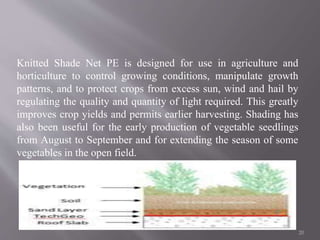
Knitted Shade Net PE is designed for use in agriculture and
horticulture to control growing conditions, manipulate growth
patterns, and to protect crops from excess sun, wind and hail by
regulating the quality and quantity of light required. This greatly
improves crop yields and permits earlier harvesting. Shading has
also been useful for the early production of vegetable seedlings
from August to September and for extending the season of some
vegetables in the open field.
20
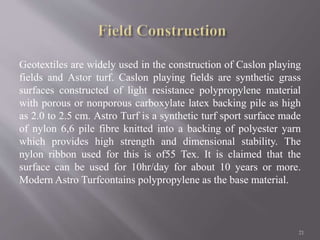
Geotextiles are widely used in the construction of Caslon playing
fields and Astor turf. Caslon playing fields are synthetic grass
surfaces constructed of light resistance polypropylene material
with porous or nonporous carboxylate latex backing pile as high
as 2.0 to 2.5 cm. Astro Turf is a synthetic turf sport surface made
of nylon 6,6 pile fibre knitted into a backing of polyester yarn
which provides high strength and dimensional stability. The
nylon ribbon used for this is of55 Tex. It is claimed that the
surface can be used for 10hr/day for about 10 years or more.
Modern Astro Turfcontains polypropylene as the base material.
21
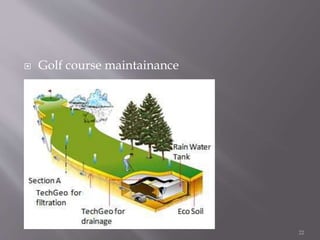
 Golf course maintainance
22
23
24
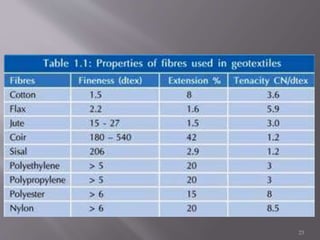
Geotextiles can be formed of synthetic fibres, natural fibres or
combination of the two. In past Geotextiles were made of natural
plant fibres while today are usually formed of synthetic polymers
such as polyester, polypropylene (PP), polyamides (PA).
Geotextiles made from natural fibres are less durable as they get
decomposed with passage of time. Choice of formation depends
on the required properties and service life for which it is used.
For example, natural fibres base Geotextiles is used for erosion
control mats where durability is not a critical factor.
25
Natural fibres can be of vegetable, animal or mineral origin.
Vegetable fibres have greatest potential for use in geotextiles
because of their superior mechanical properties. The important
vegetable fibres which are either in use or have potential to be
used as raw material for geotextiles are jute, coir, sisal, flax,
abaca, pineapple etc.
26
Synthetic polymers are not subject to any degradation due to any
biological and chemical processes. But suffers from the main
disadvantage in terms environmental friendliness as are formed
from non-renewable resources as well as cause environmental
pollution which may lead to health hazards
27
28
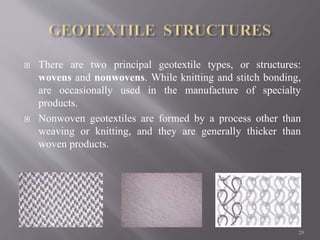
 There are two principal geotextile types, or structures:
wovens and nonwovens. While knitting and stitch bonding,
are occasionally used in the manufacture of specialty
products.
 Nonwoven geotextiles are formed by a process other than
weaving or knitting, and they are generally thicker than
woven products.
29
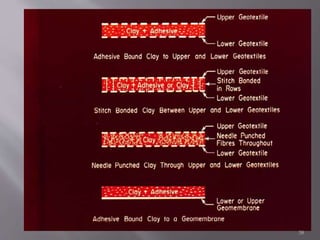
(a) Needle punching. Bonding by needle punching process
causes the fibres to be mechanically entangled . The resulting
geotextile has the appearance of a felt mat.
(b) Heat bonding. This is done by fibres of the same polymer
type but having different melting points in the mat, or by using
polymer on the inside and covered or heated with a polymer
having a lower melting point from outside.
30
(c) Resin bonding. Resin is introduced into the fibres mat,
coating the fibres and bonding the contacts between fibres.
(d) Combination bonding. Sometimes a combination of bonding
techniques is used to facilitate manufacturing or obtain desired
properties.
Composite geotextiles are materials which combine two or more
of the fabrication techniques. The most common composite
geotextile is a nonwoven mat that has been bonded by needle
punching to one or both sides of a woven scrim
31
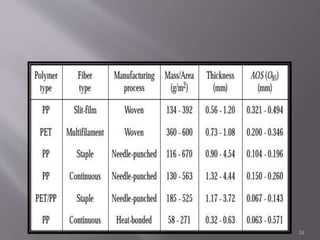
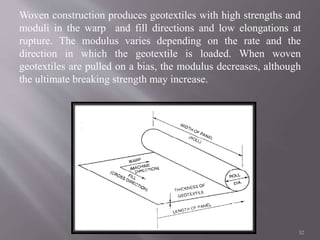
Woven construction produces geotextiles with high strengths and
moduli in the warp and fill directions and low elongations at
rupture. The modulus varies depending on the rate and the
direction in which the geotextile is loaded. When woven
geotextiles are pulled on a bias, the modulus decreases, although
the ultimate breaking strength may increase.
32
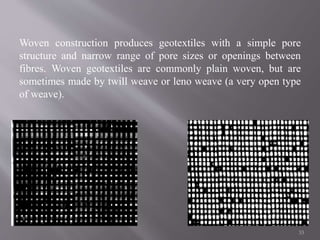
Woven construction produces geotextiles with a simple pore
structure and narrow range of pore sizes or openings between
fibres. Woven geotextiles are commonly plain woven, but are
sometimes made by twill weave or leno weave (a very open type
of weave).
33
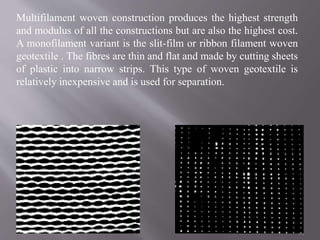
Multifilament woven construction produces the highest strength
and modulus of all the constructions but are also the highest cost.
A monofilament variant is the slit-film or ribbon filament woven
geotextile . The fibres are thin and flat and made by cutting sheets
of plastic into narrow strips. This type of woven geotextile is
relatively inexpensive and is used for separation.
34
Typical geotextile fibres types:
(a) monofilament
(b) multifilament
(c) slit-film
(d) fibrillated
(e) continuous filament
(f) staple
(g) multifilament yarn
(h) staple yarn
(i) slit-film yarn
35
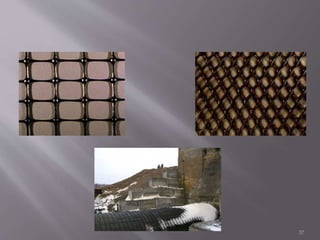
So from the applications geoproducts are available in markets
with various names and sector is growing many companies are
coming to invest in this sector.
 Geocomposites
 Geogrids
 Geomembranes
 Geocontainers
 Geopipes
 Geonets
36
37
38
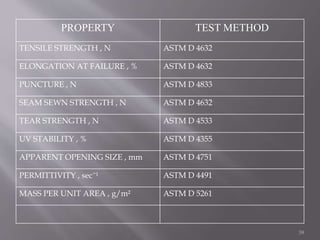
PROPERTY TEST METHOD
TENSILE STRENGTH , N ASTM D 4632
ELONGATION AT FAILURE , % ASTM D 4632
PUNCTURE , N ASTM D 4833
SEAM SEWN STRENGTH , N ASTM D 4632
TEAR STRENGTH , N ASTM D 4533
UV STABILITY , % ASTM D 4355
APPARENT OPENING SIZE , mm ASTM D 4751
PERMITTIVITY , sec⁻¹ ASTM D 4491
MASS PER UNIT AREA , g/m² ASTM D 5261
39
The global market for geotextiles was valued at US$3.2 bln in
2011 and is expected to reach US$6.4 bln in 2018, growing at a
CAGR of 10.3% from 2012 to 2018, as per Transparency Market
Research. In terms of volume, the demand for geotextiles was
1,904 mln sq. meters in 2011 and is expected to reach 3,398.4
mln sq. meters in 2018, growing at a CAGR of 8.6% from 2012
to 2018
The emerging economies have large number of projects
which are being developed currently. Countries such as
China, India and other Asian economies are growing
markets for geotextiles industry. . Within Europe, most of
the major market players are situated in countries such as
U.K., Germany, Denmark, The Netherlands and Italy.
40
41
THANK YOU FOR YOUR ATTENTION
42

Geo textile technical textile

  • 1.
    1 INSTITUTE OF CHEMICALTECHNOLOGY MUMBAI TextilesRelated to Earth
  • 2.
    Geotextile : Apermeable geosynthetic comprised solely of textiles. Geotextiles are used with foundation, soil, rock, earth, or any other geotechnical engineering-related material as an integral part of a human-made product structure, or system. 2
  • 3.
     Separation  Reinforcement Filtration  Drainage  Sealing Function 3
  • 4.
    Separation is definedas, “The introduction of a flexible porous textile placed between dissimilar materials so that the integrity and the functioning of both the materials can remain intact or be improved”. 4
  • 5.
    It is definedas “the equilibrium geotextile-to-soil system that allows for adequate liquid flow with limited soil loss across the plane of the geotextile over a service lifetime compatible with the application under consideration”. 5
  • 6.
    This refers tothe ability of thick nonwoven geotextile whose three-dimensional structure provides an avenue for flow of water through the plane of the geotextile. Here the geotextile promotes a lateral flow thereby dissipating the kinetic energy of the capillary rise of ground water. 6
  • 7.
    This is thesynergistic improvement in the total system strength created by the introduction of a geotextile into a soil In this method, the structural stability of the soil is greatly improved by the tensile strength of the geosynthetic material. This concept is similar to that of reinforcing concrete with steel. Since concrete is weak in tension, reinforcing steel is used to strengthen it. Geosynthetic materials function in a similar manner as the reinforcing steel by providing strength that helps to hold the soil in place. Reinforcement provided by geotextiles or geogrids allow embankments and roads to be built over very weak soils and allows for steeper embankments to be built. 7
  • 8.
    A non-woven geotextileperforms this function when impregnated with asphalt or other polymeric mixes rendering it relatively impermeable to both cross-plane and in-plane flow. The classic application of a geotextile as a liquid barrier is paved road rehabilitation. Here the non-woven geotextile is placed on the existing pavement surface following the application of an asphalt tack coat. The geotextile absorbs asphalt to become a waterproofing membrane minimizing vertical flow of water into the pavement structure. 8
  • 9.
  • 10.
    PHYSICAL MECHANIC AL HYDRAULIC DEGRADATIO N ENDURANCE specific gravity weight thickness stiffness density tenacity tensile strength bursting strength drivability compatibility flexibility tearing strength frictional resistance porosity permeability permittivity transitivity turbidity/soil retention filtration length etc. biodegradation hydrolytic degradation photo degradation chemical degradation mechanical degradation elongation abrasion resistance clogging length and flow etc. 10
  • 11.
     Road Works Railway Works  River Canals and Coastal Works  Sports field construction  Agriculture 11
  • 12.
    Geotextile materials increasethe service life of roads, The Geotextile materials between the soil layers of the road, separate the layers and does not allow the crossing of the layers and hence increases the life of the roads. The fabrics are used to provide tensile strength in the earth mass in locations where shear stress would be generated.  Paved surface rehabitalisation  Crack treatment  Reinforce embankment on soft foundation  drainage 12
  • 13.
  • 14.
    The use ofgeotextiles in a railroad track structure is dependent upon many factors including the traffic, track structure, subgrade conditions, drainage conditions, and maintenance requirements woven geotextiles are not recommended for use in railroad track applications. Test installations have shown that woven geotextiles tend to clog with time and act almost as a plastic sheet preventing water from draining out of the subgrade. Geotextiles selected for use in the track structure of military railroads should be nonwoven, needle-punched materials that meet the requirements 14
  • 15.
     Protective sandlayer  Distribute load better  Stable track formation  Drainage  Low maintainance 15
  • 16.
  • 17.
    For erosion prevention,geotextile used can be either woven or nonwoven. The woven fabrics are recommended in soils of larger particle size as they usually have larger pore size. Nonwovens are used where soils such as clay silt are formed. Where hydrostatic uplift is expected, these fabrics must be of sufficiently high permeability. Erosion is caused by a group of physical and chemical processes by which the soil or rock material is loosened, detached, and transported from one place to another by running water, waves, wind, moving ice, 17
  • 18.
     Erosion control Sediment control  Cover material 18
  • 19.
    It is usedfor mud control. For the improvement of muddy paths and trails those used by cattle or light traffic, nonwoven fabrics are used and are folded by overlapping to include the pipe or a mass of grit. Non Woven white agricultural fabric ranges from 17 GSM to 30 GSM. It is ideally used for frost prevention and crop protection from white flies. It is available in widths up to 10 feet and a maximum of 3200 rolls. This product is also available in Poly Packs with colour inserts. 19
  • 20.
    Knitted Shade NetPE is designed for use in agriculture and horticulture to control growing conditions, manipulate growth patterns, and to protect crops from excess sun, wind and hail by regulating the quality and quantity of light required. This greatly improves crop yields and permits earlier harvesting. Shading has also been useful for the early production of vegetable seedlings from August to September and for extending the season of some vegetables in the open field. 20
  • 21.
    Geotextiles are widelyused in the construction of Caslon playing fields and Astor turf. Caslon playing fields are synthetic grass surfaces constructed of light resistance polypropylene material with porous or nonporous carboxylate latex backing pile as high as 2.0 to 2.5 cm. Astro Turf is a synthetic turf sport surface made of nylon 6,6 pile fibre knitted into a backing of polyester yarn which provides high strength and dimensional stability. The nylon ribbon used for this is of55 Tex. It is claimed that the surface can be used for 10hr/day for about 10 years or more. Modern Astro Turfcontains polypropylene as the base material. 21
  • 22.
     Golf coursemaintainance 22
  • 23.
  • 24.
  • 25.
    Geotextiles can beformed of synthetic fibres, natural fibres or combination of the two. In past Geotextiles were made of natural plant fibres while today are usually formed of synthetic polymers such as polyester, polypropylene (PP), polyamides (PA). Geotextiles made from natural fibres are less durable as they get decomposed with passage of time. Choice of formation depends on the required properties and service life for which it is used. For example, natural fibres base Geotextiles is used for erosion control mats where durability is not a critical factor. 25
  • 26.
    Natural fibres canbe of vegetable, animal or mineral origin. Vegetable fibres have greatest potential for use in geotextiles because of their superior mechanical properties. The important vegetable fibres which are either in use or have potential to be used as raw material for geotextiles are jute, coir, sisal, flax, abaca, pineapple etc. 26
  • 27.
    Synthetic polymers arenot subject to any degradation due to any biological and chemical processes. But suffers from the main disadvantage in terms environmental friendliness as are formed from non-renewable resources as well as cause environmental pollution which may lead to health hazards 27
  • 28.
  • 29.
     There aretwo principal geotextile types, or structures: wovens and nonwovens. While knitting and stitch bonding, are occasionally used in the manufacture of specialty products.  Nonwoven geotextiles are formed by a process other than weaving or knitting, and they are generally thicker than woven products. 29
  • 30.
    (a) Needle punching.Bonding by needle punching process causes the fibres to be mechanically entangled . The resulting geotextile has the appearance of a felt mat. (b) Heat bonding. This is done by fibres of the same polymer type but having different melting points in the mat, or by using polymer on the inside and covered or heated with a polymer having a lower melting point from outside. 30
  • 31.
    (c) Resin bonding.Resin is introduced into the fibres mat, coating the fibres and bonding the contacts between fibres. (d) Combination bonding. Sometimes a combination of bonding techniques is used to facilitate manufacturing or obtain desired properties. Composite geotextiles are materials which combine two or more of the fabrication techniques. The most common composite geotextile is a nonwoven mat that has been bonded by needle punching to one or both sides of a woven scrim 31
  • 32.
    Woven construction producesgeotextiles with high strengths and moduli in the warp and fill directions and low elongations at rupture. The modulus varies depending on the rate and the direction in which the geotextile is loaded. When woven geotextiles are pulled on a bias, the modulus decreases, although the ultimate breaking strength may increase. 32
  • 33.
    Woven construction producesgeotextiles with a simple pore structure and narrow range of pore sizes or openings between fibres. Woven geotextiles are commonly plain woven, but are sometimes made by twill weave or leno weave (a very open type of weave). 33
  • 34.
    Multifilament woven constructionproduces the highest strength and modulus of all the constructions but are also the highest cost. A monofilament variant is the slit-film or ribbon filament woven geotextile . The fibres are thin and flat and made by cutting sheets of plastic into narrow strips. This type of woven geotextile is relatively inexpensive and is used for separation. 34
  • 35.
    Typical geotextile fibrestypes: (a) monofilament (b) multifilament (c) slit-film (d) fibrillated (e) continuous filament (f) staple (g) multifilament yarn (h) staple yarn (i) slit-film yarn 35
  • 36.
    So from theapplications geoproducts are available in markets with various names and sector is growing many companies are coming to invest in this sector.  Geocomposites  Geogrids  Geomembranes  Geocontainers  Geopipes  Geonets 36
  • 37.
  • 38.
  • 39.
    PROPERTY TEST METHOD TENSILESTRENGTH , N ASTM D 4632 ELONGATION AT FAILURE , % ASTM D 4632 PUNCTURE , N ASTM D 4833 SEAM SEWN STRENGTH , N ASTM D 4632 TEAR STRENGTH , N ASTM D 4533 UV STABILITY , % ASTM D 4355 APPARENT OPENING SIZE , mm ASTM D 4751 PERMITTIVITY , sec⁻¹ ASTM D 4491 MASS PER UNIT AREA , g/m² ASTM D 5261 39
  • 40.
    The global marketfor geotextiles was valued at US$3.2 bln in 2011 and is expected to reach US$6.4 bln in 2018, growing at a CAGR of 10.3% from 2012 to 2018, as per Transparency Market Research. In terms of volume, the demand for geotextiles was 1,904 mln sq. meters in 2011 and is expected to reach 3,398.4 mln sq. meters in 2018, growing at a CAGR of 8.6% from 2012 to 2018 The emerging economies have large number of projects which are being developed currently. Countries such as China, India and other Asian economies are growing markets for geotextiles industry. . Within Europe, most of the major market players are situated in countries such as U.K., Germany, Denmark, The Netherlands and Italy. 40
  • 41.
  • 42.
    THANK YOU FORYOUR ATTENTION 42