Visit www.seminarlinks.blogspot.in to Download
INTRODUCTION
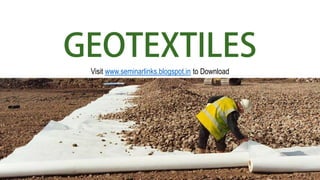
 Geotextiles are permeable fabrics which, when used in association
with soil, have the ability to separate, filter, reinforce, protect, or drain.
 Typically made from polypropylene or polyester, geotextile fabrics
come in three basic forms:
• woven (looks like mail bag sacking)
• needle punched (looks like felt)
• heat bonded (looks like ironed felt).
FUNCTIONS OF GEOTEXTILES
 Filtration
 Drainage
 Separation
 Reinforcement
 Sealing
FILTRATION
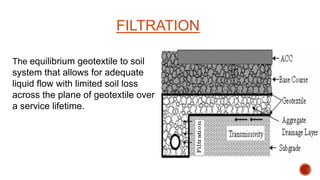
The equilibrium geotextile to soil
system that allows for adequate
liquid flow with limited soil loss
across the plane of geotextile over
a service lifetime.
DRAINAGE/TRANSMISSIVITY
Ability of thick nonwoven geotextile
whose 3-dimensional structure
provides an avenue for flow of water
through the plane of the geotextile.
SEPARATION
The introduction of a flexible porous textile placed between dissimilar
materials so that the integrity and functioning of both the materials can
remain intact or be improved.
REINFORCEMENT
Geotextile acts as a reinforcing element in
a soil mass or in combination with the soil
to produce a composite that has improved
strength and deformation properties.
SEALING
• The classic application of a geoxtile
as a liquid barrier is paved road
rehabilitation.
• It minimizes vertical flow of water
into the pavement structure.
TYPES OF GEOTEXTILES
Woven fabrics
Non-woven fabrics
Knitted fabrics
DESIGN PROPERTIES
 Puncture Strength
 Burst Strength
 Dynamic Puncture
 Permeability
 Apparent Opening Size (AOS)
 Grab Tensile Strength and Elongation
PUNCTURE STRENGTH
 To measure puncture resistance
 Stimulates puncture strength to static load of aggregates
 Resistance to puncture measured in Newton
 Stimulates strength of geotextile to a continuous hydraulic load
 Force causing rupture recorded in units of pounds per square inch or kilo
Pascal.
BURST STRENGTH
DYNAMIC PUNCTURE
 To measure the strength of geotextile to falling objects.
 Stimulates placement of aggregate over geotextile during installation
stage.
 Expressed in mm.
PERMEABILITY
 Measures the rate at which liquids can pass through the geotextile
 x=k/t
x- geotextile permittivity (sec-1)
k- geotextile permeability(cm/sec)
t- geotextile thickness (mm)
 Expressed in liters per square meters per second
APPARENT OPENING SIZE (AOS)
 Reflects approximate largest opening dimension available through which
the soil may pass.
 Expressed in mm.
GRAB TENSILE STRENGTH AND
ELONGATION
 Measures tensile strength and elongation along the plane of the
geotextile by loading it continually
 Value of breaking load expressed in Newton and elongation at break in
percent.
AREAS OF APPLICATION
• Flexible paved road construction
• Drainage applications
• Pavement overlays
FLEXIBLE PAVED ROAD CONSTRUCTION
Function of geotextiles:
• service life of roads
• load carrying capacity
• rutting
RESEARCHES ON GEOTEXTILE
For weak subgrades (CBR=2%)
 Service life by a factor of 2.5-3.0
 AASHTO structural number by 19%
For moderate strength (CBR=4.2-4.5%)
 Service life by a factor of 2.0-3.3
 AASHTO structural number by 13-22%
AASHTO DESIGN METHOD
Excellent drainage
 SNeff
 Drainage factor - 1.20
Poor drainage
 SNeff
 Drainage factor as 0.60
GEOTEXTILE REQUIREMENT
Selection of geotextile
 Depends on survivability
 Governed by anticipated construction stresses
PAVEMENT OVERLAYS
Benefits of using Fabric Interlayer
 Waterproofing of the lower layers
 Retarding reflection cracking in the overlay
 Increase in structural stability
 Absorption of stresses
CAPABILITIES OF PAVING FABRICS:-
 Reduces permeability of a pavement
 Reduces infiltration of moisture
 Maintains the strength of subgrade, sub base and base course
 Limiting damage due to saturated condition pore pressures
PROPERTIES OF PAVING FABRICS
 Nonwoven fabrics from grades ranging from 135gm/m² to
200gm/m²
 Lighter fabrics are moisture barriers
 Heavier fabrics provides cushioning or stress-relieving
membrane
INSTALLATION PROCEDURE
• The surface is cleaned
• Cracks are filled or repaired
• Tack coat ranging from 1-1.35 l/m² of residual asphalt is evenly
applied
• The paving fabric is laid with minimum wrinkles
• Finally hot mix overlay is placed
DRAINAGE
• Drainage system should fulfill 2 criteria:-
• Have maintained permeability
 by providing relatively unimpeded flow of water
• Filtration of base soil
 by preventing the migration of soil fines into the drain
CONCLUSION
 Geotextiles are an efficient effective and economic method of solving
most of the geotechnical problems in roads.
 The design engineer should be well aware of the possible problems
and should use this relatively new tool for solving them.
 For this he/she should understand properties and capabilities of the
geotextile material.
THANK YOU
Visit www.seminarlinks.blogspot.in to Download

Geotextiles

  • 1.
  • 2.
    INTRODUCTION  Geotextiles arepermeable fabrics which, when used in association with soil, have the ability to separate, filter, reinforce, protect, or drain.  Typically made from polypropylene or polyester, geotextile fabrics come in three basic forms: • woven (looks like mail bag sacking) • needle punched (looks like felt) • heat bonded (looks like ironed felt).
  • 4.
    FUNCTIONS OF GEOTEXTILES Filtration  Drainage  Separation  Reinforcement  Sealing
  • 6.
    FILTRATION The equilibrium geotextileto soil system that allows for adequate liquid flow with limited soil loss across the plane of geotextile over a service lifetime.
  • 7.
    DRAINAGE/TRANSMISSIVITY Ability of thicknonwoven geotextile whose 3-dimensional structure provides an avenue for flow of water through the plane of the geotextile.
  • 8.
    SEPARATION The introduction ofa flexible porous textile placed between dissimilar materials so that the integrity and functioning of both the materials can remain intact or be improved.
  • 9.
    REINFORCEMENT Geotextile acts asa reinforcing element in a soil mass or in combination with the soil to produce a composite that has improved strength and deformation properties.
  • 10.
    SEALING • The classicapplication of a geoxtile as a liquid barrier is paved road rehabilitation. • It minimizes vertical flow of water into the pavement structure.
  • 11.
    TYPES OF GEOTEXTILES Wovenfabrics Non-woven fabrics Knitted fabrics
  • 12.
    DESIGN PROPERTIES  PunctureStrength  Burst Strength  Dynamic Puncture  Permeability  Apparent Opening Size (AOS)  Grab Tensile Strength and Elongation
  • 13.
    PUNCTURE STRENGTH  Tomeasure puncture resistance  Stimulates puncture strength to static load of aggregates  Resistance to puncture measured in Newton
  • 14.
     Stimulates strengthof geotextile to a continuous hydraulic load  Force causing rupture recorded in units of pounds per square inch or kilo Pascal. BURST STRENGTH
  • 15.
    DYNAMIC PUNCTURE  Tomeasure the strength of geotextile to falling objects.  Stimulates placement of aggregate over geotextile during installation stage.  Expressed in mm.
  • 16.
    PERMEABILITY  Measures therate at which liquids can pass through the geotextile  x=k/t x- geotextile permittivity (sec-1) k- geotextile permeability(cm/sec) t- geotextile thickness (mm)  Expressed in liters per square meters per second
  • 17.
    APPARENT OPENING SIZE(AOS)  Reflects approximate largest opening dimension available through which the soil may pass.  Expressed in mm.
  • 18.
    GRAB TENSILE STRENGTHAND ELONGATION  Measures tensile strength and elongation along the plane of the geotextile by loading it continually  Value of breaking load expressed in Newton and elongation at break in percent.
  • 19.
    AREAS OF APPLICATION •Flexible paved road construction • Drainage applications • Pavement overlays
  • 20.
    FLEXIBLE PAVED ROADCONSTRUCTION Function of geotextiles: • service life of roads • load carrying capacity • rutting
  • 21.
    RESEARCHES ON GEOTEXTILE Forweak subgrades (CBR=2%)  Service life by a factor of 2.5-3.0  AASHTO structural number by 19% For moderate strength (CBR=4.2-4.5%)  Service life by a factor of 2.0-3.3  AASHTO structural number by 13-22%
  • 22.
    AASHTO DESIGN METHOD Excellentdrainage  SNeff  Drainage factor - 1.20 Poor drainage  SNeff  Drainage factor as 0.60
  • 23.
    GEOTEXTILE REQUIREMENT Selection ofgeotextile  Depends on survivability  Governed by anticipated construction stresses
  • 25.
    PAVEMENT OVERLAYS Benefits ofusing Fabric Interlayer  Waterproofing of the lower layers  Retarding reflection cracking in the overlay  Increase in structural stability  Absorption of stresses
  • 27.
    CAPABILITIES OF PAVINGFABRICS:-  Reduces permeability of a pavement  Reduces infiltration of moisture  Maintains the strength of subgrade, sub base and base course  Limiting damage due to saturated condition pore pressures
  • 28.
    PROPERTIES OF PAVINGFABRICS  Nonwoven fabrics from grades ranging from 135gm/m² to 200gm/m²  Lighter fabrics are moisture barriers  Heavier fabrics provides cushioning or stress-relieving membrane
  • 29.
    INSTALLATION PROCEDURE • Thesurface is cleaned • Cracks are filled or repaired • Tack coat ranging from 1-1.35 l/m² of residual asphalt is evenly applied • The paving fabric is laid with minimum wrinkles • Finally hot mix overlay is placed
  • 31.
    DRAINAGE • Drainage systemshould fulfill 2 criteria:- • Have maintained permeability  by providing relatively unimpeded flow of water • Filtration of base soil  by preventing the migration of soil fines into the drain
  • 33.
    CONCLUSION  Geotextiles arean efficient effective and economic method of solving most of the geotechnical problems in roads.  The design engineer should be well aware of the possible problems and should use this relatively new tool for solving them.  For this he/she should understand properties and capabilities of the geotextile material.
  • 34.