

1
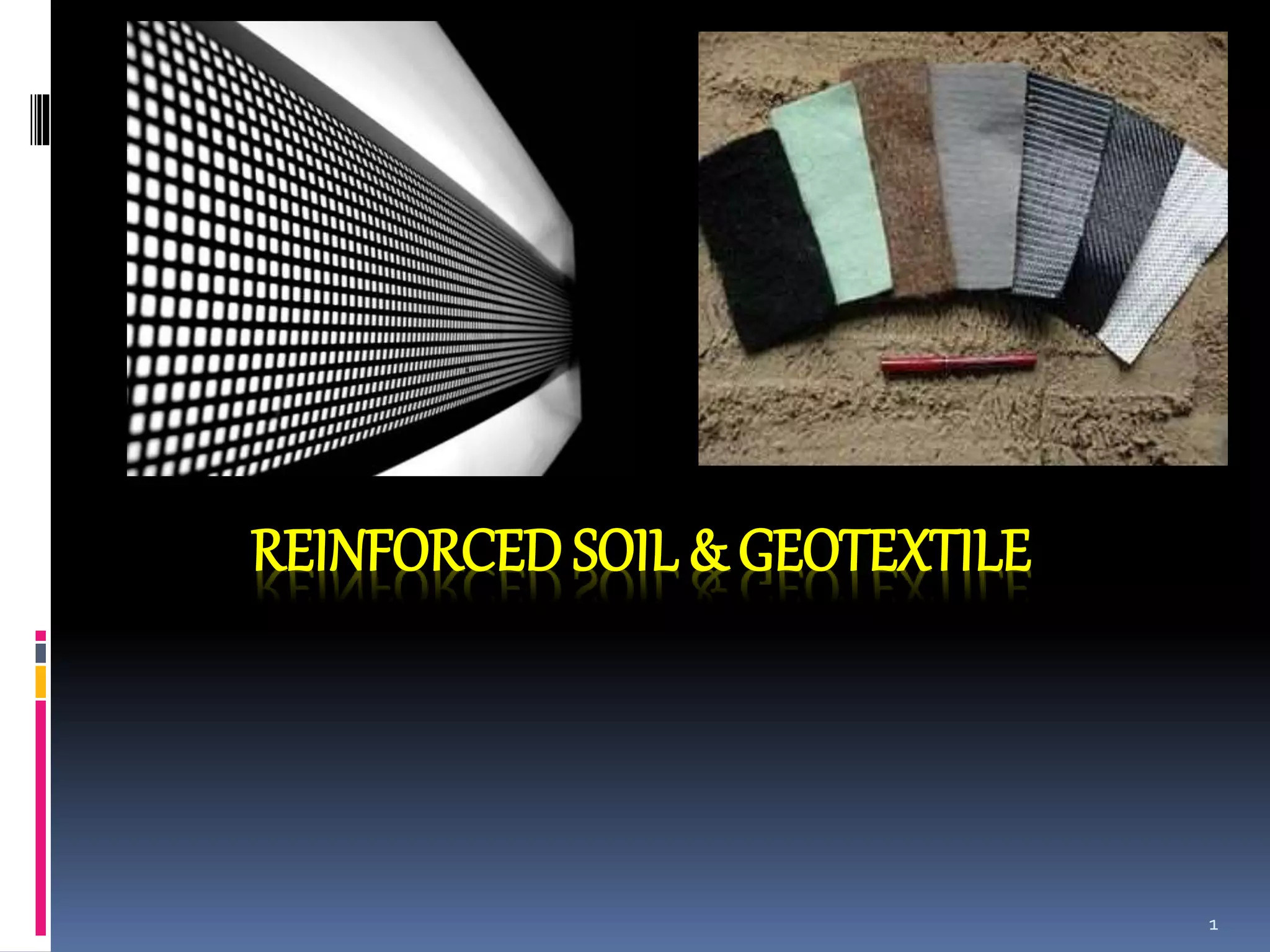
REINFORCED SOIL & GEOTEXTILE
PROF SACHINKULKARNI
ASSISTANT PROFESSOR
DEPARTMENT OF CIVIL ENGINEERING
KLS GOGTE INSTITUTE OF TECHNOLOGY BELAGAVI,
KARNATAKA
INTRODUCTION
 Geosynthetic is a term composed ’geo+synthetic’, meaning
‘earth+a product manufactured by man’. These are
designated as a flat product made from polymer materials
(synthetic or natural ) used in contact with massive natural
soils or rocks, or other material in geotechnical engineering
works. The discipline of Geosynthetics began many years
before it had a name.
 The terms “geotextile” and “Geosynthetics” were not coined
until Dr. J. P Giroud used those terms in a seminar paper and
presentation at an engineering conference in Paris in 1997.
 The permeable fabrics which used for reinforcing the soil,
have the ability to separate, filter, reinforce, protect or drain.
3
SOIL REINFORCEMENT
This is the synergistic improvement in the total system, strength
created by the introduction of a geotextile into a soil and developed
primarily through the following three mechanisms:
One, lateral restraint through interfacial friction between
geotextile and soil/aggregate.
Two, forcing the potential bearing surface failure plane to develop
at alternate higher shear strength surface.
And three, membrane type of support of the wheel loads.
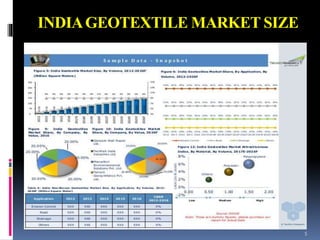
INDIAGEOTEXTILE MARKET SIZE
5
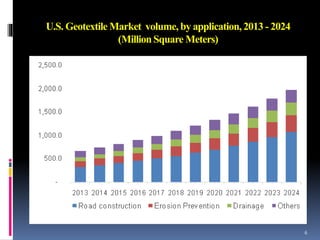
U.S. Geotextile Market volume, by application,2013 - 2024
(MillionSquare Meters)
6
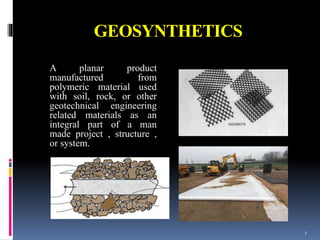
GEOSYNTHETICS
A planar product
manufactured from
polymeric material used
with soil, rock, or other
geotechnical engineering
related materials as an
integral part of a man
made project , structure ,
or system.
7
8
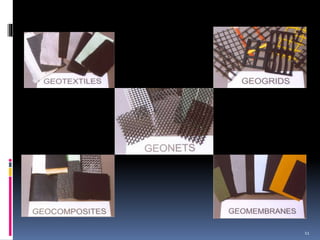
Geonet is a polymeric structure in the form of
manufactured sheet, consisting of a regular
network of integrally connected overlapping
ribs, whose openings are usually larger than its
constituents.
Geogrid is a polymeric structure, unidirectional or
bidirectional, in the form of manufactured sheet,
consisting of a regular network of integrally
connected elements which may be linked by
extrusion, bonding, and whose openings are larger
than the constituents and are used in geotechnical,
environmental, hydraulic and transportation
engineering applications.
Geocomposite is an assembled polymeric
material in the form of manufactured sheet or
strips, consisting of at least, one geosynthetic
among the components, used in geotechnical
environmental and transportational engineering
applications.
Geomembrane is an essentially impermeable
membrane in the form of manufactured sheet
used widely as cut-offs and liners. They are often
used to line landfills.
Geotextiles, as permeable textile materials are
used in contact with soil, rock, earth or any other
geotechnical related material as an integral part
of civil engineering project, structure, or system.
9
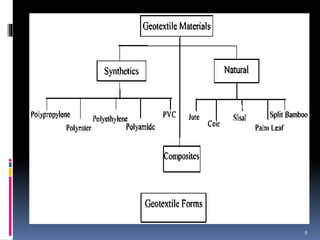
Families of Geosynthetic
Materials
10
11
12
REINFORCEMENT OF STEEP SLOPES, RETAINING STRUCTURES
ANDEMBANKMENTS
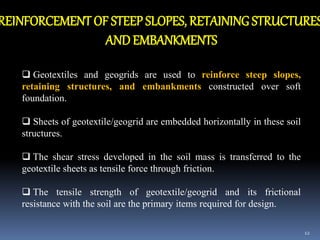
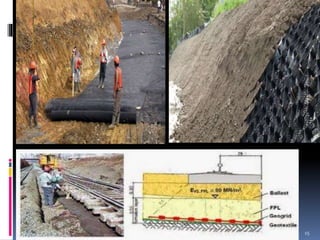
 Geotextiles and geogrids are used to reinforce steep slopes,
retaining structures, and embankments constructed over soft
foundation.
 Sheets of geotextile/geogrid are embedded horizontally in these soil
structures.
 The shear stress developed in the soil mass is transferred to the
geotextile sheets as tensile force through friction.
 The tensile strength of geotextile/geogrid and its frictional
resistance with the soil are the primary items required for design.
FUNCTIONS OF GEOTEXTILES
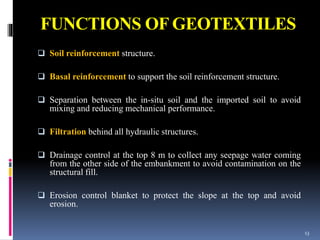
 Soil reinforcement structure.
 Basal reinforcement to support the soil reinforcement structure.
 Separation between the in-situ soil and the imported soil to avoid
mixing and reducing mechanical performance.
 Filtration behind all hydraulic structures.
 Drainage control at the top 8 m to collect any seepage water coming
from the other side of the embankment to avoid contamination on the
structural fill.
 Erosion control blanket to protect the slope at the top and avoid
erosion.
13
USES OF GEOTEXTILE
 Filtration of Water.
 Separation of Soil
Layers.
 Drainage Works.
 Soil Reinforcement.
 Soil Erosion
Control.
14
15
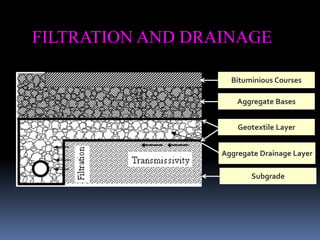
FILTRATION AND DRAINAGE
Bituminious Courses
Aggregate Bases
Geotextile Layer
Aggregate Drainage Layer
Subgrade
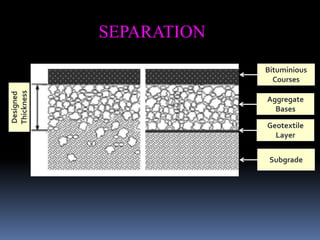
SEPARATION
Bituminious
Courses
Aggregate
Bases
Geotextile
Layer
Subgrade
Designed
Thickness
ADVANTAGESOFGEOTEXTILES
 Geotextiles makes easier handling and laying on site; thus
transport and labour cost are less in real terms.
 Knitted geotextiles have exceptional Tear strength. Additional
strength can be designed and built in to weft direction such that
a biaxial high tensile, high strength warp / weft geotextile
becomes reality; e.g. 500kNm warp and 500kNm weft.
 Knitted geotextiles can incorporate an additional fabric to
form a true composite geotextile, the fabric being simply
knitted-in.
18
DISADVANTAGES OF GEOTEXTILES
 Properly installed matting provide excellent erosion control but
do so at relatively high cost.
 Geotextiles and mats may delay seed germination, due to
reduction in soil temperature.
 Plastic sheeting is easily vandalized, easily torn,
photodegradable, and must be disposed of at a landfill.
 Plastic results in 100% runoff, which may cause serious
erosion problems in the areas receiving the increased flow.
19
CASE STUDY
Geosynthetics In Road Construction
By DennisAyemba -
Oct 18, 2018-Africa
20
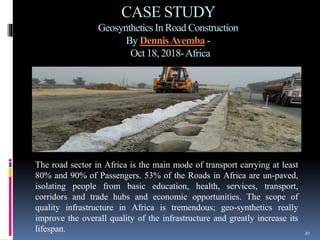
The road sector in Africa is the main mode of transport carrying at least
80% and 90% of Passengers. 53% of the Roads in Africa are un-paved,
isolating people from basic education, health, services, transport,
corridors and trade hubs and economic opportunities. The scope of
quality infrastructure in Africa is tremendous; geo-synthetics really
improve the overall quality of the infrastructure and greatly increase its
lifespan.
21
22
CONCLUSION
 Sheet-like, geosynthetics take up much less space in a landfill
than do comparable soil and aggregate layers.
 Soil and aggregate are generally heterogeneous
materials that may vary significantly across a site or borrow area.
Geosynthetics on the other hand are relatively homogeneous
because they are manufactured under tightly controlled
conditions in a factory. They undergo rigorous quality control to
minimize material variation.
 Geosynthetics are manufactured and often factory
“prefabricated” into large sheets. This minimizes the required
number of field connections, or seams. Both factory and field
seams are made and tested by trained technicians. Conversely,
soil and aggregate layers are constructed in place and are subject
to variations caused by weather, handling and placement.
23
CONCLUSION
 Geosynthetic materials are generally less costly to purchase,
transport and install than soils and aggregates.
 Geosynthetics can be installed quickly, providing the flexibility
to construct during short construction seasons, breaks in
inclement weather, or without the need to demobilize and
remobilize the earthwork contractor.
 Numerous suppliers of most geosynthetics and ease of shipping
insure competitive pricing and ready availability of materials.
 Geosynthetic systems reduce the use of natural resources and
the environmental damage associated quarrying, trucking, and
other material handling activities.
24
25

Reinforced soil structure and geotextile

  • 1.
  • 2.
    PROF SACHINKULKARNI ASSISTANT PROFESSOR DEPARTMENTOF CIVIL ENGINEERING KLS GOGTE INSTITUTE OF TECHNOLOGY BELAGAVI, KARNATAKA
  • 3.
    INTRODUCTION  Geosynthetic isa term composed ’geo+synthetic’, meaning ‘earth+a product manufactured by man’. These are designated as a flat product made from polymer materials (synthetic or natural ) used in contact with massive natural soils or rocks, or other material in geotechnical engineering works. The discipline of Geosynthetics began many years before it had a name.  The terms “geotextile” and “Geosynthetics” were not coined until Dr. J. P Giroud used those terms in a seminar paper and presentation at an engineering conference in Paris in 1997.  The permeable fabrics which used for reinforcing the soil, have the ability to separate, filter, reinforce, protect or drain. 3
  • 4.
    SOIL REINFORCEMENT This isthe synergistic improvement in the total system, strength created by the introduction of a geotextile into a soil and developed primarily through the following three mechanisms: One, lateral restraint through interfacial friction between geotextile and soil/aggregate. Two, forcing the potential bearing surface failure plane to develop at alternate higher shear strength surface. And three, membrane type of support of the wheel loads.
  • 5.
  • 6.
    U.S. Geotextile Marketvolume, by application,2013 - 2024 (MillionSquare Meters) 6
  • 7.
    GEOSYNTHETICS A planar product manufacturedfrom polymeric material used with soil, rock, or other geotechnical engineering related materials as an integral part of a man made project , structure , or system. 7
  • 8.
  • 9.
    Geonet is apolymeric structure in the form of manufactured sheet, consisting of a regular network of integrally connected overlapping ribs, whose openings are usually larger than its constituents. Geogrid is a polymeric structure, unidirectional or bidirectional, in the form of manufactured sheet, consisting of a regular network of integrally connected elements which may be linked by extrusion, bonding, and whose openings are larger than the constituents and are used in geotechnical, environmental, hydraulic and transportation engineering applications. Geocomposite is an assembled polymeric material in the form of manufactured sheet or strips, consisting of at least, one geosynthetic among the components, used in geotechnical environmental and transportational engineering applications. Geomembrane is an essentially impermeable membrane in the form of manufactured sheet used widely as cut-offs and liners. They are often used to line landfills. Geotextiles, as permeable textile materials are used in contact with soil, rock, earth or any other geotechnical related material as an integral part of civil engineering project, structure, or system. 9 Families of Geosynthetic Materials
  • 10.
  • 11.
  • 12.
    12 REINFORCEMENT OF STEEPSLOPES, RETAINING STRUCTURES ANDEMBANKMENTS  Geotextiles and geogrids are used to reinforce steep slopes, retaining structures, and embankments constructed over soft foundation.  Sheets of geotextile/geogrid are embedded horizontally in these soil structures.  The shear stress developed in the soil mass is transferred to the geotextile sheets as tensile force through friction.  The tensile strength of geotextile/geogrid and its frictional resistance with the soil are the primary items required for design.
  • 13.
    FUNCTIONS OF GEOTEXTILES Soil reinforcement structure.  Basal reinforcement to support the soil reinforcement structure.  Separation between the in-situ soil and the imported soil to avoid mixing and reducing mechanical performance.  Filtration behind all hydraulic structures.  Drainage control at the top 8 m to collect any seepage water coming from the other side of the embankment to avoid contamination on the structural fill.  Erosion control blanket to protect the slope at the top and avoid erosion. 13
  • 14.
    USES OF GEOTEXTILE Filtration of Water.  Separation of Soil Layers.  Drainage Works.  Soil Reinforcement.  Soil Erosion Control. 14
  • 15.
  • 16.
    FILTRATION AND DRAINAGE BituminiousCourses Aggregate Bases Geotextile Layer Aggregate Drainage Layer Subgrade
  • 17.
  • 18.
    ADVANTAGESOFGEOTEXTILES  Geotextiles makeseasier handling and laying on site; thus transport and labour cost are less in real terms.  Knitted geotextiles have exceptional Tear strength. Additional strength can be designed and built in to weft direction such that a biaxial high tensile, high strength warp / weft geotextile becomes reality; e.g. 500kNm warp and 500kNm weft.  Knitted geotextiles can incorporate an additional fabric to form a true composite geotextile, the fabric being simply knitted-in. 18
  • 19.
    DISADVANTAGES OF GEOTEXTILES Properly installed matting provide excellent erosion control but do so at relatively high cost.  Geotextiles and mats may delay seed germination, due to reduction in soil temperature.  Plastic sheeting is easily vandalized, easily torn, photodegradable, and must be disposed of at a landfill.  Plastic results in 100% runoff, which may cause serious erosion problems in the areas receiving the increased flow. 19
  • 20.
    CASE STUDY Geosynthetics InRoad Construction By DennisAyemba - Oct 18, 2018-Africa 20 The road sector in Africa is the main mode of transport carrying at least 80% and 90% of Passengers. 53% of the Roads in Africa are un-paved, isolating people from basic education, health, services, transport, corridors and trade hubs and economic opportunities. The scope of quality infrastructure in Africa is tremendous; geo-synthetics really improve the overall quality of the infrastructure and greatly increase its lifespan.
  • 21.
  • 22.
  • 23.
    CONCLUSION  Sheet-like, geosyntheticstake up much less space in a landfill than do comparable soil and aggregate layers.  Soil and aggregate are generally heterogeneous materials that may vary significantly across a site or borrow area. Geosynthetics on the other hand are relatively homogeneous because they are manufactured under tightly controlled conditions in a factory. They undergo rigorous quality control to minimize material variation.  Geosynthetics are manufactured and often factory “prefabricated” into large sheets. This minimizes the required number of field connections, or seams. Both factory and field seams are made and tested by trained technicians. Conversely, soil and aggregate layers are constructed in place and are subject to variations caused by weather, handling and placement. 23
  • 24.
    CONCLUSION  Geosynthetic materialsare generally less costly to purchase, transport and install than soils and aggregates.  Geosynthetics can be installed quickly, providing the flexibility to construct during short construction seasons, breaks in inclement weather, or without the need to demobilize and remobilize the earthwork contractor.  Numerous suppliers of most geosynthetics and ease of shipping insure competitive pricing and ready availability of materials.  Geosynthetic systems reduce the use of natural resources and the environmental damage associated quarrying, trucking, and other material handling activities. 24
  • 25.

Editor's Notes

  • #17 It is defined as “the equilibrium geotextile-to-soil system that allows for adequate liquid flow with limited soil loss across the plane of the geotextile over a service lifetime compatible with the application under consideration (Koerner, 1995) [3]. To perform this function the geotextile needs to satisfy two conflicting requirements: the filter’s pore size must be small enough to retain fine soil particles while the geotextile should permit relatively unimpeded flow of water into the drainage media. A common application illustrating the filtration function is the use of a geotextile in a pavement edge drain.
  • #18 Separation is defined as, “The introduction of a flexible porous textile placed between dissimilar materials so that the integrity and the functioning of both the materials can remain intact or be improved” (Koerner, 1995) [3]. In transportation applications separation refers to the geotextile’s role in preventing the intermixing of two adjacent soils. For example, by separating fine subgrade soil from the aggregates of the base course, the geotextile reserves the drainage and the strength characteristics of the aggregate material. The effect of separation is illustrated.