"Mathematics
teaches you
to think"
Properties of
Congruence
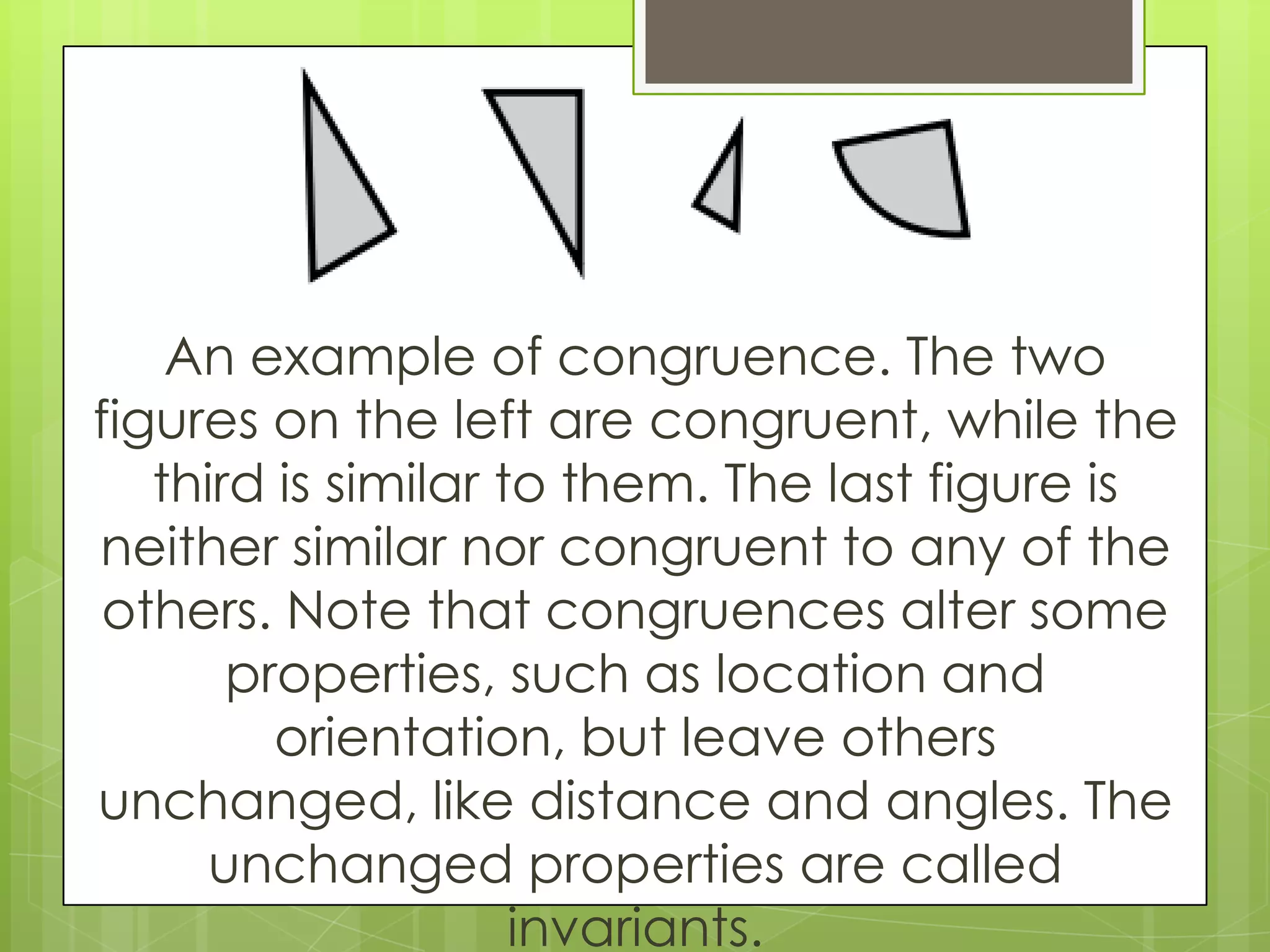
An example of congruence. The two
figures on the left are congruent, while the
   third is similar to them. The last figure is
neither similar nor congruent to any of the
 others. Note that congruences alter some
       properties, such as location and
         orientation, but leave others
unchanged, like distance and angles. The
      unchanged properties are called
                     invariants.
Congruence
of triangles
Determining
Congruence
The shape of a triangle is
            determined up to
            congruence by specifying
            two sides and the angle
            between them (SAS),
two angles and the side between them
       (ASA) or two angles and a
  corresponding adjacent side (AAS).
 Specifying two sides and an adjacent
  angle (SSA), however, can yield two
        distinct possible triangles.
Sufficient evidence for
congruence between two
triangles in Euclidean space
can be shown through the
following comparisons:
Angle-Angle-Angle
 In Euclidean geometry, AAA (Angle-
   Angle-Angle) (or just AA, since in
 Euclidean geometry the angles of a
   triangle add up to 180°) does not
provide information regarding the size
of the two triangles and hence proves
 only similarity and not congruence in
            Euclidean space.
However, in spherical
geometry and hyperbolic
geometry (where the sum
of the angles of a triangle
  varies with size) AAA is
sufficient for congruence
 on a given curvature of
          surface.
If two triangles are
congruent, then each part of the
     triangle (side or angle) is
congruent to the corresponding
  part in the other triangle. This is
  the true value of the concept;
    once you have proved two
triangles are congruent, you can
find the angles or sides of one of
        them from the other.
"Corresponding Parts
  of Congruent Triangles are Congruent"

CPCTC is intended as an easy way
to remember that when you have
    two triangles and you have
 proved they are congruent, then
each part of one triangle (side, or
     angle) is congruent to the
 corresponding part in the other.
Justification
Using
Properties of
Equality and
Congruence
Properties Of
Equality For
Real Numbers
Properties Of
Congruence
EXAMPLES:
Statement               Reason


1. 15y + 7 = 12 - 20y   1. Given


2. 35y + 7 = 12         2. Additive Property


3. 35y = 5              3. Subtractive Property


4. Y = 1/7              4. Division Property
Statement Reason      Statement Reason


1. m ∠1 + m ∠2 =100   1. Given


2. m∠ 1 = 80          2. Given


3. 80 + m∠ 2 = 100    3. Substitution Property


4. m ∠2 = 20          4. Subtraction Property
Statement Reason      Statement Reason


1. m∠ 1 + m∠ 3 = 80   1. Given


2. m∠ 1 = 40          2. Given


3. m∠ 3 = 40          3. Subtraction Property


4. m∠ 4 + m∠ 2 = 80   4. Given


5. m∠ 2 = 40          5. Given


6. m∠ 4 = 40          6. Subtraction Property


7. m∠ 3 = m∠ 4        7. Transitive Property
Statement Reason               Statement Reason


1. m∠ 1 + m∠ 2 = 180           1. Given


2. m∠ 2 + m∠ 3 = 180           2. Given


3. m∠ 1 + m∠ 2 = m∠ 2 + m∠ 3   3. Transitive Property


4. m∠ 2 = m∠ 2                 4. Reflexive Property


5. m∠ 1 = m∠ 3                 5. Subtraction Property
Proofs are the heart of mathematics. If
you are a math major, then you must
 come to terms with proofs--you must
   be able to read, understand and
 write them. What is the secret? What
   magic do you need to know? The
 short answer is: there is no secret, no
mystery, no magic. All that is needed
 is some common sense and a basic
 understanding of a few trusted and
    easy to understand techniques.
PROOFS
Ending a proof
  Sometimes, the abbreviation "Q.E.D." is written
to indicate the end of a proof. This abbreviation
  stands for "Quod Erat Demonstrandum", which
is Latin for "that which was to be demonstrated".
  A more common alternative is to use a square
     or a rectangle, such as □ or ∎, known as a
   "tombstone" or "halmos" after its eponym Paul
     Halmos. Often, "which was to be shown" is
 verbally stated when writing "QED", "□", or "∎" in
          an oral presentation on a board.
EXAMPLE
THE END.

Properties of Congruence

  • 1.
  • 2.
  • 4.
    An example ofcongruence. The two figures on the left are congruent, while the third is similar to them. The last figure is neither similar nor congruent to any of the others. Note that congruences alter some properties, such as location and orientation, but leave others unchanged, like distance and angles. The unchanged properties are called invariants.
  • 5.
  • 8.
  • 9.
    The shape ofa triangle is determined up to congruence by specifying two sides and the angle between them (SAS), two angles and the side between them (ASA) or two angles and a corresponding adjacent side (AAS). Specifying two sides and an adjacent angle (SSA), however, can yield two distinct possible triangles.
  • 10.
    Sufficient evidence for congruencebetween two triangles in Euclidean space can be shown through the following comparisons:
  • 22.
    Angle-Angle-Angle In Euclideangeometry, AAA (Angle- Angle-Angle) (or just AA, since in Euclidean geometry the angles of a triangle add up to 180°) does not provide information regarding the size of the two triangles and hence proves only similarity and not congruence in Euclidean space.
  • 23.
    However, in spherical geometryand hyperbolic geometry (where the sum of the angles of a triangle varies with size) AAA is sufficient for congruence on a given curvature of surface.
  • 24.
    If two trianglesare congruent, then each part of the triangle (side or angle) is congruent to the corresponding part in the other triangle. This is the true value of the concept; once you have proved two triangles are congruent, you can find the angles or sides of one of them from the other.
  • 25.
    "Corresponding Parts of Congruent Triangles are Congruent" CPCTC is intended as an easy way to remember that when you have two triangles and you have proved they are congruent, then each part of one triangle (side, or angle) is congruent to the corresponding part in the other.
  • 26.
  • 27.
  • 34.
  • 38.
  • 40.
    Statement Reason 1. 15y + 7 = 12 - 20y 1. Given 2. 35y + 7 = 12 2. Additive Property 3. 35y = 5 3. Subtractive Property 4. Y = 1/7 4. Division Property
  • 42.
    Statement Reason Statement Reason 1. m ∠1 + m ∠2 =100 1. Given 2. m∠ 1 = 80 2. Given 3. 80 + m∠ 2 = 100 3. Substitution Property 4. m ∠2 = 20 4. Subtraction Property
  • 44.
    Statement Reason Statement Reason 1. m∠ 1 + m∠ 3 = 80 1. Given 2. m∠ 1 = 40 2. Given 3. m∠ 3 = 40 3. Subtraction Property 4. m∠ 4 + m∠ 2 = 80 4. Given 5. m∠ 2 = 40 5. Given 6. m∠ 4 = 40 6. Subtraction Property 7. m∠ 3 = m∠ 4 7. Transitive Property
  • 46.
    Statement Reason Statement Reason 1. m∠ 1 + m∠ 2 = 180 1. Given 2. m∠ 2 + m∠ 3 = 180 2. Given 3. m∠ 1 + m∠ 2 = m∠ 2 + m∠ 3 3. Transitive Property 4. m∠ 2 = m∠ 2 4. Reflexive Property 5. m∠ 1 = m∠ 3 5. Subtraction Property
  • 47.
    Proofs are theheart of mathematics. If you are a math major, then you must come to terms with proofs--you must be able to read, understand and write them. What is the secret? What magic do you need to know? The short answer is: there is no secret, no mystery, no magic. All that is needed is some common sense and a basic understanding of a few trusted and easy to understand techniques.
  • 48.
  • 55.
    Ending a proof Sometimes, the abbreviation "Q.E.D." is written to indicate the end of a proof. This abbreviation stands for "Quod Erat Demonstrandum", which is Latin for "that which was to be demonstrated". A more common alternative is to use a square or a rectangle, such as □ or ∎, known as a "tombstone" or "halmos" after its eponym Paul Halmos. Often, "which was to be shown" is verbally stated when writing "QED", "□", or "∎" in an oral presentation on a board.
  • 56.
  • 64.