What are Rocks?
Year 8 Science
What are rocks made from?
Essential Question
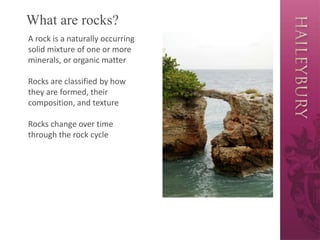
What are rocks?
A rock is a naturally occurring
solid mixture of one or more
minerals, or organic matter
Rocks are classified by how
they are formed, their
composition, and texture
Rocks change over time
through the rock cycle
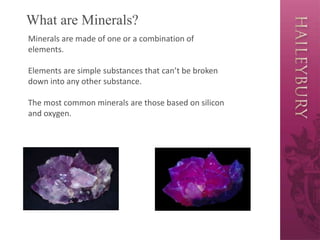
What are Minerals?
Minerals are made of one or a combination of
elements.
Elements are simple substances that can’t be broken
down into any other substance.
The most common minerals are those based on silicon
and oxygen.
Igneous Rocks
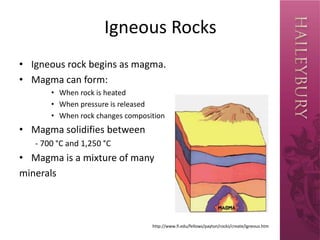
• Igneous rock begins as magma.
• Magma can form:
• When rock is heated
• When pressure is released
• When rock changes composition
• Magma solidifies between
- 700 °C and 1,250 °C
• Magma is a mixture of many
minerals
http://www.fi.edu/fellows/payton/rocks/create/igneous.htm
Igneous Rocks
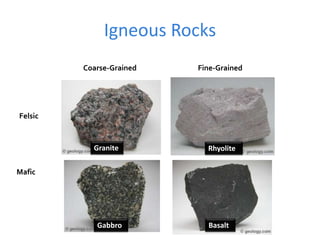
• Felsic: light coloured rocks that are
rich in elements such as aluminum,
potassium, silicon, and sodium
• Mafic: dark coloured rocks that are
rich in calcium, iron, and magnesium,
poor in silicon
• Coarse-grained: takes longer to cool,
giving mineral crystals more time to
grow
• Fine-grained: cools quickly with little
to no crystals
Igneous Rocks
Felsic
Mafic
Coarse-Grained Fine-Grained
Granite
Gabbro Basalt
Rhyolite
Igneous Rocks
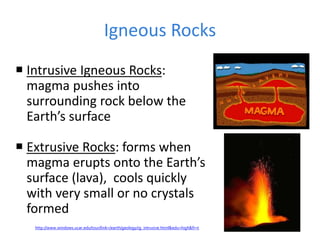
 Intrusive Igneous Rocks:
magma pushes into
surrounding rock below the
Earth’s surface
 Extrusive Rocks: forms when
magma erupts onto the Earth’s
surface (lava), cools quickly
with very small or no crystals
formed
http://www.windows.ucar.edu/tour/link=/earth/geology/ig_intrusive.html&edu=high&fr=t
Igneous Rocks
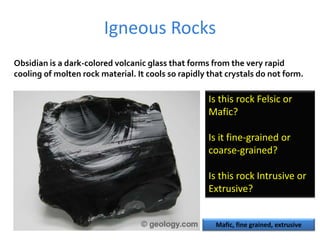
Obsidian is a dark-colored volcanic glass that forms from the very rapid
cooling of molten rock material. It cools so rapidly that crystals do not form.
Is this rock Felsic or
Mafic?
Is it fine-grained or
coarse-grained?
Is this rock Intrusive or
Extrusive?
Mafic, fine grained, extrusive
Sedimentary Rocks
http://www.fi.edu/fellows/payton/rocks/create/sediment.htm
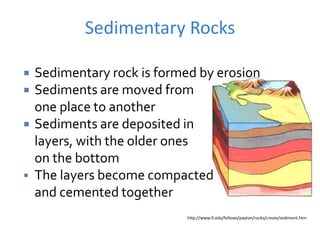
 Sedimentary rock is formed by erosion
 Sediments are moved from
one place to another
 Sediments are deposited in
layers, with the older ones
on the bottom
 The layers become compacted
and cemented together
Sedimentary Rock
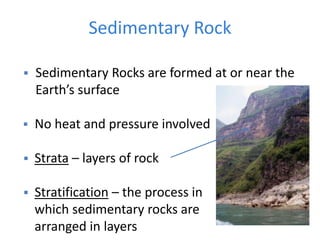
 Sedimentary Rocks are formed at or near the
Earth’s surface
 No heat and pressure involved
 Strata – layers of rock
 Stratification – the process in
which sedimentary rocks are
arranged in layers
Sedimentary Rock
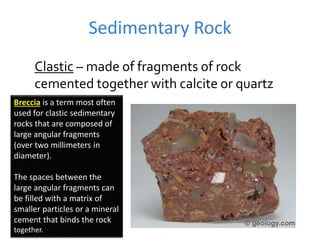
Clastic – made of fragments of rock
cemented together with calcite or quartz
Breccia is a term most often
used for clastic sedimentary
rocks that are composed of
large angular fragments
(over two millimeters in
diameter).
The spaces between the
large angular fragments can
be filled with a matrix of
smaller particles or a mineral
cement that binds the rock
together.
Sedimentary Rock
Chemical sedimentary – minerals crystallize
out of solution to become rock
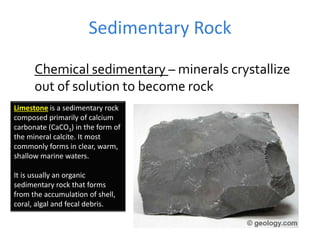
Limestone is a sedimentary rock
composed primarily of calcium
carbonate (CaCO3) in the form of
the mineral calcite. It most
commonly forms in clear, warm,
shallow marine waters.
It is usually an organic
sedimentary rock that forms
from the accumulation of shell,
coral, algal and fecal debris.
Sedimentary Rock
Organic sedimentary – remains of plants and
animals
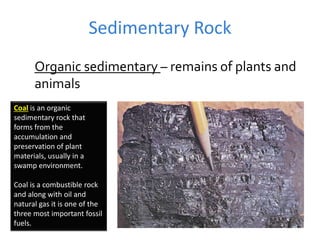
Coal is an organic
sedimentary rock that
forms from the
accumulation and
preservation of plant
materials, usually in a
swamp environment.
Coal is a combustible rock
and along with oil and
natural gas it is one of the
three most important fossil
fuels.
Metamorphic Rock
http://www.fi.edu/fellows/payton/rocks/create/metamorph.htm
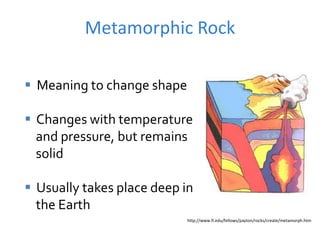
 Meaning to change shape
 Changes with temperature
and pressure, but remains
solid
 Usually takes place deep in
the Earth
Metamorphic Rocks
• Contact Metamorphism – heated by nearby magma
• Increased temperature changes the composition of
the rock, minerals are changed into new minerals
Hornfels is a fine-grained non-foliated
metamorphic rock produced by
contact metamorphism
http://www.windows.ucar.edu/tour/link=/earth/geology/meta_contact.html&edu=h igh&fr=t
Metamorphic Rocks
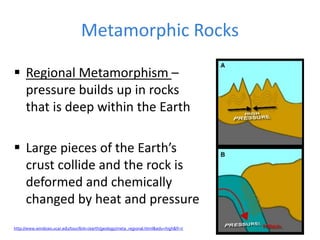
 Regional Metamorphism –
pressure builds up in rocks
that is deep within the Earth
 Large pieces of the Earth’s
crust collide and the rock is
deformed and chemically
changed by heat and pressure
http://www.windows.ucar.edu/tour/link=/earth/geology/meta_regional.html&edu=high&fr=t
Metamorphic Rock
• Foliated - contain aligned grains of flat
minerals
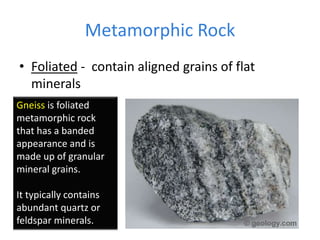
Gneiss is foliated
metamorphic rock
that has a banded
appearance and is
made up of granular
mineral grains.
It typically contains
abundant quartz or
feldspar minerals.
Metamorphic Rock
• Non-Foliated – mineral grains are not
arranged in plains or bands
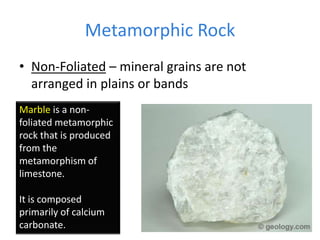
Marble is a non-
foliated metamorphic
rock that is produced
from the
metamorphism of
limestone.
It is composed
primarily of calcium
carbonate.
Metamorphic Rock
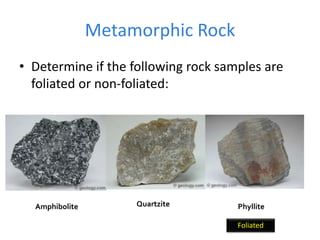
• Determine if the following rock samples are
foliated or non-foliated:
Amphibolite Quartzite Phyllite
Foliated

Geology - Rock Types

  • 1.
  • 2.
    What are rocksmade from? Essential Question
  • 3.
    What are rocks? Arock is a naturally occurring solid mixture of one or more minerals, or organic matter Rocks are classified by how they are formed, their composition, and texture Rocks change over time through the rock cycle
  • 4.
    What are Minerals? Mineralsare made of one or a combination of elements. Elements are simple substances that can’t be broken down into any other substance. The most common minerals are those based on silicon and oxygen.
  • 5.
    Igneous Rocks • Igneousrock begins as magma. • Magma can form: • When rock is heated • When pressure is released • When rock changes composition • Magma solidifies between - 700 °C and 1,250 °C • Magma is a mixture of many minerals http://www.fi.edu/fellows/payton/rocks/create/igneous.htm
  • 6.
    Igneous Rocks • Felsic:light coloured rocks that are rich in elements such as aluminum, potassium, silicon, and sodium • Mafic: dark coloured rocks that are rich in calcium, iron, and magnesium, poor in silicon • Coarse-grained: takes longer to cool, giving mineral crystals more time to grow • Fine-grained: cools quickly with little to no crystals
  • 7.
  • 8.
    Igneous Rocks  IntrusiveIgneous Rocks: magma pushes into surrounding rock below the Earth’s surface  Extrusive Rocks: forms when magma erupts onto the Earth’s surface (lava), cools quickly with very small or no crystals formed http://www.windows.ucar.edu/tour/link=/earth/geology/ig_intrusive.html&edu=high&fr=t
  • 9.
    Igneous Rocks Obsidian isa dark-colored volcanic glass that forms from the very rapid cooling of molten rock material. It cools so rapidly that crystals do not form. Is this rock Felsic or Mafic? Is it fine-grained or coarse-grained? Is this rock Intrusive or Extrusive? Mafic, fine grained, extrusive
  • 10.
    Sedimentary Rocks http://www.fi.edu/fellows/payton/rocks/create/sediment.htm  Sedimentaryrock is formed by erosion  Sediments are moved from one place to another  Sediments are deposited in layers, with the older ones on the bottom  The layers become compacted and cemented together
  • 11.
    Sedimentary Rock  SedimentaryRocks are formed at or near the Earth’s surface  No heat and pressure involved  Strata – layers of rock  Stratification – the process in which sedimentary rocks are arranged in layers
  • 12.
    Sedimentary Rock Clastic –made of fragments of rock cemented together with calcite or quartz Breccia is a term most often used for clastic sedimentary rocks that are composed of large angular fragments (over two millimeters in diameter). The spaces between the large angular fragments can be filled with a matrix of smaller particles or a mineral cement that binds the rock together.
  • 13.
    Sedimentary Rock Chemical sedimentary– minerals crystallize out of solution to become rock Limestone is a sedimentary rock composed primarily of calcium carbonate (CaCO3) in the form of the mineral calcite. It most commonly forms in clear, warm, shallow marine waters. It is usually an organic sedimentary rock that forms from the accumulation of shell, coral, algal and fecal debris.
  • 14.
    Sedimentary Rock Organic sedimentary– remains of plants and animals Coal is an organic sedimentary rock that forms from the accumulation and preservation of plant materials, usually in a swamp environment. Coal is a combustible rock and along with oil and natural gas it is one of the three most important fossil fuels.
  • 15.
    Metamorphic Rock http://www.fi.edu/fellows/payton/rocks/create/metamorph.htm  Meaningto change shape  Changes with temperature and pressure, but remains solid  Usually takes place deep in the Earth
  • 16.
    Metamorphic Rocks • ContactMetamorphism – heated by nearby magma • Increased temperature changes the composition of the rock, minerals are changed into new minerals Hornfels is a fine-grained non-foliated metamorphic rock produced by contact metamorphism http://www.windows.ucar.edu/tour/link=/earth/geology/meta_contact.html&edu=h igh&fr=t
  • 17.
    Metamorphic Rocks  RegionalMetamorphism – pressure builds up in rocks that is deep within the Earth  Large pieces of the Earth’s crust collide and the rock is deformed and chemically changed by heat and pressure http://www.windows.ucar.edu/tour/link=/earth/geology/meta_regional.html&edu=high&fr=t
  • 18.
    Metamorphic Rock • Foliated- contain aligned grains of flat minerals Gneiss is foliated metamorphic rock that has a banded appearance and is made up of granular mineral grains. It typically contains abundant quartz or feldspar minerals.
  • 19.
    Metamorphic Rock • Non-Foliated– mineral grains are not arranged in plains or bands Marble is a non- foliated metamorphic rock that is produced from the metamorphism of limestone. It is composed primarily of calcium carbonate.
  • 20.
    Metamorphic Rock • Determineif the following rock samples are foliated or non-foliated: Amphibolite Quartzite Phyllite Foliated