- A simple theory that provides a
unifying framework for understanding
the way Earth works and how Earth
systems interact to create our
environment.
- About 5 billion years ago, a ball
of dust and gas forms the Sun and
later on, the planets.
- About 4.6 billion years ago, the
planet become hot.
- The term tectonics is taken from
the Greek “tektonikos” meaning
“construction”.
- Temperature at Earth’s center is about
6,000 degree Celsius, that creates
earthquakes, volcanic eruptions, mountain
building and continual movements of the
continents and ocean basins.
- Early in the twentieth century by a young
German scientist named Alfred Wegener.
- Pangea from the Greek root words for “all
lands”. The northern part called Laurasia and the
southern part Gondwanaland.
- Fossils of the same species are now found in
Antarctica, Africa, Australia, South America, and India.
- Some species of animals are Cynognathus,
Lystrosaurus, Mesosaurus and Glossopteris.
- Uncommon rock type which is identical to rocks
on the other side.
– concept of a single supercontinent that broke apart to
form the modern continents.
-first, that continents plow their way through oceanic crust,
shoving it aside as a ship plows through water; or second, that
continental crust slides over oceanic crust.
- In 1930, the German government
send him to Greenland to build a weather
situation.
- Wegener’s coworker, Rasmus
Willimsen.
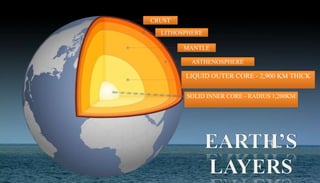
CRUST
LITHOSPHERE
ASTHENOSPHERE
LIQUID OUTER CORE - 2,900 KM THICK
SOLID INNER CORE - RADIUS 1,200KM
MANTLE
- Is the outer most and thinnest layer.
Because it is cool relative to the layer below
the crust consists of hard and strong rock.
- Mantle lies directly below the crust. It
is almost 2,900 kilometers thick and makes
up 80 % of earth’s volume.
- The outer part of the earth, including
both the uppermost mantle and the crust,
make up the lithosphere.
- At a depth varying from 75 to 125
kilometers beneath earth’s surface, the
combined effects of rising temperature and
pressure approach the melting point of
mantle rock.
- It lies below the lithosphere, at depths
between approximately 80 and 200 km (50 and
120 miles) below the surface
-it is plastic and capable of flowing slowly,
over geologic time.
- It is the innermost of earth’s layers. It
is sphere with a radius of about 3,470
kilometers, about the same size as mars.
MID-OCEANIC RIDGE
- The largest chain on earth.
- A mid-ocean ridge or mid-oceanic ridge is an underwater
mountain range, formed by plate tectonics. This uplifting of
the ocean floor occurs when convection currents rise in the mantle
beneath the oceanic crust and create magma where two tectonic
plates meet at a divergent boundary.
MID-ATLANTIC RIDGE
- One leg of this huge submarine mountain
chain
- Is a mid-ocean ridge, a divergent tectonic
plate or constructive plate boundary located
along the floor of the Atlantic Ocean, and part of
the longest mountain range in the world.
- Scientists had recently discovered that
earth’s magnetic field has reversed its
polarity on the average of every 500,000
years during the pat 65 million years.
- Periodic reversals of Earth’s magnetic
field were well known by the early 1960s.
- Vine, Matthews, and Morley
suggested that the sea floor is spreading
continuously away from the Mid-Oceanic
Ridge.
- New basalt lava rises through cracks
that form at the ridge axis as the two sides
of the sea floor separate.
- The sea floor and oceanic crust
should become older with increasing
distance from the ridge axis.
- Oceanographers discovered that
thin layer of mud that overlies sea-floor
basalt in most parts of the oceans is
thinnest at the Mid-oceanic Ridge.
- Oceanographers found that fossils in
the deepest layers of mud overlying basalt
were very young at the ridge axis.
- Symmetrical magnetic patterns and
similar mud age and thickness trends were
quickly discovered at other parts of other
part of the Mid-Oceanic Ridge System.
- This theory states the
lithosphere is a shell of hard, strong
rock about 100 kilometers thick that
floats on the hot, plastic
asthenosphere.
- The lithosphere is broken into 7
large tectonic plates.
- Tectonic plates are also called
lithospheric plates.
- Plate boundary is a fracture
that separates one plate from
another.
- Divergent boundary is a two
plates move apart from each other.
- Convergent boundary is a
two plates move toward each other.
- Transform boundary, they
slide horizontally past each other.
- It is also called as spreading center and a
rift zone.
- Two plates spread apart from one another.
- Both the lower lithosphere and the asthenosphere
are parts of the mantle and thus have similar chemical
composition and their main difference is one of
mechanical strength.
• Divergent
• Convergent
• Transform
- New lithosphere at an oceanic spreading center
is warmer than older lithosphere rock farther away
from the spreading center, and therefore the new
lithosphere has lower density. Consequently, it floats
toa high level, forming the undersea mountain chain
called the mid-oceanic ridge system.
- The mid-oceanic ridge system
encircles earth like the seam on a
baseball, forming earth’s longest
mountain chain.
- A divergent plate boundary can
rip a continent in half in a process
called continental rifting.
- At a convergent plate boundary, two
lithospheric plates move toward each other.
- When two plates of different densities
converge, the denser one sinks into the
mantle beneath the other.
- A subduction zone is a long,
narrow belt where a lithospheric
plate is sinking into the mantle.
- When an oceanic plate
converges with a continental plate,
the denser oceanic plate sinks into
the mantle beneath the edge of the
continent.
- When two oceanic plates
converge, the older , denser one sinks
into the mantle.
- If two converging plates
carry continents, neither can sink
deeply into the mantle.
- A transform plate boundary
forms where two plates slide
horizontally past one another as
they move in opposite directions.
1. A plate is a segment of the
lithosphere.
2. A single plate can carry both
oceanic crust and continental crust.
3. A plate is composed of hard,
mechanically strong rock.
4. A plate floats on the underlying
hot, plastic asthenosphere and
glides horizontally over it.
5. A plates behaves like a slab of ice
floating on a pond.
6. A plate margin is
tectonically active.
7. Tectonic plates move
at rates that vary
from less than 1 to
16 centimeters per
year.
- In contrast to the huge, curtain-shaped mass of mantle
that rises beneath a spreading center, a mantle plume is a
relatively small rising column of plastic mantle rock that is hotter
than surrounding rock
- Between 2 billion and 1.8 billion years ago , tectonic
plate movements swept these microcontinents together to form a
single landmass called supercontinents.
Isostasy: vertical
- The lithosphere behaves in a similar manner.
If a large mass is added to the lithosphere, it settles
and the underlying asthenosphere flows laterally
away from that region to make space for the settling
lithosphere.
How Plate movements affect earth system- The movements of tectonic plates
generate volcanic eruptions and
earthquakes, which help shape Earth’s
surface. They also build mountain ranges
and change the global distributions of
continents and oceans.
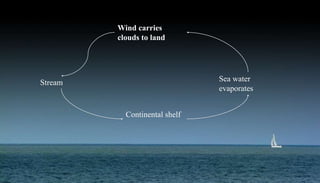
Wind carries
clouds to land
Sea water
evaporates
Stream
Continental shelf
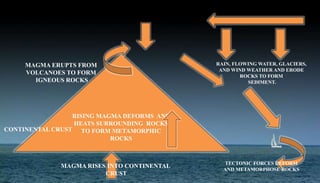
RISING MAGMA DEFORMS AND
HEATS SURROUNDING ROCKS
TO FORM METAMORPHIC
ROCKS
Rain falls
RAIN, FLOWING WATER, GLACIERS,
AND WIND WEATHER AND ERODE
ROCKS TO FORM
SEDIMENT.
TECTONIC FORCES DEFORM
AND METAMORPHOSE ROCKS
MAGMA RISES INTO CONTINENTAL
CRUST
MAGMA ERUPTS FROM
VOLCANOES TO FORM
IGNEOUS ROCKS
CONTINENTAL CRUST
Earthquakes- Quakes concentrate at plate
boundaries simply because those
boundaries are zones where one
plate slips past one another. The
slippage is rarely smooth and
continuous.
Mountain Building- Gany of the world’s great
mountain chains formed at subduction
zones.
- Great chains of volcanic
mountains form at rift zones because
the new, hot lithosphere floats to a high
level and large amounts of magma form
in these zones.
Migrating Continents and
Oceans.
- Both continents and oceans
basins migrate over Earth’s surface
because they are parts of the moving
lithospheric plates: they simply ride
piggyback on the plates.
- As the Atlantic Oceans widens,
the Pacific is shrinking. Thus, as
continents move, ocean basins open
and close over geologic time.
- Migration of continents and
ocean basins alter both regional
and global climate.
Prepared and Presented by:
LUDOVICO, CHRISTIAN
DEL ROSARIO, HAZEL
CRUZ, MARY GRACE
BALMACEDA, SHANE
CELESTE, ARON
BORINGOT, MARY ROZELLE
Submitted to:
EARTH AND ENVIRONMENTAL SCIENCE INSTRUCTRESS

PLATE TECTONIC

  • 2.
    - A simpletheory that provides a unifying framework for understanding the way Earth works and how Earth systems interact to create our environment.
  • 3.
    - About 5billion years ago, a ball of dust and gas forms the Sun and later on, the planets.
  • 4.
    - About 4.6billion years ago, the planet become hot. - The term tectonics is taken from the Greek “tektonikos” meaning “construction”.
  • 5.
    - Temperature atEarth’s center is about 6,000 degree Celsius, that creates earthquakes, volcanic eruptions, mountain building and continual movements of the continents and ocean basins.
  • 6.
    - Early inthe twentieth century by a young German scientist named Alfred Wegener. - Pangea from the Greek root words for “all lands”. The northern part called Laurasia and the southern part Gondwanaland.
  • 7.
    - Fossils ofthe same species are now found in Antarctica, Africa, Australia, South America, and India. - Some species of animals are Cynognathus, Lystrosaurus, Mesosaurus and Glossopteris. - Uncommon rock type which is identical to rocks on the other side.
  • 8.
    – concept ofa single supercontinent that broke apart to form the modern continents. -first, that continents plow their way through oceanic crust, shoving it aside as a ship plows through water; or second, that continental crust slides over oceanic crust.
  • 9.
    - In 1930,the German government send him to Greenland to build a weather situation. - Wegener’s coworker, Rasmus Willimsen.
  • 11.
    CRUST LITHOSPHERE ASTHENOSPHERE LIQUID OUTER CORE- 2,900 KM THICK SOLID INNER CORE - RADIUS 1,200KM MANTLE
  • 12.
    - Is theouter most and thinnest layer. Because it is cool relative to the layer below the crust consists of hard and strong rock.
  • 13.
    - Mantle liesdirectly below the crust. It is almost 2,900 kilometers thick and makes up 80 % of earth’s volume.
  • 14.
    - The outerpart of the earth, including both the uppermost mantle and the crust, make up the lithosphere.
  • 15.
    - At adepth varying from 75 to 125 kilometers beneath earth’s surface, the combined effects of rising temperature and pressure approach the melting point of mantle rock.
  • 16.
    - It liesbelow the lithosphere, at depths between approximately 80 and 200 km (50 and 120 miles) below the surface -it is plastic and capable of flowing slowly, over geologic time.
  • 17.
    - It isthe innermost of earth’s layers. It is sphere with a radius of about 3,470 kilometers, about the same size as mars.
  • 18.
    MID-OCEANIC RIDGE - Thelargest chain on earth. - A mid-ocean ridge or mid-oceanic ridge is an underwater mountain range, formed by plate tectonics. This uplifting of the ocean floor occurs when convection currents rise in the mantle beneath the oceanic crust and create magma where two tectonic plates meet at a divergent boundary.
  • 19.
    MID-ATLANTIC RIDGE - Oneleg of this huge submarine mountain chain - Is a mid-ocean ridge, a divergent tectonic plate or constructive plate boundary located along the floor of the Atlantic Ocean, and part of the longest mountain range in the world.
  • 21.
    - Scientists hadrecently discovered that earth’s magnetic field has reversed its polarity on the average of every 500,000 years during the pat 65 million years. - Periodic reversals of Earth’s magnetic field were well known by the early 1960s.
  • 22.
    - Vine, Matthews,and Morley suggested that the sea floor is spreading continuously away from the Mid-Oceanic Ridge. - New basalt lava rises through cracks that form at the ridge axis as the two sides of the sea floor separate.
  • 23.
    - The seafloor and oceanic crust should become older with increasing distance from the ridge axis. - Oceanographers discovered that thin layer of mud that overlies sea-floor basalt in most parts of the oceans is thinnest at the Mid-oceanic Ridge.
  • 24.
    - Oceanographers foundthat fossils in the deepest layers of mud overlying basalt were very young at the ridge axis. - Symmetrical magnetic patterns and similar mud age and thickness trends were quickly discovered at other parts of other part of the Mid-Oceanic Ridge System.
  • 26.
    - This theorystates the lithosphere is a shell of hard, strong rock about 100 kilometers thick that floats on the hot, plastic asthenosphere. - The lithosphere is broken into 7 large tectonic plates.
  • 27.
    - Tectonic platesare also called lithospheric plates. - Plate boundary is a fracture that separates one plate from another.
  • 28.
    - Divergent boundaryis a two plates move apart from each other. - Convergent boundary is a two plates move toward each other. - Transform boundary, they slide horizontally past each other.
  • 30.
    - It isalso called as spreading center and a rift zone. - Two plates spread apart from one another. - Both the lower lithosphere and the asthenosphere are parts of the mantle and thus have similar chemical composition and their main difference is one of mechanical strength.
  • 32.
  • 34.
    - New lithosphereat an oceanic spreading center is warmer than older lithosphere rock farther away from the spreading center, and therefore the new lithosphere has lower density. Consequently, it floats toa high level, forming the undersea mountain chain called the mid-oceanic ridge system.
  • 35.
    - The mid-oceanicridge system encircles earth like the seam on a baseball, forming earth’s longest mountain chain.
  • 37.
    - A divergentplate boundary can rip a continent in half in a process called continental rifting.
  • 39.
    - At aconvergent plate boundary, two lithospheric plates move toward each other. - When two plates of different densities converge, the denser one sinks into the mantle beneath the other.
  • 40.
    - A subductionzone is a long, narrow belt where a lithospheric plate is sinking into the mantle.
  • 42.
    - When anoceanic plate converges with a continental plate, the denser oceanic plate sinks into the mantle beneath the edge of the continent.
  • 44.
    - When twooceanic plates converge, the older , denser one sinks into the mantle.
  • 46.
    - If twoconverging plates carry continents, neither can sink deeply into the mantle.
  • 48.
    - A transformplate boundary forms where two plates slide horizontally past one another as they move in opposite directions.
  • 50.
    1. A plateis a segment of the lithosphere. 2. A single plate can carry both oceanic crust and continental crust. 3. A plate is composed of hard, mechanically strong rock.
  • 51.
    4. A platefloats on the underlying hot, plastic asthenosphere and glides horizontally over it. 5. A plates behaves like a slab of ice floating on a pond.
  • 52.
    6. A platemargin is tectonically active. 7. Tectonic plates move at rates that vary from less than 1 to 16 centimeters per year.
  • 53.
    - In contrastto the huge, curtain-shaped mass of mantle that rises beneath a spreading center, a mantle plume is a relatively small rising column of plastic mantle rock that is hotter than surrounding rock - Between 2 billion and 1.8 billion years ago , tectonic plate movements swept these microcontinents together to form a single landmass called supercontinents.
  • 54.
    Isostasy: vertical - Thelithosphere behaves in a similar manner. If a large mass is added to the lithosphere, it settles and the underlying asthenosphere flows laterally away from that region to make space for the settling lithosphere.
  • 55.
    How Plate movementsaffect earth system- The movements of tectonic plates generate volcanic eruptions and earthquakes, which help shape Earth’s surface. They also build mountain ranges and change the global distributions of continents and oceans.
  • 56.
    Wind carries clouds toland Sea water evaporates Stream Continental shelf
  • 57.
    RISING MAGMA DEFORMSAND HEATS SURROUNDING ROCKS TO FORM METAMORPHIC ROCKS Rain falls RAIN, FLOWING WATER, GLACIERS, AND WIND WEATHER AND ERODE ROCKS TO FORM SEDIMENT. TECTONIC FORCES DEFORM AND METAMORPHOSE ROCKS MAGMA RISES INTO CONTINENTAL CRUST MAGMA ERUPTS FROM VOLCANOES TO FORM IGNEOUS ROCKS CONTINENTAL CRUST
  • 59.
    Earthquakes- Quakes concentrateat plate boundaries simply because those boundaries are zones where one plate slips past one another. The slippage is rarely smooth and continuous.
  • 60.
    Mountain Building- Ganyof the world’s great mountain chains formed at subduction zones. - Great chains of volcanic mountains form at rift zones because the new, hot lithosphere floats to a high level and large amounts of magma form in these zones.
  • 61.
    Migrating Continents and Oceans. -Both continents and oceans basins migrate over Earth’s surface because they are parts of the moving lithospheric plates: they simply ride piggyback on the plates.
  • 62.
    - As theAtlantic Oceans widens, the Pacific is shrinking. Thus, as continents move, ocean basins open and close over geologic time.
  • 63.
    - Migration ofcontinents and ocean basins alter both regional and global climate.
  • 64.
    Prepared and Presentedby: LUDOVICO, CHRISTIAN DEL ROSARIO, HAZEL CRUZ, MARY GRACE BALMACEDA, SHANE CELESTE, ARON BORINGOT, MARY ROZELLE
  • 65.
    Submitted to: EARTH ANDENVIRONMENTAL SCIENCE INSTRUCTRESS