Introduction to OSHA OSHA
What is OSHA? O ccupational S afety and  H ealth  A dministration O S H A
Why was OSHA created? 14,000 employees died annually from job-related injuries and illnesses Nearly 2.5 million employees were disabled Ten times as many person-days were lost due to job-related disabilities than from strikes 300,000 new cases of occupational disease
The OSHA Act of 1970 The purpose of the OSH Act is to  “assure so far as possible every working,  man and woman in the nation safe and  healthful working conditions and to  preserve our human resources.”
Who is covered – Federal OSHA? Private employers with one or more employees business effecting commerce Federal government employees Not covered self-employed working conditions regulated by other federal agencies farms employing only family members
State and local government employees Private employers not on federal property federal parks military bases Who is covered –  State OSHA?
How do they operate ? Regional and area offices Standards Inspections Citations and Penalties
Section 5(a)(1) of the OSH Act “ Each employer shall furnish to each of his employees employment and a place of employment which is free from recognized hazards that are causing or likely to cause death or serious physical harm to his employees.” General Duty Clause
Advisory Committees National Advisory Committee on Occupational Safety and Health (NACOSH) Advisory Committee on Construction Safety and Health NIOSH Recommendations OSHA  Standards Development
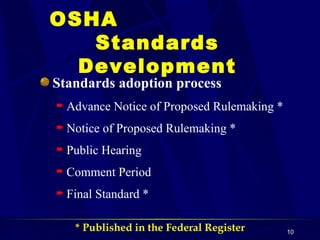
OSHA  Standards Development Standards adoption process Advance Notice of Proposed Rulemaking * Notice of Proposed Rulemaking * Public Hearing Comment Period Final Standard *  * Published in the Federal Register
Emergency Temporary Standards* workers in grave danger proposed permanent standard Final ruling within 6 months Appealing a Standard Variances Public Petitions OSHA  Standards Development *  Published in the Federal Register
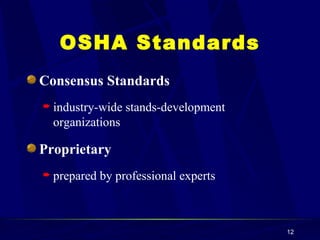
Consensus Standards industry-wide stands-development organizations Proprietary prepared by professional experts OSHA Standards
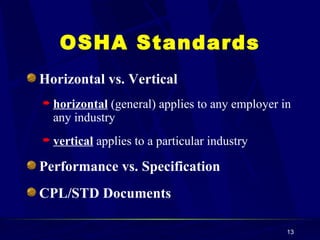
Horizontal vs. Vertical  horizontal  (general) applies to any employer in any industry vertical  applies to a particular industry Performance vs. Specification CPL/STD Documents OSHA Standards
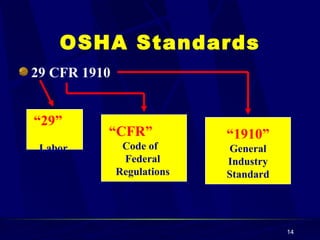
OSHA Standards 29 CFR 1910 “ 29”   Labor “ CFR”   Code of  Federal Regulations “ 1910”   General Industry Standard
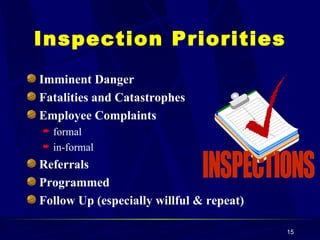
Inspection Priorities Imminent Danger Fatalities and Catastrophes Employee Complaints formal in-formal Referrals Programmed Follow Up (especially willful & repeat)
Imminent Danger reasonable certainty that danger exists  may not be eliminated via normal enforcement procedures prior to  death serious physical harm Inspection Priorities 1 st  PRIORITY
Fatalities and Catastrophes hospitalization of 3 or more employees report to OSHA by employer within 8 hours CALL 1 (800) 321 OSHA after hours 29 CFR 1904.8 Inspection Priorities 2 nd  PRIORITY
Employee Complaints and Referrals formal inspected 95% within 5 days in-formal phone/fax response from OSHA within 1 day 5 days for employer to respond  serious referrals Inspection Priorities 3 rd  PRIORITY
Programmed Inspections site-specific targeting national emphasis programs  local emphasis programs Construction scheduler Inspection Priorities 4 th  PRIORITY
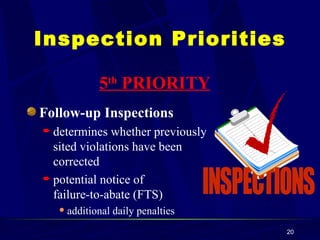
Follow-up Inspections determines whether previously sited violations have been corrected potential notice of  failure-to-abate (FTS) additional daily penalties Inspection Priorities 5 th  PRIORITY
OSHA  Inspection Process Opening Conference Inspection Tour (walkaround) Closing Conference
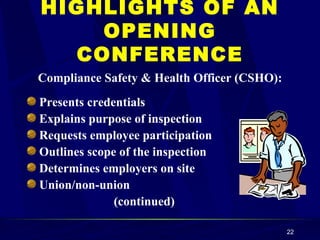
HIGHLIGHTS OF AN OPENING CONFERENCE Compliance Safety & Health Officer (CSHO): Presents credentials Explains purpose of inspection Requests employee participation Outlines scope of the inspection Determines employers on site Union/non-union (continued)
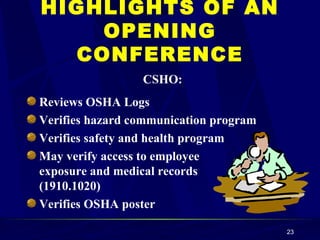
HIGHLIGHTS OF AN OPENING CONFERENCE CSHO: Reviews OSHA Logs Verifies hazard communication program Verifies safety and health program May verify access to employee  exposure and medical records  (1910.1020) Verifies OSHA poster
HIGHLIGHTS OF AN OSHA WALKAROUND INSPECTION CSHO: Identifies potential safety and health hazards determines employee awareness & knowledge evaluates PPE selection, maintenance & use  Documents apparent violations Photographs or videotapes them  Instrument readings Questions employees privately
HIGHLIGHTS OF AN OSHA CLOSING CONFERENCE CSHO: Gives  Employer Rights & Responsibilities Following an OSHA Inspection . Explains: employer’s rights contest procedures informal conference Penalties may be issued by Area Director consultation services
CSHO: Employee’s representative may be present Employer may produce records to show compliance Discusses apparent violations Requests abatement of violations HIGHLIGHTS OF AN OSHA CLOSING CONFERENCE
Serious There is a substantial probability that death or serious physical harm could result, and the employer knew or should have known or the hazard. Maximum Penalty: $7,000. CITATION TYPES Citation
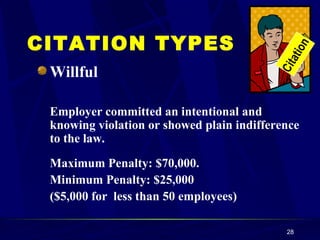
Willful Employer committed an intentional and knowing violation or showed plain indifference to the law. Maximum Penalty: $70,000. Minimum Penalty: $25,000 ($5,000 for  less than 50 employees)  CITATION TYPES Citation
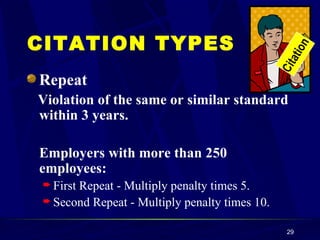
Repeat  Violation of the same or similar standard within 3 years. Employers with more than 250 employees: First Repeat - Multiply penalty times 5. Second Repeat - Multiply penalty times 10. CITATION TYPES Citation
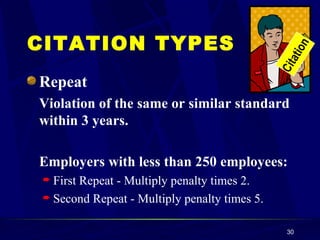
Repeat  Violation of the same or similar standard within 3 years. Employers with less than 250 employees: First Repeat - Multiply penalty times 2. Second Repeat - Multiply penalty times 5. CITATION TYPES Citation
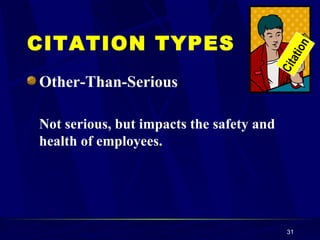
Other-Than-Serious Not serious, but impacts the safety and health of employees. CITATION TYPES Citation Citation
Failure to Abate Max CITATION TYPES Citation Citation
De Minimus Violation which has no direct or immediate relationship to employee safety and health. No Penalty. CITATION TYPES Citation
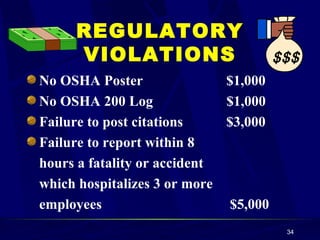
REGULATORY VIOLATIONS No OSHA Poster    $1,000 No OSHA 200 Log   $1,000 Failure to post citations   $3,000 Failure to report within 8  hours a fatality or accident  which hospitalizes 3 or more employees   $5,000 $$$
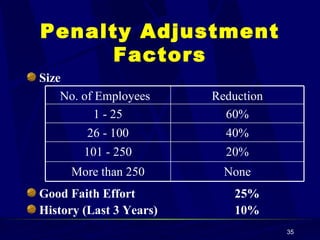
Penalty Adjustment Factors Size Good Faith Effort   25% History (Last 3 Years)   10% None More than 250 20% 101 - 250 40% 26 - 100 60% 1 - 25 Reduction No. of Employees
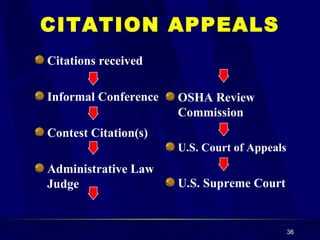
CITATION APPEALS Citations received Informal Conference Contest Citation(s) Administrative Law Judge OSHA Review Commission U.S. Court of Appeals U.S. Supreme Court
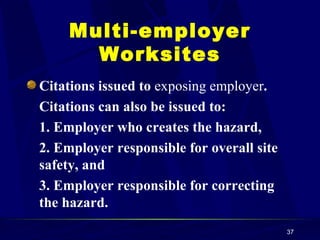
Multi-employer Worksites Citations issued to  exposing   employer . Citations can also be issued to: 1. Employer who creates the hazard, 2. Employer responsible for overall site safety, and 3. Employer responsible for correcting the hazard.
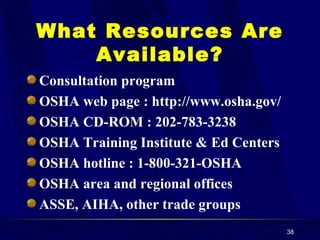
What Resources Are Available? Consultation program OSHA web page : http://www.osha.gov/ OSHA CD-ROM : 202-783-3238 OSHA Training Institute & Ed Centers OSHA hotline : 1-800-321-OSHA OSHA area and regional offices ASSE, AIHA, other trade groups
OSHA  Consultation Program No cost, confidential assistance On-site assistance with safety, health, ergonomics Serious hazard obligation! Sometimes there is a backlog Focused compliance assistance or comprehensive assistance
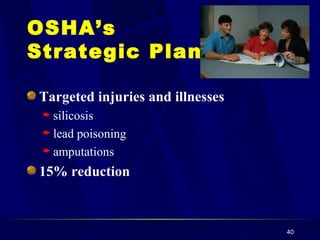
Targeted injuries and illnesses silicosis lead poisoning amputations  15% reduction OSHA’s  Strategic Plan
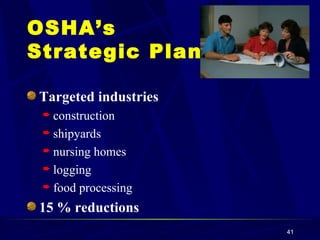
Targeted industries construction shipyards nursing homes  logging food processing 15 % reductions OSHA’s  Strategic Plan
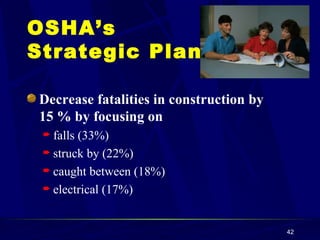
Decrease fatalities in construction by  15 % by focusing on falls (33%) struck by (22%) caught between (18%) electrical (17%) OSHA’s  Strategic Plan
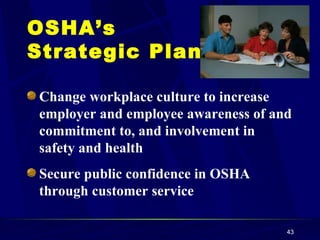
Change workplace culture to increase employer and employee awareness of and commitment to, and involvement in safety and health Secure public confidence in OSHA through customer service OSHA’s  Strategic Plan
The OSHA Web Site www.osha.gov SAFETY & HEALTH

Introduction To Osha

  • 1.
  • 2.
    What is OSHA?O ccupational S afety and H ealth A dministration O S H A
  • 3.
    Why was OSHAcreated? 14,000 employees died annually from job-related injuries and illnesses Nearly 2.5 million employees were disabled Ten times as many person-days were lost due to job-related disabilities than from strikes 300,000 new cases of occupational disease
  • 4.
    The OSHA Actof 1970 The purpose of the OSH Act is to “assure so far as possible every working, man and woman in the nation safe and healthful working conditions and to preserve our human resources.”
  • 5.
    Who is covered– Federal OSHA? Private employers with one or more employees business effecting commerce Federal government employees Not covered self-employed working conditions regulated by other federal agencies farms employing only family members
  • 6.
    State and localgovernment employees Private employers not on federal property federal parks military bases Who is covered – State OSHA?
  • 7.
    How do theyoperate ? Regional and area offices Standards Inspections Citations and Penalties
  • 8.
    Section 5(a)(1) ofthe OSH Act “ Each employer shall furnish to each of his employees employment and a place of employment which is free from recognized hazards that are causing or likely to cause death or serious physical harm to his employees.” General Duty Clause
  • 9.
    Advisory Committees NationalAdvisory Committee on Occupational Safety and Health (NACOSH) Advisory Committee on Construction Safety and Health NIOSH Recommendations OSHA Standards Development
  • 10.
    OSHA StandardsDevelopment Standards adoption process Advance Notice of Proposed Rulemaking * Notice of Proposed Rulemaking * Public Hearing Comment Period Final Standard * * Published in the Federal Register
  • 11.
    Emergency Temporary Standards*workers in grave danger proposed permanent standard Final ruling within 6 months Appealing a Standard Variances Public Petitions OSHA Standards Development * Published in the Federal Register
  • 12.
    Consensus Standards industry-widestands-development organizations Proprietary prepared by professional experts OSHA Standards
  • 13.
    Horizontal vs. Vertical horizontal (general) applies to any employer in any industry vertical applies to a particular industry Performance vs. Specification CPL/STD Documents OSHA Standards
  • 14.
    OSHA Standards 29CFR 1910 “ 29” Labor “ CFR” Code of Federal Regulations “ 1910” General Industry Standard
  • 15.
    Inspection Priorities ImminentDanger Fatalities and Catastrophes Employee Complaints formal in-formal Referrals Programmed Follow Up (especially willful & repeat)
  • 16.
    Imminent Danger reasonablecertainty that danger exists may not be eliminated via normal enforcement procedures prior to death serious physical harm Inspection Priorities 1 st PRIORITY
  • 17.
    Fatalities and Catastropheshospitalization of 3 or more employees report to OSHA by employer within 8 hours CALL 1 (800) 321 OSHA after hours 29 CFR 1904.8 Inspection Priorities 2 nd PRIORITY
  • 18.
    Employee Complaints andReferrals formal inspected 95% within 5 days in-formal phone/fax response from OSHA within 1 day 5 days for employer to respond serious referrals Inspection Priorities 3 rd PRIORITY
  • 19.
    Programmed Inspections site-specifictargeting national emphasis programs local emphasis programs Construction scheduler Inspection Priorities 4 th PRIORITY
  • 20.
    Follow-up Inspections determineswhether previously sited violations have been corrected potential notice of failure-to-abate (FTS) additional daily penalties Inspection Priorities 5 th PRIORITY
  • 21.
    OSHA InspectionProcess Opening Conference Inspection Tour (walkaround) Closing Conference
  • 22.
    HIGHLIGHTS OF ANOPENING CONFERENCE Compliance Safety & Health Officer (CSHO): Presents credentials Explains purpose of inspection Requests employee participation Outlines scope of the inspection Determines employers on site Union/non-union (continued)
  • 23.
    HIGHLIGHTS OF ANOPENING CONFERENCE CSHO: Reviews OSHA Logs Verifies hazard communication program Verifies safety and health program May verify access to employee exposure and medical records (1910.1020) Verifies OSHA poster
  • 24.
    HIGHLIGHTS OF ANOSHA WALKAROUND INSPECTION CSHO: Identifies potential safety and health hazards determines employee awareness & knowledge evaluates PPE selection, maintenance & use Documents apparent violations Photographs or videotapes them Instrument readings Questions employees privately
  • 25.
    HIGHLIGHTS OF ANOSHA CLOSING CONFERENCE CSHO: Gives Employer Rights & Responsibilities Following an OSHA Inspection . Explains: employer’s rights contest procedures informal conference Penalties may be issued by Area Director consultation services
  • 26.
    CSHO: Employee’s representativemay be present Employer may produce records to show compliance Discusses apparent violations Requests abatement of violations HIGHLIGHTS OF AN OSHA CLOSING CONFERENCE
  • 27.
    Serious There isa substantial probability that death or serious physical harm could result, and the employer knew or should have known or the hazard. Maximum Penalty: $7,000. CITATION TYPES Citation
  • 28.
    Willful Employer committedan intentional and knowing violation or showed plain indifference to the law. Maximum Penalty: $70,000. Minimum Penalty: $25,000 ($5,000 for less than 50 employees) CITATION TYPES Citation
  • 29.
    Repeat Violationof the same or similar standard within 3 years. Employers with more than 250 employees: First Repeat - Multiply penalty times 5. Second Repeat - Multiply penalty times 10. CITATION TYPES Citation
  • 30.
    Repeat Violationof the same or similar standard within 3 years. Employers with less than 250 employees: First Repeat - Multiply penalty times 2. Second Repeat - Multiply penalty times 5. CITATION TYPES Citation
  • 31.
    Other-Than-Serious Not serious,but impacts the safety and health of employees. CITATION TYPES Citation Citation
  • 32.
    Failure to AbateMax CITATION TYPES Citation Citation
  • 33.
    De Minimus Violationwhich has no direct or immediate relationship to employee safety and health. No Penalty. CITATION TYPES Citation
  • 34.
    REGULATORY VIOLATIONS NoOSHA Poster $1,000 No OSHA 200 Log $1,000 Failure to post citations $3,000 Failure to report within 8 hours a fatality or accident which hospitalizes 3 or more employees $5,000 $$$
  • 35.
    Penalty Adjustment FactorsSize Good Faith Effort 25% History (Last 3 Years) 10% None More than 250 20% 101 - 250 40% 26 - 100 60% 1 - 25 Reduction No. of Employees
  • 36.
    CITATION APPEALS Citationsreceived Informal Conference Contest Citation(s) Administrative Law Judge OSHA Review Commission U.S. Court of Appeals U.S. Supreme Court
  • 37.
    Multi-employer Worksites Citationsissued to exposing employer . Citations can also be issued to: 1. Employer who creates the hazard, 2. Employer responsible for overall site safety, and 3. Employer responsible for correcting the hazard.
  • 38.
    What Resources AreAvailable? Consultation program OSHA web page : http://www.osha.gov/ OSHA CD-ROM : 202-783-3238 OSHA Training Institute & Ed Centers OSHA hotline : 1-800-321-OSHA OSHA area and regional offices ASSE, AIHA, other trade groups
  • 39.
    OSHA ConsultationProgram No cost, confidential assistance On-site assistance with safety, health, ergonomics Serious hazard obligation! Sometimes there is a backlog Focused compliance assistance or comprehensive assistance
  • 40.
    Targeted injuries andillnesses silicosis lead poisoning amputations 15% reduction OSHA’s Strategic Plan
  • 41.
    Targeted industries constructionshipyards nursing homes logging food processing 15 % reductions OSHA’s Strategic Plan
  • 42.
    Decrease fatalities inconstruction by 15 % by focusing on falls (33%) struck by (22%) caught between (18%) electrical (17%) OSHA’s Strategic Plan
  • 43.
    Change workplace cultureto increase employer and employee awareness of and commitment to, and involvement in safety and health Secure public confidence in OSHA through customer service OSHA’s Strategic Plan
  • 44.
    The OSHA WebSite www.osha.gov SAFETY & HEALTH