Physical and chemical changes
How are new substances made?
How can you tell a new substance
has been formed?
I. Both living and non-living things are made
up of matter (atoms).
II. Matter around us undergoes changes. These
changes can be classified into two types
 - physical changes
 - chemical changes
 “Those who matter don’t mind…”
1. Physical changes in a substance affect its
physical properties, such as
• Shape
• Volume
• Density
• State of matter (solid, liquid, gas)
• Colour
• Mass
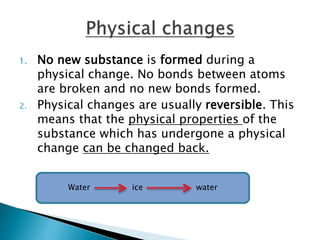
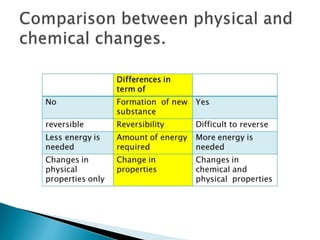
1. No new substance is formed during a
physical change. No bonds between atoms
are broken and no new bonds formed.
2. Physical changes are usually reversible. This
means that the physical properties of the
substance which has undergone a physical
change can be changed back.
Water ice water
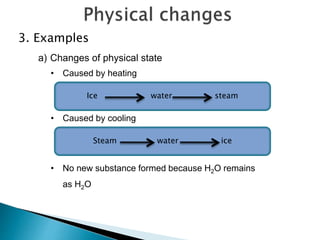
3. Examples
a) Changes of physical state
• Caused by heating
Steam water ice
Ice water steam
• Caused by cooling
• No new substance formed because H2O remains
as H2O
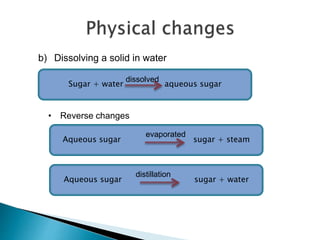
b) Dissolving a solid in water
Sugar + water aqueous sugar
• Reverse changes
Aqueous sugar sugar + steam
evaporated
dissolved
Aqueous sugar sugar + water
distillation
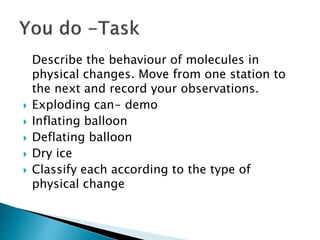
Describe the behaviour of molecules in
physical changes. Move from one station to
the next and record your observations.
 Exploding can- demo
 Inflating balloon
 Deflating balloon
 Dry ice
 Classify each according to the type of
physical change
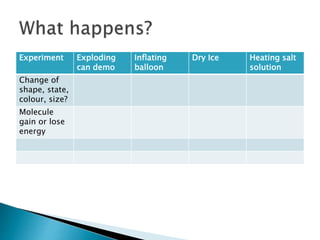
Experiment Exploding
can demo
Inflating
balloon
Dry Ice Heating salt
solution
Change of
shape, state,
colour, size?
Molecule
gain or lose
energy
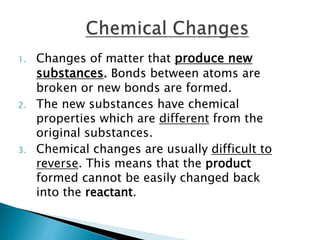
1. Changes of matter that produce new
substances. Bonds between atoms are
broken or new bonds are formed.
2. The new substances have chemical
properties which are different from the
original substances.
3. Chemical changes are usually difficult to
reverse. This means that the product
formed cannot be easily changed back
into the reactant.
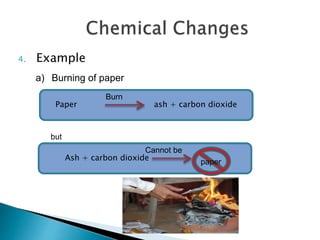
4. Example
a) Burning of paper
Paper ash + carbon dioxide
Burn
but
Ash + carbon dioxide
Cannot be
paper
 A chemical change has definitely occurred if
there is any of these: –
 A permanent colour change
 A gas is given off
 A change in temperature
 A precipitate (solid) forms when two liquids
are mixed
 Light emitted
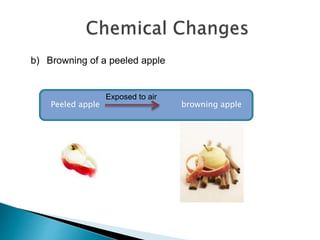
b) Browning of a peeled apple
Peeled apple browning apple
Exposed to air
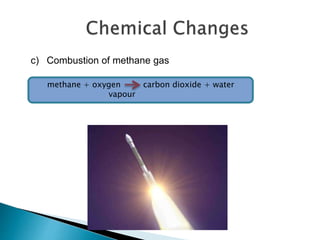
c) Combustion of methane gas
methane + oxygen carbon dioxide + water
vapour
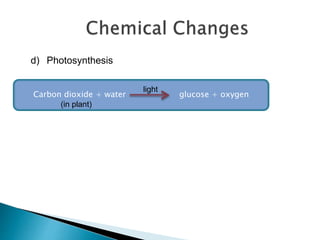
d) Photosynthesis
Carbon dioxide + water glucose + oxygen
light
(in plant)
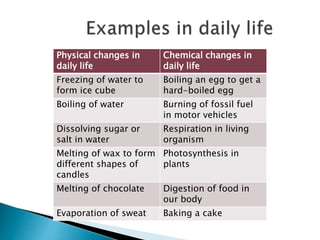
Physical changes in
daily life
Chemical changes in
daily life
Freezing of water to
form ice cube
Boiling an egg to get a
hard-boiled egg
Boiling of water Burning of fossil fuel
in motor vehicles
Dissolving sugar or
salt in water
Respiration in living
organism
Melting of wax to form
different shapes of
candles
Photosynthesis in
plants
Melting of chocolate Digestion of food in
our body
Evaporation of sweat Baking a cake
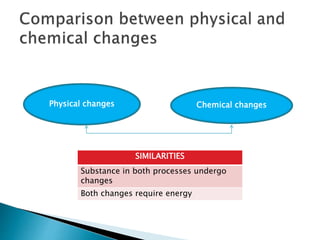
Physical changes Chemical changes
SIMILARITIES
Substance in both processes undergo
changes
Both changes require energy
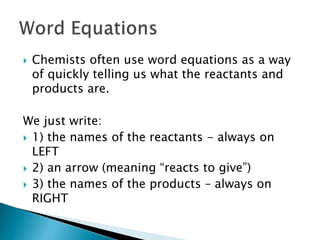
 Chemists often use word equations as a way
of quickly telling us what the reactants and
products are.
We just write:
 1) the names of the reactants - always on
LEFT
 2) an arrow (meaning “reacts to give”)
 3) the names of the products – always on
RIGHT
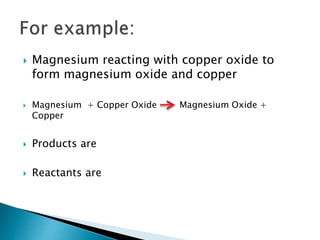
 Magnesium reacting with copper oxide to
form magnesium oxide and copper
 Magnesium + Copper Oxide Magnesium Oxide +
Copper
 Products are
 Reactants are
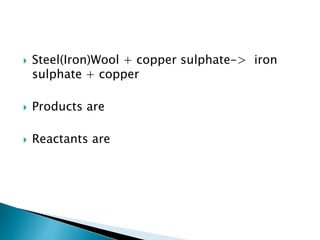
 Steel(Iron)Wool + copper sulphate-> iron
sulphate + copper
 Products are
 Reactants are
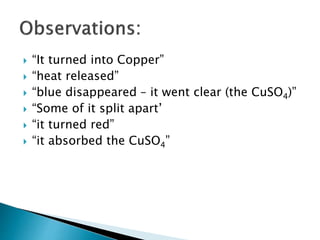
 “It turned into Copper”
 “heat released”
 “blue disappeared – it went clear (the CuSO4)”
 “Some of it split apart’
 “it turned red”
 “it absorbed the CuSO4”
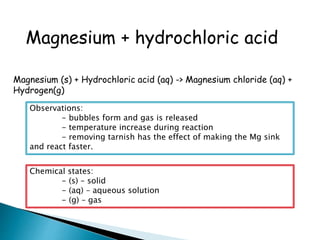
Magnesium + hydrochloric acid
Magnesium (s) + Hydrochloric acid (aq) -> Magnesium chloride (aq) +
Hydrogen(g)
Observations:
- bubbles form and gas is released
- temperature increase during reaction
- removing tarnish has the effect of making the Mg sink
and react faster.
Chemical states:
- (s) – solid
- (aq) – aqueous solution
- (g) – gas
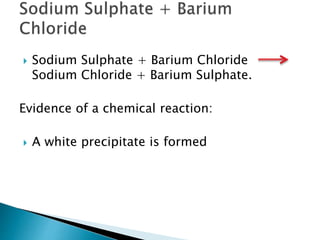
 Sodium Sulphate + Barium Chloride
Sodium Chloride + Barium Sulphate.
Evidence of a chemical reaction:
 A white precipitate is formed
 Magnesium burned brightly reacting with the
oxygen in the air to form magnesium oxide.
 List Products
 List Reactants
 Hydrochloric acid reacted with the calcium
hydroxide to give water and calcium chloride
 List Products
 List Reactants
 Electrolysis of aluminium oxide produced
aluminium metal and oxygen gas
 List Products
 List Reactants
 Write word equations for the following
chemical reactions.
◦ Octane gas is burnt with oxygen in a car engine to
produce carbon dioxide and water.
◦ Sodium metal reacts with chlorine gas to form
sodium chloride.
◦ Hydrogen gas and oxygen gas combine to form
water.
◦ Zinc metal dissolves in hydrochloric acid to form
hydrogen gas and zinc chloride.
Factors that affect the rate of reaction:
 Surface area
 Temperature
 Concentration of reactants
 Rate of reaction – how fast the alka –seltzer
dissolves – gas released is carbon dioxide.

Chemcial reactions

  • 1.
  • 2.
    How are newsubstances made? How can you tell a new substance has been formed?
  • 3.
    I. Both livingand non-living things are made up of matter (atoms). II. Matter around us undergoes changes. These changes can be classified into two types  - physical changes  - chemical changes  “Those who matter don’t mind…”
  • 4.
    1. Physical changesin a substance affect its physical properties, such as • Shape • Volume • Density • State of matter (solid, liquid, gas) • Colour • Mass
  • 5.
    1. No newsubstance is formed during a physical change. No bonds between atoms are broken and no new bonds formed. 2. Physical changes are usually reversible. This means that the physical properties of the substance which has undergone a physical change can be changed back. Water ice water
  • 6.
    3. Examples a) Changesof physical state • Caused by heating Steam water ice Ice water steam • Caused by cooling • No new substance formed because H2O remains as H2O
  • 7.
    b) Dissolving asolid in water Sugar + water aqueous sugar • Reverse changes Aqueous sugar sugar + steam evaporated dissolved Aqueous sugar sugar + water distillation
  • 8.
    Describe the behaviourof molecules in physical changes. Move from one station to the next and record your observations.  Exploding can- demo  Inflating balloon  Deflating balloon  Dry ice  Classify each according to the type of physical change
  • 9.
    Experiment Exploding can demo Inflating balloon DryIce Heating salt solution Change of shape, state, colour, size? Molecule gain or lose energy
  • 10.
    1. Changes ofmatter that produce new substances. Bonds between atoms are broken or new bonds are formed. 2. The new substances have chemical properties which are different from the original substances. 3. Chemical changes are usually difficult to reverse. This means that the product formed cannot be easily changed back into the reactant.
  • 11.
    4. Example a) Burningof paper Paper ash + carbon dioxide Burn but Ash + carbon dioxide Cannot be paper
  • 12.
     A chemicalchange has definitely occurred if there is any of these: –  A permanent colour change  A gas is given off  A change in temperature  A precipitate (solid) forms when two liquids are mixed  Light emitted
  • 13.
    b) Browning ofa peeled apple Peeled apple browning apple Exposed to air
  • 14.
    c) Combustion ofmethane gas methane + oxygen carbon dioxide + water vapour
  • 15.
    d) Photosynthesis Carbon dioxide+ water glucose + oxygen light (in plant)
  • 16.
    Physical changes in dailylife Chemical changes in daily life Freezing of water to form ice cube Boiling an egg to get a hard-boiled egg Boiling of water Burning of fossil fuel in motor vehicles Dissolving sugar or salt in water Respiration in living organism Melting of wax to form different shapes of candles Photosynthesis in plants Melting of chocolate Digestion of food in our body Evaporation of sweat Baking a cake
  • 17.
    Physical changes Chemicalchanges SIMILARITIES Substance in both processes undergo changes Both changes require energy
  • 19.
     Chemists oftenuse word equations as a way of quickly telling us what the reactants and products are. We just write:  1) the names of the reactants - always on LEFT  2) an arrow (meaning “reacts to give”)  3) the names of the products – always on RIGHT
  • 20.
     Magnesium reactingwith copper oxide to form magnesium oxide and copper  Magnesium + Copper Oxide Magnesium Oxide + Copper  Products are  Reactants are
  • 21.
     Steel(Iron)Wool +copper sulphate-> iron sulphate + copper  Products are  Reactants are
  • 22.
     “It turnedinto Copper”  “heat released”  “blue disappeared – it went clear (the CuSO4)”  “Some of it split apart’  “it turned red”  “it absorbed the CuSO4”
  • 23.
    Magnesium + hydrochloricacid Magnesium (s) + Hydrochloric acid (aq) -> Magnesium chloride (aq) + Hydrogen(g) Observations: - bubbles form and gas is released - temperature increase during reaction - removing tarnish has the effect of making the Mg sink and react faster. Chemical states: - (s) – solid - (aq) – aqueous solution - (g) – gas
  • 24.
     Sodium Sulphate+ Barium Chloride Sodium Chloride + Barium Sulphate. Evidence of a chemical reaction:  A white precipitate is formed
  • 25.
     Magnesium burnedbrightly reacting with the oxygen in the air to form magnesium oxide.  List Products  List Reactants
  • 26.
     Hydrochloric acidreacted with the calcium hydroxide to give water and calcium chloride  List Products  List Reactants
  • 27.
     Electrolysis ofaluminium oxide produced aluminium metal and oxygen gas  List Products  List Reactants
  • 28.
     Write wordequations for the following chemical reactions. ◦ Octane gas is burnt with oxygen in a car engine to produce carbon dioxide and water. ◦ Sodium metal reacts with chlorine gas to form sodium chloride. ◦ Hydrogen gas and oxygen gas combine to form water. ◦ Zinc metal dissolves in hydrochloric acid to form hydrogen gas and zinc chloride.
  • 29.
    Factors that affectthe rate of reaction:  Surface area  Temperature  Concentration of reactants  Rate of reaction – how fast the alka –seltzer dissolves – gas released is carbon dioxide.