ROCKS
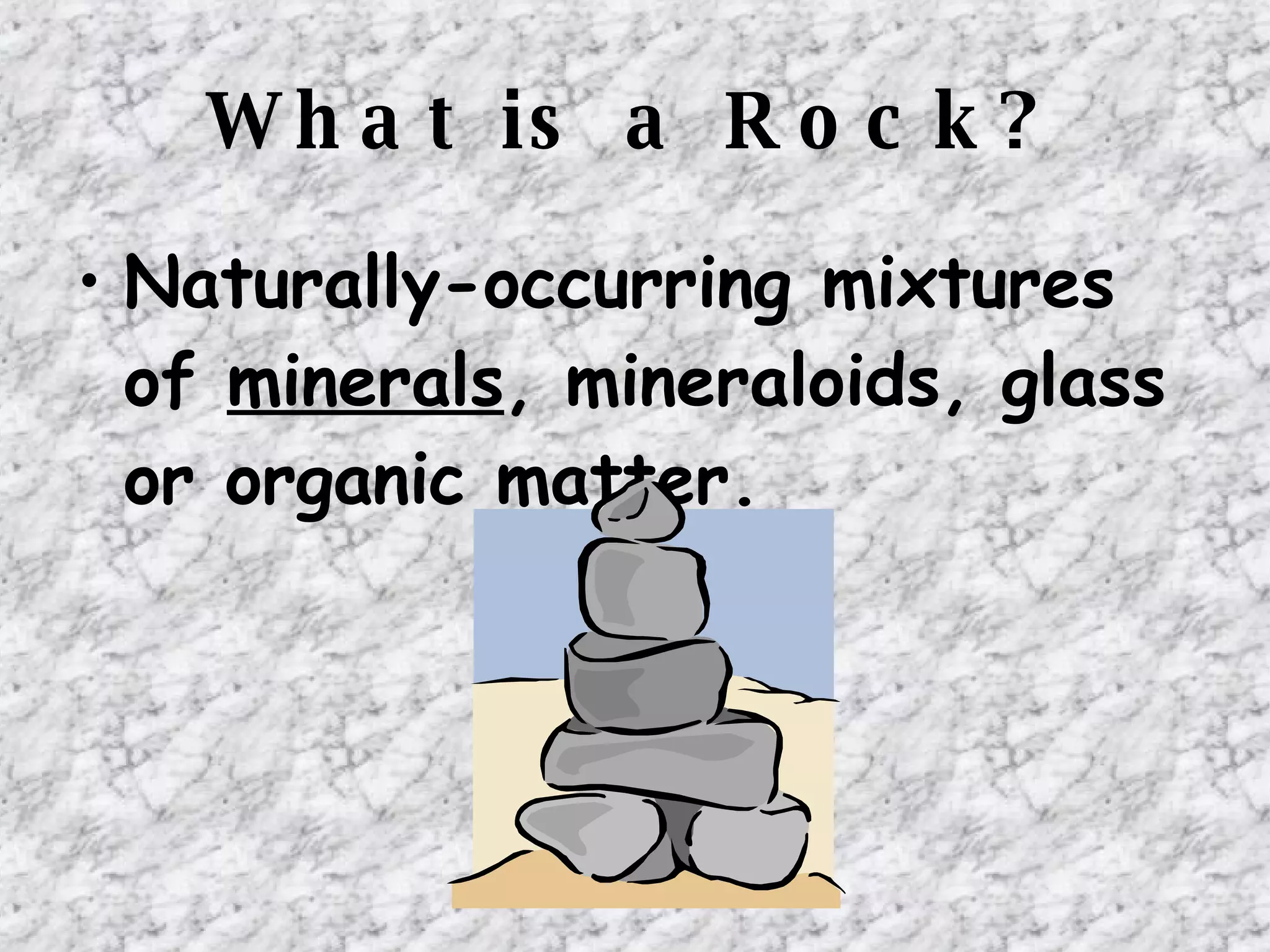
What is a Rock? Naturally-occurring mixtures of  minerals , mineraloids, glass or organic matter.
What is a Rock? Rocks are divided into 3 groups based on how they were formed: IGNEOUS SEDIMENTARY METAMORPHIC
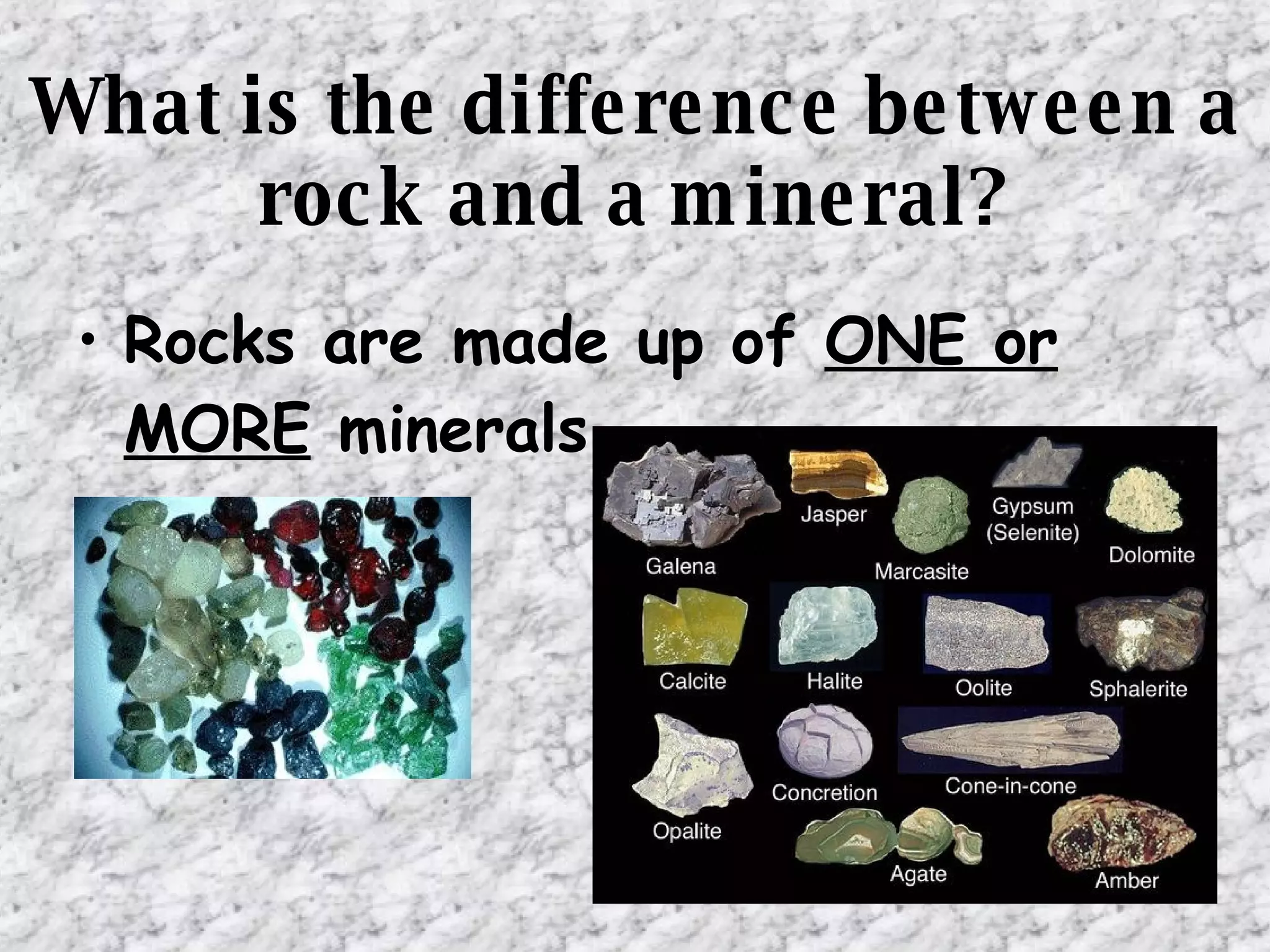
What is the difference between a rock and a mineral? Rocks are made up of  ONE or MORE  minerals.
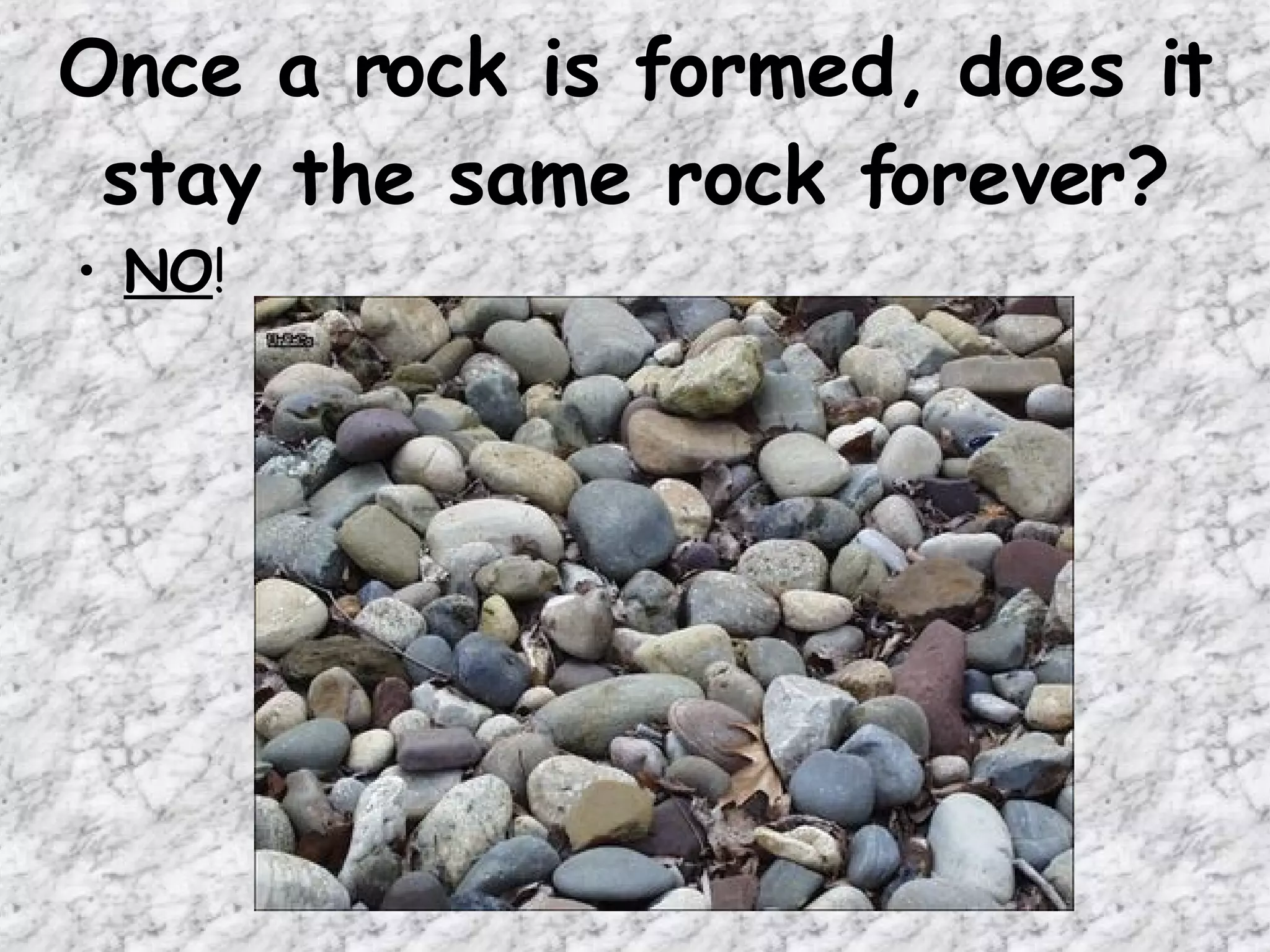
Once a rock is formed, does it stay the same rock forever? NO !
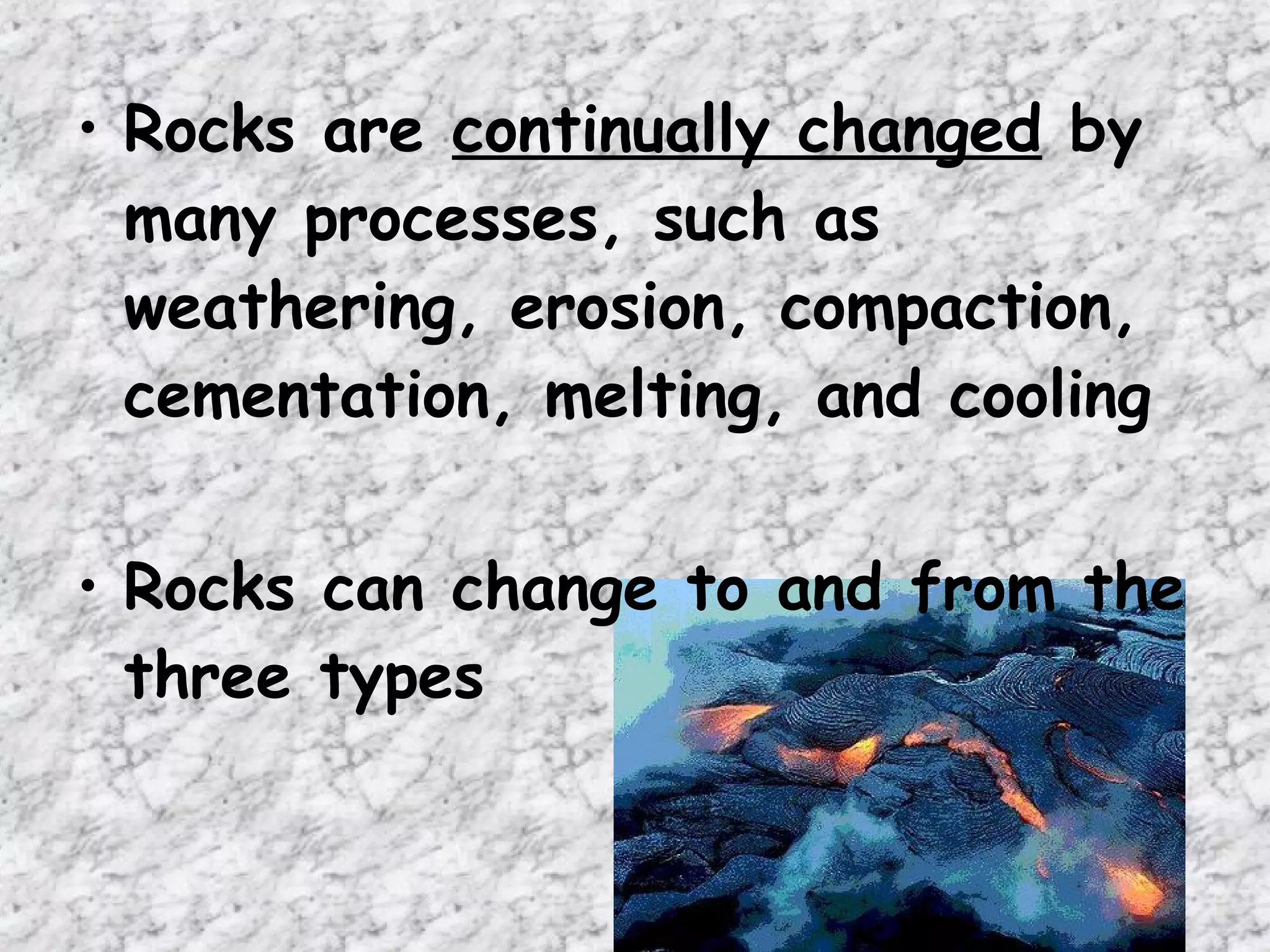
Rocks are  continually changed  by many processes, such as weathering, erosion, compaction, cementation, melting, and cooling Rocks can change to and from the three types
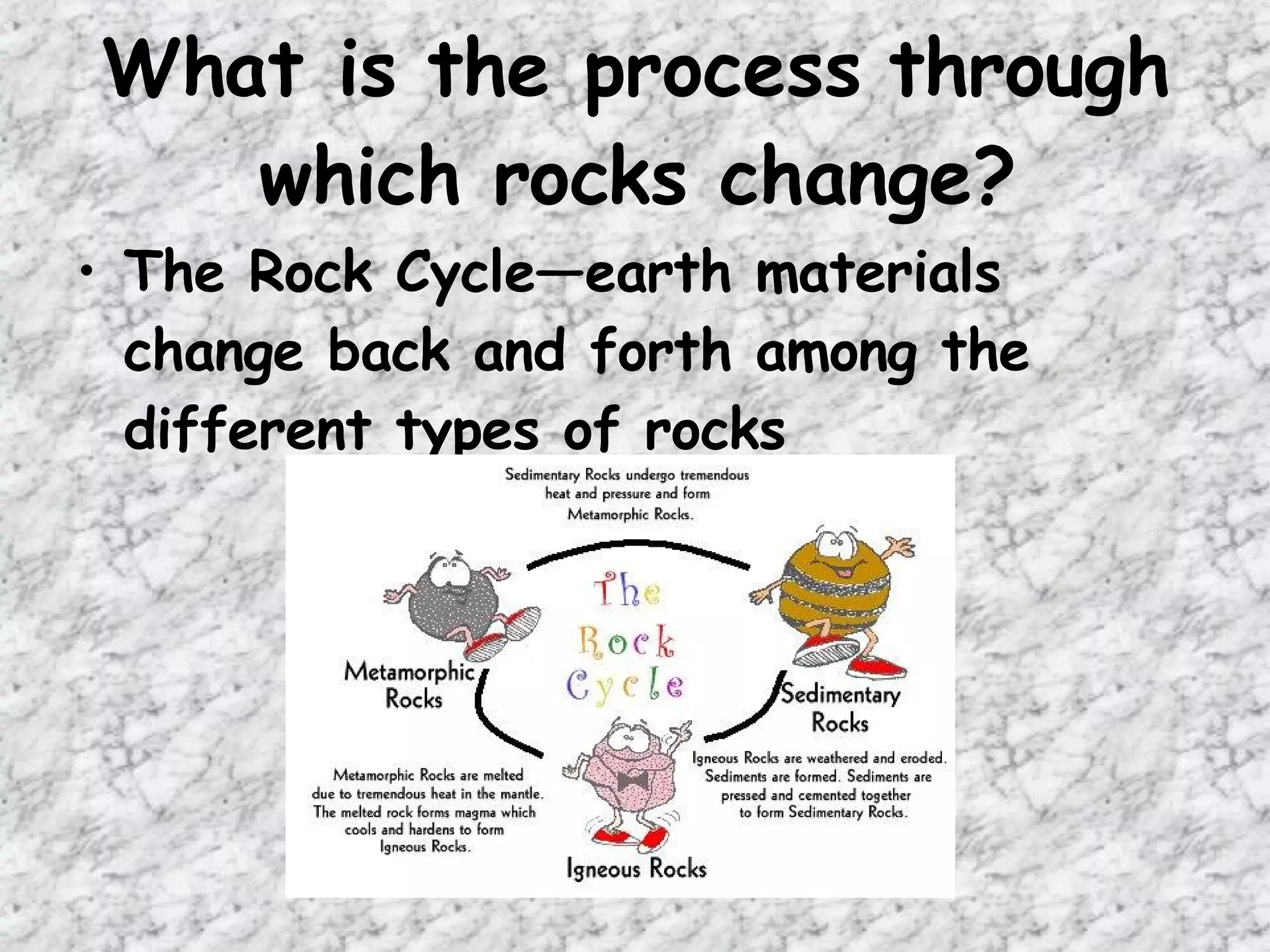
What is the process through which rocks change? The Rock Cycle—earth materials change back and forth among the different types of rocks
 
 
No set path a rock takes to become another kind of rock
Weathering, Erosion, Compaction, Cementation Recrystallization Weathering, Erosion, Compaction, Cementation Recrystallization Melting, Solidification Melting, Solidification IGNEOUS SEDIMENTARY METAMORPHIC
How are rocks redistributed? The core, mantle, & crust are one giant rock  recycling machine
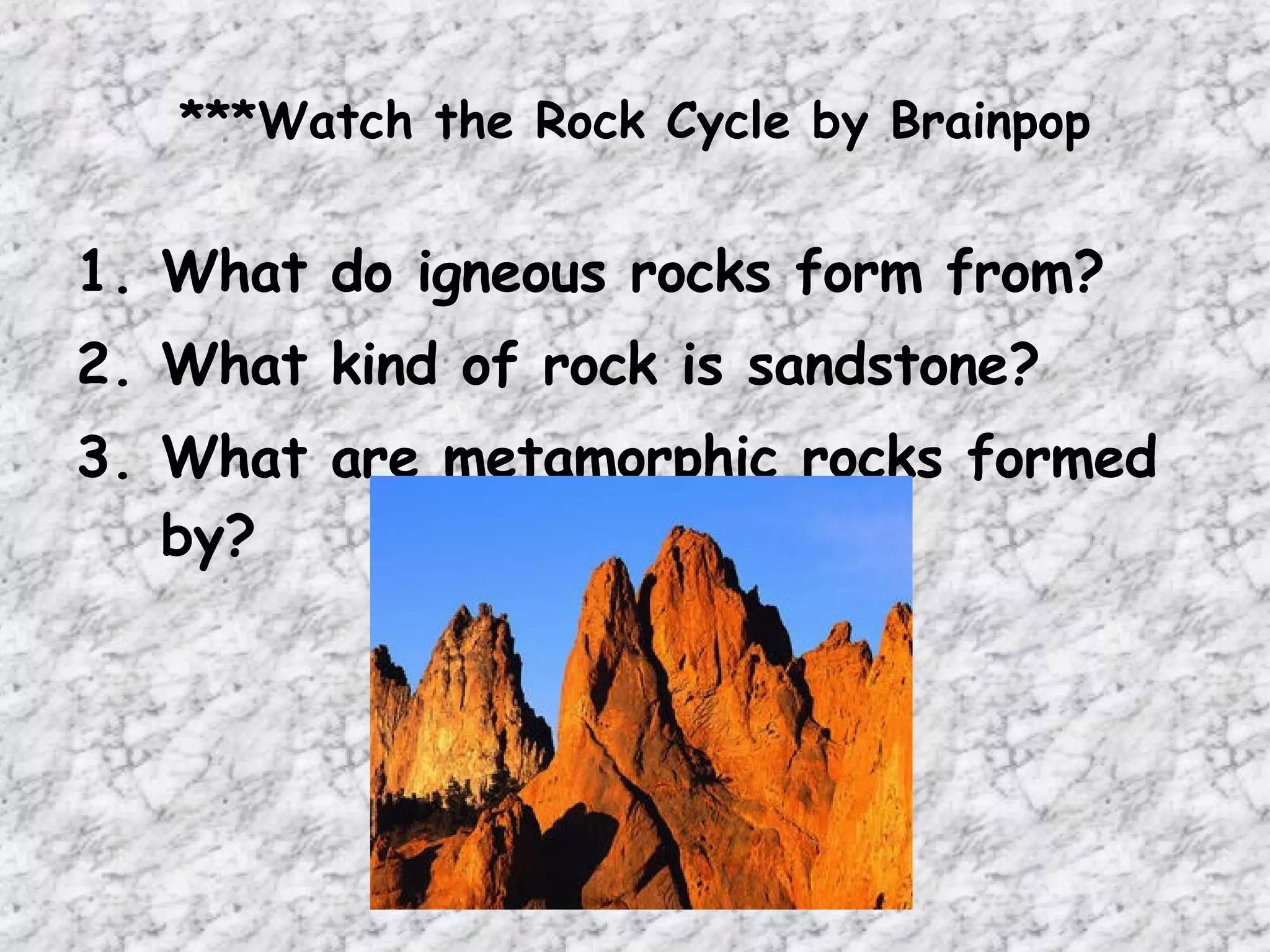
***Watch the Rock Cycle by Brainpop What do igneous rocks form from? What kind of rock is sandstone? What are metamorphic rocks formed by?
“ Ignis” = Latin for “ fire ” Formed from the cooling of either  magma or lava The most  abundant  type of rock Classified according to their  origin  and  composition Igneous Rocks
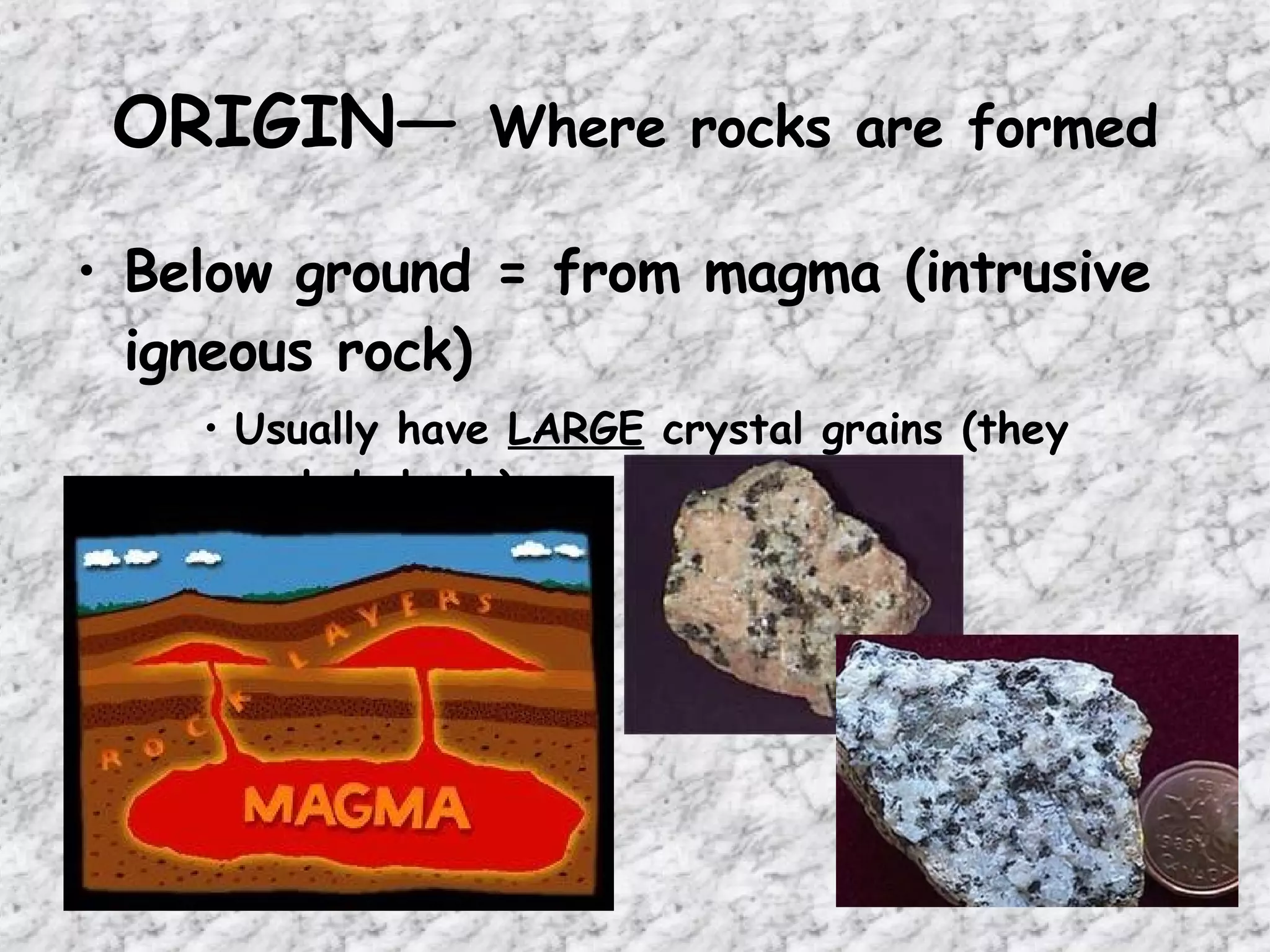
ORIGIN—  Where rocks are formed Below ground = from magma (intrusive igneous rock) Usually have  LARGE  crystal grains (they cooled  slowly )
Some have large & small crystals (called porphyritic)
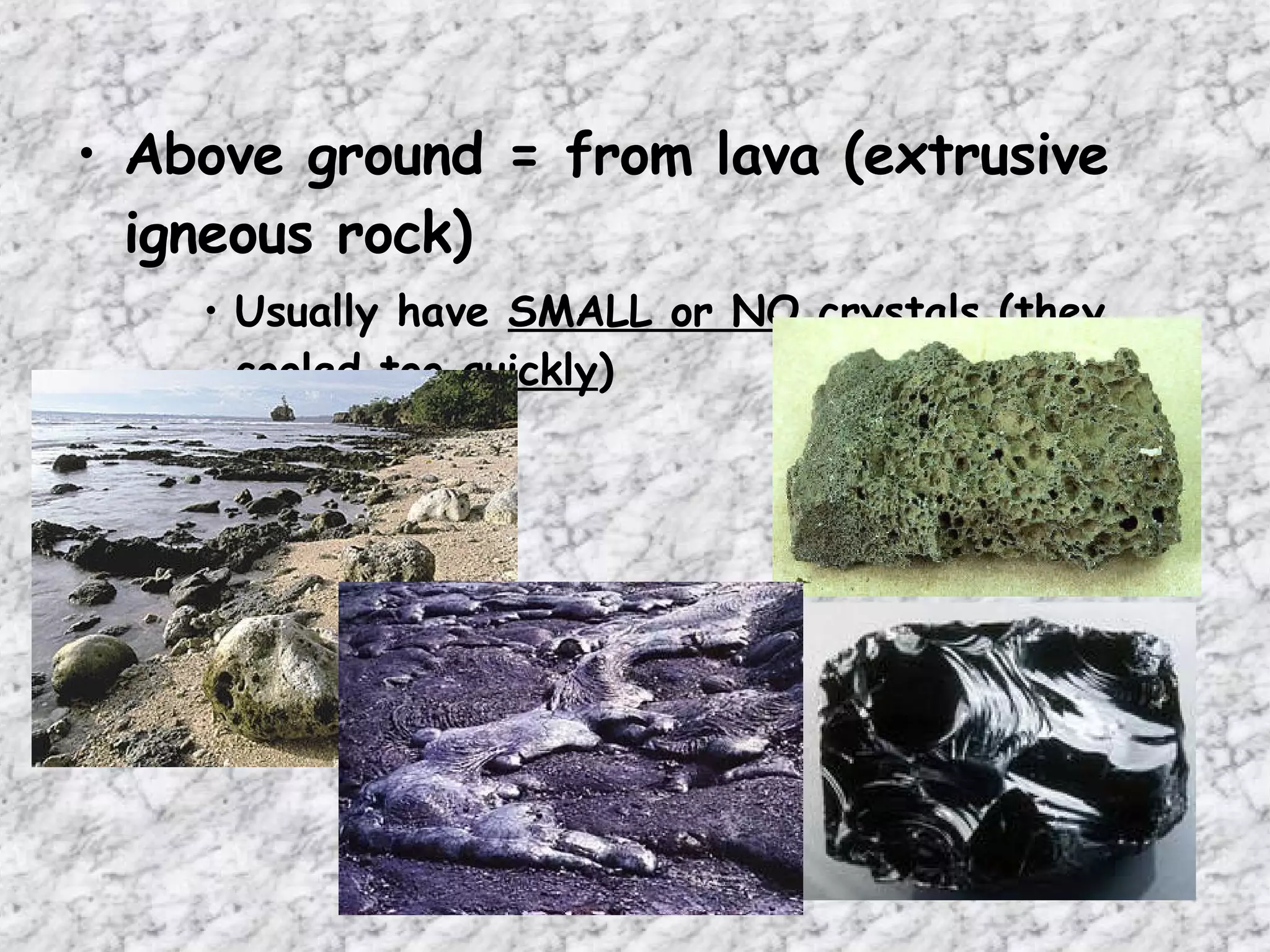
Above ground = from lava (extrusive igneous rock) Usually have  SMALL or NO  crystals (they cooled too  quickly )
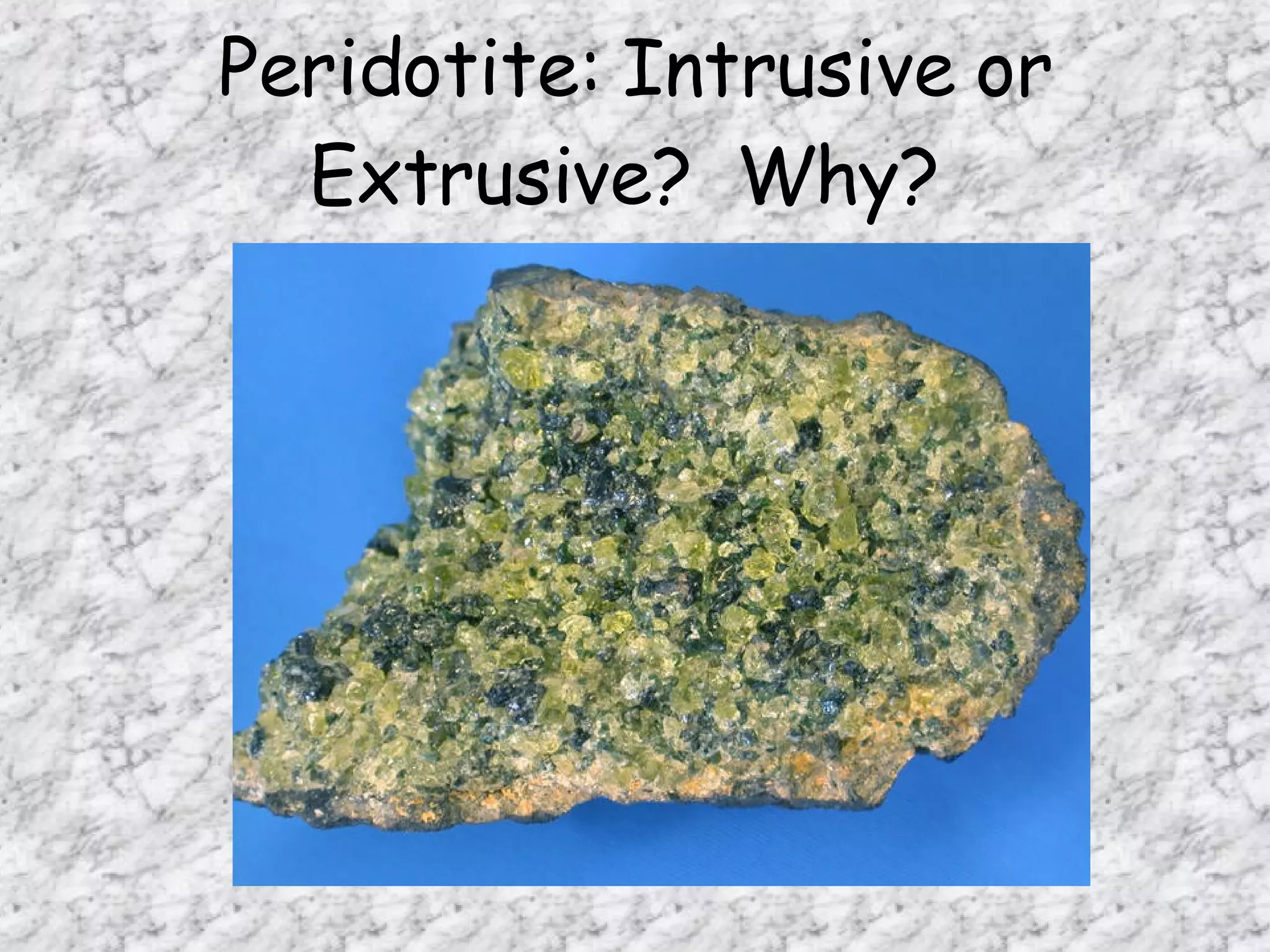
Peridotite: Intrusive or Extrusive?  Why?
Granite: Intrusive or Extrusive?  Why?
Porphyry: Intrusive or Extrusive?  Why?
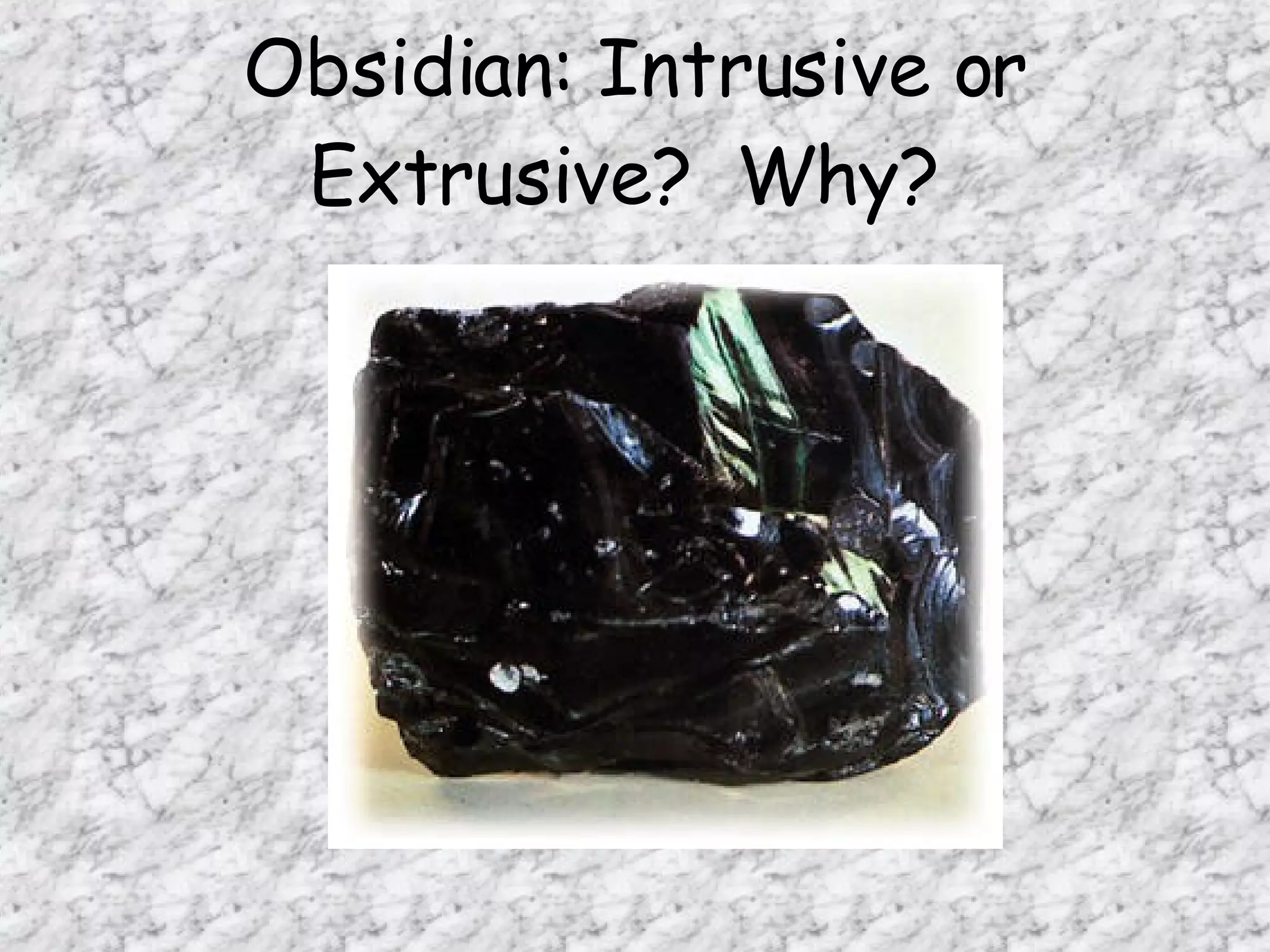
Obsidian: Intrusive or Extrusive?  Why?
COMPOSITION—  What kind of substances the rocks are made of
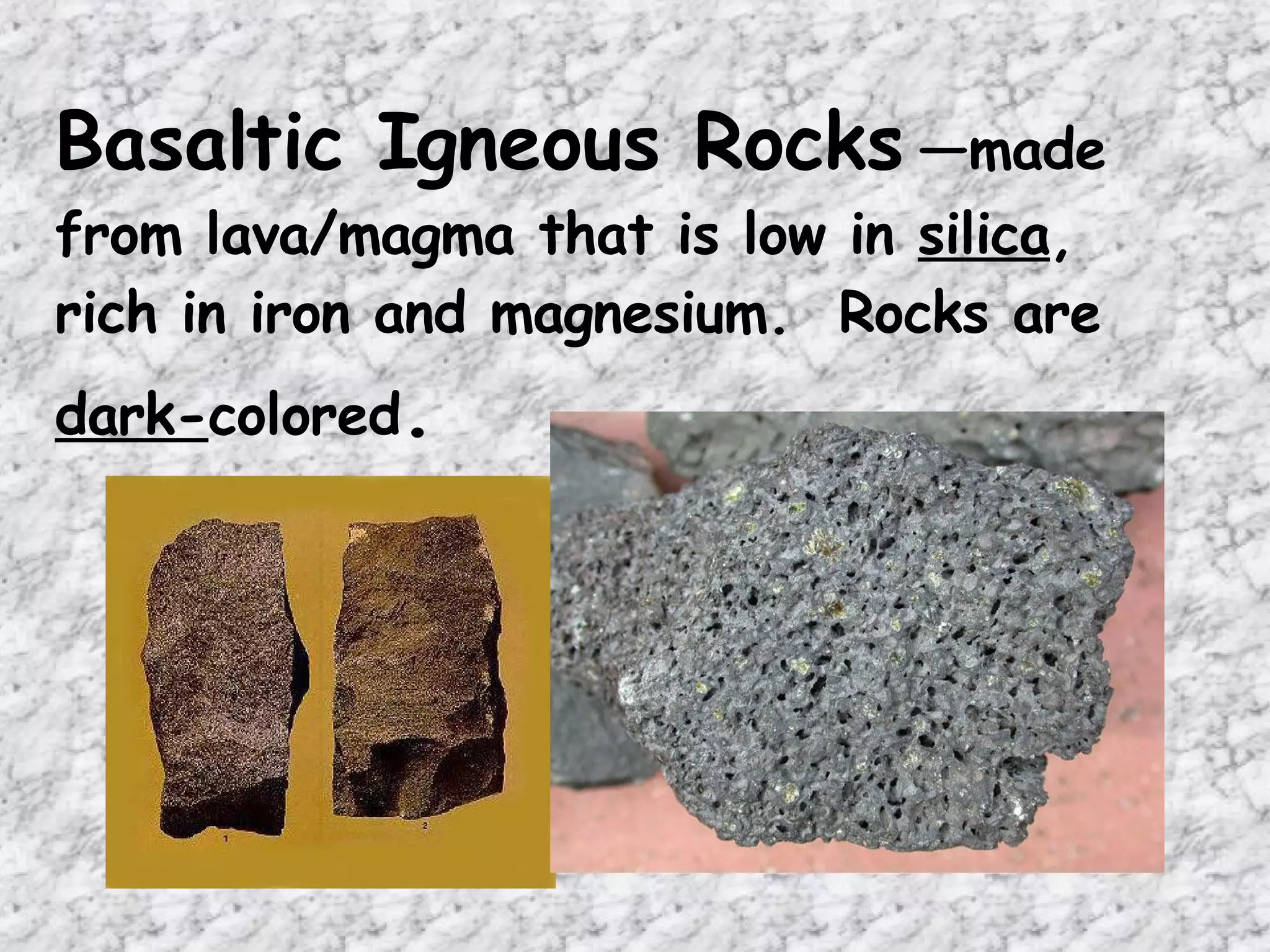
Basaltic Igneous Rocks  —made from lava/magma that is low in  silica , rich in iron and magnesium.  Rocks are  dark- colored .
Granitic Igneous Rocks—made from magma/lava  high  in silica and oxygen.  Rocks are  light -colored.
Andesitic Igneous Rocks—have a composition between basaltic and  granitic .
Diorite
Basalt
Granite
Formed from  sediments  (rock fragments, mineral grains, animal & plant remains) that are pressed or cemented together or when sediments  precipitate  out of a solution. Sedimentary Rocks
These sediments are moved by wind, water, ice or gravity. Sedimentary rocks represent  7%  of the Earth’s crust, but they cover  70%  of the Earth’s surface. Sedimentary rocks are  fossil -carrying rocks. Sedimentary Rocks
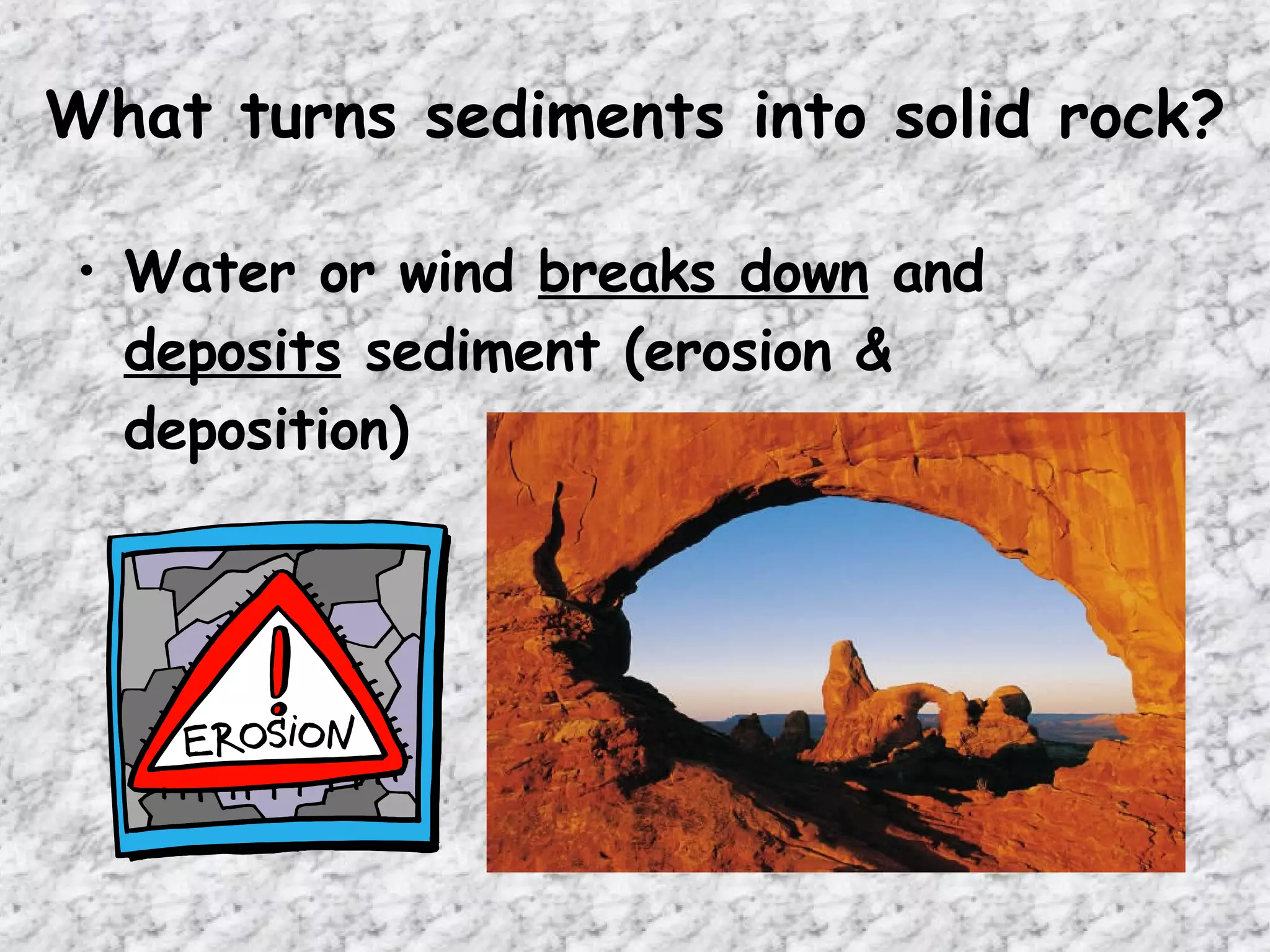
What turns sediments into solid rock? Water or wind  breaks down  and  deposits  sediment (erosion & deposition)
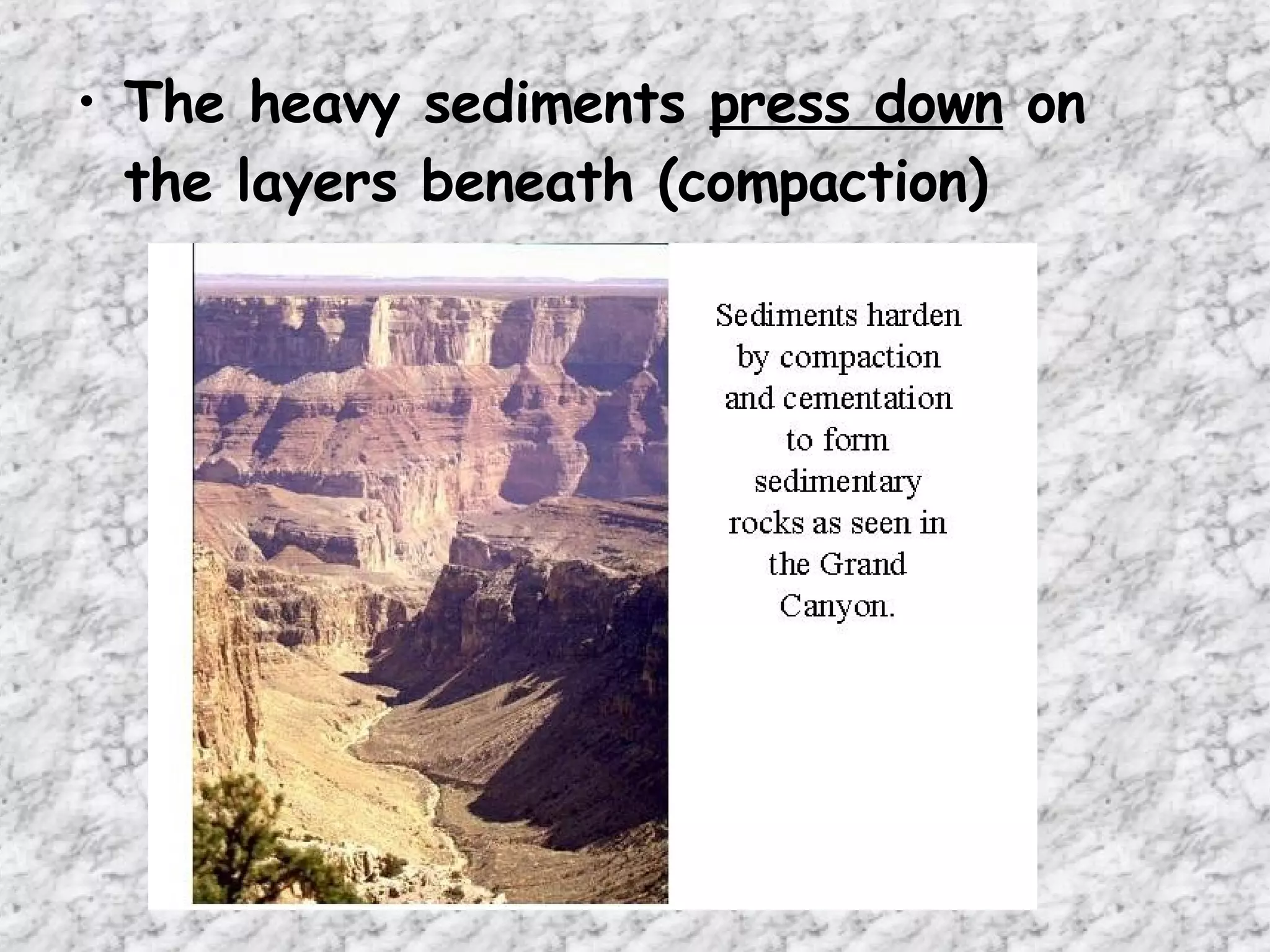
The heavy sediments  press down  on the layers beneath (compaction)
Dissolved minerals flow between the particles and  cement  them together (cementation)
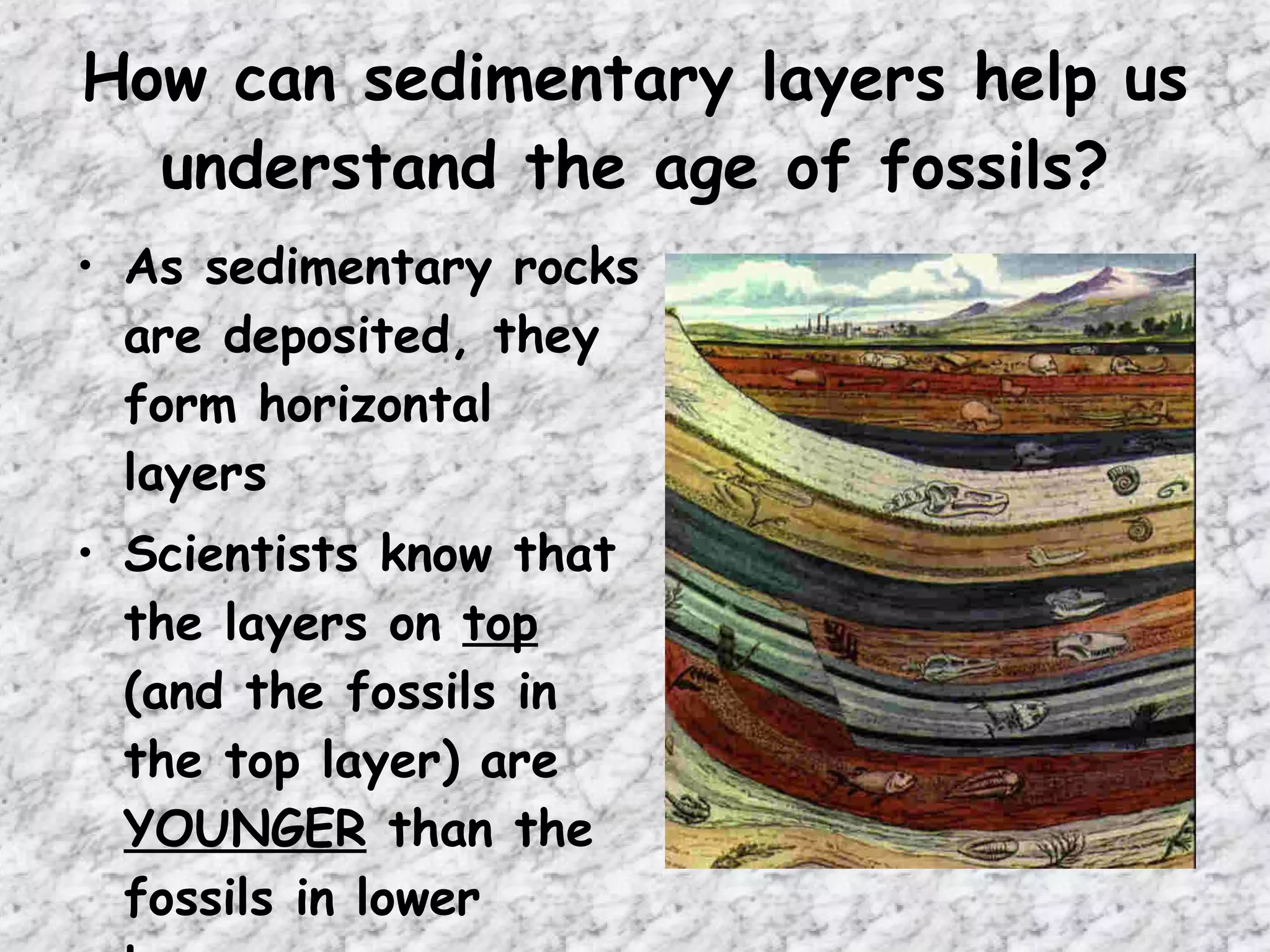
How can sedimentary layers help us understand the age of fossils? As sedimentary rocks are deposited, they form horizontal layers Scientists know that the layers on  top  (and the fossils in the top layer) are  YOUNGER  than the fossils in lower layers.
3 Types of Sedimentary Rocks: Clastic (also called Detrial)—made of  broken  pieces of other rocks
Organic—remains of  plants and animals  are deposited in thick layers Examples Fossil rich limestone is made from the shells of ocean animals; used to make chalk 3 Types of Sedimentary Rocks:
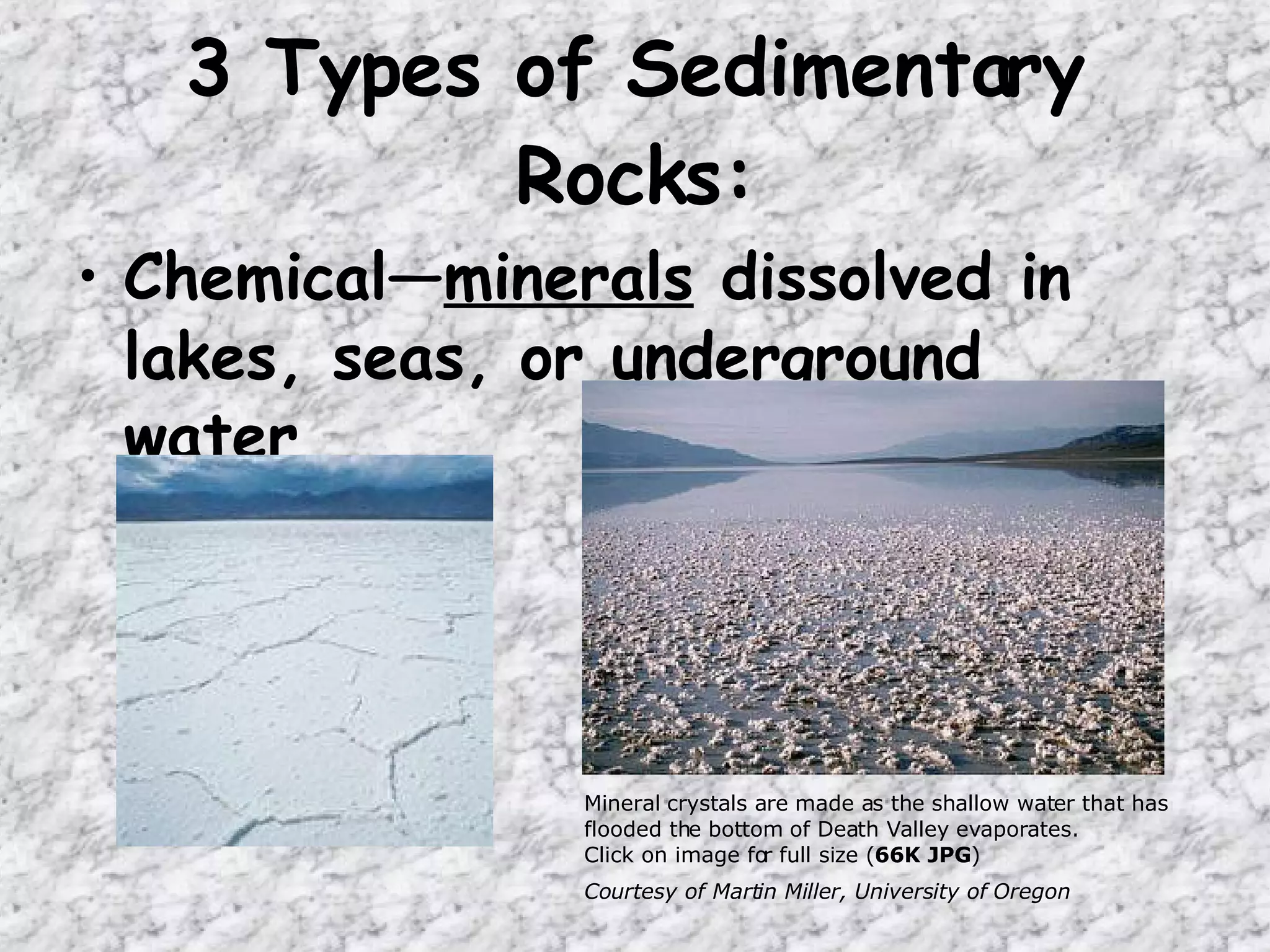
Chemical— minerals  dissolved in lakes, seas, or underground water 3 Types of Sedimentary Rocks: Mineral crystals are made as the shallow water that has flooded the bottom of Death Valley evaporates.  Click on image for full size ( 66K JPG ) Courtesy of Martin Miller, University of Oregon
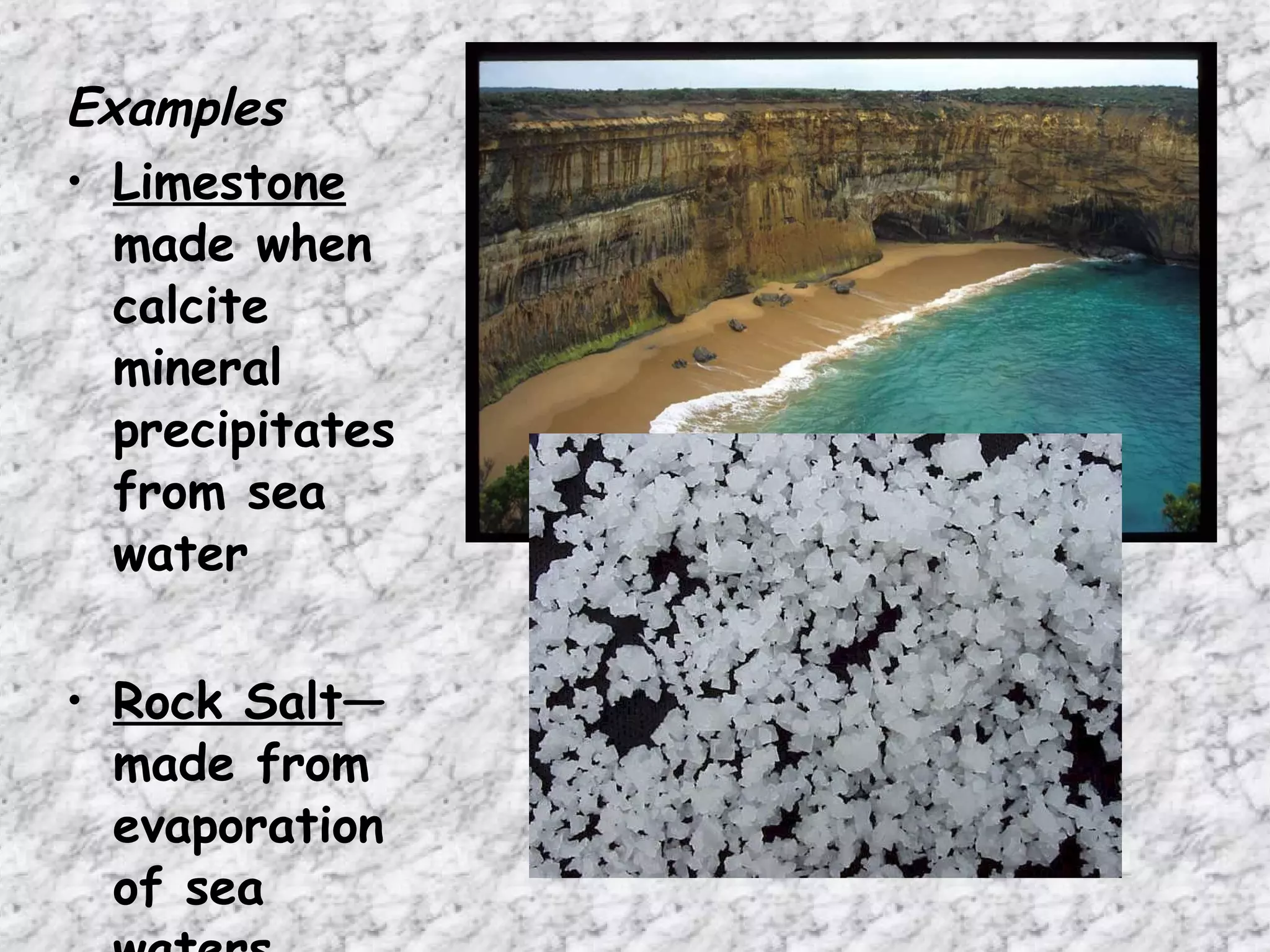
Examples Limestone  made when calcite mineral precipitates from sea water  Rock Salt —made from evaporation of sea waters
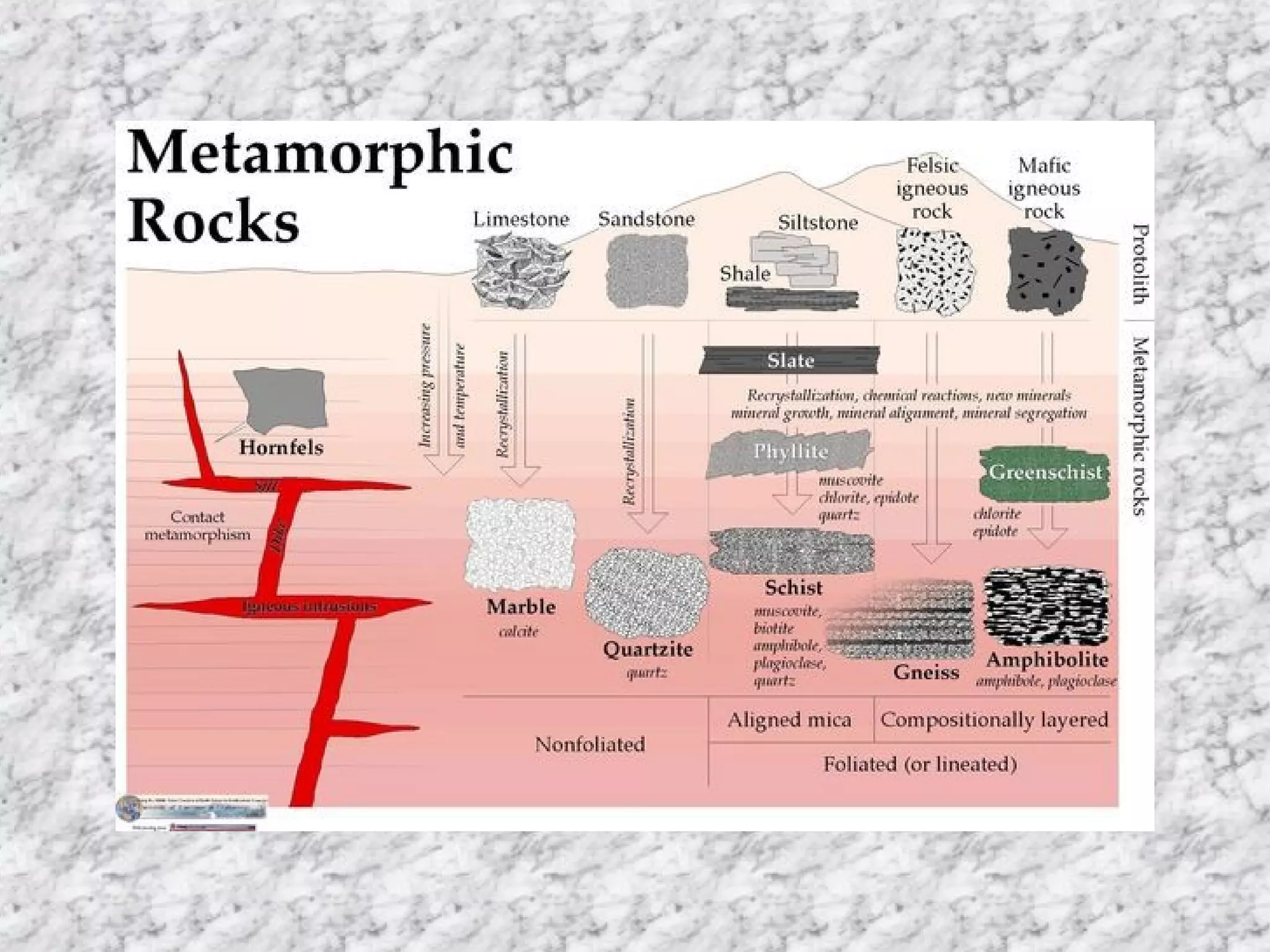
Rocks that have changed due to intense  temperature  and  pressure “ Meta” means “ change ” and morphosis means “ form ” in Greek Igneous, sedimentary and other metamorphic rocks can change to become metamorphic rocks Metamorphic Rocks
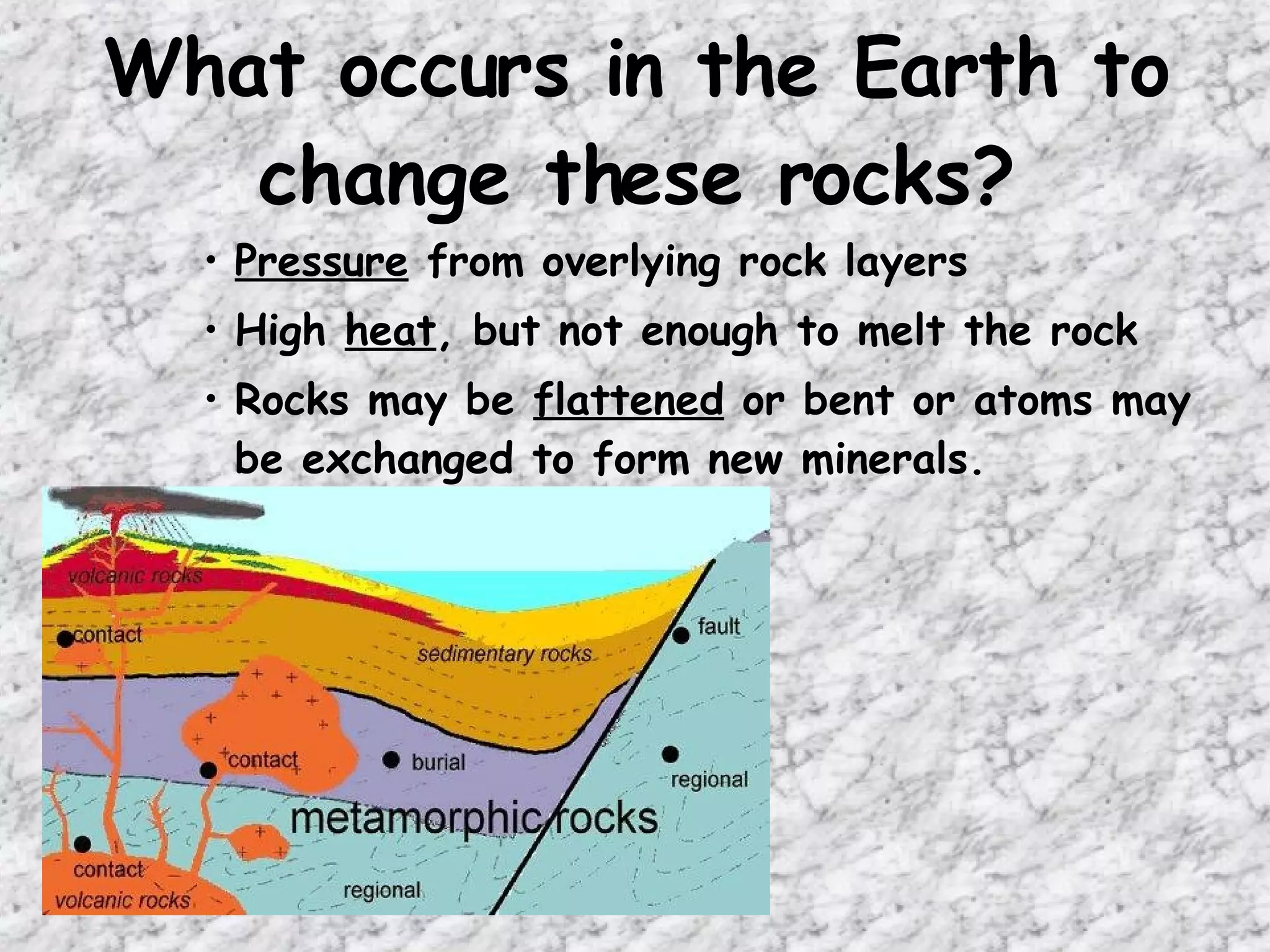
What occurs in the Earth to change these rocks? Pressure  from overlying rock layers High  heat , but not enough to melt the rock Rocks may be  flattened  or bent or atoms may be exchanged to form new minerals.
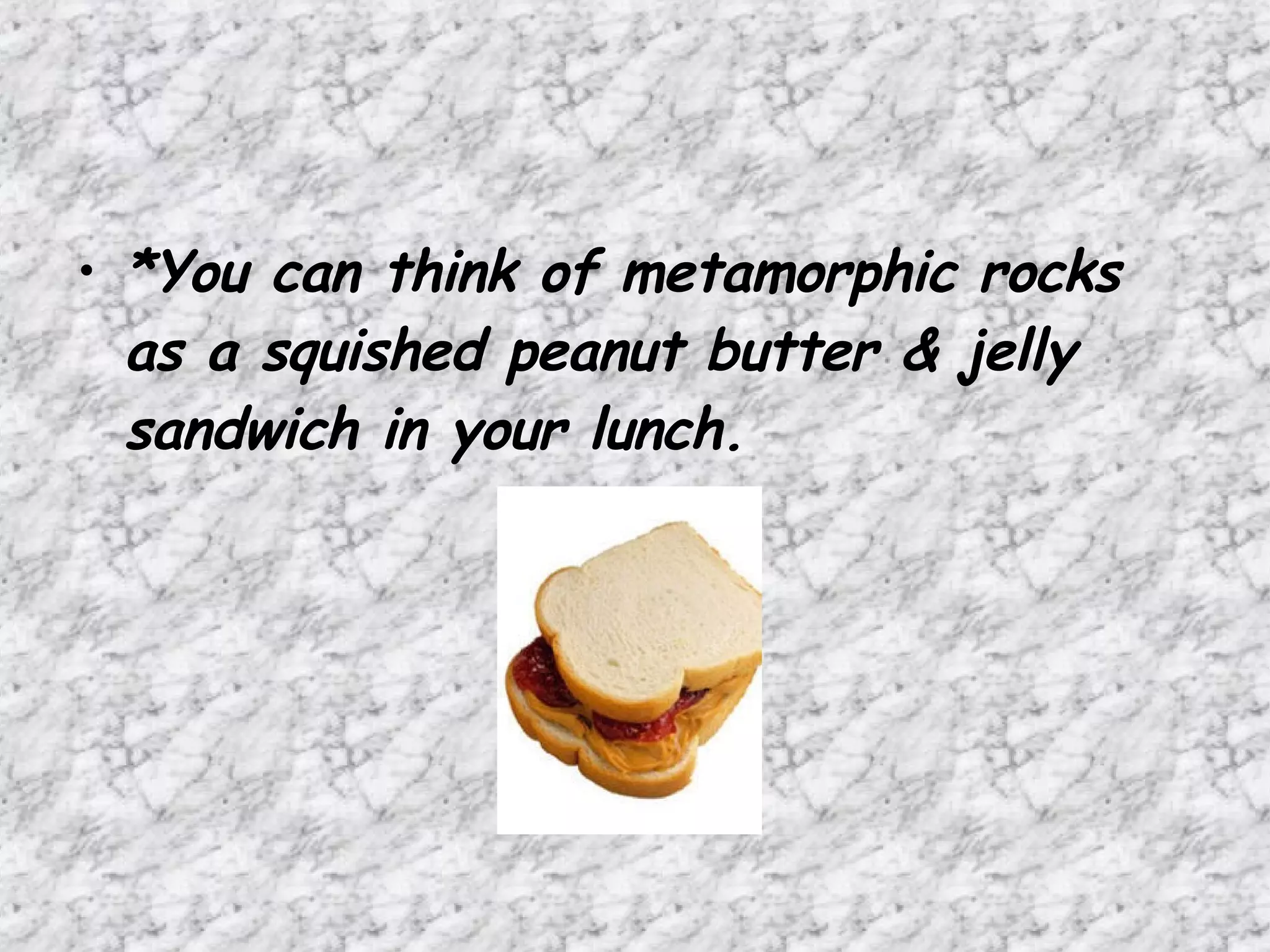
*You can think of metamorphic rocks as a squished peanut butter & jelly sandwich in your lunch.
How are metamorphic rocks classified? Foliated—mineral grains are flattened and line up in parallel  bands Example : gneiss formed from rearrangement of minerals in granite into bands
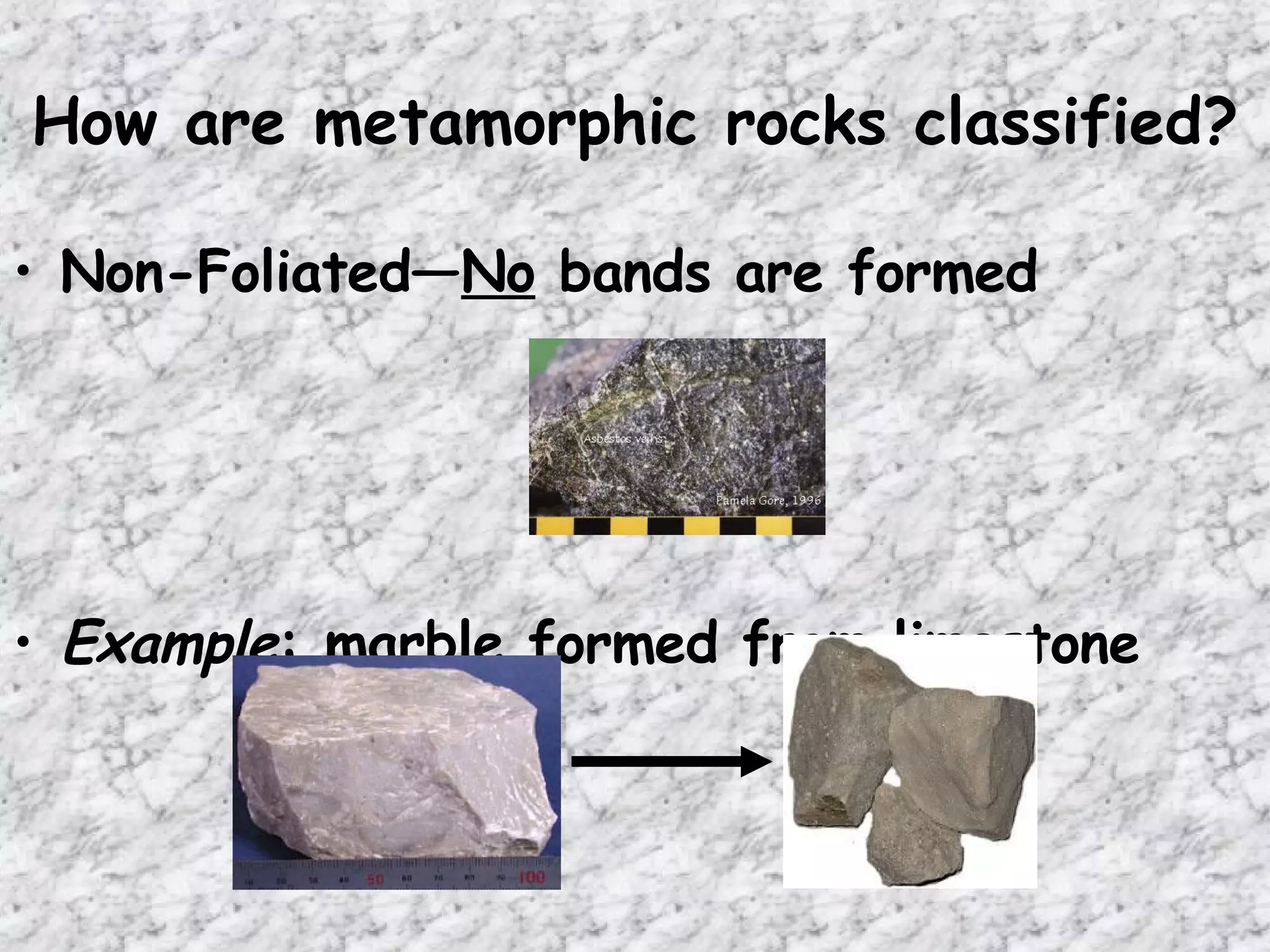
How are metamorphic rocks classified? Non-Foliated— No  bands are formed Example : marble formed from limestone
Where do metamorphic rocks usually form?   Where magma  intrudes  relatively cool rock Near  colliding  plates (near mountain ranges) Places that are covered miles thick with other rock causing pressure When hot water intrudes rock Where a  meteorite  strikes Earth (rare) Where lightning bolts strike rocks (rare)
 

Rocks

  • 1.
  • 2.
    What is aRock? Naturally-occurring mixtures of minerals , mineraloids, glass or organic matter.
  • 3.
    What is aRock? Rocks are divided into 3 groups based on how they were formed: IGNEOUS SEDIMENTARY METAMORPHIC
  • 4.
    What is thedifference between a rock and a mineral? Rocks are made up of ONE or MORE minerals.
  • 5.
    Once a rockis formed, does it stay the same rock forever? NO !
  • 6.
    Rocks are continually changed by many processes, such as weathering, erosion, compaction, cementation, melting, and cooling Rocks can change to and from the three types
  • 7.
    What is theprocess through which rocks change? The Rock Cycle—earth materials change back and forth among the different types of rocks
  • 8.
  • 9.
  • 10.
    No set patha rock takes to become another kind of rock
  • 11.
    Weathering, Erosion, Compaction,Cementation Recrystallization Weathering, Erosion, Compaction, Cementation Recrystallization Melting, Solidification Melting, Solidification IGNEOUS SEDIMENTARY METAMORPHIC
  • 12.
    How are rocksredistributed? The core, mantle, & crust are one giant rock recycling machine
  • 13.
    ***Watch the RockCycle by Brainpop What do igneous rocks form from? What kind of rock is sandstone? What are metamorphic rocks formed by?
  • 14.
    “ Ignis” =Latin for “ fire ” Formed from the cooling of either magma or lava The most abundant type of rock Classified according to their origin and composition Igneous Rocks
  • 15.
    ORIGIN— Whererocks are formed Below ground = from magma (intrusive igneous rock) Usually have LARGE crystal grains (they cooled slowly )
  • 16.
    Some have large& small crystals (called porphyritic)
  • 17.
    Above ground =from lava (extrusive igneous rock) Usually have SMALL or NO crystals (they cooled too quickly )
  • 18.
    Peridotite: Intrusive orExtrusive? Why?
  • 19.
    Granite: Intrusive orExtrusive? Why?
  • 20.
    Porphyry: Intrusive orExtrusive? Why?
  • 21.
    Obsidian: Intrusive orExtrusive? Why?
  • 22.
    COMPOSITION— Whatkind of substances the rocks are made of
  • 23.
    Basaltic Igneous Rocks —made from lava/magma that is low in silica , rich in iron and magnesium. Rocks are dark- colored .
  • 24.
    Granitic Igneous Rocks—madefrom magma/lava high in silica and oxygen. Rocks are light -colored.
  • 25.
    Andesitic Igneous Rocks—havea composition between basaltic and granitic .
  • 26.
  • 27.
  • 28.
  • 29.
    Formed from sediments (rock fragments, mineral grains, animal & plant remains) that are pressed or cemented together or when sediments precipitate out of a solution. Sedimentary Rocks
  • 30.
    These sediments aremoved by wind, water, ice or gravity. Sedimentary rocks represent 7% of the Earth’s crust, but they cover 70% of the Earth’s surface. Sedimentary rocks are fossil -carrying rocks. Sedimentary Rocks
  • 31.
    What turns sedimentsinto solid rock? Water or wind breaks down and deposits sediment (erosion & deposition)
  • 32.
    The heavy sediments press down on the layers beneath (compaction)
  • 33.
    Dissolved minerals flowbetween the particles and cement them together (cementation)
  • 34.
    How can sedimentarylayers help us understand the age of fossils? As sedimentary rocks are deposited, they form horizontal layers Scientists know that the layers on top (and the fossils in the top layer) are YOUNGER than the fossils in lower layers.
  • 35.
    3 Types ofSedimentary Rocks: Clastic (also called Detrial)—made of broken pieces of other rocks
  • 36.
    Organic—remains of plants and animals are deposited in thick layers Examples Fossil rich limestone is made from the shells of ocean animals; used to make chalk 3 Types of Sedimentary Rocks:
  • 37.
    Chemical— minerals dissolved in lakes, seas, or underground water 3 Types of Sedimentary Rocks: Mineral crystals are made as the shallow water that has flooded the bottom of Death Valley evaporates. Click on image for full size ( 66K JPG ) Courtesy of Martin Miller, University of Oregon
  • 38.
    Examples Limestone made when calcite mineral precipitates from sea water Rock Salt —made from evaporation of sea waters
  • 39.
    Rocks that havechanged due to intense temperature and pressure “ Meta” means “ change ” and morphosis means “ form ” in Greek Igneous, sedimentary and other metamorphic rocks can change to become metamorphic rocks Metamorphic Rocks
  • 40.
    What occurs inthe Earth to change these rocks? Pressure from overlying rock layers High heat , but not enough to melt the rock Rocks may be flattened or bent or atoms may be exchanged to form new minerals.
  • 41.
    *You can thinkof metamorphic rocks as a squished peanut butter & jelly sandwich in your lunch.
  • 42.
    How are metamorphicrocks classified? Foliated—mineral grains are flattened and line up in parallel bands Example : gneiss formed from rearrangement of minerals in granite into bands
  • 43.
    How are metamorphicrocks classified? Non-Foliated— No bands are formed Example : marble formed from limestone
  • 44.
    Where do metamorphicrocks usually form? Where magma intrudes relatively cool rock Near colliding plates (near mountain ranges) Places that are covered miles thick with other rock causing pressure When hot water intrudes rock Where a meteorite strikes Earth (rare) Where lightning bolts strike rocks (rare)
  • 45.