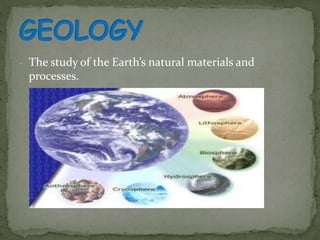
- The study of the Earth’s natural materials and
processes.
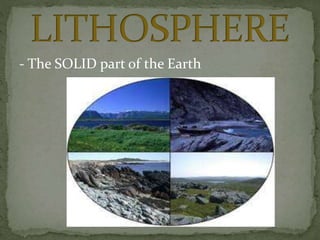
- The SOLID part of the Earth
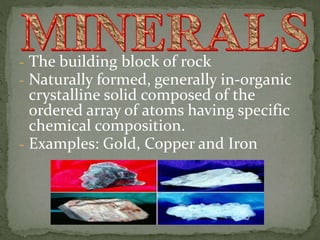
- The building block of rock
- Naturally formed, generally in-organic
crystalline solid composed of the
ordered array of atoms having specific
chemical composition.
- Examples: Gold, Copper and Iron
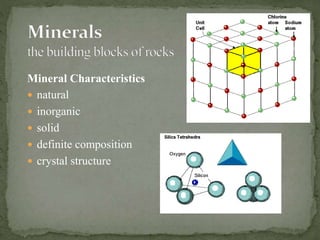
Mineral Characteristics
 natural
 inorganic
 solid
 definite composition
 crystal structure
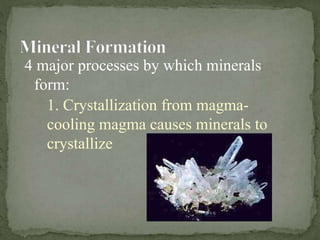
4 major processes by which minerals
form:
1. Crystallization from magma-
cooling magma causes minerals to
crystallize
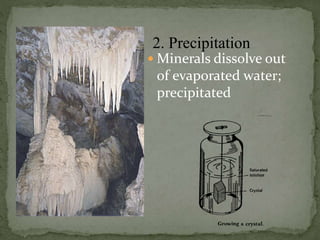
2. Precipitation
 Minerals dissolve out
of evaporated water;
precipitated
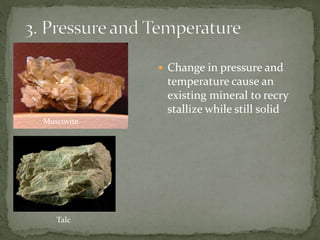
 Change in pressure and
temperature cause an
existing mineral to recry
stallize while still solid
Muscovite
Talc
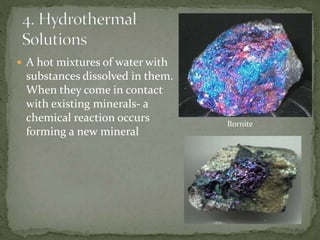
 A hot mixtures of water with
substances dissolved in them.
When they come in contact
with existing minerals- a
chemical reaction occurs
forming a new mineral
Bornite
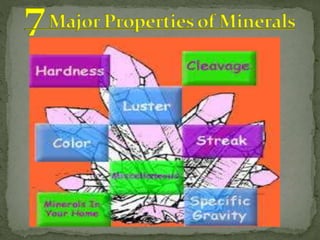
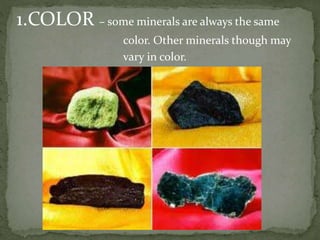
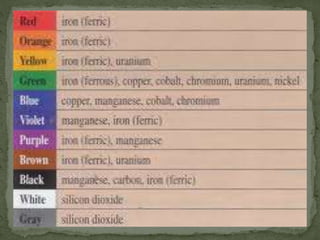
1.COLOR – some minerals are always the same
color. Other minerals though may
vary in color.
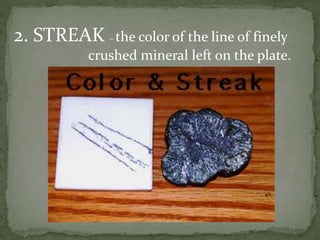
2. STREAK – the color of the line of finely
crushed mineral left on the plate.
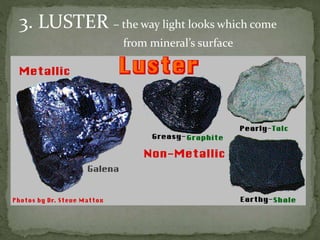
3. LUSTER – the way light looks which come
from mineral’s surface
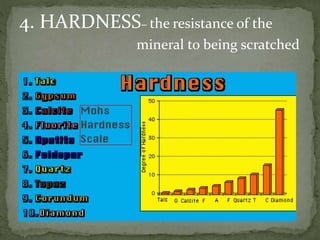
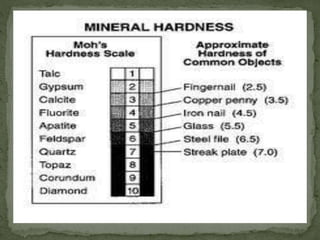
4. HARDNESS– the resistance of the
mineral to being scratched
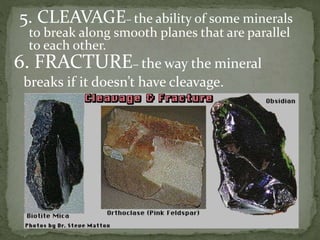
5. CLEAVAGE– the ability of some minerals
to break along smooth planes that are parallel
to each other.
6. FRACTURE– the way the mineral
breaks if it doesn’t have cleavage.
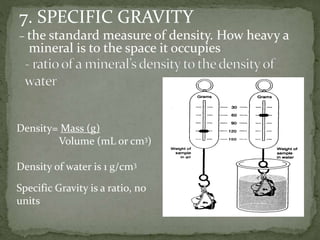
7. SPECIFIC GRAVITY
– the standard measure of density. How heavy a
mineral is to the space it occupies
Density= Mass (g)

Volume (mL or cm3)
Density of water is 1 g/cm3
Specific Gravity is a ratio, no
units
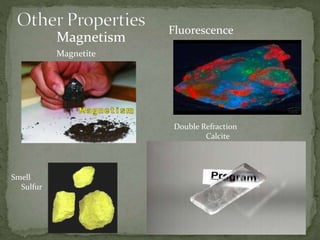
Magnetism
Magnetite
Fluorescence
Double Refraction
Calcite
Smell
Sulfur
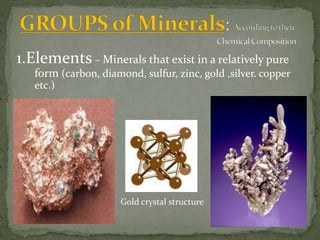
1.Elements – Minerals that exist in a relatively pure
form (carbon, diamond, sulfur, zinc, gold ,silver. copper
etc.)
Gold crystal structure
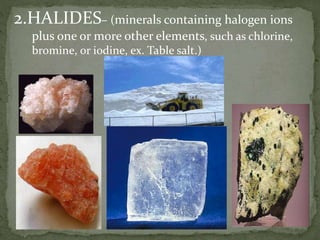
2.HALIDES– (minerals containing halogen ions
plus one or more other elements, such as chlorine,
bromine, or iodine, ex. Table salt.)
3.OXIDES– (Minerals that contain oxygen and one
or more other element(s), ex. Hematite[iron oxide].)
4.SULFIDES– (Minerals containing sulfur, ex.
pyrite[iron sulfide], galena [lead sulfide].)
Gypsum Pyrite
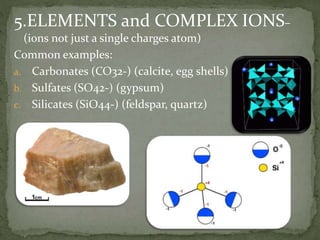
5.ELEMENTS and COMPLEX IONS–
(ions not just a single charges atom)
Common examples:
a. Carbonates (CO32-) (calcite, egg shells)
b. Sulfates (SO42-) (gypsum)
c. Silicates (SiO44-) (feldspar, quartz)
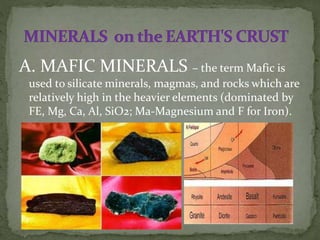
A. MAFIC MINERALS – the term Mafic is
used to silicate minerals, magmas, and rocks which are
relatively high in the heavier elements (dominated by
FE, Mg, Ca, Al, SiO2; Ma-Magnesium and F for Iron).
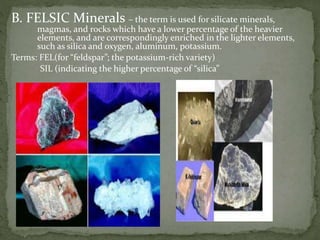
B. FELSIC Minerals – the term is used for silicate minerals,
magmas, and rocks which have a lower percentage of the heavier
elements, and are correspondingly enriched in the lighter elements,
such as silica and oxygen, aluminum, potassium.
Terms: FEL(for “feldspar”; the potassium-rich variety)
SIL (indicating the higher percentage of “silica”
-
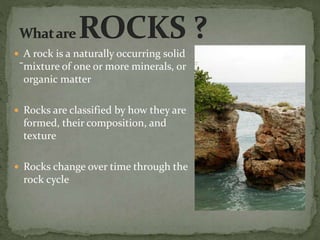
 A rock is a naturally occurring solid
mixture of one or more minerals, or
organic matter
 Rocks are classified by how they are
formed, their composition, and
texture
 Rocks change over time through the
rock cycle
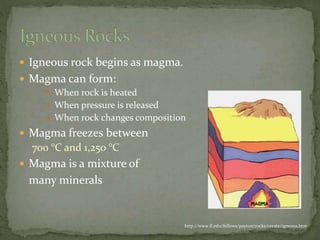
 Igneous rock begins as magma.
 Magma can form:
 When rock is heated
 When pressure is released
 When rock changes composition
 Magma freezes between
700 °C and 1,250 °C
 Magma is a mixture of
many minerals
http://www.fi.edu/fellows/payton/rocks/create/igneous.htm
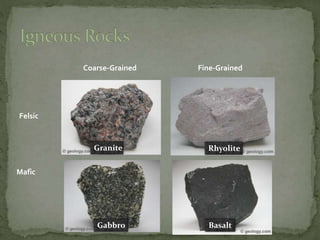
 Felsic: light colored rocks that are rich in elements
such as aluminum, potassium, silicon, and sodium
 Mafic: dark colored rocks that are rich in calcium,
iron, and magnesium, poor in silicon
 Coarse-grained: takes longer to cool, giving mineral
crystals more time to grow
 Fine-grained: cools quickly with little to no crystals
Felsic
Mafic
Coarse-Grained Fine-Grained
Granite
Gabbro Basalt
Rhyolite
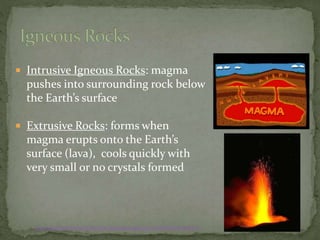
 Intrusive Igneous Rocks: magma
pushes into surrounding rock below
the Earth’s surface
 Extrusive Rocks: forms when
magma erupts onto the Earth’s
surface (lava), cools quickly with
very small or no crystals formed
http://www.windows.ucar.edu/tour/link=/earth/geology/ig_intrusive.html&edu=high&fr=t
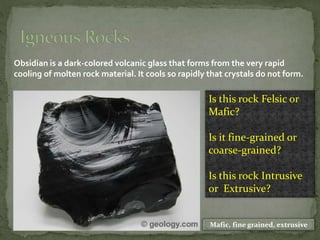
Obsidian is a dark-colored volcanic glass that forms from the very rapid
cooling of molten rock material. It cools so rapidly that crystals do not form.
Is this rock Felsic or
Mafic?
Is it fine-grained or
coarse-grained?
Is this rock Intrusive
or Extrusive?
Mafic, fine grained, extrusive
http://www.fi.edu/fellows/payton/rocks/create/sediment.ht
m
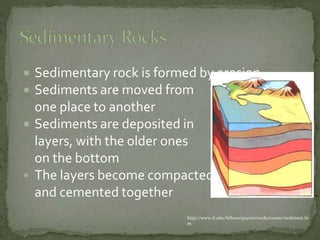
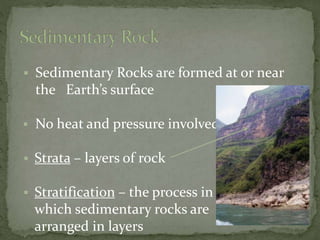
 Sedimentary rock is formed by erosion
 Sediments are moved from
one place to another
 Sediments are deposited in
layers, with the older ones
on the bottom
 The layers become compacted
and cemented together
 Sedimentary Rocks are formed at or near
the Earth’s surface
 No heat and pressure involved
 Strata – layers of rock
 Stratification – the process in
which sedimentary rocks are
arranged in layers
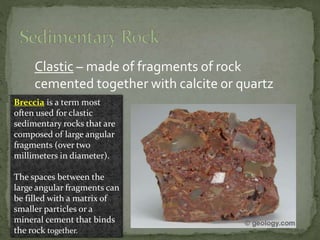
Clastic – made of fragments of rock
cemented together with calcite or quartz
Breccia is a term most
often used for clastic
sedimentary rocks that are
composed of large angular
fragments (over two
millimeters in diameter).
The spaces between the
large angular fragments can
be filled with a matrix of
smaller particles or a
mineral cement that binds
the rock together.
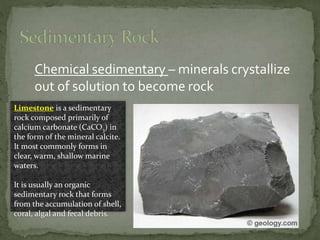
Chemical sedimentary – minerals crystallize
out of solution to become rock
Limestone is a sedimentary
rock composed primarily of
calcium carbonate (CaCO3) in
the form of the mineral calcite.
It most commonly forms in
clear, warm, shallow marine
waters.
It is usually an organic
sedimentary rock that forms
from the accumulation of shell,
coral, algal and fecal debris.
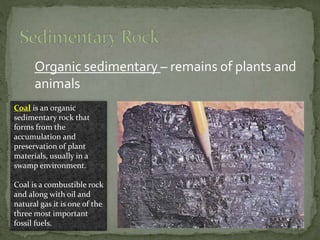
Organic sedimentary – remains of plants and
animals
Coal is an organic
sedimentary rock that
forms from the
accumulation and
preservation of plant
materials, usually in a
swamp environment.
Coal is a combustible rock
and along with oil and
natural gas it is one of the
three most important
fossil fuels.
http://www.fi.edu/fellows/payton/rocks/create/metamorph.ht
m
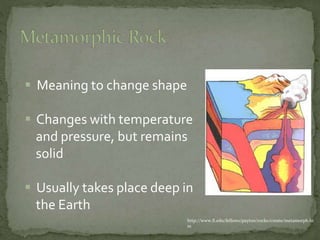
 Meaning to change shape
 Changes with temperature
and pressure, but remains
solid
 Usually takes place deep in
the Earth
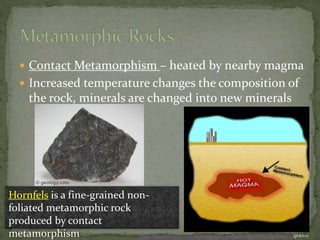
 Contact Metamorphism – heated by nearby magma
 Increased temperature changes the composition of
the rock, minerals are changed into new minerals
Hornfels is a fine-grained non-
foliated metamorphic rock
produced by contact
metamorphism http://www.windows.ucar.edu/tour/link=/earth/geology/meta_contact.html&edu=h igh&fr=t
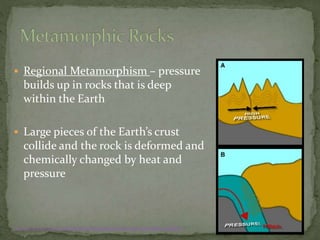
 Regional Metamorphism – pressure
builds up in rocks that is deep
within the Earth
 Large pieces of the Earth’s crust
collide and the rock is deformed and
chemically changed by heat and
pressure
http://www.windows.ucar.edu/tour/link=/earth/geology/meta_regional.html&edu=high&fr=t
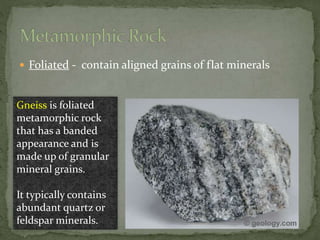
 Foliated - contain aligned grains of flat minerals
Gneiss is foliated
metamorphic rock
that has a banded
appearance and is
made up of granular
mineral grains.
It typically contains
abundant quartz or
feldspar minerals.
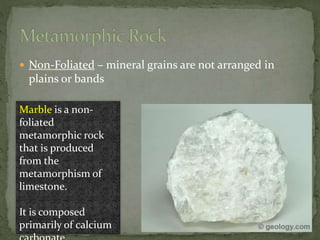
 Non-Foliated – mineral grains are not arranged in
plains or bands
Marble is a non-
foliated
metamorphic rock
that is produced
from the
metamorphism of
limestone.
It is composed
primarily of calcium
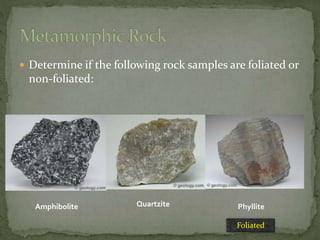
 Determine if the following rock samples are foliated or
non-foliated:
Amphibolite Quartzite Phyllite
Foliated
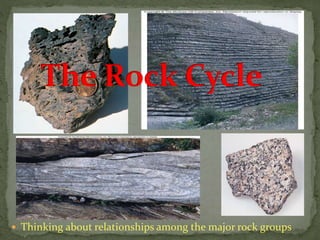
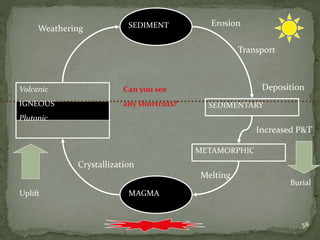
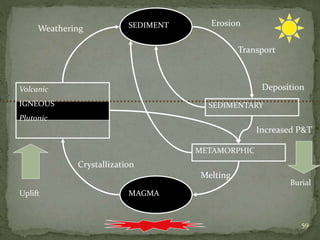
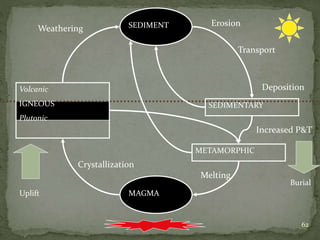
 Thinking about relationships among the major rock groups
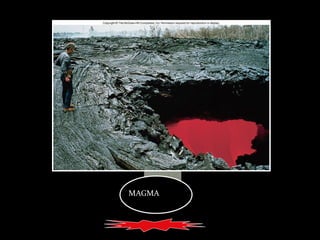
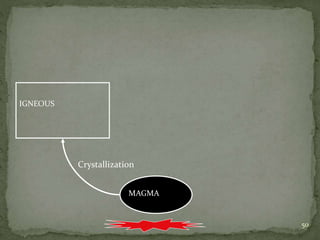
MAGMA
50
MAGMA
Crystallization
IGNEOUS
51
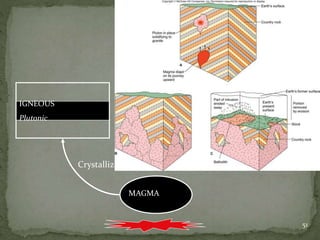
MAGMA
IGNEOUS
Plutonic
Crystallization
52
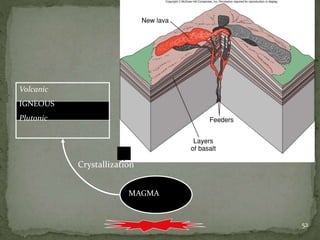
MAGMA
Volcanic
IGNEOUS
Plutonic
Crystallization
53
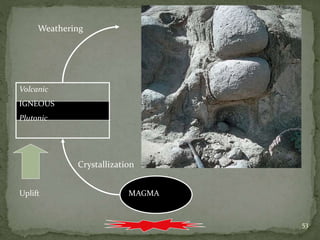
MAGMA
Volcanic
IGNEOUS
Plutonic
Uplift
Crystallization
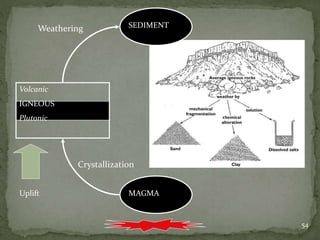
Weathering
54
MAGMA
Volcanic
IGNEOUS
Plutonic
SEDIMENT
Uplift
Crystallization
Weathering SEDIMENT
55
MAGMA
Volcanic
IGNEOUS
Plutonic
SEDIMENT
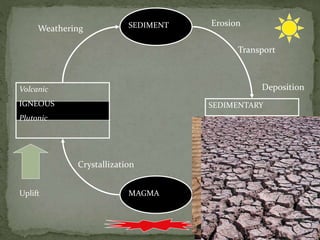
SEDIMENTARY
Uplift
Crystallization
Weathering
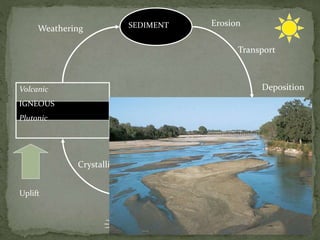
Erosion
Transport
Deposition
56
MAGMA
Volcanic
IGNEOUS
Plutonic
SEDIMENT
SEDIMENTARY
Uplift
Crystallization
Weathering
Erosion
Transport
Deposition
57
MAGMA
Volcanic
IGNEOUS
Plutonic
SEDIMENT
SEDIMENTARY
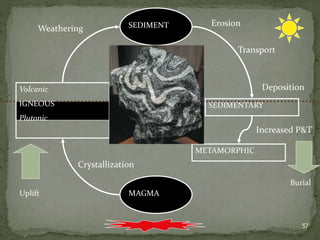
METAMORPHIC
Uplift
Burial
Increased P&T
Crystallization
Weathering
Erosion
Transport
Deposition
58
MAGMA
Volcanic
IGNEOUS
Plutonic
SEDIMENT
SEDIMENTARY
METAMORPHIC
Uplift
Burial
Increased P&T
Melting
Crystallization
Weathering
Erosion
Transport
DepositionCan you see
any shortcuts?
59
MAGMA
Volcanic
IGNEOUS
Plutonic
SEDIMENT
SEDIMENTARY
METAMORPHIC
Uplift
Burial
Increased P&T
Melting
Crystallization
Weathering
Erosion
Transport
Deposition
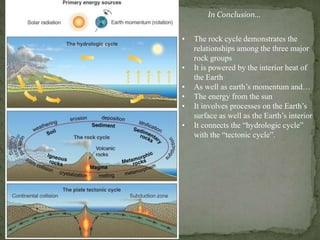
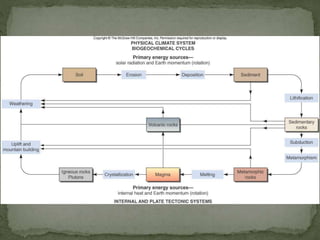
• The rock cycle demonstrates the
relationships among the three major
rock groups
• It is powered by the interior heat of
the Earth
• As well as earth’s momentum and…
• The energy from the sun
• It involves processes on the Earth’s
surface as well as the Earth’s interior
• It connects the “hydrologic cycle”
with the “tectonic cycle”.
In Conclusion…
62
MAGMA
Volcanic
IGNEOUS
Plutonic
SEDIMENT
SEDIMENTARY
METAMORPHIC
Uplift
Burial
Increased P&T
Melting
Crystallization
Weathering
Erosion
Transport
Deposition
Earth Science

Earth Science