 Contacts:
• Normal depositional contact.
• Intrusive contact.
• Fault contact.
• Unconformable contact.
Contact:
• A surface that separate geological unit
including primary boundaries such as
depositional contact, all kind of
unconformity, intrusive contact, as well as
fault that separate geologic unit.
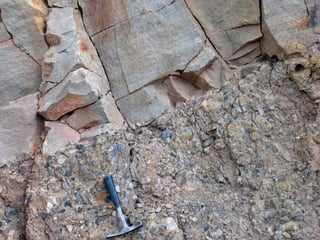
• Normal depositional contact:
• lithogenetic contact at which a
sedimentary or volcanic rock has been
deposite on another rock. The relation
between older and younger rock is
unknown.
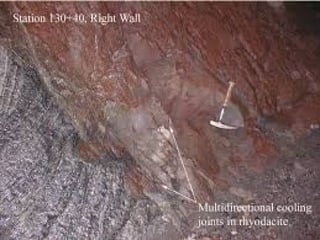
• Intrusive contact:
• An intrusive contact between younger
igneous rock and an older pre-existing
geological unit into which it has een
intruded.
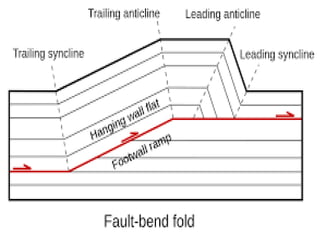
• Fault contact:
• A contact separating two bodies of material
across which one body has slide past the
other.
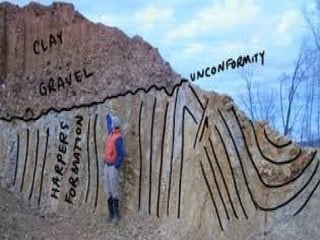
• Unconformable contact:
• The contact in which older and younger
rock unit is parallel to each other but it is
marked by irregular or uneven surface.
 Unconformity:
• Introduction.
• Type of unconformity.
Unconformity
• It is one of the most common geological
feature found in rocks or in succession.
• It is different then all other geological
structures viz. the fold, joints and faults
• Unconformities are resulted due to tectonic
activity in form of uplift or subsidence of
land
• It is referred to a period of non-deposition
Types of Unconformities
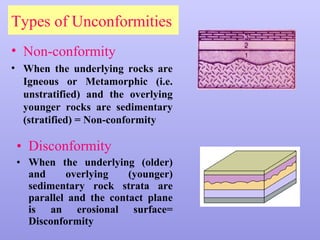
• Non-conformity
• When the underlying rocks are
Igneous or Metamorphic (i.e.
unstratified) and the overlying
younger rocks are sedimentary
(stratified) = Non-conformity
• Disconformity
• When the underlying (older)
and overlying (younger)
sedimentary rock strata are
parallel and the contact plane
is an erosional surface=
Disconformity
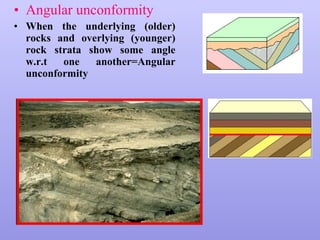
• Angular unconformity
• When the underlying (older)
rocks and overlying (younger)
rock strata show some angle
w.r.t one another=Angular
unconformity
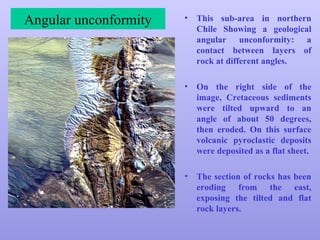
Angular unconformity • This sub-area in northern
Chile Showing a geological
angular unconformity: a
contact between layers of
rock at different angles.
• On the right side of the
image, Cretaceous sediments
were tilted upward to an
angle of about 50 degrees,
then eroded. On this surface
volcanic pyroclastic deposits
were deposited as a flat sheet.
• The section of rocks has been
eroding from the east,
exposing the tilted and flat
rock layers.
 Shear zone:
• A shear zone is very important structural
disconformity surface in the earth’s crust
and upper mantle. It form as a response to
inhomogenous deformation partitioning
strain into planer or curviplaner high strain
zone .
Bundle of thanks to hear me

Unconformity

  • 1.
     Contacts: • Normaldepositional contact. • Intrusive contact. • Fault contact. • Unconformable contact.
  • 2.
    Contact: • A surfacethat separate geological unit including primary boundaries such as depositional contact, all kind of unconformity, intrusive contact, as well as fault that separate geologic unit.
  • 3.
    • Normal depositionalcontact: • lithogenetic contact at which a sedimentary or volcanic rock has been deposite on another rock. The relation between older and younger rock is unknown.
  • 5.
    • Intrusive contact: •An intrusive contact between younger igneous rock and an older pre-existing geological unit into which it has een intruded.
  • 7.
    • Fault contact: •A contact separating two bodies of material across which one body has slide past the other.
  • 9.
    • Unconformable contact: •The contact in which older and younger rock unit is parallel to each other but it is marked by irregular or uneven surface.
  • 11.
  • 12.
    Unconformity • It isone of the most common geological feature found in rocks or in succession. • It is different then all other geological structures viz. the fold, joints and faults • Unconformities are resulted due to tectonic activity in form of uplift or subsidence of land • It is referred to a period of non-deposition
  • 13.
    Types of Unconformities •Non-conformity • When the underlying rocks are Igneous or Metamorphic (i.e. unstratified) and the overlying younger rocks are sedimentary (stratified) = Non-conformity • Disconformity • When the underlying (older) and overlying (younger) sedimentary rock strata are parallel and the contact plane is an erosional surface= Disconformity
  • 14.
    • Angular unconformity •When the underlying (older) rocks and overlying (younger) rock strata show some angle w.r.t one another=Angular unconformity
  • 15.
    Angular unconformity •This sub-area in northern Chile Showing a geological angular unconformity: a contact between layers of rock at different angles. • On the right side of the image, Cretaceous sediments were tilted upward to an angle of about 50 degrees, then eroded. On this surface volcanic pyroclastic deposits were deposited as a flat sheet. • The section of rocks has been eroding from the east, exposing the tilted and flat rock layers.
  • 16.
     Shear zone: •A shear zone is very important structural disconformity surface in the earth’s crust and upper mantle. It form as a response to inhomogenous deformation partitioning strain into planer or curviplaner high strain zone .
  • 17.
    Bundle of thanksto hear me