GEOGRAPHICAL
INDICATION
What is GI ?
◦ According to the World Intellectual Property Organization (WIPO), the geographical
indications tag is a type of label in which a product is given a special geographical
identity.
◦ A product whose characteristic or prestige depends mainly on natural and human
factors.
◦ The State is given the legal right to a specific item found in any region of India on the
basis of the 1999 introduction of geographical indications of goods under the
Registration and Protection Act by Parliament in India.
◦ This tag is to prevent illegal use of objects found or produced in a particular
geographical condition.
◦ State-wise GI
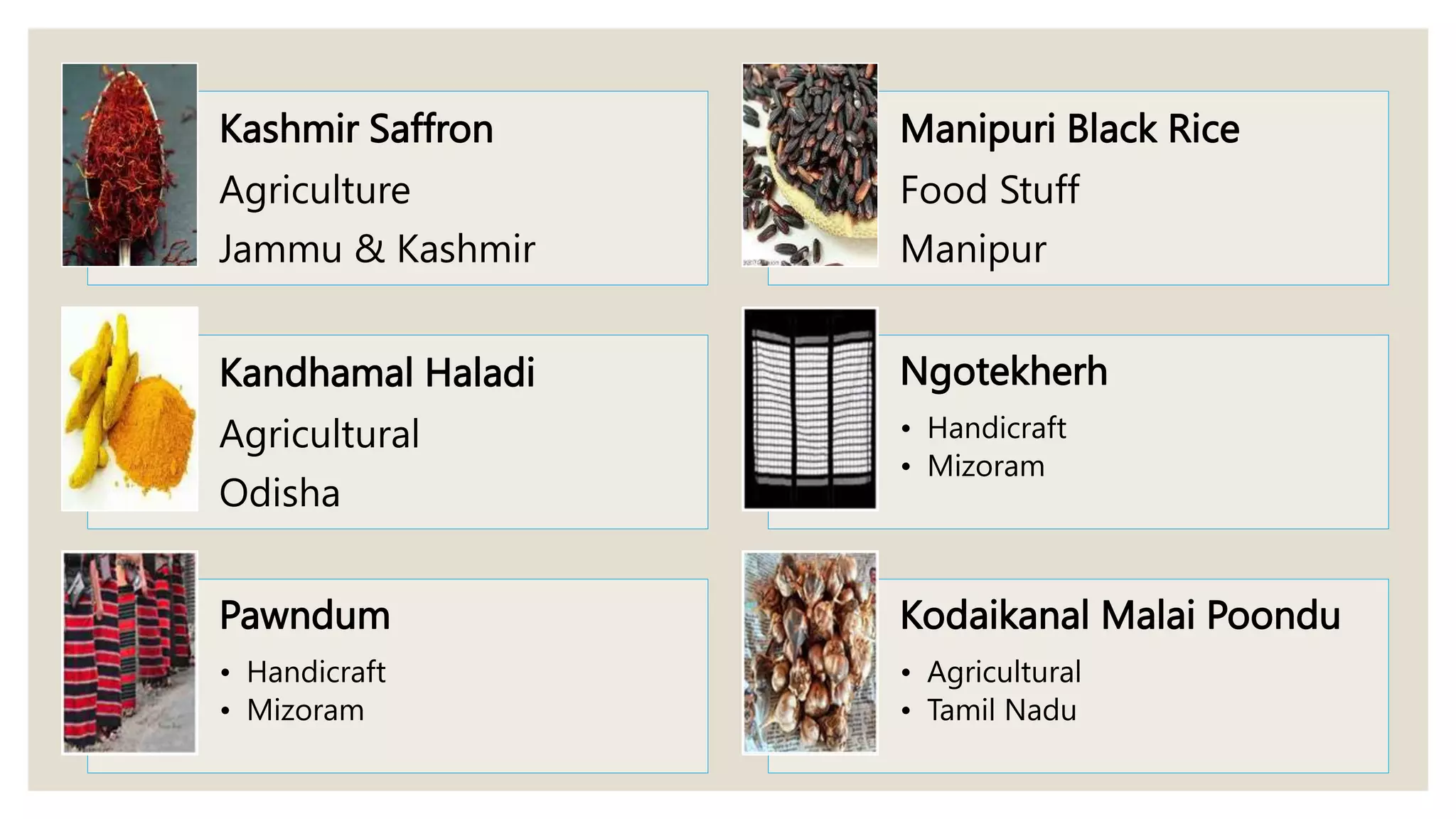
Kashmir Saffron
Agriculture
Jammu & Kashmir
Manipuri Black Rice
Food Stuff
Manipur
Kandhamal Haladi
Agricultural
Odisha
Ngotekherh
• Handicraft
• Mizoram
Pawndum
• Handicraft
• Mizoram
Kodaikanal Malai Poondu
• Agricultural
• Tamil Nadu
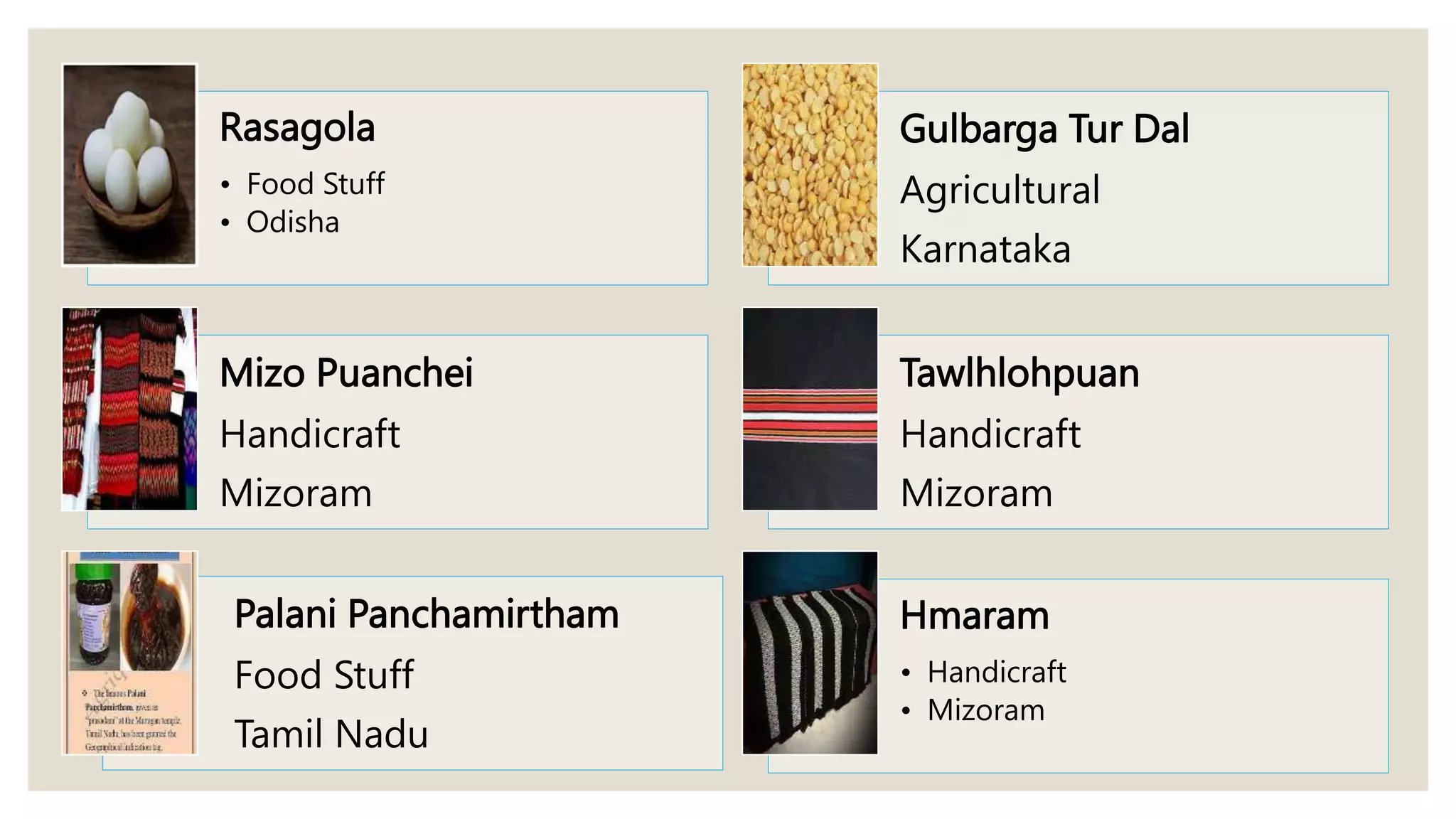
Rasagola
• Food Stuff
• Odisha
Gulbarga Tur Dal
Agricultural
Karnataka
Mizo Puanchei
Handicraft
Mizoram
Tawlhlohpuan
Handicraft
Mizoram
Palani Panchamirtham
Food Stuff
Tamil Nadu
Hmaram
• Handicraft
• Mizoram
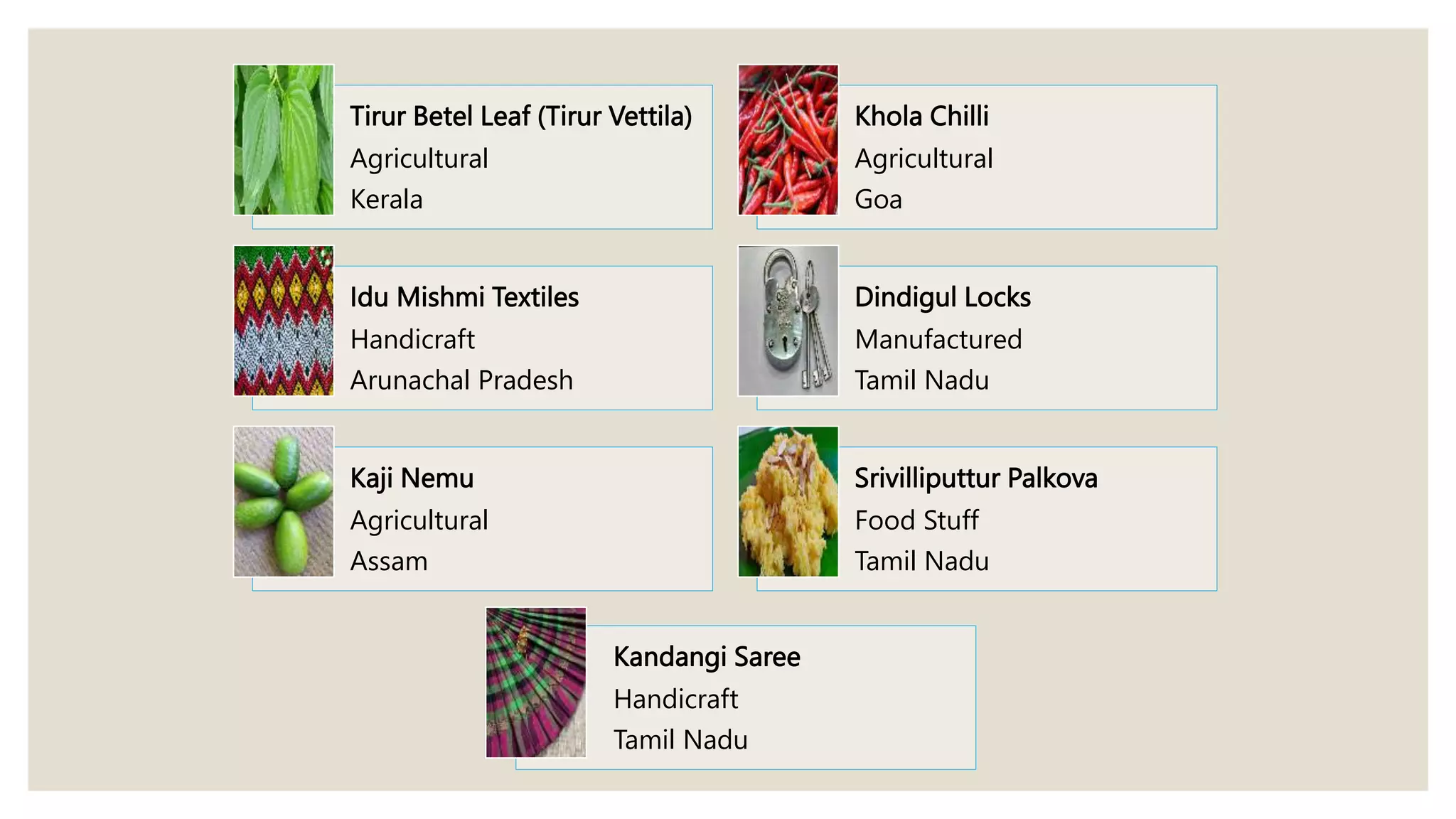
Tirur Betel Leaf (Tirur Vettila)
Agricultural
Kerala
Khola Chilli
Agricultural
Goa
Idu Mishmi Textiles
Handicraft
Arunachal Pradesh
Dindigul Locks
Manufactured
Tamil Nadu
Kaji Nemu
Agricultural
Assam
Srivilliputtur Palkova
Food Stuff
Tamil Nadu
Kandangi Saree
Handicraft
Tamil Nadu
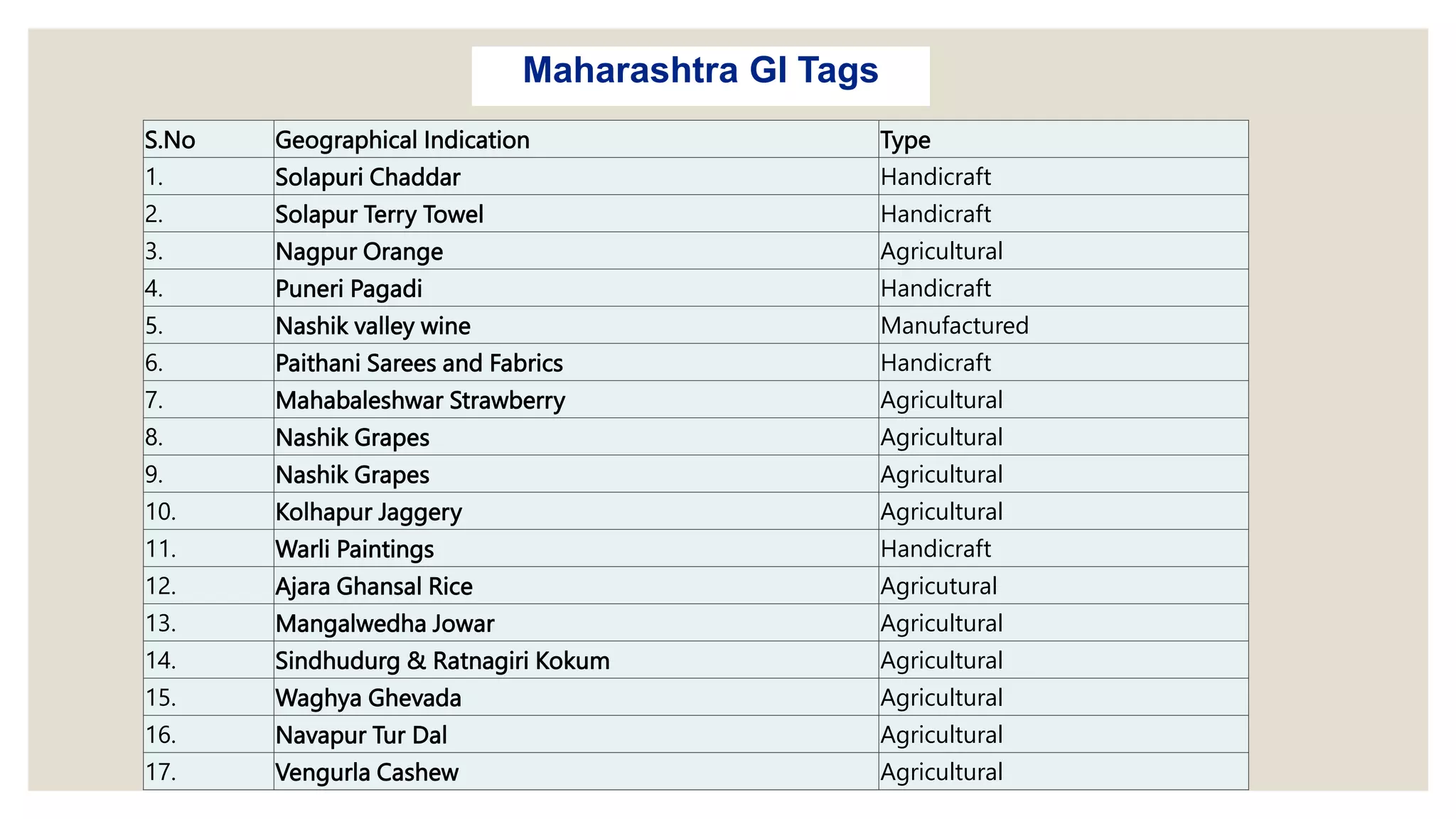
S.No Geographical Indication Type
1. Solapuri Chaddar Handicraft
2. Solapur Terry Towel Handicraft
3. Nagpur Orange Agricultural
4. Puneri Pagadi Handicraft
5. Nashik valley wine Manufactured
6. Paithani Sarees and Fabrics Handicraft
7. Mahabaleshwar Strawberry Agricultural
8. Nashik Grapes Agricultural
9. Nashik Grapes Agricultural
10. Kolhapur Jaggery Agricultural
11. Warli Paintings Handicraft
12. Ajara Ghansal Rice Agricutural
13. Mangalwedha Jowar Agricultural
14. Sindhudurg & Ratnagiri Kokum Agricultural
15. Waghya Ghevada Agricultural
16. Navapur Tur Dal Agricultural
17. Vengurla Cashew Agricultural
Maharashtra GI Tags
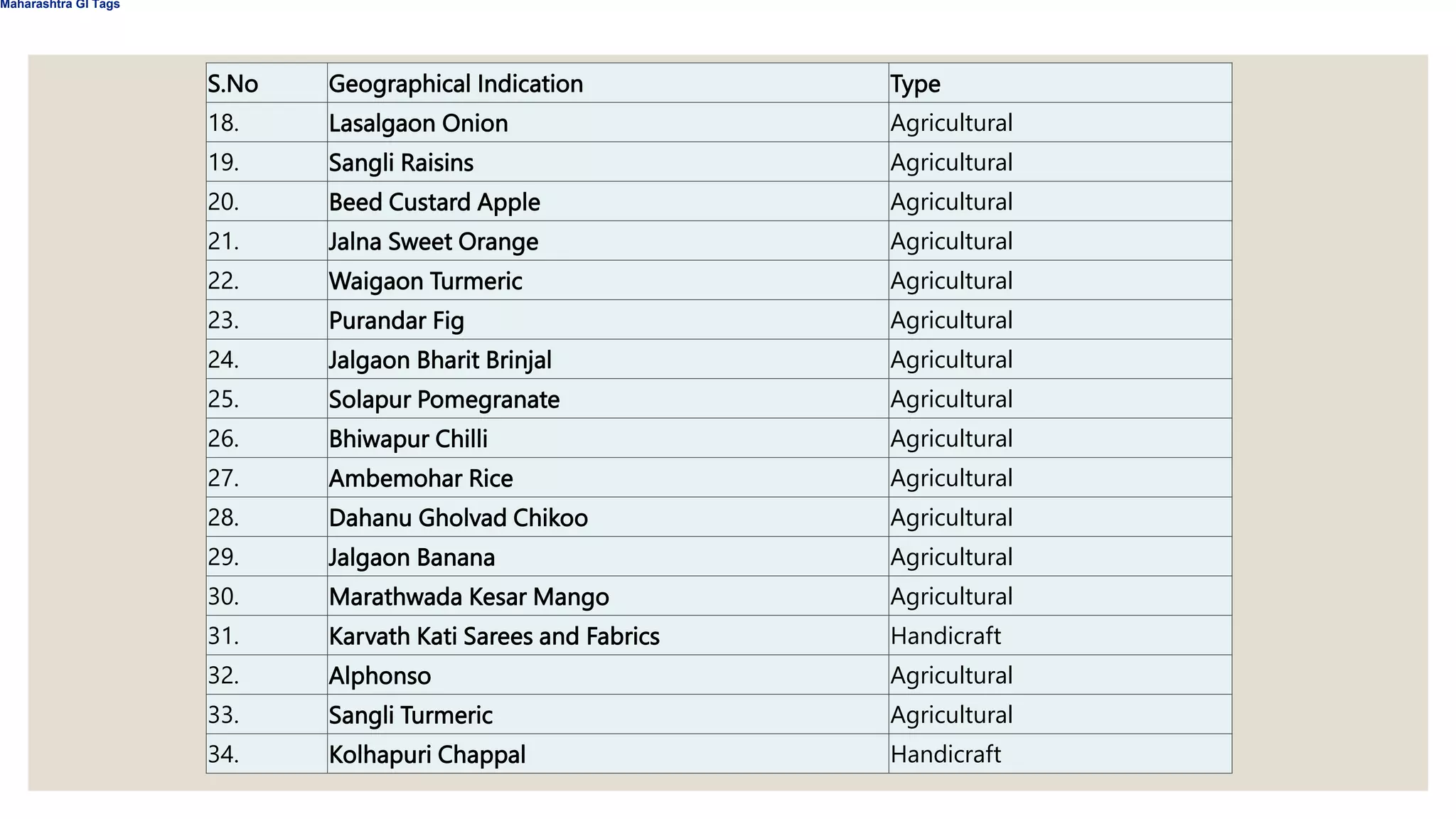
S.No Geographical Indication Type
18. Lasalgaon Onion Agricultural
19. Sangli Raisins Agricultural
20. Beed Custard Apple Agricultural
21. Jalna Sweet Orange Agricultural
22. Waigaon Turmeric Agricultural
23. Purandar Fig Agricultural
24. Jalgaon Bharit Brinjal Agricultural
25. Solapur Pomegranate Agricultural
26. Bhiwapur Chilli Agricultural
27. Ambemohar Rice Agricultural
28. Dahanu Gholvad Chikoo Agricultural
29. Jalgaon Banana Agricultural
30. Marathwada Kesar Mango Agricultural
31. Karvath Kati Sarees and Fabrics Handicraft
32. Alphonso Agricultural
33. Sangli Turmeric Agricultural
34. Kolhapuri Chappal Handicraft
Maharashtra GI Tags
Benefits of GI tag
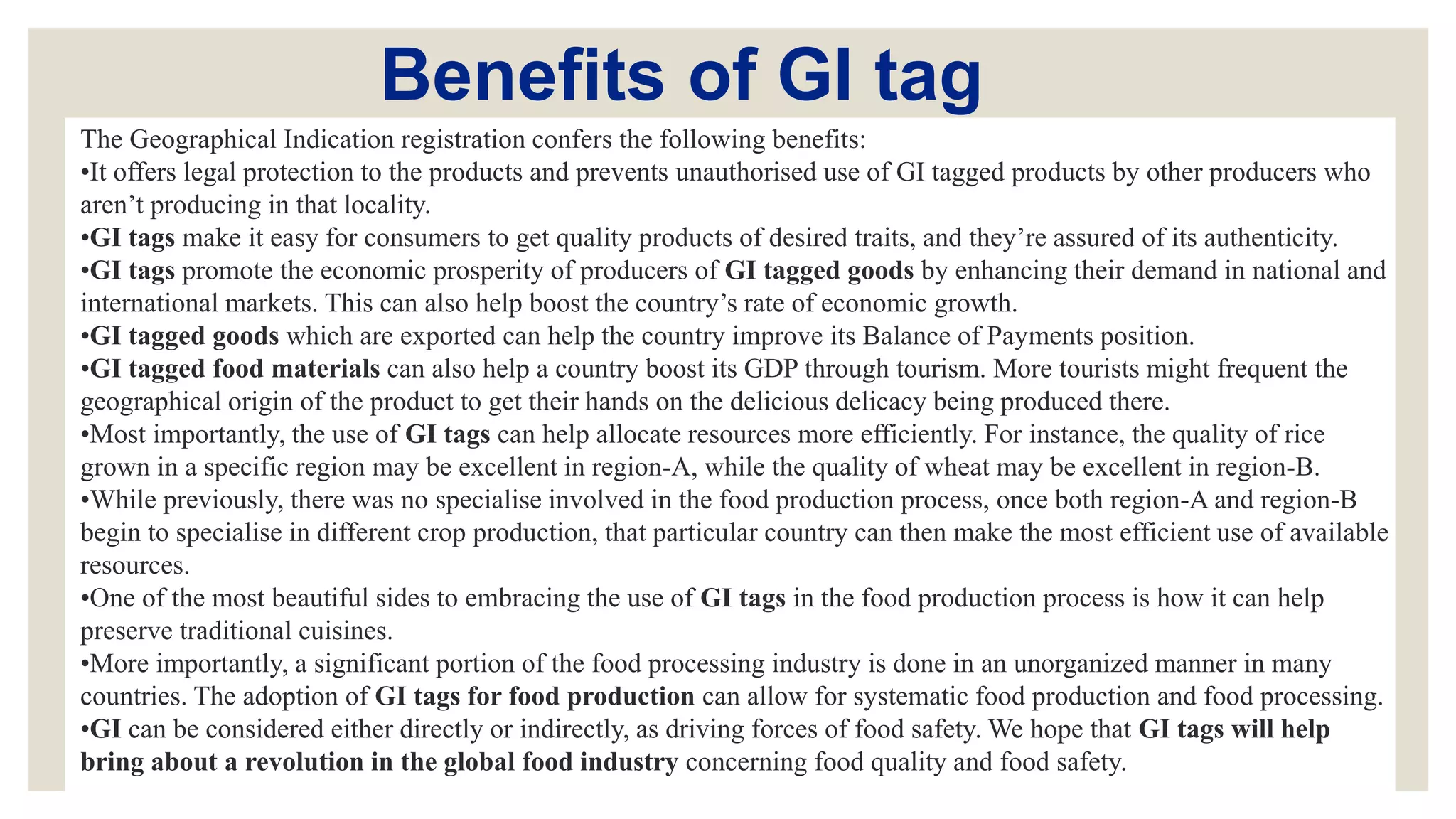
The Geographical Indication registration confers the following benefits:
•It offers legal protection to the products and prevents unauthorised use of GI tagged products by other producers who
aren’t producing in that locality.
•GI tags make it easy for consumers to get quality products of desired traits, and they’re assured of its authenticity.
•GI tags promote the economic prosperity of producers of GI tagged goods by enhancing their demand in national and
international markets. This can also help boost the country’s rate of economic growth.
•GI tagged goods which are exported can help the country improve its Balance of Payments position.
•GI tagged food materials can also help a country boost its GDP through tourism. More tourists might frequent the
geographical origin of the product to get their hands on the delicious delicacy being produced there.
•Most importantly, the use of GI tags can help allocate resources more efficiently. For instance, the quality of rice
grown in a specific region may be excellent in region-A, while the quality of wheat may be excellent in region-B.
•While previously, there was no specialise involved in the food production process, once both region-A and region-B
begin to specialise in different crop production, that particular country can then make the most efficient use of available
resources.
•One of the most beautiful sides to embracing the use of GI tags in the food production process is how it can help
preserve traditional cuisines.
•More importantly, a significant portion of the food processing industry is done in an unorganized manner in many
countries. The adoption of GI tags for food production can allow for systematic food production and food processing.
•GI can be considered either directly or indirectly, as driving forces of food safety. We hope that GI tags will help
bring about a revolution in the global food industry concerning food quality and food safety.
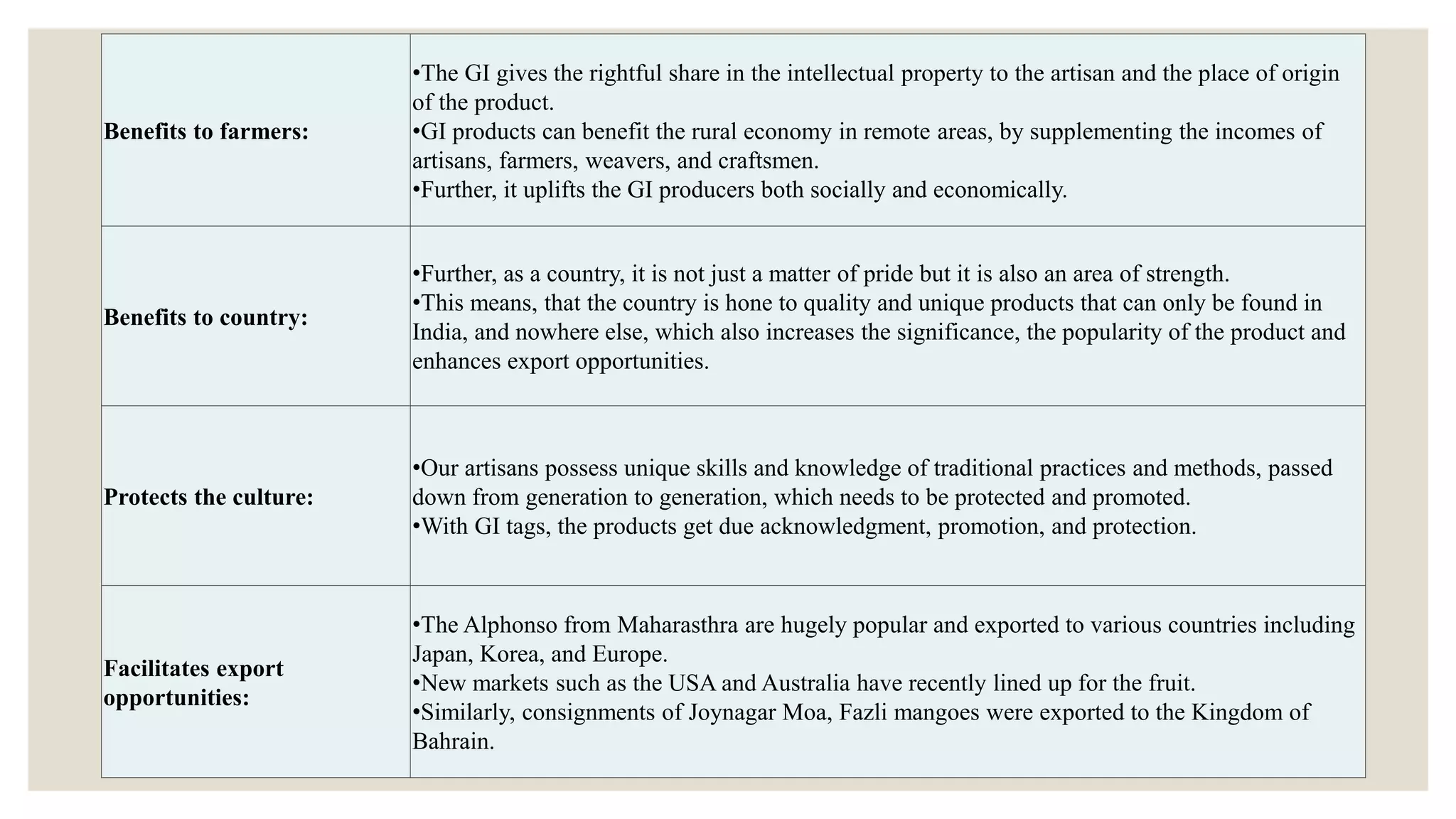
Benefits to farmers:
•The GI gives the rightful share in the intellectual property to the artisan and the place of origin
of the product.
•GI products can benefit the rural economy in remote areas, by supplementing the incomes of
artisans, farmers, weavers, and craftsmen.
•Further, it uplifts the GI producers both socially and economically.
Benefits to country:
•Further, as a country, it is not just a matter of pride but it is also an area of strength.
•This means, that the country is hone to quality and unique products that can only be found in
India, and nowhere else, which also increases the significance, the popularity of the product and
enhances export opportunities.
Protects the culture:
•Our artisans possess unique skills and knowledge of traditional practices and methods, passed
down from generation to generation, which needs to be protected and promoted.
•With GI tags, the products get due acknowledgment, promotion, and protection.
Facilitates export
opportunities:
•The Alphonso from Maharasthra are hugely popular and exported to various countries including
Japan, Korea, and Europe.
•New markets such as the USA and Australia have recently lined up for the fruit.
•Similarly, consignments of Joynagar Moa, Fazli mangoes were exported to the Kingdom of
Bahrain.
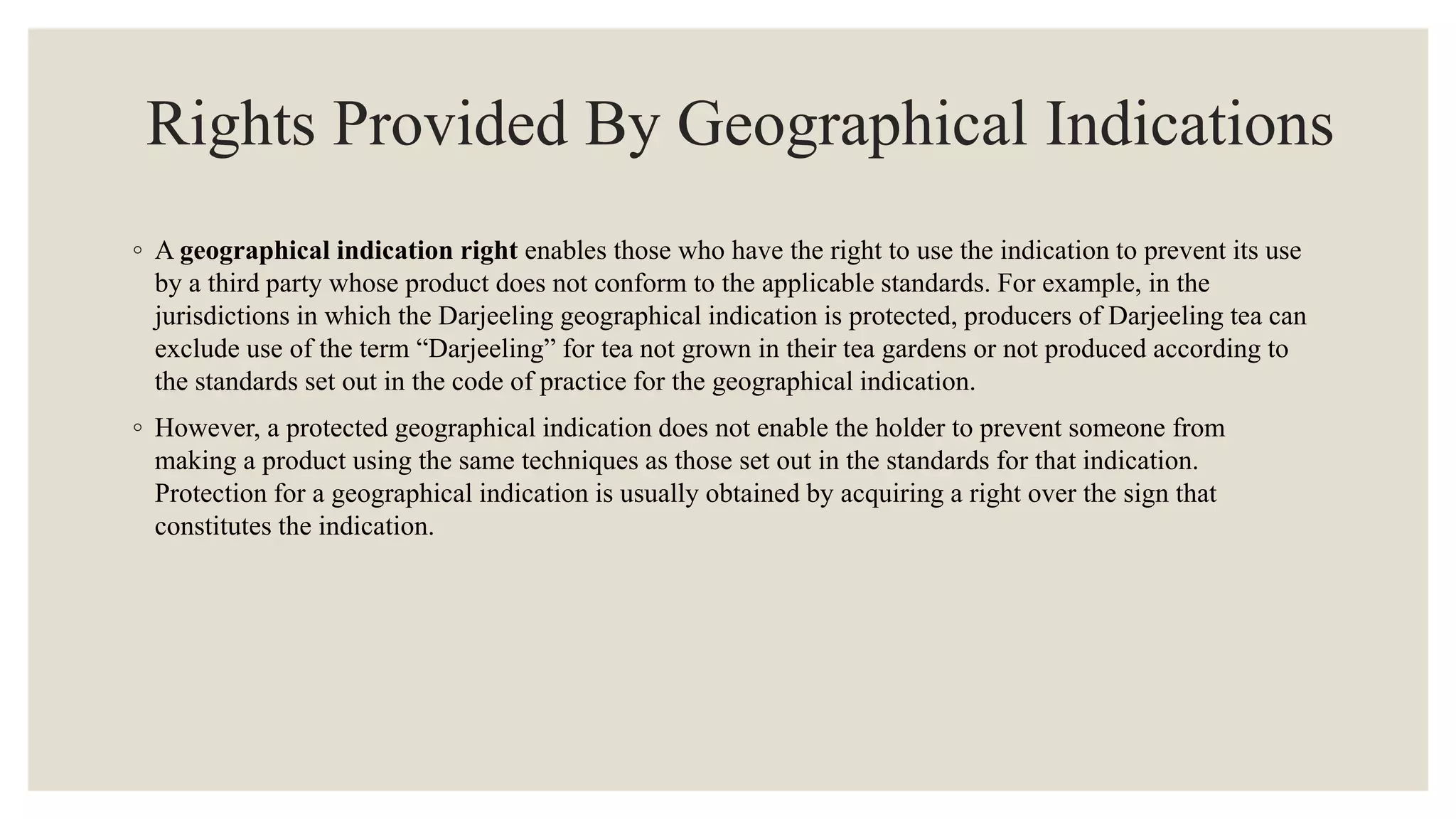
Rights Provided By Geographical Indications
◦ A geographical indication right enables those who have the right to use the indication to prevent its use
by a third party whose product does not conform to the applicable standards. For example, in the
jurisdictions in which the Darjeeling geographical indication is protected, producers of Darjeeling tea can
exclude use of the term “Darjeeling” for tea not grown in their tea gardens or not produced according to
the standards set out in the code of practice for the geographical indication.
◦ However, a protected geographical indication does not enable the holder to prevent someone from
making a product using the same techniques as those set out in the standards for that indication.
Protection for a geographical indication is usually obtained by acquiring a right over the sign that
constitutes the indication.
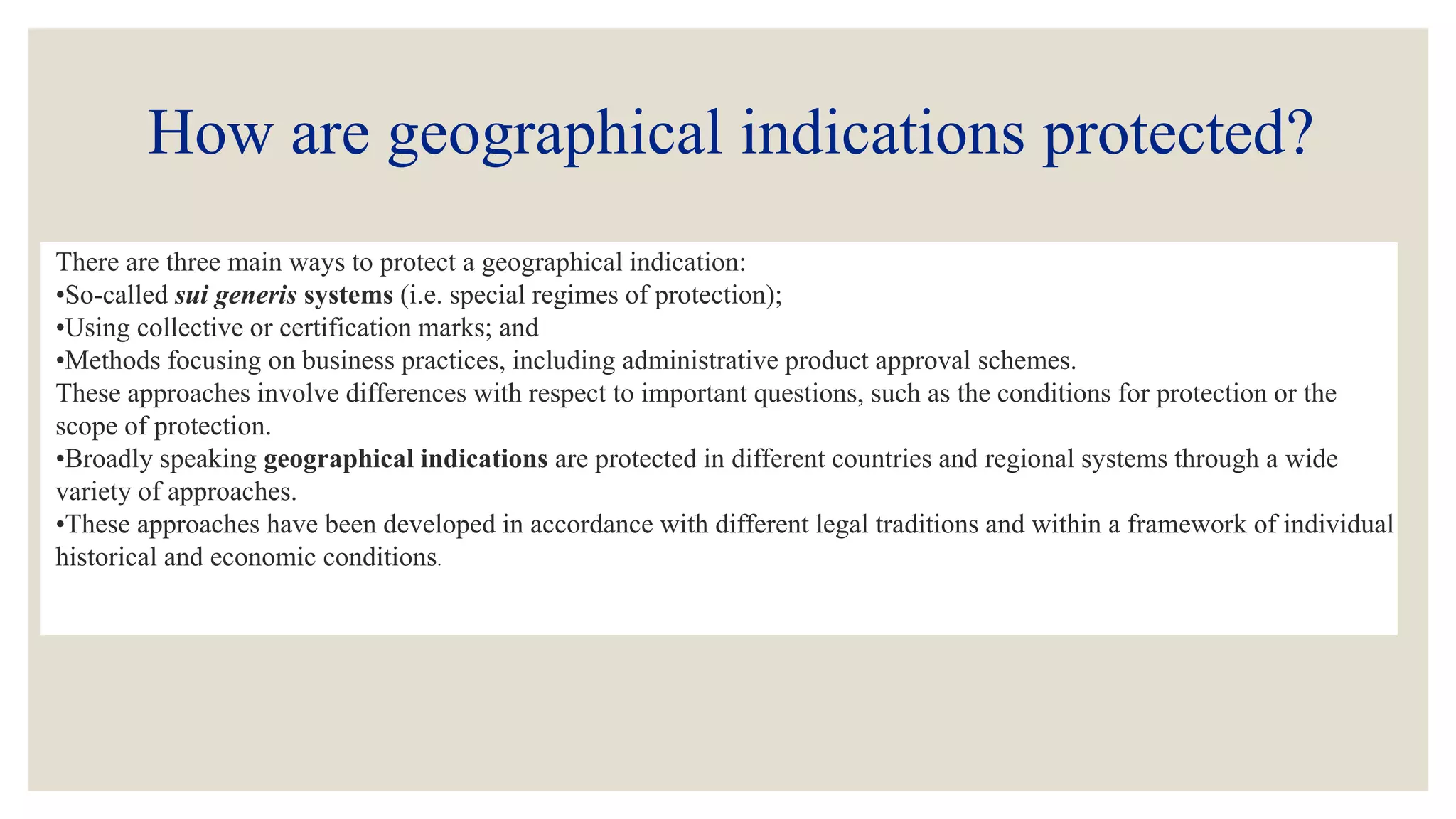
How are geographical indications protected?
There are three main ways to protect a geographical indication:
•So-called sui generis systems (i.e. special regimes of protection);
•Using collective or certification marks; and
•Methods focusing on business practices, including administrative product approval schemes.
These approaches involve differences with respect to important questions, such as the conditions for protection or the
scope of protection.
•Broadly speaking geographical indications are protected in different countries and regional systems through a wide
variety of approaches.
•These approaches have been developed in accordance with different legal traditions and within a framework of individual
historical and economic conditions.

Geographical Indication.pptx

  • 1.
  • 2.
    What is GI? ◦ According to the World Intellectual Property Organization (WIPO), the geographical indications tag is a type of label in which a product is given a special geographical identity. ◦ A product whose characteristic or prestige depends mainly on natural and human factors. ◦ The State is given the legal right to a specific item found in any region of India on the basis of the 1999 introduction of geographical indications of goods under the Registration and Protection Act by Parliament in India. ◦ This tag is to prevent illegal use of objects found or produced in a particular geographical condition. ◦ State-wise GI
  • 3.
    Kashmir Saffron Agriculture Jammu &Kashmir Manipuri Black Rice Food Stuff Manipur Kandhamal Haladi Agricultural Odisha Ngotekherh • Handicraft • Mizoram Pawndum • Handicraft • Mizoram Kodaikanal Malai Poondu • Agricultural • Tamil Nadu
  • 4.
    Rasagola • Food Stuff •Odisha Gulbarga Tur Dal Agricultural Karnataka Mizo Puanchei Handicraft Mizoram Tawlhlohpuan Handicraft Mizoram Palani Panchamirtham Food Stuff Tamil Nadu Hmaram • Handicraft • Mizoram
  • 5.
    Tirur Betel Leaf(Tirur Vettila) Agricultural Kerala Khola Chilli Agricultural Goa Idu Mishmi Textiles Handicraft Arunachal Pradesh Dindigul Locks Manufactured Tamil Nadu Kaji Nemu Agricultural Assam Srivilliputtur Palkova Food Stuff Tamil Nadu Kandangi Saree Handicraft Tamil Nadu
  • 6.
    S.No Geographical IndicationType 1. Solapuri Chaddar Handicraft 2. Solapur Terry Towel Handicraft 3. Nagpur Orange Agricultural 4. Puneri Pagadi Handicraft 5. Nashik valley wine Manufactured 6. Paithani Sarees and Fabrics Handicraft 7. Mahabaleshwar Strawberry Agricultural 8. Nashik Grapes Agricultural 9. Nashik Grapes Agricultural 10. Kolhapur Jaggery Agricultural 11. Warli Paintings Handicraft 12. Ajara Ghansal Rice Agricutural 13. Mangalwedha Jowar Agricultural 14. Sindhudurg & Ratnagiri Kokum Agricultural 15. Waghya Ghevada Agricultural 16. Navapur Tur Dal Agricultural 17. Vengurla Cashew Agricultural Maharashtra GI Tags
  • 7.
    S.No Geographical IndicationType 18. Lasalgaon Onion Agricultural 19. Sangli Raisins Agricultural 20. Beed Custard Apple Agricultural 21. Jalna Sweet Orange Agricultural 22. Waigaon Turmeric Agricultural 23. Purandar Fig Agricultural 24. Jalgaon Bharit Brinjal Agricultural 25. Solapur Pomegranate Agricultural 26. Bhiwapur Chilli Agricultural 27. Ambemohar Rice Agricultural 28. Dahanu Gholvad Chikoo Agricultural 29. Jalgaon Banana Agricultural 30. Marathwada Kesar Mango Agricultural 31. Karvath Kati Sarees and Fabrics Handicraft 32. Alphonso Agricultural 33. Sangli Turmeric Agricultural 34. Kolhapuri Chappal Handicraft Maharashtra GI Tags
  • 8.
    Benefits of GItag The Geographical Indication registration confers the following benefits: •It offers legal protection to the products and prevents unauthorised use of GI tagged products by other producers who aren’t producing in that locality. •GI tags make it easy for consumers to get quality products of desired traits, and they’re assured of its authenticity. •GI tags promote the economic prosperity of producers of GI tagged goods by enhancing their demand in national and international markets. This can also help boost the country’s rate of economic growth. •GI tagged goods which are exported can help the country improve its Balance of Payments position. •GI tagged food materials can also help a country boost its GDP through tourism. More tourists might frequent the geographical origin of the product to get their hands on the delicious delicacy being produced there. •Most importantly, the use of GI tags can help allocate resources more efficiently. For instance, the quality of rice grown in a specific region may be excellent in region-A, while the quality of wheat may be excellent in region-B. •While previously, there was no specialise involved in the food production process, once both region-A and region-B begin to specialise in different crop production, that particular country can then make the most efficient use of available resources. •One of the most beautiful sides to embracing the use of GI tags in the food production process is how it can help preserve traditional cuisines. •More importantly, a significant portion of the food processing industry is done in an unorganized manner in many countries. The adoption of GI tags for food production can allow for systematic food production and food processing. •GI can be considered either directly or indirectly, as driving forces of food safety. We hope that GI tags will help bring about a revolution in the global food industry concerning food quality and food safety.
  • 9.
    Benefits to farmers: •TheGI gives the rightful share in the intellectual property to the artisan and the place of origin of the product. •GI products can benefit the rural economy in remote areas, by supplementing the incomes of artisans, farmers, weavers, and craftsmen. •Further, it uplifts the GI producers both socially and economically. Benefits to country: •Further, as a country, it is not just a matter of pride but it is also an area of strength. •This means, that the country is hone to quality and unique products that can only be found in India, and nowhere else, which also increases the significance, the popularity of the product and enhances export opportunities. Protects the culture: •Our artisans possess unique skills and knowledge of traditional practices and methods, passed down from generation to generation, which needs to be protected and promoted. •With GI tags, the products get due acknowledgment, promotion, and protection. Facilitates export opportunities: •The Alphonso from Maharasthra are hugely popular and exported to various countries including Japan, Korea, and Europe. •New markets such as the USA and Australia have recently lined up for the fruit. •Similarly, consignments of Joynagar Moa, Fazli mangoes were exported to the Kingdom of Bahrain.
  • 10.
    Rights Provided ByGeographical Indications ◦ A geographical indication right enables those who have the right to use the indication to prevent its use by a third party whose product does not conform to the applicable standards. For example, in the jurisdictions in which the Darjeeling geographical indication is protected, producers of Darjeeling tea can exclude use of the term “Darjeeling” for tea not grown in their tea gardens or not produced according to the standards set out in the code of practice for the geographical indication. ◦ However, a protected geographical indication does not enable the holder to prevent someone from making a product using the same techniques as those set out in the standards for that indication. Protection for a geographical indication is usually obtained by acquiring a right over the sign that constitutes the indication.
  • 11.
    How are geographicalindications protected? There are three main ways to protect a geographical indication: •So-called sui generis systems (i.e. special regimes of protection); •Using collective or certification marks; and •Methods focusing on business practices, including administrative product approval schemes. These approaches involve differences with respect to important questions, such as the conditions for protection or the scope of protection. •Broadly speaking geographical indications are protected in different countries and regional systems through a wide variety of approaches. •These approaches have been developed in accordance with different legal traditions and within a framework of individual historical and economic conditions.