1
GEOGRAPHICAL
INDICATIONS
2
GEOGRAPHICAL INDICATIONS-DEFINITION
 A GI is defined as a sign that can be used on products
belonging to a particular geographical location/region and
possesses qualities or a reputation associated with that
region.
 In GI, there is a strong link between the product and its
original place of production
3
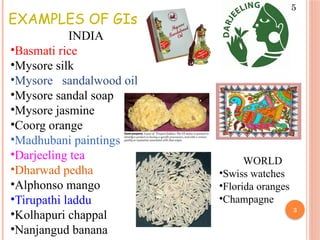
EXAMPLES OF GIs
INDIA
•Basmati rice
•Mysore silk
•Mysore sandalwood oil
•Mysore sandal soap
•Mysore jasmine
•Coorg orange
•Madhubani paintings
•Darjeeling tea
•Dharwad pedha
•Alphonso mango
•Tirupathi laddu
•Kolhapuri chappal
•Nanjangud banana
WORLD
•Swiss watches
•Florida oranges
•Champagne
5
4
Acts, Laws and Rules Pertaining to GI
In India, GI was introduced in 2003 and is
governed under the Geographical Indications
of Goods (Reg-istration & Protection) Act,
1999
 Geographical Indications of Goods
(Registration & Protection) Rules, 2002.
5
Ownership of GI
The ownership/holders of GI (registered)
can be of the producers,
 as a group/association/cooperative
society, or association, or in certain cases,
the government
6
Rights Granted to the Holders
 Right to grant the license to others:
Right to sue:
Right to exploit:
Right to get reliefs:
7
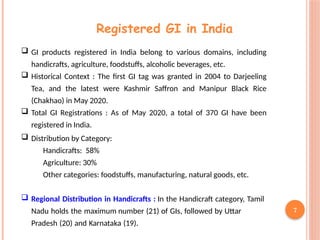
Registered GI in India
 GI products registered in India belong to various domains, including
handicrafts, agriculture, foodstuffs, alcoholic beverages, etc.
 Historical Context : The first GI tag was granted in 2004 to Darjeeling
Tea, and the latest were Kashmir Saffron and Manipur Black Rice
(Chakhao) in May 2020.
 Total GI Registrations : As of May 2020, a total of 370 GI have been
registered in India.
 Distribution by Category:
Handicrafts: 58%
Agriculture: 30%
Other categories: foodstuffs, manufacturing, natural goods, etc.
 Regional Distribution in Handicrafts : In the Handicraft category, Tamil
Nadu holds the maximum number (21) of GIs, followed by Uttar
Pradesh (20) and Karnataka (19).
8
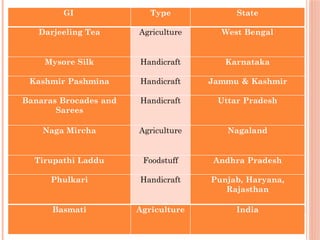
GI Type State
Darjeeling Tea Agriculture West Bengal
Mysore Silk Handicraft Karnataka
Kashmir Pashmina Handicraft Jammu & Kashmir
Banaras Brocades and
Sarees
Handicraft Uttar Pradesh
Naga Mircha Agriculture Nagaland
Tirupathi Laddu Foodstuff Andhra Pradesh
Phulkari Handicraft Punjab, Haryana,
Rajasthan
Basmati Agriculture India
9
Identification of Registered GI
 Registered GI products are granted a tag, which is printed on the
registered products.
 The tag confirms the genuineness of the product in terms of its
production (by set standards) and location of production.
 Non-registered GI products cannot use/exploit this tag.
 e.g., Darjeeling Tea, Mysore Silk, Tirupathi Laddu, etc
 Issuance of GI Tags :
 Global Standards :
10
Is the registration of a Geographic Indication
compulsory and how does it help the applicant
• Registration is not compulsory
• Registration affords better legal protection to
facilitate an action for infringement
• The registered proprietor and authorized users
can initiate infringement actions.
• The authorized user can exercise the
exclusive right to use the Geographical
Indication
•The registration of a geographical indication is
valid for a period of 10 years and renewed from
time to time
11
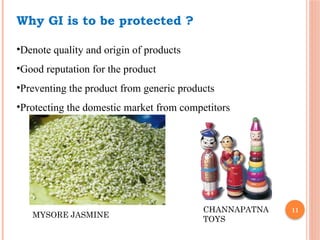
Why GI is to be protected ?
•Denote quality and origin of products
•Good reputation for the product
•Preventing the product from generic products
•Protecting the domestic market from competitors
MYSORE JASMINE
CHANNAPATNA
TOYS
12
GI in India
•The Central Government of India has established
the Geographical Indications Registry with all India
jurisdiction in chennai
•The GI Act is
being administered by the Controller General of Patents, D
esigns and Trade Marks who is
‐
the Registrar of Geographical Indications
• India, as a member of the World Trade
Organization(WTO), enacted the Geographical Indications
of Goods (Registration and Protection) Act, 1999 has
come into force with effect from 15 September 2003
13
CONDITIONS TO GET GI TAG
•It relates to a goods, although in some countries,
services are also included;
•These goods/services must originate from a defined
area;
•The goods/services must have qualities, reputations or
other characteristics which are clearly linked to the
geographical origin of goods
14
Why are geographical indications
valuable?
•GIs are a marketing tool
•Reputation for quality associated with place name used
on labels, advertising
•GI-identified products are believed to command higher
prices
•Of particular interest to developing countries
15
Geographical indications and
trademarks
• GIs are closely related to
trademarks; both indicate product
origin
• GIs and trademarks differ in two ways:
1. A trademark belongs to a particular
company; it distinguishes that
company’s products. GIs are shared by
all producers in the region identified by
the GI.
2. Gis are attached to a location;but
trademarks don’t
16
ECONOMIC AND SOCIAL BENEFITS OF GI
• Higher retail price and better distribution of
economic returns for primary producers
• Capitalize on consumers’ desire for authentic,
quality products - 1999 consumer survey -40%
of EU consumers ready to pay premium price
for origin-guaranteed products
• Production of growth: increase production
output and land value
• Legal protection creates opportunities for
investment in a product and region
• Rural development and sustainability: provide
the right owners with the opportunity to get
economic benefits from their geographical
indication and with the right to exclude
non-entitled users
17
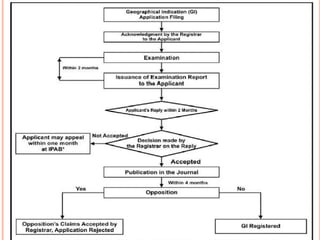
The Registration Process
STEP 1 : Filing of application
 first check whether the indication
comes within the ambit of the definition of
a Gl under section 2(1)(e). The association of persons or producers
or any organization or authority should
represent the interest of producers of the
concerned goods and should file an
affidavit how the applicant claims to
represent their interest.
Application must be made in triplicate.
•The application shall be signed by the
applicant or his agent and must be
accompanied by a statement of case.
Details of the special characteristics and
how those standards are maintained.
STEP 2 and 3: Preliminary scrutiny and
examination
18
The Examiner will scrutinize the
application for any deficiencies.
The applicant should within one month of
the communication in this regard, remedy
the same
STEP 4: Show cause notice
If the Registrar has any objection to the
application, he will communicate such
objection.
The applicant must respond within two
months or apply for a hearing.
STEP 5: Publication in the
geographical indications
Journal
Every application, within three moths of
acceptance shall be published in the
Geographical Indications Journal.
19
STEP 6: Opposition to Registration
Any person can file a notice of opposition within three months
(extendable by another month on request which has to be
filed before three months) opposing the GI application
published in the Journal.
The registrar shall serve a copy of the notice on the applicant.
STEP 7: Registration
Where an application for a GI has been accepted, the
registrar shall register the geographical indication. If
registered the date of filing of the application shall be
deemed to be the date of registration.
The registrar shall issue to the applicant a certificate with
the seal of the Geographical indications registry.
STEP 8: Renewal
A registered GI shall be valid for 10 years
and can be renewed on payment of
renewal fee.
20
21
A case Study of the Basmati Rice
(India-US Basmati Rice Dispute): The Geographical Indication
Perspective.
•In the late 1997, when an American company RiceTec Inc
was granted a patent by the US patent office to call the
aromatic rice grown outside India "Basmati", India objected
to it
As India has been one of the major exporters of
Basmati to several countries and such a grant by the
US patent office was likely to affect its trade.
Since Basmati rice is traditionally grown in India and Pakistan, it was
opined that granting patent to RiceTec violated the Geographical
Indications Act under the TRIPS agreement.
Eventually, a request for re-examination of this patent was filed
on April 28, 2000. Soon after filling the re-examination request,
Rice Tec chose to withdraw its claims.
22
Biopiracy Case Study 2: turmeric
In March 1995, two expatriate Indians at the
University of Mississippi Medical Centre were
granted a US patent for turmeric to be used to heal
wounds
The Indian Council for Scientific and
Industrial Research (CSIR) filed a case with the
US Patent Office challenging the patent on the
grounds of "prior art" i.e already existing
public knowledge.
CSIR argued that turmeric has been used for
thousands of years for healing wounds and
rashes and therefore its medicinal use was not a
novel invention.
The claim had to be backed by written
documentation claiming traditional wisdom
or knowledge.
The CSIR went so far as to present an ancient
Sanskrit text and a paper published in 1953 in
the Journal of the Indian Medical Association.
•The US Patent Office upheld the objection and
cancelled the patent
• It also cancelled several other patent
applications pending for turmeric.
•The turmeric case was a landmark judgment
case as it was for the first time that a patent
based on the traditional knowledge of a
developing country was successfully
challenged.
.
23
THANK
YOU

geographical indication for engineering student

  • 1.
  • 2.
    2 GEOGRAPHICAL INDICATIONS-DEFINITION  AGI is defined as a sign that can be used on products belonging to a particular geographical location/region and possesses qualities or a reputation associated with that region.  In GI, there is a strong link between the product and its original place of production
  • 3.
    3 EXAMPLES OF GIs INDIA •Basmatirice •Mysore silk •Mysore sandalwood oil •Mysore sandal soap •Mysore jasmine •Coorg orange •Madhubani paintings •Darjeeling tea •Dharwad pedha •Alphonso mango •Tirupathi laddu •Kolhapuri chappal •Nanjangud banana WORLD •Swiss watches •Florida oranges •Champagne 5
  • 4.
    4 Acts, Laws andRules Pertaining to GI In India, GI was introduced in 2003 and is governed under the Geographical Indications of Goods (Reg-istration & Protection) Act, 1999  Geographical Indications of Goods (Registration & Protection) Rules, 2002.
  • 5.
    5 Ownership of GI Theownership/holders of GI (registered) can be of the producers,  as a group/association/cooperative society, or association, or in certain cases, the government
  • 6.
    6 Rights Granted tothe Holders  Right to grant the license to others: Right to sue: Right to exploit: Right to get reliefs:
  • 7.
    7 Registered GI inIndia  GI products registered in India belong to various domains, including handicrafts, agriculture, foodstuffs, alcoholic beverages, etc.  Historical Context : The first GI tag was granted in 2004 to Darjeeling Tea, and the latest were Kashmir Saffron and Manipur Black Rice (Chakhao) in May 2020.  Total GI Registrations : As of May 2020, a total of 370 GI have been registered in India.  Distribution by Category: Handicrafts: 58% Agriculture: 30% Other categories: foodstuffs, manufacturing, natural goods, etc.  Regional Distribution in Handicrafts : In the Handicraft category, Tamil Nadu holds the maximum number (21) of GIs, followed by Uttar Pradesh (20) and Karnataka (19).
  • 8.
    8 GI Type State DarjeelingTea Agriculture West Bengal Mysore Silk Handicraft Karnataka Kashmir Pashmina Handicraft Jammu & Kashmir Banaras Brocades and Sarees Handicraft Uttar Pradesh Naga Mircha Agriculture Nagaland Tirupathi Laddu Foodstuff Andhra Pradesh Phulkari Handicraft Punjab, Haryana, Rajasthan Basmati Agriculture India
  • 9.
    9 Identification of RegisteredGI  Registered GI products are granted a tag, which is printed on the registered products.  The tag confirms the genuineness of the product in terms of its production (by set standards) and location of production.  Non-registered GI products cannot use/exploit this tag.  e.g., Darjeeling Tea, Mysore Silk, Tirupathi Laddu, etc  Issuance of GI Tags :  Global Standards :
  • 10.
    10 Is the registrationof a Geographic Indication compulsory and how does it help the applicant • Registration is not compulsory • Registration affords better legal protection to facilitate an action for infringement • The registered proprietor and authorized users can initiate infringement actions. • The authorized user can exercise the exclusive right to use the Geographical Indication •The registration of a geographical indication is valid for a period of 10 years and renewed from time to time
  • 11.
    11 Why GI isto be protected ? •Denote quality and origin of products •Good reputation for the product •Preventing the product from generic products •Protecting the domestic market from competitors MYSORE JASMINE CHANNAPATNA TOYS
  • 12.
    12 GI in India •TheCentral Government of India has established the Geographical Indications Registry with all India jurisdiction in chennai •The GI Act is being administered by the Controller General of Patents, D esigns and Trade Marks who is ‐ the Registrar of Geographical Indications • India, as a member of the World Trade Organization(WTO), enacted the Geographical Indications of Goods (Registration and Protection) Act, 1999 has come into force with effect from 15 September 2003
  • 13.
    13 CONDITIONS TO GETGI TAG •It relates to a goods, although in some countries, services are also included; •These goods/services must originate from a defined area; •The goods/services must have qualities, reputations or other characteristics which are clearly linked to the geographical origin of goods
  • 14.
    14 Why are geographicalindications valuable? •GIs are a marketing tool •Reputation for quality associated with place name used on labels, advertising •GI-identified products are believed to command higher prices •Of particular interest to developing countries
  • 15.
    15 Geographical indications and trademarks •GIs are closely related to trademarks; both indicate product origin • GIs and trademarks differ in two ways: 1. A trademark belongs to a particular company; it distinguishes that company’s products. GIs are shared by all producers in the region identified by the GI. 2. Gis are attached to a location;but trademarks don’t
  • 16.
    16 ECONOMIC AND SOCIALBENEFITS OF GI • Higher retail price and better distribution of economic returns for primary producers • Capitalize on consumers’ desire for authentic, quality products - 1999 consumer survey -40% of EU consumers ready to pay premium price for origin-guaranteed products • Production of growth: increase production output and land value • Legal protection creates opportunities for investment in a product and region • Rural development and sustainability: provide the right owners with the opportunity to get economic benefits from their geographical indication and with the right to exclude non-entitled users
  • 17.
    17 The Registration Process STEP1 : Filing of application  first check whether the indication comes within the ambit of the definition of a Gl under section 2(1)(e). The association of persons or producers or any organization or authority should represent the interest of producers of the concerned goods and should file an affidavit how the applicant claims to represent their interest. Application must be made in triplicate. •The application shall be signed by the applicant or his agent and must be accompanied by a statement of case. Details of the special characteristics and how those standards are maintained. STEP 2 and 3: Preliminary scrutiny and examination
  • 18.
    18 The Examiner willscrutinize the application for any deficiencies. The applicant should within one month of the communication in this regard, remedy the same STEP 4: Show cause notice If the Registrar has any objection to the application, he will communicate such objection. The applicant must respond within two months or apply for a hearing. STEP 5: Publication in the geographical indications Journal Every application, within three moths of acceptance shall be published in the Geographical Indications Journal.
  • 19.
    19 STEP 6: Oppositionto Registration Any person can file a notice of opposition within three months (extendable by another month on request which has to be filed before three months) opposing the GI application published in the Journal. The registrar shall serve a copy of the notice on the applicant. STEP 7: Registration Where an application for a GI has been accepted, the registrar shall register the geographical indication. If registered the date of filing of the application shall be deemed to be the date of registration. The registrar shall issue to the applicant a certificate with the seal of the Geographical indications registry. STEP 8: Renewal A registered GI shall be valid for 10 years and can be renewed on payment of renewal fee.
  • 20.
  • 21.
    21 A case Studyof the Basmati Rice (India-US Basmati Rice Dispute): The Geographical Indication Perspective. •In the late 1997, when an American company RiceTec Inc was granted a patent by the US patent office to call the aromatic rice grown outside India "Basmati", India objected to it As India has been one of the major exporters of Basmati to several countries and such a grant by the US patent office was likely to affect its trade. Since Basmati rice is traditionally grown in India and Pakistan, it was opined that granting patent to RiceTec violated the Geographical Indications Act under the TRIPS agreement. Eventually, a request for re-examination of this patent was filed on April 28, 2000. Soon after filling the re-examination request, Rice Tec chose to withdraw its claims.
  • 22.
    22 Biopiracy Case Study2: turmeric In March 1995, two expatriate Indians at the University of Mississippi Medical Centre were granted a US patent for turmeric to be used to heal wounds The Indian Council for Scientific and Industrial Research (CSIR) filed a case with the US Patent Office challenging the patent on the grounds of "prior art" i.e already existing public knowledge. CSIR argued that turmeric has been used for thousands of years for healing wounds and rashes and therefore its medicinal use was not a novel invention. The claim had to be backed by written documentation claiming traditional wisdom or knowledge. The CSIR went so far as to present an ancient Sanskrit text and a paper published in 1953 in the Journal of the Indian Medical Association. •The US Patent Office upheld the objection and cancelled the patent • It also cancelled several other patent applications pending for turmeric. •The turmeric case was a landmark judgment case as it was for the first time that a patent based on the traditional knowledge of a developing country was successfully challenged. .
  • 23.