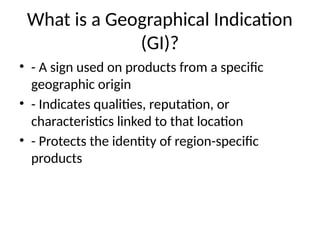
What is aGeographical Indication
(GI)?
• - A sign used on products from a specific
geographic origin
• - Indicates qualities, reputation, or
characteristics linked to that location
• - Protects the identity of region-specific
products
3.
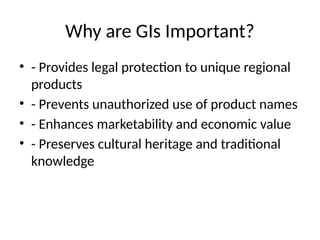
Why are GIsImportant?
• - Provides legal protection to unique regional
products
• - Prevents unauthorized use of product names
• - Enhances marketability and economic value
• - Preserves cultural heritage and traditional
knowledge
Where and Howare GIs
Registered?
• - Registered with appropriate national
authorities
• - Application must describe the product,
origin, and unique qualities
• - Registration grants exclusive rights to the
region's producers
6.
Time Duration andValidity of GIs
• - Valid as long as the characteristics and
reputation are maintained
• - Requires periodic renewal to ensure
continued protection
• - Specific duration may vary by country
7.
Boundary and Scopeof GIs
• - Limited to products with distinct regional
characteristics
• - Enforcement within national and
international boundaries
• - TRIPS Agreement provides a global
framework for GI protection
8.
Challenges and Conclusion
•- Challenges: Enforcement, misuse, global
recognition
• - GIs play a crucial role in protecting regional
products
• - Contribute to economic and cultural
prosperity of regions
9.
International Protection ofGIs
• - TRIPS Agreement under WTO provides global
GI protection
• - Countries can negotiate bilateral agreements
• - Helps in protecting GIs across borders
10.
Economic Impact ofGIs
• - Boosts local economies by enhancing
product value
• - Encourages rural development and tourism
• - Provides economic incentives for producers
11.
Legal Framework andEnforcement
• - National laws govern GI registration and
protection
• - Enforcement ensures compliance and
prevents misuse
• - Legal actions can be taken against
infringements
12.
Future Prospects andInnovations
• - Increasing importance in global trade
• - Potential for new GI registrations in emerging
markets
• - Innovations in GI management and
promotion


![Intellectual Property Rights [ Geographical Indication]](https://cdn.slidesharecdn.com/ss_thumbnails/gi-220108083647-thumbnail.jpg?width=640&height=640&fit=bounds)


![제 23회 보아즈(BOAZ) 빅데이터 컨퍼런스 - [MBOAX] : ABSA를 활용한 소비자 반응 분석 기반 운영 효율화 대시보드 설계](https://cdn.slidesharecdn.com/ss_thumbnails/3-1boaz23rdconferencemboax-260203102709-9d519923-thumbnail.jpg?width=640&height=640&fit=bounds)


