by
Prof V. V. Sasane (Assistant Professor)
Department of Civil Engineering
Sanjivani College of Engineering, Kopargaon, 423603
Subject: Environmental Engineering-II
B.E. Civil
Unit-II: Sewage Treatment
2.6 Sedimentation
Sanjivani Rural Education Society’s
Sanjivani College of Engineering, Kopargaon, 423603
An Autonomous Institute Affiliated to Savitribai Phule Pune University, Pune
Contents
1. Introduction to primary sedimentation in wastewater
2. Principle of sedimentation
3. Factor affecting sedimentation
4. Types of Settling
Introduction to Primary Sedimentation in
Wastewater Treatment
• After removal of larger floating and suspended materials (through screening) and
heavier grit materials (in grit chamber), the wastewater is typically directed to
Primary Clarifier (Sedimentation) for the removal of suspended organics as well
as finer inorganic solids.
• Sedimentation is essentially a phase separation operation for separating liquid
and solids.
• A sedimentation tank is structure in which wastewater is filled and stored for some
time to remove the suspended particles present in the water. These particles may
settle at the bottom of the tank and are removed by using scrapers.
• General Considerations:
Wastewater treatment is usually characterized as consisting of four sequential
processes: preliminary, primary, secondary and tertiary (sometimes called
“advanced”) treatment.
This course discusses primary treatment. The purpose of primary treatment is to
remove solids which are not removed during preliminary treatment.
Processes which can be used to provide primary treatment include the following:
1) primary sedimentation, also called clarification;
2) microscreens; and
3) Imhoff tanks. In most facilities, primary treatment is used as a preliminary step
ahead of biological treatment.
• The objective of primary sedimentation (also known as primary treatment) is the
removal of settleable organic solids and floating organic material (called scum) in
order to reduce the suspended solids load for downstream treatment processes.
• Scum is usually disposed separately or in combination with sludge/biosolids in
wastewater treatment plants. Primary sedimentation is a form of centralized or semi-
centralized wastewater treatment and is an integral part of conventional wastewater
treatment (primary and secondary treatment).
• The settled primary sludge solids, which are highly putrescible, must be continuously
removed from the bottom of the sedimentation tank and stabilized, usually by
anaerobic digestion. Primary sludge typically contains 2 to 5% total solids with 60 to
80% organic content.
Principle of Sedimentation
• The very fundamental principle under lying the process of sedimentation is
that, the organic matter present in sewage ,is having specific gravity greater
than that of water. In still sewage these particles will therefore tend to settle
down by gravity, where as in a flowing sewage ,they kept in suspension
because of turbulence. Hence as soon as turbulence is retarded by offering
storage to the sewage or reducing the flow velocity, the impurities tend to
settle at the bottom of the tank. This the principle of sedimentation.
Factors Affecting Sedimentation
• Shape, Size, Density and Nature of particles
• Viscosity, density and temperature of water/wastewater
• Surface overflow rate
• Velocity of flow
• Inlet and outlet arrangements
• Detention period
• Effective depth of settling zone
Types of Settling
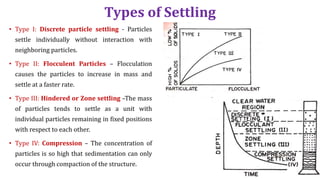
• Type I: Discrete particle settling - Particles
settle individually without interaction with
neighboring particles.
• Type II: Flocculent Particles – Flocculation
causes the particles to increase in mass and
settle at a faster rate.
• Type III: Hindered or Zone settling –The mass
of particles tends to settle as a unit with
individual particles remaining in fixed positions
with respect to each other.
• Type IV: Compression – The concentration of
particles is so high that sedimentation can only
occur through compaction of the structure.
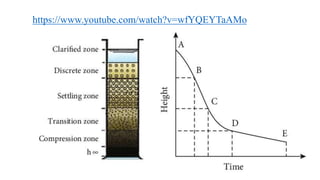
https://www.youtube.com/watch?v=wfYQEYTaAMo
Thank you

4. sedimentation

  • 1.
    by Prof V. V.Sasane (Assistant Professor) Department of Civil Engineering Sanjivani College of Engineering, Kopargaon, 423603 Subject: Environmental Engineering-II B.E. Civil Unit-II: Sewage Treatment 2.6 Sedimentation Sanjivani Rural Education Society’s Sanjivani College of Engineering, Kopargaon, 423603 An Autonomous Institute Affiliated to Savitribai Phule Pune University, Pune
  • 2.
    Contents 1. Introduction toprimary sedimentation in wastewater 2. Principle of sedimentation 3. Factor affecting sedimentation 4. Types of Settling
  • 3.
    Introduction to PrimarySedimentation in Wastewater Treatment • After removal of larger floating and suspended materials (through screening) and heavier grit materials (in grit chamber), the wastewater is typically directed to Primary Clarifier (Sedimentation) for the removal of suspended organics as well as finer inorganic solids. • Sedimentation is essentially a phase separation operation for separating liquid and solids. • A sedimentation tank is structure in which wastewater is filled and stored for some time to remove the suspended particles present in the water. These particles may settle at the bottom of the tank and are removed by using scrapers.
  • 4.
    • General Considerations: Wastewatertreatment is usually characterized as consisting of four sequential processes: preliminary, primary, secondary and tertiary (sometimes called “advanced”) treatment. This course discusses primary treatment. The purpose of primary treatment is to remove solids which are not removed during preliminary treatment. Processes which can be used to provide primary treatment include the following: 1) primary sedimentation, also called clarification; 2) microscreens; and 3) Imhoff tanks. In most facilities, primary treatment is used as a preliminary step ahead of biological treatment.
  • 5.
    • The objectiveof primary sedimentation (also known as primary treatment) is the removal of settleable organic solids and floating organic material (called scum) in order to reduce the suspended solids load for downstream treatment processes. • Scum is usually disposed separately or in combination with sludge/biosolids in wastewater treatment plants. Primary sedimentation is a form of centralized or semi- centralized wastewater treatment and is an integral part of conventional wastewater treatment (primary and secondary treatment). • The settled primary sludge solids, which are highly putrescible, must be continuously removed from the bottom of the sedimentation tank and stabilized, usually by anaerobic digestion. Primary sludge typically contains 2 to 5% total solids with 60 to 80% organic content.
  • 6.
    Principle of Sedimentation •The very fundamental principle under lying the process of sedimentation is that, the organic matter present in sewage ,is having specific gravity greater than that of water. In still sewage these particles will therefore tend to settle down by gravity, where as in a flowing sewage ,they kept in suspension because of turbulence. Hence as soon as turbulence is retarded by offering storage to the sewage or reducing the flow velocity, the impurities tend to settle at the bottom of the tank. This the principle of sedimentation.
  • 7.
    Factors Affecting Sedimentation •Shape, Size, Density and Nature of particles • Viscosity, density and temperature of water/wastewater • Surface overflow rate • Velocity of flow • Inlet and outlet arrangements • Detention period • Effective depth of settling zone
  • 8.
    Types of Settling •Type I: Discrete particle settling - Particles settle individually without interaction with neighboring particles. • Type II: Flocculent Particles – Flocculation causes the particles to increase in mass and settle at a faster rate. • Type III: Hindered or Zone settling –The mass of particles tends to settle as a unit with individual particles remaining in fixed positions with respect to each other. • Type IV: Compression – The concentration of particles is so high that sedimentation can only occur through compaction of the structure.
  • 9.
  • 10.