Presentation on
PROTECTION OF PLANT VARIETIES
AND FARMERS' RIGHTS ACT
Submitted To: Submitted By :
Dr. Hulas Pathak Bhupendra Kumar Patel
(Course Teacher) M.Sc.(Ag.) Previous
Dept. of Genetics &Plant Breeding
OUTLINES
Plant variety protection & farmers act
What are farmers’ rights?
Objectives of ppvfr act
The plant variety protection and farmers rights act 2001
Why protection for plants is required in India?
What is a plant variety
Registerable plant varieties in India
Non-registerable plant varieties in India
Criteria for protecting a plant variety
Who can apply for the registration of a plant variety?
Where to file the application for the registration of a plant variety?
Prerequisites for filing an application form for
Registration of plant variety
Deposition of seed or propagating material before Registration
Duration of protection for a registered plant variety
Exemptions provided under the act
Plants that are covered under the ppvfr act
The rights enjoyed by the owner of variety/breeder’s rights
PLANT VARIETY PROTECTION & THE PURPOSE
• Plant variety protection provides legal protection of a
plant variety to a breeder in the form of Plant breeder’s
rights.
• Plant Breeder’s Rights are intellectual property rights
that provide exclusive rights to a breeder of the
registered variety.
What are farmers’ rights?
i. A farmer who has bred or developed a new variety shall be entitled for
registration and other protection in like manner as a breeder of a variety
under this Act;
ii. The farmers’ variety shall be entitled for registration if the application
contains declaration as specified in clause (h) or sub-section (1) of section
18;
iii. A farmer who is engaged in the conservation of genetic resources of land
races and wild relatives of economic plants and their improvement
through selection and preservation shall be entitled in the prescribed
manner for recognition and reward from the Gene Fund.
Provided that material so selected and preserved has been used as
donors of genes in varieties registerable under this Act;
iv. A farmer shall be deemed to be entitled to save, use, sow, resow ,
exchange, share or sell his farm produce including seed of a variety
protected under this Act in the same manner as he was entitled before the
coming into force of this Act.
 Note: Branded seed means any seed put in a package or any
other container and labelled in a manner which gives
indication that such seed is of a variety protected under this
Act.
Objectives of PPVFR Act
1. To stimulate investments for research and development
both in the public and the private sectors for the
developments of new plant varieties by ensuring
appropriate returns on such investments;
2. To facilitate the growth of the seed industry in the
country through domestic and foreign investment which
will ensure the availability of high quality seeds and
planting material to Indian farmers; and
3. To recognize the role of farmers as cultivators and
conservers and the contribution of traditional, rural and
tribal communities to the country’s agro biodiversity by
rewarding them for their contribution through benefit
sharing and protecting the traditional right of the
farmers.
THE PLANT VARIETY PROTECTION AND
FARMERS RIGHTS ACT 2001
• a sui generis system, is an attempt by the Indian
Government to recognize and protect the rights of
both commercial plant breeders and farmers in
respect of their contribution made in conserving,
improving and making available plant genetic
resources for development of new plant varieties
and to encourage the development of new plants
varieties.
• Protection of the plant varieties under the Act
accelerates agricultural development and stimulates
investment for research and development for the
development of new plant varieties which in turn
facilities the growth of the seed industry and
ensures the availability of high quality seeds and
plant in material to the farmers.
WHY PROTECTION FOR PLANTS IS REQUIRED
IN India?
• The Agreement on TRIPS requires WTO members to introduce an “effective
system” for the protection of plant varieties. Article 27 (3) of the TRIPS
agreement reads
• Member countries may exclude
“plants and animals other than micro-organisms and essentially biological
processes for the production of plants and animals other than non-biological
and microbiological processes. However, Members shall provide for the
protection of plant varieties either by Patents or by an effective sui generis
system or by any combination thereof.
• India is among the first countries in the world to have passed legislation
granting Farmers' Rights in the form of the Protection of Plant Varieties and
Farmers' Rights Act, 2001 (PPVFR).
• Nine rights are given to farmers under the Act including: the rights to save,
exchange and (to a limited extent) sell seeds and propagating material, to
register varieties, to recognition and reward for conservation of varieties, to
benefit sharing, to information about expected performance of a variety,
compensation for failure of variety to perform, availability of seeds of
registered variety, free services for registration, conducting tests on varieties,
legal claims under the Act, and protection from infringement.
WHAT IS A PLANT VARIETY
• A variety is a plant grouping within a single botanical
taxon of the lowest known rank, defined by the
expression of the characteristics resulting from a
given genotype or combination of genotypes. The
variety should be distinguished from other plant
grouping by expression and should be considered as a
unit with regard to its suitability for being propagated
unchanged.
REGISTERABLE PLANT VARIETIES IN
India
• New Varieties: A Variety which is not in public domain in
India earlier than one year before the date of filing or
outside India, in the case of trees or vines earlier than six
years or in any other case earlier than four years.
• Extant Variety: A Variety which is notified under Seed
Act, 1966 or a variety about which there is common
knowledge or a farmer’s variety or any other variety
which is in public domain is considers as an Extant
Variety.
contd…
• contd…
• Farmer’s Variety: A Variety which has been traditionally
cultivated and evolved by the farmers in their fields or a
variety which is a wild relative or land race of a variety
about which farmers possess common knowledge.
• Essentially Derived Variety (EDV):
i)Predominantly derived from such initial variety, or from a
variety that itself is predominantly derived from such initial
variety, while retaining the expression of the essential
characteristics that result from the genotype or combination
of genotypes of such initial variety.
ii)Is clearly distinguishable from such initial variety; and
iii)Conforms to such initial variety in the expression of the
essential characteristics.
NON-REGISTERABLE PLANT
VARIETIES IN India
• All plant varieties cannot get legal protection in India.
Certain Plant varieties are excluded from the
protection under PPVFR Act 2001. Any variety where
prevention of commercial exploitation of such variety
is necessary to protect public order or public morality
or human, animal and plant life and health or to avoid
serious prejudice to the environment or any varieties
which has terminator technology or any variety
belonging to the species or genera which is not listed
in the notification issued by the Central Government
cannot be registered for the protection under the Act.
CRITERIA FOR PROTECTING A PLANT
VARIETY
The plant variety must be:
• Distinct: A variety should be clearly distinguishable by
at least one essential characteristic from existing or
commonly known varieties in any country at the time
of filing of the application.
• Uniform: A Variety must be sufficiently uniform in its
essential characteristics.
• Stable: Essential characteristics of a variety must be
stable after repeated propagation or in the case of a
particular cycle of propagation at the end of each
cycle.
WHO CAN APPLY FOR THE REGISTRATION
OF A PLANT VARIETY?
• Any person claiming to be the breeder of the variety;
• Any successor of the breeder of the variety;
• Any person being the Assignee or the breeder of the
variety in respect of the right to make such
application;
• Any farmer or group of farmers or community of
farmers claiming to the breeder of the variety;
• Any person authorized to make application on behalf
of farmers; and
• Any university or publicly funded agricultural
institution claiming to the breeder of the variety.
WHERE TO FILE THE APPLICATION FOR THE
REGISTRATION OF A PLANT VARIETY?
• For the purposes of Protection of Plant Varieties and
Framers Right Act, 2001 Protection of Plant Varieties
and Farmers Right Authority was established in
October 2005 and its Head Quarters is located at
NASC Complex, DPS Marg, Opp-Todapur, New
Delhi – 110 012.
• Any information regarding protection, application, fee
structure etc can be obtained from the office or at
http://www.Plantauthority.gov.in/
PREREQUISITES FOR FILING AN APPLICATION
FORM FOR REGISTERATION OF PLANT VARIETY
• Denomination assigned to such variety
• An affidavit that variety does not contain any gene or gene
sequence involving terminator technology
• Complete passport data of parental lines with its geographical
location in India and all such information relating to the
contribution if any, of any farmer(s) village, community,
institution etc in breeding and developing the variety
• Characteristics of variety with description of Novelty,
Distinctiveness, Uniformity and Stability
• A declaration that the genetic material used for breeding of such
variety has been lawfully acquired
• A breeder or other person making application for registration
shall disclose the use of genetic material conserved by any
tribal or rural families for improvement of such variety
DEPOSITION OF SEED OR PROPAGATING
MATERIAL BEFORE REGISTRATION
• Deposition of seeds is necessary for DUS test
conducted by PPV & FR authority. The applicant
needs to deposit the fixed amount of seed or
propagating material with prescribed germination
percentage and physical purity along with the seed
quality test report to the authority.
DURATION OF PROTECTION FOR A
REGISTERED PLANT VARIETY
• Trees and Vines: 18 Years
• Other crops: 15 Years.
• Extant Varieties: 15 Years from the date of
notification of that variety by the Central
Government under Seed Act, 1966.
EXEMPTIONS PROVIDED UNDER THE
ACT
• Farmers Exemption: Farmer shall be entitled to
produce, save, use, sow, re-sow, exchange, share or sell
his farm produce including seed of a variety protected
under this Act.
• Researchers Exemption: Researchers are allowed to
(i)use the registered variety for conducting experiment
• (ii) use the variety as an initial source of variety for the
purpose of creating other varieties.
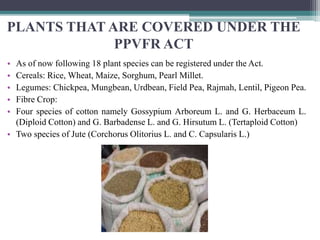
PLANTS THAT ARE COVERED UNDER THE
PPVFR ACT
• As of now following 18 plant species can be registered under the Act.
• Cereals: Rice, Wheat, Maize, Sorghum, Pearl Millet.
• Legumes: Chickpea, Mungbean, Urdbean, Field Pea, Rajmah, Lentil, Pigeon Pea.
• Fibre Crop:
• Four species of cotton namely Gossypium Arboreum L. and G. Herbaceum L.
(Diploid Cotton) and G. Barbadense L. and G. Hirsutum L. (Tertaploid Cotton)
• Two species of Jute (Corchorus Olitorius L. and C. Capsularis L.)
THE RIGHTS ENJOYED BY THE OWNER OF
VARIETY/BREEDER’S RIGHTS
The owner of the protected variety has the following
rights
a. To produce
b. To Sell
c. To market
d. To distribute
e. To import and
f. To export the variety.
• The knowledge of the indigenous people and the traditional
farmers has made a significant contribution in the
development of new crop types and biodiversity
conservation.
• Monsanto sued farmers for re-sowing GM seed62:
Monsanto Company is suing dozens of American and
Canadian farmers for infringement of its patent on
genetically modified (GM) crops. Investigators hired by the
company keeps an eye on the farmers and collect evidence
of the illegal planting of the Monsanto’s GM crops of cotton,
maize, rapeseed and soybean. Farmers who used Monsanto’s
crops to produce seed for planting have been fined thousand
of dollars for patent infringement and some face bankruptcy.
The company also advertises a toll-free-telephone number
for people to inform on farmers who use unlicensed seed.
• BENEFIT SHARING
The Plant Variety Act of India has benefit sharing mechanisms
which requires sharing the benefits arising from
commercialization of traditional knowledge. The bio-diversity
has a great economic value and hence need to be conserved.
Unless there is adequate incentive for conserving the bio
diversity for future generations, there will be genetic erosion that
will ultimately be detrimental to the interests of the society.
• Case Study of Jeevani: the Miracle Drug
The drug Jeevani is developed from the perennial plant
Arogyapaacha. Four patent applications were filed on Jeevani.
The technology was then licensed to the Arya Vaidya Pharmacy
Ltd. an Indian pharmaceutical manufacturer pursuing the
commercialization of ayurvedic herbal formulations. A trust was
established to share the benefits arising from the
commercialization of the traditional knowledge based drug called
‘Jeevani’. The rationale attributed being, if the local communities
had not conserved the biodiversity, the probability of scientists
making any selection at all would have been remote or nil.
plant variety protection and farmer act

plant variety protection and farmer act

  • 1.
    Presentation on PROTECTION OFPLANT VARIETIES AND FARMERS' RIGHTS ACT Submitted To: Submitted By : Dr. Hulas Pathak Bhupendra Kumar Patel (Course Teacher) M.Sc.(Ag.) Previous Dept. of Genetics &Plant Breeding
  • 2.
    OUTLINES Plant variety protection& farmers act What are farmers’ rights? Objectives of ppvfr act The plant variety protection and farmers rights act 2001 Why protection for plants is required in India? What is a plant variety Registerable plant varieties in India Non-registerable plant varieties in India Criteria for protecting a plant variety Who can apply for the registration of a plant variety? Where to file the application for the registration of a plant variety? Prerequisites for filing an application form for Registration of plant variety Deposition of seed or propagating material before Registration Duration of protection for a registered plant variety Exemptions provided under the act Plants that are covered under the ppvfr act The rights enjoyed by the owner of variety/breeder’s rights
  • 3.
    PLANT VARIETY PROTECTION& THE PURPOSE • Plant variety protection provides legal protection of a plant variety to a breeder in the form of Plant breeder’s rights. • Plant Breeder’s Rights are intellectual property rights that provide exclusive rights to a breeder of the registered variety.
  • 4.
    What are farmers’rights? i. A farmer who has bred or developed a new variety shall be entitled for registration and other protection in like manner as a breeder of a variety under this Act; ii. The farmers’ variety shall be entitled for registration if the application contains declaration as specified in clause (h) or sub-section (1) of section 18; iii. A farmer who is engaged in the conservation of genetic resources of land races and wild relatives of economic plants and their improvement through selection and preservation shall be entitled in the prescribed manner for recognition and reward from the Gene Fund. Provided that material so selected and preserved has been used as donors of genes in varieties registerable under this Act; iv. A farmer shall be deemed to be entitled to save, use, sow, resow , exchange, share or sell his farm produce including seed of a variety protected under this Act in the same manner as he was entitled before the coming into force of this Act.  Note: Branded seed means any seed put in a package or any other container and labelled in a manner which gives indication that such seed is of a variety protected under this Act.
  • 5.
    Objectives of PPVFRAct 1. To stimulate investments for research and development both in the public and the private sectors for the developments of new plant varieties by ensuring appropriate returns on such investments; 2. To facilitate the growth of the seed industry in the country through domestic and foreign investment which will ensure the availability of high quality seeds and planting material to Indian farmers; and 3. To recognize the role of farmers as cultivators and conservers and the contribution of traditional, rural and tribal communities to the country’s agro biodiversity by rewarding them for their contribution through benefit sharing and protecting the traditional right of the farmers.
  • 6.
    THE PLANT VARIETYPROTECTION AND FARMERS RIGHTS ACT 2001 • a sui generis system, is an attempt by the Indian Government to recognize and protect the rights of both commercial plant breeders and farmers in respect of their contribution made in conserving, improving and making available plant genetic resources for development of new plant varieties and to encourage the development of new plants varieties. • Protection of the plant varieties under the Act accelerates agricultural development and stimulates investment for research and development for the development of new plant varieties which in turn facilities the growth of the seed industry and ensures the availability of high quality seeds and plant in material to the farmers.
  • 7.
    WHY PROTECTION FORPLANTS IS REQUIRED IN India? • The Agreement on TRIPS requires WTO members to introduce an “effective system” for the protection of plant varieties. Article 27 (3) of the TRIPS agreement reads • Member countries may exclude “plants and animals other than micro-organisms and essentially biological processes for the production of plants and animals other than non-biological and microbiological processes. However, Members shall provide for the protection of plant varieties either by Patents or by an effective sui generis system or by any combination thereof. • India is among the first countries in the world to have passed legislation granting Farmers' Rights in the form of the Protection of Plant Varieties and Farmers' Rights Act, 2001 (PPVFR). • Nine rights are given to farmers under the Act including: the rights to save, exchange and (to a limited extent) sell seeds and propagating material, to register varieties, to recognition and reward for conservation of varieties, to benefit sharing, to information about expected performance of a variety, compensation for failure of variety to perform, availability of seeds of registered variety, free services for registration, conducting tests on varieties, legal claims under the Act, and protection from infringement.
  • 8.
    WHAT IS APLANT VARIETY • A variety is a plant grouping within a single botanical taxon of the lowest known rank, defined by the expression of the characteristics resulting from a given genotype or combination of genotypes. The variety should be distinguished from other plant grouping by expression and should be considered as a unit with regard to its suitability for being propagated unchanged.
  • 9.
    REGISTERABLE PLANT VARIETIESIN India • New Varieties: A Variety which is not in public domain in India earlier than one year before the date of filing or outside India, in the case of trees or vines earlier than six years or in any other case earlier than four years. • Extant Variety: A Variety which is notified under Seed Act, 1966 or a variety about which there is common knowledge or a farmer’s variety or any other variety which is in public domain is considers as an Extant Variety. contd…
  • 10.
    • contd… • Farmer’sVariety: A Variety which has been traditionally cultivated and evolved by the farmers in their fields or a variety which is a wild relative or land race of a variety about which farmers possess common knowledge. • Essentially Derived Variety (EDV): i)Predominantly derived from such initial variety, or from a variety that itself is predominantly derived from such initial variety, while retaining the expression of the essential characteristics that result from the genotype or combination of genotypes of such initial variety. ii)Is clearly distinguishable from such initial variety; and iii)Conforms to such initial variety in the expression of the essential characteristics.
  • 11.
    NON-REGISTERABLE PLANT VARIETIES INIndia • All plant varieties cannot get legal protection in India. Certain Plant varieties are excluded from the protection under PPVFR Act 2001. Any variety where prevention of commercial exploitation of such variety is necessary to protect public order or public morality or human, animal and plant life and health or to avoid serious prejudice to the environment or any varieties which has terminator technology or any variety belonging to the species or genera which is not listed in the notification issued by the Central Government cannot be registered for the protection under the Act.
  • 12.
    CRITERIA FOR PROTECTINGA PLANT VARIETY The plant variety must be: • Distinct: A variety should be clearly distinguishable by at least one essential characteristic from existing or commonly known varieties in any country at the time of filing of the application. • Uniform: A Variety must be sufficiently uniform in its essential characteristics. • Stable: Essential characteristics of a variety must be stable after repeated propagation or in the case of a particular cycle of propagation at the end of each cycle.
  • 13.
    WHO CAN APPLYFOR THE REGISTRATION OF A PLANT VARIETY? • Any person claiming to be the breeder of the variety; • Any successor of the breeder of the variety; • Any person being the Assignee or the breeder of the variety in respect of the right to make such application; • Any farmer or group of farmers or community of farmers claiming to the breeder of the variety; • Any person authorized to make application on behalf of farmers; and • Any university or publicly funded agricultural institution claiming to the breeder of the variety.
  • 14.
    WHERE TO FILETHE APPLICATION FOR THE REGISTRATION OF A PLANT VARIETY? • For the purposes of Protection of Plant Varieties and Framers Right Act, 2001 Protection of Plant Varieties and Farmers Right Authority was established in October 2005 and its Head Quarters is located at NASC Complex, DPS Marg, Opp-Todapur, New Delhi – 110 012. • Any information regarding protection, application, fee structure etc can be obtained from the office or at http://www.Plantauthority.gov.in/
  • 15.
    PREREQUISITES FOR FILINGAN APPLICATION FORM FOR REGISTERATION OF PLANT VARIETY • Denomination assigned to such variety • An affidavit that variety does not contain any gene or gene sequence involving terminator technology • Complete passport data of parental lines with its geographical location in India and all such information relating to the contribution if any, of any farmer(s) village, community, institution etc in breeding and developing the variety • Characteristics of variety with description of Novelty, Distinctiveness, Uniformity and Stability • A declaration that the genetic material used for breeding of such variety has been lawfully acquired • A breeder or other person making application for registration shall disclose the use of genetic material conserved by any tribal or rural families for improvement of such variety
  • 16.
    DEPOSITION OF SEEDOR PROPAGATING MATERIAL BEFORE REGISTRATION • Deposition of seeds is necessary for DUS test conducted by PPV & FR authority. The applicant needs to deposit the fixed amount of seed or propagating material with prescribed germination percentage and physical purity along with the seed quality test report to the authority.
  • 17.
    DURATION OF PROTECTIONFOR A REGISTERED PLANT VARIETY • Trees and Vines: 18 Years • Other crops: 15 Years. • Extant Varieties: 15 Years from the date of notification of that variety by the Central Government under Seed Act, 1966.
  • 18.
    EXEMPTIONS PROVIDED UNDERTHE ACT • Farmers Exemption: Farmer shall be entitled to produce, save, use, sow, re-sow, exchange, share or sell his farm produce including seed of a variety protected under this Act. • Researchers Exemption: Researchers are allowed to (i)use the registered variety for conducting experiment • (ii) use the variety as an initial source of variety for the purpose of creating other varieties.
  • 19.
    PLANTS THAT ARECOVERED UNDER THE PPVFR ACT • As of now following 18 plant species can be registered under the Act. • Cereals: Rice, Wheat, Maize, Sorghum, Pearl Millet. • Legumes: Chickpea, Mungbean, Urdbean, Field Pea, Rajmah, Lentil, Pigeon Pea. • Fibre Crop: • Four species of cotton namely Gossypium Arboreum L. and G. Herbaceum L. (Diploid Cotton) and G. Barbadense L. and G. Hirsutum L. (Tertaploid Cotton) • Two species of Jute (Corchorus Olitorius L. and C. Capsularis L.)
  • 20.
    THE RIGHTS ENJOYEDBY THE OWNER OF VARIETY/BREEDER’S RIGHTS The owner of the protected variety has the following rights a. To produce b. To Sell c. To market d. To distribute e. To import and f. To export the variety.
  • 21.
    • The knowledgeof the indigenous people and the traditional farmers has made a significant contribution in the development of new crop types and biodiversity conservation. • Monsanto sued farmers for re-sowing GM seed62: Monsanto Company is suing dozens of American and Canadian farmers for infringement of its patent on genetically modified (GM) crops. Investigators hired by the company keeps an eye on the farmers and collect evidence of the illegal planting of the Monsanto’s GM crops of cotton, maize, rapeseed and soybean. Farmers who used Monsanto’s crops to produce seed for planting have been fined thousand of dollars for patent infringement and some face bankruptcy. The company also advertises a toll-free-telephone number for people to inform on farmers who use unlicensed seed.
  • 22.
    • BENEFIT SHARING ThePlant Variety Act of India has benefit sharing mechanisms which requires sharing the benefits arising from commercialization of traditional knowledge. The bio-diversity has a great economic value and hence need to be conserved. Unless there is adequate incentive for conserving the bio diversity for future generations, there will be genetic erosion that will ultimately be detrimental to the interests of the society. • Case Study of Jeevani: the Miracle Drug The drug Jeevani is developed from the perennial plant Arogyapaacha. Four patent applications were filed on Jeevani. The technology was then licensed to the Arya Vaidya Pharmacy Ltd. an Indian pharmaceutical manufacturer pursuing the commercialization of ayurvedic herbal formulations. A trust was established to share the benefits arising from the commercialization of the traditional knowledge based drug called ‘Jeevani’. The rationale attributed being, if the local communities had not conserved the biodiversity, the probability of scientists making any selection at all would have been remote or nil.