An ASSIGNMENT on
GEOGRAPHICAL INDICATION
SUBMITTED TO- Dr. ( Prof.) S.B.S. YADAV
SUBMITTED BY – UMESH KUMAR
PRAJAPAT
M.V.Sc 1st Year
ANIMAL NUTRITION
DEPARTMENT
DEFINITION OF GEOGRAPHICAL INDICATION
A geographical indication is a sign used on
goods that have a specific geographical origin
and possess qualities, a reputation or
characteristics that are essentially attributable to
that place of origin.
Most commonly, a geographical indication
includes the name of the place of origin of the
goods. For example, agricultural products
typically have qualities that derive from their
place of production and are influenced by
specific local factors, such as climate and soil.
BASE OF GEOGRAPHICAL INDICATIONS
Name of country region or locality (Darjeeling
Tea)
Any name which relates to a specific
geographical area and is used upon or in
relation to particular goods originating from that
country region or locality(Basmati rice).
Goods - Agricultural, Natural , Manufactured,
Handicrafts , Industrial products, Food stuffs etc.
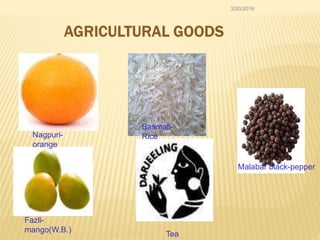
AGRICULTURAL GOODS
 Nagpuri-orange(Maharashtra)
 Fazli-Mango (W.B.)
 Spice –Malabar-pepper(Kerala)
 BhaliaWheat – Bhal region(Gujrat)
 Udupimattu gulla Brinjal(karnataka)
3/20/2016
Fazli-
mango(W.B.)
Basmati-
Rice
Tea
Malabar black-pepper
Nagpuri-
orange
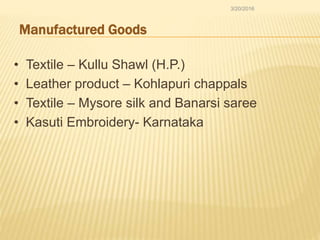
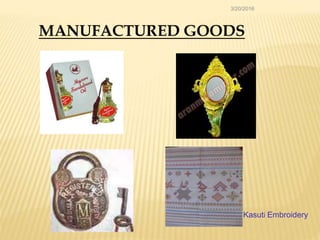
Manufactured Goods
• Textile – Kullu Shawl (H.P.)
• Leather product – Kohlapuri chappals
• Textile – Mysore silk and Banarsi saree
• Kasuti Embroidery- Karnataka
3/20/2016
3/20/2016
Kasuti Embroidery
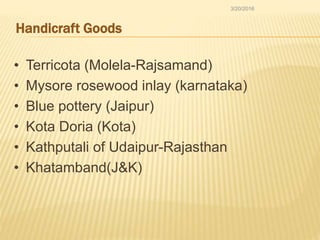
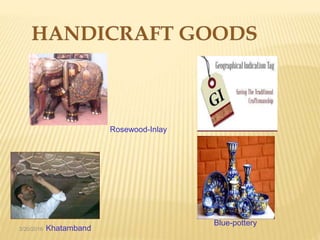
Handicraft Goods
• Terricota (Molela-Rajsamand)
• Mysore rosewood inlay (karnataka)
• Blue pottery (Jaipur)
• Kota Doria (Kota)
• Kathputali of Udaipur-Rajasthan
• Khatamband(J&K)
3/20/2016
3/20/2016
Rosewood-Inlay
Blue-pottery
Khatamband
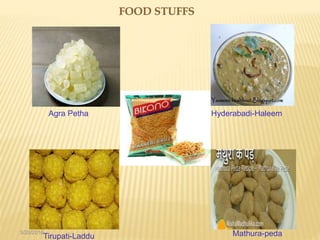
Food stuffs
• Bikaneri bhujiya-Bikaner(Raj.)
• Nagauri maalpua-(Raj.)
• Agra Petha-Agra(U.P.)
• Mathura peda-(U.P.)
• Andhra pickles-(Andhrapradesh)
• Tirupati Laddu/Srivari laddu- (Andhrapradesh)
3/20/2016
3/20/2016
Agra Petha Hyderabadi-Haleem
Tirupati-Laddu Mathura-peda
NATURAL GOODS
 LIGNITE- NEYVELLI
 GOLD -KOLAR, JOHANNESBURG, S.
AFRICA
 PETROLEUM – ARABIAN
WHAT IS THE DIFFERENCE BETWEEN A
GEOGRAPHICAL INDICATION AND A TRADEMARK?
 GIs are closely related to trademarks; both indicate product
origin
 Trademarks identify a good or service as originating from a
particular company. Geographical indications identify a good as
originating from a particular place. Based on its place of origin,
consumers may associate a good with a particular quality,
characteristic or reputation.
• GIs attach to a location; trademarks don’t.
 A trademark can be assigned or licensed to anyone, anywhere in
the world, because it is linked to a specific company and not to a
particular place.
 the sign denote a GI used by all persons who, in the area of
origin, However, its link with the place of origin. A GI cannot be
assigned or licensed to someone outside that place or not
belonging to the group of authorized producers.
WHO CAN APPLY FOR THE REGISTRATION OF A
GEOGRAPHICAL INDICATION
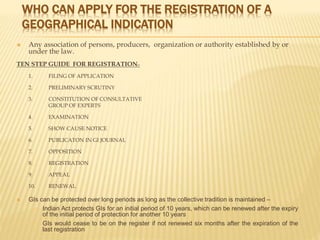
 Any association of persons, producers, organization or authority established by or
under the law.
TEN STEP GUIDE FOR REGISTRATION:-
1. FILING OF APPLICATION
2. PRELIMINARY SCRUTINY
3. CONSTITUTION OF CONSULTATIVE
GROUP OF EXPERTS
4. EXAMINATION
5. SHOW CAUSE NOTICE
6. PUBLICATON IN GI JOURNAL
7. OPPOSITION
8. REGISTRATION
9. APPEAL
10. RENEWAL
 GIs can be protected over long periods as long as the collective tradition is maintained –
 Indian Act protects GIs for an initial period of 10 years, which can be renewed after the expiry
of the initial period of protection for another 10 years
 GIs would cease to be on the register if not renewed six months after the expiration of the
last registration
WHY PROTECT A GEOGRAPHICAL INDICATION?
 Geographical indications are understood by consumers to
denote the origin and the quality of products.
 Many of them have acquired valuable reputations which,
if not adequately protected, may be misrepresented by
dishonest commercial operators and False use of
geographical indications by unauthorized parties and
legitimate producers are detrimental to consumers then
its results tarnishing its reputation.
 Consumers are deceived into believing that they are
buying a genuine product with specific qualities and
characteristics, when they are in fact getting an imitation.
Legitimate producers are deprived of valuable business
and the established reputation of their products is
damaged.
Why are geographical indications valuable?
• GIs are a marketing tool.
• Reputation for quality associated with place
name used on labels, advertising.
• GI-identified products are believed to
command higher prices.
• Of particular interest to developing countries.
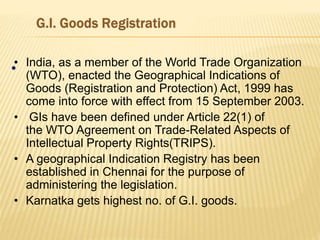
•• India, as a member of the World Trade Organization
(WTO), enacted the Geographical Indications of
Goods (Registration and Protection) Act, 1999 has
come into force with effect from 15 September 2003.
• GIs have been defined under Article 22(1) of
the WTO Agreement on Trade-Related Aspects of
Intellectual Property Rights(TRIPS).
• A geographical Indication Registry has been
established in Chennai for the purpose of
administering the legislation.
• Karnatka gets highest no. of G.I. goods.
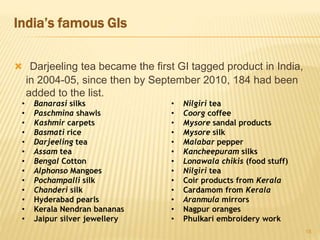
India’s famous GIs
 Darjeeling tea became the first GI tagged product in India,
in 2004-05, since then by September 2010, 184 had been
added to the list.
18
• Banarasi silks
• Paschmina shawls
• Kashmir carpets
• Basmati rice
• Darjeeling tea
• Assam tea
• Bengal Cotton
• Alphonso Mangoes
• Pochampalli silk
• Chanderi silk
• Hyderabad pearls
• Kerala Nendran bananas
• Jaipur silver jewellery
• Nilgiri tea
• Coorg coffee
• Mysore sandal products
• Mysore silk
• Malabar pepper
• Kancheepuram silks
• Lonawala chikis (food stuff)
• Nilgiri tea
• Coir products from Kerala
• Cardamom from Kerala
• Aranmula mirrors
• Nagpur oranges
• Phulkari embroidery work
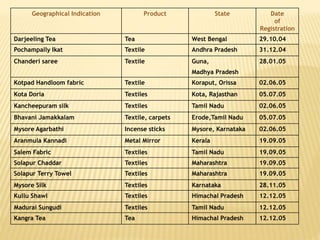
Geographical Indication Product State Date
of
Registration
Darjeeling Tea Tea West Bengal 29.10.04
Pochampally Ikat Textile Andhra Pradesh 31.12.04
Chanderi saree Textile Guna, 28.01.05
Madhya Pradesh
Kotpad Handloom fabric Textile Koraput, Orissa 02.06.05
Kota Doria Textiles Kota, Rajasthan 05.07.05
Kancheepuram silk Textiles Tamil Nadu 02.06.05
Bhavani Jamakkalam Textile, carpets Erode,Tamil Nadu 05.07.05
Mysore Agarbathi Incense sticks Mysore, Karnataka 02.06.05
Aranmula Kannadi Metal Mirror Kerala 19.09.05
Salem Fabric Textiles Tamil Nadu 19.09.05
Solapur Chaddar Textiles Maharashtra 19.09.05
Solapur Terry Towel Textiles Maharashtra 19.09.05
Mysore Silk Textiles Karnataka 28.11.05
Kullu Shawl Textiles Himachal Pradesh 12.12.05
Madurai Sungudi Textiles Tamil Nadu 12.12.05
Kangra Tea Tea Himachal Pradesh 12.12.05
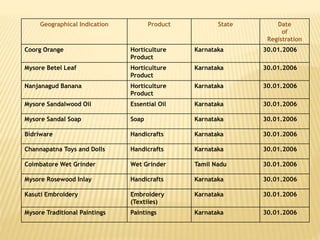
Geographical Indication Product State Date
of
Registration
Coorg Orange Horticulture
Product
Karnataka 30.01.2006
Mysore Betel Leaf Horticulture
Product
Karnataka 30.01.2006
Nanjanagud Banana Horticulture
Product
Karnataka 30.01.2006
Mysore Sandalwood Oil Essential Oil Karnataka 30.01.2006
Mysore Sandal Soap Soap Karnataka 30.01.2006
Bidriware Handicrafts Karnataka 30.01.2006
Channapatna Toys and Dolls Handicrafts Karnataka 30.01.2006
Coimbatore Wet Grinder Wet Grinder Tamil Nadu 30.01.2006
Mysore Rosewood Inlay Handicrafts Karnataka 30.01.2006
Kasuti Embroidery Embroidery
(Textiles)
Karnataka 30.01.2006
Mysore Traditional Paintings Paintings Karnataka 30.01.2006
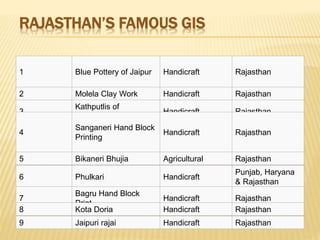
RAJASTHAN’S FAMOUS GIS
1 Blue Pottery of Jaipur Handicraft Rajasthan
2 Molela Clay Work Handicraft Rajasthan
3
Kathputlis of
Rajasthan
Handicraft Rajasthan
4
Sanganeri Hand Block
Printing
Handicraft Rajasthan
5 Bikaneri Bhujia Agricultural Rajasthan
6 Phulkari Handicraft
Punjab, Haryana
& Rajasthan
7
Bagru Hand Block
Print
Handicraft Rajasthan
8 Kota Doria Handicraft Rajasthan
9 Jaipuri rajai Handicraft Rajasthan
geographical indications

geographical indications

  • 1.
    An ASSIGNMENT on GEOGRAPHICALINDICATION SUBMITTED TO- Dr. ( Prof.) S.B.S. YADAV SUBMITTED BY – UMESH KUMAR PRAJAPAT M.V.Sc 1st Year ANIMAL NUTRITION DEPARTMENT
  • 2.
    DEFINITION OF GEOGRAPHICALINDICATION A geographical indication is a sign used on goods that have a specific geographical origin and possess qualities, a reputation or characteristics that are essentially attributable to that place of origin. Most commonly, a geographical indication includes the name of the place of origin of the goods. For example, agricultural products typically have qualities that derive from their place of production and are influenced by specific local factors, such as climate and soil.
  • 3.
    BASE OF GEOGRAPHICALINDICATIONS Name of country region or locality (Darjeeling Tea) Any name which relates to a specific geographical area and is used upon or in relation to particular goods originating from that country region or locality(Basmati rice). Goods - Agricultural, Natural , Manufactured, Handicrafts , Industrial products, Food stuffs etc.
  • 4.
    AGRICULTURAL GOODS  Nagpuri-orange(Maharashtra) Fazli-Mango (W.B.)  Spice –Malabar-pepper(Kerala)  BhaliaWheat – Bhal region(Gujrat)  Udupimattu gulla Brinjal(karnataka)
  • 5.
  • 6.
    Manufactured Goods • Textile– Kullu Shawl (H.P.) • Leather product – Kohlapuri chappals • Textile – Mysore silk and Banarsi saree • Kasuti Embroidery- Karnataka 3/20/2016
  • 7.
  • 8.
    Handicraft Goods • Terricota(Molela-Rajsamand) • Mysore rosewood inlay (karnataka) • Blue pottery (Jaipur) • Kota Doria (Kota) • Kathputali of Udaipur-Rajasthan • Khatamband(J&K) 3/20/2016
  • 9.
  • 10.
    Food stuffs • Bikaneribhujiya-Bikaner(Raj.) • Nagauri maalpua-(Raj.) • Agra Petha-Agra(U.P.) • Mathura peda-(U.P.) • Andhra pickles-(Andhrapradesh) • Tirupati Laddu/Srivari laddu- (Andhrapradesh) 3/20/2016
  • 11.
  • 12.
    NATURAL GOODS  LIGNITE-NEYVELLI  GOLD -KOLAR, JOHANNESBURG, S. AFRICA  PETROLEUM – ARABIAN
  • 13.
    WHAT IS THEDIFFERENCE BETWEEN A GEOGRAPHICAL INDICATION AND A TRADEMARK?  GIs are closely related to trademarks; both indicate product origin  Trademarks identify a good or service as originating from a particular company. Geographical indications identify a good as originating from a particular place. Based on its place of origin, consumers may associate a good with a particular quality, characteristic or reputation. • GIs attach to a location; trademarks don’t.  A trademark can be assigned or licensed to anyone, anywhere in the world, because it is linked to a specific company and not to a particular place.  the sign denote a GI used by all persons who, in the area of origin, However, its link with the place of origin. A GI cannot be assigned or licensed to someone outside that place or not belonging to the group of authorized producers.
  • 14.
    WHO CAN APPLYFOR THE REGISTRATION OF A GEOGRAPHICAL INDICATION  Any association of persons, producers, organization or authority established by or under the law. TEN STEP GUIDE FOR REGISTRATION:- 1. FILING OF APPLICATION 2. PRELIMINARY SCRUTINY 3. CONSTITUTION OF CONSULTATIVE GROUP OF EXPERTS 4. EXAMINATION 5. SHOW CAUSE NOTICE 6. PUBLICATON IN GI JOURNAL 7. OPPOSITION 8. REGISTRATION 9. APPEAL 10. RENEWAL  GIs can be protected over long periods as long as the collective tradition is maintained –  Indian Act protects GIs for an initial period of 10 years, which can be renewed after the expiry of the initial period of protection for another 10 years  GIs would cease to be on the register if not renewed six months after the expiration of the last registration
  • 15.
    WHY PROTECT AGEOGRAPHICAL INDICATION?  Geographical indications are understood by consumers to denote the origin and the quality of products.  Many of them have acquired valuable reputations which, if not adequately protected, may be misrepresented by dishonest commercial operators and False use of geographical indications by unauthorized parties and legitimate producers are detrimental to consumers then its results tarnishing its reputation.  Consumers are deceived into believing that they are buying a genuine product with specific qualities and characteristics, when they are in fact getting an imitation. Legitimate producers are deprived of valuable business and the established reputation of their products is damaged.
  • 16.
    Why are geographicalindications valuable? • GIs are a marketing tool. • Reputation for quality associated with place name used on labels, advertising. • GI-identified products are believed to command higher prices. • Of particular interest to developing countries.
  • 17.
    •• India, asa member of the World Trade Organization (WTO), enacted the Geographical Indications of Goods (Registration and Protection) Act, 1999 has come into force with effect from 15 September 2003. • GIs have been defined under Article 22(1) of the WTO Agreement on Trade-Related Aspects of Intellectual Property Rights(TRIPS). • A geographical Indication Registry has been established in Chennai for the purpose of administering the legislation. • Karnatka gets highest no. of G.I. goods.
  • 18.
    India’s famous GIs Darjeeling tea became the first GI tagged product in India, in 2004-05, since then by September 2010, 184 had been added to the list. 18 • Banarasi silks • Paschmina shawls • Kashmir carpets • Basmati rice • Darjeeling tea • Assam tea • Bengal Cotton • Alphonso Mangoes • Pochampalli silk • Chanderi silk • Hyderabad pearls • Kerala Nendran bananas • Jaipur silver jewellery • Nilgiri tea • Coorg coffee • Mysore sandal products • Mysore silk • Malabar pepper • Kancheepuram silks • Lonawala chikis (food stuff) • Nilgiri tea • Coir products from Kerala • Cardamom from Kerala • Aranmula mirrors • Nagpur oranges • Phulkari embroidery work
  • 19.
    Geographical Indication ProductState Date of Registration Darjeeling Tea Tea West Bengal 29.10.04 Pochampally Ikat Textile Andhra Pradesh 31.12.04 Chanderi saree Textile Guna, 28.01.05 Madhya Pradesh Kotpad Handloom fabric Textile Koraput, Orissa 02.06.05 Kota Doria Textiles Kota, Rajasthan 05.07.05 Kancheepuram silk Textiles Tamil Nadu 02.06.05 Bhavani Jamakkalam Textile, carpets Erode,Tamil Nadu 05.07.05 Mysore Agarbathi Incense sticks Mysore, Karnataka 02.06.05 Aranmula Kannadi Metal Mirror Kerala 19.09.05 Salem Fabric Textiles Tamil Nadu 19.09.05 Solapur Chaddar Textiles Maharashtra 19.09.05 Solapur Terry Towel Textiles Maharashtra 19.09.05 Mysore Silk Textiles Karnataka 28.11.05 Kullu Shawl Textiles Himachal Pradesh 12.12.05 Madurai Sungudi Textiles Tamil Nadu 12.12.05 Kangra Tea Tea Himachal Pradesh 12.12.05
  • 20.
    Geographical Indication ProductState Date of Registration Coorg Orange Horticulture Product Karnataka 30.01.2006 Mysore Betel Leaf Horticulture Product Karnataka 30.01.2006 Nanjanagud Banana Horticulture Product Karnataka 30.01.2006 Mysore Sandalwood Oil Essential Oil Karnataka 30.01.2006 Mysore Sandal Soap Soap Karnataka 30.01.2006 Bidriware Handicrafts Karnataka 30.01.2006 Channapatna Toys and Dolls Handicrafts Karnataka 30.01.2006 Coimbatore Wet Grinder Wet Grinder Tamil Nadu 30.01.2006 Mysore Rosewood Inlay Handicrafts Karnataka 30.01.2006 Kasuti Embroidery Embroidery (Textiles) Karnataka 30.01.2006 Mysore Traditional Paintings Paintings Karnataka 30.01.2006
  • 21.
    RAJASTHAN’S FAMOUS GIS 1Blue Pottery of Jaipur Handicraft Rajasthan 2 Molela Clay Work Handicraft Rajasthan 3 Kathputlis of Rajasthan Handicraft Rajasthan 4 Sanganeri Hand Block Printing Handicraft Rajasthan 5 Bikaneri Bhujia Agricultural Rajasthan 6 Phulkari Handicraft Punjab, Haryana & Rajasthan 7 Bagru Hand Block Print Handicraft Rajasthan 8 Kota Doria Handicraft Rajasthan 9 Jaipuri rajai Handicraft Rajasthan