

1
2
INTELLECTUAL
PROPERTY
RIGHTS IN
AGRICULTURE
Revolutions of the late 20th Century
3
GLOBALISATION
INFORMATION
TECHNOLOGY
BIOTECHNOLOGY
INTELLECTUAL
PROPERTY RIGHTS
Expanded
Innovation
Potential
The Mission Is Vital
“Over the next 20 years,
the rice genome will make
more of a difference to
human health than the
human genome”
- Donald Kennedy,
Editor-In -Chief, Science
4
INTRODUCTION
5
• Intellectual Property Rights – gained
importance in face of changing trade
environment.
• Legal right established over the creative or
innovative ideas.
• Signal to the society.
OBJECTIVES
• To understand the concepts of IPR.
• To know the advantages and disadvantages of
IPR.
• To review the studies related to IPR in
Agriculture.
6
EVOLUTION OF IPR
• GATT – signed by 23 countries on
30th Oct.1947.
• Uruguay round – 1986-1994.
• GATT 1994 – redesignated as WTA.
• WTO – established to oversee the
implementation of WTA.
7
• WTA – 16 articles and 4
annexes.
• TRIPS – Annex 1C
8
IPR
INTELLECTUAL PROPERTY RIGHTS
• IPR given to the owners and creators of
invention, designs and literary and
artistic material.
• To protect their ideas and innovations.
• Owner is rewarded and can control its
use.
• Encourage further innovation and
creativity.
• Promote investment in research and
development. 9
• Awarded by the Government.
• Monopoly rights.
• IPR can be assigned, gifted, sold
and licensed like any other
property.
• Territorial rights.
10
• Rights should be renewed from
time to time
• IPR have fixed term.
• These rights can be
simultaneously held in many
countries at the same time.
11
• TRIPS agreement recognizes seven kinds of
intellectual property. They are:-
Patents
Copyrights and related rights
Trademarks
Geographical Indications
Industrial Designs
Layout Designs of integrated circuits
Protection of undisclosed information (Trade
secrets)
12
13
PATENTS
• Patents are legal rights granted for
new inventions employing scientific
and technical knowledge.
• Exclusive right granted by a country
to the owner of the invention.
• Inventiveness Investment
14
• Patent right can be gifted,
inherited, assigned, sold or
licensed.
• Patent protection is granted for
20 years from the date of filing
the application.
15
History and evolution of patent law in
India
Pre Independence status
• First Indian statute of patent – 1856.
• 1859 Act.
• Patents and Designs Protection Act – 1872.
• Indian Patents and Designs Act(IPDA) – 1911.
16
 Post Independence status
• Justice Rajagopal Ayyengar – appointed
to examine the inadequacies of IPDA.
• Patent Bill – 1967.
• Patent Act – 1970.
• Patent Act came into force in 1972.
17
Three phases of India’s evolving patent
regime
18
COLONIAL
PERIOD
INDEPENDENCE
(1947)
GLOBALISATION
(1990 onwards)
•British
imposed
patent
statutes
from 1856
•First
independent
patent law : The
Patent Act,
1970
•Generic drug
manufacturing
sector thrived.
•GATT Uruguay
round negotiations
•Economic Reforms
•WTO/TRIPS
•Patent amendments
Administration of patent
• Administration of patents – Controller
General of Patents,Designs and
Trademark.
• Supervised by – Ministry of Commerce
and Industry, Department of Industrial
Policy and Promotion, GoI.
• Head Office – Calcutta.
• Office of the Controller General –
Mumbai.
19
Patent facilitating organisations
• Patent Facilitating Centre(PFC),New Delhi.
• Patent Information System, Nagpur.
• CSIR- Intellectual Property Management
Division (IPMD),New Delhi.
• National Institute of Science,
Communication and Information Resources
(NISCAIR).
20
• National Research
Development
Corporation(NRDC), New Delhi.
• Society for Technology
Management
(STEM),Hyderabad.
• Patent Information Centre,
Trivandrum.
21
CONDITIONS FOR PATENTABIITY
• Patentable subject matter.
• Novelty.
• Non-obviousness.
• Usefulness.
• Non- patentable inventions- relating
to atomic energy, nuclear
transformations and treatment of
human and animals.
22
• Patents are granted for,
An invention.
Innovation/ improvement over an
innovation.
Process of an invention.
Concept.
23
Procedure for securing patents
• Filing a patent application.
• Submission of documents.
• Disclosure of invention.
24
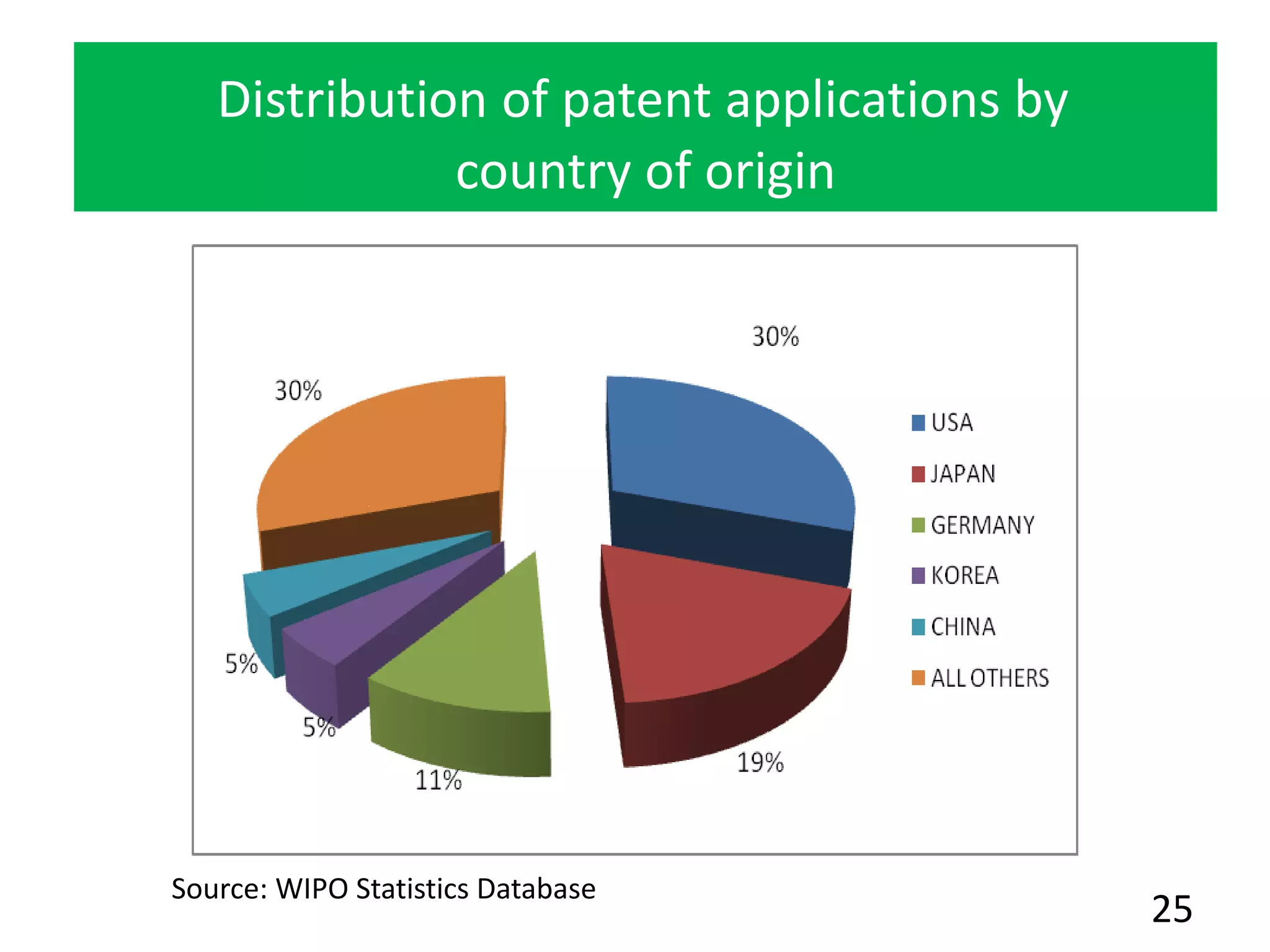
Distribution of patent applications by
country of origin
Source: WIPO Statistics Database
25
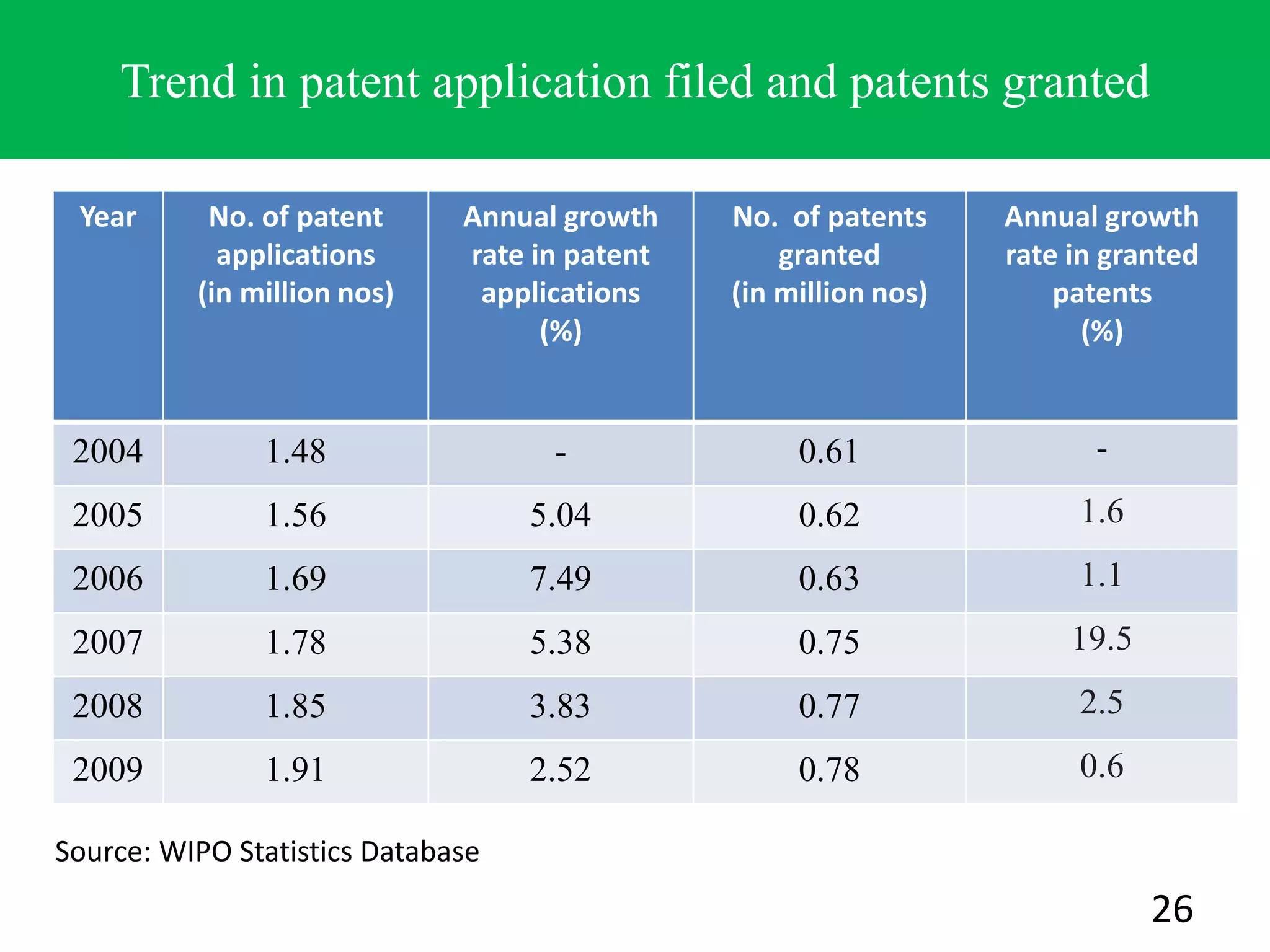
Trend in patent application filed and patents granted
Year No. of patent
applications
(in million nos)
Annual growth
rate in patent
applications
(%)
No. of patents
granted
(in million nos)
Annual growth
rate in granted
patents
(%)
2004 1.48 - 0.61 -
2005 1.56 5.04 0.62 1.6
2006 1.69 7.49 0.63 1.1
2007 1.78 5.38 0.75 19.5
2008 1.85 3.83 0.77 2.5
2009 1.91 2.52 0.78 0.6
Source: WIPO Statistics Database
26
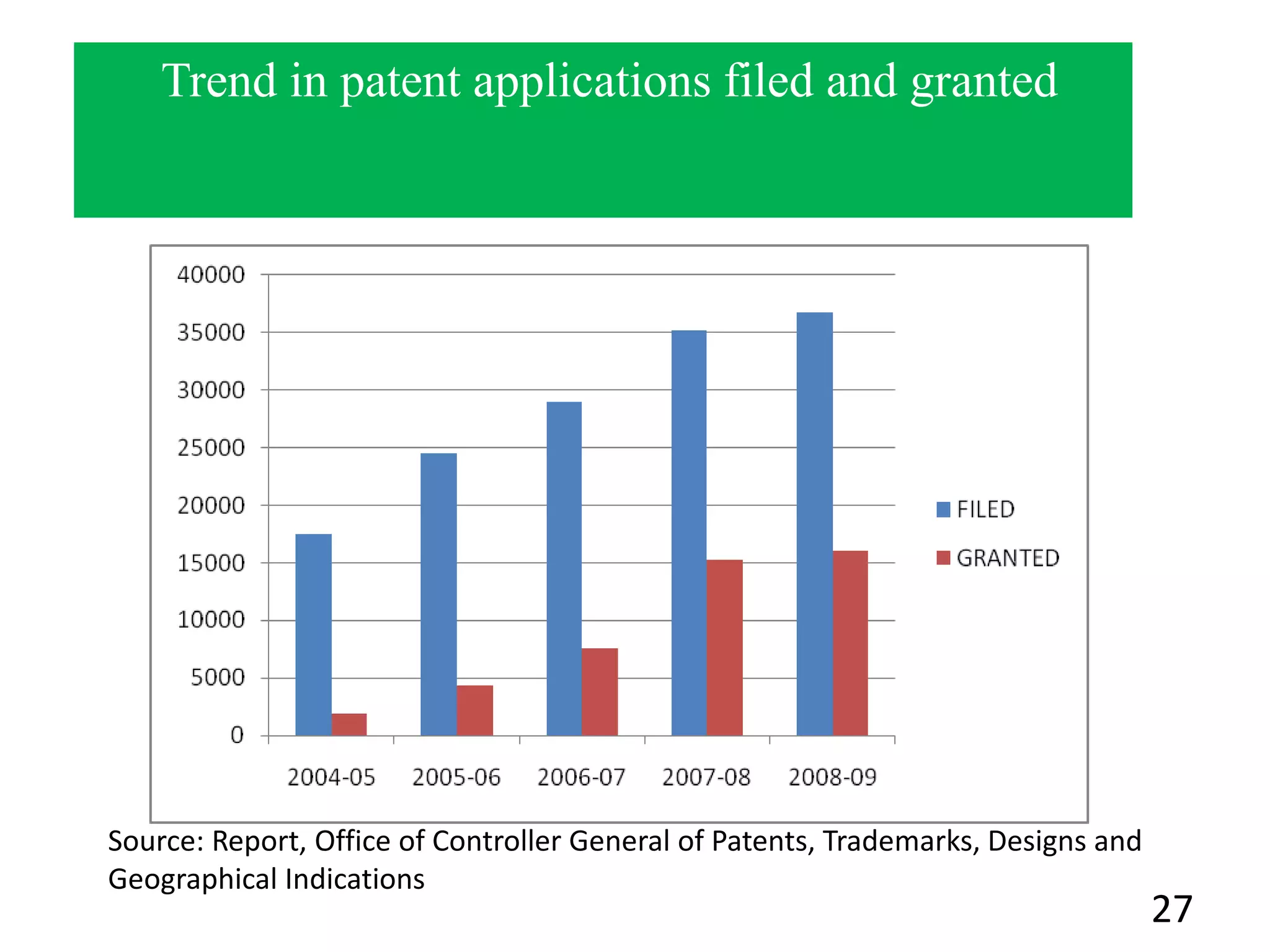
Source: Report, Office of Controller General of Patents, Trademarks, Designs and
Geographical Indications
Trend in patent applications filed and granted
27
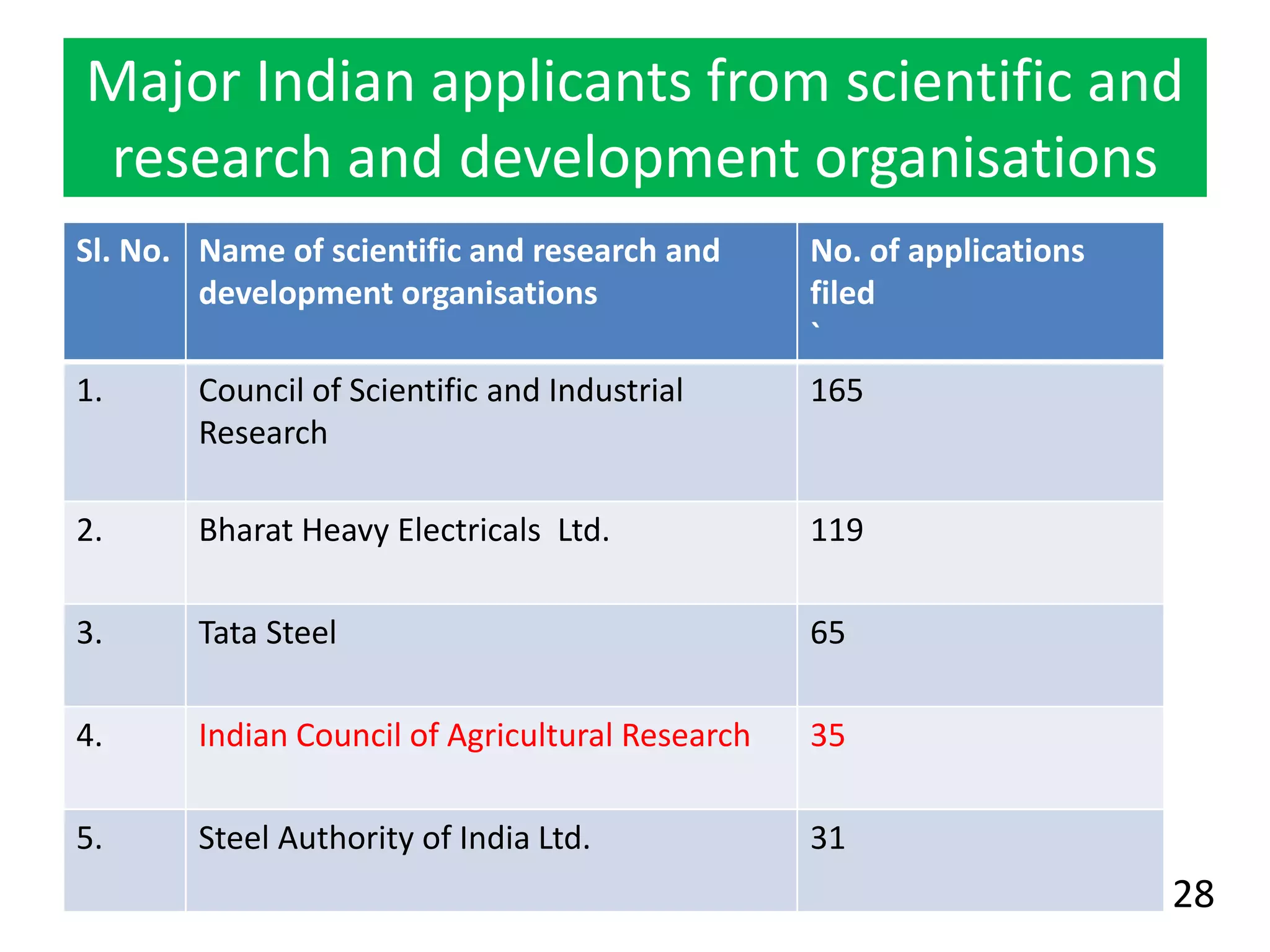
Major Indian applicants from scientific and
research and development organisations
Sl. No. Name of scientific and research and
development organisations
No. of applications
filed
`
1. Council of Scientific and Industrial
Research
165
2. Bharat Heavy Electricals Ltd. 119
3. Tata Steel 65
4. Indian Council of Agricultural Research 35
5. Steel Authority of India Ltd. 31
28
29
Why bother then?
30
Protect your own
ideas
Let others know
your boundaries
Modify others’
ideas legitimately
Don’t become a
trespasser
IPRs are necessary no matter which side of the wall you are on!!
• IPR becomes popular with technology
31
TRADEMARKS
• A word, a logo, a number, a letter, a
slogan etc.
• To identify the services or goods of one
enterprise from those of competitors.
• Maintain and improve the quality of the
product.
• Protection to the owner.
32
• Collective marks – owned by an
association whose members use
them to identify themselves with a
level of quality and other
requirement set by an organisation.
• Certification marks – given for
compliance with the defined
standards, but are not confined to
any membership.
33
Trademark protection
• Application for registration filed
with competent government
authority(trademark office).
• Relevant details, list of goods, signs
along with the prescribed fee.
• Acceptance or refusal will be
published in the trademark register.
34
Service mark – SM
Registered trademark –
• System of international registration
of marks – International Bureau of
WIPO.
• Trademark law treaty – 1996.
35
R
• Trademarks Act – 1999.
• Controller General of Patent
Designs and Trademark –
responsible for implementation of
Trademark law in India.
36
37
GEOGRAPHICAL INDICATION
• An indication.
• To identify agricultural, natural
and manufactured goods.
• Applied to specified goods
originating or manufactured
from a definite geographical
territory.
38
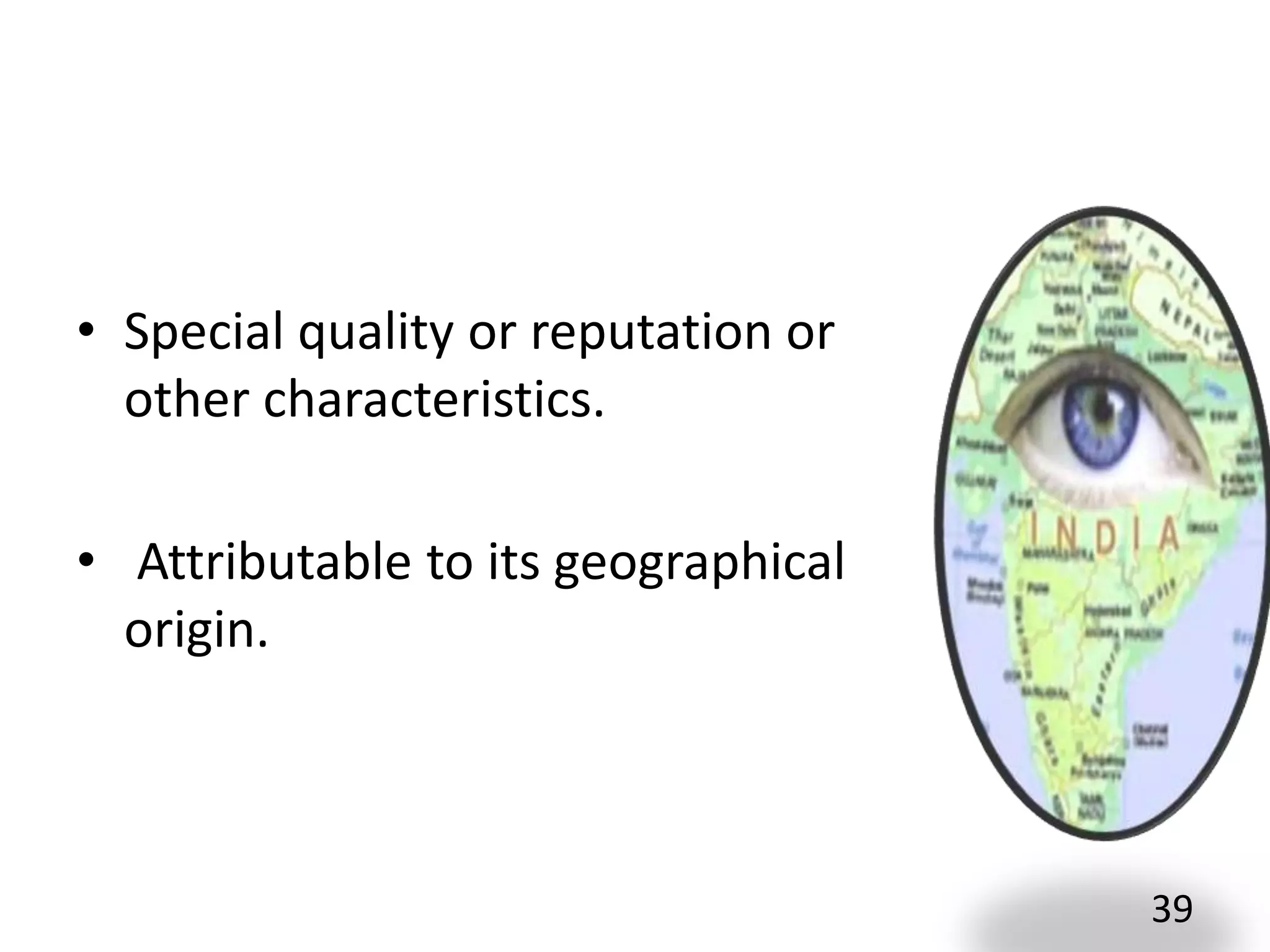
• Special quality or reputation or
other characteristics.
• Attributable to its geographical
origin.
39
Protection of GIs
International level
• Paris convention – 1883
• Madrid agreement – 1891
• Lisbon agreement – 1958
• TRIPS – 1995
National level
• The Geographical Indications of Goods
(Registration and Protection) Act,
1999.
40
• Registrar of GIs – The Controller General of
Patents, Designs and Trademarks.
• GI Registry – Chennai.
• Particulars required for application.
• Application fee – Rs.5000/class of GI.
41
• Registration
• Infringement
• Duration of registration
42
BENEFITS OF REGISTRATION OF GIs
• Confers legal protection to GIs in India.
• Prevents unauthorized use of a GI by others.
• Helps consumers to get quality products of
desired brands.
• Promotes economic prosperity of the
producers of goods.
• Essential to get protection in other
countries.
43
GIs and Developing Countries
• Instrument of Rural Development - benefit to the rural
economy, in particular to less-favored or remote areas.
• Differentiation of products can lead to:
– Increase in prices of the protected products
– Allows genuine producers to capture the rents, entry
barriers for “fakes”
• Large market for genuine products.
44
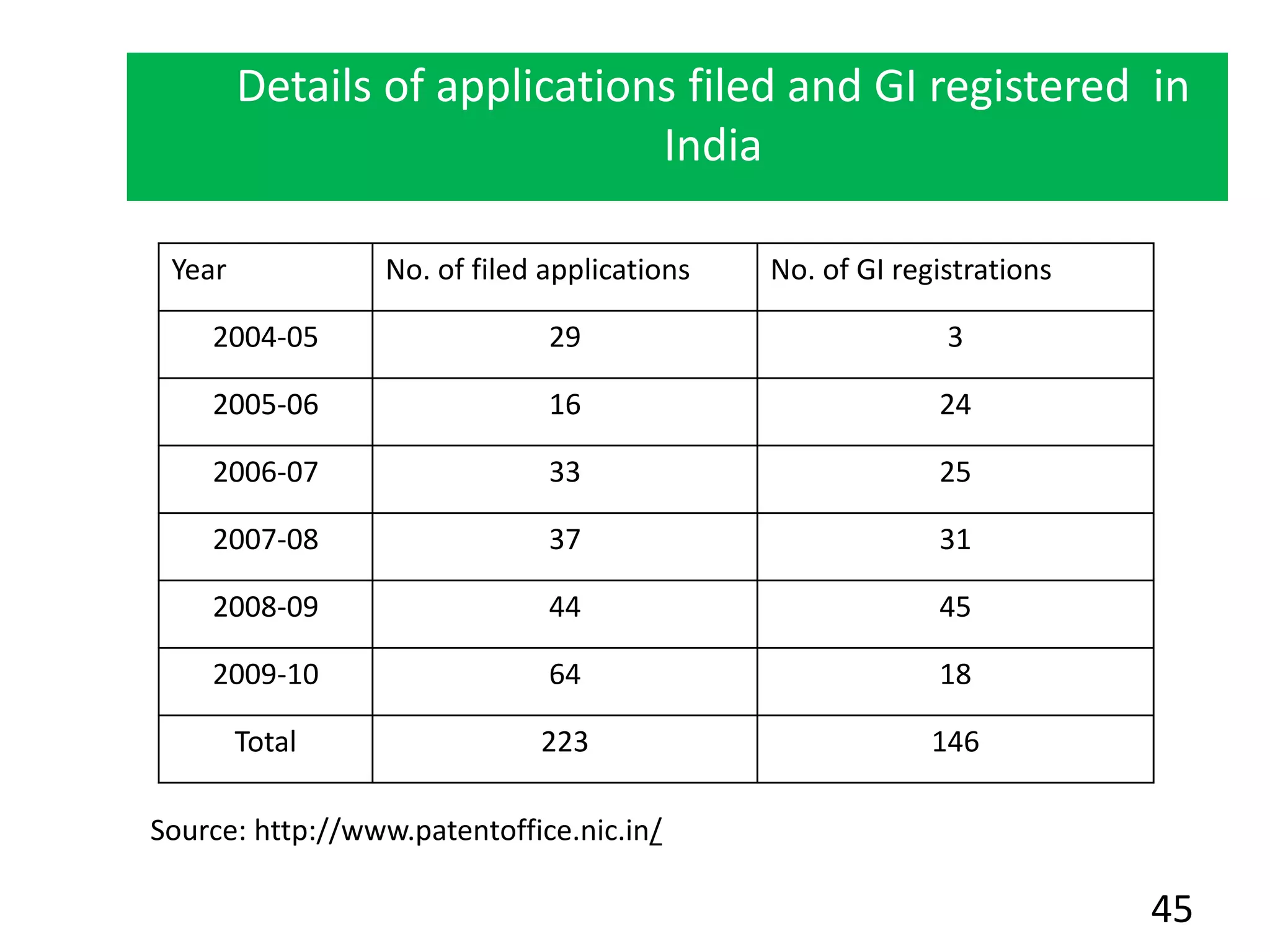
Details of applications filed and GI registered in
India
Year No. of filed applications No. of GI registrations
2004-05 29 3
2005-06 16 24
2006-07 33 25
2007-08 37 31
2008-09 44 45
2009-10 64 18
Total 223 146
Source: http://www.patentoffice.nic.in/
45
Source: http://www.patentoffice.nic.in
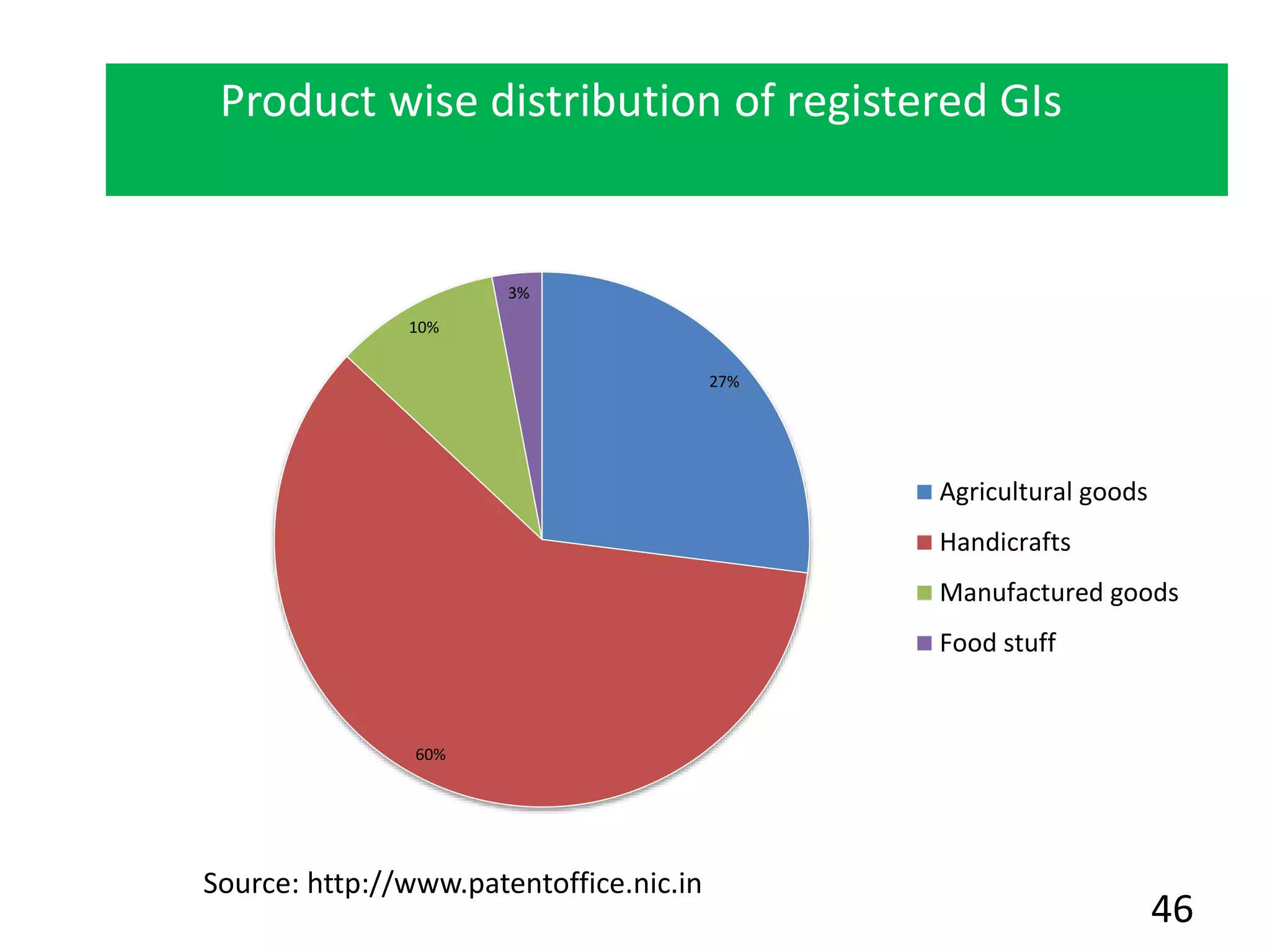
Product wise distribution of registered GIs
46
27%
60%
10%
3%
Agricultural goods
Handicrafts
Manufactured goods
Food stuff
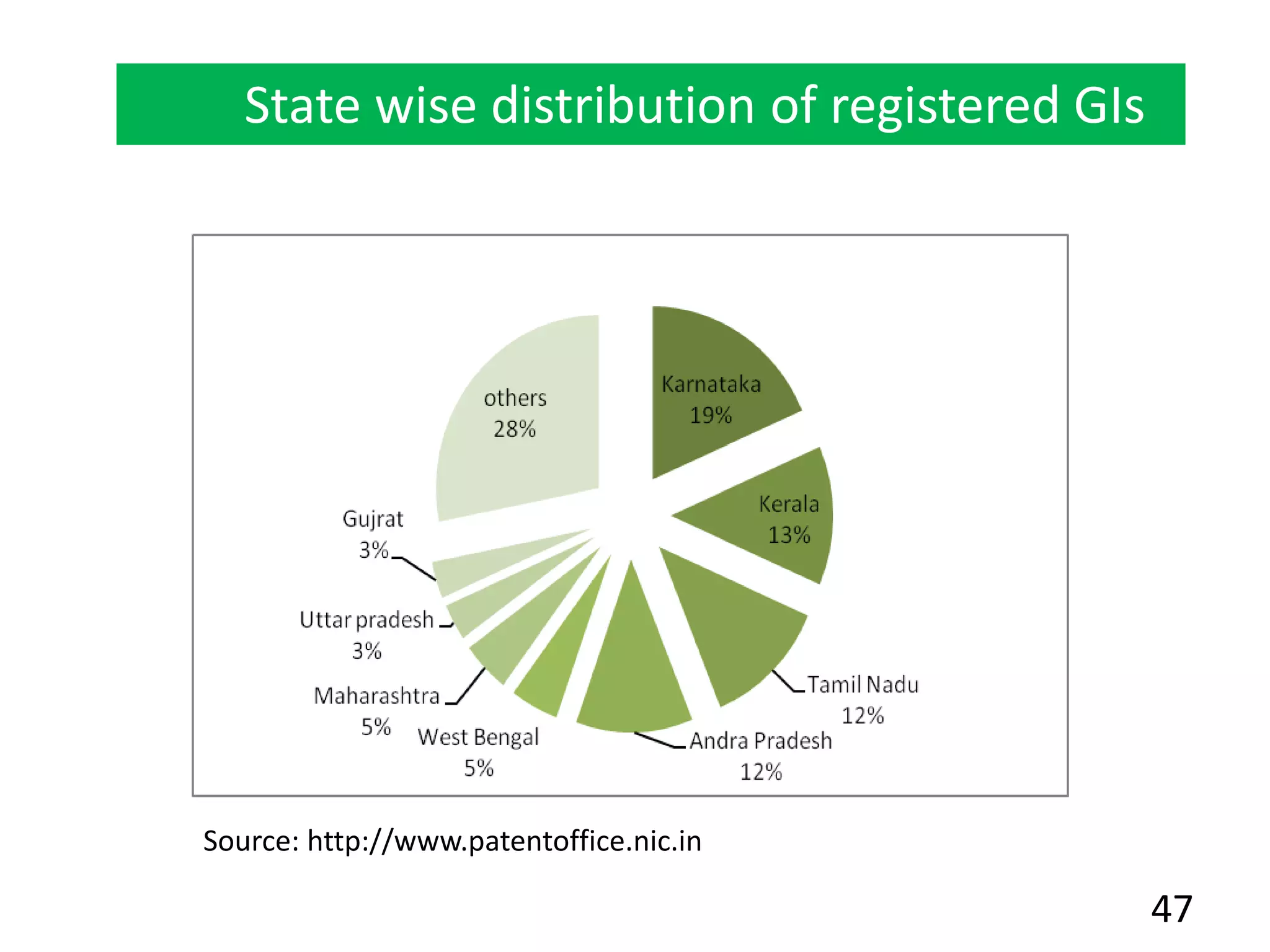
Source: http://www.patentoffice.nic.in
State wise distribution of registered GIs
47
POPULAR GIs
48
IPR on new plant varieties
Protection of plant varieties
• By patents
• By an effective sui generis system
• By any combination thereof
49
PPV& FR Act, 2001.
Protection of Plant Varieties and
Farmers’ Right Authority.
National register for plant varieties.
Plant varieties that can be registered
under the Act.
Persons who can make application.
Registration.
50
Opposition for registration
Duration of registration
Non-registrable varieties
Researchers’ rights
Farmers’ rights
51
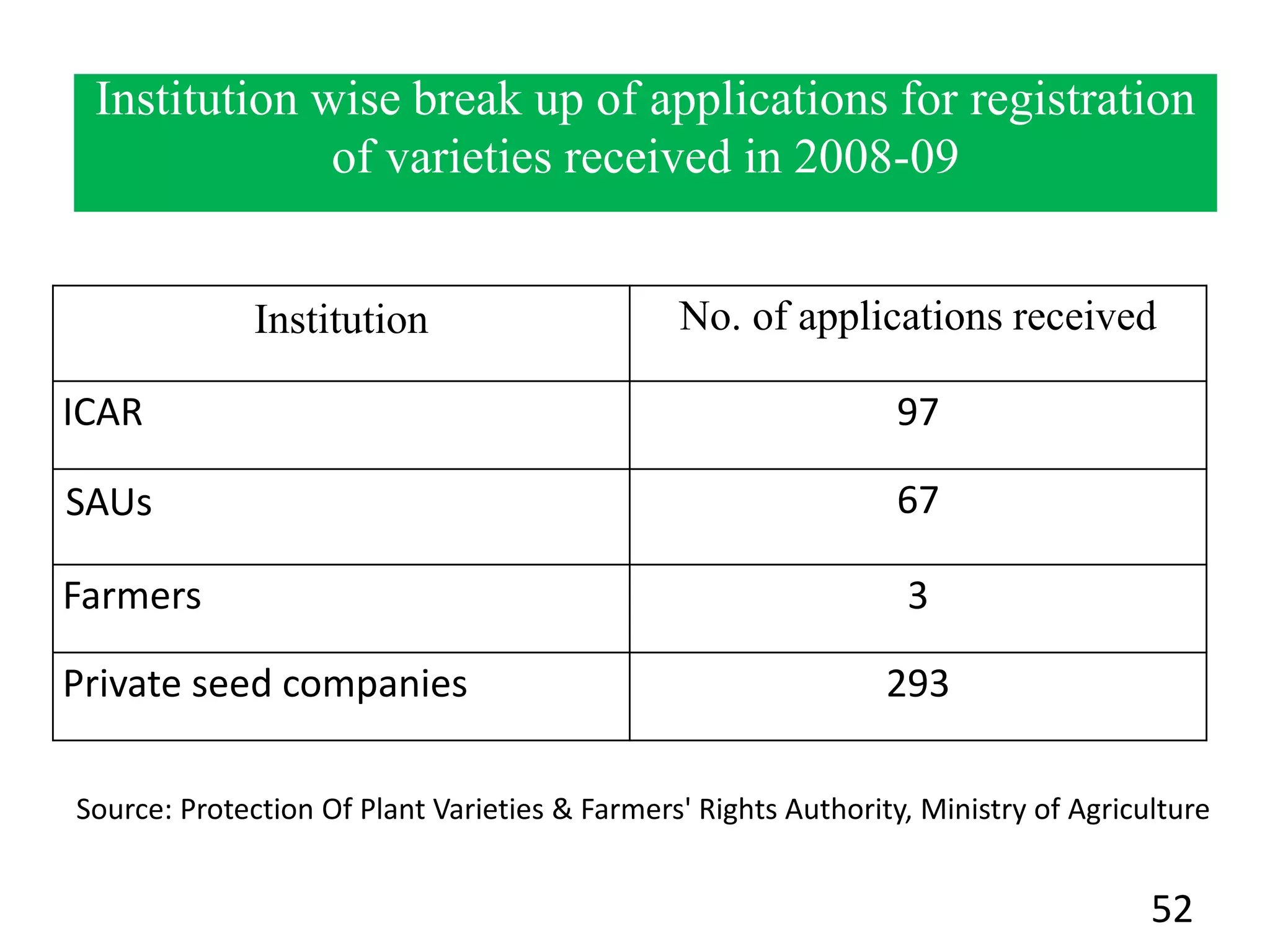
Institution wise break up of applications for registration
of varieties received in 2008-09
Institution No. of applications received
ICAR 97
SAUs 67
Farmers 3
Private seed companies 293
Source: Protection Of Plant Varieties & Farmers' Rights Authority, Ministry of Agriculture
52
IPR on Biological Diversity
India
• One of the 12 mega
biodiversity countries of the
world
• Two global hot spots
• 7.8 per cent of the global
recorded species
• 10th among the plant rich
nations of the world
• 4th among the Asian countries
53
• Convention on biological diversity.
• National legislation for protection
of biological diversity.
• Regulation of access to biological
diversity.
• Protection of IPR on biological
resources.
54
Main advantages of IPR
• To protect ideas and
innovations.
• Owner is rewarded and can
control its use.
• Encourage further innovation
and creativity.
• Promotion in research and
development.
• Employment generation.
• Promotion of tourism.
• Rural development. 55
Main drawbacks of IPR
• Restrict access to innovative knowledge.
• Patenting of genetic modifications.
• Favours commercialization in agriculture –
Promoting monoculture and cash crops.
• Genetic erosion.
• IP restrictions have devastating impacts on
human right to food and protection of traditional
knowledge.
• Cost of enforcement is more.
• Favours monopoly.
56
IPR in developing countries
• Less access to resources.
• Few resources are devoted to innovation.
• No sufficient IP expertise at national academic
or research institutions.
• Low awareness about the IP regime.
57
IPR and Agricultural Extension
• Provides awareness to people.
• Dispute settlement.
• Rural development.
• Prosperity.
58
59
DARJEELING TEA
• 1st product registered as a GI in India.
• World’s most expensive and exotically flavoured
tea.
• Total area – 19000 ha.
• 87 tea gardens.
60
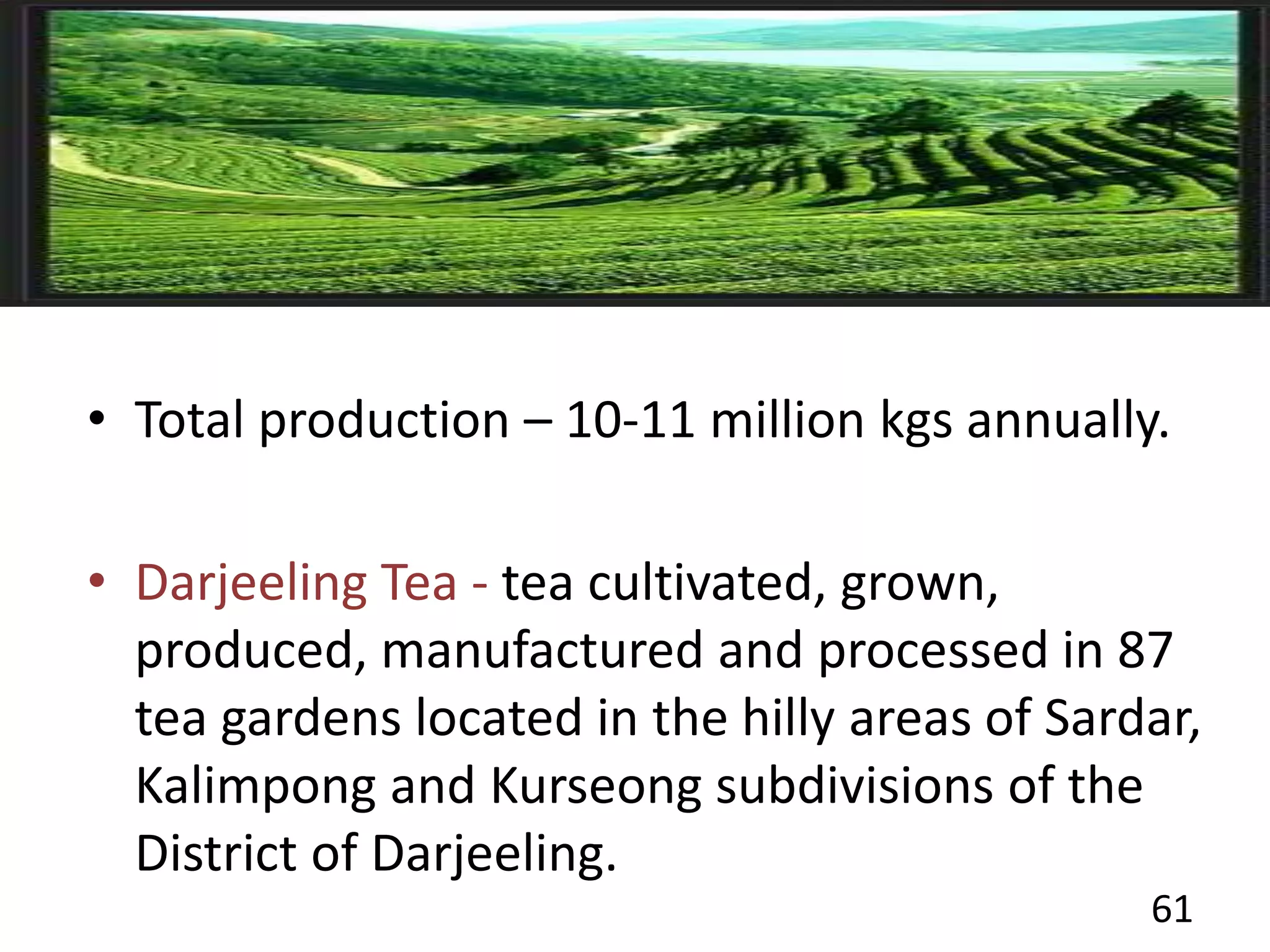
• Total production – 10-11 million kgs annually.
• Darjeeling Tea - tea cultivated, grown,
produced, manufactured and processed in 87
tea gardens located in the hilly areas of Sardar,
Kalimpong and Kurseong subdivisions of the
District of Darjeeling.
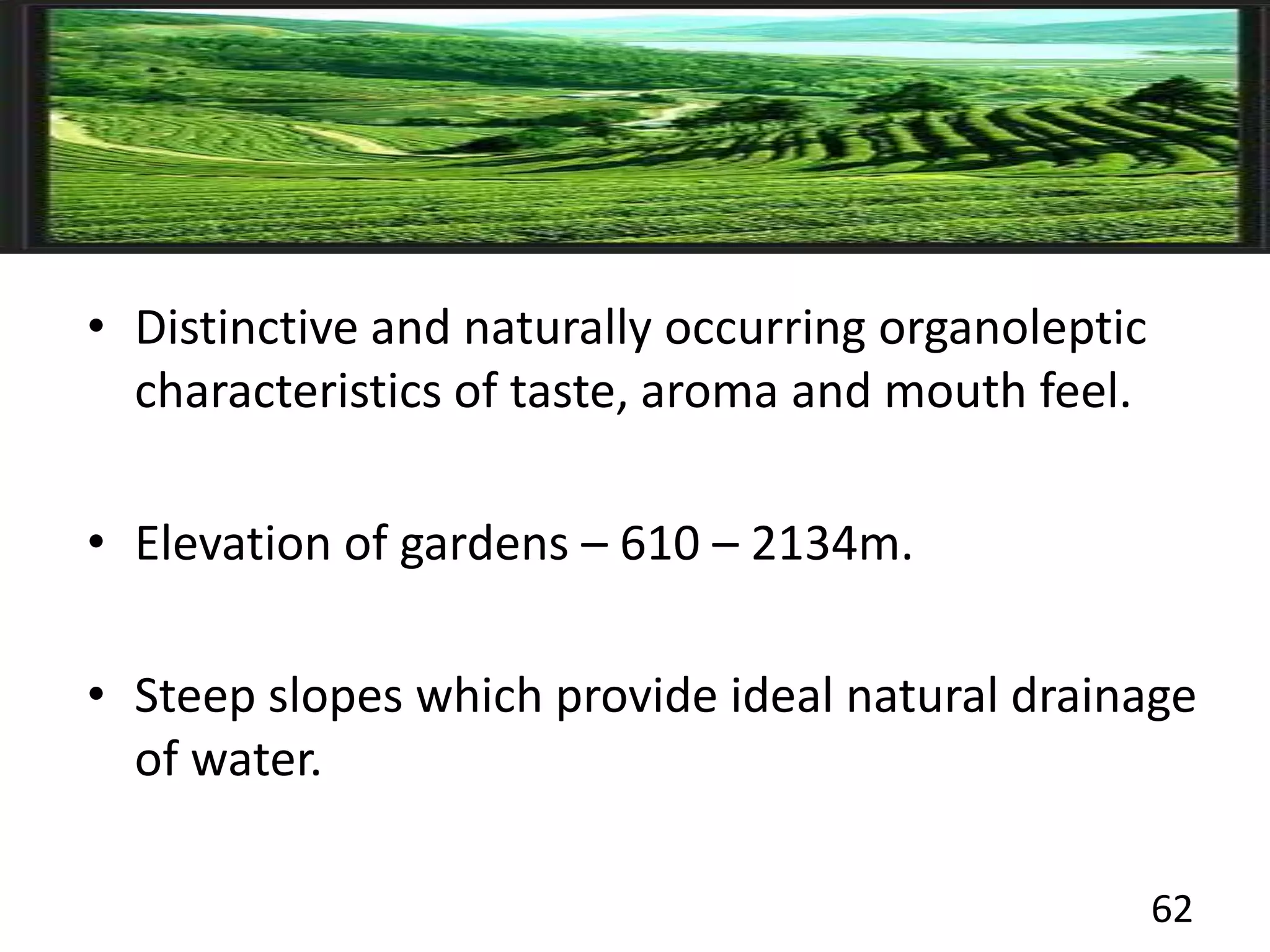
61
• Distinctive and naturally occurring organoleptic
characteristics of taste, aroma and mouth feel.
• Elevation of gardens – 610 – 2134m.
• Steep slopes which provide ideal natural drainage
of water.
62
• Intermittent cloud and sunshine.
• Rare flavour – plant genes, soil chemistry,
elevation, temperature and rainfall.
• Darjeeling produces 10 million kg of tea.
63
• But, 40 million kg of
Darjeeling tea was available
in the world market every
year.
• Tea Board intervened.
• Registered it as a
Certification Trademark with
a specialty tea logo.
• Registered under Trademark
laws of different countries.
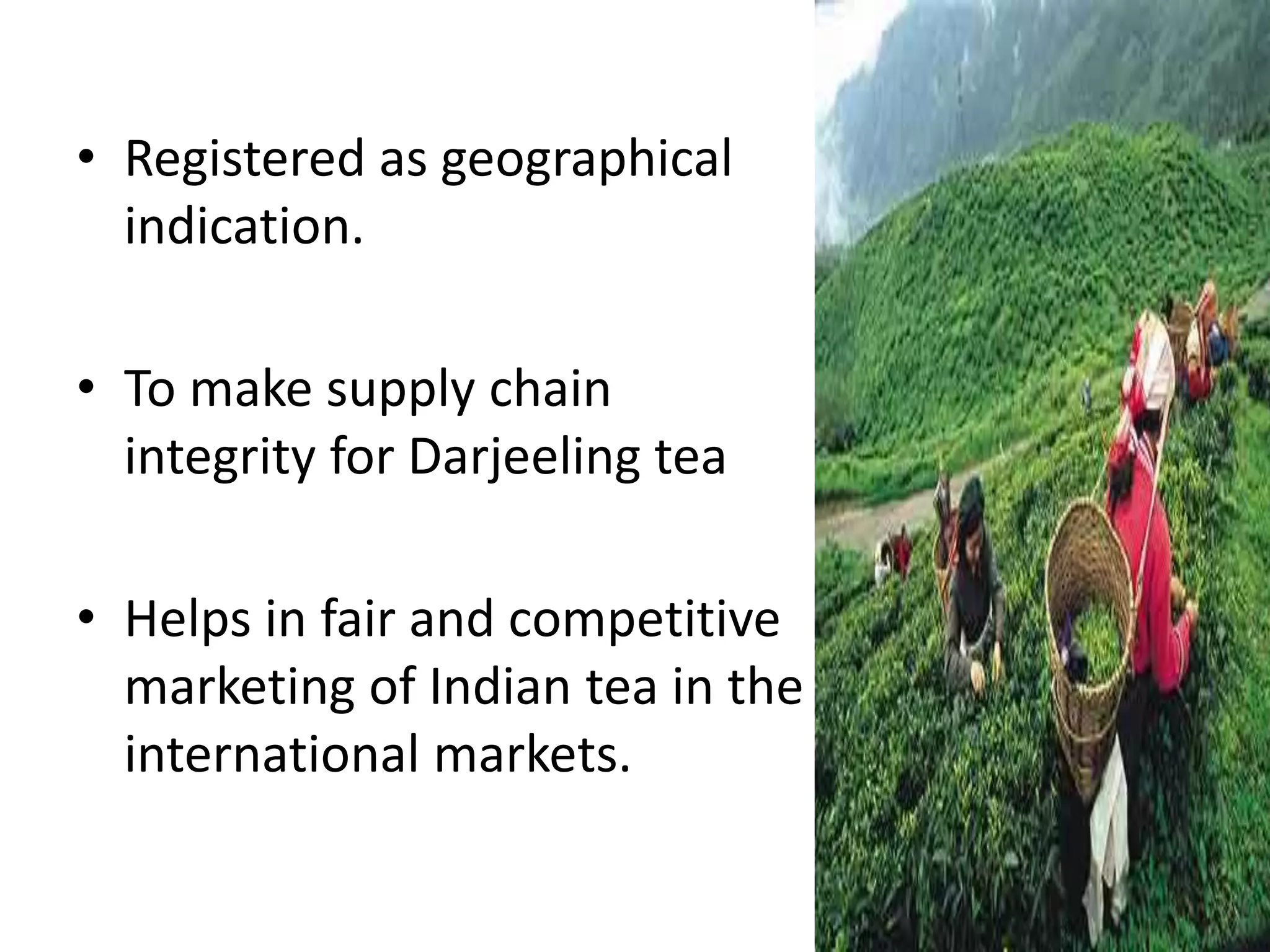
64
• Registered as geographical
indication.
• To make supply chain
integrity for Darjeeling tea
• Helps in fair and competitive
marketing of Indian tea in the
international markets.
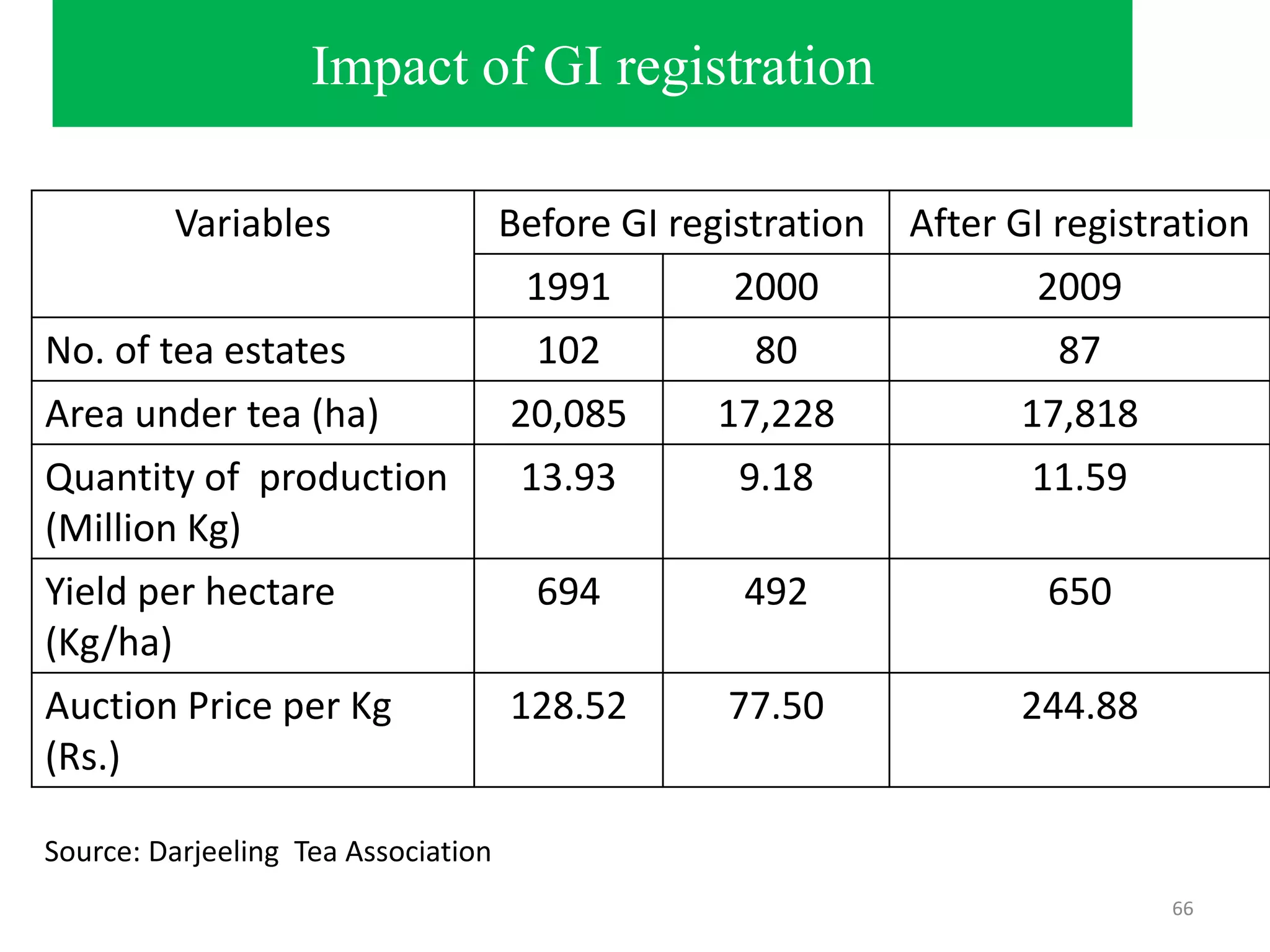
65
Impact of GI registration
Variables Before GI registration After GI registration
1991 2000 2009
No. of tea estates 102 80 87
Area under tea (ha) 20,085 17,228 17,818
Quantity of production
(Million Kg)
13.93 9.18 11.59
Yield per hectare
(Kg/ha)
694 492 650
Auction Price per Kg
(Rs.)
128.52 77.50 244.88
Source: Darjeeling Tea Association
66
TURMERIC PATENT
• Two NRI researchers got US patent
in March 1995 on turmeric.
• For a method of promoting healing
of wound by administering turmeric
to the wound.
• CSIR decided to intervene – use of
turmeric for wound healing was
practiced in India for centuries.
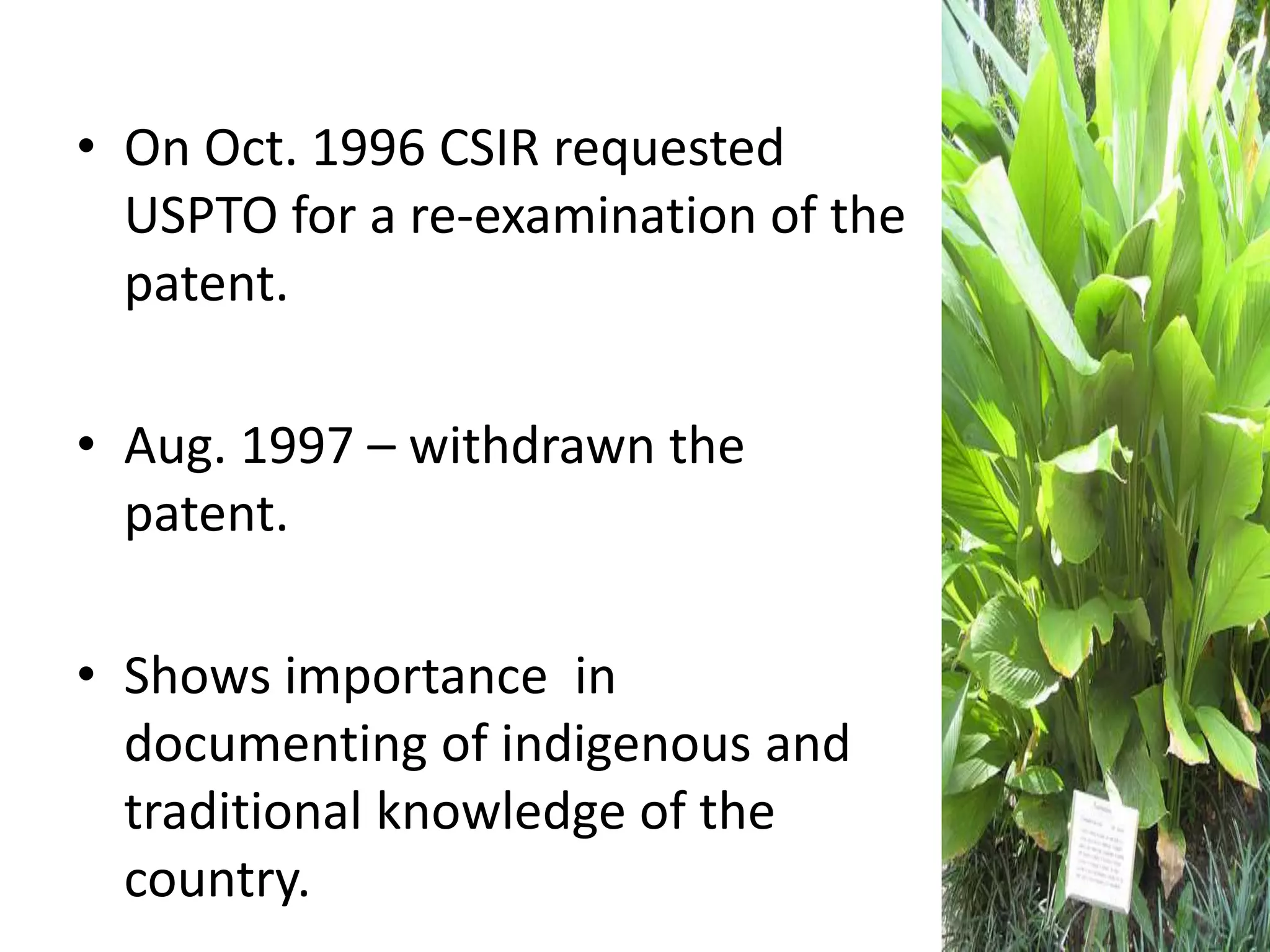
67
• On Oct. 1996 CSIR requested
USPTO for a re-examination of the
patent.
• Aug. 1997 – withdrawn the
patent.
• Shows importance in
documenting of indigenous and
traditional knowledge of the
country. 68
69
Patenting scenario in agriculture: Indian
perspective
Rekha Mittal and Gian Singh
70
Total output of Indian patents in
agriculture
71
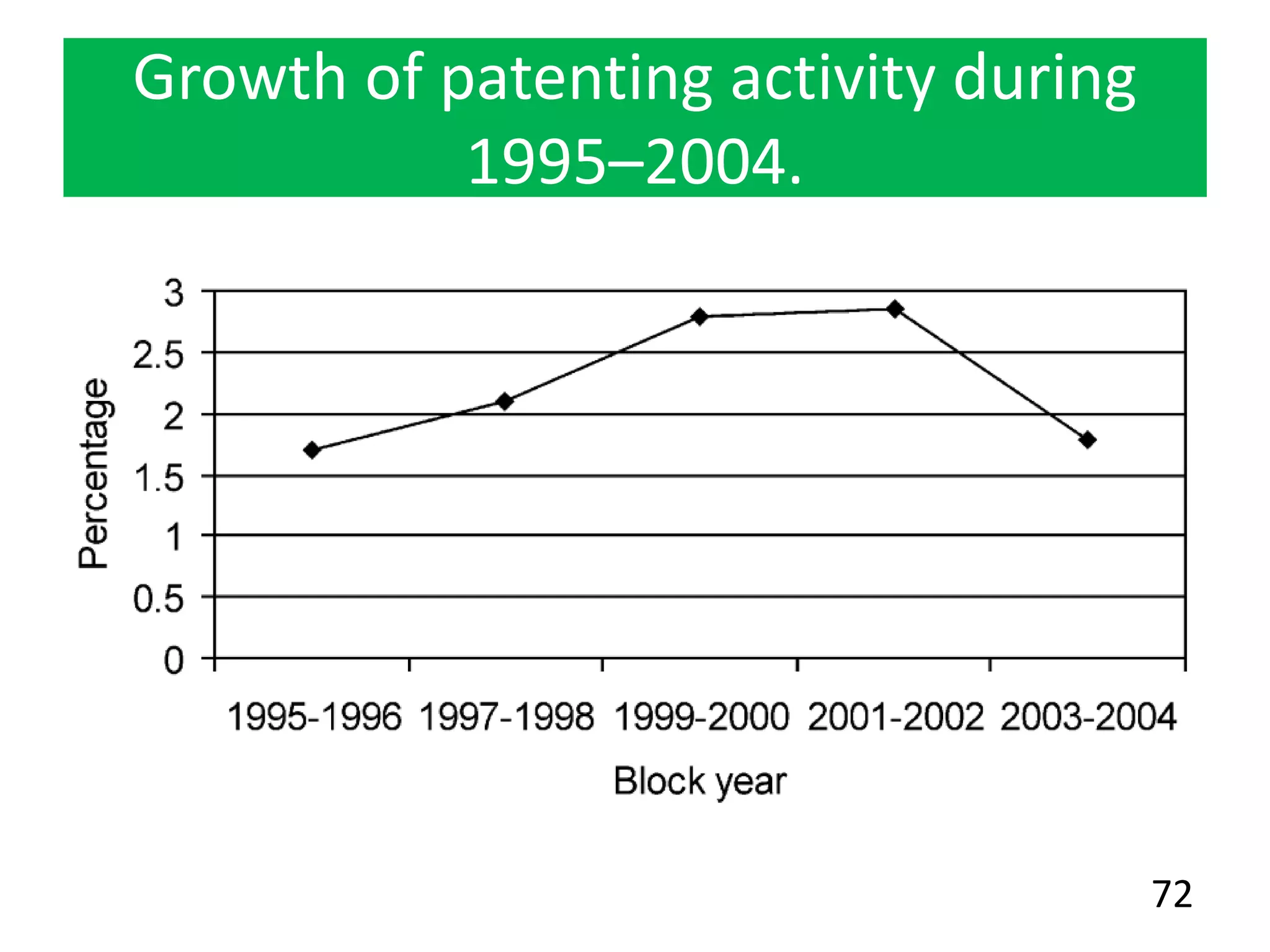
Block year Total no. of
granted
patents
Total no. of
patents in
agriculture
Percentage
1995–96 2780 47 1.69
1997–98 4780 100 2.09
1999–2000 3250 91 2.80
2001–02 3820 109 2.85
2003–04 5930 102 1.78
10 yrs 20,560 449 2.18
Growth of patenting activity during
1995–2004.
72
Distribution based on IPC
IPC
class
Class title Total no: of
patents
Total no: of
Indian patents
A01B Soil working in agriculture or forestry
agriculture machines or implements
11 11
A01C Planting, sowing, fertilizing 15 10
A01D Harvesting, mowing 22 14
A01F Processing of harvested produce, devices
for storing
8 4
A01G Horticulture, cultivation, forestry 33 22
A01H New plants or processes for obtaining
them, plant reproduction
11 8
A01J Manufacture of dairy products 9 4
A01K Animal husbandry, rearing or breeding
animals
30 16
A01M Catching, trapping apparatus 12 7
A01N Biocides, pest-repellants or attractants 298 192
Total 449 288
73
Institutional Issues for Developing Countries
in Intellectual Property Policymaking,
Administration & Enforcement
Mart Leesti and Tom Pengelly, 2001.
74
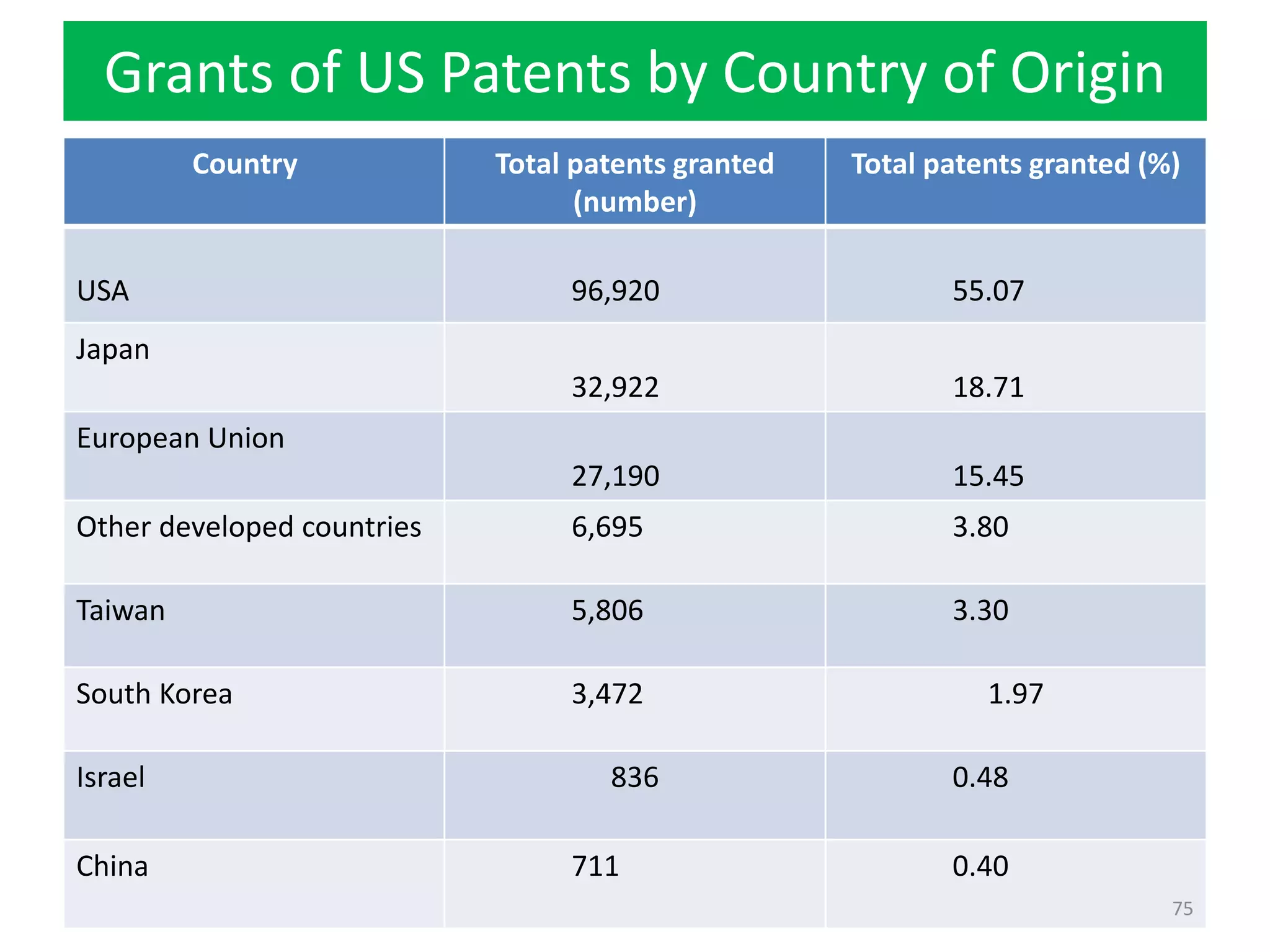
Grants of US Patents by Country of Origin
Country Total patents granted
(number)
Total patents granted (%)
USA 96,920 55.07
Japan
32,922 18.71
European Union
27,190 15.45
Other developed countries 6,695 3.80
Taiwan 5,806 3.30
South Korea 3,472 1.97
Israel 836 0.48
China 711 0.40
75
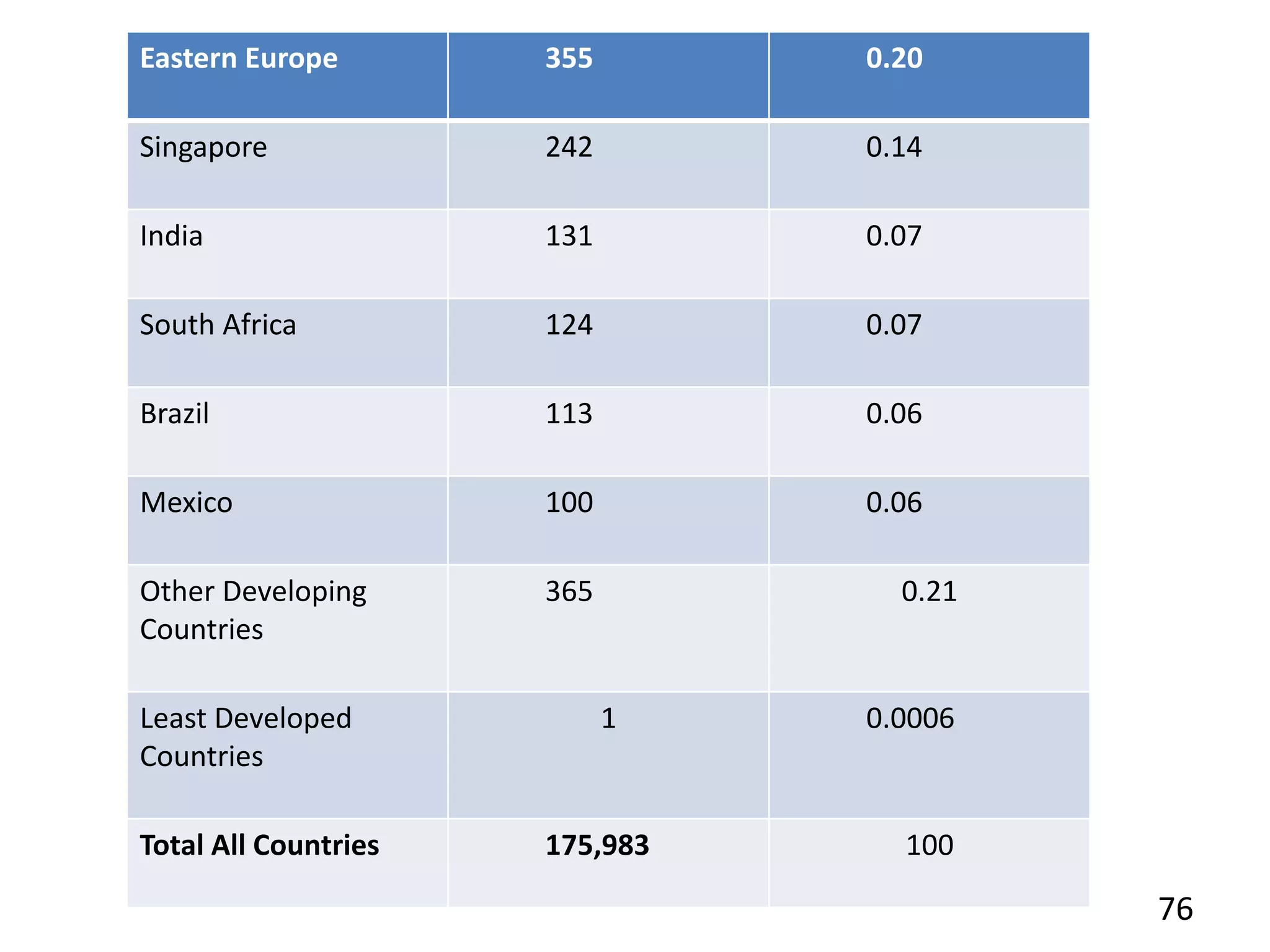
Eastern Europe 355 0.20
Singapore 242 0.14
India 131 0.07
South Africa 124 0.07
Brazil 113 0.06
Mexico 100 0.06
Other Developing
Countries
365 0.21
Least Developed
Countries
1 0.0006
Total All Countries 175,983 100
76
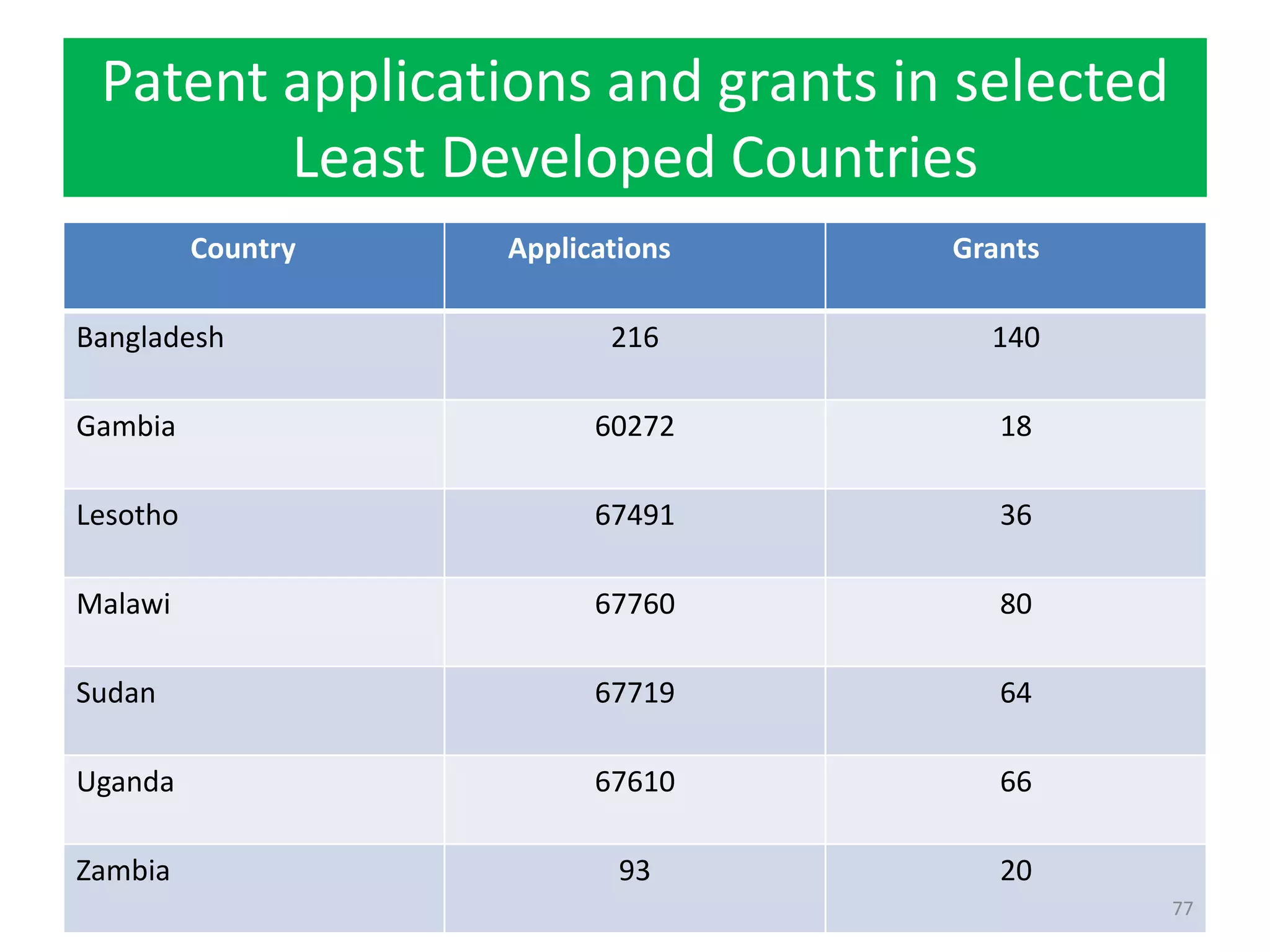
Patent applications and grants in selected
Least Developed Countries
Country Applications Grants
Bangladesh 216 140
Gambia 60272 18
Lesotho 67491 36
Malawi 67760 80
Sudan 67719 64
Uganda 67610 66
Zambia 93 20
77
Expenditure and Revenue on IPR
administration in selected developing
countries
Country Expenditure
(US$)
Revenue
(US$)
India
1,697,400 2,495,000
Jamaica
283,752 161,693
Kenya
418,592 28,205
78
CONCLUSION
79
80

Intellectual Property Rights in Agriculture

  • 1.
  • 2.
  • 3.
    Revolutions of thelate 20th Century 3 GLOBALISATION INFORMATION TECHNOLOGY BIOTECHNOLOGY INTELLECTUAL PROPERTY RIGHTS Expanded Innovation Potential
  • 4.
    The Mission IsVital “Over the next 20 years, the rice genome will make more of a difference to human health than the human genome” - Donald Kennedy, Editor-In -Chief, Science 4
  • 5.
    INTRODUCTION 5 • Intellectual PropertyRights – gained importance in face of changing trade environment. • Legal right established over the creative or innovative ideas. • Signal to the society.
  • 6.
    OBJECTIVES • To understandthe concepts of IPR. • To know the advantages and disadvantages of IPR. • To review the studies related to IPR in Agriculture. 6
  • 7.
    EVOLUTION OF IPR •GATT – signed by 23 countries on 30th Oct.1947. • Uruguay round – 1986-1994. • GATT 1994 – redesignated as WTA. • WTO – established to oversee the implementation of WTA. 7
  • 8.
    • WTA –16 articles and 4 annexes. • TRIPS – Annex 1C 8 IPR
  • 9.
    INTELLECTUAL PROPERTY RIGHTS •IPR given to the owners and creators of invention, designs and literary and artistic material. • To protect their ideas and innovations. • Owner is rewarded and can control its use. • Encourage further innovation and creativity. • Promote investment in research and development. 9
  • 10.
    • Awarded bythe Government. • Monopoly rights. • IPR can be assigned, gifted, sold and licensed like any other property. • Territorial rights. 10
  • 11.
    • Rights shouldbe renewed from time to time • IPR have fixed term. • These rights can be simultaneously held in many countries at the same time. 11
  • 12.
    • TRIPS agreementrecognizes seven kinds of intellectual property. They are:- Patents Copyrights and related rights Trademarks Geographical Indications Industrial Designs Layout Designs of integrated circuits Protection of undisclosed information (Trade secrets) 12
  • 13.
  • 14.
    PATENTS • Patents arelegal rights granted for new inventions employing scientific and technical knowledge. • Exclusive right granted by a country to the owner of the invention. • Inventiveness Investment 14
  • 15.
    • Patent rightcan be gifted, inherited, assigned, sold or licensed. • Patent protection is granted for 20 years from the date of filing the application. 15
  • 16.
    History and evolutionof patent law in India Pre Independence status • First Indian statute of patent – 1856. • 1859 Act. • Patents and Designs Protection Act – 1872. • Indian Patents and Designs Act(IPDA) – 1911. 16
  • 17.
     Post Independencestatus • Justice Rajagopal Ayyengar – appointed to examine the inadequacies of IPDA. • Patent Bill – 1967. • Patent Act – 1970. • Patent Act came into force in 1972. 17
  • 18.
    Three phases ofIndia’s evolving patent regime 18 COLONIAL PERIOD INDEPENDENCE (1947) GLOBALISATION (1990 onwards) •British imposed patent statutes from 1856 •First independent patent law : The Patent Act, 1970 •Generic drug manufacturing sector thrived. •GATT Uruguay round negotiations •Economic Reforms •WTO/TRIPS •Patent amendments
  • 19.
    Administration of patent •Administration of patents – Controller General of Patents,Designs and Trademark. • Supervised by – Ministry of Commerce and Industry, Department of Industrial Policy and Promotion, GoI. • Head Office – Calcutta. • Office of the Controller General – Mumbai. 19
  • 20.
    Patent facilitating organisations •Patent Facilitating Centre(PFC),New Delhi. • Patent Information System, Nagpur. • CSIR- Intellectual Property Management Division (IPMD),New Delhi. • National Institute of Science, Communication and Information Resources (NISCAIR). 20
  • 21.
    • National Research Development Corporation(NRDC),New Delhi. • Society for Technology Management (STEM),Hyderabad. • Patent Information Centre, Trivandrum. 21
  • 22.
    CONDITIONS FOR PATENTABIITY •Patentable subject matter. • Novelty. • Non-obviousness. • Usefulness. • Non- patentable inventions- relating to atomic energy, nuclear transformations and treatment of human and animals. 22
  • 23.
    • Patents aregranted for, An invention. Innovation/ improvement over an innovation. Process of an invention. Concept. 23
  • 24.
    Procedure for securingpatents • Filing a patent application. • Submission of documents. • Disclosure of invention. 24
  • 25.
    Distribution of patentapplications by country of origin Source: WIPO Statistics Database 25
  • 26.
    Trend in patentapplication filed and patents granted Year No. of patent applications (in million nos) Annual growth rate in patent applications (%) No. of patents granted (in million nos) Annual growth rate in granted patents (%) 2004 1.48 - 0.61 - 2005 1.56 5.04 0.62 1.6 2006 1.69 7.49 0.63 1.1 2007 1.78 5.38 0.75 19.5 2008 1.85 3.83 0.77 2.5 2009 1.91 2.52 0.78 0.6 Source: WIPO Statistics Database 26
  • 27.
    Source: Report, Officeof Controller General of Patents, Trademarks, Designs and Geographical Indications Trend in patent applications filed and granted 27
  • 28.
    Major Indian applicantsfrom scientific and research and development organisations Sl. No. Name of scientific and research and development organisations No. of applications filed ` 1. Council of Scientific and Industrial Research 165 2. Bharat Heavy Electricals Ltd. 119 3. Tata Steel 65 4. Indian Council of Agricultural Research 35 5. Steel Authority of India Ltd. 31 28
  • 29.
  • 30.
    Why bother then? 30 Protectyour own ideas Let others know your boundaries Modify others’ ideas legitimately Don’t become a trespasser IPRs are necessary no matter which side of the wall you are on!! • IPR becomes popular with technology
  • 31.
  • 32.
    TRADEMARKS • A word,a logo, a number, a letter, a slogan etc. • To identify the services or goods of one enterprise from those of competitors. • Maintain and improve the quality of the product. • Protection to the owner. 32
  • 33.
    • Collective marks– owned by an association whose members use them to identify themselves with a level of quality and other requirement set by an organisation. • Certification marks – given for compliance with the defined standards, but are not confined to any membership. 33
  • 34.
    Trademark protection • Applicationfor registration filed with competent government authority(trademark office). • Relevant details, list of goods, signs along with the prescribed fee. • Acceptance or refusal will be published in the trademark register. 34
  • 35.
    Service mark –SM Registered trademark – • System of international registration of marks – International Bureau of WIPO. • Trademark law treaty – 1996. 35 R
  • 36.
    • Trademarks Act– 1999. • Controller General of Patent Designs and Trademark – responsible for implementation of Trademark law in India. 36
  • 37.
  • 38.
    GEOGRAPHICAL INDICATION • Anindication. • To identify agricultural, natural and manufactured goods. • Applied to specified goods originating or manufactured from a definite geographical territory. 38
  • 39.
    • Special qualityor reputation or other characteristics. • Attributable to its geographical origin. 39
  • 40.
    Protection of GIs Internationallevel • Paris convention – 1883 • Madrid agreement – 1891 • Lisbon agreement – 1958 • TRIPS – 1995 National level • The Geographical Indications of Goods (Registration and Protection) Act, 1999. 40
  • 41.
    • Registrar ofGIs – The Controller General of Patents, Designs and Trademarks. • GI Registry – Chennai. • Particulars required for application. • Application fee – Rs.5000/class of GI. 41
  • 42.
    • Registration • Infringement •Duration of registration 42
  • 43.
    BENEFITS OF REGISTRATIONOF GIs • Confers legal protection to GIs in India. • Prevents unauthorized use of a GI by others. • Helps consumers to get quality products of desired brands. • Promotes economic prosperity of the producers of goods. • Essential to get protection in other countries. 43
  • 44.
    GIs and DevelopingCountries • Instrument of Rural Development - benefit to the rural economy, in particular to less-favored or remote areas. • Differentiation of products can lead to: – Increase in prices of the protected products – Allows genuine producers to capture the rents, entry barriers for “fakes” • Large market for genuine products. 44
  • 45.
    Details of applicationsfiled and GI registered in India Year No. of filed applications No. of GI registrations 2004-05 29 3 2005-06 16 24 2006-07 33 25 2007-08 37 31 2008-09 44 45 2009-10 64 18 Total 223 146 Source: http://www.patentoffice.nic.in/ 45
  • 46.
    Source: http://www.patentoffice.nic.in Product wisedistribution of registered GIs 46 27% 60% 10% 3% Agricultural goods Handicrafts Manufactured goods Food stuff
  • 47.
    Source: http://www.patentoffice.nic.in State wisedistribution of registered GIs 47
  • 48.
  • 49.
    IPR on newplant varieties Protection of plant varieties • By patents • By an effective sui generis system • By any combination thereof 49
  • 50.
    PPV& FR Act,2001. Protection of Plant Varieties and Farmers’ Right Authority. National register for plant varieties. Plant varieties that can be registered under the Act. Persons who can make application. Registration. 50
  • 51.
    Opposition for registration Durationof registration Non-registrable varieties Researchers’ rights Farmers’ rights 51
  • 52.
    Institution wise breakup of applications for registration of varieties received in 2008-09 Institution No. of applications received ICAR 97 SAUs 67 Farmers 3 Private seed companies 293 Source: Protection Of Plant Varieties & Farmers' Rights Authority, Ministry of Agriculture 52
  • 53.
    IPR on BiologicalDiversity India • One of the 12 mega biodiversity countries of the world • Two global hot spots • 7.8 per cent of the global recorded species • 10th among the plant rich nations of the world • 4th among the Asian countries 53
  • 54.
    • Convention onbiological diversity. • National legislation for protection of biological diversity. • Regulation of access to biological diversity. • Protection of IPR on biological resources. 54
  • 55.
    Main advantages ofIPR • To protect ideas and innovations. • Owner is rewarded and can control its use. • Encourage further innovation and creativity. • Promotion in research and development. • Employment generation. • Promotion of tourism. • Rural development. 55
  • 56.
    Main drawbacks ofIPR • Restrict access to innovative knowledge. • Patenting of genetic modifications. • Favours commercialization in agriculture – Promoting monoculture and cash crops. • Genetic erosion. • IP restrictions have devastating impacts on human right to food and protection of traditional knowledge. • Cost of enforcement is more. • Favours monopoly. 56
  • 57.
    IPR in developingcountries • Less access to resources. • Few resources are devoted to innovation. • No sufficient IP expertise at national academic or research institutions. • Low awareness about the IP regime. 57
  • 58.
    IPR and AgriculturalExtension • Provides awareness to people. • Dispute settlement. • Rural development. • Prosperity. 58
  • 59.
  • 60.
    DARJEELING TEA • 1stproduct registered as a GI in India. • World’s most expensive and exotically flavoured tea. • Total area – 19000 ha. • 87 tea gardens. 60
  • 61.
    • Total production– 10-11 million kgs annually. • Darjeeling Tea - tea cultivated, grown, produced, manufactured and processed in 87 tea gardens located in the hilly areas of Sardar, Kalimpong and Kurseong subdivisions of the District of Darjeeling. 61
  • 62.
    • Distinctive andnaturally occurring organoleptic characteristics of taste, aroma and mouth feel. • Elevation of gardens – 610 – 2134m. • Steep slopes which provide ideal natural drainage of water. 62
  • 63.
    • Intermittent cloudand sunshine. • Rare flavour – plant genes, soil chemistry, elevation, temperature and rainfall. • Darjeeling produces 10 million kg of tea. 63
  • 64.
    • But, 40million kg of Darjeeling tea was available in the world market every year. • Tea Board intervened. • Registered it as a Certification Trademark with a specialty tea logo. • Registered under Trademark laws of different countries. 64
  • 65.
    • Registered asgeographical indication. • To make supply chain integrity for Darjeeling tea • Helps in fair and competitive marketing of Indian tea in the international markets. 65
  • 66.
    Impact of GIregistration Variables Before GI registration After GI registration 1991 2000 2009 No. of tea estates 102 80 87 Area under tea (ha) 20,085 17,228 17,818 Quantity of production (Million Kg) 13.93 9.18 11.59 Yield per hectare (Kg/ha) 694 492 650 Auction Price per Kg (Rs.) 128.52 77.50 244.88 Source: Darjeeling Tea Association 66
  • 67.
    TURMERIC PATENT • TwoNRI researchers got US patent in March 1995 on turmeric. • For a method of promoting healing of wound by administering turmeric to the wound. • CSIR decided to intervene – use of turmeric for wound healing was practiced in India for centuries. 67
  • 68.
    • On Oct.1996 CSIR requested USPTO for a re-examination of the patent. • Aug. 1997 – withdrawn the patent. • Shows importance in documenting of indigenous and traditional knowledge of the country. 68
  • 69.
  • 70.
    Patenting scenario inagriculture: Indian perspective Rekha Mittal and Gian Singh 70
  • 71.
    Total output ofIndian patents in agriculture 71 Block year Total no. of granted patents Total no. of patents in agriculture Percentage 1995–96 2780 47 1.69 1997–98 4780 100 2.09 1999–2000 3250 91 2.80 2001–02 3820 109 2.85 2003–04 5930 102 1.78 10 yrs 20,560 449 2.18
  • 72.
    Growth of patentingactivity during 1995–2004. 72
  • 73.
    Distribution based onIPC IPC class Class title Total no: of patents Total no: of Indian patents A01B Soil working in agriculture or forestry agriculture machines or implements 11 11 A01C Planting, sowing, fertilizing 15 10 A01D Harvesting, mowing 22 14 A01F Processing of harvested produce, devices for storing 8 4 A01G Horticulture, cultivation, forestry 33 22 A01H New plants or processes for obtaining them, plant reproduction 11 8 A01J Manufacture of dairy products 9 4 A01K Animal husbandry, rearing or breeding animals 30 16 A01M Catching, trapping apparatus 12 7 A01N Biocides, pest-repellants or attractants 298 192 Total 449 288 73
  • 74.
    Institutional Issues forDeveloping Countries in Intellectual Property Policymaking, Administration & Enforcement Mart Leesti and Tom Pengelly, 2001. 74
  • 75.
    Grants of USPatents by Country of Origin Country Total patents granted (number) Total patents granted (%) USA 96,920 55.07 Japan 32,922 18.71 European Union 27,190 15.45 Other developed countries 6,695 3.80 Taiwan 5,806 3.30 South Korea 3,472 1.97 Israel 836 0.48 China 711 0.40 75
  • 76.
    Eastern Europe 3550.20 Singapore 242 0.14 India 131 0.07 South Africa 124 0.07 Brazil 113 0.06 Mexico 100 0.06 Other Developing Countries 365 0.21 Least Developed Countries 1 0.0006 Total All Countries 175,983 100 76
  • 77.
    Patent applications andgrants in selected Least Developed Countries Country Applications Grants Bangladesh 216 140 Gambia 60272 18 Lesotho 67491 36 Malawi 67760 80 Sudan 67719 64 Uganda 67610 66 Zambia 93 20 77
  • 78.
    Expenditure and Revenueon IPR administration in selected developing countries Country Expenditure (US$) Revenue (US$) India 1,697,400 2,495,000 Jamaica 283,752 161,693 Kenya 418,592 28,205 78
  • 79.
  • 80.