SUBMITED BY:
UPASANA PRADHAN
M.Sc. 1st SEM (1st YR)
DEPT. OF HORTIULTURE
SIKKIM UNIVERSITY
DEFINITION
 It is an indication.
 It originates from a definite geographical territory.
 It is used to identify goods having special characteristics
originating from a definite geographical territory.
 It is used to identify agricultural, natural, handicraft ,
manufactured goods or food stuffs.
 The manufactured goods should be processed or
produced in that territory.
 It should have a special quality or reputation or other
characteristics.
AGRICULTURAL GOODS
HANDICRAFT
JAIPUR UDAIPUR
MANUFACTURED GOODS
KULLU SHAWL KOLHAPURI CHAPPAL
KANCHIPURAM SAREES
FOOD STUFFS
AGRA PETHA
BENEFITS OF GIs
 It confers legal protection to goods.
 Prevents unauthorized use of a registered geographical
indication by others.
 Promotes economic prosperity of producers of goods
produced in a geographical territory.
 Boost the export .
EXAMPLES OF GIs
INDIA WORLD
 Basmati rice
 Coorg orange
 Darjeeling tea
 Alphonso mango
 Kolhapuri chappal
 Tirupati ladoo
 Canadian whisky
 Swiss watches
 Florida oranges
 champagne
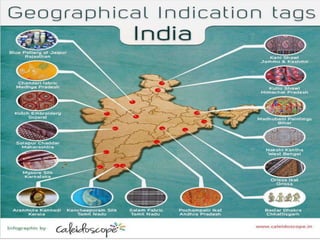
‘DAREJEELING TEA’ became the first GI
tagged product in India.
WHO CAN APPLY?
 Any association of persons, producers, organization or
authority established by or under the law can apply .
 The producers may be organized as an entity, such as a
cooperative or association, which represents them and
ensures that the product fulfils certain requirements.
 In some jurisdictions, protection may also be
requested by a national competent authority (for
example, a local government authority).
WHO IS A REGISTERED PROPRIETER OF GI
 Any association of persons, producers, organization or
authority established by or under the law can be a
registered proprietor. Their name should be entered in
the register of GI as registered proprietor for the GI
applied for.
WHY GI IS TO BE PROTECTED
 Denote quality and origin of products.
 Good reputation for the product.
 Preventing the product from generic products.
 Protecting the domestic market from competitors.
VALIDITY OF GI
 The registration of geographical indication is valid for
a period of 10 years.
 It can be renewed from time to time for further period
of 10 years.
 If a registered geographical indication is not renewed
it is liable to be removed from the register.
GI IN INDIA
 India, as a member of world trade organization
(WTO), enacted the GI of goods(registration and
protection) act, 1999 has come into force with effect
from 15 September 2003.
 The central government of India has established GI
registry with all India jurisdiction in Chennai.
 The GI act is being administered by the controller
general of patents, designs and trademarks - who is
registrar of GI.
GEOGRAPHICAL INDICATION AND TRADEMARK
 GIs are closely related to trademark; both indicate
product origin.
 GIs and trademarks differs in two ways:
1. A trademark belongs to a particular company; it
distinguishes that company’s products. GIs are
shared by all producers in the region unidentified by
the GI.
2. GIs attach to the location; trademarks don’t.
geographical indication

geographical indication

  • 1.
    SUBMITED BY: UPASANA PRADHAN M.Sc.1st SEM (1st YR) DEPT. OF HORTIULTURE SIKKIM UNIVERSITY
  • 2.
    DEFINITION  It isan indication.  It originates from a definite geographical territory.  It is used to identify goods having special characteristics originating from a definite geographical territory.  It is used to identify agricultural, natural, handicraft , manufactured goods or food stuffs.  The manufactured goods should be processed or produced in that territory.  It should have a special quality or reputation or other characteristics.
  • 3.
  • 4.
  • 5.
    MANUFACTURED GOODS KULLU SHAWLKOLHAPURI CHAPPAL KANCHIPURAM SAREES
  • 6.
  • 8.
    BENEFITS OF GIs It confers legal protection to goods.  Prevents unauthorized use of a registered geographical indication by others.  Promotes economic prosperity of producers of goods produced in a geographical territory.  Boost the export .
  • 9.
    EXAMPLES OF GIs INDIAWORLD  Basmati rice  Coorg orange  Darjeeling tea  Alphonso mango  Kolhapuri chappal  Tirupati ladoo  Canadian whisky  Swiss watches  Florida oranges  champagne ‘DAREJEELING TEA’ became the first GI tagged product in India.
  • 10.
    WHO CAN APPLY? Any association of persons, producers, organization or authority established by or under the law can apply .  The producers may be organized as an entity, such as a cooperative or association, which represents them and ensures that the product fulfils certain requirements.  In some jurisdictions, protection may also be requested by a national competent authority (for example, a local government authority).
  • 11.
    WHO IS AREGISTERED PROPRIETER OF GI  Any association of persons, producers, organization or authority established by or under the law can be a registered proprietor. Their name should be entered in the register of GI as registered proprietor for the GI applied for.
  • 12.
    WHY GI ISTO BE PROTECTED  Denote quality and origin of products.  Good reputation for the product.  Preventing the product from generic products.  Protecting the domestic market from competitors.
  • 13.
    VALIDITY OF GI The registration of geographical indication is valid for a period of 10 years.  It can be renewed from time to time for further period of 10 years.  If a registered geographical indication is not renewed it is liable to be removed from the register.
  • 14.
    GI IN INDIA India, as a member of world trade organization (WTO), enacted the GI of goods(registration and protection) act, 1999 has come into force with effect from 15 September 2003.  The central government of India has established GI registry with all India jurisdiction in Chennai.  The GI act is being administered by the controller general of patents, designs and trademarks - who is registrar of GI.
  • 15.
    GEOGRAPHICAL INDICATION ANDTRADEMARK  GIs are closely related to trademark; both indicate product origin.  GIs and trademarks differs in two ways: 1. A trademark belongs to a particular company; it distinguishes that company’s products. GIs are shared by all producers in the region unidentified by the GI. 2. GIs attach to the location; trademarks don’t.