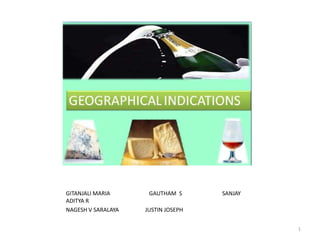
GITANJALI MARIA      GAUTHAM S      SANJAY
ADITYA R
NAGESH V SARALAYA   JUSTIN JOSEPH


                                             1
INTRODUCTION
• It is a type of intellectual property
• It is a name or sign used on certain products which
  corresponds to a specific geographical location or
  origin (e.g. a town, region, or country).
• Geographical indications are intended to designate
  product quality, highlight brand identity, and preserve
  cultural traditions.
• Often food products. E.g: Champagne, Florida oranges,
  New Zealand lamb.
• But not limited to agro products, extended to any
  product. E.g: Swiss watches, Czech Crystals, Indian
  carpets.

                                                            2
HISTORY OF GI
• First GI system used in France –20th century--
  appellation d'origine contrôlée (AOC).
   – Items that meet geographical origin and quality standards
     may be endorsed with a government-issued stamp which
     acts as official certification of the origins and standards of
     the product to the consumer.
   – E.g: Gruyère cheese (from Switzerland) and many French
     wines.

    Geographical indications have long been associated with
     the concept of terroir and with Europe as an entity, where
     there is a tradition of associating certain food products
     with particular regions

                                                                      3
CONDITIONS TO GET GI
• It relates to a good although, in some countries,
  services are also included;

• These goods/services must originate from a
  defined area;


• The goods/services must have qualities,
  reputations or other characteristics which are
  clearly linked to the geographical origin of goods.

                                                        4
NECESSITY OF GI
• Geographical indications allows producers to
  obtain market recognition and often a premium
  price.

• Geographical indications have become a key
  source of niche marketing.

• Geographical indications are also often
  associated with non-monetary benefits such as
  the protection of knowledge and community
  rights.
                                                  5
International Agreements and
Organizations on Geographical
          Indications
Agreements
                          Paris Convention for the Protection of Industrial
                          Property (1883)


• Applies to industrial property in the widest sense.

• Three main categories: national treatment, right of priority, common rules

Lisbon Agreement for the Protection of Appellations of Origin and their
International Registration (1958)

• The Agreement is open to States party to the Paris Convention for the Protection
  of Industrial Property (1883).

• About 170 geographical indications were registered by Lisbon Agreement
  members as of 1997.
Organizations
                       • One of the 17 specialized agencies of
                           the United Nations created in 1967.
                       • Currently has 185 member states and is
                          headquartered in Geneva, Switzerland.

 • To promote the protection of intellectual property throughout the world.
 • Francis Gurry is the current Director General of WIPO
Agreement on Trade-Related Aspects of Intellectual Property Rights (1994)

                        • Two basic obligations on WTO member governments relating to
                          GIs in the TRIPS agreement

                        • Article 22: Prevent misleading the public as to the geographical
                          origin of the good

                        • Article 23: prevent the use of a geographical indication
                          identifying wines not originating in the place.
GI in India
• India, as a member of the World Trade
  Organization (WTO), enacted the Geographical
  Indications      of   Goods     (Registration     &
  Protection)Act, 1999 has come into force with
  effect from 15th September 2003.
• the Central Government of India has establishe
  d the Geographical Indications Registry with all
   India jurisdiction in Chennai.
• The GI Act is being administered by the Controll
  er General of Patents, Designs and Trade Marks ‐
  who is the Registrar of Geographical Indications.
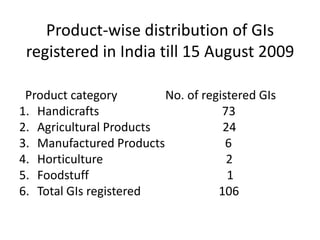
Product-wise distribution of GIs
 registered in India till 15 August 2009

 Product category        No. of registered GIs
1. Handicrafts                      73
2. Agricultural Products            24
3. Manufactured Products             6
4. Horticulture                      2
5. Foodstuff                         1
6. Total GIs registered            106
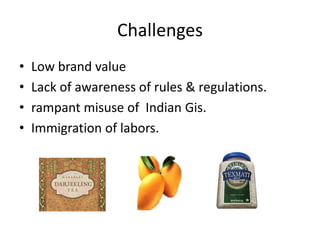
Challenges
•   Low brand value
•   Lack of awareness of rules & regulations.
•   rampant misuse of Indian Gis.
•   Immigration of labors.
GI
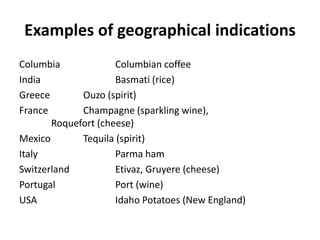
Examples of geographical indications
Columbia             Columbian coffee
India                Basmati (rice)
Greece       Ouzo (spirit)
France       Champagne (sparkling wine),
       Roquefort (cheese)
Mexico       Tequila (spirit)
Italy                Parma ham
Switzerland          Etivaz, Gruyere (cheese)
Portugal             Port (wine)
USA                  Idaho Potatoes (New England)
EU & GI
• Three European Union schemes of geographical
  indications and traditional specialities known as
• Protected designation of origin (PDO),
• Protected geographical indication (PGI)
• Traditional speciality guaranteed (TSG)
They promote and protect names of quality agricultural
products and foodstuffs.
Why are geographical indications valuable?

• GIs are a marketing tool
• Reputation for quality associated with place
  name used on labels, advertising
• GI-identified products are believed to
  command higher prices
• Of particular interest to developing countries
Controversies
• Consumer vs. producer interests
• Long-time, generic use of expressions that
  have geographic origins (parmesan)
• Differing national treatment of GIs
  -weaker: (Canada, US) “Canadian Champagne;”
    “American-made Pecorino cheese”
  -stronger: (EU) GI use reserved to producers in the
    region, even if other origin is indicated
Geographical indications and trademarks

•    GIs are closely related to trademarks; both
     indicate product origin
•    GIs and trademarks differ in two ways:
    1. A trademark belongs to a particular company; it
       distinguishes that company’s products. GIs are
       shared by all producers in the region identified
       by the GI.
    2. GIs attach to a location; trademarks don’t.
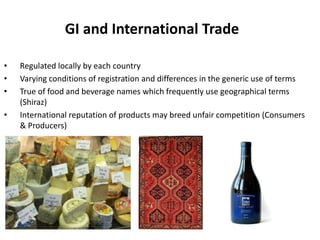
GI and International Trade

•   Regulated locally by each country
•   Varying conditions of registration and differences in the generic use of terms
•   True of food and beverage names which frequently use geographical terms
    (Shiraz)
•   International reputation of products may breed unfair competition (Consumers
    & Producers)
European Union Initiative
•     European Union Initiative- Establishment of DOOR
•     Supports the agricultural product quality policy
•     Modern IT system for the dissemination of public data
•     Registered PDOs (Protected Designations of Origin), PGIs (Protected
      Geographical Indications) and TSG (Traditional Specialties Guaranteed)

   Denomination (in original language only)
   Type of product
   Member State of origin
   Product specification (original language only)
   Summary in all official languages
   Dates of application and registration
   Name and contact details of the responsible authority
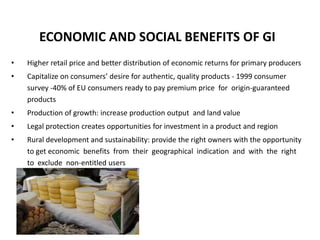
ECONOMIC AND SOCIAL BENEFITS OF GI
•   Higher retail price and better distribution of economic returns for primary producers
•   Capitalize on consumers’ desire for authentic, quality products - 1999 consumer
    survey -40% of EU consumers ready to pay premium price for origin-guaranteed
    products
•   Production of growth: increase production output and land value
•   Legal protection creates opportunities for investment in a product and region
•   Rural development and sustainability: provide the right owners with the opportunity
    to get economic benefits from their geographical indication and with the right
    to exclude non-entitled users
THANK YOU

            21

Geographical indicators

  • 1.
    GITANJALI MARIA GAUTHAM S SANJAY ADITYA R NAGESH V SARALAYA JUSTIN JOSEPH 1
  • 2.
    INTRODUCTION • It isa type of intellectual property • It is a name or sign used on certain products which corresponds to a specific geographical location or origin (e.g. a town, region, or country). • Geographical indications are intended to designate product quality, highlight brand identity, and preserve cultural traditions. • Often food products. E.g: Champagne, Florida oranges, New Zealand lamb. • But not limited to agro products, extended to any product. E.g: Swiss watches, Czech Crystals, Indian carpets. 2
  • 3.
    HISTORY OF GI •First GI system used in France –20th century-- appellation d'origine contrôlée (AOC). – Items that meet geographical origin and quality standards may be endorsed with a government-issued stamp which acts as official certification of the origins and standards of the product to the consumer. – E.g: Gruyère cheese (from Switzerland) and many French wines.  Geographical indications have long been associated with the concept of terroir and with Europe as an entity, where there is a tradition of associating certain food products with particular regions 3
  • 4.
    CONDITIONS TO GETGI • It relates to a good although, in some countries, services are also included; • These goods/services must originate from a defined area; • The goods/services must have qualities, reputations or other characteristics which are clearly linked to the geographical origin of goods. 4
  • 5.
    NECESSITY OF GI •Geographical indications allows producers to obtain market recognition and often a premium price. • Geographical indications have become a key source of niche marketing. • Geographical indications are also often associated with non-monetary benefits such as the protection of knowledge and community rights. 5
  • 6.
    International Agreements and Organizationson Geographical Indications
  • 7.
    Agreements Paris Convention for the Protection of Industrial Property (1883) • Applies to industrial property in the widest sense. • Three main categories: national treatment, right of priority, common rules Lisbon Agreement for the Protection of Appellations of Origin and their International Registration (1958) • The Agreement is open to States party to the Paris Convention for the Protection of Industrial Property (1883). • About 170 geographical indications were registered by Lisbon Agreement members as of 1997.
  • 8.
    Organizations • One of the 17 specialized agencies of the United Nations created in 1967. • Currently has 185 member states and is headquartered in Geneva, Switzerland. • To promote the protection of intellectual property throughout the world. • Francis Gurry is the current Director General of WIPO Agreement on Trade-Related Aspects of Intellectual Property Rights (1994) • Two basic obligations on WTO member governments relating to GIs in the TRIPS agreement • Article 22: Prevent misleading the public as to the geographical origin of the good • Article 23: prevent the use of a geographical indication identifying wines not originating in the place.
  • 9.
    GI in India •India, as a member of the World Trade Organization (WTO), enacted the Geographical Indications of Goods (Registration & Protection)Act, 1999 has come into force with effect from 15th September 2003. • the Central Government of India has establishe d the Geographical Indications Registry with all India jurisdiction in Chennai. • The GI Act is being administered by the Controll er General of Patents, Designs and Trade Marks ‐ who is the Registrar of Geographical Indications.
  • 10.
    Product-wise distribution ofGIs registered in India till 15 August 2009 Product category No. of registered GIs 1. Handicrafts 73 2. Agricultural Products 24 3. Manufactured Products 6 4. Horticulture 2 5. Foodstuff 1 6. Total GIs registered 106
  • 11.
    Challenges • Low brand value • Lack of awareness of rules & regulations. • rampant misuse of Indian Gis. • Immigration of labors.
  • 12.
  • 13.
    Examples of geographicalindications Columbia Columbian coffee India Basmati (rice) Greece Ouzo (spirit) France Champagne (sparkling wine), Roquefort (cheese) Mexico Tequila (spirit) Italy Parma ham Switzerland Etivaz, Gruyere (cheese) Portugal Port (wine) USA Idaho Potatoes (New England)
  • 14.
    EU & GI •Three European Union schemes of geographical indications and traditional specialities known as • Protected designation of origin (PDO), • Protected geographical indication (PGI) • Traditional speciality guaranteed (TSG) They promote and protect names of quality agricultural products and foodstuffs.
  • 15.
    Why are geographicalindications valuable? • GIs are a marketing tool • Reputation for quality associated with place name used on labels, advertising • GI-identified products are believed to command higher prices • Of particular interest to developing countries
  • 16.
    Controversies • Consumer vs.producer interests • Long-time, generic use of expressions that have geographic origins (parmesan) • Differing national treatment of GIs -weaker: (Canada, US) “Canadian Champagne;” “American-made Pecorino cheese” -stronger: (EU) GI use reserved to producers in the region, even if other origin is indicated
  • 17.
    Geographical indications andtrademarks • GIs are closely related to trademarks; both indicate product origin • GIs and trademarks differ in two ways: 1. A trademark belongs to a particular company; it distinguishes that company’s products. GIs are shared by all producers in the region identified by the GI. 2. GIs attach to a location; trademarks don’t.
  • 18.
    GI and InternationalTrade • Regulated locally by each country • Varying conditions of registration and differences in the generic use of terms • True of food and beverage names which frequently use geographical terms (Shiraz) • International reputation of products may breed unfair competition (Consumers & Producers)
  • 19.
    European Union Initiative • European Union Initiative- Establishment of DOOR • Supports the agricultural product quality policy • Modern IT system for the dissemination of public data • Registered PDOs (Protected Designations of Origin), PGIs (Protected Geographical Indications) and TSG (Traditional Specialties Guaranteed)  Denomination (in original language only)  Type of product  Member State of origin  Product specification (original language only)  Summary in all official languages  Dates of application and registration  Name and contact details of the responsible authority
  • 20.
    ECONOMIC AND SOCIALBENEFITS OF GI • Higher retail price and better distribution of economic returns for primary producers • Capitalize on consumers’ desire for authentic, quality products - 1999 consumer survey -40% of EU consumers ready to pay premium price for origin-guaranteed products • Production of growth: increase production output and land value • Legal protection creates opportunities for investment in a product and region • Rural development and sustainability: provide the right owners with the opportunity to get economic benefits from their geographical indication and with the right to exclude non-entitled users
  • 21.

Editor's Notes

  • #4 Governments have been protecting trade names and trademarks used in relation to food products identified with a particular region since at least the end of the nineteenth century, using laws against false trade descriptions or passing off, which generally protect against suggestions that a product has a certain origin, quality or association when it does not. In such cases, the limitation on competitive freedoms which results from the grant of a monopoly of use over a geographical indication is justified by governments either by consumer protection benefits or by producer protection benefits.
  • #8 The Convention applies to industrial property in the widest sense, including patents, marks, industrial designs, utility models (a kind of “small patent” provided for by the laws of some countries), trade names (designations under which an industrial or commercial activity is carried on), geographical indications (indications of source and appellations of origin) and the repression of unfair competition.The substantive provisions of the Convention fall into three main categories: national treatment, right of priority, common rulesThe Paris Convention, concluded in 1883, was revised at Brussels in 1900, at Washington in 1911, at The Hague in 1925, at London in 1934, at Lisbon in 1958 and at Stockholm in 1967, and it was amended in 1979.Names are registered by the International Bureau of WIPO in Geneva upon the request of the competent authorities of the interested contracting State
  • #9 WIPO became a specialized agency of the UN in 1974.TRIPS- Agreed to set certain basic standards for the protection of GIs in all member countries
  • #15 The Protected designation of origin is the name of an area, a specific place or, in exceptional cases, the name of a country, used as a designation for an agricultural product or a foodstuff,which comes from such an area, place or country,whose quality or properties are significantly or exclusively determined by the geographical environment, including natural and human factors,whose production, processing and preparation takes place within the determined geographical area.In other words, to receive the PDO status, the entire product must be traditionally and entirely manufactured (prepared, processed AND produced) within the specific region and thus acquire unique properties.[edit]Protected geographical indication (PGI)The Protected geographical indication is the name of an area, a specific place or, in exceptional cases, the name of a country, used as a description of an agricultural product or a foodstuff,which comes from such an area, place or country,which has a specific quality, goodwill or other characteristic property, attributable to its geographical origin,whose production, processing or preparation takes place within the determined geographical area.In other words, to receive the PGI status, the entire product must be traditionally and at least partially manufactured (prepared, processed OR produced) within the specific region and thus acquire unique properties.[edit]Traditional speciality guaranteed (TSG)The Traditional speciality guaranteed is a trademark for an agricultural product or a foodstuff, which has a certain feature or a set of features, setting it clearly apart from other similar products or foodstuffs belonging to the same category.[6] The product or foodstuff must be manufactured using traditional ingredients or must be characteristic for its traditional composition, production process, or processing reflecting a traditional type of manufacturing or processing.In other words, to receive a TSG status, the product does not have to be manufactured in a specific geographically delimited area; it is sufficient that it be traditional and different from other similar products.