Prepared by
Dr. V.V Sasane
Assistant Professor, Department of Civil Engineering
Sanjivani College of Engineering, Kopargaon, 423603
Mail- sasanevrushalicivil@Sanjivani.org.in
VECE252: Environmental Studies
Unit 3:-Eco Systems
2.
Concept of anEcosystem
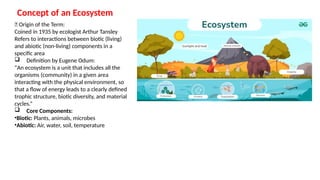
🧠 Origin of the Term:
Coined in 1935 by ecologist Arthur Tansley
Refers to interactions between biotic (living)
and abiotic (non-living) components in a
specific area
Definition by Eugene Odum:
“An ecosystem is a unit that includes all the
organisms (community) in a given area
interacting with the physical environment, so
that a flow of energy leads to a clearly defined
trophic structure, biotic diversity, and material
cycles.”
Core Components:
•Biotic: Plants, animals, microbes
•Abiotic: Air, water, soil, temperature
3.
Key Features:
•Flow ofenergy
•Trophic structure (feeding levels)
•Material cycles like water, nitrogen, and carbon
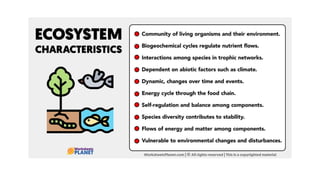
Characteristics of an Ecosystem (Smith, 1966)
1.The ecosystem is a primary structural and functional unit of ecology.
2.High Species Diversity → More complex ecosystem
3.The function of the ecosystem is related to Energy Flow and Material
Cycling.
4.Complex ecosystems need less energy to maintain themselves.
5.Succession leads from simple to complex ecosystems
6.Each ecosystem has its energy budget, which cannot be exceeded
7.Adaptation is essential for species survival
8.Ecosystem Cycles like water, nitrogen, and oxygen are driven by energy
5.
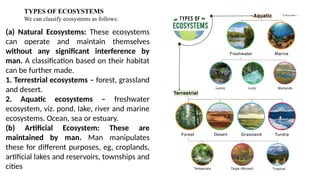
TYPES OF ECOSYSTEMS
Wecan classify ecosystems as follows:
(a) Natural Ecosystems: These ecosystems
can operate and maintain themselves
without any significant interference by
man. A classification based on their habitat
can be further made.
1. Terrestrial ecosystems – forest, grassland
and desert.
2. Aquatic ecosystems – freshwater
ecosystem, viz. pond, lake, river and marine
ecosystems. Ocean, sea or estuary.
(b) Artificial Ecosystem: These are
maintained by man. Man manipulates
these for different purposes, eg, croplands,
artificial lakes and reservoirs, townships and
cities
6.
BASIC STRUCTURE OFAN ECOSYSTEM
Every ecosystem has non-living (abiotic) and living (biotic) components.
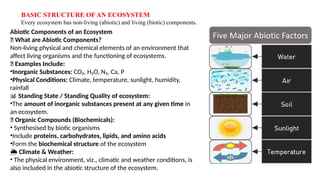
Abiotic Components of an Ecosystem
🧪 What are Abiotic Components?
Non-living physical and chemical elements of an environment that
affect living organisms and the functioning of ecosystems.
🔹 Examples Include:
•Inorganic Substances: CO₂, H₂O, N₂, Ca, P
•Physical Conditions: Climate, temperature, sunlight, humidity,
rainfall
📊 Standing State / Standing Quality of ecosystem:
•The amount of inorganic substances present at any given time in
an ecosystem.
🔬 Organic Compounds (Biochemicals):
• Synthesised by biotic organisms
•Include proteins, carbohydrates, lipids, and amino acids
•Form the biochemical structure of the ecosystem
️
🌦️Climate & Weather:
• The physical environment, viz., climatic and weather conditions, is
also included in the abiotic structure of the ecosystem.
7.
Biotic Components ofan Ecosystem
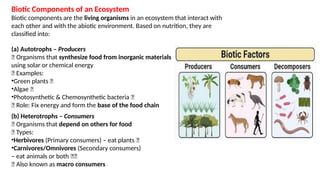
Biotic components are the living organisms in an ecosystem that interact with
each other and with the abiotic environment. Based on nutrition, they are
classified into:
(a) Autotrophs – Producers
🔹 Organisms that synthesize food from inorganic materials
using solar or chemical energy
🔹 Examples:
•Green plants 🌱
•Algae 🌿
•Photosynthetic & Chemosynthetic bacteria 🦠
🔸 Role: Fix energy and form the base of the food chain
(b) Heterotrophs – Consumers
🔹 Organisms that depend on others for food
🔹 Types:
•Herbivores (Primary consumers) – eat plants 🌾
•Carnivores/Omnivores (Secondary consumers)
– eat animals or both 🍗🥦
🔸 Also known as macro consumers
8.
(c) Decomposers –Reducers
🔹 Organisms that break down dead matter into simpler substances
🔹 Mostly bacteria and fungi 🍄
🔸 Role: Recycle nutrients back to the producers
🔸 Also called micro consumers
9.
🔄 Key FunctionalAspects:
1 ️
1️⃣Energy Flow
•Energy enters via producers and flows through consumers
•Energy decreases as it moves up the trophic levels
2️⃣Food Chain & Food Web
•Food Chain: Linear flow of energy
•Food Web: Interconnected food chains for stability
•Leads to ecological pyramids: energy, biomass, numbers
3 ️
3️⃣Biogeochemical Cycles
•Circulation of essential elements like carbon, nitrogen, and water
•Maintains nutrient balance within the ecosystem
4️⃣Ecological Succession
•Natural evolution of ecosystems from simple to complex
•Ensures adaptability and sustainability
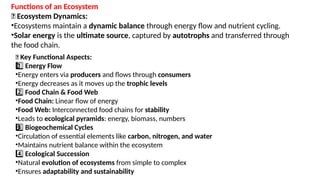
Functions of an Ecosystem
🌞 Ecosystem Dynamics:
•Ecosystems maintain a dynamic balance through energy flow and nutrient cycling.
•Solar energy is the ultimate source, captured by autotrophs and transferred through
the food chain.
10.
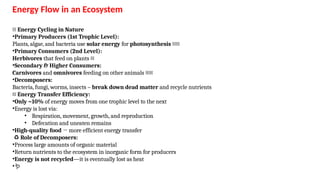
Energy Flow inan Ecosystem
🔄 Energy Cycling in Nature
•Primary Producers (1st Trophic Level):
Plants, algae, and bacteria use solar energy for photosynthesis 🌞🌱
•Primary Consumers (2nd Level):
Herbivores that feed on plants 🐄
•Secondary & Higher Consumers:
Carnivores and omnivores feeding on other animals 🦁🐻
•Decomposers:
Bacteria, fungi, worms, insects – break down dead matter and recycle nutrients
🔺 Energy Transfer Efficiency:
•Only ~10% of energy moves from one trophic level to the next
•Energy is lost via:
• Respiration, movement, growth, and reproduction
• Defecation and uneaten remains
•High-quality food → more efficient energy transfer
♻️Role of Decomposers:
•Process large amounts of organic material
•Return nutrients to the ecosystem in inorganic form for producers
•Energy is not recycled—it is eventually lost as heat
•🪱
12.
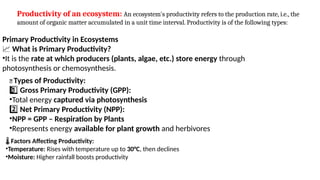
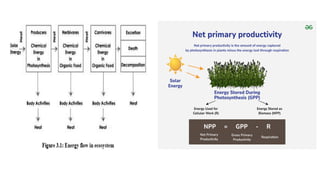
Productivity of anecosystem: An ecosystem's productivity refers to the production rate, i.e., the
amount of organic matter accumulated in a unit time interval. Productivity is of the following types:
Primary Productivity in Ecosystems
📈 What is Primary Productivity?
•It is the rate at which producers (plants, algae, etc.) store energy through
photosynthesis or chemosynthesis.
🌞 Types of Productivity:
1 ️
1️⃣Gross Primary Productivity (GPP):
•Total energy captured via photosynthesis
2️⃣Net Primary Productivity (NPP):
•NPP = GPP – Respiration by Plants
•Represents energy available for plant growth and herbivores
️
🌡️Factors Affecting Productivity:
•Temperature: Rises with temperature up to 30°C, then declines
•Moisture: Higher rainfall boosts productivity
13.
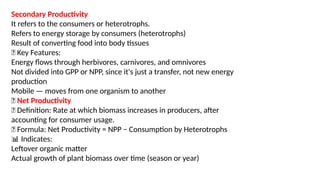
Secondary Productivity
It refersto the consumers or heterotrophs.
Refers to energy storage by consumers (heterotrophs)
Result of converting food into body tissues
🔄 Key Features:
Energy flows through herbivores, carnivores, and omnivores
Not divided into GPP or NPP, since it's just a transfer, not new energy
production
Mobile — moves from one organism to another
🌱 Net Productivity
📌 Definition: Rate at which biomass increases in producers, after
accounting for consumer usage.
🧮 Formula: Net Productivity = NPP − Consumption by Heterotrophs
📊 Indicates:
Leftover organic matter
Actual growth of plant biomass over time (season or year)
15.
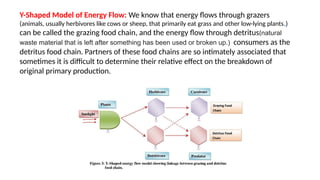
Y-Shaped Model ofEnergy Flow: We know that energy flows through grazers
(animals, usually herbivores like cows or sheep, that primarily eat grass and other low-lying plants.)
can be called the grazing food chain, and the energy flow through detritus(natural
waste material that is left after something has been used or broken up.) consumers as the
detritus food chain. Partners of these food chains are so intimately associated that
sometimes it is difficult to determine their relative effect on the breakdown of
original primary production.
16.
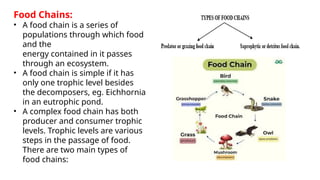
Food Chains:
• Afood chain is a series of
populations through which food
and the
energy contained in it passes
through an ecosystem.
• A food chain is simple if it has
only one trophic level besides
the decomposers, eg. Eichhornia
in an eutrophic pond.
• A complex food chain has both
producer and consumer trophic
levels. Trophic levels are various
steps in the passage of food.
There are two main types of
food chains:
17.
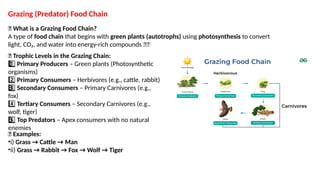
Grazing (Predator) FoodChain
🌿 What is a Grazing Food Chain?
A type of food chain that begins with green plants (autotrophs) using photosynthesis to convert
light, CO₂, and water into energy-rich compounds 🌞🌱
🔗 Trophic Levels in the Grazing Chain:
1 ️
1️⃣Primary Producers – Green plants (Photosynthetic
organisms)
2️⃣Primary Consumers – Herbivores (e.g., cattle, rabbit)
3 ️
3️⃣Secondary Consumers – Primary Carnivores (e.g.,
fox)
4️⃣Tertiary Consumers – Secondary Carnivores (e.g.,
wolf, tiger)
5 ️
5️⃣Top Predators – Apex consumers with no natural
enemies
🧩 Examples:
•i) Grass → Cattle → Man
•ii) Grass → Rabbit → Fox → Wolf → Tiger
18.
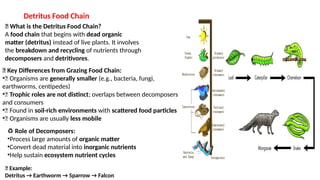
Detritus Food Chain
🔄What is the Detritus Food Chain?
A food chain that begins with dead organic
matter (detritus) instead of live plants. It involves
the breakdown and recycling of nutrients through
decomposers and detritivores.
🌿 Key Differences from Grazing Food Chain:
•🐛 Organisms are generally smaller (e.g., bacteria, fungi,
earthworms, centipedes)
•🔬 Trophic roles are not distinct; overlaps between decomposers
and consumers
•🌱 Found in soil-rich environments with scattered food particles
•🐌 Organisms are usually less mobile
♻️Role of Decomposers:
•Process large amounts of organic matter
•Convert dead material into inorganic nutrients
•Help sustain ecosystem nutrient cycles
📌 Example:
Detritus → Earthworm → Sparrow → Falcon