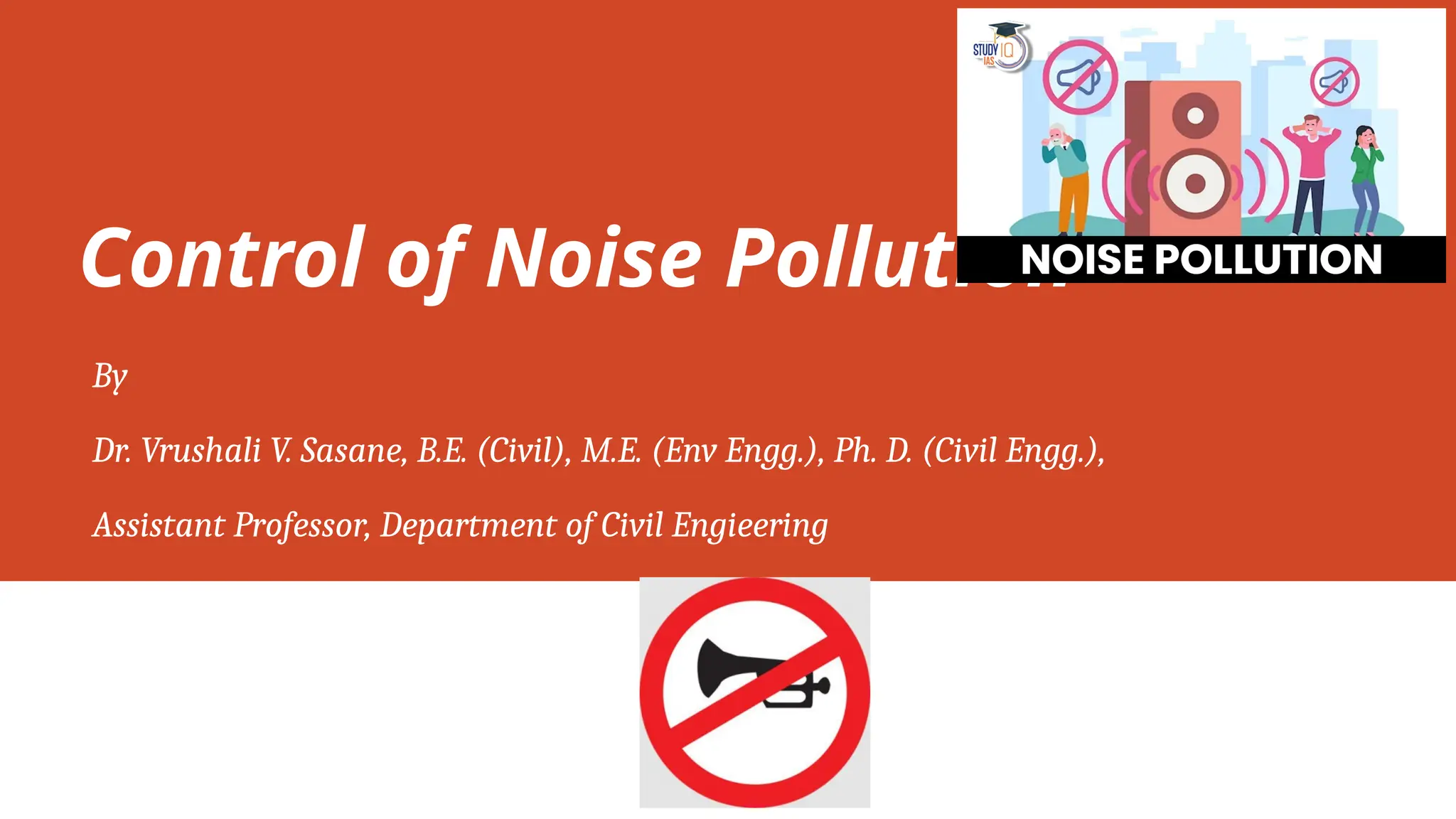
Control of NoisePollution
By
Dr. Vrushali V. Sasane, B.E. (Civil), M.E. (Env Engg.), Ph. D. (Civil Engg.),
Assistant Professor, Department of Civil Engieering
3.
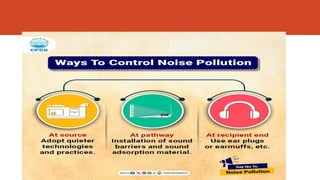
A) Noise Reductionat Source
• Selection of machinery: Noise should be reduced as near the source as possible so that acoustical treatment
is less expensive and a large number of people are protected from the noise. While the operational
processes in a factory may be fixed and may have no quieter alternative, careful selection of the machine
tools and equipment to be used may considerably help attaining lower noise levels in the machine shop.
One make of machine tool may have noisy mechanical system compared with another of similar
performance.
• Reducing noise from potential source: Impact that is not essential to a process should be quietened. Noise
from handling and dropping of materials on hard surfaces may be reduced by using soft resilient
materials on containers, fixing rubber tyres on trucks, trolleys etc. Machine noise may be kept to a
minimum by proper maintenance. Proper lubrication reduces noise by friction from conveyors, rollers etc.
4.
A) Noise Reductionat Source
• Noise from radiation surfaces: This can be reduced by reducing the radiating area. For example, if the area is halved,
the noise intensity will be reduced by three dB and at low frequencies the reduction will be much greater. Supporting structures
for vibrating machines and other equipment should be frames rather than cabinets or sheeted enclosures. If an enclosure is
used, precaution should be taken to isolate it and line it on the inside with sound-absorbent material. The noise radiated by
machinery guards can be minimized by making them of perforated sheet or of wire mesh.
• Reducing transmission of mechanical vibrations A vibrating source does not usually contain a large radiating
surface but the vibration is conducted along mechanically rigid paths to surfaces that can act as effective radiator. If the rigid
connecting paths are interrupted by resilient material, the transmission of vibration and consequently the noise radiated may be
greatly reduced. The reduction depends on the ratio of the driving (forcing) frequency of the source to the natural frequency of
the resilient system.
• Material for isolators: Vibration isolators are usually made of resilient materials like steel in the form of springs, rubber,
cork and felt.
5.
A) Noise Reductionat Source
Noise reduction by Enclosure and barrier: Air borne noise generated by a machine may be reduced by placing the machine in an
enclosure or behind a barrier. Much larger noise reduction can be achieved with complete enclosures. The enclosure may be in the form of
close - fitting acoustic box around the machine such that the operator performs his normal work outside the box and thus is not subjected
to the high noise levels of the machine. The enclosure may also be made DIof sheet metal lined inside with an acoustical material.
Where size of the machine, working area and the operation do not permit close - fitting enclosures, the machine may be housed in a room
of its own. The inside of the enclosure should be lined with sound -absorbing materials to reduce the noise level of the contained sound.
The walls of the enclosures shall also have adequate transmission loss to provide proper sound insulation.
A partial elimination of noise in certain directions may be obtained by barriers or partial enclosures. Two sided or three sided barrier, with
acoustic absorption material may affect appreciable noise reduction. Where it is possible, the opening should face a wall covered with
sound absorbing material. If the top of the enclosure is open, the reduction may be increased by placing the sound-absorbing material on
the ceiling overhead.
6.
A) Noise Reductionat Source
• Acoustical absorption devices: In order to reduce the general reverberant noise
level in machine shops, acoustical material may be placed on the ceiling and
side walls. With this treatment three to eight dB reduction of middle and high
frequency noise may be achieved. This would bring down the general
reverberation noise level and as a consequence, the noise conditions may
become less confusing.
7.
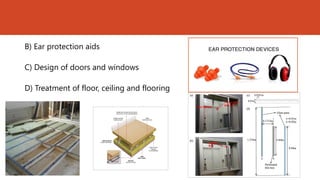
B) Ear protectionaids
C) Design of doors and windows
D) Treatment of floor, ceiling and flooring
8.
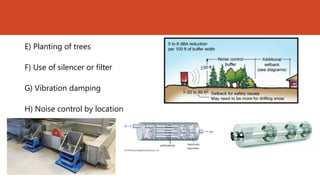
E) Planting oftrees
F) Use of silencer or filter
G) Vibration damping
H) Noise control by location
9.
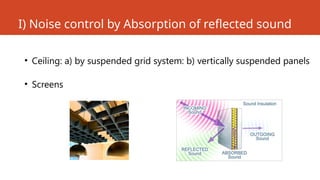
I) Noise controlby Absorption of reflected sound
• Ceiling: a) by suspended grid system: b) vertically suspended panels
• Screens
10.
J) Noise controlby Town planning and legislation
Town Planning Strategies:
Zoning:
Designate specific areas for different activities (industrial, commercial, residential, and silence zones) to minimize noise pollution in
sensitive areas.
Noise Mapping:
Conduct noise mapping to identify noise hotspots and assess noise exposure, informing planning decisions and mitigation
measures.
Land Use Planning:
Strategic land use planning can separate noise-generating activities from noise-sensitive areas, such as hospitals and schools.
Building Codes and Design:
Implement building codes and design standards that incorporate noise insulation and soundproofing measures.
Green Spaces and Infrastructure:
Incorporate green spaces and noise barriers to absorb and reduce noise levels.
11.
J) Noise controlby Town planning and legislation
Transportation Planning:
Prioritize sustainable transportation options and manage traffic flow to minimize road noise.
Legislation and Regulations:
Noise Pollution (Regulation and Control) Rules, 2000:
Enforce regulations regarding permissible noise levels in different zones, including silence zones around hospitals,
educational institutions, and courts.
Penalties for Violations:
Implement penalties for exceeding noise limits or violating regulations.
Permit System:
Establish a permit system for using loud speakers and public address systems, particularly during nighttime.
12.
J) Noise controlby Town planning and legislation
Complaints and Enforcement:
Establish a clear mechanism for citizens to report noise complaints and for authorities to investigate and take action.
Collaboration:
Foster collaboration between various government agencies, local authorities, and community organizations to address
noise pollution effectively.
Public Awareness:
Implement public awareness campaigns to educate the public about noise pollution and its effects, as well as ways to
reduce noise.
13.
Design
Right from thestart, you’ll have access to beautiful,
widescreen themes that you can easily change to
match your style. Every theme comes with a variety
of color variants that you can mix and match.
New features like Merge Shapes and a color-
matching Eyedropper open up new possibilities for
your designs.
Line up your layouts, photos, and diagrams perfectly
in seconds with alignment guides and smart guides.
14.
Impress
The improved PresenterView has new tools to keep you in
control. The new Auto-Extend instantly applies the right settings
for you, so you can focus on speaking instead of your display.
• Slide zoom – Help focus your audience on your ideas. Just click
to zoom in and out on a specific diagram, chart or graphic.
• Slide Navigator – A feature that enables the user to visually
browse for and navigate to other slides without leaving Slide
Show view. Your audience only sees the slide you’re presenting.
15.
Work Together
Edit withothers from different PCs at the
same time and have conversations with
improved commenting.
Sharing online is simple. Even if your
audience doesn’t have PowerPoint, simply
project to their browser with Present Online.
Work together with others at the same time
from different locations, whether you are
using PowerPoint on your desktop or
PowerPoint Online.