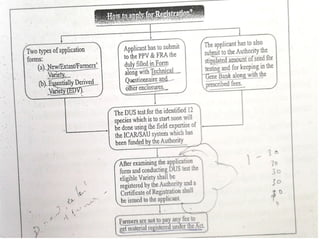
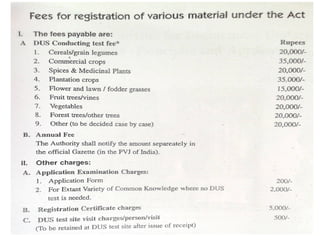
Procedure for registration of a variety under
PPV and FR Act 2001, forms and fees
SST 803 DUS testing
Hridya V Rejeendran
2016801804
1st
Ph.D Scholar, SST
Why Protection for plants is required in
India?
Compliance with TRIPS
Some form of IPR protection is necessary for plants
Can be in the form of patent protection; or
By a sui generis system; or
By a combination of both
Crops Covered under the PPVFRA
Class of crops Crops
Cereals Rice, wheat, maize, sorghum, pearl millet
Pulses Chickpea, mungbean, urdbean, field pea, rajmash, lentil,
pigeon pea
Oilseeds Mustard, groundnut, soybean, sunflower, safflower, castor,
sesame, linseed
Fibre Crops Cotton and Jute
Spices Turmeric, ginger, black pepper, coriander, small
cardamom
Fruit crop Mango
Vegetables Tomato, brinjal, okra, cauliflower, cabbage, potato, onion,
garlic, pea
Flowers Rose, chrysanthemum
Medicinal & Aromatic Plantago, Field Mint, Damask Rose, Periwinkle,
Ashwagandha, Brahmi
PLANTATION CROPS Eucalyptus, Casuarinas, Coconut, Isabgol
Varieties that can be registered
Novel Variety
Extant Variety
Farmers Variety
Essentially derived variety
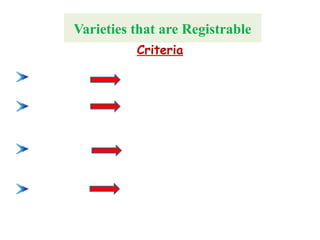
Varieties that are Registrable
DISTINCT
UNIFORM
STABLE
Atleast one essential characteristic
Sufficiently uniform
Susceptible to change after repeated
propagation
Criteria
NOVEL Variety is new
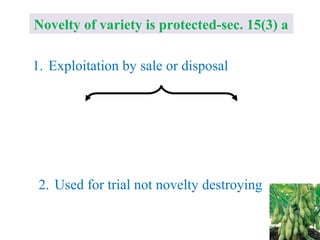
Novelty of variety is protected-sec. 15(3) a
1. Exploitation by sale or disposal
2. Used for trial not novelty destroying
< 1 Year
IN INDIA OVERSEAS
For Trees & Vines < 6 Yrs
Others < 4 Yrs
Extant Variety (Section 2j )
A variety in public domain is eligible for protection
Notified under section 5 of Seeds act 1966
Farmers’ variety
A variety about which there is common knowledge and includes the
propagating material from extant variety
Registration within Three Years
Essentially Derived Variety (Section 2i)
 Is a variety which is essentially derived from an initial variety
 Retains expression of the essential characteristics
 Clearly distinguishable from the initial variety
 Conforms to the initial variety in the expression of essential
characteristics except variation which result in the process of
derivation
 Not clearly defined in the Act
 DUS testing guidelines For EDV not developed yet.
People who can apply for protection of a Variety
any person claiming to be the breeder of the variety
any successor of the breeder of the variety
any person being the assignee of the breeder of the variety
any farmer or group of farmers or community of farmers claiming to
be the breeder of the variety
any person authorised in the prescribed manner by the persons
mentioned above
any university or publicly funded agricultural institution claiming to
be the breeder of the variety
PVP Conditions
Denomination
Descriptors of variety
Novelty
DUS Characters
Parental lines
Terminator technology
Rights of the Owner of the Variety (Sec. 28)
The owner of the protected variety has the right to
Produce the protected variety
Sell the variety
Market the variety
Distribute the variety
Import the variety
Export the variety
In case of the variety being an EDV where the EDV derived from a
protected variety then an authorisation required from the breeder of the
initial variety
Infringement (Sec. 64)
Any one of the following done by a person other than the
owner or without his authorisation / license
Sells, exports, imports or exports a registered
variety
Sells, exports, imports or exports a variety
deceptively similar to the registered variety
Acts not considered to be infringement
Researcher Rights (Sec 30) :
Use of variety for research and experimental purposes allowed
Use of variety as an initial variety for the creation of a new
variety allowed
Repeated use of the variety for commercial production of a
new variety is not allowed without the authorization of the
breeder of the registered variety.
Relief in Case of Infringement (Sec. 66)
An injunction awarded against the infringer
The plaintiff has the option to claim for damages or a share of the
profits of the infringer
Other Protection Provided
The PPVFRA provides a civil as well as a criminal liability for other acts
which violates the rights of the owner of the protected variety
Penalty for selling varieties to which false denomination is applied (Sec.
71) – punishable offence with heavy fine.
Penalty for falsely representing a variety as registered (Sec 72) –
punishable offence.
Penalty for subsequent offence (Sec 73).
Duty of the Breeder of a Protected Variety
Shall in all circumstances provide correctly the expected
yield/performance under a given set of conditions.
Shall ensure that the denomination of the protected variety conforms
with the description of the protected variety.
Who is a Farmer ?
A farmer is defined in the PPVFRA as :
Section 2(k) "farmer" means any person who--
i. cultivates crops by cultivating the land himself; or
ii. cultivates crops by directly supervising the cultivation of land
through any other person; or
iii. conserves and preserves, severally or jointly'. with any person
any wild species or traditional varieties, or adds value to such
wild species or traditional varieties through selection and
identification of their useful properties.
Farmers’ Rights (Sec 39)
Has the same privilege with respect to a breeder of a variety.
A farmers’ variety shall be entitled for registration if a declaration
has been made that the initial variety has been lawfully obtained.
Can save, use, sow, re-sow, exchange, share or sell his farm
produce including seed of a protected variety.
The farmer as such cannot sell branded seeds of a protected variety.
A farmer can claim damages if the seed of the protected variety does
not give the yield as stated by the breeder.
Protection Against Unintentional Use
(Sec 42)
The act provides farmers against the unintentional and accidental use of
the protected variety
No infringement if the farmer was unaware of the existence of
the rights.
A relief granted as damages for infringement shall not be
granted if the farmer proves before court that at that time he was
unaware of the existence of such right.
Farmers Are Exempted From Fees (Sec. 44)
Farmer or a group of farmers not liable to pay
Fees in any proceedings
Including any fees payable for inspection
For obtaining any copy of a document or a copy of a decision
A Compulsory Licensing System
Section 47
If seeds of a protected variety are not available after 3 yrs of
registration in adequate quantity, and at reasonable price, the
Authority may grant license to a third party to
(a) undertake production,
(b) distribution and
(c) sale of the seed on reasonable royalty
Benefit Sharing- National Gene Fund
Authority will invite claims for benefit sharing from persons or
organizations.
Benefit sharing only for Indian Citizens and Organizations.
Breeder can oppose the claims.
Authority shall decide the quantum.
The amount of benefit sharing shall be deposited with the National
Gene Fund.
Review and Renewal fee
The renewal fee payable by the breeder, agent and license shall be as
contained in the 2nd
schedule of the PPV & FR Rules, 2003. they will
apply to the registrar of the authority using form PV -6 for review
and renewal under 39 (4) (b) of the PPV & FR Rules, 2003.
REFERENCE
• http://plantauthority.gov.in/pdf/PVJFeb2013Final.pdf
• http://plantauthority.gov.in/
• DUS guidelines
THANK YOU

PPVFRA

  • 1.
    Procedure for registrationof a variety under PPV and FR Act 2001, forms and fees SST 803 DUS testing Hridya V Rejeendran 2016801804 1st Ph.D Scholar, SST
  • 2.
    Why Protection forplants is required in India? Compliance with TRIPS Some form of IPR protection is necessary for plants Can be in the form of patent protection; or By a sui generis system; or By a combination of both
  • 3.
    Crops Covered underthe PPVFRA Class of crops Crops Cereals Rice, wheat, maize, sorghum, pearl millet Pulses Chickpea, mungbean, urdbean, field pea, rajmash, lentil, pigeon pea Oilseeds Mustard, groundnut, soybean, sunflower, safflower, castor, sesame, linseed Fibre Crops Cotton and Jute Spices Turmeric, ginger, black pepper, coriander, small cardamom Fruit crop Mango Vegetables Tomato, brinjal, okra, cauliflower, cabbage, potato, onion, garlic, pea Flowers Rose, chrysanthemum Medicinal & Aromatic Plantago, Field Mint, Damask Rose, Periwinkle, Ashwagandha, Brahmi PLANTATION CROPS Eucalyptus, Casuarinas, Coconut, Isabgol
  • 4.
    Varieties that canbe registered Novel Variety Extant Variety Farmers Variety Essentially derived variety
  • 5.
    Varieties that areRegistrable DISTINCT UNIFORM STABLE Atleast one essential characteristic Sufficiently uniform Susceptible to change after repeated propagation Criteria NOVEL Variety is new
  • 6.
    Novelty of varietyis protected-sec. 15(3) a 1. Exploitation by sale or disposal 2. Used for trial not novelty destroying < 1 Year IN INDIA OVERSEAS For Trees & Vines < 6 Yrs Others < 4 Yrs
  • 7.
    Extant Variety (Section2j ) A variety in public domain is eligible for protection Notified under section 5 of Seeds act 1966 Farmers’ variety A variety about which there is common knowledge and includes the propagating material from extant variety Registration within Three Years
  • 8.
    Essentially Derived Variety(Section 2i)  Is a variety which is essentially derived from an initial variety  Retains expression of the essential characteristics  Clearly distinguishable from the initial variety  Conforms to the initial variety in the expression of essential characteristics except variation which result in the process of derivation  Not clearly defined in the Act  DUS testing guidelines For EDV not developed yet.
  • 9.
    People who canapply for protection of a Variety any person claiming to be the breeder of the variety any successor of the breeder of the variety any person being the assignee of the breeder of the variety any farmer or group of farmers or community of farmers claiming to be the breeder of the variety any person authorised in the prescribed manner by the persons mentioned above any university or publicly funded agricultural institution claiming to be the breeder of the variety
  • 10.
    PVP Conditions Denomination Descriptors ofvariety Novelty DUS Characters Parental lines Terminator technology
  • 11.
    Rights of theOwner of the Variety (Sec. 28) The owner of the protected variety has the right to Produce the protected variety Sell the variety Market the variety Distribute the variety Import the variety Export the variety In case of the variety being an EDV where the EDV derived from a protected variety then an authorisation required from the breeder of the initial variety
  • 12.
    Infringement (Sec. 64) Anyone of the following done by a person other than the owner or without his authorisation / license Sells, exports, imports or exports a registered variety Sells, exports, imports or exports a variety deceptively similar to the registered variety
  • 13.
    Acts not consideredto be infringement Researcher Rights (Sec 30) : Use of variety for research and experimental purposes allowed Use of variety as an initial variety for the creation of a new variety allowed Repeated use of the variety for commercial production of a new variety is not allowed without the authorization of the breeder of the registered variety.
  • 14.
    Relief in Caseof Infringement (Sec. 66) An injunction awarded against the infringer The plaintiff has the option to claim for damages or a share of the profits of the infringer
  • 15.
    Other Protection Provided ThePPVFRA provides a civil as well as a criminal liability for other acts which violates the rights of the owner of the protected variety Penalty for selling varieties to which false denomination is applied (Sec. 71) – punishable offence with heavy fine. Penalty for falsely representing a variety as registered (Sec 72) – punishable offence. Penalty for subsequent offence (Sec 73).
  • 16.
    Duty of theBreeder of a Protected Variety Shall in all circumstances provide correctly the expected yield/performance under a given set of conditions. Shall ensure that the denomination of the protected variety conforms with the description of the protected variety.
  • 17.
    Who is aFarmer ? A farmer is defined in the PPVFRA as : Section 2(k) "farmer" means any person who-- i. cultivates crops by cultivating the land himself; or ii. cultivates crops by directly supervising the cultivation of land through any other person; or iii. conserves and preserves, severally or jointly'. with any person any wild species or traditional varieties, or adds value to such wild species or traditional varieties through selection and identification of their useful properties.
  • 18.
    Farmers’ Rights (Sec39) Has the same privilege with respect to a breeder of a variety. A farmers’ variety shall be entitled for registration if a declaration has been made that the initial variety has been lawfully obtained. Can save, use, sow, re-sow, exchange, share or sell his farm produce including seed of a protected variety. The farmer as such cannot sell branded seeds of a protected variety. A farmer can claim damages if the seed of the protected variety does not give the yield as stated by the breeder.
  • 19.
    Protection Against UnintentionalUse (Sec 42) The act provides farmers against the unintentional and accidental use of the protected variety No infringement if the farmer was unaware of the existence of the rights. A relief granted as damages for infringement shall not be granted if the farmer proves before court that at that time he was unaware of the existence of such right.
  • 20.
    Farmers Are ExemptedFrom Fees (Sec. 44) Farmer or a group of farmers not liable to pay Fees in any proceedings Including any fees payable for inspection For obtaining any copy of a document or a copy of a decision
  • 21.
    A Compulsory LicensingSystem Section 47 If seeds of a protected variety are not available after 3 yrs of registration in adequate quantity, and at reasonable price, the Authority may grant license to a third party to (a) undertake production, (b) distribution and (c) sale of the seed on reasonable royalty
  • 22.
    Benefit Sharing- NationalGene Fund Authority will invite claims for benefit sharing from persons or organizations. Benefit sharing only for Indian Citizens and Organizations. Breeder can oppose the claims. Authority shall decide the quantum. The amount of benefit sharing shall be deposited with the National Gene Fund.
  • 25.
    Review and Renewalfee The renewal fee payable by the breeder, agent and license shall be as contained in the 2nd schedule of the PPV & FR Rules, 2003. they will apply to the registrar of the authority using form PV -6 for review and renewal under 39 (4) (b) of the PPV & FR Rules, 2003.
  • 26.
  • 27.

Editor's Notes

  • #7 INSERT THE CROP INCLUDED FOR DUS TESTING
  • #17 See Section 39(2) for expected yield