Palakdeep Kaur(179005)
Department of Pharmaceutical Sciences & Technology 1
TABLE OF CONTENT
Introduction
History of GI
Features of GI
Who can apply for the registration of a
GI?
Contents of the Application
GI in India
Examples of geographical indications
TRADEMARK AND GI
2
GEOGRAPHICAL
INDICATIONS (GI)
• An indication which identifies goods as
agricultural goods, natural goods or
manufactured goods.
• Originating or manufactured in the
territory of a country or a region or
locality.
• Where a given quality, reputation or other
characteristics of such goods is essentially
attributable to its geographical origin. 3
INDICATION
• Indication referring to a country or to a
place situated therein as being the country
or place of origin of a product.
• Refers to the geographical origin of the
product.
• No special characteristic implied.
4
APPELLATION OF ORIGIN
• Used on products that have a
specific quality that is exclusively
or essentially due to the
geographical environment in
which the products are produced.
5
HISTORY OF GI
• First GI system used in France –20th century-appellation
d'origine contrôlée (AOC). – Items that meet
geographical origin and quality standards may be
endorsed with a government-issued stamp which acts as
official certification of the origins and standards of the
product to the consumer.
– E.g: Gruyère cheese (from Switzerland) and many
French wines.
 Geographical indications have long been associated with
the concept of terroir and with Europe as an entity, where
there is a tradition of associating certain food products
with particular regions. 6
7
8
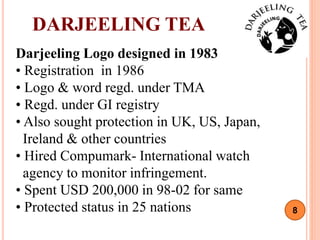
Darjeeling Logo designed in 1983
• Registration in 1986
• Logo & word regd. under TMA
• Regd. under GI registry
• Also sought protection in UK, US, Japan,
Ireland & other countries
• Hired Compumark- International watch
agency to monitor infringement.
• Spent USD 200,000 in 98-02 for same
• Protected status in 25 nations
DARJEELING TEA
FEATURES OF GI
• Collective community rights-protects groups of
producers
• Exclusive (no individual right)
• No right to assign- increases scope of protection
• Right in perpetuity- remains with the community
• Knowledge underlying GI remains in the public
domain
• Protects goods that are already famous-
reputation must pre exist
• Functions like a trademark. 9
WHO CAN APPLY FOR THE
REGISTRATION OF A
GEOGRAPHICAL INDICATION?
• Any association of persons, producers,
organisation or authority established by or
under the law.
• Registered proprietor
• Authorised user
• Producer
10
CONTENTS OF THE APPLICATION
Every application for the registration must contain:-
• A statement as to how the GIs serves to designate goods as originating from the
concerned territory of the country/region/locality in the country
• The class of goods to which the GI shall apply
• The Geographical map of the country, region or locality in the country in which
the goods originate or are being manufactured.
The particulars regarding the appearance of the GIs as to
whether it comprises of the
• words or figurative elements or both.
• Shall be in prescribed format
• Mechanism to ensure quality, standards, uniqueness
• Special human skills
• Name and address of the associations
• Inspection structure for maintaining quality
• Protection measures for eliminating infringement
11
GI IN INDIA
• India, as a member of the World Trade Organization
(WTO), enacted the Geographical Indications of
Goods (Registration & Protection)Act, 1999 has
come into force with effect from 15th September
2003.
• The Central Government of India has established
the Geographical Indications Registry with all India
jurisdiction in Chennai.
• The GI Act is being administered by the Controller
General of Patents, Designs and Trade Marks who
is the Registrar of Geographical Indications.
12
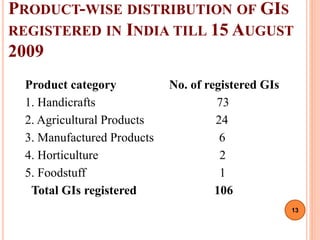
PRODUCT-WISE DISTRIBUTION OF GIS
REGISTERED IN INDIA TILL 15 AUGUST
2009
Product category No. of registered GIs
1. Handicrafts 73
2. Agricultural Products 24
3. Manufactured Products 6
4. Horticulture 2
5. Foodstuff 1
Total GIs registered 106
13
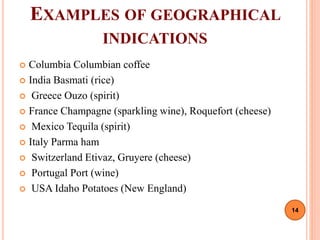
EXAMPLES OF GEOGRAPHICAL
INDICATIONS
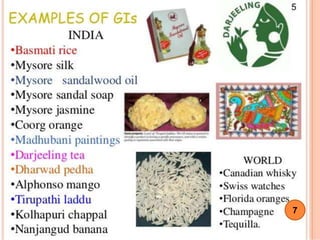
 Columbia Columbian coffee
 India Basmati (rice)
 Greece Ouzo (spirit)
 France Champagne (sparkling wine), Roquefort (cheese)
 Mexico Tequila (spirit)
 Italy Parma ham
 Switzerland Etivaz, Gruyere (cheese)
 Portugal Port (wine)
 USA Idaho Potatoes (New England)
14
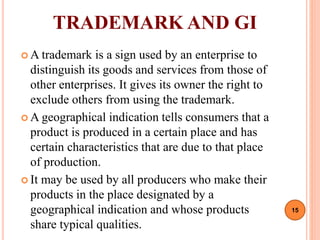
TRADEMARK AND GI
 A trademark is a sign used by an enterprise to
distinguish its goods and services from those of
other enterprises. It gives its owner the right to
exclude others from using the trademark.
 A geographical indication tells consumers that a
product is produced in a certain place and has
certain characteristics that are due to that place
of production.
 It may be used by all producers who make their
products in the place designated by a
geographical indication and whose products
share typical qualities.
15
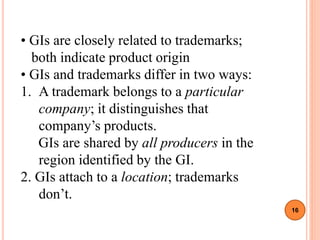
• GIs are closely related to trademarks;
both indicate product origin
• GIs and trademarks differ in two ways:
1. A trademark belongs to a particular
company; it distinguishes that
company’s products.
GIs are shared by all producers in the
region identified by the GI.
2. GIs attach to a location; trademarks
don’t.
16
THANK YOU

Geographical indications ppt

  • 1.
    Palakdeep Kaur(179005) Department ofPharmaceutical Sciences & Technology 1
  • 2.
    TABLE OF CONTENT Introduction Historyof GI Features of GI Who can apply for the registration of a GI? Contents of the Application GI in India Examples of geographical indications TRADEMARK AND GI 2
  • 3.
    GEOGRAPHICAL INDICATIONS (GI) • Anindication which identifies goods as agricultural goods, natural goods or manufactured goods. • Originating or manufactured in the territory of a country or a region or locality. • Where a given quality, reputation or other characteristics of such goods is essentially attributable to its geographical origin. 3
  • 4.
    INDICATION • Indication referringto a country or to a place situated therein as being the country or place of origin of a product. • Refers to the geographical origin of the product. • No special characteristic implied. 4
  • 5.
    APPELLATION OF ORIGIN •Used on products that have a specific quality that is exclusively or essentially due to the geographical environment in which the products are produced. 5
  • 6.
    HISTORY OF GI •First GI system used in France –20th century-appellation d'origine contrôlée (AOC). – Items that meet geographical origin and quality standards may be endorsed with a government-issued stamp which acts as official certification of the origins and standards of the product to the consumer. – E.g: Gruyère cheese (from Switzerland) and many French wines.  Geographical indications have long been associated with the concept of terroir and with Europe as an entity, where there is a tradition of associating certain food products with particular regions. 6
  • 7.
  • 8.
    8 Darjeeling Logo designedin 1983 • Registration in 1986 • Logo & word regd. under TMA • Regd. under GI registry • Also sought protection in UK, US, Japan, Ireland & other countries • Hired Compumark- International watch agency to monitor infringement. • Spent USD 200,000 in 98-02 for same • Protected status in 25 nations DARJEELING TEA
  • 9.
    FEATURES OF GI •Collective community rights-protects groups of producers • Exclusive (no individual right) • No right to assign- increases scope of protection • Right in perpetuity- remains with the community • Knowledge underlying GI remains in the public domain • Protects goods that are already famous- reputation must pre exist • Functions like a trademark. 9
  • 10.
    WHO CAN APPLYFOR THE REGISTRATION OF A GEOGRAPHICAL INDICATION? • Any association of persons, producers, organisation or authority established by or under the law. • Registered proprietor • Authorised user • Producer 10
  • 11.
    CONTENTS OF THEAPPLICATION Every application for the registration must contain:- • A statement as to how the GIs serves to designate goods as originating from the concerned territory of the country/region/locality in the country • The class of goods to which the GI shall apply • The Geographical map of the country, region or locality in the country in which the goods originate or are being manufactured. The particulars regarding the appearance of the GIs as to whether it comprises of the • words or figurative elements or both. • Shall be in prescribed format • Mechanism to ensure quality, standards, uniqueness • Special human skills • Name and address of the associations • Inspection structure for maintaining quality • Protection measures for eliminating infringement 11
  • 12.
    GI IN INDIA •India, as a member of the World Trade Organization (WTO), enacted the Geographical Indications of Goods (Registration & Protection)Act, 1999 has come into force with effect from 15th September 2003. • The Central Government of India has established the Geographical Indications Registry with all India jurisdiction in Chennai. • The GI Act is being administered by the Controller General of Patents, Designs and Trade Marks who is the Registrar of Geographical Indications. 12
  • 13.
    PRODUCT-WISE DISTRIBUTION OFGIS REGISTERED IN INDIA TILL 15 AUGUST 2009 Product category No. of registered GIs 1. Handicrafts 73 2. Agricultural Products 24 3. Manufactured Products 6 4. Horticulture 2 5. Foodstuff 1 Total GIs registered 106 13
  • 14.
    EXAMPLES OF GEOGRAPHICAL INDICATIONS Columbia Columbian coffee  India Basmati (rice)  Greece Ouzo (spirit)  France Champagne (sparkling wine), Roquefort (cheese)  Mexico Tequila (spirit)  Italy Parma ham  Switzerland Etivaz, Gruyere (cheese)  Portugal Port (wine)  USA Idaho Potatoes (New England) 14
  • 15.
    TRADEMARK AND GI A trademark is a sign used by an enterprise to distinguish its goods and services from those of other enterprises. It gives its owner the right to exclude others from using the trademark.  A geographical indication tells consumers that a product is produced in a certain place and has certain characteristics that are due to that place of production.  It may be used by all producers who make their products in the place designated by a geographical indication and whose products share typical qualities. 15
  • 16.
    • GIs areclosely related to trademarks; both indicate product origin • GIs and trademarks differ in two ways: 1. A trademark belongs to a particular company; it distinguishes that company’s products. GIs are shared by all producers in the region identified by the GI. 2. GIs attach to a location; trademarks don’t. 16
  • 17.

Editor's Notes

  • #11 Benefits of Registration :-Geographical Indications registration gives to the registered proprietor and its authorised users, the legal right to the exclusive use of the GI and also the right to obtain relief in case of its infringement. Exclusion of unauthorized persons from misusing GI would ensure that genuine products of the rightful producers are marketed.
  • #12 Duration of Registration :-According to Section 18, a registered geographical indication shall be valid for 10 years and can be renewed from time to time on payment of renewal fee. Any person aggrieved by an order or decision of the Registrar may prefer an appeal to the intellectual property appellate board (IPAB) within three months. [Section31]