Dr. D.K. Janghel
Pulses Section (Chickpea)
Department of Genetics and Plant Breeding,
CCS Haryana Agricultural University, Hisar-125004, Haryana
Gene Pyramiding
MAS based gene pyramiding could facilitate in
pyramiding of genes effectively into a single genetic
Background.
Gene pyramiding or gene stacking or gene assembling
defined as a process of combining two or more genes
from multiple parents into a varieties.
or
Pyramiding is a stacking of multiple genes for
simultaneous expression of more than one gene in a elite
line.
B
C
E
D
A
B C
C D E
F G H I
H
F
I
A
G
Why gene pyramiding?
Gene pyramiding is an important strategy for germplasm
improvement-
 Enhancing trait performance by combining two or more genes.
 Remedy of deficits by introgression of genes from other sources.
 Increasing the durability of disease resistance.
 Broadening the genetic basis of released cultivars.
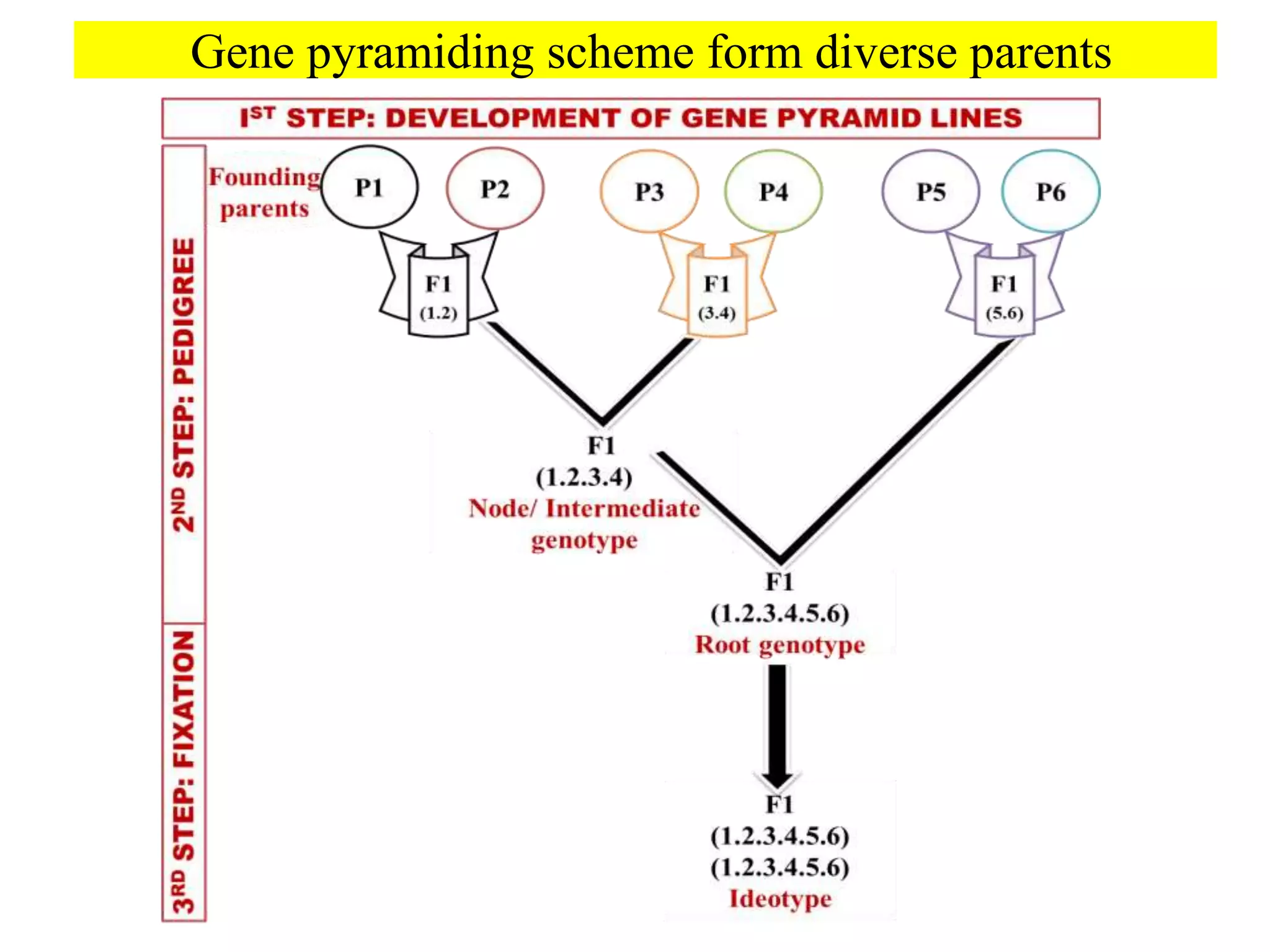
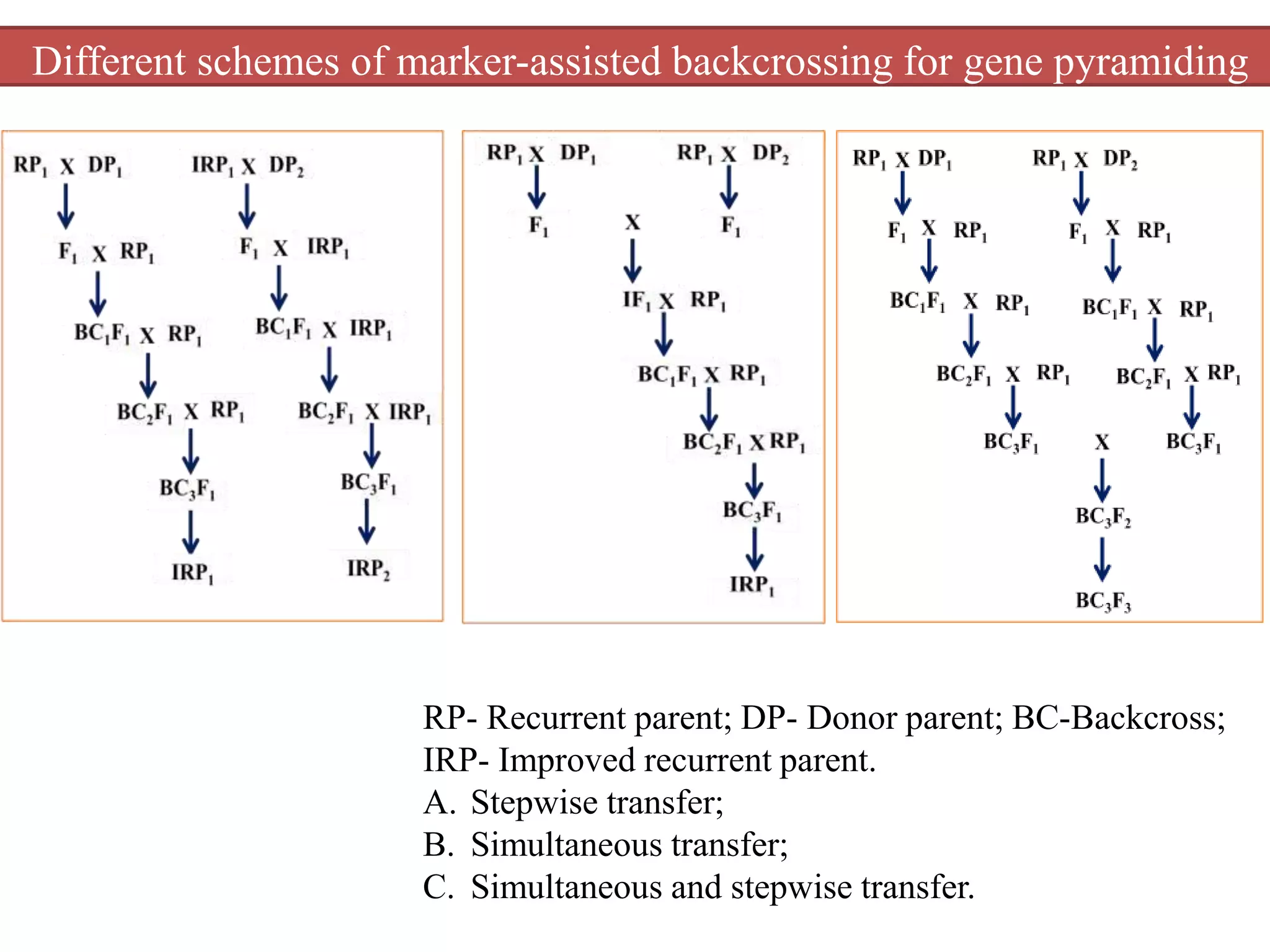
Gene pyramiding scheme form diverse parents
Different schemes of marker-assisted backcrossing for gene pyramiding
RP- Recurrent parent; DP- Donor parent; BC-Backcross;
IRP- Improved recurrent parent.
A. Stepwise transfer;
B. Simultaneous transfer;
C. Simultaneous and stepwise transfer.
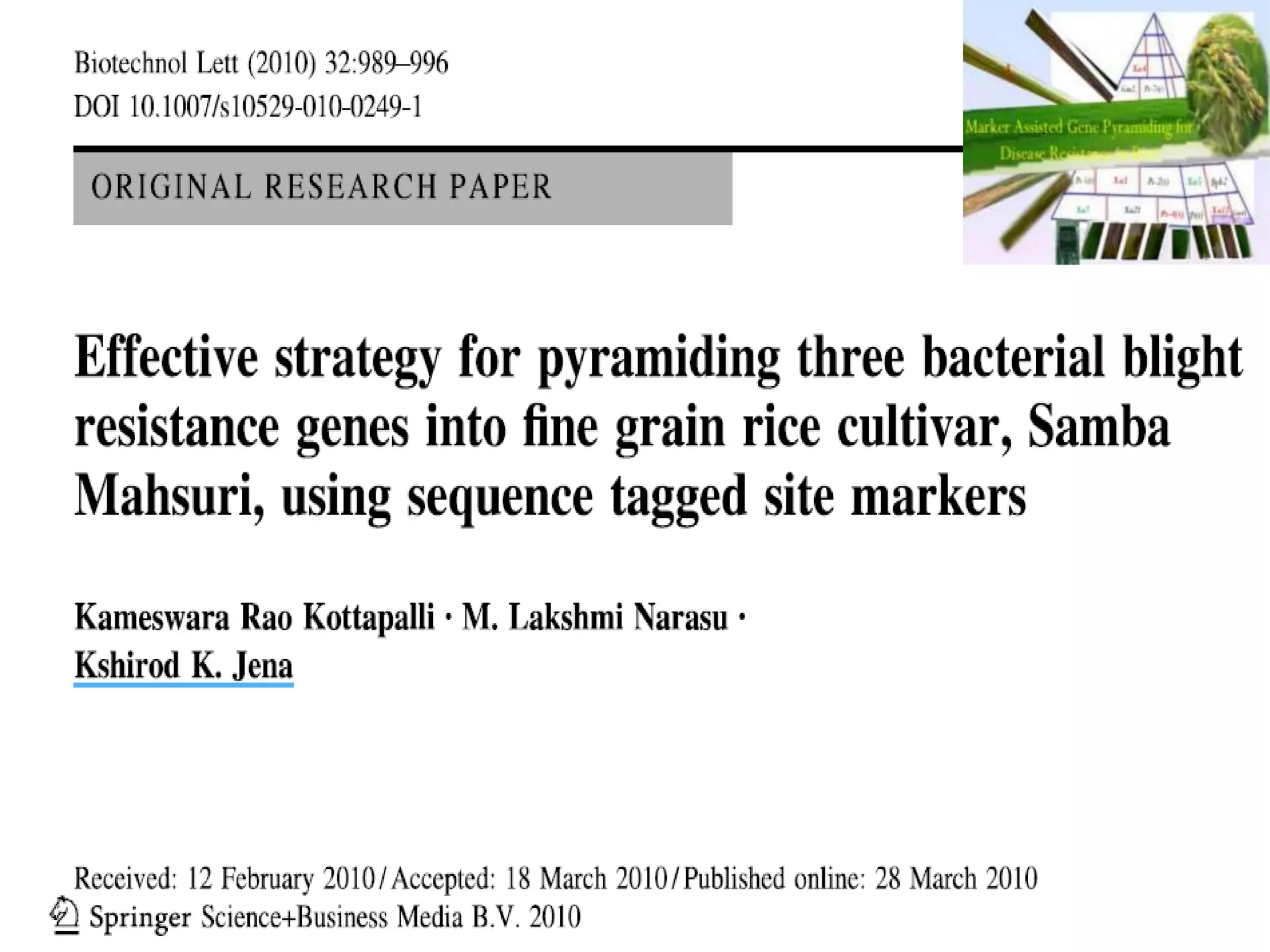
Durable BB resistance in Samba Mahsuri of
Rice cultivar
• The pathogen, Xanthomonas oryzae pv. oryzae, causing the
disease is highly virulent to rice crops and is capable of
evolving new races.
• Breeding efforts to incorporate single BB resistant gene often
leads to resistance breakdown within a short period.
• To overcome such breakdown, they developed durable BB
resistance germplasm by introgressing three bacterial blight
resistance genes xa5, xa13 and Xa21 into a premium quality
fine rice grain variety, Samba Mahsuri, using sequence
tagged site (STS) markers linked to these genes.
Plant Materials
• A premium quality fine rice grain variety, Samba Mahsuri, of South India
with great consumer preference across the world.
Resistant Donors
• Three near isogenic lines IRBB5 (xa5), IRBB13 (xa13) & IRBB21 (Xa21)
and
• A pyramid line IRBB59 with all the three genes (xa5, xa13 & Xa21) in the
background of IR 24.
Susceptible Checks
• Three varieties, IR 24, Taichung Native-1 (TN-1) and Sona Mahsuri were
used as BB susceptible checks.
Gene Pyramiding method
• Conventional backcross breeding programme in conjunction with MAS.
Materials and Methods
• The recurrent parent Samba Mahsuri was crossed separately with
each of the near isogenic lines for xa5, xa13 and Xa21 resistance
genes.
• The F1 plants from these crosses were selfed and crossed with
each other to generate two gene pyramids (one gene and two gene
Samba Mahsuri pyramid lines, respectively).
• The plants carrying two genes were ciossed with plants having
the other gene to generate three gene (xa5, xa13 and Xa21)
pyramid lines.
• Also crosses were made between Samba Mahsuri pyramid line and
IRBB59 (xa5, xa13 and Xa21).
Gene Pyramiding Scheme
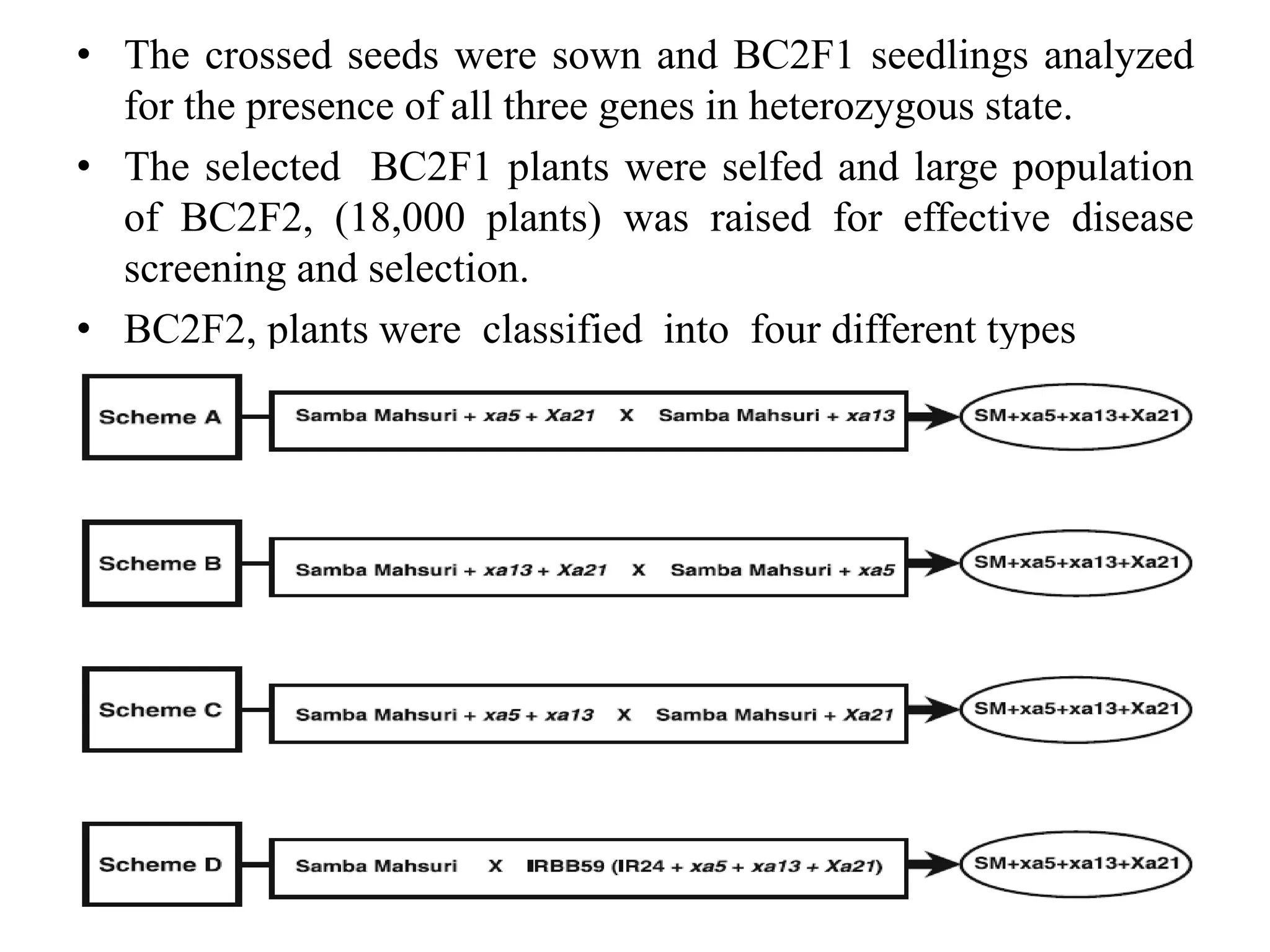
• The crossed seeds were sown and BC2F1 seedlings analyzed
for the presence of all three genes in heterozygous state.
• The selected BC2F1 plants were selfed and large population
of BC2F2, (18,000 plants) was raised for effective disease
screening and selection.
• BC2F2, plants were classified into four different types
Disease Resistant Screening
Phenotype Screening
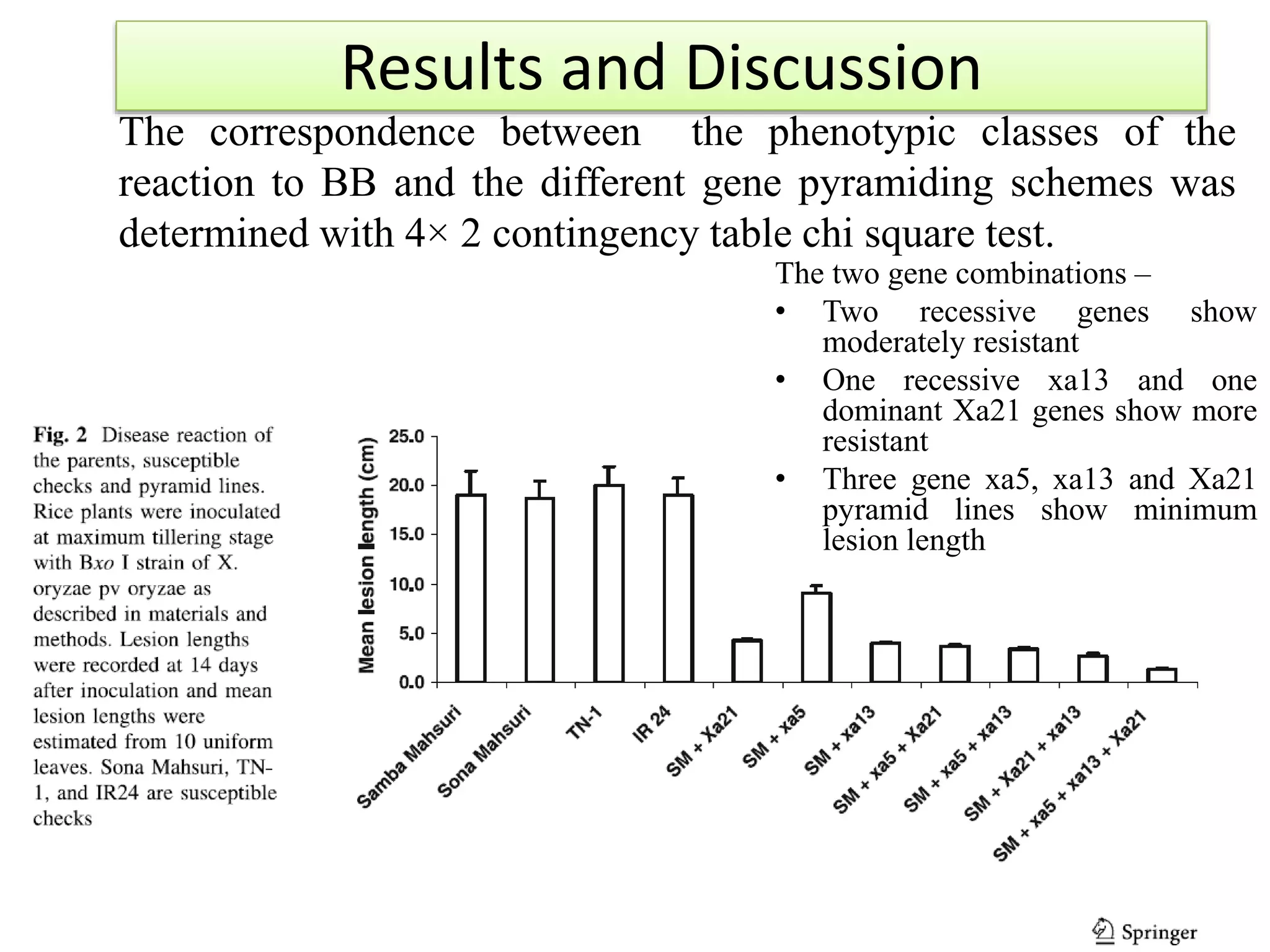
• The parental lines, donors and pyramid lines from the BC families
were artificially inoculated at maximum tillering stage with Bxol
pathogen, a representative of wild Indian isolate Xanthomonas
oryzae pv. oryzae. The lesion lengths were evaluated 14 days after
inoculation and mean lesion lengths were recorded for10 leaves.
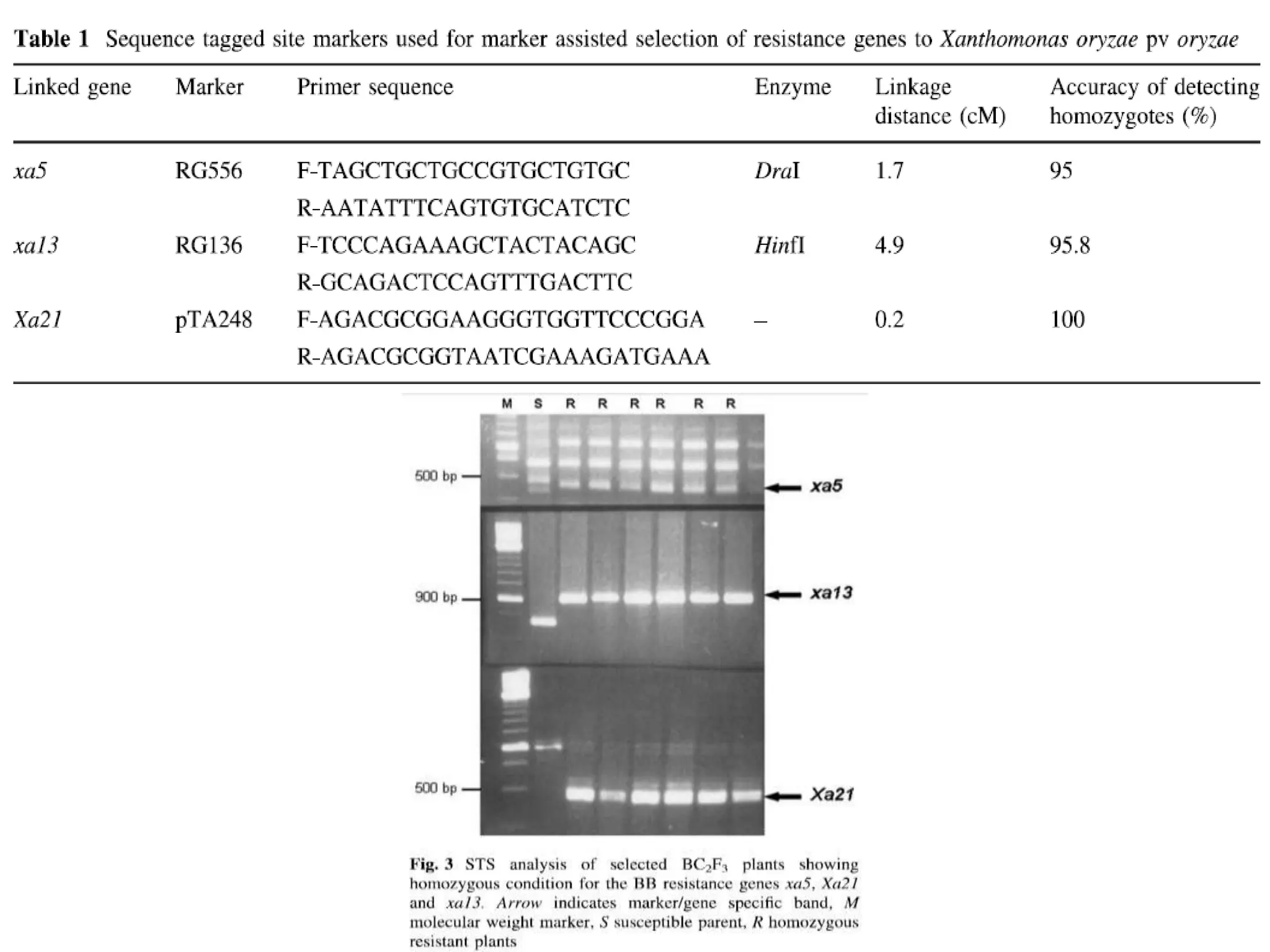
Genotype Screening
• Phenotvpically resistant plants selected after field screening, were
analyzed at molecular level using DNA markers for xa5, xa13, and
Xa21 genes.
• STS markers linked to the BB resistance genes xa5, xa13 and Xa21
were synthesized from Life Technologies Inc., USA (Table 1).
Results and Discussion
The correspondence between the phenotypic classes of the
reaction to BB and the different gene pyramiding schemes was
determined with 4× 2 contingency table chi square test.
The two gene combinations –
• Two recessive genes show
moderately resistant
• One recessive xa13 and one
dominant Xa21 genes show more
resistant
• Three gene xa5, xa13 and Xa21
pyramid lines show minimum
lesion length
Results and Discussion
Gene Pyramiding11.pptx

Gene Pyramiding11.pptx

  • 1.
    Dr. D.K. Janghel PulsesSection (Chickpea) Department of Genetics and Plant Breeding, CCS Haryana Agricultural University, Hisar-125004, Haryana
  • 2.
    Gene Pyramiding MAS basedgene pyramiding could facilitate in pyramiding of genes effectively into a single genetic Background. Gene pyramiding or gene stacking or gene assembling defined as a process of combining two or more genes from multiple parents into a varieties. or Pyramiding is a stacking of multiple genes for simultaneous expression of more than one gene in a elite line.
  • 3.
    B C E D A B C C DE F G H I H F I A G
  • 4.
    Why gene pyramiding? Genepyramiding is an important strategy for germplasm improvement-  Enhancing trait performance by combining two or more genes.  Remedy of deficits by introgression of genes from other sources.  Increasing the durability of disease resistance.  Broadening the genetic basis of released cultivars.
  • 5.
    Gene pyramiding schemeform diverse parents
  • 6.
    Different schemes ofmarker-assisted backcrossing for gene pyramiding RP- Recurrent parent; DP- Donor parent; BC-Backcross; IRP- Improved recurrent parent. A. Stepwise transfer; B. Simultaneous transfer; C. Simultaneous and stepwise transfer.
  • 8.
    Durable BB resistancein Samba Mahsuri of Rice cultivar • The pathogen, Xanthomonas oryzae pv. oryzae, causing the disease is highly virulent to rice crops and is capable of evolving new races. • Breeding efforts to incorporate single BB resistant gene often leads to resistance breakdown within a short period. • To overcome such breakdown, they developed durable BB resistance germplasm by introgressing three bacterial blight resistance genes xa5, xa13 and Xa21 into a premium quality fine rice grain variety, Samba Mahsuri, using sequence tagged site (STS) markers linked to these genes.
  • 9.
    Plant Materials • Apremium quality fine rice grain variety, Samba Mahsuri, of South India with great consumer preference across the world. Resistant Donors • Three near isogenic lines IRBB5 (xa5), IRBB13 (xa13) & IRBB21 (Xa21) and • A pyramid line IRBB59 with all the three genes (xa5, xa13 & Xa21) in the background of IR 24. Susceptible Checks • Three varieties, IR 24, Taichung Native-1 (TN-1) and Sona Mahsuri were used as BB susceptible checks. Gene Pyramiding method • Conventional backcross breeding programme in conjunction with MAS. Materials and Methods
  • 10.
    • The recurrentparent Samba Mahsuri was crossed separately with each of the near isogenic lines for xa5, xa13 and Xa21 resistance genes. • The F1 plants from these crosses were selfed and crossed with each other to generate two gene pyramids (one gene and two gene Samba Mahsuri pyramid lines, respectively). • The plants carrying two genes were ciossed with plants having the other gene to generate three gene (xa5, xa13 and Xa21) pyramid lines. • Also crosses were made between Samba Mahsuri pyramid line and IRBB59 (xa5, xa13 and Xa21). Gene Pyramiding Scheme
  • 11.
    • The crossedseeds were sown and BC2F1 seedlings analyzed for the presence of all three genes in heterozygous state. • The selected BC2F1 plants were selfed and large population of BC2F2, (18,000 plants) was raised for effective disease screening and selection. • BC2F2, plants were classified into four different types
  • 12.
    Disease Resistant Screening PhenotypeScreening • The parental lines, donors and pyramid lines from the BC families were artificially inoculated at maximum tillering stage with Bxol pathogen, a representative of wild Indian isolate Xanthomonas oryzae pv. oryzae. The lesion lengths were evaluated 14 days after inoculation and mean lesion lengths were recorded for10 leaves. Genotype Screening • Phenotvpically resistant plants selected after field screening, were analyzed at molecular level using DNA markers for xa5, xa13, and Xa21 genes. • STS markers linked to the BB resistance genes xa5, xa13 and Xa21 were synthesized from Life Technologies Inc., USA (Table 1).
  • 14.
    Results and Discussion Thecorrespondence between the phenotypic classes of the reaction to BB and the different gene pyramiding schemes was determined with 4× 2 contingency table chi square test. The two gene combinations – • Two recessive genes show moderately resistant • One recessive xa13 and one dominant Xa21 genes show more resistant • Three gene xa5, xa13 and Xa21 pyramid lines show minimum lesion length
  • 15.