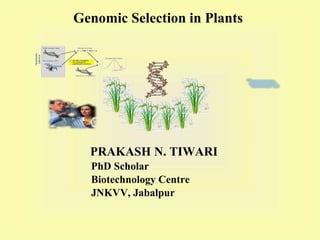
Genomic Selection in Plants
PRAKASH N. TIWARI
PhD Scholar
Biotechnology Centre
JNKVV, Jabalpur
Presentation Overview
 Introduction (GS)
 Preparation of phenotypic and
genotypic data
 Construction of GS model
 Fitting and evaluation of GS model
 GS in breeding programs
 Case study
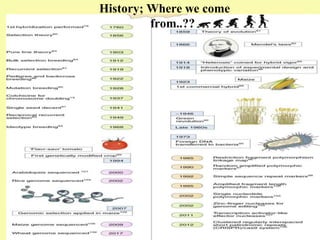
History; Where we come
from..??
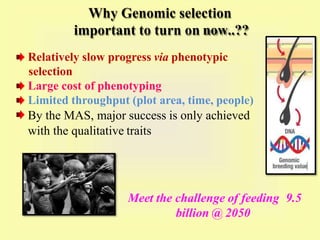
Why Genomic selection
important to turn on now..??
Relatively slow progress via phenotypic
selection
Large cost of phenotyping
Limited throughput (plot area, time, people)
By the MAS, major success is only achieved
with the qualitative traits
Meet the challenge of feeding 9.5
billion @ 2050
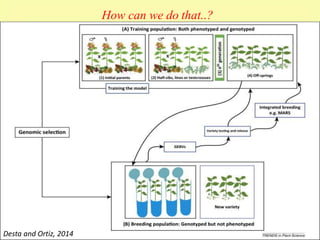
GENOMIC SELECTION (GS)
• Proposed by Meuwissen et al. (2001)
• Genomic selection is based on estimation of detailed
associations between a very dense set of genetic markers and
phenotypes on a selected group of plants (the
reference population)
• The resulting prediction equations are then applied to SNP
genotyped rest population to estimate their genomic
breeding value (GEBV), without the need of additional
phenotypes (Oldenbroek, 2015)
Desta and Ortiz, 2014
How can we do that..?
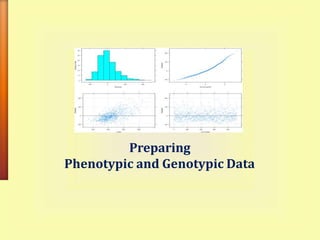
Preparing
Phenotypic and Genotypic Data
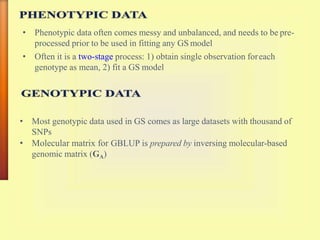
• Phenotypic data often comes messy and unbalanced, and needs to be pre-
processed prior to be used in fitting any GS model
• Often it is a two-stage process: 1) obtain single observation foreach
genotype as mean, 2) fit a GS model
• Most genotypic data used in GS comes as large datasets with thousand of
SNPs
• Molecular matrix for GBLUP is prepared by inversing molecular-based
genomic matrix (GA)
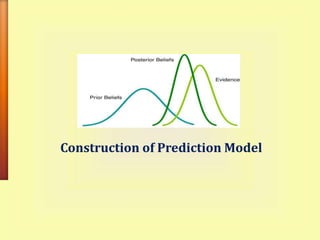
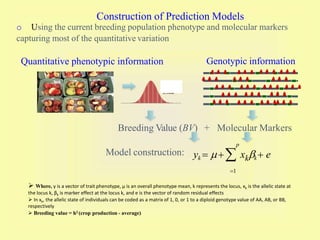
Construction of Prediction Model
Range: -0.0190 ~ 0
Mean: -0.00021
SD: 0.00380
Model construction:
Breeding Value (BV) + Molecular Markers
p
o Using the current breeding population phenotype and molecular markers
capturing most of the quantitative variation
Quantitative phenotypic information Genotypic information
Construction of Prediction Models
 Where, y is a vector of trait phenotype, μ is an overall phenotype mean, k represents the locus, xk is the allelic state at
the locus k, βk is marker effect at the locus k, and e is the vector of random residual effects
 In xk, the allelic state of individuals can be coded as a matrix of 1, 0, or 1 to a diploid genotype value of AA, AB, or BB,
respectively
 Breeding value = h2 (crop production - average)
yk   xkk e
1
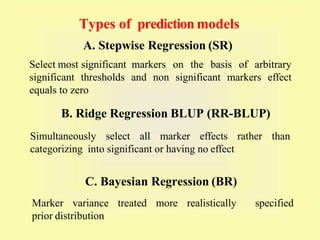
Select most significant markers on the basis of arbitrary
significant thresholds and non significant markers effect
equals to zero
A. Stepwise Regression (SR)
B. Ridge Regression BLUP (RR-BLUP)
Simultaneously select all marker effects rather than
categorizing into significant or having no effect
C. Bayesian Regression (BR)
Marker variance treated more realistically specified
prior distribution
Types of prediction models
Fitting and Evaluating a GS Model
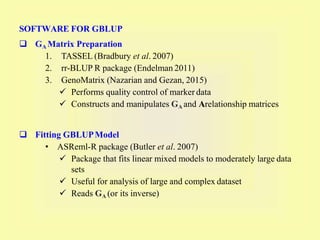
SOFTWARE FOR GBLUP
 GA Matrix Preparation
1. TASSEL (Bradbury et al. 2007)
2. rr-BLUP R package (Endelman 2011)
3. GenoMatrix (Nazarian and Gezan, 2015)
 Performs quality control of marker data
 Constructs and manipulates GA and Arelationship matrices
 Fitting GBLUPModel
• ASReml-R package (Butler et al. 2007)
 Package that fits linear mixed models to moderately large data
sets
 Useful for analysis of large and complex dataset
 Reads GA (or its inverse)
Genomic Selection
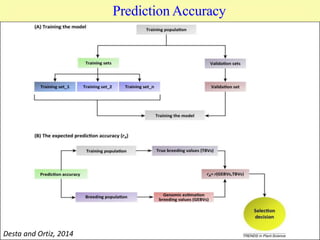
Desta and Ortiz, 2014
Prediction Accuracy
Validation of a GS model fit
Validation is often done by:
1. Partitioning the data: Validation with the same data
is expected to give the best results
2. Cross-validation: Use different portions of the data
3. True-validation: Use data from a different trial,
another season, or data from the next generation of
breeding
4. K-fold Cross-Validation: By randomly selecting
(1/k) of the observations at random as the training
population and the remaining (1-1/k) are used for
validation
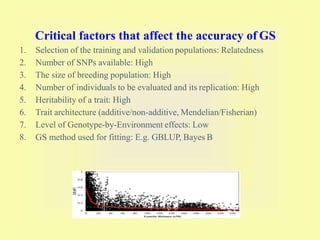
Critical factors that affect the accuracy of GS
1. Selection of the training and validation populations: Relatedness
2. Number of SNPs available: High
3. The size of breeding population: High
4. Number of individuals to be evaluated and its replication: High
5. Heritability of a trait: High
6. Trait architecture (additive/non-additive, Mendelian/Fisherian)
7. Level of Genotype-by-Environment effects: Low
8. GS method used for fitting: E.g. GBLUP, Bayes B
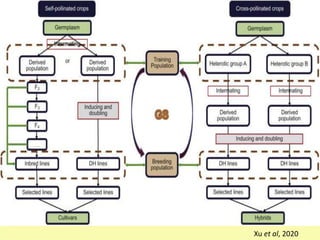
Xu et al, 2020
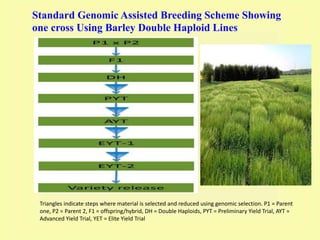
Standard Genomic Assisted Breeding Scheme Showing
one cross Using Barley Double Haploid Lines
Triangles indicate steps where material is selected and reduced using genomic selection. P1 = Parent
one, P2 = Parent 2, F1 = offspring/hybrid, DH = Double Haploids, PYT = Preliminary Yield Trial, AYT =
Advanced Yield Trial, YET = Elite Yield Trial
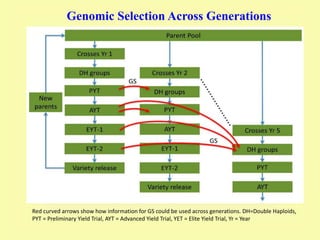
Genomic Selection Across Generations
Red curved arrows show how information for GS could be used across generations. DH=Double Haploids,
PYT = Preliminary Yield Trial, AYT = Advanced Yield Trial, YET = Elite Yield Trial, Yr = Year
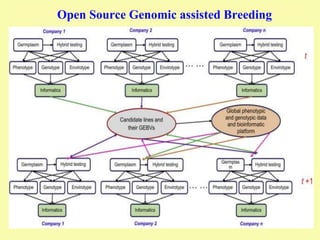
Open Source Genomic assisted Breeding
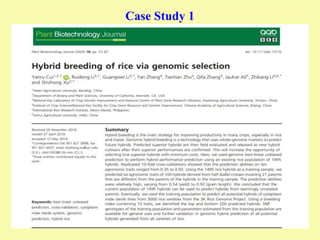
Case Study
Case Study 1
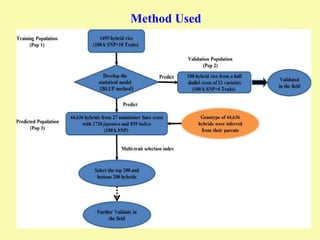
Method Used
Result
 Using a breeding index combining 10 traits, they identified the top and
bottom 200 predicted hybrids
 This will increase the opportunity of selecting true superior hybrids
with
 SNP genotypes of the training population and parameters estimated
from this training population are available for general uses and further
validation in genomic hybrid prediction of all potential hybrids
generated from all varieties of rice
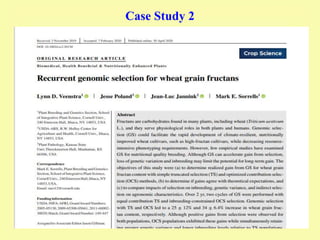
Case Study 2
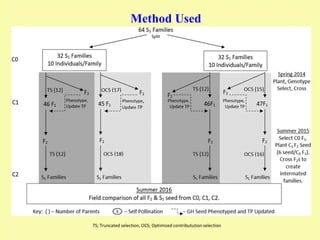
Method Used
TS; Truncated selection, OCS; Optimized contributution selection
Result
 Genomic selection with TS and OCS led to a 25 ± 12% and 34 ± 6.4%
increase in wheat grain fructan content, respectively
 Although positive gains from selection were observed for both
populations, OCS populations exhibited these gains while
simultaneously retaining greater genetic variance and lower
inbreeding levels relative to TS populations
 Selection for wheat grain fructan content did not change plant height
but significantly decreased days to heading in OCS populations
 In this study, GS effectively improved the nutritional quality of wheat,
and OCS controlled the rate of inbreeding
Conclusion
Morrell et al., 2012
Genomic Selection Speeds Breeding
Thank you

Genomic Selection in Plants

  • 1.
    Genomic Selection inPlants PRAKASH N. TIWARI PhD Scholar Biotechnology Centre JNKVV, Jabalpur
  • 2.
    Presentation Overview  Introduction(GS)  Preparation of phenotypic and genotypic data  Construction of GS model  Fitting and evaluation of GS model  GS in breeding programs  Case study
  • 3.
    History; Where wecome from..??
  • 4.
    Why Genomic selection importantto turn on now..?? Relatively slow progress via phenotypic selection Large cost of phenotyping Limited throughput (plot area, time, people) By the MAS, major success is only achieved with the qualitative traits Meet the challenge of feeding 9.5 billion @ 2050
  • 5.
    GENOMIC SELECTION (GS) •Proposed by Meuwissen et al. (2001) • Genomic selection is based on estimation of detailed associations between a very dense set of genetic markers and phenotypes on a selected group of plants (the reference population) • The resulting prediction equations are then applied to SNP genotyped rest population to estimate their genomic breeding value (GEBV), without the need of additional phenotypes (Oldenbroek, 2015)
  • 6.
    Desta and Ortiz,2014 How can we do that..?
  • 7.
  • 8.
    • Phenotypic dataoften comes messy and unbalanced, and needs to be pre- processed prior to be used in fitting any GS model • Often it is a two-stage process: 1) obtain single observation foreach genotype as mean, 2) fit a GS model • Most genotypic data used in GS comes as large datasets with thousand of SNPs • Molecular matrix for GBLUP is prepared by inversing molecular-based genomic matrix (GA)
  • 9.
  • 10.
    Range: -0.0190 ~0 Mean: -0.00021 SD: 0.00380 Model construction: Breeding Value (BV) + Molecular Markers p o Using the current breeding population phenotype and molecular markers capturing most of the quantitative variation Quantitative phenotypic information Genotypic information Construction of Prediction Models  Where, y is a vector of trait phenotype, μ is an overall phenotype mean, k represents the locus, xk is the allelic state at the locus k, βk is marker effect at the locus k, and e is the vector of random residual effects  In xk, the allelic state of individuals can be coded as a matrix of 1, 0, or 1 to a diploid genotype value of AA, AB, or BB, respectively  Breeding value = h2 (crop production - average) yk   xkk e 1
  • 11.
    Select most significantmarkers on the basis of arbitrary significant thresholds and non significant markers effect equals to zero A. Stepwise Regression (SR) B. Ridge Regression BLUP (RR-BLUP) Simultaneously select all marker effects rather than categorizing into significant or having no effect C. Bayesian Regression (BR) Marker variance treated more realistically specified prior distribution Types of prediction models
  • 12.
  • 13.
    SOFTWARE FOR GBLUP GA Matrix Preparation 1. TASSEL (Bradbury et al. 2007) 2. rr-BLUP R package (Endelman 2011) 3. GenoMatrix (Nazarian and Gezan, 2015)  Performs quality control of marker data  Constructs and manipulates GA and Arelationship matrices  Fitting GBLUPModel • ASReml-R package (Butler et al. 2007)  Package that fits linear mixed models to moderately large data sets  Useful for analysis of large and complex dataset  Reads GA (or its inverse)
  • 14.
  • 15.
    Desta and Ortiz,2014 Prediction Accuracy
  • 16.
    Validation of aGS model fit Validation is often done by: 1. Partitioning the data: Validation with the same data is expected to give the best results 2. Cross-validation: Use different portions of the data 3. True-validation: Use data from a different trial, another season, or data from the next generation of breeding 4. K-fold Cross-Validation: By randomly selecting (1/k) of the observations at random as the training population and the remaining (1-1/k) are used for validation
  • 17.
    Critical factors thataffect the accuracy of GS 1. Selection of the training and validation populations: Relatedness 2. Number of SNPs available: High 3. The size of breeding population: High 4. Number of individuals to be evaluated and its replication: High 5. Heritability of a trait: High 6. Trait architecture (additive/non-additive, Mendelian/Fisherian) 7. Level of Genotype-by-Environment effects: Low 8. GS method used for fitting: E.g. GBLUP, Bayes B
  • 19.
  • 20.
    Standard Genomic AssistedBreeding Scheme Showing one cross Using Barley Double Haploid Lines Triangles indicate steps where material is selected and reduced using genomic selection. P1 = Parent one, P2 = Parent 2, F1 = offspring/hybrid, DH = Double Haploids, PYT = Preliminary Yield Trial, AYT = Advanced Yield Trial, YET = Elite Yield Trial
  • 21.
    Genomic Selection AcrossGenerations Red curved arrows show how information for GS could be used across generations. DH=Double Haploids, PYT = Preliminary Yield Trial, AYT = Advanced Yield Trial, YET = Elite Yield Trial, Yr = Year
  • 22.
    Open Source Genomicassisted Breeding
  • 23.
  • 24.
  • 25.
  • 26.
    Result  Using abreeding index combining 10 traits, they identified the top and bottom 200 predicted hybrids  This will increase the opportunity of selecting true superior hybrids with  SNP genotypes of the training population and parameters estimated from this training population are available for general uses and further validation in genomic hybrid prediction of all potential hybrids generated from all varieties of rice
  • 27.
  • 28.
    Method Used TS; Truncatedselection, OCS; Optimized contributution selection
  • 29.
    Result  Genomic selectionwith TS and OCS led to a 25 ± 12% and 34 ± 6.4% increase in wheat grain fructan content, respectively  Although positive gains from selection were observed for both populations, OCS populations exhibited these gains while simultaneously retaining greater genetic variance and lower inbreeding levels relative to TS populations  Selection for wheat grain fructan content did not change plant height but significantly decreased days to heading in OCS populations  In this study, GS effectively improved the nutritional quality of wheat, and OCS controlled the rate of inbreeding
  • 30.
  • 31.
    Morrell et al.,2012 Genomic Selection Speeds Breeding
  • 32.