©2000 Timothy G. Standish
Genesis 25:24-26
24 And when her days to be delivered
were fulfilled, behold, there were
twins in her womb.
25 And the first came out red, all over like
an hairy garment; and they called his
name Esau.
26 And after that came his brother out, and
his hand took hold on Esau's heel; and
his name was called Jacob . . .
©2000 Timothy G. Standish
Timothy G. Standish, Ph. D.
Quantitative
Quantitative
Genetics
Genetics
©2000 Timothy G. Standish
How Could Noah Have Done It?
 The diversity of appearance in humans and other animals is
immense
 How could Adam and Eve or Noah and his family have
held in their genomes genes for all that we see today?
 At least one explanation, that the dark-skinned races
descended from Cain who was marked with dark pigment
(the mark of Cain mentioned in Gen. 4:15) or Ham as a
result of the curse mentioned in Gen. 9:22-27
 Quantitative or polygenic inheritance offers much more
satisfying answer to this quandary
©2000 Timothy G. Standish
Definitions
Definitions
 Traits examined so far have resulted in discontinuous phenotypic traits
– Tall or dwarf
– Round or wrinkled
– Red, pink or white
 Quantitative inheritance deals with genetic control of phenotypic traits
that vary on a continuous basis:
– Height
– Weight
– Skin color
 Many quantitative traits are also influenced by the environment
©2000 Timothy G. Standish
Nature Vs Nurture
Nature Vs Nurture
 Quantitative genes’ influence on phenotype are at the crux of the
nature/nurture debate
 Socialism emphasizes the environment
 Fascism emphasizes genetics
 Understanding quantitative genetics helps us to understand the
degree to which genetics and the environment impact phenotype
 Aside from political considerations, quantitative genetics helps
us to understand the potential for selection to impact productivity
in crops and livestock
©2000 Timothy G. Standish
Additive Alleles
Additive Alleles
CR
CW
CR
CR
CW
CW
F2 Generation
2: 1
1:
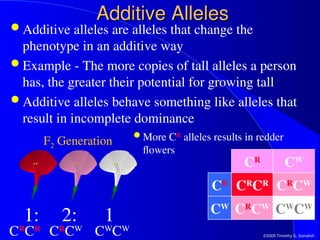
 Additive alleles are alleles that change the
phenotype in an additive way
 Example - The more copies of tall alleles a person
has, the greater their potential for growing tall
 Additive alleles behave something like alleles that
result in incomplete dominance
 More CR
alleles results in redder
flowers
CR
CR
CR
CW
CR
CW
CW
CW
CR
CW
CR
CW
©2000 Timothy G. Standish
Additive Alleles
Additive Alleles
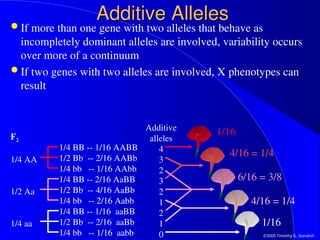
 If more than one gene with two alleles that behave as
incompletely dominant alleles are involved, variability occurs
over more of a continuum
 If two genes with two alleles are involved, X phenotypes can
result
Additive
alleles
4
3
2
3
2
1
2
1
0
F2
1/4 AA
1/2 Aa
1/4 aa
1/4 BB -- 1/16 AABB
1/2 Bb -- 2/16 AABb
1/4 bb -- 1/16 AAbb
1/4 BB -- 2/16 AaBB
1/2 Bb -- 4/16 AaBb
1/4 bb -- 2/16 Aabb
1/4 BB -- 1/16 aaBB
1/2 Bb -- 2/16 aaBb
1/4 bb -- 1/16 aabb
1/16
6/16 = 3/8
1/16
4/16 = 1/4
4/16 = 1/4
©2000 Timothy G. Standish
Additive Alleles
Additive Alleles
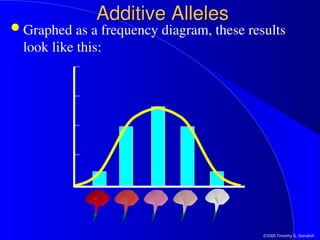
 Graphed as a frequency diagram, these results
look like this:
©2000 Timothy G. Standish
Estimating Gene Numbers
 If 1/64th of the offspring of an F2 cross of the kind
described above are the same as the parents, then
 The more genes involved in producing a trait, the
more gradations will be observed in that trait
 If two examples of extremes of variation for a trait
are crossed and the F2 progeny are examined, the
proportion exhibiting the extreme variations can be
used to calculate the number of genes involved:
4n
1 = F2 extreme phenotypes in total offspring
64
1
43
1
= N = 3 so there are probably
about 3 genes involved
©2000 Timothy G. Standish
Economic Implications
Environment
or genetics?
©2000 Timothy G. Standish
Describing Quantitative Traits:
The Mean
The Mean
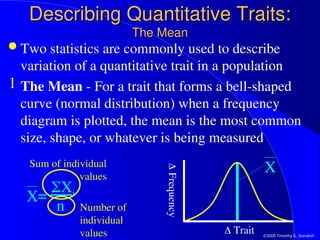
 Two statistics are commonly used to describe
variation of a quantitative trait in a population
1 The Mean - For a trait that forms a bell-shaped
curve (normal distribution) when a frequency
diagram is plotted, the mean is the most common
size, shape, or whatever is being measured
=
n
Xi
Sum of individual
values
Number of
individual
values
X
X

Frequency
 Trait
©2000 Timothy G. Standish
-1 +1
68.3%
=
n(n - 1)
nf(x2
) - (fx2
)
Describing Quantitative Traits:
Standard Deviation
Standard Deviation
2 Standard Deviation - Describes the amount of
variation from the mean in units of the trait
 Large SD indicates great variability
 68 % of individuals exhibiting the trait will fall
within ±1 SD of the mean, 95.5 % ±2, 99.7 % ±3 SD
 95 % fall within 1.96 SD
s
X

Frequency
 Trait
Total number of
individuals in sample
Number of individuals
in each unit measured
Gradations of
units of
measurement
©2000 Timothy G. Standish
Heritability
Heritability
 Heritability is a measure of how much quantitative genes influence
phenotype
 Two types of heritability can be calculated:
1 Broad-Sense Heritability:
 H2
- Expresses the proportion of phenotypic variance seen in a sample
that is the result of genetic as opposed to environmental influences
2 Narrow-Sense Heritability:
 h2
- Assesses the potential of selection to change a specific
continuously varying phenotypic trait in a randomly breeding
population
©2000 Timothy G. Standish
1 Broad-Sense Heritability
 As long as this is the case, broad heritability can be
expressed as the ratio of environmental to genetic
components in phenotypic variation
VP = VE + VG
Genetics
Genetic and
Environmental
interactions
Environment
 Proportion of phenotypic variance resulting from
genetic rather than environmental influences
 Components contributing to phenotypic variation
(VP) can be summarized as follows:
VP = VE + VG + VGE
 VGE is typically negligible so this formula can be
simplified to:
=
VP
VG
H2
©2000 Timothy G. Standish
2 Narrow-Sense Heritability
 As long as this is the case, narrow-sense heritability
can be expressed as the ratio as follows:
VP = VE + VG
Dominance
Interactive or
epistatic
variance
Additive
 Potential of selection to change a specific
continuously varying phenotypic trait
 Narrow-sense heritability concentrates on VG which
can be subdivided as follows:
VG = VA + VD + VI
 VA is typically negligible so this formula can be
simplified to:
=
VP
VA
h2
©2000 Timothy G. Standish

powerpoint-quantitative-genetics.itisppt

  • 1.
    ©2000 Timothy G.Standish Genesis 25:24-26 24 And when her days to be delivered were fulfilled, behold, there were twins in her womb. 25 And the first came out red, all over like an hairy garment; and they called his name Esau. 26 And after that came his brother out, and his hand took hold on Esau's heel; and his name was called Jacob . . .
  • 2.
    ©2000 Timothy G.Standish Timothy G. Standish, Ph. D. Quantitative Quantitative Genetics Genetics
  • 3.
    ©2000 Timothy G.Standish How Could Noah Have Done It? How Could Noah Have Done It?  The diversity of appearance in humans and other animals is immense  How could Adam and Eve or Noah and his family have held in their genomes genes for all that we see today?  At least one explanation, that the dark-skinned races descended from Cain who was marked with dark pigment (the mark of Cain mentioned in Gen. 4:15) or Ham as a result of the curse mentioned in Gen. 9:22-27  Quantitative or polygenic inheritance offers much more satisfying answer to this quandary
  • 4.
    ©2000 Timothy G.Standish Definitions Definitions  Traits examined so far have resulted in discontinuous phenotypic traits – Tall or dwarf – Round or wrinkled – Red, pink or white  Quantitative inheritance deals with genetic control of phenotypic traits that vary on a continuous basis: – Height – Weight – Skin color  Many quantitative traits are also influenced by the environment
  • 5.
    ©2000 Timothy G.Standish Nature Vs Nurture Nature Vs Nurture  Quantitative genes’ influence on phenotype are at the crux of the nature/nurture debate  Socialism emphasizes the environment  Fascism emphasizes genetics  Understanding quantitative genetics helps us to understand the degree to which genetics and the environment impact phenotype  Aside from political considerations, quantitative genetics helps us to understand the potential for selection to impact productivity in crops and livestock
  • 6.
    ©2000 Timothy G.Standish Additive Alleles Additive Alleles CR CW CR CR CW CW F2 Generation 2: 1 1:  Additive alleles are alleles that change the phenotype in an additive way  Example - The more copies of tall alleles a person has, the greater their potential for growing tall  Additive alleles behave something like alleles that result in incomplete dominance  More CR alleles results in redder flowers CR CR CR CW CR CW CW CW CR CW CR CW
  • 7.
    ©2000 Timothy G.Standish Additive Alleles Additive Alleles  If more than one gene with two alleles that behave as incompletely dominant alleles are involved, variability occurs over more of a continuum  If two genes with two alleles are involved, X phenotypes can result Additive alleles 4 3 2 3 2 1 2 1 0 F2 1/4 AA 1/2 Aa 1/4 aa 1/4 BB -- 1/16 AABB 1/2 Bb -- 2/16 AABb 1/4 bb -- 1/16 AAbb 1/4 BB -- 2/16 AaBB 1/2 Bb -- 4/16 AaBb 1/4 bb -- 2/16 Aabb 1/4 BB -- 1/16 aaBB 1/2 Bb -- 2/16 aaBb 1/4 bb -- 1/16 aabb 1/16 6/16 = 3/8 1/16 4/16 = 1/4 4/16 = 1/4
  • 8.
    ©2000 Timothy G.Standish Additive Alleles Additive Alleles  Graphed as a frequency diagram, these results look like this:
  • 9.
    ©2000 Timothy G.Standish Estimating Gene Numbers Estimating Gene Numbers  If 1/64th of the offspring of an F2 cross of the kind described above are the same as the parents, then  The more genes involved in producing a trait, the more gradations will be observed in that trait  If two examples of extremes of variation for a trait are crossed and the F2 progeny are examined, the proportion exhibiting the extreme variations can be used to calculate the number of genes involved: 4n 1 = F2 extreme phenotypes in total offspring 64 1 43 1 = N = 3 so there are probably about 3 genes involved
  • 10.
    ©2000 Timothy G.Standish Economic Implications Economic Implications Environment or genetics?
  • 11.
    ©2000 Timothy G.Standish Describing Quantitative Traits: Describing Quantitative Traits: The Mean The Mean  Two statistics are commonly used to describe variation of a quantitative trait in a population 1 The Mean - For a trait that forms a bell-shaped curve (normal distribution) when a frequency diagram is plotted, the mean is the most common size, shape, or whatever is being measured = n Xi Sum of individual values Number of individual values X X  Frequency  Trait
  • 12.
    ©2000 Timothy G.Standish -1 +1 68.3% = n(n - 1) nf(x2 ) - (fx2 ) Describing Quantitative Traits: Describing Quantitative Traits: Standard Deviation Standard Deviation 2 Standard Deviation - Describes the amount of variation from the mean in units of the trait  Large SD indicates great variability  68 % of individuals exhibiting the trait will fall within ±1 SD of the mean, 95.5 % ±2, 99.7 % ±3 SD  95 % fall within 1.96 SD s X  Frequency  Trait Total number of individuals in sample Number of individuals in each unit measured Gradations of units of measurement
  • 13.
    ©2000 Timothy G.Standish Heritability Heritability  Heritability is a measure of how much quantitative genes influence phenotype  Two types of heritability can be calculated: 1 Broad-Sense Heritability:  H2 - Expresses the proportion of phenotypic variance seen in a sample that is the result of genetic as opposed to environmental influences 2 Narrow-Sense Heritability:  h2 - Assesses the potential of selection to change a specific continuously varying phenotypic trait in a randomly breeding population
  • 14.
    ©2000 Timothy G.Standish 1 Broad-Sense Heritability 1 Broad-Sense Heritability  As long as this is the case, broad heritability can be expressed as the ratio of environmental to genetic components in phenotypic variation VP = VE + VG Genetics Genetic and Environmental interactions Environment  Proportion of phenotypic variance resulting from genetic rather than environmental influences  Components contributing to phenotypic variation (VP) can be summarized as follows: VP = VE + VG + VGE  VGE is typically negligible so this formula can be simplified to: = VP VG H2
  • 15.
    ©2000 Timothy G.Standish 2 Narrow-Sense Heritability 2 Narrow-Sense Heritability  As long as this is the case, narrow-sense heritability can be expressed as the ratio as follows: VP = VE + VG Dominance Interactive or epistatic variance Additive  Potential of selection to change a specific continuously varying phenotypic trait  Narrow-sense heritability concentrates on VG which can be subdivided as follows: VG = VA + VD + VI  VA is typically negligible so this formula can be simplified to: = VP VA h2
  • 16.