Complextraits
Submittedby-
RheaAnnExpidite
INTRODUCTION
● Mendelian genetics put forward the concept of dominant and recessive
traits, where the phenotypes are controlled by single genes. These traits are
known as monogenic or Mendelian traits.
● There are features or traits in human genetics which are controlled by
multiple genes and whose inheritance does not follow the rules of
Mendelian genetics. Such traits are known as complex traits.
● Complex traits are believed to result from gene-gene and gene-environment
interactions, genetic heterogeneity, and potentially other yet unknown
reasons.
● Complex traits do not follow readily predictable patterns of inheritance.
● Complex=quantitative traits
SpectrumofComplextraits
PolygenicInheritance
● Polygenic trait refers to a trait that is controlled by multiple non-allelic genes.
● These genes are called polygenes. They are a group of genes that, when turned on,
are expressed as a unit. Each of them produces an effect that adds up to the trait.
● Because of the wide range of trait variations, the possible trait outcomes cannot be
easily and straightforwardly categorized into groups, but by a wide spectrum.
● Traits are usually quantified by measurement rather than counting.
● Best expressed in populations rather than individuals.
● In humans, height, skin color, hair color, and eye color are examples of polygenic
traits.
PolygenicInheritancecontd.
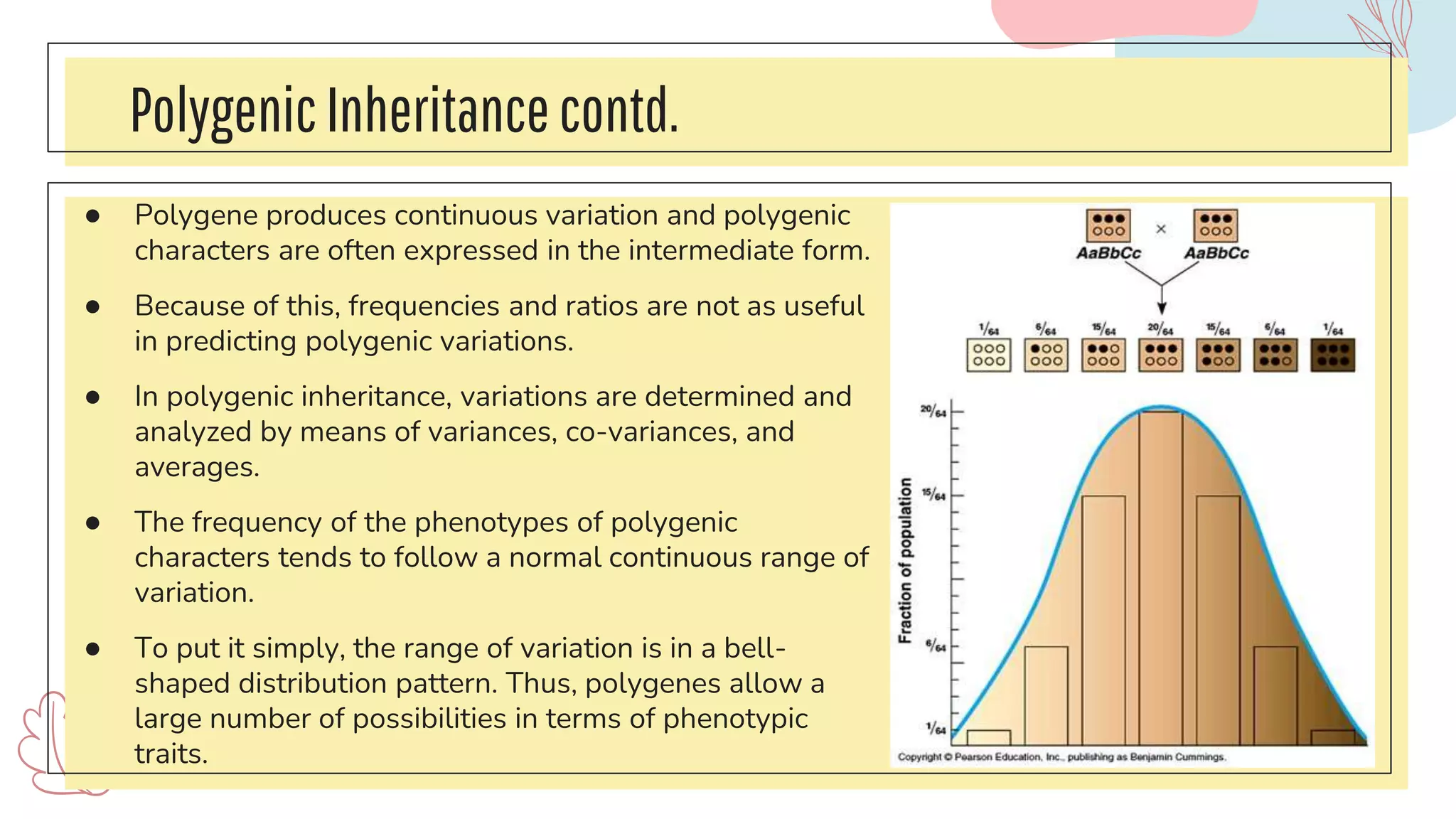
● Polygene produces continuous variation and polygenic
characters are often expressed in the intermediate form.
● Because of this, frequencies and ratios are not as useful
in predicting polygenic variations.
● In polygenic inheritance, variations are determined and
analyzed by means of variances, co-variances, and
averages.
● The frequency of the phenotypes of polygenic
characters tends to follow a normal continuous range of
variation.
● To put it simply, the range of variation is in a bell-
shaped distribution pattern. Thus, polygenes allow a
large number of possibilities in terms of phenotypic
traits.
MultifactorialTraits
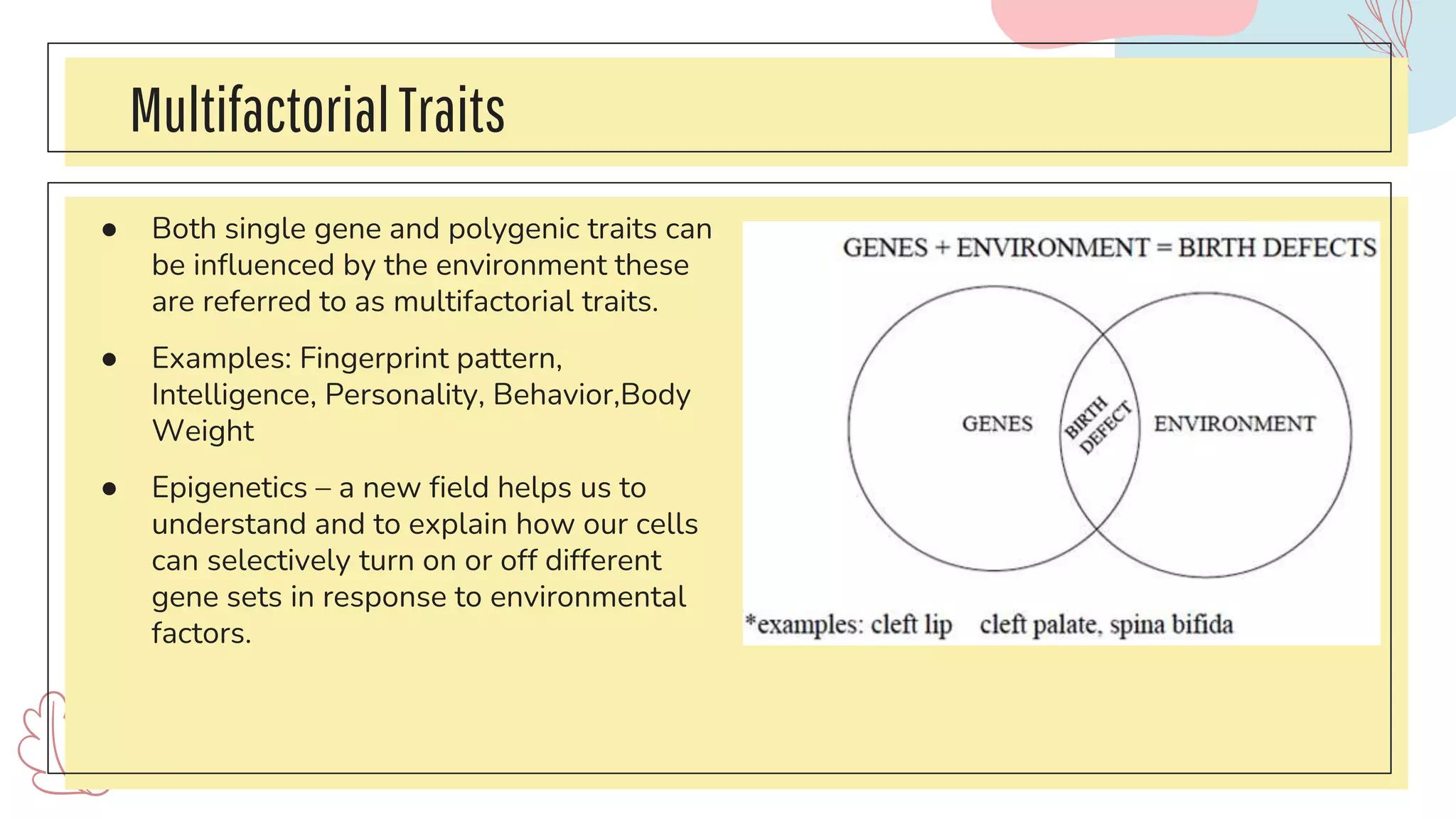
● Both single gene and polygenic traits can
be influenced by the environment these
are referred to as multifactorial traits.
● Examples: Fingerprint pattern,
Intelligence, Personality, Behavior,Body
Weight
● Epigenetics – a new field helps us to
understand and to explain how our cells
can selectively turn on or off different
gene sets in response to environmental
factors.
Some MultifactorialTraits
Obesity:amultifactorialtrait?
● Twin studies have been used to estimate how much of obesity is genetic.
● It occurs in both Monozygotic twins ~70% of the time: 70% concordance.
● In humans, mutations in the gene for Leptin (LP) of the Leptin receptor (LEPR)
account for about 5% of all cases of obesity
● Other factors cause the recent explosive increase in obesity.
● Obesity is a complex disorder involving the action and interaction of multiple
genes and environmental factors.
● More than 70 genes associated with obesity have been identified through genome
scans.
TheLiability/ThresholdModel
● Explains the discontinuous distribution of some multifactorial traits.
● All of the factors which influence the development of a multifactorial disorder- genetic or
environmental, can be considered as a single entity known as liability.
● Liability for a genetic disorder distributed in a normal curve.
● Caused by a number of genes, each acting additively.
● Only individuals with genetic liability above certain threshold are affected if exposed to
certain environmental conditions.
● Environmental conditions are most likely to have the greatest impact on those individuals
who have the highest level of genetic predisposition.
● Threshold effect in families – as degree of relatedness decreases, so does the probability
that individuals will have the same combination of alleles for the genes that control the
trait.
TheLiability/ThresholdModelcontd..
● In multifactorial disorders, the risk of recurrence depends on several factors:
● Consanguinity – first-cousin parents have about a twofold higher risk than unrelated
parents of having a child with a multifactorial disease because of the shared genes they
carry.
● Previous affected child – If parents have 2 affected children, it means their genotypes are
probably close to threshold, increasing the risk of recurrence.
● Severity of defect – A severely affected phenotype means that the affected child’s
genotype is well over the threshold and that the parental genotypes confer a higher
recurrence risk in children.
● Higher frequency in one sex – if disease is expressed more often in one sex than the other,
the threshold in the less frequently affected sex is shifted to the right, and the rate for that
sex is lower.
TheLiability/ThresholdModel
RelativeRisk(λᵣ)
● The familial aggregation of a disease can be measured by comparing the frequency of
the disease in the relatives of an affected proband with its frequency (prevalence) in the
general population.
● The relative risk ratio is defined as
λᵣ = prevalence of the disease in a relative “r” of an affected person
population prevalence of the disease
● The larger λᵣ is, the greater the familial aggregation.
● A value of λᵣ = 1 indicates that a relative is no more likely to develop the disease than is
any individual in the population.
FamilialRisksforMultifactorialTraits
Concordance andDiscordance
● When two related individuals in a family have the same disease, they are called
corcandant for the disorder.
● Conversely, when only one member of the pair of relatives is affected and the other is
not, the relatives are discordant for the disease.
● Diseases with complex inheritance result from the impact of environmental factors on
individuals with certain genotypes.
● Discordance for the phenotype between relatives who share a genotype at loci that
predispose to disease can be explained if the unaffected individual has not experienced
the other factors necessary to trigger the disease process and manifest it.
● Conversely, concordance for a phenotype may occur even when the two affected
relatives have different predisposing genotypes, if the disease in one relative is a
genocopy or phenocopy of the disease in the other relative.
● Lack of penetrance and frequent genocopies and phenocopies all contribute to obscuring
the inheritance pattern in multifactorial genetic disease.
SeparatingGeneticandEnvironmentalFactors
● The more closely related two individuals are, the more likely they are to share the same
environment as well.
● One way to separate family environment from genetic influences is to compare the
incidence of disease in unrelated family members (adoptees, spouses) to that in biological
relatives.
● Another common method is Twin studies, including both MZ and DZ.
● DZ twins reared together allow to measure disease concordance in relatives who grow up in
similar environments but do not share all their genes.
● MZ twins provide an opportunity to compare relatives with identical genotypes who may or
may not be reared together in the same environment.
● If trait is completely controlled by genes, concordance should be 1.0 in MZ twins and close
to 0.5 in DZ twins
● The greater the difference, the greater the heritability.
● Concordance for cleft lip in MZ twins is higher than DZ twins (42% vs. 5%).
● Although this suggests a genetic component, the value is so far below 100% that
environmental factors are obviously important in the majority of cases.
LimitationsofTwin studies:
● Mz twins do not have precisely identical gene expression despite having identical
genotype, for eg, random X-inactivation after cleavage into two female MZ zygotes
produces significant differences in the expression of alleles of X-linked genes in different
tissues.
● Second, environmental exposures may not be the same. For eg, MZ twins frequently
share a placenta, and there may be a disparity between the twins in blood supply,
intrauterine development, and birth weight.
● Third, measurements of disease concordance in mZ twins give an average estimate that
may not be accurate if the relevant predisposing alleles or environmental factors are
different in different twin pairs.
GeneticAnalysisofQuantitativeTraits
Normal Distribution- a graph of the number of individuals in the population (y-axis) having a
particular quantitative value (x-axis) produces the familiar bell shaped curve known as the
normal (gaussian) distribution.
- The position of the peak of the graph and the shape of the graph is governed by two
quantities: the mean (μ) and the variance (σ2).
The Normal range- Eg: extremely tall or short stature, hypertension, hypercholesterolemia and
obesity are all considered abnormal when a value sits clearly outside the normal range.
Correlation- tendency for the actual values of a physiological measurement to be more similar
among relatives than among the general population.
-coefficient of correlation is a statistical measure that measures the degree of
interdependence of two or more variables.
● The fraction of genes shared by two relatives.
● A child receives half of his or her genes from each parent – half set of genes corresponds
to a correlation coefficient of 0.5
● Identical twins have 100% of their genes in common (correlation coefficient = 1.0)
● When raised in separate environments identical twins provide an estimate of the degree
of environmental influence on gene expression.
● The correlation among relatives can be used to estimate genetic influence on a
quantitative trait if one assumes that the degree of similarity in the values of the trait
measured among relatives is proportional to the number of alleles they share at the
relevant loci for that trait.
● However, correlation of a particular physiological value among relatives reflects the
influence of both heredity and common environmental factors.
Heritability
● Heritability (h2) is defined as the fraction of the total phenotypic variance of a quantitative
trait that is caused by genes.
● Therefore, a measure of the extent to which different alleles at various loci are responsible
for the variability in a given quantitative trait seen across population.
● Higher the heritability, greater is the contribution of genetic differences among people in
causing variability of the trait.
● Uses single number 0 to 1.
● If heritability is high (100% when H = 1), observed variation in phenotypes is genetic, with
little or no environmental contribution.
● If heritability is low (zero when H = 0), there is little or no genetic contribution and the
environmental contribution is high.
Geneticmapping ofcomplextraits
● Two major approaches have been used to locate and identify genes that predispose to
complex diseases or contribute to the genetic variance of quantitative traits.
● The first is a type of linkage analysis that relies on a family members such a siblings who
are concordant for the phenotype.
● Model free or non-parametric methods have been developed that make no assumptions
concerning the number of loci or the role of environment and chance in causing lack of
penetrance.
● This method depends solely on the examination that two affected relatives will have
disease predisposing alleles in common.
● However, this method is also imprecise, as one cannot determine definitely whether a
recombination has occurred between a possible disease- predisposing locus and the
disease phenotype.
● Model-free method can only identify broad regions of increased allele- sharing and not a
narrow, critical region the delimiting the location of a gene contributing to a complex trait.
● The second approach is association which looks for increased frequency of particular
alleles in affected compared with and affected individuals in the population.
● The strength of an association is measured by the odds ratio, which is calculated from the
frequency of a specific allele in patients and controls.
● Odds ratio is then= ad/bc
● If the frequency of the alele in question were the same in patients and controls, the odds
ratio would be 1.
● A different but related measure of association is the relative risk (RR), which compares
the risk of developing a disease when one carries a specific allele relative to the risk if one
carries a specific allele relative to the risk if one does not carry it.
DiseasewithComplexInheritance
Some diseases with complex inheritance include Digenic Retinitis Pigmentosa, Cerebral Venous
Thrombosis, Hirschsprung’s disease, Diabetes mellitus.
Digenic Retinitis Pigmentosa
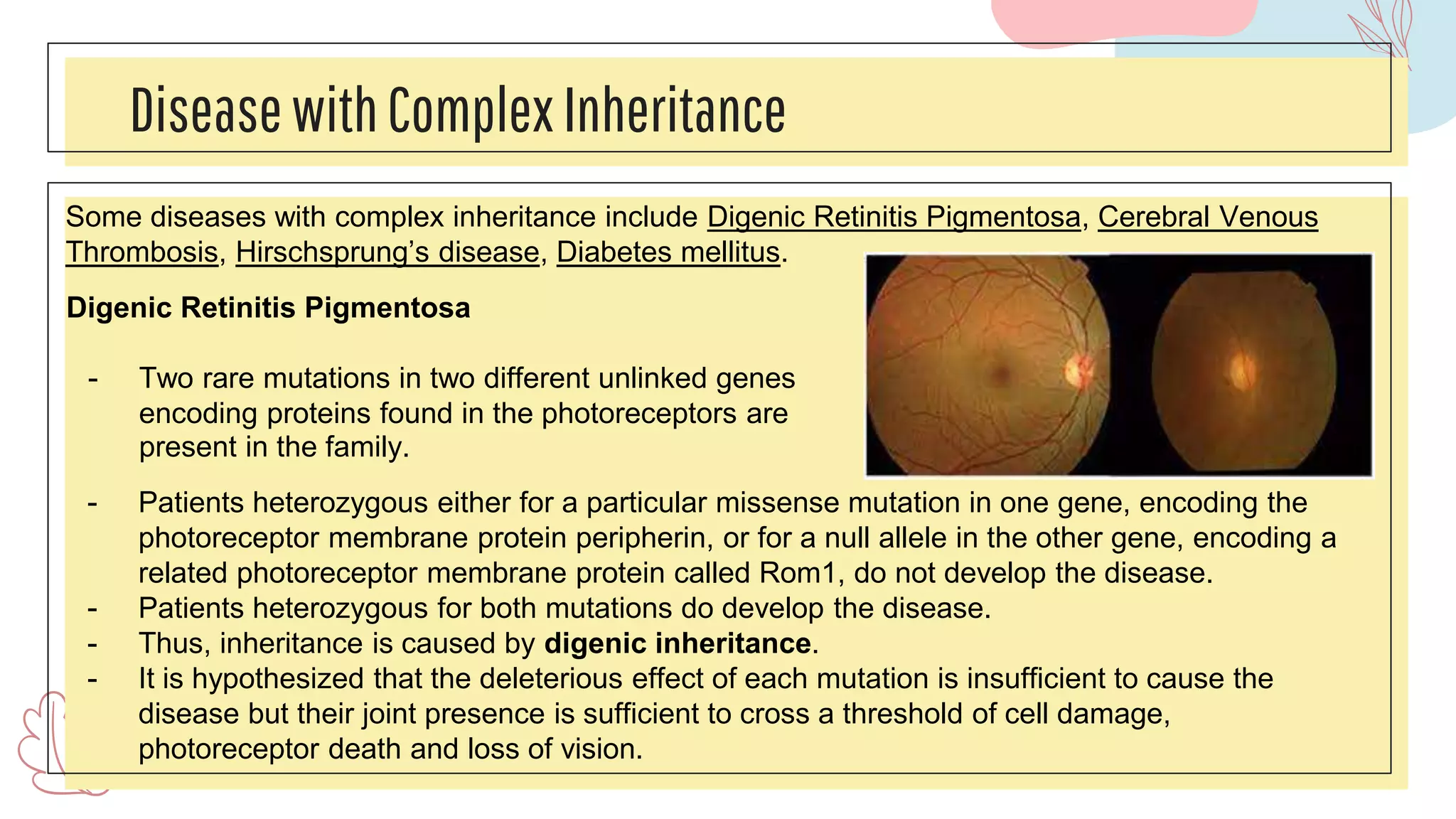
- Two rare mutations in two different unlinked genes
encoding proteins found in the photoreceptors are
present in the family.
- Patients heterozygous either for a particular missense mutation in one gene, encoding the
photoreceptor membrane protein peripherin, or for a null allele in the other gene, encoding a
related photoreceptor membrane protein called Rom1, do not develop the disease.
- Patients heterozygous for both mutations do develop the disease.
- Thus, inheritance is caused by digenic inheritance.
- It is hypothesized that the deleterious effect of each mutation is insufficient to cause the
disease but their joint presence is sufficient to cross a threshold of cell damage,
photoreceptor death and loss of vision.
Fig: Pedigree of a family with Retinitis Pigmentosa due to digenic inheritance.
Filled symbols are affected individuals. Each individual’s genotypes at the peripherin locus (first
line) and ROM1 locus (second line) are written below each symbol. The normal allele is ‘+’ and the
mutant allele is ‘mut’.
MultifactorialCongenitalMalformations
Some of the important congenital malformations with complex inheritance are neural tube
defects, cleft lip with or without cleft palate, and congenital heart malformations.
Neural Tube Defects
- Anencephaly and spina bifida are neural tube defects that
frequently occur together in families and are considered to
have a common pathogenesis.
- In anencephaly, the forebrain, overlying meninges, vault of
the skull, and skin are all absent. Most infants are stillborn or
those born alive survive a few hours at most.
- In spina bifida, there is a failure of fusion of the arches of the
vertebrae, typically in the lumbar region.
- A small proportion of NTDs are caused by amniotic bands,
single gene defects with pleiotropic expression,
chromosomal disorders, teratogens. The greatest factor in
causing NDTs is a vitamin deficiency.
MultifactorialCongenitalMalformationscontd..
- The risk of NTDs is inversely correlated with maternal serum folic acid levels during
pregnancy, with a threshold of 200 μg/L, below which risk of NTD becomes very significant.
- The impact of folic acid deficiency is exacerbated by a genetic variant of the enzyme 5,10-
methylenetetrahydrofolate reductase (MTHFR), caused by a common missense mutation that
makes the enzyme less stable than normal.
- Instability of MTHFR hinders the recycling of tetrahydrofolate and interferes with the
methylation of homocysteine to methionine.
Prevention- Dietary supplementation with 400 to 800 μg of folic acid/ day for women who
plan their pregnancies has been shown to reduce the incidence of NTDs by more than 75
percent.
Prenatal Diagnosis- Anencephaly and most cases of open spina bifida can be identified by
detection of excess levels of alpha-fetoprotein (AFP) and other fetal substances in the
amniotic fluid and by ultrasonographic scanning.
ThankYou

Genetics: Complex traits (Quantitative traits)

  • 1.
  • 2.
    INTRODUCTION ● Mendelian geneticsput forward the concept of dominant and recessive traits, where the phenotypes are controlled by single genes. These traits are known as monogenic or Mendelian traits. ● There are features or traits in human genetics which are controlled by multiple genes and whose inheritance does not follow the rules of Mendelian genetics. Such traits are known as complex traits. ● Complex traits are believed to result from gene-gene and gene-environment interactions, genetic heterogeneity, and potentially other yet unknown reasons. ● Complex traits do not follow readily predictable patterns of inheritance. ● Complex=quantitative traits
  • 3.
  • 4.
    PolygenicInheritance ● Polygenic traitrefers to a trait that is controlled by multiple non-allelic genes. ● These genes are called polygenes. They are a group of genes that, when turned on, are expressed as a unit. Each of them produces an effect that adds up to the trait. ● Because of the wide range of trait variations, the possible trait outcomes cannot be easily and straightforwardly categorized into groups, but by a wide spectrum. ● Traits are usually quantified by measurement rather than counting. ● Best expressed in populations rather than individuals. ● In humans, height, skin color, hair color, and eye color are examples of polygenic traits.
  • 5.
    PolygenicInheritancecontd. ● Polygene producescontinuous variation and polygenic characters are often expressed in the intermediate form. ● Because of this, frequencies and ratios are not as useful in predicting polygenic variations. ● In polygenic inheritance, variations are determined and analyzed by means of variances, co-variances, and averages. ● The frequency of the phenotypes of polygenic characters tends to follow a normal continuous range of variation. ● To put it simply, the range of variation is in a bell- shaped distribution pattern. Thus, polygenes allow a large number of possibilities in terms of phenotypic traits.
  • 6.
    MultifactorialTraits ● Both singlegene and polygenic traits can be influenced by the environment these are referred to as multifactorial traits. ● Examples: Fingerprint pattern, Intelligence, Personality, Behavior,Body Weight ● Epigenetics – a new field helps us to understand and to explain how our cells can selectively turn on or off different gene sets in response to environmental factors.
  • 7.
  • 8.
    Obesity:amultifactorialtrait? ● Twin studieshave been used to estimate how much of obesity is genetic. ● It occurs in both Monozygotic twins ~70% of the time: 70% concordance. ● In humans, mutations in the gene for Leptin (LP) of the Leptin receptor (LEPR) account for about 5% of all cases of obesity ● Other factors cause the recent explosive increase in obesity. ● Obesity is a complex disorder involving the action and interaction of multiple genes and environmental factors. ● More than 70 genes associated with obesity have been identified through genome scans.
  • 9.
    TheLiability/ThresholdModel ● Explains thediscontinuous distribution of some multifactorial traits. ● All of the factors which influence the development of a multifactorial disorder- genetic or environmental, can be considered as a single entity known as liability. ● Liability for a genetic disorder distributed in a normal curve. ● Caused by a number of genes, each acting additively. ● Only individuals with genetic liability above certain threshold are affected if exposed to certain environmental conditions. ● Environmental conditions are most likely to have the greatest impact on those individuals who have the highest level of genetic predisposition. ● Threshold effect in families – as degree of relatedness decreases, so does the probability that individuals will have the same combination of alleles for the genes that control the trait.
  • 10.
    TheLiability/ThresholdModelcontd.. ● In multifactorialdisorders, the risk of recurrence depends on several factors: ● Consanguinity – first-cousin parents have about a twofold higher risk than unrelated parents of having a child with a multifactorial disease because of the shared genes they carry. ● Previous affected child – If parents have 2 affected children, it means their genotypes are probably close to threshold, increasing the risk of recurrence. ● Severity of defect – A severely affected phenotype means that the affected child’s genotype is well over the threshold and that the parental genotypes confer a higher recurrence risk in children. ● Higher frequency in one sex – if disease is expressed more often in one sex than the other, the threshold in the less frequently affected sex is shifted to the right, and the rate for that sex is lower.
  • 11.
  • 12.
    RelativeRisk(λᵣ) ● The familialaggregation of a disease can be measured by comparing the frequency of the disease in the relatives of an affected proband with its frequency (prevalence) in the general population. ● The relative risk ratio is defined as λᵣ = prevalence of the disease in a relative “r” of an affected person population prevalence of the disease ● The larger λᵣ is, the greater the familial aggregation. ● A value of λᵣ = 1 indicates that a relative is no more likely to develop the disease than is any individual in the population.
  • 13.
  • 14.
    Concordance andDiscordance ● Whentwo related individuals in a family have the same disease, they are called corcandant for the disorder. ● Conversely, when only one member of the pair of relatives is affected and the other is not, the relatives are discordant for the disease. ● Diseases with complex inheritance result from the impact of environmental factors on individuals with certain genotypes. ● Discordance for the phenotype between relatives who share a genotype at loci that predispose to disease can be explained if the unaffected individual has not experienced the other factors necessary to trigger the disease process and manifest it. ● Conversely, concordance for a phenotype may occur even when the two affected relatives have different predisposing genotypes, if the disease in one relative is a genocopy or phenocopy of the disease in the other relative. ● Lack of penetrance and frequent genocopies and phenocopies all contribute to obscuring the inheritance pattern in multifactorial genetic disease.
  • 15.
    SeparatingGeneticandEnvironmentalFactors ● The moreclosely related two individuals are, the more likely they are to share the same environment as well. ● One way to separate family environment from genetic influences is to compare the incidence of disease in unrelated family members (adoptees, spouses) to that in biological relatives. ● Another common method is Twin studies, including both MZ and DZ. ● DZ twins reared together allow to measure disease concordance in relatives who grow up in similar environments but do not share all their genes. ● MZ twins provide an opportunity to compare relatives with identical genotypes who may or may not be reared together in the same environment. ● If trait is completely controlled by genes, concordance should be 1.0 in MZ twins and close to 0.5 in DZ twins ● The greater the difference, the greater the heritability. ● Concordance for cleft lip in MZ twins is higher than DZ twins (42% vs. 5%). ● Although this suggests a genetic component, the value is so far below 100% that environmental factors are obviously important in the majority of cases.
  • 16.
    LimitationsofTwin studies: ● Mztwins do not have precisely identical gene expression despite having identical genotype, for eg, random X-inactivation after cleavage into two female MZ zygotes produces significant differences in the expression of alleles of X-linked genes in different tissues. ● Second, environmental exposures may not be the same. For eg, MZ twins frequently share a placenta, and there may be a disparity between the twins in blood supply, intrauterine development, and birth weight. ● Third, measurements of disease concordance in mZ twins give an average estimate that may not be accurate if the relevant predisposing alleles or environmental factors are different in different twin pairs.
  • 18.
    GeneticAnalysisofQuantitativeTraits Normal Distribution- agraph of the number of individuals in the population (y-axis) having a particular quantitative value (x-axis) produces the familiar bell shaped curve known as the normal (gaussian) distribution. - The position of the peak of the graph and the shape of the graph is governed by two quantities: the mean (μ) and the variance (σ2). The Normal range- Eg: extremely tall or short stature, hypertension, hypercholesterolemia and obesity are all considered abnormal when a value sits clearly outside the normal range. Correlation- tendency for the actual values of a physiological measurement to be more similar among relatives than among the general population. -coefficient of correlation is a statistical measure that measures the degree of interdependence of two or more variables.
  • 19.
    ● The fractionof genes shared by two relatives. ● A child receives half of his or her genes from each parent – half set of genes corresponds to a correlation coefficient of 0.5 ● Identical twins have 100% of their genes in common (correlation coefficient = 1.0) ● When raised in separate environments identical twins provide an estimate of the degree of environmental influence on gene expression. ● The correlation among relatives can be used to estimate genetic influence on a quantitative trait if one assumes that the degree of similarity in the values of the trait measured among relatives is proportional to the number of alleles they share at the relevant loci for that trait. ● However, correlation of a particular physiological value among relatives reflects the influence of both heredity and common environmental factors.
  • 20.
    Heritability ● Heritability (h2)is defined as the fraction of the total phenotypic variance of a quantitative trait that is caused by genes. ● Therefore, a measure of the extent to which different alleles at various loci are responsible for the variability in a given quantitative trait seen across population. ● Higher the heritability, greater is the contribution of genetic differences among people in causing variability of the trait. ● Uses single number 0 to 1. ● If heritability is high (100% when H = 1), observed variation in phenotypes is genetic, with little or no environmental contribution. ● If heritability is low (zero when H = 0), there is little or no genetic contribution and the environmental contribution is high.
  • 21.
    Geneticmapping ofcomplextraits ● Twomajor approaches have been used to locate and identify genes that predispose to complex diseases or contribute to the genetic variance of quantitative traits. ● The first is a type of linkage analysis that relies on a family members such a siblings who are concordant for the phenotype. ● Model free or non-parametric methods have been developed that make no assumptions concerning the number of loci or the role of environment and chance in causing lack of penetrance. ● This method depends solely on the examination that two affected relatives will have disease predisposing alleles in common. ● However, this method is also imprecise, as one cannot determine definitely whether a recombination has occurred between a possible disease- predisposing locus and the disease phenotype. ● Model-free method can only identify broad regions of increased allele- sharing and not a narrow, critical region the delimiting the location of a gene contributing to a complex trait.
  • 22.
    ● The secondapproach is association which looks for increased frequency of particular alleles in affected compared with and affected individuals in the population. ● The strength of an association is measured by the odds ratio, which is calculated from the frequency of a specific allele in patients and controls. ● Odds ratio is then= ad/bc ● If the frequency of the alele in question were the same in patients and controls, the odds ratio would be 1. ● A different but related measure of association is the relative risk (RR), which compares the risk of developing a disease when one carries a specific allele relative to the risk if one carries a specific allele relative to the risk if one does not carry it.
  • 23.
    DiseasewithComplexInheritance Some diseases withcomplex inheritance include Digenic Retinitis Pigmentosa, Cerebral Venous Thrombosis, Hirschsprung’s disease, Diabetes mellitus. Digenic Retinitis Pigmentosa - Two rare mutations in two different unlinked genes encoding proteins found in the photoreceptors are present in the family. - Patients heterozygous either for a particular missense mutation in one gene, encoding the photoreceptor membrane protein peripherin, or for a null allele in the other gene, encoding a related photoreceptor membrane protein called Rom1, do not develop the disease. - Patients heterozygous for both mutations do develop the disease. - Thus, inheritance is caused by digenic inheritance. - It is hypothesized that the deleterious effect of each mutation is insufficient to cause the disease but their joint presence is sufficient to cross a threshold of cell damage, photoreceptor death and loss of vision.
  • 24.
    Fig: Pedigree ofa family with Retinitis Pigmentosa due to digenic inheritance. Filled symbols are affected individuals. Each individual’s genotypes at the peripherin locus (first line) and ROM1 locus (second line) are written below each symbol. The normal allele is ‘+’ and the mutant allele is ‘mut’.
  • 25.
    MultifactorialCongenitalMalformations Some of theimportant congenital malformations with complex inheritance are neural tube defects, cleft lip with or without cleft palate, and congenital heart malformations. Neural Tube Defects - Anencephaly and spina bifida are neural tube defects that frequently occur together in families and are considered to have a common pathogenesis. - In anencephaly, the forebrain, overlying meninges, vault of the skull, and skin are all absent. Most infants are stillborn or those born alive survive a few hours at most. - In spina bifida, there is a failure of fusion of the arches of the vertebrae, typically in the lumbar region. - A small proportion of NTDs are caused by amniotic bands, single gene defects with pleiotropic expression, chromosomal disorders, teratogens. The greatest factor in causing NDTs is a vitamin deficiency.
  • 26.
    MultifactorialCongenitalMalformationscontd.. - The riskof NTDs is inversely correlated with maternal serum folic acid levels during pregnancy, with a threshold of 200 μg/L, below which risk of NTD becomes very significant. - The impact of folic acid deficiency is exacerbated by a genetic variant of the enzyme 5,10- methylenetetrahydrofolate reductase (MTHFR), caused by a common missense mutation that makes the enzyme less stable than normal. - Instability of MTHFR hinders the recycling of tetrahydrofolate and interferes with the methylation of homocysteine to methionine. Prevention- Dietary supplementation with 400 to 800 μg of folic acid/ day for women who plan their pregnancies has been shown to reduce the incidence of NTDs by more than 75 percent. Prenatal Diagnosis- Anencephaly and most cases of open spina bifida can be identified by detection of excess levels of alpha-fetoprotein (AFP) and other fetal substances in the amniotic fluid and by ultrasonographic scanning.
  • 27.