The term GMO’s is most commonly used to refer
to crop plants created for human or animal
consumption using the latest molecular biology
techniques.These plants have been modified in
the laboratory to enhance desired traits such as
increased resistance to herbicides or improved
nutritional content.The enhancement of desired
traits has traditionally been undertaken through
breeding, but conventional plant breeding
methods can be very time consuming and are
often not very accurate.
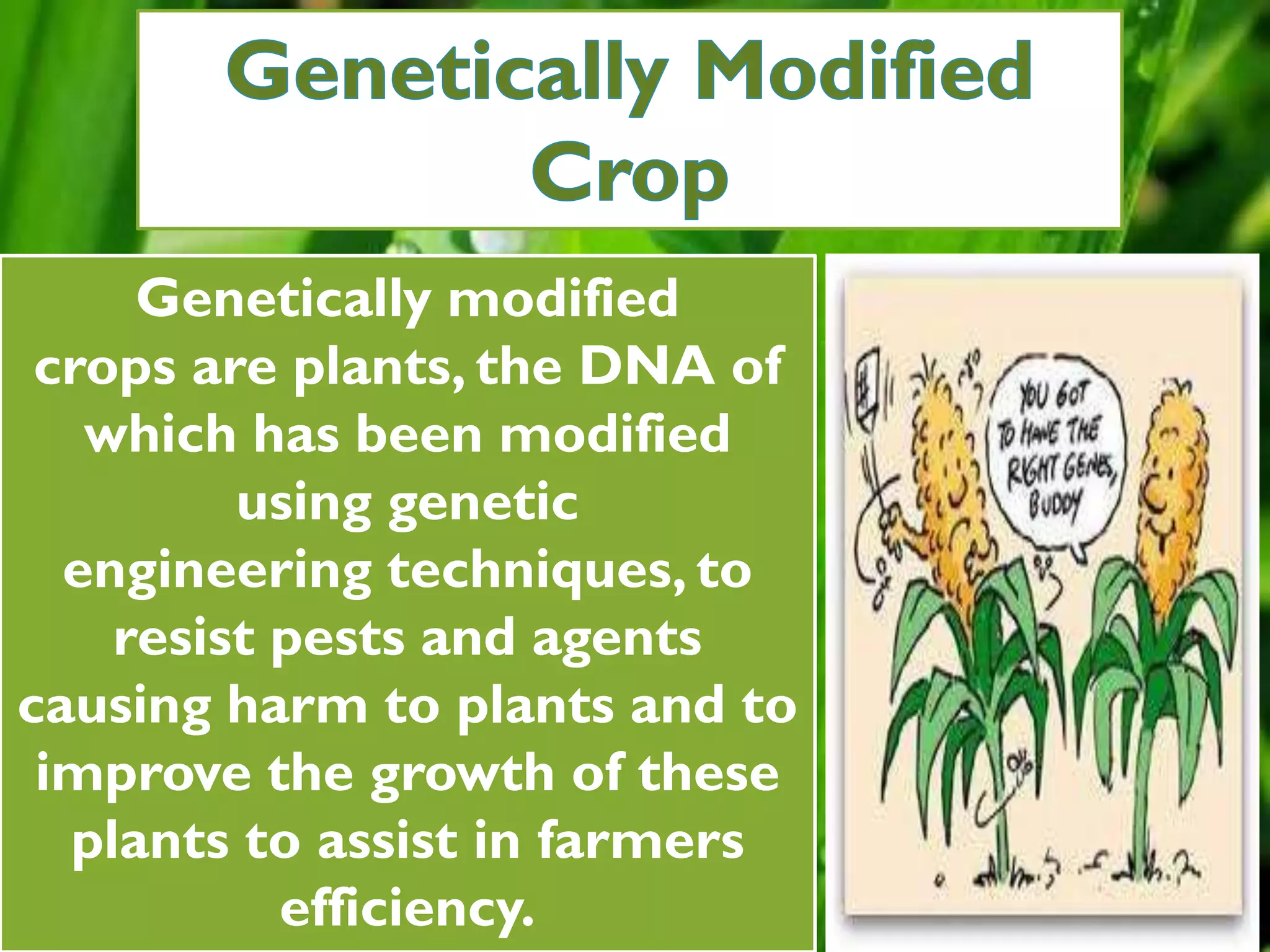
Genetically modified
crops are plants, the DNA of
which has been modified
using genetic
engineering techniques, to
resist pests and agents
causing harm to plants and to
improve the growth of these
plants to assist in farmers
efficiency.
Scientists first discovered that DNA naturally
transfers between organisms in 1946.It is now known
that there are several natural mechanisms for flow of
genes, or these occur in nature on a large scale – for
example, it is a major mechanism for antibiotic
resistance in pathogenic bacteria, and it occurs
between plant species often move to new species
over an evolutionary time scale[and play a major role
in dynamic changes to chromosomes during evolution
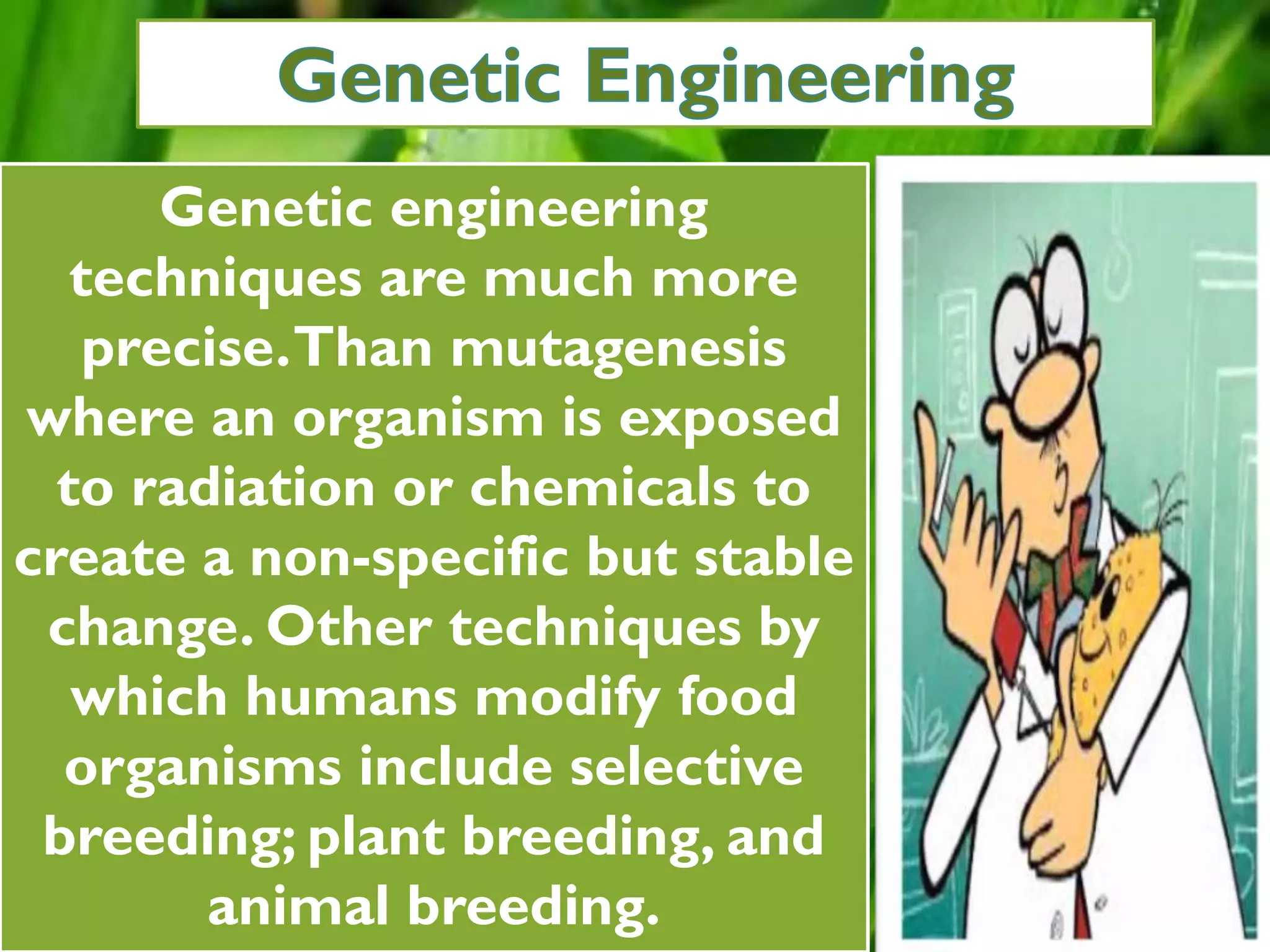
Genetic engineering
techniques are much more
precise.Than mutagenesis
where an organism is exposed
to radiation or chemicals to
create a non-specific but stable
change. Other techniques by
which humans modify food
organisms include selective
breeding; plant breeding, and
animal breeding.
The first genetically modified plant was
produced in 1982, using an antibiotic-
resistant tobacco plant.The first field trials
of genetically engineered plants occurred in
France and the USA in 1986, when tobacco
plants were engineered to be resistant
to herbicides.
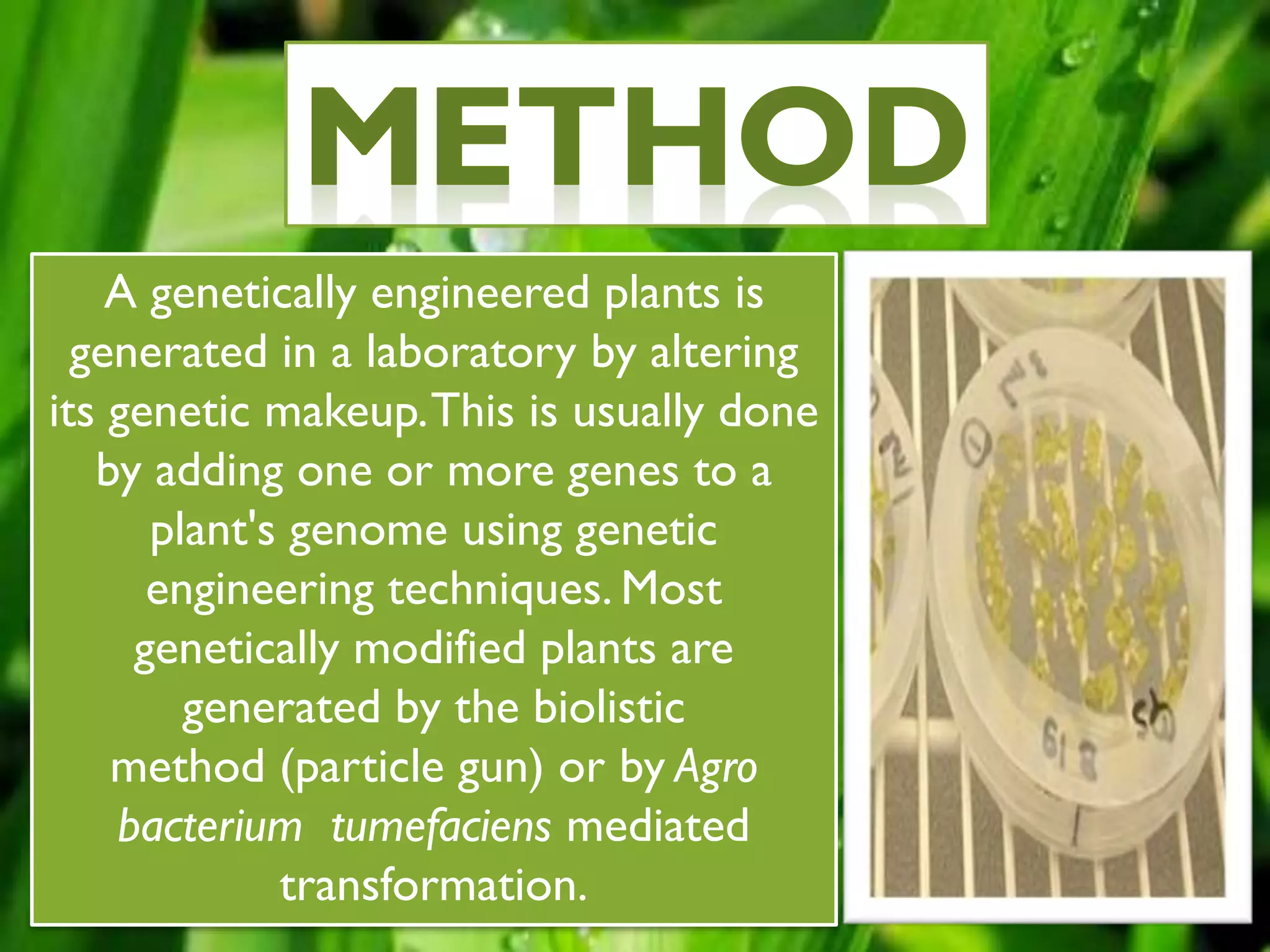
A genetically engineered plants is
generated in a laboratory by altering
its genetic makeup.This is usually done
by adding one or more genes to a
plant's genome using genetic
engineering techniques. Most
genetically modified plants are
generated by the biolistic
method (particle gun) or by Agro
bacterium tumefaciens mediated
transformation.
The largest share of the GMO crops planted
globally are from seed created by the United
States firm Monsanto. In 2007, Monsanto's trait
technologies were planted on 246 million acres
throughout the world, a growth of 13 percent
from 2006. However, patents on the first
Monsanto products to enter the marketplace
will begin to expire in 2014, democratizing
Monsanto products.
Increasing crop output
o Increasing crop yield is one of the main reason
that growers use genetic engineering .
o Farmers also use genetic engineering to create
herbicide-resistant plants.
 Creating pesticides-resistant or herbicide
resistant plants could damage the
environment by changing the interactions
between plants and insects or animals.
 It is intended harm to other organisms.
 It reduce effectiveness of pesticides.
i. Concerns about human health risks have limited the use of
genetically-modified foods.Transferring genes into plants
could potential cause harm to the people who eat them.
Gene transfers could also insert allergens into foods that
wouldn’t normally have strong potential to cause allergies.
ii. Cross-Contamination between fields can also occur,
resulting in a crop not intended for genetic
modification being altered.This has already
occurred in the united states, when a maize field
intended for animal feed cross-contaminated a field
intended for human use, according to theWorld
health organization.
•Increased invasiveness.
•Development of new, more virulent strains of viruses on transgenic virus resistant
plants.
•Effect of toxic, transgenic products from insect, and pathogen resistant plants on non-
target organisms.
•Overcoming the resistance mechanism of the transgenes by insect pests leading to
more virulent insect biotypes.
•Transfer of antibiotic resistance genes, used as selectable markers in the process of
developing transgenics, to other organisms.
•Safety of food items obtained from transgenic crops – allergic reactions.
•Agene flow to other crop cultivars, traditional varieties, land races, wild, weedy related
species leading to the loss of biodiversity.
•Along term effects.
•Non-foreseeable effects on ecosystems.
ENVIRONMENTAL
RISK FROM GE CROPS
It can introduce a new trait
Pest resistant
Herbicide tolerance
Disease resistant
Cold tolerance
Drought tolerance / salinity tolerance
Better nutrition
Pharmaceuticals
Phyto-remediation
GE crops, approved for cultivation by the regulatory
agencies, are as safe as any other conventionally bred
cultivars for human consumption, as well as for the
environment. Occasionally they may transfer their genes
into other cultivars in the neighboring fields or wild
related species through out crossing, like other cultivars.
Cross-pollination, even in highly self-pollinated species, is
part of the nature to enhance biodiversity. It occurs in the
natural stands of the ancestral species of the crops, and
has been going on between the cultivated and their related
wild species since domestication.
http://en.wikipedia.org/wiki/Genetically_modified_crops
file:///C:/Documents%20and%20Settings/user/My%20Documents/genetic
ally%20modified%20crops%20cartoons%20-
%20Google%20Search.htm?biw=1366&bih=653&sei=qjUiUb6WCsLRrQ
fAkYCIBQ
file:///C:/Documents%20and%20Settings/user/My%20Documents/Monsa
nto%20-%20Wikipedia,%20the%20free%20encyclopedia.htm
file:///C:/Documents%20and%20Settings/user/My%20Documents/Genetica
lly%20modified%20crops%20-
%20Wikipedia,%20the%20free%20encyclopedia.htm
file:///C:/Documents%20and%20Settings/user/My%20Documents/gmc%20
1.htm
Notes
Genetically modified crop

Genetically modified crop

  • 5.
    The term GMO’sis most commonly used to refer to crop plants created for human or animal consumption using the latest molecular biology techniques.These plants have been modified in the laboratory to enhance desired traits such as increased resistance to herbicides or improved nutritional content.The enhancement of desired traits has traditionally been undertaken through breeding, but conventional plant breeding methods can be very time consuming and are often not very accurate.
  • 6.
    Genetically modified crops areplants, the DNA of which has been modified using genetic engineering techniques, to resist pests and agents causing harm to plants and to improve the growth of these plants to assist in farmers efficiency.
  • 7.
    Scientists first discoveredthat DNA naturally transfers between organisms in 1946.It is now known that there are several natural mechanisms for flow of genes, or these occur in nature on a large scale – for example, it is a major mechanism for antibiotic resistance in pathogenic bacteria, and it occurs between plant species often move to new species over an evolutionary time scale[and play a major role in dynamic changes to chromosomes during evolution
  • 8.
    Genetic engineering techniques aremuch more precise.Than mutagenesis where an organism is exposed to radiation or chemicals to create a non-specific but stable change. Other techniques by which humans modify food organisms include selective breeding; plant breeding, and animal breeding.
  • 9.
    The first geneticallymodified plant was produced in 1982, using an antibiotic- resistant tobacco plant.The first field trials of genetically engineered plants occurred in France and the USA in 1986, when tobacco plants were engineered to be resistant to herbicides.
  • 11.
    A genetically engineeredplants is generated in a laboratory by altering its genetic makeup.This is usually done by adding one or more genes to a plant's genome using genetic engineering techniques. Most genetically modified plants are generated by the biolistic method (particle gun) or by Agro bacterium tumefaciens mediated transformation.
  • 12.
    The largest shareof the GMO crops planted globally are from seed created by the United States firm Monsanto. In 2007, Monsanto's trait technologies were planted on 246 million acres throughout the world, a growth of 13 percent from 2006. However, patents on the first Monsanto products to enter the marketplace will begin to expire in 2014, democratizing Monsanto products.
  • 14.
    Increasing crop output oIncreasing crop yield is one of the main reason that growers use genetic engineering . o Farmers also use genetic engineering to create herbicide-resistant plants.
  • 15.
     Creating pesticides-resistantor herbicide resistant plants could damage the environment by changing the interactions between plants and insects or animals.  It is intended harm to other organisms.  It reduce effectiveness of pesticides.
  • 16.
    i. Concerns abouthuman health risks have limited the use of genetically-modified foods.Transferring genes into plants could potential cause harm to the people who eat them. Gene transfers could also insert allergens into foods that wouldn’t normally have strong potential to cause allergies. ii. Cross-Contamination between fields can also occur, resulting in a crop not intended for genetic modification being altered.This has already occurred in the united states, when a maize field intended for animal feed cross-contaminated a field intended for human use, according to theWorld health organization.
  • 17.
    •Increased invasiveness. •Development ofnew, more virulent strains of viruses on transgenic virus resistant plants. •Effect of toxic, transgenic products from insect, and pathogen resistant plants on non- target organisms. •Overcoming the resistance mechanism of the transgenes by insect pests leading to more virulent insect biotypes. •Transfer of antibiotic resistance genes, used as selectable markers in the process of developing transgenics, to other organisms. •Safety of food items obtained from transgenic crops – allergic reactions. •Agene flow to other crop cultivars, traditional varieties, land races, wild, weedy related species leading to the loss of biodiversity. •Along term effects. •Non-foreseeable effects on ecosystems. ENVIRONMENTAL RISK FROM GE CROPS
  • 18.
    It can introducea new trait Pest resistant Herbicide tolerance Disease resistant Cold tolerance Drought tolerance / salinity tolerance Better nutrition Pharmaceuticals Phyto-remediation
  • 19.
    GE crops, approvedfor cultivation by the regulatory agencies, are as safe as any other conventionally bred cultivars for human consumption, as well as for the environment. Occasionally they may transfer their genes into other cultivars in the neighboring fields or wild related species through out crossing, like other cultivars. Cross-pollination, even in highly self-pollinated species, is part of the nature to enhance biodiversity. It occurs in the natural stands of the ancestral species of the crops, and has been going on between the cultivated and their related wild species since domestication.
  • 20.