www.gmcontaminationregister.org 
GM Contamination Report 
2005 
A review of cases of contamination, 
illegal planting 
and negative side effects 
of genetically modified organisms 
UK 
GeneWatch 
GeneWatch UK and Greenpeace International
Contents 
1 Executive summary .............................................................................................................. 3 
2 Ten years of GM contamination........................................................................................... 6 
2.1 Contamination over time ...................................................................................................... 6 
2.2 Countries affected................................................................................................................ 7 
2.3 GM organisms involved ....................................................................................................... 9 
2.4 Causes of GM contamination............................................................................................... 9 
2.5 Illegal releases................................................................................................................... 10 
2.6 Adverse agricultural side-effects........................................................................................ 11 
2.7 Discussion.......................................................................................................................... 12 
3 Syngenta’s Bt10 maize contamination incident............................................................... 14 
3.1 Introduction ........................................................................................................................ 14 
3.2 How the contamination incident unfolded .......................................................................... 14 
3.3 How Bt10 has been modified – secrecy prevails ............................................................... 15 
3.4 Keeping testing under control ............................................................................................ 17 
3.5 The official response.......................................................................................................... 18 
3.6 The Biosafety Protocol....................................................................................................... 19 
3.7 Lessons to be learnt........................................................................................................... 20 
4 Conclusions and Recommendations ................................................................................ 22 
5 References........................................................................................................................... 23 
6 Appendix.............................................................................................................................. 24 
List of Tables 
Table 1: Categories of reported incidents 1996–2005 ...................................................................... 6 
Table 2: All incidents according to country 1996–2005 .................................................................... 8 
Table 3: Contamination register incidents by organism and year .................................................... 9 
Table 4: Chronology of events surrounding the Bt10 contamination incident................................. 16 
Table 5: Details of the shipments of contaminated Bt10 maize into Japan,,,,, ................................. 17 
List of Boxes 
Box A: Papaya contamination in Thailand ........................................................................................ 7 
Box B: Two cases of GM contaminated food aid in Bolivia............................................................... 9 
Box C: Contaminated oilseed rape seed in the UK......................................................................... 10 
Box D: GM oilseed rape contamination around ports in Japan....................................................... 10 
Box E: Illegal cotton in India............................................................................................................ 11 
Box F: Triple resistant oilseed rape volunteer weeds in Canada.................................................... 11 
Box G: GMO testing – finding only what you look for ..................................................................... 16 
GM Contamination Register Report 2005 2
1 Executive summary 
This report is the first from the on-line GM Contamination Register (www.gmcontaminationregister.org) 
and reviews cases reported in the public and scientific literature of contamination, illegal plantings and 
releases of GM organisms, and negative agricultural side-effects since GM crops were first grown 
commercially on a large scale in 1996. This represents a sample of the actual cases of GM contamination 
that have taken place, many of which are not detected or not revealed because they are part of food 
producers quality control systems. 
This report also includes a special review of the Syngenta Bt10 GM maize contamination incident that 
took place in 2005, affecting the USA, Europe and Japan and probably many other countries importing 
maize from the USA. It considers the scope and causes of all the incidents, to make recommendations for 
action. 
There are 113 incidents included in the register: 88 cases of contamination, 17 illegal releases and eight 
reports of negative agricultural side-effects. For 2005, this includes seven cases of contamination, eight 
illegal releases and three cases of negative agricultural side-effects. 
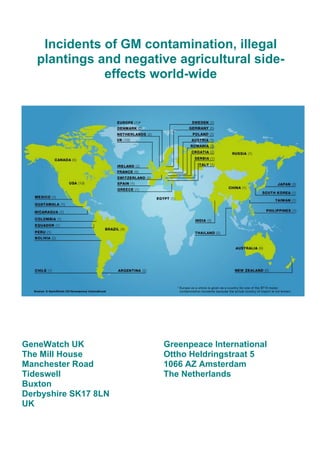
A total of 39 countries on five continents are known to have been affected by an incident of GM 
contamination, illegal planting or adverse agricultural side-effect since 1996. This is almost twice the 
number of countries that grow GM crops. The USA has had almost twice the number (19) of 
contamination and other incidents compared to any other country over the first ten years of growing GM 
crops. This is likely to reflect the high acreage of GM crops grown there. The UK has the second largest 
number of reported incidents (ten) even though it grows no GM crops commercially. The high detection 
rate in the UK is likely to reflect the increased scrutiny of GM crops that has taken place there and the 
greater efforts to detect contamination. It may also serve as an indicator for the total number of cases in 
countries with similar conditions had they applied the same level of scrutiny. 
In 2005, 11 countries and Europe as a whole were affected by a contamination incident, illegal release or 
report of a negative agricultural side-effect: USA (two); Australia (four); Brazil (one); Germany (one); 
New Zealand (one); Japan (one); Romania (three); India (one); Ireland (one); China (one); Serbia (one); 
and Europe (one). 
Over 90% of the 113 incidents were associated with the four major GM crops grown commercially: maize 
(35%); soybean (23%); oilseed rape (18%); and cotton (9%). The incidents involving other GM 
organisms, except for GM papaya which is grown commercially in Hawaii, involved illegal releases 
(grass, plum, potato, rice), contamination of a GM crop to be used in field trials (sugar beet) or arose from 
poor record keeping or ‘mistakes’ (pig, tomato and zucchini). In 2005, GM maize was associated with 
five incidents; soybean, four; oilseed rape, three; and cotton, plum, potato, zucchini and rice, one each. 
Although the majority of contamination cases are not fully investigated, cross-pollination appears to be 
the major cause in the majority of seed contamination incidents. With food, feed and seed contamination, 
poor quality control and failure of post-harvest segregation also play an important role. 
GM Contamination Register Report 2005 3
There are 17 illegal releases included in the register which are associated with research and development 
or black-market growing (in India, Brazil and Romania). Mistakes and errors in handling are one 
apparently common cause of illegal releases associated with research and development. Failures in 
inspection and enforcement of controls on field trials have also been highlighted in a 2005 USDA review 
of its own systems. 
Eight reported and verified cases of adverse agricultural side-effects have been reported with GM crops, 
affecting the USA, Argentina, Canada and Australia. These include the emergence of herbicide-tolerant 
weeds in the USA and Argentina, unreliable performance of Bt cotton in India, and the first field case in 
Australia of cotton bollworm resistance to a toxin, Cry1Ac, used in GM cotton. 
The data from the GM Contamination Register show that GM contamination can arise at every stage of 
development – from the laboratory, to the field, to the plate. Cases of misidentification, poor quality 
control and lack of awareness of proper controls in laboratories have led to GM tomato, zucchini and 
maize seed being distributed around the world and meat from GM pigs entering the food chain. Seed used 
for GM field trials, even the high-profile scientific farm-scale evaluations in the UK, has been found to be 
contaminated by other GM crops. Experimental trials have led to contamination of neighbouring and 
subsequent crops. Cross-pollination and poor quality control have led to non-GM seed and food aid being 
contaminated. Illegal large-scale growing of GM crops in Brazil, India and Romania, together with 
scientists conducting illegal trials or failing to contain them properly, show that GM organisms are often 
out-of-control even when claimed to be ‘strictly contained’. 
The Bt10 maize contamination incident in 2005 reveals a particular problem with detection and 
prevention of GM contamination. In official terms, this GM maize did not exist. It had not been tested in 
field trials, so no details had to be disclosed to authorities to gain authorisation. Even if it had been used in 
trials, it is unlikely that information about the construct and genes inserted would have been in the public 
domain, as this is often deemed ‘confidential business information’. This has become standard practice 
only over the past years. At the same time an increasing array of potentially dangerous genes with respect 
to human health are being introduced into crops – coding for drugs or other biologically active compounds 
– that could easily escape detection. Poor controls of trials with such GM drug producing crops were also 
highlighted by the USDA. 
The main conclusions from this first review of the GM Contamination Register are: 
• Present controls on GM organisms from the laboratory to the field are ineffective and prone to failure. 
• Countries and companies are often unable to prevent illegal sales of GM crops. 
• No control system is totally foolproof, human error will always result in accidents. 
• There are no independent systems in place to detect and investigate contamination, illegal releases and 
negative side-effects of GM organisms. National, international and corporate structures are inadequate 
and thus probably the majority of GM contamination incidents are undetected and certainly only a 
fraction of detected cases is published. 
• Countries are not full filling their obligations under the Cartagena Protocol on Biosafety to inform the 
Clearing House of illegal transboundary movements of GMOs. 
GM Contamination Register Report 2005 4
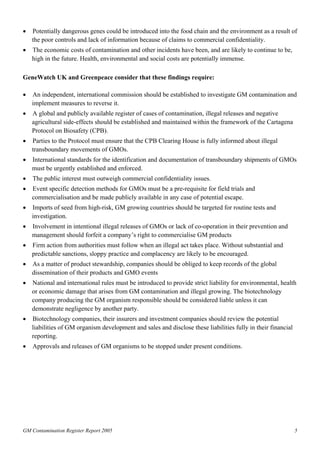
• Potentially dangerous genes could be introduced into the food chain and the environment as a result of 
the poor controls and lack of information because of claims to commercial confidentiality. 
• The economic costs of contamination and other incidents have been, and are likely to continue to be, 
high in the future. Health, environmental and social costs are potentially immense. 
GeneWatch UK and Greenpeace consider that these findings require: 
• An independent, international commission should be established to investigate GM contamination and 
implement measures to reverse it. 
• A global and publicly available register of cases of contamination, illegal releases and negative 
agricultural side-effects should be established and maintained within the framework of the Cartagena 
Protocol on Biosafety (CPB). 
• Parties to the Protocol must ensure that the CPB Clearing House is fully informed about illegal 
transboundary movements of GMOs. 
• International standards for the identification and documentation of transboundary shipments of GMOs 
must be urgently established and enforced. 
• The public interest must outweigh commercial confidentiality issues. 
• Event specific detection methods for GMOs must be a pre-requisite for field trials and 
commercialisation and be made publicly available in any case of potential escape. 
• Imports of seed from high-risk, GM growing countries should be targeted for routine tests and 
investigation. 
• Involvement in intentional illegal releases of GMOs or lack of co-operation in their prevention and 
management should forfeit a company’s right to commercialise GM products 
• Firm action from authorities must follow when an illegal act takes place. Without substantial and 
predictable sanctions, sloppy practice and complacency are likely to be encouraged. 
• As a matter of product stewardship, companies should be obliged to keep records of the global 
dissemination of their products and GMO events 
• National and international rules must be introduced to provide strict liability for environmental, health 
or economic damage that arises from GM contamination and illegal growing. The biotechnology 
company producing the GM organism responsible should be considered liable unless it can 
demonstrate negligence by another party. 
• Biotechnology companies, their insurers and investment companies should review the potential 
liabilities of GM organism development and sales and disclose these liabilities fully in their financial 
reporting. 
• Approvals and releases of GM organisms to be stopped under present conditions. 
GM Contamination Register Report 2005 5
2 Ten years of GM contamination 
Large scale commercial planting of GM crops began in 1996 but there is no global monitoring scheme of their 
impacts on food production or the environment. Because of this failure of international agencies, GeneWatch 
UK and Greenpeace started the GM Contamination Register in June 2005. The register contains records of: 
• contamination incidents – when food, feed or a related wild species have been found to contain 
unintended GM material from a GM crop or other organism. These are included when there is 
evidence from laboratory testing that GM contamination has occurred; 
• illegal plantings or releases of GM organisms – when an unauthorised planting or other release into the 
environment or food chain has taken place. These cases are included when there has been official 
acknowledgement that rules on the release of GM organisms have not been followed; 
• negative agricultural side-effects – when there has been a report in the scientific literature of 
agricultural problems arising from the GM organism and how it is managed. 
Only those incidents which have been publicly documented are recorded. As such, the register entries 
represent a sample of the actual contamination incidents that have taken place globally. There will be others 
that are, as yet, undetected or unreported because in most countries there is no systematic monitoring of GM 
crops post-commercialisation and any contamination that is detected as part of food producers quality control 
procedures is not published. It is probable that the large majority of GM contamination incidents fall into the 
undetected or undisclosed category. 
Therefore, this first report from the register only gives details of the known incidents of GM contamination, 
illegal plantings and adverse agricultural side-effects that have occurred during the first ten years of 
commercial GM crop cultivation. However, although it cannot be comprehensive, it provides the only public 
resource available to examine the causes of GM contamination and to inform control measures. 
This report includes a review of the Syngenta Bt10 maize contamination incident which took place during 
2005. In this case, an unauthorised variety of GM maize, Bt10, had been grown and exported worldwide, 
going undetected for four years. 
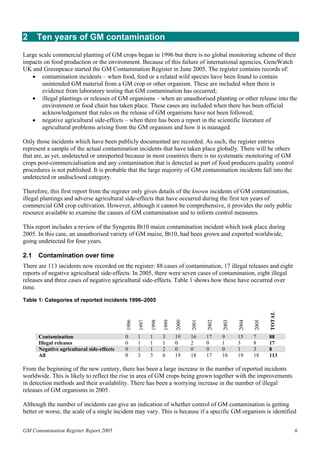
2.1 Contamination over time 
There are 113 incidents now recorded on the register: 88 cases of contamination, 17 illegal releases and eight 
reports of negative agricultural side-effects. In 2005, there were seven cases of contamination, eight illegal 
releases and three cases of negative agricultural side-effects. Table 1 shows how these have occurred over 
time. 
Table 1: Categories of reported incidents 1996–2005 
1996 
1997 
1998 
1999 
2000 
2001 
2002 
2003 
2004 
2005 
TOTAL 
Contamination 0 1 1 3 19 16 17 9 15 7 88 
Illegal releases 0 1 1 1 0 2 0 1 3 8 17 
Negative agricultural side-effects 0 1 1 2 0 0 0 0 1 3 8 
All 0 3 3 6 19 18 17 10 19 18 113 
From the beginning of the new century, there has been a large increase in the number of reported incidents 
worldwide. This is likely to reflect the rise in area of GM crops being grown together with the improvements 
in detection methods and their availability. There has been a worrying increase in the number of illegal 
releases of GM organisms in 2005. 
Although the number of incidents can give an indication of whether control of GM contamination is getting 
better or worse, the scale of a single incident may vary. This is because if a specific GM organism is identified 
GM Contamination Register Report 2005 6
as contaminating food or feed in any one country on several occasions, it is included in the register only once 
if the original cause is the same. For example, in 2005, Syngenta’s illegal Bt10 maize was found in eleven 
shipments into Japan, but this is included as only one incident. When Bt10 was reported in shipments to 
Ireland and continental Europe, they were recorded as separate incidents. A single incident may also be spread 
over a long period of time. For example, in Thailand papaya was first found to be contaminated in 2004, and 
this has continued during 2005 (see Box A). 
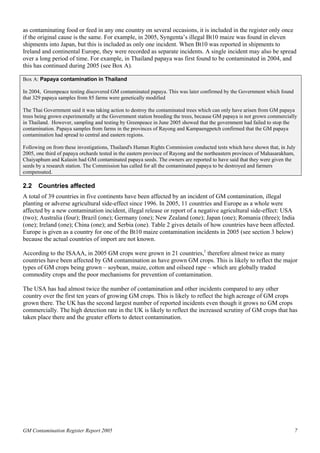
Box A: Papaya contamination in Thailand 
In 2004, Greenpeace testing discovered GM contaminated papaya. This was later confirmed by the Government which found 
that 329 papaya samples from 85 farms were genetically modified 
The Thai Government said it was taking action to destroy the contaminated trees which can only have arisen from GM papaya 
trees being grown experimentally at the Government station breeding the trees, because GM papaya is not grown commercially 
in Thailand. However, sampling and testing by Greenpeace in June 2005 showed that the government had failed to stop the 
contamination. Papaya samples from farms in the provinces of Rayong and Kampaengpetch confirmed that the GM papaya 
contamination had spread to central and eastern regions. 
Following on from these investigations, Thailand's Human Rights Commission conducted tests which have shown that, in July 
2005, one third of papaya orchards tested in the eastern province of Rayong and the northeastern provinces of Mahasarakham, 
Chaiyaphum and Kalasin had GM contaminated papaya seeds. The owners are reported to have said that they were given the 
seeds by a research station. The Commission has called for all the contaminated papaya to be destroyed and farmers 
compensated. 
2.2 Countries affected 
A total of 39 countries in five continents have been affected by an incident of GM contamination, illegal 
planting or adverse agricultural side-effect since 1996. In 2005, 11 countries and Europe as a whole were 
affected by a new contamination incident, illegal release or report of a negative agricultural side-effect: USA 
(two); Australia (four); Brazil (one); Germany (one); New Zealand (one); Japan (one); Romania (three); India 
(one); Ireland (one); China (one); and Serbia (one). Table 2 gives details of how countries have been affected. 
Europe is given as a country for one of the Bt10 maize contamination incidents in 2005 (see section 3 below) 
because the actual countries of import are not known. 
According to the ISAAA, in 2005 GM crops were grown in 21 countries,1 therefore almost twice as many 
countries have been affected by GM contamination as have grown GM crops. This is likely to reflect the major 
types of GM crops being grown – soybean, maize, cotton and oilseed rape – which are globally traded 
commodity crops and the poor mechanisms for prevention of contamination. 
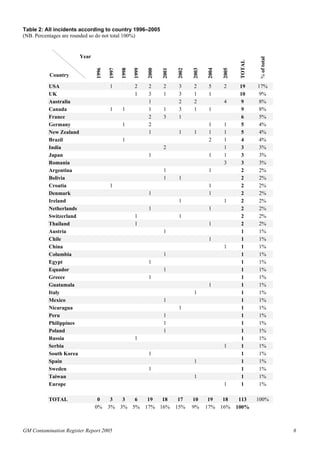
The USA has had almost twice the number of contamination and other incidents compared to any other 
country over the first ten years of growing GM crops. This is likely to reflect the high acreage of GM crops 
grown there. The UK has the second largest number of reported incidents even though it grows no GM crops 
commercially. The high detection rate in the UK is likely to reflect the increased scrutiny of GM crops that has 
taken place there and the greater efforts to detect contamination. 
GM Contamination Register Report 2005 7
Table 2: All incidents according to country 1996–2005 
(NB. Percentages are rounded so do not total 100%) 
Year 
Country 
1996 
1997 
1998 
1999 
2000 
2001 
2002 
2003 
2004 
2005 
TOTAL 
% of total 
USA 1 2 2 2 3 2 5 2 19 17% 
UK 1 3 1 3 1 1 10 9% 
Australia 1 2 2 4 9 8% 
Canada 1 1 1 1 3 1 1 9 8% 
France 2 3 1 6 5% 
Germany 1 2 1 1 5 4% 
New Zealand 1 1 1 1 1 5 4% 
Brazil 1 2 1 4 4% 
India 2 1 3 3% 
Japan 1 1 1 3 3% 
Romania 3 3 3% 
Argentina 1 1 2 2% 
Bolivia 1 1 2 2% 
Croatia 1 1 2 2% 
Denmark 1 1 2 2% 
Ireland 1 1 2 2% 
Netherlands 1 1 2 2% 
Switzerland 1 1 2 2% 
Thailand 1 1 2 2% 
Austria 1 1 1% 
Chile 1 1 1% 
China 1 1 1% 
Columbia 1 1 1% 
Egypt 1 1 1% 
Equador 1 1 1% 
Greece 1 1 1% 
Guatamala 1 1 1% 
Italy 1 1 1% 
Mexico 1 1 1% 
Nicaragua 1 1 1% 
Peru 1 1 1% 
Philippines 1 1 1% 
Poland 1 1 1% 
Russia 1 1 1% 
Serbia 1 1 1% 
South Korea 1 1 1% 
Spain 1 1 1% 
Sweden 1 1 1% 
Taiwan 1 1 1% 
Europe 1 1 1% 
TOTAL 0 3 3 6 19 18 17 10 19 18 113 100% 
0% 3% 3% 5% 17% 16% 15% 9% 17% 16% 100% 
GM Contamination Register Report 2005 8
2.3 GM organisms involved 
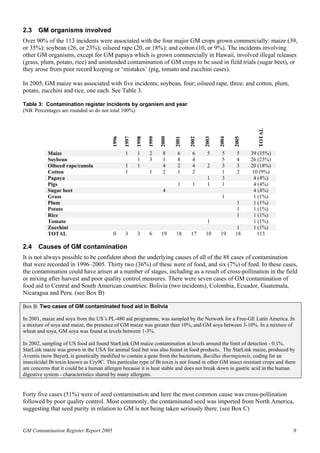
Over 90% of the 113 incidents were associated with the four major GM crops grown commercially: maize (39, 
or 35%); soybean (26, or 23%); oilseed rape (20, or 18%); and cotton (10, or 9%). The incidents involving 
other GM organisms, except for GM papaya which is grown commercially in Hawaii, involved illegal releases 
(grass, plum, potato, rice) and unintended contamination of GM crops to be used in field trials (sugar beet), or 
they arose from poor record keeping or ‘mistakes’ (pig, tomato and zucchini cases). 
In 2005, GM maize was associated with five incidents; soybean, four; oilseed rape, three; and cotton, plum, 
potato, zucchini and rice, one each. See Table 3. 
Table 3: Contamination register incidents by organism and year 
(NB. Percentages are rounded so do not total 100%) 
1996 
1997 
1998 
1999 
2000 
2001 
2002 
2003 
2004 
2005 
TOTAL 
Maize 1 1 2 8 6 6 5 5 5 39 (35%) 
Soybean 1 3 1 8 4 5 4 26 (23%) 
Oilseed rape/canola 1 1 4 2 4 2 3 3 20 (18%) 
Cotton 1 1 2 1 2 1 2 10 (9%) 
Papaya 1 3 4 (4%) 
Pigs 1 1 1 1 4 (4%) 
Sugar beet 4 4 (4%) 
Grass 1 1 (1%) 
Plum 1 1 (1%) 
Potato 1 1 (1%) 
Rice 1 1 (1%) 
Tomato 1 1 (1%) 
Zucchini 1 1 (1%) 
TOTAL 0 3 3 6 19 18 17 10 19 18 113 
2.4 Causes of GM contamination 
It is not always possible to be confident about the underlying causes of all of the 88 cases of contamination 
that were recorded in 1996–2005. Thirty two (36%) of these were of food, and six (7%) of feed. In these cases, 
the contamination could have arisen at a number of stages, including as a result of cross-pollination in the field 
or mixing after harvest and poor quality control measures. There were seven cases of GM contamination of 
food aid to Central and South American countries: Bolivia (two incidents), Colombia, Ecuador, Guatemala, 
Nicaragua and Peru. (see Box B) 
Box B: Two cases of GM contaminated food aid in Bolivia 
In 2001, maize and soya from the US’s PL-480 aid programme, was sampled by the Network for a Free-GE Latin America. In 
a mixture of soya and maize, the presence of GM maize was greater than 10%, and GM soya between 3-10%. In a mixture of 
wheat and soya, GM soya was found at levels between 1-3%. 
In 2002, sampling of US food aid found StarLink GM maize contamination at levels around the limit of detection - 0.1%. 
StarLink maize was grown in the USA for animal feed but was also found in food products. The StarLink maize, produced by 
Aventis (now Bayer), is genetically modified to contain a gene from the bacterium, Bacillus thuringiensis, coding for an 
insecticidal Bt toxin known as Cry9C. This particular type of Bt toxin is not found in other GM insect resistant crops and there 
are concerns that it could be a human allergen because it is heat stable and does not break down in gastric acid in the human 
digestive system - characteristics shared by many allergens. 
Forty five cases (51%) were of seed contamination and here the most common cause was cross-pollination 
followed by poor quality control. Most commonly, the contaminated seed was imported from North America, 
suggesting that seed purity in relation to GM is not being taken seriously there. (see Box C) 
GM Contamination Register Report 2005 9
Box C: Contaminated oilseed rape seed in the UK 
In 2000, the UK Government admitted that Advanta Seeds had imported the seed of an oilseed rape variety known as Hyola, 
which was contaminated with around 1% of GM glyphosate and glufosinate tolerant seed and that this had been sown on 
approximately 4,700 hectares. 
The contaminated seed had been identified as a result of checks in Germany and the company informed the UK Government 
about the problem. Farmers who had inadvertently planted the seeds found they had no market for their oilseed rape when the 
Seed Crushers’ and Oil Producers’ Association announced they would not accept it for food use. Advanta was eventually 
forced into paying compensation to affected farmers. 
The contaminated seed was produced in Canada and, according to evidence given by Advanta to the House of Commons 
Agriculture Select Committee, was produced from plants grown over 4 kilometres from the nearest GM crop. Because the seed 
Advanta was importing was a hybrid, it was produced by planting male sterile plants interspersed with a few (usually about 
20%) male fertile plants to pollinate them. Under these growing conditions, known as varietal associations, because there is less 
pollen than normal in the field, pollen transported into the field has a greater chance of pollinating the crop. 
In the remaining cases where there was contamination of native landraces (one incident in Mexico), wild 
relatives (one incident in Canada) or neighbouring crops (one incident in Germany), cross-pollination was the 
underlying cause. A feral population of oilseed rape now contains GM events as a result of spillage of 
imported seed between the port and processing plant in Japan (see Box D). One case of volunteers carrying 
over contamination into a subsequent crop involved GM maize modified to produce a drug (a pig vaccine) in 
the USA. 
Box D: GM oilseed rape contamination around ports in Japan 
In 2004, it was revealed that GM oilseed rape was found growing wild in many locations close to the ports where it was 
imported into Japan and the seed spilt during movement. The contamination appears to be spreading and establishing. 
A February 2005 report from the Japanese National Institute for Environmental Studies (NIES) confirmed that herbicide-resistant 
GM oilseed rape plants has been detected in five of the six Japanese ports where samples were collected. In total, GM 
oilseed rape has now been found at eight of the ten ports importing it from Canada. 
2.5 Illegal releases 
There are 17 illegal releases included in the register. These tend to fall into two categories – those associated 
with experimental growing and those where commercial growing is not properly controlled within a country or 
internationally. 
Seven cases are associated in some way with the experimental development of GM crops. Three of these 
involved unlicensed trials with GM plums and potatoes in Romania in 2005 and an early field trial in1997 in 
Croatia which took place before regulations were in place. Another concerned a field trial with GM grass in 
the USA, where unreported pollen dispersal from the site in 2004 led to the company, Scotts (owned by 
Monsanto), being fined. In three other cases – papaya in Thailand (2004) and Taiwan (2003) and rice in China 
(2005) – GM crops in the process of experimental development have found their way onto the market. 
Failure to control the sale of GM seeds has also led to illegal growing of GM crops in at least three cases: 
• The development of a black market in GM soybeans has led to wide-scale illegal growing in Romania in 
2005. Here farmers ‘brown bag’ seed and do not record future growing as is required under Romanian 
law. 
• Monsanto’s GM cotton has been ‘pirated’ by cotton breeders in India since 2001, with several illegal 
varieties being grown, many of which are failing to give good yields and often appear to have increased 
susceptibility to disease. (see Box E) 
• In Brazil, there has been a black market in GM soya since the late 1990s, reportedly fed by Argentinian 
contraband seeds. 
GM Contamination Register Report 2005 10
Sometimes the reason for the illegal release is not clear; however human error features frequently in the causes 
including in four 2005 cases. The import of zucchini seeds into Germany was the result of a labelling error. 
Poor quality control led to the growing of Bt10 maize for four years in the USA and its export to Ireland, 
continental Europe and Japan (listed as three incidents). The Bt10 case is reviewed in detail below because it 
reveals fundamental problems with the management of GM crops and the refusal of the corporation to release 
full details of the incident to the public. 
Box E: Illegal GM cotton in India 
In 2001, some 10,000 hectares of GM cotton were grown illegally in India from GM cotton seed sold by the Navbharat seed 
company. It is thought the seed was produced by crossing US varieties of GM cotton and local varieties. Farmers were asked to 
destroy their crop and harvested cotton was also destroyed. 
In 2002, some GM cotton varieties were given official approval for planting in some states of India. However, illegal growing 
of unapproved varieties in India continues and is considered widespread. The illegal varieties are reported to perform poorly 
and their growing continues today. 
2.6 Adverse agricultural side-effects 
The register includes details of eight reported and verified cases of adverse agricultural side-effects with GM 
crops. Such incidents are recorded only when there is supporting evidence in the scientific literature. 
Therefore, this is likely to be a conservative estimate of the situation. The eight incidents are: 
1997: USA – cotton farmers in Mississippi receive compensation for Roundup Ready cotton boll failure. 
1998: Canada – oilseed rape volunteer weeds are resistant to three herbicides only three years after first GM 
herbicide-tolerant oilseed rape grown. (see Box F) 
1999: USA – farmers report higher than usual incidence of sudden death syndrome associated with Roundup 
Ready soybeans. 
1999: USA – GM soybeans performed less well in hot temperatures as a result of stem splitting. 
2004: Argentina – the emergence of glyphosate (Roundup) resistant weeds as a result of the growing of 
Roundup Ready soybean and increased use of glyphosate as a herbicide. 
2005: USA – the emergence of populations of glyphosate (Roundup) resistant weeds as a result of the growing 
of Roundup Ready soybean and increased use of glyphosate as a herbicide. 
2005: Australia – field resistance to the Bt Cry1Ac toxin is reported to be associated with the growing of GM 
insect-resistant cotton. 
2005: India – Bt cotton found to be unreliable against the cotton bollworm pest. 
Because there has been no systematic monitoring of GM crop growing and possibly associated side effects in 
the five major countries of GM cultivation, other problems may not have been reported. 
Box F: Triple resistant oilseed rape volunteer weeds in Canada 
GM oilseed rape has been grown commercially in Canada since 1996. Cross-pollination between GM canola crops has led to 
herbicide tolerant ‘super-weeds’ emerging. These volunteer oilseed rape weeds (where seed shed from a crop grown in a field 
in the previous season germinates and is a weed in the following crop), that are tolerant to three herbicides (Liberty, Roundup 
and Clearfield), were first identified in Canada in 1998, only 3 years after GM herbicide tolerant oilseed rape was first grown. 
This resistance to more than one herbicide is known as ‘gene stacking’ and arises through pollination of one herbicide tolerant 
variety by another. An Agriculture Canada project found evidence of stacking at all 11 sites it sampled in 1999 with gene flow 
taking place at distances of up to 800 metres. 
To control these herbicide tolerant weeds, both 2,4-D and paraquat (gramoxone) are being recommended by government 
agencies to control herbicide tolerant oilseed rape volunteers in Canada. 2,4-D is considered "highly toxic" due to its hazard to 
eyes and some forms are also highly toxic to fish. 
GM Contamination Register Report 2005 11
2.7 Discussion 
There are very few systematic investigations of GM contamination when it occurs and no national or 
international register of contamination incidents. Currently, GM contamination is most often exposed 
following sampling by non-governmental organisations (NGOs), such as Greenpeace or Friends of the Earth. 
Monitoring of the purity of food ingredients is being undertaken by food producers and public authorities in 
some countries, but the findings are not in the public domain. And, while the biotechnology industry is anxious 
to report the number of hectares of GM crops being grown worldwide, it becomes secretive when faced with 
issues of contamination. Although it is not comprehensive, the sample of incidents that the GM Contamination 
Register represents, shows that GM contamination has affected around twice as many countries as are involved 
in growing GM crops. 
One real problem with the detection of GM contamination came to the fore in 2005 with the Bt10 maize 
contamination incident. In official terms, this GM maize did not exist. It had not been tested in field trials, so 
no details had to be disclosed to authorities to gain authorisation. Even if it had been used in trials, it is 
unlikely that information about the genes inserted would have been in the public domain, as this is often 
deemed ‘confidential business information’. There is an array of potentially dangerous genes being introduced 
into crops – coding for drugs or other biologically active compounds – that could easily escape detection. In 
2005, 12 tonne of GM peas with a bean alpha-amylase inhibitor gene had to be destroyed when it was 
belatedly discovered in their development that the GM version of the alpha-amylase inhibitor could cause an 
allergic reaction in mice.2 Past experience, as revealed in the GM Contamination Register, is that these peas 
could have gone astray and entered the food chain. Whether countries, especially developing countries, even 
have the capacity to detect GM contamination is doubtful especially when considering that Syngenta, a major 
multinational corporation, took four years to detect that its seed supplies were contaminated (see review 
below). 
In many cases of GM contamination, the source is not usually reliably identified and so steps to prevent or 
detect future contamination are not taken. Underlying causes are usually revealed only if official agencies 
follow up cases and practice varies. For example, New Zealand does follow up incidents when detected and 
information about them is made available. In Australia, breaches of GM license conditions that are reported to 
the Federal Regulator are generally investigated in order to identify the cause of the contamination and are 
publicly reported. However, this is not required in relation to seed imports, food contamination or breaches 
that occur under different State legislation. In the USA, where most GM crops are grown commercially, there 
seems little interest in tracing and containing contamination even with respect to experimental field trials 
which must be monitored as part of their permits. A recent audit by the US Department of Agriculture of the 
inspection of experimental GMO releases revealed serious weaknesses and failures which included the 
potential to allow GM organisms to persist in the environment.3 The site of field trials was not always known, 
information was lacking, and inspections had not taken place, with only 1 of 12 drug producing GM field trials 
examined being inspected fully. The audit concluded that poor systems for post-harvest management could 
lead to drug producing crops accidentally entering the food chain. 
The data from the GM Contamination Register shows that GM contamination can arise at every stage of 
development – from the laboratory to the field. Cases of misidentification, poor quality control and lack of 
awareness of controls in laboratories have led to GM tomato, zucchini and maize seed being distributed around 
the world, and meat from GM pigs entering the food chain. Seed used for GM field trials, even the high-profile 
scientific farm-scale evaluations in the UK, has been found to be contaminated by other GM crops. 
Experimental trials have led to contamination of neighbouring and subsequent crops. Cross-pollination and 
poor quality control have led to non-GM seed and food aid being contaminated. Illegal large-scale growing of 
GM crops in Brazil, India and Romania, together with scientists conducting illegal trials or failing to contain 
them properly, show how out-of-control GM crops are even when apparently ‘strictly contained’. 
Despite this apparent systemic failure to control contamination, official reactions to contamination and illegal 
releases are weak. The most common reaction to cases of contamination is for companies and governments to 
consider raising thresholds for allowable contamination. For example, in response to the Bt10 incident (see 
below) Japan has been considering a 1% threshold to avoid shipments being rejected, and Syngenta is reported 
GM Contamination Register Report 2005 12
to be supporting such a move.4 Also in 2005, the Australian Government set a 0.9% threshold for GM 
contamination in harvested oilseed rape and 0.5% in seed following problems with low levels of contamination 
in oilseed rape seed.5 This is despite all the oilseed rape-growing states in Australia having moratoria on the 
growing of GM oilseed rape to maintain GM-free status. It is difficult to avoid the conclusion that the industry 
and its allies consider contamination to be useful in forcing acceptance of GM crops by making them 
‘inevitable’. Governments with the interests of the biotechnology industry at heart appear willing to support 
such relaxation of standards at odds with the preferences of citizens and non-GM organic and conventional 
farmers. 
Illegal releases of GM organisms, when identified, tend to be better investigated than cases of GM 
contamination of food, feed or seed. However, in the case of illegal and unreported GM soya growing in 
Romania and illegal varieties of GM insect-resistant cotton in India, official responses have been weak and 
unable to contain the problem. 
While many claims have been made for the advantages of GM crops, there are serious issues over the 
sustainability of the technology. The first negative agricultural side-effects were seen in 1998, only two years 
after GM crops were first grown commercially. The unanticipated occurrence of cotton boll failure has been 
managed by altering recommendations on herbicide use, to avoid damaging effects on the plant. The 
emergence of herbicide-tolerant weeds as a result of the adoption of GM Roundup Ready soybeans was widely 
predicted and has led to the use of other chemical herbicides to control them. 
Multiple resistance to herbicides has already arisen in Canada, where cross-pollination has led to the 
emergence of oilseed rape volunteer weeds that are resistant to three herbicides. These incidents, together with 
the first field case of Bt insect resistance associated with a GM crop, raise questions about the sustainability of 
the technology. While the agricultural biotechnology companies may profit from the need for more chemicals, 
farmers may suffer crop failures and lowered profit margins. 
In all incidents of contamination, illegal releases and negative side-effects there are likely to be economic costs 
which are rarely calculated. In the case of the Starlink contamination, where a GM maize intended only for 
animal consumption was found in human food, costs to the company, Aventis, have been estimated at $500 
million in payments to farmers, food producers and processors who had to withdraw food products. The total 
costs of the Bt10 contamination incident are not known, but are likely to have been considerable. 
The costs to human health and the environment could prove to be even higher in the future when the restricted 
extent of controls is considered. Companies and their insurers will need to review the financial liabilities of the 
biotechnology industry. 
In considering liabilities, the following realities will have to be acknowledged: 
• Selling and promoting GM crops in countries where the existing infrastructure will not allow even basic 
controls to succeed poses real problems. 
• Efforts to isolate GM crops through separation from other crops are unlikely to prevent contamination 
even if accompanied by serious enforcement regimes and quality control procedures. 
• The international nature of the crop commodity market and the companies selling GM crops means that an 
international response is needed to contain GM contamination. 
As the review of the Bt10 incident illustrates, it is probably impossible to prevent all GM contamination and 
the potential for serious harm remains. 
GM Contamination Register Report 2005 13
3 Syngenta’s Bt10 maize contamination incident 
‘This incident points to fundamental problems with the regulatory framework for agricultural biotechnology in 
the United States. And the response of the agencies involved gives little confidence that these problems are 
being seriously addressed.’ Nature, Editorial, 14 April 20056 
3.1 Introduction 
The Bt contamination incident of 2005 was one of the most important of the year in terms of its extent and 
implications. This special review brings together the information that is known about the Bt10 contamination 
incident and analyses the corporate and official government responses to it in an effort to aid learning and 
avoid such events in the future. Whether Bt10 proves to be safe or not, that an unapproved GM crop was 
wrongly marketed for four years indicates that current control systems are inadequate. With the development 
taking place of GM crops to produce drugs, an urgent reappraisal is needed to avoid serious harm arising in the 
future. 
On 22 March 2005, the science journal Nature revealed that a line of GM maize, Bt10, that does not have 
regulatory approval anywhere in the world had been grown accidentally for four years.7 The Bt10 maize was 
produced by the agricultural biotechnology company Syngenta, and was ‘mistakenly identified’ as its 
approved commercial GM maize line, Bt11, and used in commercial maize breeding lines. Although the 
company informed the US authorities about the error in December 2004, other countries that may have 
received the Bt10 maize were not informed by Syngenta or the US authorities, even though the export of Bt10 
elsewhere was likely to have been illegal. 
In addition, the full details of the contamination incident, including the molecular characterisation of Bt10 
maize as required for a risk assessment, have still not been made available to the public. The presence of an 
antibiotic resistance gene was not revealed initially and independent testing has been obstructed because a 
specific test for Bt10 was not developed until four months after the initial mistake was detected. Sygenta has 
also put restrictions on access to Bt10 test material, hampering independent analysis by third parties. 
3.2 How the contamination incident unfolded 
The journal Nature first revealed that Syngenta had inadvertently produced and distributed a variety of GM 
maize, Bt10, which did not have regulatory approval, in March 2005.7 Between 2001 and 2004, several 
hundred tonnes of the Bt10 maize were distributed and grown commercially as if it were Bt11 maize in the 
USA and, to a lesser extent, in Canada. As a result, the maize was exported to other countries. Bt10 maize was 
also mistakenly used in field trials in Spain, Chile, Canada and Argentina and in a contained growing system 
(phytotron) in France in 2001. The breach was reported by the company to the US authorities in December 
2004, but was not made public until three months later. 
Table 4 gives a chronology of the events surrounding the Bt10 contamination incident and shows that the 
European Commission was not informed until two days before the Nature article was published, despite a 
statement to the journal by the US authorities that other countries had been informed. In a meeting with 
Greenpeace, GeneWatch UK and Save Our Seeds on 11 May, Syngenta representatives made the excuse that 
the company was involved in tracking the contaminated seed, putting it in quarantine and arranging its 
disposal. By implication, Syngenta, a giant multinational corporation that employs 19,000 people in over 90 
countries and had sales of $7.3 billion in 2004, was simply too busy and did not have the resources to inform 
other countries or the United Nation’s Cartagena Biosafety Protocol’s Clearing House of the possible 
contamination. The company also argued that informing possibly affected third parties about the 
contamination was the responsibility of the US authorities. Although the European Commission did not share 
this view, it did not take any formal action as a result. 
The mix-up between Bt10 and Bt11 arose because Syngenta’s quality control procedures were not sufficiently 
rigorous and did not differentiate between Bt10 and Bt11. The company had relied upon field observations and 
GM Contamination Register Report 2005 14
testing for Bt proteins using an ELISA technique which detects the presence of the Cry1A protein which is 
present in both Bt10 and Bt1.8 As a result, Bt10 lines were mistakenly used in breeding. The error was 
detected after four years by Garst seeds, a seed company recently taken over by Syngenta, using more 
sophisticated DNA-based techniques looking at the specific DNA construct inserted. (see Box G for 
explanation of testing approaches) 
In relation to the scale of the incident, Syngenta asserts: ‘The Bt10 event was found in five Bt corn breeding 
lines in the USA, three of which were used between 2001 and 2004 primarily for pre-commercial development. 
The seeds produced could have planted an estimated 37,000 acres (15,000 hectares) in the USA accumulative 
over the four-year time period. This equates to one-one hundredth of one percent (0.01 percent) of the annual 
total US corn acreage (annual US corn plantings is 80 million acres or 32 million hectares). Only around 18 
percent of US corn is exported to other countries. Therefore, although it is possible that some Bt10 grain could 
have entered US export channels, any such amount would have been in very small volumes.’9 It has been 
estimated that about 1,000 tonnes of Bt10 could have been imported into Europe between 2001 and 2004. 
However, despite the delay between detection of the contamination and its public acknowledgement, when any 
contaminated maize would have moved undetected, 12 shipments of contaminated maize have been reported 
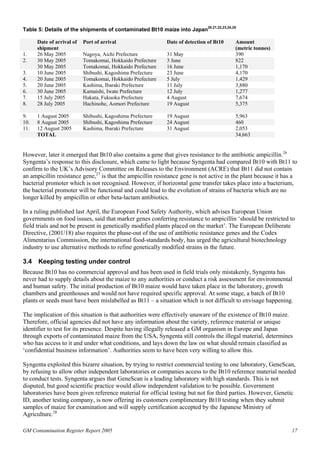
(11 to Japan – see Table 5 – and one to Ireland). It is possible that Syngenta has failed to identify the extent of 
the contamination, or that Bt10 maize has been disproportionately exported to Japan for some reason, or that 
other shipments have been identified in the USA before departure and their export halted. 
According to Syngenta, once the problem was identified, all the Bt10 seed was tracked and quarantined, if it 
had not already entered the food chain. The contamination, from the company’s perspective, is contained. In a 
response to the UK’s Department of the Environment, Farming and Rural Affairs (DEFRA) on 5 April 2005, 
Syngenta said 19,000 bags of Bt10 maize seed were in quarantine. However, because Syngenta has placed 
restrictions on access to reference material for Bt10, and has claimed commercial confidentiality in relation to 
the affected maize breeding lines, independent verification will be difficult and will probably prove 
impossible. 
3.3 How Bt10 has been modified – secrecy prevails 
One of the most important pieces of information needed to assess the safety of GM crops is detail about the 
way in which the crop has been modified – including exactly what DNA has been integrated, how many copies 
and where in the genome. Compositional analysis to ensure there have been no unintended effects is also 
required for each genetic modification event, because each one is different. 
This information is needed to understand how the modified crop will behave and what safety questions may 
need addressing. However, this information is still not in the public domain because Syngenta considers that it 
is commercially confidential. Syngenta has also insisted that authorities keep such information confidential 
when it has been supplied to them, but the scope of the data provided to them is obviously not as 
comprehensive as that normally required for a risk assessment.19 
Syngenta’s actions have also tended to conceal the full picture in other ways. When the mix-up between Bt10 
and Bt11 first came to light, Syngenta emphasised the similarity between the two GM maize varieties in its 
statement to Nature. Both include insecticidal Cry1Ab toxins as a result of the introduction of a gene from the 
soil microorganism Bacillus thuringiensis and a gene (the PAT gene) which gives herbicide tolerance to 
glufosinate, also from a soil micro-organism. The company simply said that the new proteins produced by the 
maize were the same in Bt10 and Bt11. 
GM Contamination Register Report 2005 15
Table 4: Chronology of events surrounding the Bt10 contamination incident 
Date Event 
2001–2004 Bt10 maize mistakenly considered to be Bt11 maize and used in breeding. Planted on an 
estimated 15,000 hectares in the USA. 
2003 and 2004 Bt10 maize mistakenly used as Bt11 in field trials in Spain. Field trials also undertaken in 
Argentina, Chile and Canada using the wrong GM maize variety, but dates not known. 
December 2004 Syngenta informs the US authorities that it has detected Bt10 in lines of Bt11 maize being sold 
commercially for four years. 
14 March 2005 The US Environment Protection Agency issues a statement to the science journal Nature, saying 
that it is investigating whether any violations of laws and regulations have been occurred. It 
states: ‘The US Government is also communicating with our major trading partners to ensure 
they understand there are no food safety or environmental concerns.’ 
22 March 2005 The US Government sends an e-mail to the European Commission informing it of the 
‘inadvertent’ release of the unauthorised Bt10 maize.10 This is the first time the Commission has 
been informed. 
24 March 2005 Nature publishes its article revealing the Bt10 release. Jeff Stein of Syngenta is quoted as 
saying: ‘What makes this somewhat unique is that Bt10 and Bt11 are physically identical and 
the proteins are identical.’ 
24 March 2005 Japan announces that it will monitor imports of maize from the USA for the presence of Bt10.11 
31 March 2005 In a letter to the European Commission Joint Research Centre, Syngenta admits for the first 
time that Bt10 differs from Bt11 in that it also contains an ampicillin resistance gene. Sygnenta 
says it is ‘in the process of developing and validating … an event specific detection 
method’.12,13 
6 April 2005 Syngenta tells the European Commission that it expects to have a validated, event-specific test 
for Bt10 available ‘at the end of this month’.14 
8 April 2005 US Department of Agriculture fines Syngenta $375,000 and requires Syngenta to fund a 
compliance conference. 
15 April 2005 EU announces that it requires certification that all maize imports from the USA do not contain 
Bt10.15 
25 April 2005 Validated test for Bt10 becomes available.16 
11 May 2005 Syngenta meets with Greenpeace, GeneWatch UK and Save Our Seeds in Brussels. Syngenta 
refuses to disclose full sequence information on Bt10.Syngenta confirms that it will not make 
Bt10 reference material generally available to independent laboratories. GeneScan is the only 
laboratory other than national labs allowed to test for Bt10. 
25 May 2005 Shipment of maize into Ireland reported to be contaminated with Bt10.17 
2 June 2005 Shipment of maize into Japan reported to be contaminated with Bt10.18 Ten further shipments 
are found to be contaminated by end of August (see Table 2 below). 
9 June 2005 European Food Standards Authority says Bt10 probably safe but not enough information has 
been provided for a full risk assessment.19 
Box G: GMO testing – finding only what you look for 
Two types of testing are used for most GMO identification: 
• ELISA (Enzyme-Linked Immunosorbent Assay): Tests for the presence of a specific protein using antibodies in the test 
kit. The protein is produced from the activation of the introduced DNA. 
• PCR (Polymerase Chain Reaction):Tests for the presence of a specific DNA sequence, which must be known and prepared 
in reference material. 
In the case of Bt10, the ELISA protein and its DNA sequence employed to identify the approved GMO Bt11 was present both 
in Bt11 and in Bt10. Hence any Bt10 could have been mistaken for Bt11. 
Unique identification requires testing for a DNA sequence which is unique to the specific GMO. These specific DNA 
sequences must initially be provided by the producer of a GMO. Where they are not available GMOs will go undetected and 
this includes most experimental GMOs at present. 
Some screening tests use DNA sequences present in a variety of different GMOs in order to assess whether further detailed 
testing is required. If a common sequence used in screening tests is not in a particular GMO, it will escape by this approach. 
GM Contamination Register Report 2005 16
Table 5: Details of the shipments of contaminated Bt10 maize into Japan20,21,22,23,24,25 
Date of arrival of 
shipment 
Port of arrival Date of detection of Bt10 Amount 
(metric tonnes) 
1. 26 May 2005 Nagoya, Aichi Prefecture 31 May 390 
30 May 2. 2005 Tomakomai, Hokkaido Prefecture 3 June 822 
30 May 2005 Tomakomai, Hokkaido Prefecture 16 June 1,170 
3. 10 June 2005 Shibushi, Kagoshima Prefecture 23 June 4,170 
4. 20 June 2005 Tomakomai, Hokkaido Prefecture 5 July 1,429 
5. 20 June 2005 Kashima, Ibaraki Prefecture 11 July 3,880 
6. 30 June 2005 Kamaishi, Iwate Prefecture 12 July 1,277 
7. 15 July 2005 Hakata, Fukuoka Prefecture 4 August 7,674 
8. 28 July 2005 
Hachinohe, Aomori Prefecture 19 August 5,375 
9. 1 August 2005 Shibushi, Kagoshima Prefecture 19 August 5,963 
10. 8 August 2005 Shibushi, Kagoshima Prefecture 24 August 460 
11. 12 August 2005 Kashima, Ibaraki Prefecture 31 August 2,053 
TOTAL 34,663 
However, later it emerged that Bt10 also contains a gene that gives resistance to the antibiotic ampicillin.26 
Syngenta’s response to this disclosure, which came to light because Syngenta had compared Bt10 with Bt11 to 
confirm to the UK’s Advisory Committee on Releases to the Environment (ACRE) that Bt11 did not contain 
an ampicillin resistance gene,27 is that the ampicillin resistance gene is not active in the plant because it has a 
bacterial promoter which is not recognised. However, if horizontal gene transfer takes place into a bacterium, 
the bacterial promoter will be functional and could lead to the evolution of strains of bacteria which are no 
longer killed by ampicillin or other beta-lactam antibiotics. 
In a ruling published last April, the European Food Safety Authority, which advises European Union 
governments on food issues, said that marker genes conferring resistance to ampicillin ‘should be restricted to 
field trials and not be present in genetically modified plants placed on the market’. The European Deliberate 
Directive, (2001/18) also requires the phase-out of the use of antibiotic resistance genes and the Codex 
Alimentarius Commission, the international food-standards body, has urged the agricultural biotechnology 
industry to use alternative methods to refine genetically modified strains in the future. 
3.4 Keeping testing under control 
Because Bt10 has no commercial approval and has been used in field trials only mistakenly, Syngenta has 
never had to supply details about the maize to any authorities or conduct a risk assessment for environmental 
and human safety. The initial production of Bt10 maize would have taken place in the laboratory, growth 
chambers and greenhouses and would not have required specific approval. At some stage, a batch of Bt10 
plants or seeds must have been mislabelled as Bt11 – a situation which is not difficult to envisage happening. 
The implication of this situation is that authorities were effectively unaware of the existence of Bt10 maize. 
Therefore, official agencies did not have any information about the variety, reference material or unique 
identifier to test for its presence. Despite having illegally released a GM organism in Europe and Japan 
through exports of contaminated maize from the USA, Syngenta still controls the illegal material, determines 
who has access to it and under what conditions, and lays down the law on what should remain classified as 
‘confidential business information’. Authorities seem to have been very willing to allow this. 
Syngenta exploited this bizarre situation, by trying to restrict commercial testing to one laboratory, GeneScan, 
by refusing to allow other independent laboratories or companies access to the Bt10 reference material needed 
to conduct tests. Syngenta argues that GeneScan is a leading laboratory with high standards. This is not 
disputed, but good scientific practice would allow independent validation to be possible. Government 
laboratories have been given reference material for official testing but not for third parties. However, Genetic 
ID, another testing company, is now offering its customers complimentary Bt10 testing when they submit 
samples of maize for examination and will supply certification accepted by the Japanese Ministry of 
Agriculture.28 
GM Contamination Register Report 2005 17
3.5 The official response 
USA 
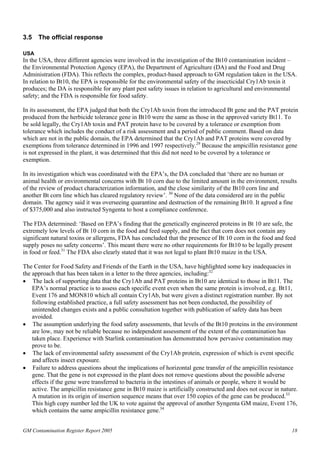
In the USA, three different agencies were involved in the investigation of the Bt10 contamination incident – 
the Environmental Protection Agency (EPA), the Department of Agriculture (DA) and the Food and Drug 
Administration (FDA). This reflects the complex, product-based approach to GM regulation taken in the USA. 
In relation to Bt10, the EPA is responsible for the environmental safety of the insecticidal Cry1Ab toxin it 
produces; the DA is responsible for any plant pest safety issues in relation to agricultural and environmental 
safety; and the FDA is responsible for food safety. 
In its assessment, the EPA judged that both the Cry1Ab toxin from the introduced Bt gene and the PAT protein 
produced from the herbicide tolerance gene in Bt10 were the same as those in the approved variety Bt11. To 
be sold legally, the Cry1Ab toxin and PAT protein have to be covered by a tolerance or exemption from 
tolerance which includes the conduct of a risk assessment and a period of public comment. Based on data 
which are not in the public domain, the EPA determined that the Cry1Ab and PAT proteins were covered by 
exemptions from tolerance determined in 1996 and 1997 respectively.29 Because the ampicillin resistance gene 
is not expressed in the plant, it was determined that this did not need to be covered by a tolerance or 
exemption. 
In its investigation which was coordinated with the EPA’s, the DA concluded that ‘there are no human or 
animal health or environmental concerns with Bt 10 corn due to the limited amount in the environment, results 
of the review of product characterization information, and the close similarity of the Bt10 corn line and 
another Bt corn line which has cleared regulatory review’. 30 None of the data considered are in the public 
domain. The agency said it was overseeing quarantine and destruction of the remaining Bt10. It agreed a fine 
of $375,000 and also instructed Syngenta to host a compliance conference. 
The FDA determined: ‘Based on EPA’s finding that the genetically engineered proteins in Bt 10 are safe, the 
extremely low levels of Bt 10 corn in the food and feed supply, and the fact that corn does not contain any 
significant natural toxins or allergens, FDA has concluded that the presence of Bt 10 corn in the food and feed 
supply poses no safety concerns’. This meant there were no other requirements for Bt10 to be legally present 
in food or feed.31 The FDA also clearly stated that it was not legal to plant Bt10 maize in the USA. 
The Center for Food Safety and Friends of the Earth in the USA, have highlighted some key inadequacies in 
the approach that has been taken in a letter to the three agencies, including:32 
• The lack of supporting data that the Cry1Ab and PAT proteins in Bt10 are identical to those in Bt11. The 
EPA’s normal practice is to assess each specific event even when the same protein is involved, e.g. Bt11, 
Event 176 and MON810 which all contain Cry1Ab, but were given a distinct registration number. By not 
following established practice, a full safety assessment has not been conducted, the possibility of 
unintended changes exists and a public consultation together with publication of safety data has been 
avoided. 
• The assumption underlying the food safety assessments, that levels of the Bt10 proteins in the environment 
are low, may not be reliable because no independent assessment of the extent of the contamination has 
taken place. Experience with Starlink contamination has demonstrated how pervasive contamination may 
prove to be. 
• The lack of environmental safety assessment of the Cry1Ab protein, expression of which is event specific 
and affects insect exposure. 
• Failure to address questions about the implications of horizontal gene transfer of the ampicillin resistance 
gene. That the gene is not expressed in the plant does not remove questions about the possible adverse 
effects if the gene were transferred to bacteria in the intestines of animals or people, where it would be 
active. The ampicillin resistance gene in Bt10 maize is artificially constructed and does not occur in nature. 
A mutation in its origin of insertion sequence means that over 150 copies of the gene can be produced.33 
This high copy number led the UK to vote against the approval of another Syngenta GM maize, Event 176, 
which contains the same ampicillin resistance gene.34 
GM Contamination Register Report 2005 18
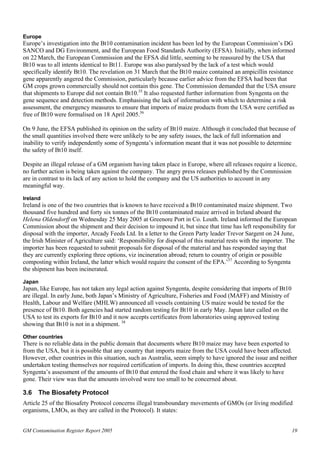
Europe 
Europe’s investigation into the Bt10 contamination incident has been led by the European Commission’s DG 
SANCO and DG Environment, and the European Food Standards Authority (EFSA). Initially, when informed 
on 22 March, the European Commission and the EFSA did little, seeming to be reassured by the USA that 
Bt10 was to all intents identical to Bt11. Europe was also paralysed by the lack of a test which would 
specifically identify Bt10. The revelation on 31 March that the Bt10 maize contained an ampicillin resistance 
gene apparently angered the Commission, particularly because earlier advice from the EFSA had been that 
GM crops grown commercially should not contain this gene. The Commission demanded that the USA ensure 
that shipments to Europe did not contain Bt10.35 It also requested further information from Syngenta on the 
gene sequence and detection methods. Emphasising the lack of information with which to determine a risk 
assessment, the emergency measures to ensure that imports of maize products from the USA were certified as 
free of Bt10 were formalised on 18 April 2005.36 
On 9 June, the EFSA published its opinion on the safety of Bt10 maize. Although it concluded that because of 
the small quantities involved there were unlikely to be any safety issues, the lack of full information and 
inability to verify independently some of Syngenta’s information meant that it was not possible to determine 
the safety of Bt10 itself. 
Despite an illegal release of a GM organism having taken place in Europe, where all releases require a licence, 
no further action is being taken against the company. The angry press releases published by the Commission 
are in contrast to its lack of any action to hold the company and the US authorities to account in any 
meaningful way. 
Ireland 
Ireland is one of the two countries that is known to have received a Bt10 contaminated maize shipment. Two 
thousand five hundred and forty six tonnes of the Bt10 contaminated maize arrived in Ireland aboard the 
Helena Oldendorff on Wednesday 25 May 2005 at Greenore Port in Co. Louth. Ireland informed the European 
Commission about the shipment and their decision to impound it, but since that time has left responsibility for 
disposal with the importer, Arcady Feeds Ltd. In a letter to the Green Party leader Trevor Sargent on 24 June, 
the Irish Minister of Agriculture said: ‘Responsibility for disposal of this material rests with the importer. The 
importer has been requested to submit proposals for disposal of the material and has responded saying that 
they are currently exploring three options, viz incineration abroad; return to country of origin or possible 
composting within Ireland, the latter which would require the consent of the EPA.’37 According to Syngenta 
the shipment has been incinerated. 
Japan 
Japan, like Europe, has not taken any legal action against Syngenta, despite considering that imports of Bt10 
are illegal. In early June, both Japan’s Ministry of Agriculture, Fisheries and Food (MAFF) and Ministry of 
Health, Labour and Welfare (MHLW) announced all vessels containing US maize would be tested for the 
presence of Bt10. Both agencies had started random testing for Bt10 in early May. Japan later called on the 
USA to test its exports for Bt10 and it now accepts certificates from laboratories using approved testing 
showing that Bt10 is not in a shipment. 38 
Other countries 
There is no reliable data in the public domain that documents where Bt10 maize may have been exported to 
from the USA, but it is possible that any country that imports maize from the USA could have been affected. 
However, other countries in this situation, such as Australia, seem simply to have ignored the issue and neither 
undertaken testing themselves nor required certification of imports. In doing this, these countries accepted 
Syngenta’s assessment of the amounts of Bt10 that entered the food chain and where it was likely to have 
gone. Their view was that the amounts involved were too small to be concerned about. 
3.6 The Biosafety Protocol 
Article 25 of the Biosafety Protocol concerns illegal transboundary movements of GMOs (or living modified 
organisms, LMOs, as they are called in the Protocol). It states: 
GM Contamination Register Report 2005 19
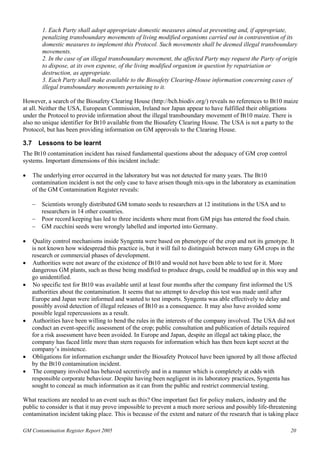
1. Each Party shall adopt appropriate domestic measures aimed at preventing and, if appropriate, 
penalizing transboundary movements of living modified organisms carried out in contravention of its 
domestic measures to implement this Protocol. Such movements shall be deemed illegal transboundary 
movements. 
2. In the case of an illegal transboundary movement, the affected Party may request the Party of origin 
to dispose, at its own expense, of the living modified organism in question by repatriation or 
destruction, as appropriate. 
3. Each Party shall make available to the Biosafety Clearing-House information concerning cases of 
illegal transboundary movements pertaining to it. 
However, a search of the Biosafety Clearing House (http://bch.biodiv.org/) reveals no references to Bt10 maize 
at all. Neither the USA, European Commission, Ireland nor Japan appear to have fulfilled their obligations 
under the Protocol to provide information about the illegal transboundary movement of Bt10 maize. There is 
also no unique identifier for Bt10 available from the Biosafety Clearing House. The USA is not a party to the 
Protocol, but has been providing information on GM approvals to the Clearing House. 
3.7 Lessons to be learnt 
The Bt10 contamination incident has raised fundamental questions about the adequacy of GM crop control 
systems. Important dimensions of this incident include: 
• The underlying error occurred in the laboratory but was not detected for many years. The Bt10 
contamination incident is not the only case to have arisen though mix-ups in the laboratory as examination 
of the GM Contamination Register reveals: 
− Scientists wrongly distributed GM tomato seeds to researchers at 12 institutions in the USA and to 
researchers in 14 other countries. 
− Poor record keeping has led to three incidents where meat from GM pigs has entered the food chain. 
− GM zucchini seeds were wrongly labelled and imported into Germany. 
• Quality control mechanisms inside Syngenta were based on phenotype of the crop and not its genotype. It 
is not known how widespread this practice is, but it will fail to distinguish between many GM crops in the 
research or commercial phases of development. 
• Authorities were not aware of the existence of Bt10 and would not have been able to test for it. More 
dangerous GM plants, such as those being modified to produce drugs, could be muddled up in this way and 
go unidentified. 
• No specific test for Bt10 was available until at least four months after the company first informed the US 
authorities about the contamination. It seems that no attempt to develop this test was made until after 
Europe and Japan were informed and wanted to test imports. Syngenta was able effectively to delay and 
possibly avoid detection of illegal releases of Bt10 as a consequence. It may also have avoided some 
possible legal repercussions as a result. 
• Authorities have been willing to bend the rules in the interests of the company involved. The USA did not 
conduct an event-specific assessment of the crop; public consultation and publication of details required 
for a risk assessment have been avoided. In Europe and Japan, despite an illegal act taking place, the 
company has faced little more than stern requests for information which has then been kept secret at the 
company’s insistence. 
• Obligations for information exchange under the Biosafety Protocol have been ignored by all those affected 
by the Bt10 contamination incident. 
• The company involved has behaved secretively and in a manner which is completely at odds with 
responsible corporate behaviour. Despite having been negligent in its laboratory practices, Syngenta has 
sought to conceal as much information as it can from the public and restrict commercial testing. 
What reactions are needed to an event such as this? One important fact for policy makers, industry and the 
public to consider is that it may prove impossible to prevent a much more serious and possibly life-threatening 
contamination incident taking place. This is because of the extent and nature of the research that is taking place 
GM Contamination Register Report 2005 20
using GM that may either deliberately (e.g. by engineering food crops to produce drugs) or unintentionally 
(e.g. by introducing a new allergen) lead to harmful compounds being produced. Because the external 
appearance of the plant may not give any information about its changed nature, there are no simple safeguards. 
The situation is made more complex because of the commercial confidentiality that surrounds GM crops. For 
example, an examination of the data on Syngenta’s field trials with GM crops in the USA from 1 May 2004 to 
30 April 2005, in the Information Systems for Biotechnology database (supported by the USDA, 
http://www.isb.vt.edu/), shows that in no case are details of the genes included – all are considered 
‘confidential business information’. Therefore, the problems for other countries or third parties wishing to 
ensure imports are not being contaminated are enormous. 
Syngenta has to hold a conference under the terms of its agreement with the USDA, the goals of which are to: 
‘1.) develop a best management practices or technical guideline for insuring no contamination or 
cross contamination of biotech genes in the seed development and breeding program; and 
2.) develop a best management practices or technical guideline to identify, promptly address, and 
implement corrective measures to resolve unintended biotech releases.’30 
Whether this conference has taken place is not known, but voluntary industry guidelines and statements of best 
practice are unlikely to be sufficient to prevent and detect contamination. Taking into account Syngenta's 
handling of the case and conduct towards the public and national authorities, binding legal requirements for 
pre-trial provision of tests for experimental GMOs appear to be indispensable to enable meaningful control of 
‘rogue’ GMOs. In addition a minimum code of conduct for GMO companies should be established. 
Companies in breach of this code should forfeit the right of conducting GMO field trials and trading GMO 
products. 
Countries involved in such incidents should also take their obligations under the Biosafety Protocol if any 
confidence is to be placed in the Clearing House to act as an information exchange mechanism as is intended. 
Ultimately, fool proof and fraud proof measures to prevent the unintended or intended spread of illegal GMOs 
may be an unachievable goal. A much more honest debate within society is needed to decide whether the risk 
is acceptable at all. 
GM Contamination Register Report 2005 21
4 Conclusions and Recommendations 
The main conclusions from this first review of the GM Contamination Register are: 
• Present controls on GM organisms from the laboratory to the field are ineffective and prone to failure. 
• Countries and companies are often unable to prevent illegal sales of GM crops. 
• No control system is totally foolproof, human error will always result in accidents. 
• There are no independent systems in place to detect and investigate contamination, illegal releases and 
negative side-effects of GM organisms. National, international and corporate structures are inadequate and 
thus probably the majority of GM contamination incidents are undetected and certainly only a fraction of 
detected cases is published. 
• Countries are not full filling their obligations under the Cartagena Protocol on Biosafety to inform the 
Clearing House of illegal transboundary movements of GMOs. 
• Potentially dangerous genes could be introduced into the food chain and the environment as a result of the 
poor controls and lack of information because of claims to commercial confidentiality. 
• The economic costs of contamination and other incidents have been, and are likely to continue to be, high 
in the future. Health, environmental and social costs are potentially immense. 
GeneWatch UK and Greenpeace consider that these findings require: 
• An independent, international commission should be established to investigate GM contamination and 
implement measures to reverse it. 
• A global and publicly available register of cases of contamination, illegal releases and negative agricultural 
side-effects should be established and maintained within the framework of the Cartagena Protocol on 
Biosafety (CPB). 
• Parties to the Protocol must ensure that the CPB Clearing House is fully informed about illegal 
transboundary movements of GMOs. 
• International standards for the identification and documentation of transboundary shipments of GMOs 
must be urgently established and enforced. 
• The public interest must outweigh commercial confidentiality issues. 
• Event specific detection methods for GMOs must be a pre-requisite for field trials and commercialisation 
and be made publicly available in any case of potential escape. 
• Imports of seed from high-risk, GM growing countries should be targeted for routine tests and 
investigation. 
• Involvement in intentional illegal releases of GMOs or lack of co-operation in their prevention and 
management should forfeit a company’s right to commercialise GM products 
• Firm action from authorities must follow when an illegal act takes place. Without substantial and 
predictable sanctions, sloppy practice and complacency are likely to be encouraged. 
• As a matter of product stewardship, companies should be obliged to keep records of the global 
dissemination of their products and GMO events 
• National and international rules must be introduced to provide strict liability for environmental, health or 
economic damage that arises from GM contamination and illegal growing. The biotechnology company 
producing the GM organism responsible should be considered liable unless it can demonstrate negligence 
by another party. 
• Biotechnology companies, their insurers and investment companies should review the potential liabilities 
of GM organism development and sales and disclose these liabilities fully in their financial reporting. 
• Approvals and releases of GM organisms to be stopped under present conditions. 
GM Contamination Register Report 2005 22
5 References 
1 James (2005). Executive summary of ‘Global status of commercialised biotech/GM crops: 2005’. ISAAA Brief 34. ISAAA: Ithaca NY. 
2 Prescott VE, Campbell PM, Moore A et al. (2005) Transgenic expression of bean alpha-amylase inhibitor in peas results in altered structure 
and immunogenicity. Journal of Agricultural and Food Chemistry, 53, 9023–30. 
3 US Department of Agriculture (2005) Audit Report. Animal and Plant Health Inspection Service controls over issuance of genetically 
engineered organism release permits. Audit 50601-8-Te. http://www.usda.gov/oig/webdocs/50601-08-TE.pdf 
4 Corn exporters Syngenta hope Japan authorizes Bt10 corn next month. Inside U.S. Trade, USA, 6 September 2005, 
www.soyatech.com/bluebook/news/viewarticle.ldml?a=20050906-8. 
5 www.maff.gov.au/releases/05/pimc9.html 
6 Don’t rely on Uncle Sam. Nature, 434, 807, 14 April 2005, 
www.nature.com/cgi-taf/DynaPage.taf?file=/nature/journal/v434/n7035/full/434807a_fs.html. 
7 Macilwain C (2005) US launches probe into sales of unapproved transgenic corn. Nature, 434, 423. 
8 Jones P (2005) Bt 10 slips into the stream of commerce. ISB News Report, www.isb.vt.edu/articles/jul0503.htm. 
9 Syngenta agrees to settlement with USDA on unintended Bt10 corn. Syngenta Press Release, 8 April 2005, 
www.syngenta.com/en/downloads/050408_Bt10_USDA_e.pdf. 
10 Letter from European Commission, DG Food Safety to Syngenta, dated 31 March 2005. 
11 Japan tests for modified corn from US. International Herald Tribune online, 24 March 2005, 
www.iht.com/articles/2005/03/23/business/bio.html. 
12 Letter from Syngenta Crop Protection AG, Basel, to the European Commission, dated 31 March 2005. 
13 Commission unable to stop unauthorised GMO. EUobserver, 4 April 2005. 
14 Letter from Syngenta Crop Protection AG, Basel, to the European Commission, dated 8 April 2005. 
15 Bt10: Commission requires certification of US exports to stop unauthorised GMO entering the EU. European Commission, 15 April 2005, 
http://europa.eu.int/rapid/pressReleasesAction.do?reference=IP/05/437&format=HTML&aged=0&language=EN&guiLanguage=en. 
16 EU detection method for Bt10 maize validated. European Commission, 25 April 2005, 
http://europa.eu.int/comm/dgs/health_consumer/dyna/enews/enews.cfm?al_id=18. 
17 Bt10: Ireland notifies contaminated consignment stopped in port. European Commission Press Release, 25 May 2005, 
http://europa.eu.int/rapid/pressReleasesAction.do?reference=IP/05/608&format=HTML&aged=0&language=EN&guiLanguage=en. 
18 Japan finds US biotech corn, now to test all imports. Reuters, 2 June 2005, www.gene.ch/genet/2005/Jun/msg00003.html. 
19 EFSA follows up on Bt10 maize. European Food Standards Agency Press Statement, 9 June 2005, 
www.efsa.eu.int/press_room/press_statements/953_en.html. 
20 From Bio Journal, October 2005, www5d.biglobe.ne.jp/~cbic/english/2005/journal0510.html. 
21 Second Bt10 contamination incident in Japan. GM Free Cymru Press Release, 7 June 2005, 
www.organicconsumers.org/ge/japan060905.cfm. 
22 Third Japanese shipment tests positive for Bt10. farms.com, 27 June 2005, www.farms.com/readstory.asp?dtnnewsid=1227044. 
23 Japan finds more Bt10 corn. Dow Jones News Wires, 12 July 2005, www.cropchoice.com/leadstrygmo071505.html. 
24 Japan to still buy US corn despite Bt10 worries. Dow Jones News Wires, 14 July 2005, 
http://money.excite.com/jsp/nw/nwdt_rt.jsp?section=news&news_id=dji-00045920050714&feed=dji&date=20050714&cat=INDUSTRY. 
25 Arizona Department of Agriculture. Ag in the news, 4 August 2005, www.azda.gov/Agnews/agnews08_04_05.htm. 
26 Macilwain C. Stray seeds had antibiotic-resistance genes, Nature online, 29 March 2005. 
27 Advisory Committee on Releases to the Environment. Advice on a notification for marketing of insect resistant and herbicide tolerant GM 
Maize. 11 September 2003, www.defra.gov.uk/environment/acre/advice/pdf/acre_advice35.pdf. 
28 Genetic ID offers complimentary Bt10 testing. 10 August 2005, www.genetic-id.com/pr/pr050810a.pdf. 
29 US Environmental Protection Agency’s Statement on Bt10. 27 April 2005, www.epa.gov/pesticides/biopesticides/pips/bt10_statement.htm. 
30 APHIS Biotechnology Regulatory Services Compliance Investigation, Syngenta Seeds Inc., www.aphis.usda.gov/brs/compliance12.html. 
31 US Food and Drug Administration's Statement on Bt10. 27 April 2005, www.cfsan.fda.gov/%7Elrd/biobt10.html. 
32 Letter dated 10 May 2005, www.centerforfoodsafety.org/pubs/LetterBt10toAgencies5.11.2005.PDF. 
33 Lin-Chao, S., Cehn, W-T. & Wong, T-T. (1992) High copy number of the pUC plasmid results from a Rom/Rop-suppressible point 
mutation in RNA II. Molecular Microbiology 6: 3385-3393. 
34 See Mayer S (2005) Antibiotic resistance and Syngenta’s Bt10 maize. A report for Greenpeace, and references therein, 
www.gmcontaminationregister.org/index.php?binobj=file&cmd=passthru&oid=6. 
35 Commission seeks clarification on Bt10 from US authorities and Syngenta. European Commission Press Release, 1 April 2005, 
http://europa.eu.int/rapid/pressReleasesAction.do?reference=IP/05/382 
36 http://europa.eu.int/eur-lex/lex/LexUriServ/site/en/oj/2005/l_101/l_10120050421en00140016.pdf. 
37 Letter from Mary Coughlan TP, Minister for Agriculture, Ireland, to Trevor Sargent Green Party TP, dated 24 June 2005, 
www.gmfreeireland.org/scandal/MaryCoughlan-Bt10.pdf. 
38 Japan to press US to check for Bt10 corn. Jiji Press, 7 June 2005, 
www.checkbiotech.org/root/index.cfm?fuseaction=news&doc_id=10492&start=1&contr. 
GM Contamination Register Report 2005 23
6 Appendix: Overview of all cases 
Argentina 
2001: Argentina - illegal planting of Monsanto GM maize discovered 
According to information leaked to Greenpeace, substantial amounts of 
Monsanto's GM herbicide tolerant Roundup Ready maize, GA 21 was 
planted in Argentina's main three maize production provinces of Buenos 
Aires, Santa Fe and Cordoba. This GM variety was not been approved for 
planting or human or animal consumption in Argentina, or for import to 
Europe. The situation was confirmed by the Argentinean Secretariat of 
Agriculture. 
Greenpeace Press Release 11 May 2001.Iillegal genetically engineered 
corn from Monsanto detected in Argentina 
http://archive.greenpeace.org/pressreleases/geneng/2001may11.html 
2004: Argentina - reports of the emergence of herbicide resistant 
weeds 
In Argentina, there have been reports of the emergence of herbicide 
tolerant weeds, including horseweed (Conyza canadensis), associated 
with the widespread growing of GM soybeans as in the USA. Problems 
with Roundup Ready soybeans as volunteer weeds have also been 
reported. This is not due to gene transfer, but simply the selection 
pressure exerted by the herbicide. Resistance to Roundup has also been 
detected in another four weed species. The use of more toxic herbicides 
and adverse effects on health and the environment are claimed to have 
occurred as a result. 
Argentina's bitter harvest. New Scientist, 17 April 2004 
Australia 
2000: Australia - unapproved GM cotton (grown in a field trial) was 
mixed with non-GM and approved varieties of GM cotton after 
harvest 
In June 2000, Monsanto reported to the Australian authorities that in 
May, approximately 57.6 tonnes of Roundup Ready GM cotton seed 
from field trials were ginned at three gins in Queensland without 
segregation and identity preservation. As a result of the lack of 
segregation and identity preservation, the Roundup Ready cotton seed 
was mixed with non-Roundup Ready cotton seed. The mixing meant 
there was no possible means to track the exact fate (export, animal feed 
or crushing) of the Roundup Ready cotton seed. Sale of whole seed to the 
domestic market as animal feed is in contravention of Australia’s 
GMAC’s advice. The seed was not packaged and secured, therefore seed 
escape was possible. 
Interim Office of the Gene Technology Regulator, Quarterly Report September 
2000, pp 14-15 
http://www.ogtr.gov.au/pdf/public/iogtrqrsep00.pdf 
2002: Australia - 15 kgs of Monsanto's GM cotton seed was spilled 
during transport 
Monsanto's GM Bollguard cotton seed had spilled into a trailer which 
was then cleaned out and the seed thrown into a rubbish bin by an 
employee who was unaware that it was GM cotton. The seed was later 
disposed of in a landfill that met required Australian Standards. 
Quarterly Report of the Gene Technology Regulator for the period 1 April to 30 
June 2003, p. 19 
http://www.ogtr.gov.au/pdf/public/jun2003qrpt.pdf 
2002: Australia - an unapproved variety of GM cotton was found in 
GM Roundup Ready cotton seed 
Monsanto's Roundup Ready GM cotton seed was found to be 
contaminated at <0.1% level by a different, unapproved variety of GM 
cotton, also tolerant to the herbicide Roundup. The contamination was 
considered to have arisen during breeding. 
Quarterly Report of the Gene Technology Regulator for the period 1 October to 31 
December 2002, p. 21 
http://www.ogtr.gov.au/pdf/public/dec2002qrpt.pdf 
2003: Australia - contaminated oilseed rape seed imported from US 
In Western Victoria, Cargill was conducting trials with conventional 
oilseed rape. At two sites, the seed was found to be contaminated with 
herbicide tolerant GM material. The seed had already been planted so 
was removed by officals and taken for disposal. 
Farmers hit out at GM seeds bungle The Age, Australia 9 May 2004 
http://theage.com.au/articles/2004/05/08/1083911453802.html 
2003: Australia - wheat exports bound for Columbia contaminated 
with GM maize 
Australian grains marketer, AWB Limited, noted a contamination 
episode in February 2003, where Australian wheat bound for Colombia 
was contaminated with GM maize that had been recently imported from the 
United States. AWB noted that this contamination brought into focus the 
impact of the commercialisation of GM varieties of grain in the Australian 
market and the potentially negative impact this may have on AWB’s ability to 
conduct its wheat export program. 
Parliament of New South Wales, Austalia, Genetically modified crops. Briefing Paper 
19/2003 
http://www.parliament.nsw.gov.au/prod/parlment/publications.nsf/0/911ACEC591F33414CA256ECF00 
09E5AF 
2005: Australia – contamination of oilseed rape exports by unapproved 
GM variety 
A routine test in Victoria in June 2005 by the Australian Barley Board of an 
oilseed rape container that was destined for Japan revealed low (about 0.01%) 
levels of contamination with a GM oilseed rape variety, Topas 19/2, produced 
by Bayer. Topas 19/2 is tolerant to Bayer’s herbicide, glufosinate (Liberty) 
and is approved for growing and human consumption in Australia by the 
Office of the Gene Technology Regulator (OGTR) and Food Standards 
Australia New Zealand. However, the Topas is not approved for planting in 
Victoria, which, like all other major oilseed rape growing states, has a 
moratorium or prohibition on the commercial growing of GM oilseed rape. 
Victoria has allowed small scale plantings of GM oilseed rape by Bayer - but 
not of the Topas 19/2. It seems likely that the contamination was introduced 
via imported seed from North America because no GM oilseed rape is grown 
commercially in Australia. 
Traces of approved GM material confirmed in canola grain. Bayer CropScience Press 
Release, 14 July 2005 
http://www.bayercropscience.com.au/news/index.asp?id=20050714GMTraces3 
Australia – GM canola investigation. Taskforce to investigate GM canola occurrence 
August 25, 2005. Agrifood News Archive 
http://www.afaa.com.au/news/news-1638.asp 
2005: Australia – farmer’s conventional oilseed rape crop contaminated 
with GM 
A farmer’s conventional oilseed rape crop in Victoria, Australia has been 
found to be contaminated with 0.5% GM. The contamination was discovered 
after sampling by Greenpeace and tests by the independent laboratory, 
AgriQualaity GMO Services, revealed the presence of 0.5% Liberty Link 
DNA. Liberty Link is the trade name Bayer gives to their GM oilseed rape 
which is modified to be tolerant to the herbicide, Liberty (glufosinate), also 
made by Bayer. Victoria, like all other oilseed rape growing states in 
Australia, has a moratorium on the growing of GM oilseed rape, although the 
GM variety has national approval, leaving the farmer in an uncertain legal 
position. The source of the contamination has not been identified but is 
suspected to be imported seed from North America. 
Bayer contaminates Victorian canola field. Greenpeace Press Release October 7, 2005 
http://www.greenpeace.org.au/features/features_details.html?site_id=45&news_id=1813 
2005: Australia – oilseed rape trials contaminated with GM 
The Government of Western Australia revealed that tests had shown that two 
varieties of non-GM oilseed rape grown in National Variety Trials (NVT) in 
WA had GM contamination at around a 0.04% level. The contamination was 
with Monsanto’s Roundup Ready oilseed rape. Similar incidents were said to 
have been reported in other oilseed rape growing States of Australia. The trials 
have not been destroyed but are being managed as GM trial sites so the oilseed 
rape will be destroyed when the trials are completed. Western Australia has a 
moratorium on the commercial growing of GM crops. In New South Wales 
where GM contamination of trials sites was also detected, all the seedlings 
were destroyed. The level of contamination was about 20% using testing based 
on response to application of Roundup. The Government of the state 
announced that its moratorium on commercial growing of GM crops was to be 
extended to 2008. According to the Weekly Times on 21 September 2005, the 
non-GM variety being tested, Victory, was developed by the Victorian 
Government's agriculture research arm, AgVic, and the North American 
corporation, Cargill, using local and North American imported breeding lines. 
This makes it likely that contaminated seed was imported from North 
America. 
Canola destroyed over contamination Herald Sun, September 15, 2005 
http://www.heraldsun.news.com.au/common/story_page/0,5478,16612749%255E1702,00.html 
GM companies warned after contamination Ninemsn News, September 15, 2005 
http://news.ninemsn.com.au/article.aspx?id=62719 
Genetically modified canola destroyed in NSW. ABC Rural, September 16, 2005 
http://www.abc.net.au/rural/nsw/stories/s1461129.htm 
2005: Australia – first field resistance to Bt toxins recorded 
Researchers in Australia have reported that a strain of the cotton bolloworm, 
Helicoverpa armigera, has developed resistance to one of the Bt toxins 
(Cry1Ac) used in GM insect resistant crops. The Cry1Ac toxin gene comes 
from the soil organism, Bacillus thuringiensis, and the toxin it codes for kills 
the cotton bollworm when it feeds on GM cotton containing the gene. The 
evolution of resistance to the Bt toxin would limit its usefulness for farmers. 
GM Contamination Register Report 2005 24
The scientists isolated the strain of the bollworm, known as the ‘silver 
strain’, from fields that were monitored following the growing of GM 
cotton. In the laboratory, they found the strain was resistant to the 
Cry1Ac toxin and considered this was due to a newly discovered 
mechanism that allowed the insects to break down the toxin. 
Gunning RV, Dang HT, Kemp FC, Nicholson IC & Moores GD (2005) 
New resistance mechanism in Helicoverpa armigera threatens transgenic 
crops expressing Bacillus thuringiensis Cry1Ac toxin. Applied and 
Environmental Microbiology 71:2558-2563. 
Austria 
2001: Austria - Greenpeace reveal contamination of maize seed 
Tests on three maize varieties in Austria by an independent laboratory 
showed the presence of both Monsanto and Novartis strains of GM maize 
seed. The conventional variety, Pioneer PR39D81, was contaminated 
with the GM varieties, Bt11 (Novartis, now Syngenta) and Monsanto 
MON 810 or MON 809 (Monsanto). The MON 810 variety is illegal in 
Austria although it has approval in the rest of the EU. The MON 809 had 
not been granted EU approval. 
Greenpeace Press Release: 3rd May 2001 Greeenpeace reveals more genetic 
contamination of seeds in European market 
http://archive.greenpeace.org/pressreleases/geneng/2001may3.html 
Bolivia 
2001: Bolivia - food aid contaminated by GM ingredients 
In Bolivia, maize and soya from the US’s PL-480 aid programme, was 
sampled by the Network for a Free-GE Latin America in April 2001. In a 
mixture of soya and maize, the presence of GM maize was greater than 
10%, and GM soya between 3-10%. In a mixture of wheat and soya, GM 
soya was found at levels between 1-3%. The tests were conducted by the 
US company Genetic ID. 
GM in Food Aid products. UNIDO BINAS Online, June 2001 
http://binas.unido.org/binas/show.php?id=326&type=html&table=news_sources&dir=news 
US shipping unwanted GE grains as "Food Aid" to Latin America. Organic 
Consumers’ Association, June 2001 
http://www.organicconsumers.org/gefood/gefoodaid112801.cfm 
2002: Bolivia - StarLink maize - a GM maize intended for animal 
feed was found in US food aid. 
Sampling of US food aid sent to Bolivia found StarLink GM 
maizecontamination at levels around the limit of detection - 0.1%. 
StarLink maize was grown in the USA for animal feed but was also 
found in food products. The StarLink maize, produced by Aventis (now 
Bayer), is genetically modified to contain a gene from the bacterium, 
Bacillus thuringiensis, coding for an insecticidal Bt toxin known as 
Cry9C. This particular type of Bt toxin is not found in other GM insect 
resistant crops and there are concerns that it could be a human allergen 
because it is heat stable and does not break down in gastric acid in the 
human digestive system - characteristics shared by many allergens 
The StarLink Situation. Iowa Grain Quality Initiative 18 November 2003 
http://www.extension.iastate.edu/grain/resources/biotech/starlink.htm 
Brazil 
1998: Brazil - Monsanto’s GM Roundup Ready soya was smuggled 
into the country and grown illegally 
Until recently, GM crops were not allowed in Brazil, but for years 
Monsanto’s GM soybeans were smuggled into the country and grown 
illegally creating severe problems for farmers and exporters wanting to 
supply the growing export market of non-GM soybean products. The 
illegal growing also forced the Government to allow the planting of farm-saved 
GM soya in 2003 for one year intially and then again for the 
2004/05 seaon under certain restrictions. It also enabled the adoption a 
new law that faciliated the approval of GMOs in spring 2005. As a 
result, Monsanto – the developer of the GM soya – did not assume any 
liability or responsibility for its own product, but benefited from the 
illegal cultivation through increased sales of its pesticide, Roundup, 
which was used on the illegal GM soya fields, and improved prospects 
for official approval. 
Vice President of the Republic of Brazil (2003) Executive Order No. 4,846 & 
Provisional Measure 131. Unoffical translation provided by: USDA Foreign 
Agriculture Service (2003) Brazil approves biotech soybeans. GAIN Report 
#BR3613 
http://www.fas.usda.gov/gainfiles/200310/145986266.pdf 
2004: Brazil - organic farmers' soybean crop contaminated 
In Brazil, some farmers have found that their soya crops are becoming 
contaminated with GM soya, and are facing more work and higher 
expenditure to prevent this contamination. Some organic business whose 
soya crops have been affected are finding they can no longer get the high 
premiums paid for organic produce. 
Greenpeace interview with Antonio Wünsch, president of Cotrimaio, a cooperative 
from Rio Grande do Sul in March 2004. Presentation by Paulo Moraes, from 
EcoBrazil Organics Ltd at the seminar "Transgênicos: aprofundar o debate para a 
votação em plenário", November 23, 2004 at the Brasilian National Congress. 
2005: Brazil – GM contaminated maize seed sold illegally 
State deputy, Frei Sérgio Antônio Görgen, has said that tests of maize seed 
being sold in Barão de Cotegipe city in the Alto Uruguay region of Rio 
Grande do Sul, Brazil, show was contaminated with Monsanto’s Roundup 
Ready GA21 maize. Over one quater (27.5%), of the seed sample was GM 
maize. The seed was said to have been illegally imported from Argentina and 
had been planted by farmers in 2004 and 2005. The Ministry of Agriculture 
said that it will investigate the incident and destroy contaminated maize fields. 
No GM maize has yet be licensed for growing in Brazil because of concerns 
that it may contaminate local landraces of maize. 
Transgênicos. Agora, chega o milho contrabandeado. Brasil de Fato, Edição Nº 14, 
November 22, 2005 
http://www.brasildefato.com.br/nacional/142agora%20chega.php 
Canada 
1997: Canada - Limagrain and Monsanto withdraw GM oilseed rape 
because it contained unauthorised gene 
In Canada, Limagrain and Monsanto had to withdraw 60,000 bags of their 
Roundup Ready oilseed rape because they were found to contain the wrong 
Roundup Ready gene that did not have approval in Canada. 
Limagrain canola back on the market. The Ag-Biotech Bulletin 6, Issue 3/4 April, 1998 
http://www.agwest.sk.ca/publications/agbiotech/abb_apr98.doc 
1998: Canada - oilseed rape volunteer weeds tolerant to three different 
herbicides since GM herbicide oilseed rape grown commercially 
GM oilseed rape has been grown commercially in Canada since 1996. Cross-pollination 
between GM canola crops has led to herbicide tolerant ‘super-weeds’ 
emerging. These volunteer oilseed rape weeds (where seed shed from a 
crop grown in a field in the previous season germinates and is a weed in the 
following crop), that are tolerant to three herbicides (Liberty, Roundup and 
Clearfield), were first identified in Canada in 1998, only 3 years after GM 
herbicide tolerant oilseed rape was first grown. This resistance to more than 
one herbicide is known as ‘gene stacking’ and arises through pollination of 
one herbicide tolerant variety by another. An Agriculture Canada project 
found evidence of stacking at all 11 sites it sampled in 1999 with gene flow 
taking place at distances of up to 800 metres. To control these herbicide 
tolerant weeds, both 2,4-D and paraquat (gramoxone) are being recommended 
by government agencies to control herbicide tolerant oilseed rape volunteers in 
Canada. 2,4-D is considered "highly toxic" due to its hazard to eyes and some 
forms are also highly toxic to fish. 
Downey, R.K. (1999) Gene flow and rape – the Canadian experience. 1999 BCPC 
Symposium Proceedings No. 72: Gene flow and agriculture: relevance for transgenic 
crops. British Crop Protection Council: Farnham Hall, L., Topinka, K., Huffman, J., 
Davis, L. & Good, A. (2000) Pollen flow between herbicide-resistant Brassica napus is 
the cause of multiple-resistant B.napus volunteers. Weed Science 48: 688-694 Beckie, 
H.J., Hall, L.M. & Warwick, S.I. (2001) Impact of herbicide-resistant crops as weeds in 
Canada. Proceedings Brighton Crop Protection Council – Weeds pp 135-142 
2000: Canada - StarLink maize - a US GM maize variety intended for 
animal feed was found in food products and grain elevators. 
Following the identification of StarLink GM maize contamination of food in 
the USA, the Canadian authorities began testing seed, feed, grain and food 
products. This resulted in the disposal of one grain load intended for export, 
one seed and one feed lot, and the recall of four imported US food products. 
StarLink is not approved for any use in Canada. The StarLink maize, produced 
by Aventis (now Bayer), is genetically modified to contain a gene from the 
bacterium, Bacillus thuringiensis, coding for an insecticidal Bt toxin known as 
Cry9C. This particular type of Bt toxin is not found in other GM insect 
resistant crops and there are concerns that it could be a human allergen 
because it is heat stable and does not break down in gastric acid in the human 
digestive system - characteristics shared by many allergens. 
Office of the Auditor General of Canada. Petition No. 34A - Genetically modified 
organisms—Canada's response to the Starlink™ corn controversy. Response of the 
Federal Departments and Agencies to the Petition filed July 23, 2001 by Greenpeace 
Canada under 
http://www.oag-bvg.gc.ca/domino/petitions.nsf/viewe1.0/1B2554929AB1268A85256C5600689AE5 
The StarLink Situation. Iowa Grain Quality Initiative 18 November 2003 
http://www.extension.iastate.edu/grain/resources/biotech/starlink.htm 
2001: Canada - Monsanto's oilseed rape variety, Quest, withdrawn 
because of GM contamination 
In Canada, Monsanto had to replace its oilseed rape variety ‘Quest‘ in spring 
2001. Tests had shown that the herbicide resistant variety Quest GT 73 was 
contaminated with another GM event, GT 200, which was not approved in any 
of Canada’s major export markets, including the U.S. and Japan. The Quest 
canola variety accounted for about 10 to 12 per cent of the canola growing 
area in Canada in 2000. 
Monsanto (April 25, 2001) Quest Canola Seed Replacement Offered (Press release). 
http://www.monsanto.com/monsanto/layout/media/01/04-25-01b.asp 
2002: Canada – GM pigs made into chicken feed 
GM Contamination Register Report 2005 25
Eleven GM piglets that had died at or shortly after birth were accidentally 
sent to a rendering plant and turned into poultry feed in January 2002. 
The piglets had been produced by researchers at the University of Guelph 
who have been producing the ‘enviropig’ which is intended to have less 
phosphate in its dung and so cause less pollution. A gene from the 
bacteria Escherichia coli (coding for the phytase enzyme) has been 
introduced into the pigs and is active in their salivary glands so that they 
can digest plant phytate. The animals were not approved for use in 
rendering for animal feed, but accidentally contaminated 675 tonnes of 
poultry feed that was sold to egg farmers, turkey farmers and broiler-chicken 
producers. The Canadian Food Inspection Agency ordered a 
recall of the feed. A scientist at Guelph told the Toronto Globe and Mail 
that "Things you don't expect to happen can happen." 
Rutovitz J and Mayer S (2002) GM and cloned animals. All in a good cause? 
GeneWatch UK: Tideswell. 
http://www.genewatch.org/GManimals/Reports/GManimalsRept.pdf 
2002: Canada - most organic farmers in Saskatchewen have had to 
abandon growing oilseed rape because of contamination 
In Canada, where large acreages of GM oilseed rape are grown 
commercially, many organic farmers have reported that they cannot grow 
oilseed rape because of contamination. Farmers are now taking legal 
action against the companies involved. On 11th May 2005, the first 
judgement in the case went against the organic farmers but they are now 
appealing against this decision. 
Seeds of Doubt. North American Farmers' experiences of GM crops. The Soil 
Association, UK. 
http://www.soilassociation.org/web/sa/saweb.nsf/848d689047cb466780256a6b002 
98980/ffa57f457da0aeb880256de10036ed1a!OpenDocument 
2002: Canada - oilseed rape seed found to be contaminated with GM 
In Canada, 33 samples were taken of oilseed rape seed sold to farmers. 
Only one sample had no GM herbicide tolerant varieties detected. Both 
glyphosate and glufosinate resistance were detected at levels up to 2%, 
with 17 samples failing seed purity standards. Six samples also had insect 
resistance at low levels of less than 0.05%. Higher levels of 
contamination are likely to have been caused by mixing and lack of 
segregation as well as cross-pollination. 
Friesen, L.F, A. Nelson and R.C. Van Acker.(2003) Evidence of contamination of 
pedigreed canola (Brassica napus) seedlots in western Canada with genetically 
engineered herbicide resistance traits. Agronomy Journal 95: 1342-1347. 
http://agron.scijournals.org/cgi/reprint/95/5/1342 
2003: Canada - wild turnip contaminated by GM oilseed rape 
The first evidence of GM contamination of a wild relative as a result of 
commercial growing of a GM crop. A herbicide tolerance gene from GM 
oilseed rape, Brassica napus, has been found in weedy B. rapa (wild 
turnip) hybrids in Canada. At present, there is no evidence that the 
herbicide tolerance trait has permanently introgressed into the weedy 
turnip, as it was only found in the first generation cross. Studies are 
continuing to see if later generations will contain the gene. 
Warwick, S.I. et al (2003) Hybridisation between transgenic Brassica napus L. and 
its wild relatives : Brassica rapa L., Rahanus raphanistrum L., Sinapsis arvensis L., 
and Erucastrum gallicum (Willd.) O.E. Schulz. Theoretical and Applied Genetics 
107: 528 
http://plantsciences.utk.edu/pdf/warwicktag2003.pdf 
2004: Canada – more GM pigs made into animal feed 
In February 2004, it was discovered that three female GM pigs produced 
by the company TGN Biotech were sent for rendering and made into 
animal feed for pigs and chickens. Officials seized 800 tonnes of feed. 
The pigs had been modified to produce protein drugs in their semen, for 
use in human and veterinary medicine. The company argued that the 
female pigs would not have been producing the drugs and so posed no 
danger. However, the pigs did carry the gene coding for the protein. A 
forklift driver is reported to have missed their ID tattoos, ear tags and 
microchips. This incident is an almost exact replicate of another GM pig 
contamination incident of animal feed two years earlier in Canada. 
Pig feed blunder. New Scientist, 28 February 2004, p 4. 
Chile 
2004: Chile - Greenpeace reveals contamination of maize seed 
Greenpeace sent seed samples from 14 varieties of commercial maize 
seed to an independent laboratory for testing. The maize seed belongs to 
ANASAC, a Chilean seed distributor, and was sold for cultivation and 
ultimately domestic consumption in Chile. One of those varieties, 
DK440, tested positive for both NK603 and MON810 sequences. 
DK440 is a variety owned by DeKalb seed, a subsidiary of Monsanto. 
ANASAC is the distributor of DeKalb seed in Chile. GM maize is 
approved in Chile for seed production for export, but there are no 
varieties of GM maize approved for cultivation for any other purpose. 
Greenpeace Chile press release: 26 April 2005 ANASAC distribuye maiz 
contaminado 
http://www.greenpeace.org/chile/press/releases/denuncia-de-greenpeace 
China 
2005: China - illegal sale and growing of GM rice 
In April 2005, Greenpeace uncovered GM rice, unapproved for human 
consumption, that appeared to have been planted and sold illegally in China 
for the previous two years. Investigations found samples of rice seed and 
unmilled and milled rice containing GM strains. An idependent testing 
laboratory confirmed the presence of transgenic DNA in 19 samples. Two of 
the samples tested positive for the Bt protein indicating they were Bt rice - a 
form which has been genetically engineered to produce an inbuilt pesticide. 
Chinese officials announced that they would conduct an investigation into the 
GM contamination of rice but in June 2005, Greenpeace discovered that illegal 
GM rice from Hubei has contaminated rice in Guangzhou, the largest city in 
Southern China. Twenty one samples of rice produced in Hubei were collected 
from rice wholesalers in Guangzhou, and two of them were found by 
GeneScan to be GM rice. One of the samples was tested positive as Bt rice. 
Greenpeace also collected nine more seed samples from Hubei province. All 
of them were found to be GM rice seeds and eight samples were tested 
positive as Bt rice. Greenpeace estimates that up to twenty nine tons of GM 
rice seeds have been sold in Hubei this year, and if no recall action is taken, 
the seeds could produce up to 14,500 tons of GM rice when harvested. 
Scandal: Greenpeace discovers illegal GE rice in China. 13th April 2005. 
http://www.greenpeace.org/international/news/scandal-greenpeace-exposes-il 
Genetically engineered rice: Illegal and unwanted in China. Greenpeace report. June 13 
2005 
http://www.greenpeace.org/raw/content/china/en/press/reports/20050613_ge_rice.pdf 
Colombia 
2001: Colombia - food aid contaminated by GM ingredients 
In 2001, Network for a Free-GE Latin America conducted tests on samples of 
food from the National Food and Nutrition Programme and found they 
contained 90% GM soya. Most of the soya used in the program is imported 
from the USA. The tests were conducted by the US company Genetic ID. 
GM in Food Aid products. UNIDO BINAS Online, June 2001 
http://binas.unido.org/binas/show.php?id=326&type=html&table=news_sources&dir=news 
Croatia 
1997: Croatia - first field trials with GM maize conducted before 
regulations in place 
AgrEvo (now Bayer CropScience) conducted the first field trials of herbicide 
tolerant GM maize in 1997 before procedures for regulating the import and 
cultivation of transgenic plants were in place. Reports state that the 
Agriculture Minister said his Ministry had no information about these trials. 
Genetically Engineered Food and Crops in Croatia: A Threat to Sustainable Agriculture. 
A report prepared for Green Action Croatia, Croatian Environmental Education Centre 
(HCZO) and, ANPED The Northern Alliance for Sustainability, 2000. 
http://www.anped.org/publications.php?section=publications 
2004: Croatia - Pioneer's maize seed found to have 0.5-0.97% GM 
contamination 
Pioneer's maize seed was found to have GM contamination at 0.2-0.5% levels. 
No GM contamination of seed is allowed and 2,000ha of maize was destroyed. 
Farmers were to receive compensation from the Government who hoped to get 
reimbursement from the industry. 
AGROW - World Crop Protection News, 22 July 2004. Croatia burns GM seed crop. 
http://www.grain.org/research/contamination.cfm?id=154 
Denmark 
2000: Denmark - unauthorised GM maize found in tortilla chips 
Friends of the Earth in Denmark (NOAH) and Friends of the Earth England 
found evidence of Monsatno's unauthorised Roundup Ready GM maize, GA21 
in a brand of Danish tortilla chips "Kims Zapatas Tortilla Chips". The same 
tests are reported to have found the GM maize in Phileas Fogg Tortilla Chips, 
and Asda and Safeways own brand tortilla chips in UK. 
NOAH afslører ulovlig gensplejset majs i dansk tortilla chips. 6 November 2000 
http://www.noah.dk/gentek/gt061100.html 
2004: Denmark - pig feed contaminated with GM soya 
Testing by Greenpeace detected GM Roundup Ready soya in Danish pig feed 
that was supposed to be non-GM. In three out of the four samples the GM 
content was far above the allowed 0,9% labelling threshold, including one in 
which half the soya contained in the feed was Monsanto's GM Roundup Ready 
soybean. 
Greenpeace saves Denmark's bacon. Press Release June 24, 2004 
http://weblog.greenpeace.org/ge/archives/001489.html 
Ecuador 
2001: Ecuador - food aid contaminated by GM ingredients 
In Ecuador, tests on samples by the Network for a Free-GE Latin America 
collected in February 2001, showed that soya used in the US food aid 
programs 'Mi Papilla and 'Mi Colada', for infants and breast feeding mothers, 
was 55% GM, despite the fact that the program's specification ruled out GM 
GM Contamination Register Report 2005 26
products. Representations were made to the World Food Program by the 
Ministry of Public Welfare. 
US shipping unwanted GE grains as "Food Aid" to Latin America. Organic 
Consumers’ Association, June 2001 
http://www.organicconsumers.org/gefood/gefoodaid112801.cfm 
Egypt 
2000: Egypt - StarLink and other GM contamination found in maize 
imported from the USA and Argentina 
A German study examined twenty maize samples collected from 
Egyptian markets in 2000/2001, which were of USA origin. Of the 
twenty samples, sixteen contained Bt176; seventeen Bt11; twelve 
MON810; nineteen T25; and nine StarLink maize. Of seven maize 
samples imported from Argentina, four contained Bt176 and MON810; 
five T25; six Bt11; and two StarLink. No local varieties of maize were 
found to be contaminated. StarLink maize was grown in the USA for 
animal feed but was also found in food products. The StarLink maize, 
produced by Aventis (now Bayer), is genetically modified to contain a 
gene from the bacterium, Bacillus thuringiensis, coding for an 
insecticidal Bt toxin known as Cry9C. This particular type of Bt toxin is 
not found in other GM insect resistant crops and there are concerns that it 
could be a human allergen because it is heat stable and does not break 
down in gastric acid in the human digestive system - characteristics 
shared by many allergens. 
Marvok, MATA (2004) Detection of genetically modified soybeans and maize in 
Egypt as well as comparative nutritional safety investigations of isogenic and 
transgenic (Bt) maize in broiler nutrition. FU Berlin Digitale Dissertation. 
http://www.diss.fu-berlin.de/2004/106/indexe.html 
European Union 
2005: Europe - European Commission says 1,000 tonnes illegal 
Sygenta's Bt10 maize imported into Europe. 
The Commission confirmed on 1 April that around 1000 tonnes of 
Syngenta's illegal Bt10 GM maize has entered the European food chain. 
Up to 10 kg of Bt10 seed may have been exported inadvertently as Bt11 
for research purposes to Spain and France. The Commission has written 
to the United States and to Syngenta for more information. The mix up 
arose because Syngenta’s quality control procedures were not sufficiently 
rigorous and did not differentiate between Bt10 and Bt11. As a result, 
Bt10 lines were mistakenly used in breeding. The error was detected after 
four years, when one of the seed companies developing Bt11 varieties, 
Garst seeds, used more sophisticated techniques. The GM maize is 
modified to be resistant to certain insect pests by the insertion of a Bt 
toxin gene from the bacterium, Bacillus thuringiensis. Bt10 also contains 
a marker gene that codes for the widely used antibiotic, ampicillin. 
Bt10: Ireland notifies contaminated consignment stopped in port - European 
Commission Press Release 25th May 2005 
http://europa.eu.int/rapid/pressReleasesAction.do?reference=IP/05/608&format=HTML&aged=0 
&language=EN&guiLanguage=en 
France 
2000: France - Advanta Seeds imported oilseed rape seed 
contaminated with around 1% of GM glyphosate and glufosinate 
tolerant seed. 
It was discovered that Advanta had sold Hyola 401 spring oilseed rape 
seed contaminated with around 1% GM glufosinate and glyphosate 
tolerant seed. When the French Government was informed, it ordered the 
destruction of the crop and farmers were paid compensation. The 
contaminated seed was produced in Canada from plants grown over 4 
kilometres from the nearest GM crop. 
Advanta Seeds UK Ltd, oral evidence to House of Commons Agriculture 
Committee, 18th July 2000. 
http://www.parliament.the-stationery-office. 
co.uk/pa/cm199900/cmselect/cmagric/812/0071805.htm 
2000: France - Aventis field trials of glufosinate-ammonium tolerant 
GM sugar beet were found to be contaminated with an unauthorised 
variety also tolerant to glyphosate. 
Field trial sites of GM sugar beet were found to contain approximately 
0.5% of a second, and unauthorized, line of GM beet. The unauthorized 
GM beet was tolerant to two herbicides, glufosinate and glyphosate. The 
contamination was noticed when some of the GM beet in the trial plots 
survived treatment with glyphosate at the end of the trial, thereby 
showing them to be tolerant to this particular herbicide. Aventis indicated 
that the unauthorized GM event was likely to be present due to cross-pollination 
during the production of the beet seed in Germany. 
Financial Times. Modified beet seed dropped after trial mistake. October 9, 2000 
2001: France - GM contamination of maize seed 
In July 2001, the French Government’s Food Inspection Agency 
(AFSSA - Agence Française de Sécurité Sanitaire des Aliments) reported 
that GM contamination of maize, soya and oilseed rape seed had occurred. 
One source of this seed contamination was GM field trials. 
AFSSA - Agence Française de Sécurité Sanitaire des Aliments. July 23, 2001. de l’Agence 
française de sécurité sanitaire des aliments relatif à l'évaluation, en termes de santé 
publique, de la signification d’un signal positif à 0,2% par une sonde 35S et du risque 
éventuel lié à la présence de semences de maïs OGM non identifiés, au regard notamment 
des taux de présence observés et de la fréquence des cas. 
2001: France - GM contamination of oilseed rape seed 
In July 2001, the French Government’s Food Inspection Agency (AFSSA - 
Agence Française de Sécurité Sanitaire des Aliments) reported that GM 
contamination of maize, soya and oilseed rape seed had occurred. One source 
of this seed contamination was GM field trials. 
AFSSA - Agence Française de Sécurité Sanitaire des Aliments. July 23, 2001. de l’Agence 
française de sécurité sanitaire des aliments relatif à l'évaluation, en termes de santé 
publique, de la signification d’un signal positif à 0,2% par une sonde 35S et du risque 
éventuel lié à la présence de semences de maïs OGM non identifiés, au regard notamment 
des taux de présence observés et de la fréquence des cas. 
2001: France - GM contamination of soya seed 
In July 2001, the French Government’s Food Inspection Agency (AFSSA - 
Agence Française de Sécurité Sanitaire des Aliments) reported that GM 
contamination of maize, soya and oilseed rape seed had occurred. One source 
of this seed contamination was GM field trials. 
AFSSA - Agence Française de Sécurité Sanitaire des Aliments. July 23, 2001. de l’Agence 
française de sécurité sanitaire des aliments relatif à l'évaluation, en termes de santé 
publique, de la signification d’un signal positif à 0,2% par une sonde 35S et du risque 
éventuel lié à la présence de semences de maïs OGM non identifiés, au regard notamment 
des taux de présence observés et de la fréquence des cas. 
2002: France - imported oilseed rape seed contaminated with GM. 
A consignment of oilseed rape seed from the Canadian 2002 harvestand 
imported into France was discovered to contain low levels of seed from three 
varieties of GM oilseed rape: Roundup Ready, Liberty Link and Seed Link. 
The oil from these three varieties of GM oilseed rape was licensed by the EU 
for food use, but growing of the seed from the GM oilseed was not. The level 
of GM oilseed rape seed present was approximately 0.0018-0.003%. 
Food Standards Agency, UK. Agency issues reminder to importers after GM seeds reach 
France. 16 May 2003 
http://www.food.gov.uk/news/newsarchive/2003/may/gmreminder 
Germany 
1998: Germany – cross-pollination by GM maize of neighbouring crop 
Greenpeace published evidence showing that a Novartis (now Syngenta) GM 
maize variety, had cross-pollinated an adjacent field of conventional maize in 
Germany. The samples analysed were taken next to a field of GM maize in the 
region of Baden-Württemberg, in southern Germany in 1998. The 
neighbouring farmer did not know that GM maize was growing less that one 
metre from his field. Maize cobs up to 10 metres away from the GM-field 
were taken by the Freiburger Institut für Umweltchemie e.V. and analysed by 
GeneScan for the GM Novartis maize. Analysis indicates that the rate of cross-pollination 
was around 5% at the field border, 0,2% at 5 metres and 0,1% at 10 
metres distance. 
GE-maize contaminates conventional crop. Greenpeace International Press Release, 
October 12 1998 
http://archive.greenpeace.org/pressreleases/geneng/1998oct12.html 
2000: Germany - Advanta Seeds imported oilseed rape seed contaminated 
with around 1% of GM glyphosate and glufosinate tolerant seed 
On March 31st 2000, the German Government informed Advanta Seeds that 
GM presence in conventional Hyola 401 spring oilseed rape from the 1998 
harvest had been discovered by a laboratory in Freiburg, Germany, using PCR 
tests. The imported oilseed rape seed was contaminated with around 1% of 
GM glyphosate and glufosinate tolerant seed. Sales of Hyola 401 were 
stopped. 
Memorandum submitted by Advanta Seeds UK Ltd to House of Commons Agriculture 
Committee, 10th July 2000. 
http://www.parliament.the-stationery-office.co.uk/pa/cm199900/cmselect/cmagric/812/0071802.htm 
2000: Germany - Aventis field trials of glufosinate tolerant GM sugar beet 
contaminated with an unauthorised variety also tolerant to glyphosate 
Thirty nine field trial sites of GM sugar beet were found to contain 
approximately 0.5% of a second, and unauthorized, line of GM beet. The 
unauthorized GM beet was tolerant to two herbicides, glufosinate and 
glyphosate. The contamination was noticed when some of the GM beet in the 
trial plots survived treatment with glyphosate at the end of the trial, thereby 
showing them to be tolerant to this particular herbicide. Aventis indicated that 
the unauthorized GM event was likely to be present due to cross-pollination 
during the production of the beet seed. 
Financial Times. Modified beet seed dropped after trial mistake. October 9, 2000 
2004: Germany - GM papaya imported from Hawaii 
GM Contamination Register Report 2005 27
The German Ministry confirmed in letters to Greenpeace and the 
European Commission that GM papaya had been imported illegally into 
Germany from Hawaii. GM papaya does not have a marketing consent in 
Europe. 
2005: Germany – illegal import and growing of GM zucchini 
Seminis seeds, a company owned by Monsanto has admitted that GM 
zucchini squash (courgette) seed had been illegally imported and planted 
in Germany. A total 90g of GM seed reached Germany via the 
Netherlands. About 100 of the approximately 1,000 seeds were than sent 
to Rheinland-Pfalz where they were planted. Details of where the 
remaining seed was sent are not available although there have been 
reports that the seeds were distributed to members of staff to plant in 
their gardens. The GM zucchini seedlings are reported to have been 
detected before they flowered and have been destroyed. The GM 
zucchini seeds were of a variety called ‘Judgement III’ which are 
genetically modified to be resistant to three viral diseases. No GM 
zucchini are approved for marketing or growing in the European Union. 
The company says that the seeds were wrongly labelled leading to their 
accidental importation. 
Kommentar. Viel zu lax. Frankfurter Rundschau online, September 14, 2005 
http://www.fr-aktuell.de/ressorts/wirtschaft_und_boerse/wirtschaft/?cnt=726433 
Greece 
2000: Greece - imported cotton seed has GM contamination 
Greenpeace took samples of cottonseed sold in Greece. Two out of seven 
samples were found to be contaminated and a third one had a strong 
indication of contamination..The seed originated from Mississippi and 
Arizona where about 2/3 of cotton grown is GM. Up to 9,000 acres of 
cotton planted with seed contaminated with GM had to be destroyed. 
Greenpeace Press Release: 10th March 2000. Greenpeace exposes genetic 
contamination of cotton in Greece 
http://archive.greenpeace.org/pressreleases/geneng/2000mar10.html 
Guatamala 
2004: Guatamala - food aid contaminated with StarLink maize 
Sampling by Friends of the Earth detected the presence of StarLink 
maize in food aid distributed in Guatamala by the World Food 
Programme. StarLink maize was authorised in the USA for use in animal 
feed but not in human food because of concerns about allergenicity. 
StarLink maize was grown in the USA for animal feed but was also 
found in food products. The StarLink maize, produced by Aventis (now 
Bayer), is genetically modified to contain a gene from the bacterium, 
Bacillus thuringiensis, coding for an insecticidal Bt toxin known as 
Cry9C. This particular type of Bt toxin is not found in other GM insect 
resistant crops and there are concerns that it could be a human allergen 
because it is heat stable and does not break down in gastric acid in the 
human digestive system - characteristics shared by many allergens. 
World Food Programe and United States denounced for distributing genetically 
modified food in Central America. February 16, 2005. 
http://www.humboldt.org.ni/transgenicos/denuncia.htm 
India 
2001: India – GM contamination found in food 
Greenpeace detected GM Rounup Ready soya in two popular products - 
Pringles Potato Chips (Procter and Gamble) and Isomil Baby food 
(Abbott Laboratories). Both products were manufactured in and imported 
from the USA. According to Indian law, it is illegal to import or sell any 
GM food products without the prior approval of the Ministry of 
Environment and Forests’ Genetic Engineering Approval Committee 
(GEAC). Neither product had a permit for importation. 
Illegal GM food in Indian Market. Greenpeace press conference report, June 6 
2001 
http://www.poptel.org.uk/panap/latest/indifood.htm 
2001: India - GM cotton seed planted illegally 
In 2001, some 10,000 hectares of GM cotton were grown illegally in 
India from GM cotton seed sold by the Navbharat seed company. It is 
thought the seed was produced by crossing US varieties of GM cotton 
and local varieties. Farmers were asked to destroy their crop and 
harvested cotton was also destroyed. In 2002, some GM cotton varieties 
were given official approval for planting in some states of India. 
However, illegal growing of unapproved varieties in India continues and 
is considered widespread. The illegal varieties are reported to perform 
poorly. 
Jayaraman, K.S. (2001) Illicit GM cotton sparks corporate fury. Nature 413: 555 
Jayaraman,K.S. (2002) Poor crop management plaques Bt cotton experiment in 
India. NatureBiotechnology 20: 1069 Bhattacharya S. (2003) Modified crops ‘have 
big benefits for Third World’, New Scientist 15th February 2003 Jayaraman, K.S. 
(2005) Indian Bt gene monoculture. Potential time bomb. Nature Biotechnology 23: 
158 
2005: India – GM Bt cotton unreliable against cotton bollworm 
Research has confirmed reports from farmers in India that Monsanto's GM Bt 
cotton does not give reliable protection against the cotton bollworm. The 
research revealed that the Bt cotton hybrids sold in India show seasonal 
changes in the amount of the insecticidal protein, Cry 1Ac, produced and also 
between plants and in different parts of the plant. There is a decline in levels 
of the toxin over the growing season so there is insufficient to kill the cotton 
bollworm late in the season and farmers have to spray with insecticides to kill 
the pests. The implications of crop failures or poor performance are 
particularly acute for poor farmers who may have to use loans to buy the more 
expensive seed. 
Kranthi K R, Naidu S, Dhawad C S, et al (2005) Temporal and intra-plant 
variability of Cry1Ac expression in Bt-cotton and its influence on the survival 
of the cotton bollworm, Helicoverpa armigera (Hübner) (Noctuidae: 
Lepidoptera). Current Science 89:291-298. 
Ireland 
2002: Ireland - Food Safety Authority publishes survey of GM 
contamination in food 
The Irish Food Safety Authority examined food for the presence of GM 
ingredients in 2002. Twelve of the seventy five samples tested (16%) 
contained GM. Nine samples contained Roundup Ready soya, one contained 
Bt176 maize, and the remaining two were not identified. Both Roundup 
Ready soya and Bt176 maize are authorised for food use within the EU. None 
of the GM-positive samples contained greater than 1% GM material which 
meant that specific GM labelling was not required. Six of the twelve foods 
containing GM material (50%) had labels indicating that they contained no 
GM ingredients, with one of those also having an organic label. 
Food Safety Authority of Ireland. GM food survey 2002. 
http://www.fsai.ie/surveillance/food/GM_survey_2002.pdf 
2005: Ireland – Bt10 maize found in imports 
On May 25th 2005, Ireland notified the European Commission and other 
Member States that the unapproved GM maize variety Bt10 had been found in 
a shipment of maize gluten. Two thousand five hundred and forty six tonnes 
of the Bt10 contaminated maize arrived in Ireland aboard the Helena 
Oldendorff on Wednesday 25 May at Greenore Port in Co. Louth.. Bt10 GM 
maize varieties is modified to be resistant to certain insect pests and also 
contains a marker gene that codes for the widely used antibiotic, ampicillin. 
Bt10: Ireland notifies contaminated consignment stopped in port - European Commission 
Press Release 25th May 2005 
http://europa.eu.int/rapid/pressReleasesAction.do?reference=IP/05/608&format=HTML&aged=0&langu 
age=EN&guiLanguage=en 
Italy 
2003: Italy - over one hundred farmers discovered that the seeds they had 
bought and planted were contaminated by GM maize 
Farmers in the region of Piemonte, Northern Italy, found that they had 
unknowingly planted 400 hectares with GM contaminated maize. 
Italian seed contamination scandal highlights need for tighter European legislation. 
Greenpeace Press Release 10 July 2003. 
http://www.greenpeace.org/international/press/releases/italian-seed-contamination-sca 
Japan 
2000: Japan - StarLink maize - a GM maize intended for animal feed, was 
found in imported maize. 
The Health and Welfare Ministry in Japan detected StarLinkGM maize mixed 
with maize used for brewing beer and making processed foods, Kyodo News 
reported. Of a batch of around 38,000 tons of corn imported from the United 
States, around 28,000 tons might have been blended with the StarLink variety, 
which is not approved in Japan. It was processed into foods and materials for 
industrial products and sold by manufacturers to distributors in Japan, the 
Ministry said. Around 17,000 tons of such maize had been used to make beer, 
starch syrup and other foods, according to the Ministry. 
U.S. ministry to check animal feed for GM corn - Kyodo News, December 2000 
Friends of the Earth report: GMO Contamination Around the World 
http://www.foe.org/camps/comm/safefood/gefood/foodaid/contamination.pdf 
2004: Japan - imported GM oilseed rape has spilt from lorries and 
established feral populations along roadsides 
In 2004, it was revealed that GM oilseed rape was found growing wild in 
many locations close to the ports where it was imported into Japan and the 
seed spilt during movement. The contamination appears to be spreading and 
establishing. A February 2005 report from the Japanese National Institute for 
Environmental Studies (NIES) confirms that herbicide-resistant GM oilseed 
rape plants were detected in five of the six Japanese ports where samples were 
collected. In total, GM oilseed rape has now been found at eight of the ten 
ports importing it from Canada. 
Bio Journal - August 2004, Trend: Serious GM canola pollution in Kashima port, Ibaraki 
Prefecture. 
http://www5d.biglobe.ne.jp/~cbic/english/2004/journal0408.html 
2005: Japan – Bt10 maize detected in imports 
GM Contamination Register Report 2005 28
Since the first reported import of GM Bt10 contaminated maize into 
Japan on 1st June 2005, a total of ten shipments of contaminated maize 
shipments have been detected. A total of 32,610 tonnes of contaminated 
maize is in quarantine and due to be returned to the USA.The Bt10 maize 
is one of Syngenta’s experimental lines of insect resistant maize 
incorporating a toxin gene from the bacterium, Bacillus thuringiensis, 
and was not intended to be commercialised. Bt10 also contains a gene 
that gives resistance to the antibiotic ampicillin. 
US Grains Council Global Update 8 July 2005 
http://www.grains.org/news/global_updates/glo-07-08-05.pdf 
Mexico 
2001: Mexico - imported GM maize from USA caused contamination 
of local landraces of maize. 
A paper published in Nature in 2001 reported GM contamination in 
native landraces of maize even though no GM maize should have been 
grown there commercially. It seems that farmers may have kept and sown 
maize imported for food. In 2003, contamination was found in maize 
grown in the states of Chihuahua, Morelos, Durango, Mexico State, 
Puebla, Oaxaca, San Luis Potosí, Tlaxcala and Veracruz. Some plants 
had evidence of contamination by up to four different GM types. The 
contamination of native varieties appeared widespread and occurred in 
24% of all communities sampled. However, recent studies published in 
August 2005 failed to detect any GM contamination in 153,746 seeds 
from 870 plants in 125 fields and 18 localities in the state of Oaxaca 
during 2003 and 2004. 
Quist, D, & Chapela, I.H. (2001) Transgenic DNA introgressed into traditional 
maize landraces in Oaxaca, Mexico. Nature 414: 541-543. 
Chapela I and Quist D (2005) Response to PNAS article failing to detect transgenes 
in maize from Oaxaca, Mexico 
http://www.pulseofscience.org/pnasstatement 
The Netherlands 
2000: The Netherlands - Aventis field trials of glufosinate-ammonium 
tolerant GM sugar beet were found to be contaminated 
with an unauthorised variety also tolerant to glyphosate 
Field trial sites of GM sugar beet in the Netherlands were found to 
contain approximately 0.5% of a second, and unauthorized, line of GM 
beet. The unauthorized GM beet was tolerant to two herbicides, 
glufosinate and glyphosate. The contamination was noticed when some 
of the GM beet in the trial plots survived treatment with glyphosate at the 
end of the trial, thereby showing them to be tolerant to this particular 
herbicide. Aventis indicated that the unauthorized GM event was likely 
to be present due to cross-pollination during the production of the beet 
seed in Germany. 
Financial Times. Modified beet seed dropped after trial mistake. October 9, 2000 
2004: The Netherlands – honey found to contain GM oilseed rape 
pollen 
In October 2004, Greenpeace and the consumer association, Goede Waar 
& Co, tested ten samples of honey for GM oilseed rape pollen. GM 
pollen was detected in four of the samples but was not labelled on the jar. 
Gode Waar & Co. Bijen oorzaak gentech stuifmeel in honing. 29 th October 2004 
http://www.goedewaar.nl/gentechbijen.asp 
New Zealand 
2000: New Zealand – seed importing company reports GM 
contamination in maize 
In November 2000, a New Zealand seed importing company informed 
the government that it had detected possible GM contamination in sweet 
corn seed imported from the USA. Testing had revealed the presence of 
two commonly used sequences in GM crops: the cauliflower mosaic 
virus (CaMV) 35S promoter and the nos 3' sequence from the bacterium 
Agrobacterium tumefasciens. These were at low levels >0.05%. The 
exact identity of the contamination was not able to be determined. In 
response to this incident, the New Zealand government introduced 
compulsory testing of imported sweet corn seed. 
Possible contamination of imported seed with genetically modified material. 
Biosecurity New Zealand,15 February 2001 
http://www.biosecurity.govt.nz/imports/plants/papers/gm-seeds/rcgm-report.htm 
2002: New Zealand - contaminated maize seed imported from US 
In August 2002, Pacific Seeds of Australia (an Advanta company) 
reported that it had found GM contamination in maize seed imported 
into, and grown at two sites in New Zealand, Gisborne and Pukekohe, for 
seed production. The hybrid maize had several GM contaminants - 
Bt176; YieldGuard; Liberty Link and probably MON802 or MON809 - 
at a level of around 0.05%. The contamination was detected at harvesting 
of the maize and was destroyed. 
Ministry of Agriculture and Forestry, New Zealand. Testing Imported Seeds For the 
Presence of GM Seeds. Investigation into GM maize grown in Pukekohe and Gisborne, 
August-September 2002 
http://www.biosecurity.govt.nz/imports/plants/papers/gm-seeds/ 
2003: New Zealand - contaminated GM sweet corn exported to Japan 
In June 2003, the New Zealand authorities were informed by Japan that GM 
maize had been detected in a pizza topping mixture. The maize content had 
originated in New Zealand. Testing revealed the presence of contamination 
with Syngenta’s Bt11 GM insect resistant maize at a level of less than 0.05%. 
The maize had been grown in the Gisborne area of New Zealand on about 
22ha in four fields. Ten tonnes of maize was sent to Japan as a trial shipment. 
Bt11 is licensed for use in food and feed but not growing in New Zealand. The 
source of contamination is thought to be in seed imported from the USA, but 
testing has not proved conclusive. 
Update on GM sweet corn investigation. Ministry of Agriculture and Forestry and New 
Zealand Food Safety Authority, 9 July 2003 
http://www.maf.govt.nz/mafnet/press/090703gm1.htm 
2003: New Zealand - contaminated GM sweet corn exported to Japan 
In June 2003, the New Zealand authorities were informed by Japan that GM 
maize had been detected in a pizza topping mixture. The maize content had 
originated in New Zealand. Testing revealed the presence of contamination 
with Syngenta’s Bt11 GM insect resistant maize at a level of less than 0.05%. 
The maize had been grown in the Gisborne area of New Zealand on about 
22ha in four fields. Ten tonnes of maize was sent to Japan as a trial shipment. 
Bt11 is licensed for use in food and feed but not growing in New Zealand. The 
source of contamination is thought to be in seed imported from the USA, but 
testing has not proved conclusive. No pure sample of the original imported 
seed remained for testing but no other sources of contamination were 
identified. 
Investigation into genetically modified sweet corn. Minister for Biosecurity and Minister 
of Agriculture, New Zealand, 1 August 2003 
http://www.biosecurity.govt.nz/imports/plants/papers/gm-sweetcorn/sweetcorn-briefing-2003-08-01.pdf 
2004: New Zealand - contaminated maize seed imported from US 
Official test results for New Zealand's Ministry of Agriculutre and Forestry 
showed the presence of GM material at a low level (less than 0.2%) in two of 
the fifteen consignments of maize seed tested. The remaining thirteen 
consignments were negative. The contamination was with the herbicide 
tolerance construct, LibertyLink T25, which is widely grown in the United 
States and Canada. 
New Zealand Ministry of Agriculture and Forestry 11 May 2004. Low level of GM 
detected in maize seed 
http://www.maf.govt.nz/mafnet/press/120504gm-test.htm 
2005: New Zealand – GM contamination of maize under investigation 
On 27 July 2005, the New Zealand authorities announced that they were 
investigating the detection of GM contamination of 13,500 tonnes of maize in 
North Island intended for use in food products.On August 17th, the Ministry 
for Agriculture and Fisheries announced that their investigations indicated that 
the cause of the contamination was residues of GMsoybean meal for animal 
feed. The same storage facilities used for the maize had previously held the 
GM soybean feed. 
GM test results point to approved GM soy, not maize. Ministry of Agriculture and 
Fisheries, August 17 2005 
http://www.maf.govt.nz/mafnet/press/1708705gmseed.htm 
Nicaragua 
2002: Nicaragua - US food aid contamination with Monsanto's Roundup 
Ready maize 
Sampling of US food aid found Monsanto's Roundup Ready maize, MON 
GA21, contamination at levels of up to 2%. 
Friends of the Earth. Food aid contaminated with genetically engineered food. 
http://www.foe.org/foodaid/ 
Peru 
2001: Peru – food aid contaminated by GM ingredients 
In 2001, Network for a Free-GE Latin America conducted tests on samples of 
food supplied as food aid in Peru and found low levels (at the limit of 
detection - 0.05%) of GM ingredients in samples of maize used in the 'Vaso de 
Leche' (Glass of Milk) program at the "La Libertad" district in Lima. The tests 
were conducted by the US company Genetic ID. More samples were 
recommended to check the findings. 
GM in Food Aid products. UNIDO BINAS Online, June 2001 
http://binas.unido.org/binas/show.php?id=326&type=html&table=news_sources&dir=news 
Philippines 
2001: Philippines – baby food with GM contamination 
In 2001, Greenpeace tested a range of baby foods on sale in the Philippines. 
Seven out of twenty products sampled tested positive for the presence of 
genetically modified material. Levels of Roundup Ready soya were high at 34 
%, 52% and 66 % in Gerber Mixed Fruits, Gerber Cream of Brown Rice and 
GM Contamination Register Report 2005 29
Gerber Green Monggo, respectively. Another baby food product which 
tested positive for GM soya was Isomil, which is a soya-based infant 
formula sold in the Philippines by the international pharmaceutical and 
food producer, Abbott Ross. Before testing the baby foods, Greenpeace 
had detected the presence of GMOs in 11 other common food products 
bought from a Metro Manila supermarket. These products included: 
Bonus Vienna franks, Rica Protina hotdogs, Campo Carne Moby 
hotdogs, Purefoods Beefy hotdogs, Quality Foods Budget franks, crab 
Cake distributed by Foodmart Enetrprises, Yung Ho soya drink , Doritos 
Smokey Red Barbecue, Nestle Nesvita Natural Cereal Drink, Knorr 
Cream of Corn soup and Isomil Soy Infant Formula. 
Popular baby food product contaminated with GMOs. Greenpeace press release, 
June 13 2001 
http://www.cyberdyaryo.com/press_release/pr2001_0614_01.htm 
Poland 
2001: Poland – GM soybean contamination in food 
Environmental groups discovered 4% GM contamination of a soya 
product sold by the Czech company Santé. The company did not have 
authorisation to place the GM product on the market and it should have 
been labelled. The tests were carried out by Genetic ID. 
GM Soya Product Found on Polish Market. BINAS Online, August 2001 
http://binas.unido.org/binas/show.php?id=351&type=html&table=news_sources& 
dir=news 
Romania 
2005: Romania – GM potatoes grown in unauthorized trials 
Greenpeace and the Sun Valley Association found that GM potatoes have 
been planted illegally. GM Bt insect resistant potatoes, of the Redsec and 
Coval varieties, were planted on 3340 sq m at the Research and 
Development Station in Tirgu-Secuiesc without the required 
authorization. Under Romanian law, a permit is required all releases of 
GM organisms, but the research station did not have such permission. 
The GM potatoes were being grown as part of a World Bank funded 
project of Banat’s University for Agricultural Sciences and Veterinary 
Medicine: “Promotion and extension of sustainable, non-polluting and 
efficient technologies for potato cultures”. The project is using Bacillus 
thuringiensis toxin (Bt) genes to introduce resistance to the Colarado 
beetle into potatoes. 
Greenpeace a descoperit culturi ilegale de cartof modificat genetic. Greenpeace 
press release, September 8, 2005 
http://www.greenpeace.ro/campaigns/story/story_95.html 
2005: Romania – illegal GM soya growing widespread 
Research in 2005 by Greenpeace, has revealed that growing of 
Monsanto’s GM Roundup Ready soybean is out of control in Romania. 
Tests of soybean leaves from farmer's fields revealed that undeclared GM 
soya growing was widespread.Under Romanian laws, farmers have to 
inform the Ministry of Agriculture when they are growing GM soybeans. 
This registration usually takes place when farmers buy their seeds but 
many farmers are now keeping seed to resow and a black market is in 
operation. Greenpeace took ten samples from fields where farmers had 
declared they were growing GM soybeans in 2004 but not in 2005 which 
were found to be positive for Roundup Ready soybeans. The counties 
affected (Iaşi, Mures, Alba, Hunedoara, Tulcea, Giurgiu, Arad, Cluj, 
Sălaj and Arges) are spread all across Romania. Interviews with local 
farmers showed that they were willing to sell farm-saved GM soya seed 
and that a black market in undeclared growing has developed. One 
farmer had not declared any of the 500ha of GM soya he was actually 
growing. In 2004, official figures put GM soya in Romania at 47% of the 
123,000ha of soya grown. It is now thought that illegal growing means 
that up to 90% of Romania’s soya crop is now GM. 
Genetically engineered organisms out of control in Romania. Ex-Monsanto director 
speaks out. Greenpeace Press Release, October 10, 2005 
http://www.greenpeace.org/international/press/releases/1010_GE-Romania 
2005: Romania – unauthorized trials with GM plums 
In September 2005, Greenpeace discovered unauthorized experimental 
trials with GM plum trees at the Research and Development Station for 
Trees in Bistriţa, Romania. The GM trees have been modified to contain 
a gene giving resistance to the antibiotics neomycin and kanamycin. 
Under Romanian law, a permit is required for all releases of GM 
organisms but the research station did not have such permission. 
According to Greenpeace in Romania, the Ministry of Environment has 
inspected the research and confirmed the existence of the illegal plum 
trees. The trials are to be halted and a fine may be imposed. 
Greenpeace descoperă pruni modificaţi genetic plantaţi ilegal Greenpeace press 
release September 26, 2005 
http://www.greenpeace.ro/campaigns/story/story_100.html 
1999: Russia – GM maize imported without a license 
Samples obtained by Greenpeace and analysed by the Federal 
Environment Agency of Austria of a cargo of maize being imported into 
Russia was shown to contain Novartis’s (now Syngenta) GM Bt 176 maize. 
The Bt 176 maize is resistant to certain insect pests. The cargo carrier, Blue 
Zenith, arrived at St. Petersburg harbour on August 16 1999 carrying 42,000 
tonnes of US maize. In July 1999, the Russian government introduced 
legislation which requires permits based on ecological assessment before GM 
crops can be imported into the country. No license to import the Bt176 maize 
had been applied for. 
US illegally dumps GE maize on Russia; Greenpeace calls for tough GMO rules to stop 
illegal exports. Greenpeace International Press Release, September 16 1999 
http://archive.greenpeace.org/pressreleases/geneng/1999sep16.html 
Serbia 
2005: Serbia – GM soybean found growing illegally 
GM soybeans were discovered to have been planted in Mačva (western Serbia) 
and Surčin (near Belgrade), on 370 hectares and 50 hectares, respectively. The 
GM soybeans were discovered following information from Mačva provided to 
inspectors of the State Plant Protection Administration, that farmers were 
buying increased amounts of herbicides and using them on their soybean 
fields. Testing revealed that the crops did contain genetically modified 
material and the Administration issued a decree that the GM soybean crop 
should be destroyed. However, the farmers refused to destroy the crops or 
disclose where they had bought the seed. They all said they had bought it at 
the market. While in previous years any GM crops that had been detected were 
systematically destroyed, in 2005 the State made a concession to the farmers 
and the GM soybeans will be used to produce middling for livestock feeds 
production. 
South Korea 
2000: South Korea - StarLink maize - a US GM maize intended for 
animal feed was found in maize being imported into the country 
In November 2000, the Korean Food and Drug Administration (KFDA) 
detected traces of StarLink GM maize in imported tortilla products. The 
KFDA recalled 14,528 kg of tortillas and has asked the US embassy in Seoul 
to ensure no more exports of maize and processed food contaminated by 
StarLink maize were made to Korea. The StarLink maize variety is not 
approved for human consumption in Korea. The KFDA also required further 
shipments of maize and processed food for human consumption to be certified 
as being free of StarLink maize. 
Friends of the Earth report: GMO Contamination Around the World 
http://www.foe.org/camps/comm/safefood/gefood/foodaid/contamination.pdf 
The StarLink Situation. Iowa Grain Quality Initiative 18 November 2003 
http://www.extension.iastate.edu/grain/resources/biotech/starlink.htm 
Spain 
2003: Spain - organic maize contaminated by GM 
Organic maize farmers in Spain have been reported to have lost their organic 
status following contamination from neighbouring farms growing GM maize. 
The first cases of organic crops contaminated by GMOs were discovered in 
the northern region of Navarra by the Council of Organic Farming in Navarra 
(CPAEN, a public organic certifying body). 
Battle heats up as strains mix with others. The Wall Street Journal, November 8, 2005 
Failing in the field. GM crops in Spain don't deliver promises, but harm farmers and 
environment. Greenpeace and Friends of the Earth Press Release. August 26, 2003 
http://www.foeeurope.org/press/2003/AW_26_August_failing.htm 
Sweden 
2000: Sweden - Advanta Seeds imported oilseed rape seed, which was 
contaminated with around 1% of GM glyphosate and glufosinate tolerant 
seed. 
In May 2000, Advanta UK's distributor in Sweden discovered contaminated 
Hyola 401 seed and informed the Swedish Government. The Hyola was 
contaminated with around 1% of GM glyphosate and glufosinate tolerant 
seed. Most of the seed had not yet been sold and so was withdrawn before 
planting. A small amount was planted. The contaminated seed was produced 
in Canada and was produced from plants grown over 4 kilometres from the 
nearest GM crop. UK House of Commons Agriculture Committee, July 2000, Eighth 
Report 'Genetically modified organisms and seed segregation' 
http://www.parliament.the-stationery-office.co.uk/pa/cm199900/cmselect/cmagric/812/81203.htm 
Switzerland 
1999: Switzerland - maize seed contaminated with GM 
The Swiss Department of Agriculture (Budesamt fur Landwirtschaft; Bern) 
and the district president of Baden-Wurtlemberg (Tubingen, Germany) 
discovered that Pioneer Hi-Bred's maize seed varieties, Ulla and Benicia, 
contained Bacillus thuringiensis genes from a variety of maize genetically 
modified to be resistant to the corn borer. The contamination of the seeds, 
imported from the United States, was "probably caused by stray pollen during 
the growing season," according to Pioneer. Before the contamination was 
discovered, Pioneer had sold enough Ulla and Benicia seeds to sow 400 
hectares (roughly 0.5% of total maize cultivation in Switzerland), about 200 
hectares of which had already been planted. 
Furst, I. (1999) Swiss soiled seed prompts tolerance question. Nature Biotechnology 17: 
GM Contamination Register Report 2005 30
2002: Switzerland - Monsanto's GM maize found in products 
imported from Argentina 
In 2002, two food products collected by Greenpeace Switzerland and sent 
to the independent laboratory, GeneScan, for testing, contained 
unapproved GM maize variety, GA21, orginating from Argentina. The 
supermarket, Coop, immediately withdrew the GA21 contaminated 
"maize semolina" products from its stores. 
Coop zieht argentinische Polenta zurück 24th April 2002 
http://www4.coop.ch/medienmitteilungen/de/archiv.cfm?id=D5BFF97E-D130-4D82- 
A230807A3AA2B5D6 
Taiwan 
2003: Taiwan – GM papaya found in markets 
GM papayas were reported to have been found being sold in markets in 
Taiwan and these are thought to have come from plants derived from 
experimental trials. GM papaya was not authorized for sale in Taiwan. 
Concern over GM papayas raised by Jao. Taipei Times 16 September 2003 
http://www.gene.ch/genet/2003/Sep/msg00064.html 
Thailand 
1999: Thailand - GM cotton grown illegally 
In September 1999, BioThai revealed that farmers had been growing GM 
insect resistant cotton which did not have approval for commercial use. 
Samples were sent to the DNA Technology Laboratory in the Kasetsart 
University in Nakhon Pathom, and these tested positive for the presence 
of Bt genes by PCR. 
Monsanto's Bt Cotton violates Thai plant quarantine laws and farmer's rights. 
http://www.biotech-info.net/open_letter.html 
2004: Thailand - papaya contaminated 
Confirming Greenpeace’s earlier revelations, the Thai government 
reported that at least nine farms had been discovered to be growing GM 
contaminated papaya trees. According to the Department of Agriculture 
memorandum of November 2004 eighty five northeastern farmers were 
found to have grown GM papaya. The memorandum states that 329 
papaya samples from 85 farms were found to be genetically modified. 
The Thai Government said it was taking action to destroy the 
contaminated trees which can only have arisen from GM papaya trees 
being grown experimentally at the Government station breeding the trees, 
because GM papaya is not grown commercially in Thailand. However, 
testing in June 2005 showed that the government had failed to stop the 
contamination. Papaya samples from farms in the provinces of Rayong 
and Kampaengpetch have tested positive as genetically modified (GM) 
variety, confirming that the GM papaya contamination spreads to central 
and eastern regions. Following on from these investigations, Thailand's 
Human Rights Commission conducted tests which have shown that in 
July 2005 one third of papaya orchards tested in the eastern province of 
Rayong and the northeastern provinces of Mahasarakham, Chaiyaphum 
and Kalasin had GM contaminated papaya seeds. The owners are 
reported to have said that they were given the seeds by a research station. 
The Commission has called for all the contaminated papaya to be 
destroyed and farmers compensated. Selling GM seed is not allowed in 
Thailand. 
Greenpeace South East Asia, 30th March 2005: GMO papaya trial begins. 
http://www.greenpeace.org/seasia/en/news/ge-20050330 
Government Admission: GM papaya confirmed in NE. The Nation, September 14, 
2004. 
http://www.agbios.com 
United Kingdom 
1999: UK - Friends of the Earth reveal GM contamination of food 
and feed 
Friends of the Earth tested twenty four samples (twenty one food and 
three animal feed) for the presence of GM contamination. The results of 
the tests conducted by Worcestershire Trading Standards Service 
revealed that: two (out of six) samples of food ingredients contained GM 
soya. Neither company was aware of this and both have since changed 
supplier; two (out of fifteen) samples of food stuffs on retail sale 
contained GM soya. One was declared on the label, the other was not and 
the company has since changed supplier; one (out of three) samples of 
animal feed contained GM material. The manufacturer has since changed 
supplier. Animal feed does not have to be labelled. 
GM-free food contaminated with GM ingredients. Companies breaking EU law on 
GM labelling.' Friends of the Earth Press Release, 28th January 1999 
http://www.foe.co.uk/resource/press_releases/19990128153835.html 
2000: UK - Aventis field trial of glufosinate tolerant GM sugar beet 
was found to be contaminated with an unauthorised variety tolerant 
to glyphosate. 
In September 2000, Aventis reported to the UK authorities that some of 
its field trials with glufosinate herbicide tolerant GM sugar beet 
contained approximately 0.5% of a second, and unauthorized, line of GM 
beet. The unauthorized GM beet was tolerant to two herbicides, 
glufosinate and glyphosate. The contamination was noticed when some of the 
GM beet in the trial plots survived treatment with glyphosate at the end of the 
trial. Aventis indicated that the unauthorized GM event was likely to be 
present due to cross-pollination during the production of the beet seed in 
Germany. 
BINAS Online. UK GM Watchdog Issues Report. October 2001. 
http://binas.unido.org/binas/show.php?id=377&type=html&table=news_sources&dir=news 
2000: UK – tortilla chips found to be contaminated with GM 
Laboratory tests by Friends of the Earth in the UK found that Phileas Fogg 
Tortilla Chips and own-brand tortilla chips sold by Asda and Safeway 
contained GM maize not licensed for sale in the UK. Illegal traces GM of GM 
maize were also found in Tesco and Sainsbury tortilla chips. Twenty samples 
were sent for analysis at GeneScan in, Germany and three were found to 
contain a Monsanto GM maize (GA21). The techniques used did not allow the 
level of contamination to be determined. Traces of Dekalb’s (owned by 
Monsanto) GM maize (DBT418) at close to the detection level were also 
found in two further products. Dekalb is also owned Monsanto. Neither GM 
ingredient was approved for use in Europe. 
Illegal GM foods. FOE Food testing in the UK. Friends of the Earth Briefing, November 
2000. 
http://www.foe.co.uk/pubsinfo/briefings/pdf/20001106170722.pdf 
2000: UK- Advanta Seeds imported contaminated oilseed rape seed 
On 17th May 2000, the UK Government admitted that Advanta Seeds had 
imported the seed of an oilseed rape variety known as Hyola, which was 
contaminated with around 1% of GM glyphosate and glufosinate tolerant seed 
and that this had been sown on approximately 4,700 hectares. The 
contaminated seed had been identified as a result of checks in Germany and 
the company informed the UK Government about the problem on 17th April. 
Farmers who had inadvertently planted the seeds found they had no market for 
their oilseed rape when the Seed Crushers’ and Oil Producers’ Association 
announced they would not accept it for food use. The Agriculture Minister, 
advised farmers to plough up the contaminated crop, long after farmers would 
have been able to reseed their fields and leaving them facing huge losses. 
Advanta was eventually forced into paying compensation to affected farmers. 
The contaminated seed was produced in Canada and, according to evidence 
given by Advanta to the House of Commons Agriculture Select Committee, 
was produced from plants grown over 4 kilometres from the nearest GM crop. 
Because the seed Advanta was importing was a hybrid, it was produced by 
planting male sterile plants interspersed with a few (usually about 20%) male 
fertile plants to pollinate them. Under these growing conditions, known as 
varietal associations, because there is less pollen than normal in the field, 
pollen transported into the field has a greater chance of pollinating the crop. 
UK House of Commons Agriculture Committee, July 2000, Eighth Report 'genetically 
modified organisms and seed segregation' 
http://www.parliament.the-stationery-office.co.uk/pa/cm199900/cmselect/cmagric/812/81203.htm 
2001: UK - trading standards officers find around 10% of foods 
contaminated by GM but not labelled 
In the UK, trading standards officers in Medway, Kent, sampled a range of 
foods and found low levels of contamination in around 10% of the processed 
foods sampled. 
2002: UK - contaminated oilseed rape seed used in Farm-Scale 
Evaluations 
In 2002, Aventis (now Bayer), revealed that oilseed rape seed used at twelve 
sites in the UK’s farm scale trials with GM crops, was contaminated with an 
unapproved GM variety. The seed had been used at a total of twenty five 
British trials dating back to 1999. 
BBC News 16 August, 2002, Urgent tests on GM crop seeds. 
news.bbc.co.uk/1/low/uk/2195762.stm http://news.bbc.co.uk/1/low/uk/2195762.stm 
2002: UK - Food Standards Agency reveals contamination of imported 
soy products 
The UK's FSA surveyed food and food ingredients in the UK. GM soybean at 
levels less than 0.1% were found in some products including, several labelled 
as non-GM. None were above the level requiring a GM label under EU law. 
UK report to the Commission on the EC co-ordinated programme for the official control 
of foodstuffs for 2002: Labelling of genetically modified foodstuffs 
http://www.food.gov.uk/multimedia/webpage/labelgmfoodstuffs 
2002: UK - organic animal feed found to be contaminated with GM 
soybean 
In the UK, the organic farming and certification organisation, the Soil 
Association, detected GM soybean contamination in organic animal feed. The 
use of GM is not allowed in organic systems. The soybean is thought to have 
been imported into the UK from Italy 
GM contamination of organic animal feed The Soil Association Press Release 14th 
November 2002 
http://www.soilassociation.org/web/sa/saweb.nsf/848d689047cb466780256a6b00298980/80256ad80055 
454980256c710045bac1!OpenDocument 
GM Contamination Register Report 2005 31
2003: UK – Greenpeace detect unapproved varieties of GM maize in 
shipments 
Sampling by Greenpeace UK revealed unapproved varieties of GM 
maize in shipments into the UK including GA21 Roundup Ready maize 
produced by Monsanto and NK603 maize, genetically modified to be 
tolerant to the herbicide, Roundup, and is produced by Monsanto. After it 
was detected in the shipment, NK603 maize was approved for use in feed 
by the European Union in 2004. Contamination with MaxGard maize 
(MON863 produced by Monsanto and is genetically modified to have 
insect resistance (via a Bt toxin gene) and herbicide resistance (to 
Roundup). Was also detected. 
2004: UK – health and organic foods contaminated with GM 
Ten out of twenty five samples of health or organic foods that contained 
whole soya were found to have GM soybean contamination at levels 
below 1%. Eight of the ten positive samples were labeled as ‘non-GM’ or 
organic. 
Partridge, M. & Murphy, D.J. (2004) Detection of genetically modified soya in a 
range of organic and health food products: Implications for the accurate labelling 
of foodstuffs derived from potential GM crops. British Food Journal 106:166-180 
USA 
1997: USA - fifty four farmers in Mississippi sought compensation 
when Monsanto’s HT cotton failed to grow properly 
Some US farmers using Monsanto's GM Roundup Ready cotton found 
that bolls were deformed and many fell off prematurely. The Arbitration 
Council (which moderates between farmers and seed companies) 
eventually ruled that Monsanto’s Roundup Ready cotton failed to 
perform as advertised and recommended payments of nearly $2 million 
to the three farmers who had not settled out of court. In these cases, there 
was fruit abortion – where cotton bolls do not form properly and drop off 
– on the lower parts of the plants. Late season growth can compensate for 
yield losses but this delays harvest and, in some places, the season was 
not long enough for compensatory growth to occur so yields were 
reduced. This problem is now attributed to the translocation of 
glyphosate to the reproductive tissues of cotton where it accumulates and 
causes damage. Advice on the use of glyphosate in combination with 
Roundup Ready cotton has been modified and the label instructions state 
that glyphosate should only be used for over-the-top applications up to 
the four true leaf stage. After the four true leaf stage, contact between the 
cotton plant and glyphosate has to be minimised using directed 
techniques as for other herbicides. 
Pline, W.A., et al (2001) Absorption and translocation of glyphosate in 
glyphosate-resistant cotton as influenced by application method and 
growth stage. Weed Science 49: 460-467. 
1999: USA - farmers report higher incidence of sudden death 
syndrome in Monsanto's Roundup Ready soybean. 
In the USA in the late 1990s, there were anecdotal reports from farmers 
that Monsanto's Roundup Ready soybeans were more susceptible to 
sudden death syndrome, caused by Fusarium solani ssp glycines, than 
non-GM soybeans. Laboratory studies have shown that Roundup Ready 
soybean, treated with Roundup, can have higher levels of disease. 
However, this is a complex association and may be caused by the stress 
of the herbicide application, rather than a GM effect, per se. 
Wendy Pline-Srnic (2005) Technical performance of some commercial 
glyphosate-resistant crops. Pest Manag Sci 61:225–234 
Sanogo S, Yang XB and Lundeen P, Field response of glyphosate-tolerant 
soybean to herbicides and sudden death syndrome. Plant Dis 
85:773–779 (2001). 
1999: USA - Roundup Ready soybeans showed evidence of heat 
stress with stem splitting 
Farmers in the southern US state of Georgia, suffered unexpected losses 
in their GM Roundup Ready soybeans during very hot spring weather in 
1998. Research at the University of Georgia showed that the Roundup 
Ready soybeans performed much worse than conventional varieties under 
conditions of heat stress. The researchers considered that the GM 
soybean stems were more brittle and split more easily, thus allowing 
infection to enter. 
Coghlan, A. (1999) Splitting headache. Monsanto’s modified soya beans 
are cracking up in the heat. New Scientist, No 2213, 20th November 
1999, p25. 
2000: USA - farmers producing soya for Japan find their crop is 
contaminated 
In the USA, soybean farmers trying to provide for the non-GM 
conventional or organic markets have found that their crops have been 
contaminated by GM. They have lost their premiums as a result. 
Seeds of Doubt. North American Farmers' experiences of GM crops. The Soil 
Association, UK. 
http://www.soilassociation.org/web/sa/saweb.nsf/ed0930aa86103d8380256aa70054918d/a72f34ecca9b6 
4e880256cd70037de0a!OpenDocument 
2000: USA - StarLink maize - a GM maize intended for animal feed found 
in human food. 
In 2000, a variety of GM maize known as StarLink was discovered in taco 
shells being sold for human consumption even though it was not approved for 
this use and should only have been used for animal feed. 
The StarLink maize, produced by Aventis (now Bayer), is genetically 
modified to contain a gene from the bacterium, Bacillus thuringiensis, coding 
for an insecticidal Bt toxin known as Cry9C. This particular type of Bt toxin is 
not found in other GM insect resistant crops and there are concerns that it 
could be a human allergen because it is heat stable and does not break down in 
gastric acid in the human digestive system - characteristics shared by many 
allergens. Because Cry9C is not found in Bt preparations used directly as an 
insecticide, there is no experience with its use and safety. Many farmers 
reportedly did not know that StarLink had to be kept separate. As a result of 
the discovery, Kraft, Safeway, Mission Foods and Western Family rapidly 
recalled their StarLink contaminated taco shells, an action that is estimated to 
have cost them millions of dollars. Aventis was forced to remove StarLink 
from sale and a formal recall order was issued by the US Department of 
Agriculture for all 350,000 acres of StarLink corn planted across the US in 
2000. Although the FDA purchased over $13 million of Starlink seed since 
then, the Cry9C gene sequences were still being detected in seed in 2003, 
possibly because contaminated seed has been used in hybrid seed production. 
The StarLink Information Center. 
http://www.starlinkcorn.com/starlinkcorn.htm 
Banned GE StarLink Corn Still Contaminating 1% of US Corn Crop. Organic 
Consumers' Association, December 1 2003 
http://www.organicconsumers.org/ge/ge_corn_starlink.cfm 
2001: USA - organic farmers report that their maize is being 
contaminated by neighbouring farmers growing GM maize 
In the USA, research by the Soil Association reveals that organic farmers' 
crops of maize are being contaminated by their neighbours' fields of GM 
maize. This contamination leads to economic losses because they are unable to 
sell all their maize as organic and so loose their premium. 
Seeds of Doubt. North American Farmers' experiences of GM crops. The Soil 
Association, UK. 
http://www.soilassociation.org/web/sa/saweb.nsf/ed0930aa86103d8380256aa70054918d/a72f34ecca9b6 
4e880256cd70037de0a!OpenDocument 
2001: USA – people eat GM sausage at funeral 
A laboratory technician at the University of Florida stole three dead 
experimental GM pigs and had them turned into sausages which were then 
eaten by at least nine people at a funeral. Reports differ as to whether the 
sausages tasted good or not. The pigs had been genetically modified to contain 
a copy of the rhodopsin gene which is involved in vision. 
Pig out. New Scientist, 28 July 2001, p 14. 
Tainted pigs show up in sausage at funeral. Associated Press, June 3 2001. 
http://www.mindfully.org/GE/GE2/Pig-Sausage-Funeral.htm 
2002: USA - experimental GM maize to produce a vaccine found growing 
in following crop 
In Iowa in September, 2002, US Government inspectors discovered volunteer 
maize plants growing in a soybean field that was used as a ProdiGene test site 
for an experimental GM maize producing a vaccine in 2001. Volunteers are 
plants that grow from seed spilled at harvest from a previous crop. Because the 
GM maize volunteers may have pollinated neighbouring commercial maize 
fields, all maize seed and plant material within 1320 feet of the previous year’s 
test plot was destroyed. Along with another violation, Prodigene had to pay a 
$250,000 fine and incurred other costs of £3.5 million. 
What is the compliance history with APHIS’ biotechnology regulations? Biotechnology 
Regulatory Services of the Animal & Plant Health Inspection Service, US Department of 
Agriculture. 
http://www.aphis.usda.gov/brs/compliance9.html 
2002: USA - North Dakota State University's Foundation Seedstocks of 
natto soybean contaminated with GM 
The Northern Plains Sustainable Agriculture Society found that North Dakota 
State University's Foundation Seedstocks of natto soybean had GM 
contamination. Natto soybeans are small soybeans specially grown to produce 
a fermented soy product known as Natto in Japan. The university thought the 
contamination arose in 2000, when seed was sent to Chile for expansion. 
Seed contamination raises control issues; Sustainable ag group says gene-altered 
soybeans spilled onto non-GMO stocks Grand Forks Herald November 18, 2002. 
http://www.biotech-info.net/control_issues.html 
2002: USA - soybeans destined for human consumption contaminated 
with stalks of ProdiGene's GM maize producing an animal vaccine. 
On November 12th 2002 in the USA, the Department of Agriculture (USDA) 
announced that it had quarantined over $2.7 million worth of soybeans 
(500,000 bushels) destined for human consumption at a Nebraska grain 
elevator after finding stalks of ProdiGene's GM maize mixed with the 
soybeans. They later ordered their destruction. The field where the soybeans 
GM Contamination Register Report 2005 32
were grown had been used previously by ProdiGene to grow GM maize 
which contained genes to produce an experimental vaccine against a pig 
disease, transmissible gastroenteritis virus (TGEV). The US Food and 
Drug Administration fined Prodigene $250,000 and the company also 
had to pay for the destroyed beans which, together with other costs came 
to $3.5 million. 
USDA press release 
http://www.aphis.usda.gov/lpa/news/2002/11/prodigene.html 
2003: USA – experimental GM pigs enter the food chain 
In February 2003, US Food and Drug Administration reported that its 
inspectors had found that between April 2001 and January 2003 
researchers at the University of Illinois at Urbana/Champaign released 
386 pigs from their studies to a livestock dealer. The researchers claimed 
that the pigs, which were offspring of GM animals, had not inherited the 
introduced gene but this could not be verified. The animals should have 
been incinerated at the end of the study to ensure they did not enter the 
food chain. The parent animals had been genetically modified to increase 
their milk supply and to produce a protein known as insulin-like growth 
factor 1 intended to improve milk digestion by piglets. 
FDA Says Food Supply May Contain Altered Pigs. New York Times, February 6 
2003. 
http://www.mindfully.org/GE/2003/Pigs-Food-Supply6feb03.htm 
2003: USA - scientists mistakenly distributed GM tomato seeds to 
colleagues in the US and overseas 
University of California scientists sent small quantities of seed of the 
processing-tomato variety known as UC-82B, to researchers at twelve 
1institutions in the United States and to researchers in fourteen other 
countries. Each sample included about twenty five seeds to be used in 
research projects at those institutions. Two samples were also sent abroad 
for demonstration gardens in England and Ethiopia. UC Davis and the 
recipients were unaware that these particular UC-82B seeds carried two 
additional genes, a PG gene and another giving resistance to the 
antibiotic gene, neomycin. The seed had originally been obtained from 
the company Petoseed (now owned by Seminis Seeds, itself taken over 
by Monsanto) and a similar variety had been used by Zeneca to produce 
tomatoes that ripened more slowly for use in the production of tomato 
paste. Seminis Seeds has had to pay a fine for sending the seeds without 
proper documentation. 
UC Davis News and Information.December 18, 2003. Tomato Seed from Seed 
Bank Found to be Genetically Modified. 
http://www.news.ucdavis.edu/search/news_detail.lasso?id=6833 
2004: Hawaii - GM papaya trees have contaminated both organic 
and conventional non-GM papaya on a wide scale 
GM papaya, modified to be resistant to a viral disease, has been grown 
widely in Hawaii since 1998. In 2004, it was discovered that GM papaya 
trees have contaminated both organic and conventional non-GM papaya 
on a wide scale. Local farmers fear that their markets will now be lost as 
a result of contamination. Fifty percent of Big Island papaya seed 
samples showed GM contamination including those taken from organic 
farms and people’s gardens. 
New 'gene flow' problems concern crop producers The Associated Press, 
September 23, 2004. 
http://pressroom.geaction.org/news/item.tcl?news_item_id=101548 
2004: USA - Roundup Ready GM bentgrass escape from field tests 
The US company Scotts (owned by Monsanto) was found to have 
allowed GM grass seed to be dispersed via the wind from field trials at 
Jefferson County, Oregon. Scotts failed to notify the US authorities and 
had to pay a fine and train staff. Creeping bentgrass is unique in that it is 
a widespread, wind-pollinated perennial, which can hybridize with many 
wild relatives and persist without human intervention. 
APHIS BRS Fiscal Year 2004 compliance investigations. 
http://www.aphis.usda.gov/brs/compliance11.html 
2004: USA - maize seed contamination reported by Union of 
Concerned Scientists 
In the USA, the Union of Concerned Scientists reported widespread GM 
contamination at levels of up to 1% in non-GM maize, oilseed rape and 
soybean seed. 
Union of Concerned Scientists (2004) Gone to seed. Transgenic contaminants in 
the traditional seed supply. UCS: Cambridge, MA. 
http://www.ucsusa.org/food_and_environment/biotechnology/page.cfm?pageID=1315 
2004: USA - oilseed rape seed contamination reported by Union of 
Concerned Scientists 
In the USA, the Union of Concerned Scientists reported widespread GM 
contamination at levels of up to 1% in non-GM maize, oilseed rape and 
soybean seed. 
Union of Concerned Scientists (2004) Gone to seed. Transgenic contaminants in 
the traditional seed supply. UCS: Cambridge, MA. 
http://www.ucsusa.org/food_and_environment/biotechnology/page.cfm?pageID=1315 
2004: USA - soybean seed contamination reported by Union of Concerned 
Scientists 
In the USA, the Union of Concerned Scientists reported widespread GM 
contamination at levels of up to 1% in non-GM maize, oilseed rape and 
soybean seed. 
Union of Concerned Scientists (2004) Gone to seed. Transgenic contaminants in the 
traditional seed supply. UCS: Cambridge, MA. 
http://www.ucsusa.org/food_and_environment/biotechnology/page.cfm?pageID=1315 
2005: USA - Syngenta reveals several hundred tonnes unauthorised GM 
Bt10 maize were produced and distributed between 2001 to 2004 
On 22nd March 2005, the journal Nature revealed that Syngenta had 
inadvertently produced and distributed a variety of GM maize, Bt10, which 
did not have regulatory approval. Between 2001 and 2004, several hundred 
tonnes of the Bt10 maize had been distributed and grown in the US and 
probably exported elsewhere and used in field trials in Spain. The breach was 
reported by the company to the US authorities in December 2004, but was not 
made public until 3 months later. The mix up arose because Syngenta’s quality 
control procedures were not sufficiently rigorous and did not differentiate 
between Bt10 and Bt11. As a result, Bt10 lines were mistakenly used in 
breeding. The error was detected after four years, when one of the seed 
companies developing Bt11 varieties, Garst seeds, used more sophisticated 
techniques.The Bt10 maize is one of Syngenta’s experimental lines of insect 
resistant maize incorporating a toxin gene from the bacterium, Bacillus 
thuringiensis, and was not intended to be commercialised. Originally, in 
making reassurances about safety, the company emphasised the similarity 
between the insecticidal Cry1a toxins produced by Bt10 and another GM 
maize variety Bt11, which has approval in the USA. However, later it emerged 
that Bt10 also contains a gene that gives resistance to the antibiotic ampicillin. 
Syngenta will not disclose the full details of how Bt10 has been genetically 
modified, but have said that it also contains the pat gene, which gives 
tolerance to the herbicide glufosinate (Liberty). 
Don’t rely on Uncle Sam. Nature, 434, 807, 14 April 2005, www.nature.com/cgi-taf/ 
DynaPage.taf?file=/nature/journal/v434/n7035/full/434807a_fs.html. 
2005: USA - emergence of herbicide resistant weeds associated with use of 
GM crops 
As a result of using herbicide tolerant Roundup Ready crops, and soybean in 
particular, evolution of herbicide-resistant weed populations attributable to the 
herbicide-resistant crop/herbicide program has been observed. Horseweed 
(Conyza canadensis), that is resistant to Roundup (glyphosate) is becoming a 
problem weed for some soybean farmers. Four to thirteen- fold increases in 
resistance to Roundup were recorded in horseweed within three years of the 
introduction of Roundup Ready soybeans. This is not due to gene transfer, but 
simply the selection pressure exerted by the herbicide. Resistance to Roundup 
has also been detected in another four weed species. The presence of resistant 
weeds may drive up the use of other, more damaging herbicides. 
Owen, MDK, & Zelaya, IA. (2005) Herbicide-resistant crops and weed 
resistance to herbicides. Pest Management Science 61:301–3 
GM Contamination Register Report 2005 33
Incidents of GM contamination, illegal 
plantings and negative agricultural side-effects 
world-wide 
GeneWatch UK 
The Mill House 
Manchester Road 
Tideswell 
Buxton 
Derbyshire SK17 8LN 
UK 
Greenpeace International 
Ottho Heldringstraat 5 
1066 AZ Amsterdam 
The Netherlands

Genetically Modified Seed Contamination

  • 1.
    www.gmcontaminationregister.org GM ContaminationReport 2005 A review of cases of contamination, illegal planting and negative side effects of genetically modified organisms UK GeneWatch GeneWatch UK and Greenpeace International
  • 2.
    Contents 1 Executivesummary .............................................................................................................. 3 2 Ten years of GM contamination........................................................................................... 6 2.1 Contamination over time ...................................................................................................... 6 2.2 Countries affected................................................................................................................ 7 2.3 GM organisms involved ....................................................................................................... 9 2.4 Causes of GM contamination............................................................................................... 9 2.5 Illegal releases................................................................................................................... 10 2.6 Adverse agricultural side-effects........................................................................................ 11 2.7 Discussion.......................................................................................................................... 12 3 Syngenta’s Bt10 maize contamination incident............................................................... 14 3.1 Introduction ........................................................................................................................ 14 3.2 How the contamination incident unfolded .......................................................................... 14 3.3 How Bt10 has been modified – secrecy prevails ............................................................... 15 3.4 Keeping testing under control ............................................................................................ 17 3.5 The official response.......................................................................................................... 18 3.6 The Biosafety Protocol....................................................................................................... 19 3.7 Lessons to be learnt........................................................................................................... 20 4 Conclusions and Recommendations ................................................................................ 22 5 References........................................................................................................................... 23 6 Appendix.............................................................................................................................. 24 List of Tables Table 1: Categories of reported incidents 1996–2005 ...................................................................... 6 Table 2: All incidents according to country 1996–2005 .................................................................... 8 Table 3: Contamination register incidents by organism and year .................................................... 9 Table 4: Chronology of events surrounding the Bt10 contamination incident................................. 16 Table 5: Details of the shipments of contaminated Bt10 maize into Japan,,,,, ................................. 17 List of Boxes Box A: Papaya contamination in Thailand ........................................................................................ 7 Box B: Two cases of GM contaminated food aid in Bolivia............................................................... 9 Box C: Contaminated oilseed rape seed in the UK......................................................................... 10 Box D: GM oilseed rape contamination around ports in Japan....................................................... 10 Box E: Illegal cotton in India............................................................................................................ 11 Box F: Triple resistant oilseed rape volunteer weeds in Canada.................................................... 11 Box G: GMO testing – finding only what you look for ..................................................................... 16 GM Contamination Register Report 2005 2
  • 3.
    1 Executive summary This report is the first from the on-line GM Contamination Register (www.gmcontaminationregister.org) and reviews cases reported in the public and scientific literature of contamination, illegal plantings and releases of GM organisms, and negative agricultural side-effects since GM crops were first grown commercially on a large scale in 1996. This represents a sample of the actual cases of GM contamination that have taken place, many of which are not detected or not revealed because they are part of food producers quality control systems. This report also includes a special review of the Syngenta Bt10 GM maize contamination incident that took place in 2005, affecting the USA, Europe and Japan and probably many other countries importing maize from the USA. It considers the scope and causes of all the incidents, to make recommendations for action. There are 113 incidents included in the register: 88 cases of contamination, 17 illegal releases and eight reports of negative agricultural side-effects. For 2005, this includes seven cases of contamination, eight illegal releases and three cases of negative agricultural side-effects. A total of 39 countries on five continents are known to have been affected by an incident of GM contamination, illegal planting or adverse agricultural side-effect since 1996. This is almost twice the number of countries that grow GM crops. The USA has had almost twice the number (19) of contamination and other incidents compared to any other country over the first ten years of growing GM crops. This is likely to reflect the high acreage of GM crops grown there. The UK has the second largest number of reported incidents (ten) even though it grows no GM crops commercially. The high detection rate in the UK is likely to reflect the increased scrutiny of GM crops that has taken place there and the greater efforts to detect contamination. It may also serve as an indicator for the total number of cases in countries with similar conditions had they applied the same level of scrutiny. In 2005, 11 countries and Europe as a whole were affected by a contamination incident, illegal release or report of a negative agricultural side-effect: USA (two); Australia (four); Brazil (one); Germany (one); New Zealand (one); Japan (one); Romania (three); India (one); Ireland (one); China (one); Serbia (one); and Europe (one). Over 90% of the 113 incidents were associated with the four major GM crops grown commercially: maize (35%); soybean (23%); oilseed rape (18%); and cotton (9%). The incidents involving other GM organisms, except for GM papaya which is grown commercially in Hawaii, involved illegal releases (grass, plum, potato, rice), contamination of a GM crop to be used in field trials (sugar beet) or arose from poor record keeping or ‘mistakes’ (pig, tomato and zucchini). In 2005, GM maize was associated with five incidents; soybean, four; oilseed rape, three; and cotton, plum, potato, zucchini and rice, one each. Although the majority of contamination cases are not fully investigated, cross-pollination appears to be the major cause in the majority of seed contamination incidents. With food, feed and seed contamination, poor quality control and failure of post-harvest segregation also play an important role. GM Contamination Register Report 2005 3
  • 4.
    There are 17illegal releases included in the register which are associated with research and development or black-market growing (in India, Brazil and Romania). Mistakes and errors in handling are one apparently common cause of illegal releases associated with research and development. Failures in inspection and enforcement of controls on field trials have also been highlighted in a 2005 USDA review of its own systems. Eight reported and verified cases of adverse agricultural side-effects have been reported with GM crops, affecting the USA, Argentina, Canada and Australia. These include the emergence of herbicide-tolerant weeds in the USA and Argentina, unreliable performance of Bt cotton in India, and the first field case in Australia of cotton bollworm resistance to a toxin, Cry1Ac, used in GM cotton. The data from the GM Contamination Register show that GM contamination can arise at every stage of development – from the laboratory, to the field, to the plate. Cases of misidentification, poor quality control and lack of awareness of proper controls in laboratories have led to GM tomato, zucchini and maize seed being distributed around the world and meat from GM pigs entering the food chain. Seed used for GM field trials, even the high-profile scientific farm-scale evaluations in the UK, has been found to be contaminated by other GM crops. Experimental trials have led to contamination of neighbouring and subsequent crops. Cross-pollination and poor quality control have led to non-GM seed and food aid being contaminated. Illegal large-scale growing of GM crops in Brazil, India and Romania, together with scientists conducting illegal trials or failing to contain them properly, show that GM organisms are often out-of-control even when claimed to be ‘strictly contained’. The Bt10 maize contamination incident in 2005 reveals a particular problem with detection and prevention of GM contamination. In official terms, this GM maize did not exist. It had not been tested in field trials, so no details had to be disclosed to authorities to gain authorisation. Even if it had been used in trials, it is unlikely that information about the construct and genes inserted would have been in the public domain, as this is often deemed ‘confidential business information’. This has become standard practice only over the past years. At the same time an increasing array of potentially dangerous genes with respect to human health are being introduced into crops – coding for drugs or other biologically active compounds – that could easily escape detection. Poor controls of trials with such GM drug producing crops were also highlighted by the USDA. The main conclusions from this first review of the GM Contamination Register are: • Present controls on GM organisms from the laboratory to the field are ineffective and prone to failure. • Countries and companies are often unable to prevent illegal sales of GM crops. • No control system is totally foolproof, human error will always result in accidents. • There are no independent systems in place to detect and investigate contamination, illegal releases and negative side-effects of GM organisms. National, international and corporate structures are inadequate and thus probably the majority of GM contamination incidents are undetected and certainly only a fraction of detected cases is published. • Countries are not full filling their obligations under the Cartagena Protocol on Biosafety to inform the Clearing House of illegal transboundary movements of GMOs. GM Contamination Register Report 2005 4
  • 5.
    • Potentially dangerousgenes could be introduced into the food chain and the environment as a result of the poor controls and lack of information because of claims to commercial confidentiality. • The economic costs of contamination and other incidents have been, and are likely to continue to be, high in the future. Health, environmental and social costs are potentially immense. GeneWatch UK and Greenpeace consider that these findings require: • An independent, international commission should be established to investigate GM contamination and implement measures to reverse it. • A global and publicly available register of cases of contamination, illegal releases and negative agricultural side-effects should be established and maintained within the framework of the Cartagena Protocol on Biosafety (CPB). • Parties to the Protocol must ensure that the CPB Clearing House is fully informed about illegal transboundary movements of GMOs. • International standards for the identification and documentation of transboundary shipments of GMOs must be urgently established and enforced. • The public interest must outweigh commercial confidentiality issues. • Event specific detection methods for GMOs must be a pre-requisite for field trials and commercialisation and be made publicly available in any case of potential escape. • Imports of seed from high-risk, GM growing countries should be targeted for routine tests and investigation. • Involvement in intentional illegal releases of GMOs or lack of co-operation in their prevention and management should forfeit a company’s right to commercialise GM products • Firm action from authorities must follow when an illegal act takes place. Without substantial and predictable sanctions, sloppy practice and complacency are likely to be encouraged. • As a matter of product stewardship, companies should be obliged to keep records of the global dissemination of their products and GMO events • National and international rules must be introduced to provide strict liability for environmental, health or economic damage that arises from GM contamination and illegal growing. The biotechnology company producing the GM organism responsible should be considered liable unless it can demonstrate negligence by another party. • Biotechnology companies, their insurers and investment companies should review the potential liabilities of GM organism development and sales and disclose these liabilities fully in their financial reporting. • Approvals and releases of GM organisms to be stopped under present conditions. GM Contamination Register Report 2005 5
  • 6.
    2 Ten yearsof GM contamination Large scale commercial planting of GM crops began in 1996 but there is no global monitoring scheme of their impacts on food production or the environment. Because of this failure of international agencies, GeneWatch UK and Greenpeace started the GM Contamination Register in June 2005. The register contains records of: • contamination incidents – when food, feed or a related wild species have been found to contain unintended GM material from a GM crop or other organism. These are included when there is evidence from laboratory testing that GM contamination has occurred; • illegal plantings or releases of GM organisms – when an unauthorised planting or other release into the environment or food chain has taken place. These cases are included when there has been official acknowledgement that rules on the release of GM organisms have not been followed; • negative agricultural side-effects – when there has been a report in the scientific literature of agricultural problems arising from the GM organism and how it is managed. Only those incidents which have been publicly documented are recorded. As such, the register entries represent a sample of the actual contamination incidents that have taken place globally. There will be others that are, as yet, undetected or unreported because in most countries there is no systematic monitoring of GM crops post-commercialisation and any contamination that is detected as part of food producers quality control procedures is not published. It is probable that the large majority of GM contamination incidents fall into the undetected or undisclosed category. Therefore, this first report from the register only gives details of the known incidents of GM contamination, illegal plantings and adverse agricultural side-effects that have occurred during the first ten years of commercial GM crop cultivation. However, although it cannot be comprehensive, it provides the only public resource available to examine the causes of GM contamination and to inform control measures. This report includes a review of the Syngenta Bt10 maize contamination incident which took place during 2005. In this case, an unauthorised variety of GM maize, Bt10, had been grown and exported worldwide, going undetected for four years. 2.1 Contamination over time There are 113 incidents now recorded on the register: 88 cases of contamination, 17 illegal releases and eight reports of negative agricultural side-effects. In 2005, there were seven cases of contamination, eight illegal releases and three cases of negative agricultural side-effects. Table 1 shows how these have occurred over time. Table 1: Categories of reported incidents 1996–2005 1996 1997 1998 1999 2000 2001 2002 2003 2004 2005 TOTAL Contamination 0 1 1 3 19 16 17 9 15 7 88 Illegal releases 0 1 1 1 0 2 0 1 3 8 17 Negative agricultural side-effects 0 1 1 2 0 0 0 0 1 3 8 All 0 3 3 6 19 18 17 10 19 18 113 From the beginning of the new century, there has been a large increase in the number of reported incidents worldwide. This is likely to reflect the rise in area of GM crops being grown together with the improvements in detection methods and their availability. There has been a worrying increase in the number of illegal releases of GM organisms in 2005. Although the number of incidents can give an indication of whether control of GM contamination is getting better or worse, the scale of a single incident may vary. This is because if a specific GM organism is identified GM Contamination Register Report 2005 6
  • 7.
    as contaminating foodor feed in any one country on several occasions, it is included in the register only once if the original cause is the same. For example, in 2005, Syngenta’s illegal Bt10 maize was found in eleven shipments into Japan, but this is included as only one incident. When Bt10 was reported in shipments to Ireland and continental Europe, they were recorded as separate incidents. A single incident may also be spread over a long period of time. For example, in Thailand papaya was first found to be contaminated in 2004, and this has continued during 2005 (see Box A). Box A: Papaya contamination in Thailand In 2004, Greenpeace testing discovered GM contaminated papaya. This was later confirmed by the Government which found that 329 papaya samples from 85 farms were genetically modified The Thai Government said it was taking action to destroy the contaminated trees which can only have arisen from GM papaya trees being grown experimentally at the Government station breeding the trees, because GM papaya is not grown commercially in Thailand. However, sampling and testing by Greenpeace in June 2005 showed that the government had failed to stop the contamination. Papaya samples from farms in the provinces of Rayong and Kampaengpetch confirmed that the GM papaya contamination had spread to central and eastern regions. Following on from these investigations, Thailand's Human Rights Commission conducted tests which have shown that, in July 2005, one third of papaya orchards tested in the eastern province of Rayong and the northeastern provinces of Mahasarakham, Chaiyaphum and Kalasin had GM contaminated papaya seeds. The owners are reported to have said that they were given the seeds by a research station. The Commission has called for all the contaminated papaya to be destroyed and farmers compensated. 2.2 Countries affected A total of 39 countries in five continents have been affected by an incident of GM contamination, illegal planting or adverse agricultural side-effect since 1996. In 2005, 11 countries and Europe as a whole were affected by a new contamination incident, illegal release or report of a negative agricultural side-effect: USA (two); Australia (four); Brazil (one); Germany (one); New Zealand (one); Japan (one); Romania (three); India (one); Ireland (one); China (one); and Serbia (one). Table 2 gives details of how countries have been affected. Europe is given as a country for one of the Bt10 maize contamination incidents in 2005 (see section 3 below) because the actual countries of import are not known. According to the ISAAA, in 2005 GM crops were grown in 21 countries,1 therefore almost twice as many countries have been affected by GM contamination as have grown GM crops. This is likely to reflect the major types of GM crops being grown – soybean, maize, cotton and oilseed rape – which are globally traded commodity crops and the poor mechanisms for prevention of contamination. The USA has had almost twice the number of contamination and other incidents compared to any other country over the first ten years of growing GM crops. This is likely to reflect the high acreage of GM crops grown there. The UK has the second largest number of reported incidents even though it grows no GM crops commercially. The high detection rate in the UK is likely to reflect the increased scrutiny of GM crops that has taken place there and the greater efforts to detect contamination. GM Contamination Register Report 2005 7
  • 8.
    Table 2: Allincidents according to country 1996–2005 (NB. Percentages are rounded so do not total 100%) Year Country 1996 1997 1998 1999 2000 2001 2002 2003 2004 2005 TOTAL % of total USA 1 2 2 2 3 2 5 2 19 17% UK 1 3 1 3 1 1 10 9% Australia 1 2 2 4 9 8% Canada 1 1 1 1 3 1 1 9 8% France 2 3 1 6 5% Germany 1 2 1 1 5 4% New Zealand 1 1 1 1 1 5 4% Brazil 1 2 1 4 4% India 2 1 3 3% Japan 1 1 1 3 3% Romania 3 3 3% Argentina 1 1 2 2% Bolivia 1 1 2 2% Croatia 1 1 2 2% Denmark 1 1 2 2% Ireland 1 1 2 2% Netherlands 1 1 2 2% Switzerland 1 1 2 2% Thailand 1 1 2 2% Austria 1 1 1% Chile 1 1 1% China 1 1 1% Columbia 1 1 1% Egypt 1 1 1% Equador 1 1 1% Greece 1 1 1% Guatamala 1 1 1% Italy 1 1 1% Mexico 1 1 1% Nicaragua 1 1 1% Peru 1 1 1% Philippines 1 1 1% Poland 1 1 1% Russia 1 1 1% Serbia 1 1 1% South Korea 1 1 1% Spain 1 1 1% Sweden 1 1 1% Taiwan 1 1 1% Europe 1 1 1% TOTAL 0 3 3 6 19 18 17 10 19 18 113 100% 0% 3% 3% 5% 17% 16% 15% 9% 17% 16% 100% GM Contamination Register Report 2005 8
  • 9.
    2.3 GM organismsinvolved Over 90% of the 113 incidents were associated with the four major GM crops grown commercially: maize (39, or 35%); soybean (26, or 23%); oilseed rape (20, or 18%); and cotton (10, or 9%). The incidents involving other GM organisms, except for GM papaya which is grown commercially in Hawaii, involved illegal releases (grass, plum, potato, rice) and unintended contamination of GM crops to be used in field trials (sugar beet), or they arose from poor record keeping or ‘mistakes’ (pig, tomato and zucchini cases). In 2005, GM maize was associated with five incidents; soybean, four; oilseed rape, three; and cotton, plum, potato, zucchini and rice, one each. See Table 3. Table 3: Contamination register incidents by organism and year (NB. Percentages are rounded so do not total 100%) 1996 1997 1998 1999 2000 2001 2002 2003 2004 2005 TOTAL Maize 1 1 2 8 6 6 5 5 5 39 (35%) Soybean 1 3 1 8 4 5 4 26 (23%) Oilseed rape/canola 1 1 4 2 4 2 3 3 20 (18%) Cotton 1 1 2 1 2 1 2 10 (9%) Papaya 1 3 4 (4%) Pigs 1 1 1 1 4 (4%) Sugar beet 4 4 (4%) Grass 1 1 (1%) Plum 1 1 (1%) Potato 1 1 (1%) Rice 1 1 (1%) Tomato 1 1 (1%) Zucchini 1 1 (1%) TOTAL 0 3 3 6 19 18 17 10 19 18 113 2.4 Causes of GM contamination It is not always possible to be confident about the underlying causes of all of the 88 cases of contamination that were recorded in 1996–2005. Thirty two (36%) of these were of food, and six (7%) of feed. In these cases, the contamination could have arisen at a number of stages, including as a result of cross-pollination in the field or mixing after harvest and poor quality control measures. There were seven cases of GM contamination of food aid to Central and South American countries: Bolivia (two incidents), Colombia, Ecuador, Guatemala, Nicaragua and Peru. (see Box B) Box B: Two cases of GM contaminated food aid in Bolivia In 2001, maize and soya from the US’s PL-480 aid programme, was sampled by the Network for a Free-GE Latin America. In a mixture of soya and maize, the presence of GM maize was greater than 10%, and GM soya between 3-10%. In a mixture of wheat and soya, GM soya was found at levels between 1-3%. In 2002, sampling of US food aid found StarLink GM maize contamination at levels around the limit of detection - 0.1%. StarLink maize was grown in the USA for animal feed but was also found in food products. The StarLink maize, produced by Aventis (now Bayer), is genetically modified to contain a gene from the bacterium, Bacillus thuringiensis, coding for an insecticidal Bt toxin known as Cry9C. This particular type of Bt toxin is not found in other GM insect resistant crops and there are concerns that it could be a human allergen because it is heat stable and does not break down in gastric acid in the human digestive system - characteristics shared by many allergens. Forty five cases (51%) were of seed contamination and here the most common cause was cross-pollination followed by poor quality control. Most commonly, the contaminated seed was imported from North America, suggesting that seed purity in relation to GM is not being taken seriously there. (see Box C) GM Contamination Register Report 2005 9
  • 10.
    Box C: Contaminatedoilseed rape seed in the UK In 2000, the UK Government admitted that Advanta Seeds had imported the seed of an oilseed rape variety known as Hyola, which was contaminated with around 1% of GM glyphosate and glufosinate tolerant seed and that this had been sown on approximately 4,700 hectares. The contaminated seed had been identified as a result of checks in Germany and the company informed the UK Government about the problem. Farmers who had inadvertently planted the seeds found they had no market for their oilseed rape when the Seed Crushers’ and Oil Producers’ Association announced they would not accept it for food use. Advanta was eventually forced into paying compensation to affected farmers. The contaminated seed was produced in Canada and, according to evidence given by Advanta to the House of Commons Agriculture Select Committee, was produced from plants grown over 4 kilometres from the nearest GM crop. Because the seed Advanta was importing was a hybrid, it was produced by planting male sterile plants interspersed with a few (usually about 20%) male fertile plants to pollinate them. Under these growing conditions, known as varietal associations, because there is less pollen than normal in the field, pollen transported into the field has a greater chance of pollinating the crop. In the remaining cases where there was contamination of native landraces (one incident in Mexico), wild relatives (one incident in Canada) or neighbouring crops (one incident in Germany), cross-pollination was the underlying cause. A feral population of oilseed rape now contains GM events as a result of spillage of imported seed between the port and processing plant in Japan (see Box D). One case of volunteers carrying over contamination into a subsequent crop involved GM maize modified to produce a drug (a pig vaccine) in the USA. Box D: GM oilseed rape contamination around ports in Japan In 2004, it was revealed that GM oilseed rape was found growing wild in many locations close to the ports where it was imported into Japan and the seed spilt during movement. The contamination appears to be spreading and establishing. A February 2005 report from the Japanese National Institute for Environmental Studies (NIES) confirmed that herbicide-resistant GM oilseed rape plants has been detected in five of the six Japanese ports where samples were collected. In total, GM oilseed rape has now been found at eight of the ten ports importing it from Canada. 2.5 Illegal releases There are 17 illegal releases included in the register. These tend to fall into two categories – those associated with experimental growing and those where commercial growing is not properly controlled within a country or internationally. Seven cases are associated in some way with the experimental development of GM crops. Three of these involved unlicensed trials with GM plums and potatoes in Romania in 2005 and an early field trial in1997 in Croatia which took place before regulations were in place. Another concerned a field trial with GM grass in the USA, where unreported pollen dispersal from the site in 2004 led to the company, Scotts (owned by Monsanto), being fined. In three other cases – papaya in Thailand (2004) and Taiwan (2003) and rice in China (2005) – GM crops in the process of experimental development have found their way onto the market. Failure to control the sale of GM seeds has also led to illegal growing of GM crops in at least three cases: • The development of a black market in GM soybeans has led to wide-scale illegal growing in Romania in 2005. Here farmers ‘brown bag’ seed and do not record future growing as is required under Romanian law. • Monsanto’s GM cotton has been ‘pirated’ by cotton breeders in India since 2001, with several illegal varieties being grown, many of which are failing to give good yields and often appear to have increased susceptibility to disease. (see Box E) • In Brazil, there has been a black market in GM soya since the late 1990s, reportedly fed by Argentinian contraband seeds. GM Contamination Register Report 2005 10
  • 11.
    Sometimes the reasonfor the illegal release is not clear; however human error features frequently in the causes including in four 2005 cases. The import of zucchini seeds into Germany was the result of a labelling error. Poor quality control led to the growing of Bt10 maize for four years in the USA and its export to Ireland, continental Europe and Japan (listed as three incidents). The Bt10 case is reviewed in detail below because it reveals fundamental problems with the management of GM crops and the refusal of the corporation to release full details of the incident to the public. Box E: Illegal GM cotton in India In 2001, some 10,000 hectares of GM cotton were grown illegally in India from GM cotton seed sold by the Navbharat seed company. It is thought the seed was produced by crossing US varieties of GM cotton and local varieties. Farmers were asked to destroy their crop and harvested cotton was also destroyed. In 2002, some GM cotton varieties were given official approval for planting in some states of India. However, illegal growing of unapproved varieties in India continues and is considered widespread. The illegal varieties are reported to perform poorly and their growing continues today. 2.6 Adverse agricultural side-effects The register includes details of eight reported and verified cases of adverse agricultural side-effects with GM crops. Such incidents are recorded only when there is supporting evidence in the scientific literature. Therefore, this is likely to be a conservative estimate of the situation. The eight incidents are: 1997: USA – cotton farmers in Mississippi receive compensation for Roundup Ready cotton boll failure. 1998: Canada – oilseed rape volunteer weeds are resistant to three herbicides only three years after first GM herbicide-tolerant oilseed rape grown. (see Box F) 1999: USA – farmers report higher than usual incidence of sudden death syndrome associated with Roundup Ready soybeans. 1999: USA – GM soybeans performed less well in hot temperatures as a result of stem splitting. 2004: Argentina – the emergence of glyphosate (Roundup) resistant weeds as a result of the growing of Roundup Ready soybean and increased use of glyphosate as a herbicide. 2005: USA – the emergence of populations of glyphosate (Roundup) resistant weeds as a result of the growing of Roundup Ready soybean and increased use of glyphosate as a herbicide. 2005: Australia – field resistance to the Bt Cry1Ac toxin is reported to be associated with the growing of GM insect-resistant cotton. 2005: India – Bt cotton found to be unreliable against the cotton bollworm pest. Because there has been no systematic monitoring of GM crop growing and possibly associated side effects in the five major countries of GM cultivation, other problems may not have been reported. Box F: Triple resistant oilseed rape volunteer weeds in Canada GM oilseed rape has been grown commercially in Canada since 1996. Cross-pollination between GM canola crops has led to herbicide tolerant ‘super-weeds’ emerging. These volunteer oilseed rape weeds (where seed shed from a crop grown in a field in the previous season germinates and is a weed in the following crop), that are tolerant to three herbicides (Liberty, Roundup and Clearfield), were first identified in Canada in 1998, only 3 years after GM herbicide tolerant oilseed rape was first grown. This resistance to more than one herbicide is known as ‘gene stacking’ and arises through pollination of one herbicide tolerant variety by another. An Agriculture Canada project found evidence of stacking at all 11 sites it sampled in 1999 with gene flow taking place at distances of up to 800 metres. To control these herbicide tolerant weeds, both 2,4-D and paraquat (gramoxone) are being recommended by government agencies to control herbicide tolerant oilseed rape volunteers in Canada. 2,4-D is considered "highly toxic" due to its hazard to eyes and some forms are also highly toxic to fish. GM Contamination Register Report 2005 11
  • 12.
    2.7 Discussion Thereare very few systematic investigations of GM contamination when it occurs and no national or international register of contamination incidents. Currently, GM contamination is most often exposed following sampling by non-governmental organisations (NGOs), such as Greenpeace or Friends of the Earth. Monitoring of the purity of food ingredients is being undertaken by food producers and public authorities in some countries, but the findings are not in the public domain. And, while the biotechnology industry is anxious to report the number of hectares of GM crops being grown worldwide, it becomes secretive when faced with issues of contamination. Although it is not comprehensive, the sample of incidents that the GM Contamination Register represents, shows that GM contamination has affected around twice as many countries as are involved in growing GM crops. One real problem with the detection of GM contamination came to the fore in 2005 with the Bt10 maize contamination incident. In official terms, this GM maize did not exist. It had not been tested in field trials, so no details had to be disclosed to authorities to gain authorisation. Even if it had been used in trials, it is unlikely that information about the genes inserted would have been in the public domain, as this is often deemed ‘confidential business information’. There is an array of potentially dangerous genes being introduced into crops – coding for drugs or other biologically active compounds – that could easily escape detection. In 2005, 12 tonne of GM peas with a bean alpha-amylase inhibitor gene had to be destroyed when it was belatedly discovered in their development that the GM version of the alpha-amylase inhibitor could cause an allergic reaction in mice.2 Past experience, as revealed in the GM Contamination Register, is that these peas could have gone astray and entered the food chain. Whether countries, especially developing countries, even have the capacity to detect GM contamination is doubtful especially when considering that Syngenta, a major multinational corporation, took four years to detect that its seed supplies were contaminated (see review below). In many cases of GM contamination, the source is not usually reliably identified and so steps to prevent or detect future contamination are not taken. Underlying causes are usually revealed only if official agencies follow up cases and practice varies. For example, New Zealand does follow up incidents when detected and information about them is made available. In Australia, breaches of GM license conditions that are reported to the Federal Regulator are generally investigated in order to identify the cause of the contamination and are publicly reported. However, this is not required in relation to seed imports, food contamination or breaches that occur under different State legislation. In the USA, where most GM crops are grown commercially, there seems little interest in tracing and containing contamination even with respect to experimental field trials which must be monitored as part of their permits. A recent audit by the US Department of Agriculture of the inspection of experimental GMO releases revealed serious weaknesses and failures which included the potential to allow GM organisms to persist in the environment.3 The site of field trials was not always known, information was lacking, and inspections had not taken place, with only 1 of 12 drug producing GM field trials examined being inspected fully. The audit concluded that poor systems for post-harvest management could lead to drug producing crops accidentally entering the food chain. The data from the GM Contamination Register shows that GM contamination can arise at every stage of development – from the laboratory to the field. Cases of misidentification, poor quality control and lack of awareness of controls in laboratories have led to GM tomato, zucchini and maize seed being distributed around the world, and meat from GM pigs entering the food chain. Seed used for GM field trials, even the high-profile scientific farm-scale evaluations in the UK, has been found to be contaminated by other GM crops. Experimental trials have led to contamination of neighbouring and subsequent crops. Cross-pollination and poor quality control have led to non-GM seed and food aid being contaminated. Illegal large-scale growing of GM crops in Brazil, India and Romania, together with scientists conducting illegal trials or failing to contain them properly, show how out-of-control GM crops are even when apparently ‘strictly contained’. Despite this apparent systemic failure to control contamination, official reactions to contamination and illegal releases are weak. The most common reaction to cases of contamination is for companies and governments to consider raising thresholds for allowable contamination. For example, in response to the Bt10 incident (see below) Japan has been considering a 1% threshold to avoid shipments being rejected, and Syngenta is reported GM Contamination Register Report 2005 12
  • 13.
    to be supportingsuch a move.4 Also in 2005, the Australian Government set a 0.9% threshold for GM contamination in harvested oilseed rape and 0.5% in seed following problems with low levels of contamination in oilseed rape seed.5 This is despite all the oilseed rape-growing states in Australia having moratoria on the growing of GM oilseed rape to maintain GM-free status. It is difficult to avoid the conclusion that the industry and its allies consider contamination to be useful in forcing acceptance of GM crops by making them ‘inevitable’. Governments with the interests of the biotechnology industry at heart appear willing to support such relaxation of standards at odds with the preferences of citizens and non-GM organic and conventional farmers. Illegal releases of GM organisms, when identified, tend to be better investigated than cases of GM contamination of food, feed or seed. However, in the case of illegal and unreported GM soya growing in Romania and illegal varieties of GM insect-resistant cotton in India, official responses have been weak and unable to contain the problem. While many claims have been made for the advantages of GM crops, there are serious issues over the sustainability of the technology. The first negative agricultural side-effects were seen in 1998, only two years after GM crops were first grown commercially. The unanticipated occurrence of cotton boll failure has been managed by altering recommendations on herbicide use, to avoid damaging effects on the plant. The emergence of herbicide-tolerant weeds as a result of the adoption of GM Roundup Ready soybeans was widely predicted and has led to the use of other chemical herbicides to control them. Multiple resistance to herbicides has already arisen in Canada, where cross-pollination has led to the emergence of oilseed rape volunteer weeds that are resistant to three herbicides. These incidents, together with the first field case of Bt insect resistance associated with a GM crop, raise questions about the sustainability of the technology. While the agricultural biotechnology companies may profit from the need for more chemicals, farmers may suffer crop failures and lowered profit margins. In all incidents of contamination, illegal releases and negative side-effects there are likely to be economic costs which are rarely calculated. In the case of the Starlink contamination, where a GM maize intended only for animal consumption was found in human food, costs to the company, Aventis, have been estimated at $500 million in payments to farmers, food producers and processors who had to withdraw food products. The total costs of the Bt10 contamination incident are not known, but are likely to have been considerable. The costs to human health and the environment could prove to be even higher in the future when the restricted extent of controls is considered. Companies and their insurers will need to review the financial liabilities of the biotechnology industry. In considering liabilities, the following realities will have to be acknowledged: • Selling and promoting GM crops in countries where the existing infrastructure will not allow even basic controls to succeed poses real problems. • Efforts to isolate GM crops through separation from other crops are unlikely to prevent contamination even if accompanied by serious enforcement regimes and quality control procedures. • The international nature of the crop commodity market and the companies selling GM crops means that an international response is needed to contain GM contamination. As the review of the Bt10 incident illustrates, it is probably impossible to prevent all GM contamination and the potential for serious harm remains. GM Contamination Register Report 2005 13
  • 14.
    3 Syngenta’s Bt10maize contamination incident ‘This incident points to fundamental problems with the regulatory framework for agricultural biotechnology in the United States. And the response of the agencies involved gives little confidence that these problems are being seriously addressed.’ Nature, Editorial, 14 April 20056 3.1 Introduction The Bt contamination incident of 2005 was one of the most important of the year in terms of its extent and implications. This special review brings together the information that is known about the Bt10 contamination incident and analyses the corporate and official government responses to it in an effort to aid learning and avoid such events in the future. Whether Bt10 proves to be safe or not, that an unapproved GM crop was wrongly marketed for four years indicates that current control systems are inadequate. With the development taking place of GM crops to produce drugs, an urgent reappraisal is needed to avoid serious harm arising in the future. On 22 March 2005, the science journal Nature revealed that a line of GM maize, Bt10, that does not have regulatory approval anywhere in the world had been grown accidentally for four years.7 The Bt10 maize was produced by the agricultural biotechnology company Syngenta, and was ‘mistakenly identified’ as its approved commercial GM maize line, Bt11, and used in commercial maize breeding lines. Although the company informed the US authorities about the error in December 2004, other countries that may have received the Bt10 maize were not informed by Syngenta or the US authorities, even though the export of Bt10 elsewhere was likely to have been illegal. In addition, the full details of the contamination incident, including the molecular characterisation of Bt10 maize as required for a risk assessment, have still not been made available to the public. The presence of an antibiotic resistance gene was not revealed initially and independent testing has been obstructed because a specific test for Bt10 was not developed until four months after the initial mistake was detected. Sygenta has also put restrictions on access to Bt10 test material, hampering independent analysis by third parties. 3.2 How the contamination incident unfolded The journal Nature first revealed that Syngenta had inadvertently produced and distributed a variety of GM maize, Bt10, which did not have regulatory approval, in March 2005.7 Between 2001 and 2004, several hundred tonnes of the Bt10 maize were distributed and grown commercially as if it were Bt11 maize in the USA and, to a lesser extent, in Canada. As a result, the maize was exported to other countries. Bt10 maize was also mistakenly used in field trials in Spain, Chile, Canada and Argentina and in a contained growing system (phytotron) in France in 2001. The breach was reported by the company to the US authorities in December 2004, but was not made public until three months later. Table 4 gives a chronology of the events surrounding the Bt10 contamination incident and shows that the European Commission was not informed until two days before the Nature article was published, despite a statement to the journal by the US authorities that other countries had been informed. In a meeting with Greenpeace, GeneWatch UK and Save Our Seeds on 11 May, Syngenta representatives made the excuse that the company was involved in tracking the contaminated seed, putting it in quarantine and arranging its disposal. By implication, Syngenta, a giant multinational corporation that employs 19,000 people in over 90 countries and had sales of $7.3 billion in 2004, was simply too busy and did not have the resources to inform other countries or the United Nation’s Cartagena Biosafety Protocol’s Clearing House of the possible contamination. The company also argued that informing possibly affected third parties about the contamination was the responsibility of the US authorities. Although the European Commission did not share this view, it did not take any formal action as a result. The mix-up between Bt10 and Bt11 arose because Syngenta’s quality control procedures were not sufficiently rigorous and did not differentiate between Bt10 and Bt11. The company had relied upon field observations and GM Contamination Register Report 2005 14
  • 15.
    testing for Btproteins using an ELISA technique which detects the presence of the Cry1A protein which is present in both Bt10 and Bt1.8 As a result, Bt10 lines were mistakenly used in breeding. The error was detected after four years by Garst seeds, a seed company recently taken over by Syngenta, using more sophisticated DNA-based techniques looking at the specific DNA construct inserted. (see Box G for explanation of testing approaches) In relation to the scale of the incident, Syngenta asserts: ‘The Bt10 event was found in five Bt corn breeding lines in the USA, three of which were used between 2001 and 2004 primarily for pre-commercial development. The seeds produced could have planted an estimated 37,000 acres (15,000 hectares) in the USA accumulative over the four-year time period. This equates to one-one hundredth of one percent (0.01 percent) of the annual total US corn acreage (annual US corn plantings is 80 million acres or 32 million hectares). Only around 18 percent of US corn is exported to other countries. Therefore, although it is possible that some Bt10 grain could have entered US export channels, any such amount would have been in very small volumes.’9 It has been estimated that about 1,000 tonnes of Bt10 could have been imported into Europe between 2001 and 2004. However, despite the delay between detection of the contamination and its public acknowledgement, when any contaminated maize would have moved undetected, 12 shipments of contaminated maize have been reported (11 to Japan – see Table 5 – and one to Ireland). It is possible that Syngenta has failed to identify the extent of the contamination, or that Bt10 maize has been disproportionately exported to Japan for some reason, or that other shipments have been identified in the USA before departure and their export halted. According to Syngenta, once the problem was identified, all the Bt10 seed was tracked and quarantined, if it had not already entered the food chain. The contamination, from the company’s perspective, is contained. In a response to the UK’s Department of the Environment, Farming and Rural Affairs (DEFRA) on 5 April 2005, Syngenta said 19,000 bags of Bt10 maize seed were in quarantine. However, because Syngenta has placed restrictions on access to reference material for Bt10, and has claimed commercial confidentiality in relation to the affected maize breeding lines, independent verification will be difficult and will probably prove impossible. 3.3 How Bt10 has been modified – secrecy prevails One of the most important pieces of information needed to assess the safety of GM crops is detail about the way in which the crop has been modified – including exactly what DNA has been integrated, how many copies and where in the genome. Compositional analysis to ensure there have been no unintended effects is also required for each genetic modification event, because each one is different. This information is needed to understand how the modified crop will behave and what safety questions may need addressing. However, this information is still not in the public domain because Syngenta considers that it is commercially confidential. Syngenta has also insisted that authorities keep such information confidential when it has been supplied to them, but the scope of the data provided to them is obviously not as comprehensive as that normally required for a risk assessment.19 Syngenta’s actions have also tended to conceal the full picture in other ways. When the mix-up between Bt10 and Bt11 first came to light, Syngenta emphasised the similarity between the two GM maize varieties in its statement to Nature. Both include insecticidal Cry1Ab toxins as a result of the introduction of a gene from the soil microorganism Bacillus thuringiensis and a gene (the PAT gene) which gives herbicide tolerance to glufosinate, also from a soil micro-organism. The company simply said that the new proteins produced by the maize were the same in Bt10 and Bt11. GM Contamination Register Report 2005 15
  • 16.
    Table 4: Chronologyof events surrounding the Bt10 contamination incident Date Event 2001–2004 Bt10 maize mistakenly considered to be Bt11 maize and used in breeding. Planted on an estimated 15,000 hectares in the USA. 2003 and 2004 Bt10 maize mistakenly used as Bt11 in field trials in Spain. Field trials also undertaken in Argentina, Chile and Canada using the wrong GM maize variety, but dates not known. December 2004 Syngenta informs the US authorities that it has detected Bt10 in lines of Bt11 maize being sold commercially for four years. 14 March 2005 The US Environment Protection Agency issues a statement to the science journal Nature, saying that it is investigating whether any violations of laws and regulations have been occurred. It states: ‘The US Government is also communicating with our major trading partners to ensure they understand there are no food safety or environmental concerns.’ 22 March 2005 The US Government sends an e-mail to the European Commission informing it of the ‘inadvertent’ release of the unauthorised Bt10 maize.10 This is the first time the Commission has been informed. 24 March 2005 Nature publishes its article revealing the Bt10 release. Jeff Stein of Syngenta is quoted as saying: ‘What makes this somewhat unique is that Bt10 and Bt11 are physically identical and the proteins are identical.’ 24 March 2005 Japan announces that it will monitor imports of maize from the USA for the presence of Bt10.11 31 March 2005 In a letter to the European Commission Joint Research Centre, Syngenta admits for the first time that Bt10 differs from Bt11 in that it also contains an ampicillin resistance gene. Sygnenta says it is ‘in the process of developing and validating … an event specific detection method’.12,13 6 April 2005 Syngenta tells the European Commission that it expects to have a validated, event-specific test for Bt10 available ‘at the end of this month’.14 8 April 2005 US Department of Agriculture fines Syngenta $375,000 and requires Syngenta to fund a compliance conference. 15 April 2005 EU announces that it requires certification that all maize imports from the USA do not contain Bt10.15 25 April 2005 Validated test for Bt10 becomes available.16 11 May 2005 Syngenta meets with Greenpeace, GeneWatch UK and Save Our Seeds in Brussels. Syngenta refuses to disclose full sequence information on Bt10.Syngenta confirms that it will not make Bt10 reference material generally available to independent laboratories. GeneScan is the only laboratory other than national labs allowed to test for Bt10. 25 May 2005 Shipment of maize into Ireland reported to be contaminated with Bt10.17 2 June 2005 Shipment of maize into Japan reported to be contaminated with Bt10.18 Ten further shipments are found to be contaminated by end of August (see Table 2 below). 9 June 2005 European Food Standards Authority says Bt10 probably safe but not enough information has been provided for a full risk assessment.19 Box G: GMO testing – finding only what you look for Two types of testing are used for most GMO identification: • ELISA (Enzyme-Linked Immunosorbent Assay): Tests for the presence of a specific protein using antibodies in the test kit. The protein is produced from the activation of the introduced DNA. • PCR (Polymerase Chain Reaction):Tests for the presence of a specific DNA sequence, which must be known and prepared in reference material. In the case of Bt10, the ELISA protein and its DNA sequence employed to identify the approved GMO Bt11 was present both in Bt11 and in Bt10. Hence any Bt10 could have been mistaken for Bt11. Unique identification requires testing for a DNA sequence which is unique to the specific GMO. These specific DNA sequences must initially be provided by the producer of a GMO. Where they are not available GMOs will go undetected and this includes most experimental GMOs at present. Some screening tests use DNA sequences present in a variety of different GMOs in order to assess whether further detailed testing is required. If a common sequence used in screening tests is not in a particular GMO, it will escape by this approach. GM Contamination Register Report 2005 16
  • 17.
    Table 5: Detailsof the shipments of contaminated Bt10 maize into Japan20,21,22,23,24,25 Date of arrival of shipment Port of arrival Date of detection of Bt10 Amount (metric tonnes) 1. 26 May 2005 Nagoya, Aichi Prefecture 31 May 390 30 May 2. 2005 Tomakomai, Hokkaido Prefecture 3 June 822 30 May 2005 Tomakomai, Hokkaido Prefecture 16 June 1,170 3. 10 June 2005 Shibushi, Kagoshima Prefecture 23 June 4,170 4. 20 June 2005 Tomakomai, Hokkaido Prefecture 5 July 1,429 5. 20 June 2005 Kashima, Ibaraki Prefecture 11 July 3,880 6. 30 June 2005 Kamaishi, Iwate Prefecture 12 July 1,277 7. 15 July 2005 Hakata, Fukuoka Prefecture 4 August 7,674 8. 28 July 2005 Hachinohe, Aomori Prefecture 19 August 5,375 9. 1 August 2005 Shibushi, Kagoshima Prefecture 19 August 5,963 10. 8 August 2005 Shibushi, Kagoshima Prefecture 24 August 460 11. 12 August 2005 Kashima, Ibaraki Prefecture 31 August 2,053 TOTAL 34,663 However, later it emerged that Bt10 also contains a gene that gives resistance to the antibiotic ampicillin.26 Syngenta’s response to this disclosure, which came to light because Syngenta had compared Bt10 with Bt11 to confirm to the UK’s Advisory Committee on Releases to the Environment (ACRE) that Bt11 did not contain an ampicillin resistance gene,27 is that the ampicillin resistance gene is not active in the plant because it has a bacterial promoter which is not recognised. However, if horizontal gene transfer takes place into a bacterium, the bacterial promoter will be functional and could lead to the evolution of strains of bacteria which are no longer killed by ampicillin or other beta-lactam antibiotics. In a ruling published last April, the European Food Safety Authority, which advises European Union governments on food issues, said that marker genes conferring resistance to ampicillin ‘should be restricted to field trials and not be present in genetically modified plants placed on the market’. The European Deliberate Directive, (2001/18) also requires the phase-out of the use of antibiotic resistance genes and the Codex Alimentarius Commission, the international food-standards body, has urged the agricultural biotechnology industry to use alternative methods to refine genetically modified strains in the future. 3.4 Keeping testing under control Because Bt10 has no commercial approval and has been used in field trials only mistakenly, Syngenta has never had to supply details about the maize to any authorities or conduct a risk assessment for environmental and human safety. The initial production of Bt10 maize would have taken place in the laboratory, growth chambers and greenhouses and would not have required specific approval. At some stage, a batch of Bt10 plants or seeds must have been mislabelled as Bt11 – a situation which is not difficult to envisage happening. The implication of this situation is that authorities were effectively unaware of the existence of Bt10 maize. Therefore, official agencies did not have any information about the variety, reference material or unique identifier to test for its presence. Despite having illegally released a GM organism in Europe and Japan through exports of contaminated maize from the USA, Syngenta still controls the illegal material, determines who has access to it and under what conditions, and lays down the law on what should remain classified as ‘confidential business information’. Authorities seem to have been very willing to allow this. Syngenta exploited this bizarre situation, by trying to restrict commercial testing to one laboratory, GeneScan, by refusing to allow other independent laboratories or companies access to the Bt10 reference material needed to conduct tests. Syngenta argues that GeneScan is a leading laboratory with high standards. This is not disputed, but good scientific practice would allow independent validation to be possible. Government laboratories have been given reference material for official testing but not for third parties. However, Genetic ID, another testing company, is now offering its customers complimentary Bt10 testing when they submit samples of maize for examination and will supply certification accepted by the Japanese Ministry of Agriculture.28 GM Contamination Register Report 2005 17
  • 18.
    3.5 The officialresponse USA In the USA, three different agencies were involved in the investigation of the Bt10 contamination incident – the Environmental Protection Agency (EPA), the Department of Agriculture (DA) and the Food and Drug Administration (FDA). This reflects the complex, product-based approach to GM regulation taken in the USA. In relation to Bt10, the EPA is responsible for the environmental safety of the insecticidal Cry1Ab toxin it produces; the DA is responsible for any plant pest safety issues in relation to agricultural and environmental safety; and the FDA is responsible for food safety. In its assessment, the EPA judged that both the Cry1Ab toxin from the introduced Bt gene and the PAT protein produced from the herbicide tolerance gene in Bt10 were the same as those in the approved variety Bt11. To be sold legally, the Cry1Ab toxin and PAT protein have to be covered by a tolerance or exemption from tolerance which includes the conduct of a risk assessment and a period of public comment. Based on data which are not in the public domain, the EPA determined that the Cry1Ab and PAT proteins were covered by exemptions from tolerance determined in 1996 and 1997 respectively.29 Because the ampicillin resistance gene is not expressed in the plant, it was determined that this did not need to be covered by a tolerance or exemption. In its investigation which was coordinated with the EPA’s, the DA concluded that ‘there are no human or animal health or environmental concerns with Bt 10 corn due to the limited amount in the environment, results of the review of product characterization information, and the close similarity of the Bt10 corn line and another Bt corn line which has cleared regulatory review’. 30 None of the data considered are in the public domain. The agency said it was overseeing quarantine and destruction of the remaining Bt10. It agreed a fine of $375,000 and also instructed Syngenta to host a compliance conference. The FDA determined: ‘Based on EPA’s finding that the genetically engineered proteins in Bt 10 are safe, the extremely low levels of Bt 10 corn in the food and feed supply, and the fact that corn does not contain any significant natural toxins or allergens, FDA has concluded that the presence of Bt 10 corn in the food and feed supply poses no safety concerns’. This meant there were no other requirements for Bt10 to be legally present in food or feed.31 The FDA also clearly stated that it was not legal to plant Bt10 maize in the USA. The Center for Food Safety and Friends of the Earth in the USA, have highlighted some key inadequacies in the approach that has been taken in a letter to the three agencies, including:32 • The lack of supporting data that the Cry1Ab and PAT proteins in Bt10 are identical to those in Bt11. The EPA’s normal practice is to assess each specific event even when the same protein is involved, e.g. Bt11, Event 176 and MON810 which all contain Cry1Ab, but were given a distinct registration number. By not following established practice, a full safety assessment has not been conducted, the possibility of unintended changes exists and a public consultation together with publication of safety data has been avoided. • The assumption underlying the food safety assessments, that levels of the Bt10 proteins in the environment are low, may not be reliable because no independent assessment of the extent of the contamination has taken place. Experience with Starlink contamination has demonstrated how pervasive contamination may prove to be. • The lack of environmental safety assessment of the Cry1Ab protein, expression of which is event specific and affects insect exposure. • Failure to address questions about the implications of horizontal gene transfer of the ampicillin resistance gene. That the gene is not expressed in the plant does not remove questions about the possible adverse effects if the gene were transferred to bacteria in the intestines of animals or people, where it would be active. The ampicillin resistance gene in Bt10 maize is artificially constructed and does not occur in nature. A mutation in its origin of insertion sequence means that over 150 copies of the gene can be produced.33 This high copy number led the UK to vote against the approval of another Syngenta GM maize, Event 176, which contains the same ampicillin resistance gene.34 GM Contamination Register Report 2005 18
  • 19.
    Europe Europe’s investigationinto the Bt10 contamination incident has been led by the European Commission’s DG SANCO and DG Environment, and the European Food Standards Authority (EFSA). Initially, when informed on 22 March, the European Commission and the EFSA did little, seeming to be reassured by the USA that Bt10 was to all intents identical to Bt11. Europe was also paralysed by the lack of a test which would specifically identify Bt10. The revelation on 31 March that the Bt10 maize contained an ampicillin resistance gene apparently angered the Commission, particularly because earlier advice from the EFSA had been that GM crops grown commercially should not contain this gene. The Commission demanded that the USA ensure that shipments to Europe did not contain Bt10.35 It also requested further information from Syngenta on the gene sequence and detection methods. Emphasising the lack of information with which to determine a risk assessment, the emergency measures to ensure that imports of maize products from the USA were certified as free of Bt10 were formalised on 18 April 2005.36 On 9 June, the EFSA published its opinion on the safety of Bt10 maize. Although it concluded that because of the small quantities involved there were unlikely to be any safety issues, the lack of full information and inability to verify independently some of Syngenta’s information meant that it was not possible to determine the safety of Bt10 itself. Despite an illegal release of a GM organism having taken place in Europe, where all releases require a licence, no further action is being taken against the company. The angry press releases published by the Commission are in contrast to its lack of any action to hold the company and the US authorities to account in any meaningful way. Ireland Ireland is one of the two countries that is known to have received a Bt10 contaminated maize shipment. Two thousand five hundred and forty six tonnes of the Bt10 contaminated maize arrived in Ireland aboard the Helena Oldendorff on Wednesday 25 May 2005 at Greenore Port in Co. Louth. Ireland informed the European Commission about the shipment and their decision to impound it, but since that time has left responsibility for disposal with the importer, Arcady Feeds Ltd. In a letter to the Green Party leader Trevor Sargent on 24 June, the Irish Minister of Agriculture said: ‘Responsibility for disposal of this material rests with the importer. The importer has been requested to submit proposals for disposal of the material and has responded saying that they are currently exploring three options, viz incineration abroad; return to country of origin or possible composting within Ireland, the latter which would require the consent of the EPA.’37 According to Syngenta the shipment has been incinerated. Japan Japan, like Europe, has not taken any legal action against Syngenta, despite considering that imports of Bt10 are illegal. In early June, both Japan’s Ministry of Agriculture, Fisheries and Food (MAFF) and Ministry of Health, Labour and Welfare (MHLW) announced all vessels containing US maize would be tested for the presence of Bt10. Both agencies had started random testing for Bt10 in early May. Japan later called on the USA to test its exports for Bt10 and it now accepts certificates from laboratories using approved testing showing that Bt10 is not in a shipment. 38 Other countries There is no reliable data in the public domain that documents where Bt10 maize may have been exported to from the USA, but it is possible that any country that imports maize from the USA could have been affected. However, other countries in this situation, such as Australia, seem simply to have ignored the issue and neither undertaken testing themselves nor required certification of imports. In doing this, these countries accepted Syngenta’s assessment of the amounts of Bt10 that entered the food chain and where it was likely to have gone. Their view was that the amounts involved were too small to be concerned about. 3.6 The Biosafety Protocol Article 25 of the Biosafety Protocol concerns illegal transboundary movements of GMOs (or living modified organisms, LMOs, as they are called in the Protocol). It states: GM Contamination Register Report 2005 19
  • 20.
    1. Each Partyshall adopt appropriate domestic measures aimed at preventing and, if appropriate, penalizing transboundary movements of living modified organisms carried out in contravention of its domestic measures to implement this Protocol. Such movements shall be deemed illegal transboundary movements. 2. In the case of an illegal transboundary movement, the affected Party may request the Party of origin to dispose, at its own expense, of the living modified organism in question by repatriation or destruction, as appropriate. 3. Each Party shall make available to the Biosafety Clearing-House information concerning cases of illegal transboundary movements pertaining to it. However, a search of the Biosafety Clearing House (http://bch.biodiv.org/) reveals no references to Bt10 maize at all. Neither the USA, European Commission, Ireland nor Japan appear to have fulfilled their obligations under the Protocol to provide information about the illegal transboundary movement of Bt10 maize. There is also no unique identifier for Bt10 available from the Biosafety Clearing House. The USA is not a party to the Protocol, but has been providing information on GM approvals to the Clearing House. 3.7 Lessons to be learnt The Bt10 contamination incident has raised fundamental questions about the adequacy of GM crop control systems. Important dimensions of this incident include: • The underlying error occurred in the laboratory but was not detected for many years. The Bt10 contamination incident is not the only case to have arisen though mix-ups in the laboratory as examination of the GM Contamination Register reveals: − Scientists wrongly distributed GM tomato seeds to researchers at 12 institutions in the USA and to researchers in 14 other countries. − Poor record keeping has led to three incidents where meat from GM pigs has entered the food chain. − GM zucchini seeds were wrongly labelled and imported into Germany. • Quality control mechanisms inside Syngenta were based on phenotype of the crop and not its genotype. It is not known how widespread this practice is, but it will fail to distinguish between many GM crops in the research or commercial phases of development. • Authorities were not aware of the existence of Bt10 and would not have been able to test for it. More dangerous GM plants, such as those being modified to produce drugs, could be muddled up in this way and go unidentified. • No specific test for Bt10 was available until at least four months after the company first informed the US authorities about the contamination. It seems that no attempt to develop this test was made until after Europe and Japan were informed and wanted to test imports. Syngenta was able effectively to delay and possibly avoid detection of illegal releases of Bt10 as a consequence. It may also have avoided some possible legal repercussions as a result. • Authorities have been willing to bend the rules in the interests of the company involved. The USA did not conduct an event-specific assessment of the crop; public consultation and publication of details required for a risk assessment have been avoided. In Europe and Japan, despite an illegal act taking place, the company has faced little more than stern requests for information which has then been kept secret at the company’s insistence. • Obligations for information exchange under the Biosafety Protocol have been ignored by all those affected by the Bt10 contamination incident. • The company involved has behaved secretively and in a manner which is completely at odds with responsible corporate behaviour. Despite having been negligent in its laboratory practices, Syngenta has sought to conceal as much information as it can from the public and restrict commercial testing. What reactions are needed to an event such as this? One important fact for policy makers, industry and the public to consider is that it may prove impossible to prevent a much more serious and possibly life-threatening contamination incident taking place. This is because of the extent and nature of the research that is taking place GM Contamination Register Report 2005 20
  • 21.
    using GM thatmay either deliberately (e.g. by engineering food crops to produce drugs) or unintentionally (e.g. by introducing a new allergen) lead to harmful compounds being produced. Because the external appearance of the plant may not give any information about its changed nature, there are no simple safeguards. The situation is made more complex because of the commercial confidentiality that surrounds GM crops. For example, an examination of the data on Syngenta’s field trials with GM crops in the USA from 1 May 2004 to 30 April 2005, in the Information Systems for Biotechnology database (supported by the USDA, http://www.isb.vt.edu/), shows that in no case are details of the genes included – all are considered ‘confidential business information’. Therefore, the problems for other countries or third parties wishing to ensure imports are not being contaminated are enormous. Syngenta has to hold a conference under the terms of its agreement with the USDA, the goals of which are to: ‘1.) develop a best management practices or technical guideline for insuring no contamination or cross contamination of biotech genes in the seed development and breeding program; and 2.) develop a best management practices or technical guideline to identify, promptly address, and implement corrective measures to resolve unintended biotech releases.’30 Whether this conference has taken place is not known, but voluntary industry guidelines and statements of best practice are unlikely to be sufficient to prevent and detect contamination. Taking into account Syngenta's handling of the case and conduct towards the public and national authorities, binding legal requirements for pre-trial provision of tests for experimental GMOs appear to be indispensable to enable meaningful control of ‘rogue’ GMOs. In addition a minimum code of conduct for GMO companies should be established. Companies in breach of this code should forfeit the right of conducting GMO field trials and trading GMO products. Countries involved in such incidents should also take their obligations under the Biosafety Protocol if any confidence is to be placed in the Clearing House to act as an information exchange mechanism as is intended. Ultimately, fool proof and fraud proof measures to prevent the unintended or intended spread of illegal GMOs may be an unachievable goal. A much more honest debate within society is needed to decide whether the risk is acceptable at all. GM Contamination Register Report 2005 21
  • 22.
    4 Conclusions andRecommendations The main conclusions from this first review of the GM Contamination Register are: • Present controls on GM organisms from the laboratory to the field are ineffective and prone to failure. • Countries and companies are often unable to prevent illegal sales of GM crops. • No control system is totally foolproof, human error will always result in accidents. • There are no independent systems in place to detect and investigate contamination, illegal releases and negative side-effects of GM organisms. National, international and corporate structures are inadequate and thus probably the majority of GM contamination incidents are undetected and certainly only a fraction of detected cases is published. • Countries are not full filling their obligations under the Cartagena Protocol on Biosafety to inform the Clearing House of illegal transboundary movements of GMOs. • Potentially dangerous genes could be introduced into the food chain and the environment as a result of the poor controls and lack of information because of claims to commercial confidentiality. • The economic costs of contamination and other incidents have been, and are likely to continue to be, high in the future. Health, environmental and social costs are potentially immense. GeneWatch UK and Greenpeace consider that these findings require: • An independent, international commission should be established to investigate GM contamination and implement measures to reverse it. • A global and publicly available register of cases of contamination, illegal releases and negative agricultural side-effects should be established and maintained within the framework of the Cartagena Protocol on Biosafety (CPB). • Parties to the Protocol must ensure that the CPB Clearing House is fully informed about illegal transboundary movements of GMOs. • International standards for the identification and documentation of transboundary shipments of GMOs must be urgently established and enforced. • The public interest must outweigh commercial confidentiality issues. • Event specific detection methods for GMOs must be a pre-requisite for field trials and commercialisation and be made publicly available in any case of potential escape. • Imports of seed from high-risk, GM growing countries should be targeted for routine tests and investigation. • Involvement in intentional illegal releases of GMOs or lack of co-operation in their prevention and management should forfeit a company’s right to commercialise GM products • Firm action from authorities must follow when an illegal act takes place. Without substantial and predictable sanctions, sloppy practice and complacency are likely to be encouraged. • As a matter of product stewardship, companies should be obliged to keep records of the global dissemination of their products and GMO events • National and international rules must be introduced to provide strict liability for environmental, health or economic damage that arises from GM contamination and illegal growing. The biotechnology company producing the GM organism responsible should be considered liable unless it can demonstrate negligence by another party. • Biotechnology companies, their insurers and investment companies should review the potential liabilities of GM organism development and sales and disclose these liabilities fully in their financial reporting. • Approvals and releases of GM organisms to be stopped under present conditions. GM Contamination Register Report 2005 22
  • 23.
    5 References 1James (2005). Executive summary of ‘Global status of commercialised biotech/GM crops: 2005’. ISAAA Brief 34. ISAAA: Ithaca NY. 2 Prescott VE, Campbell PM, Moore A et al. (2005) Transgenic expression of bean alpha-amylase inhibitor in peas results in altered structure and immunogenicity. Journal of Agricultural and Food Chemistry, 53, 9023–30. 3 US Department of Agriculture (2005) Audit Report. Animal and Plant Health Inspection Service controls over issuance of genetically engineered organism release permits. Audit 50601-8-Te. http://www.usda.gov/oig/webdocs/50601-08-TE.pdf 4 Corn exporters Syngenta hope Japan authorizes Bt10 corn next month. Inside U.S. Trade, USA, 6 September 2005, www.soyatech.com/bluebook/news/viewarticle.ldml?a=20050906-8. 5 www.maff.gov.au/releases/05/pimc9.html 6 Don’t rely on Uncle Sam. Nature, 434, 807, 14 April 2005, www.nature.com/cgi-taf/DynaPage.taf?file=/nature/journal/v434/n7035/full/434807a_fs.html. 7 Macilwain C (2005) US launches probe into sales of unapproved transgenic corn. Nature, 434, 423. 8 Jones P (2005) Bt 10 slips into the stream of commerce. ISB News Report, www.isb.vt.edu/articles/jul0503.htm. 9 Syngenta agrees to settlement with USDA on unintended Bt10 corn. Syngenta Press Release, 8 April 2005, www.syngenta.com/en/downloads/050408_Bt10_USDA_e.pdf. 10 Letter from European Commission, DG Food Safety to Syngenta, dated 31 March 2005. 11 Japan tests for modified corn from US. International Herald Tribune online, 24 March 2005, www.iht.com/articles/2005/03/23/business/bio.html. 12 Letter from Syngenta Crop Protection AG, Basel, to the European Commission, dated 31 March 2005. 13 Commission unable to stop unauthorised GMO. EUobserver, 4 April 2005. 14 Letter from Syngenta Crop Protection AG, Basel, to the European Commission, dated 8 April 2005. 15 Bt10: Commission requires certification of US exports to stop unauthorised GMO entering the EU. European Commission, 15 April 2005, http://europa.eu.int/rapid/pressReleasesAction.do?reference=IP/05/437&format=HTML&aged=0&language=EN&guiLanguage=en. 16 EU detection method for Bt10 maize validated. European Commission, 25 April 2005, http://europa.eu.int/comm/dgs/health_consumer/dyna/enews/enews.cfm?al_id=18. 17 Bt10: Ireland notifies contaminated consignment stopped in port. European Commission Press Release, 25 May 2005, http://europa.eu.int/rapid/pressReleasesAction.do?reference=IP/05/608&format=HTML&aged=0&language=EN&guiLanguage=en. 18 Japan finds US biotech corn, now to test all imports. Reuters, 2 June 2005, www.gene.ch/genet/2005/Jun/msg00003.html. 19 EFSA follows up on Bt10 maize. European Food Standards Agency Press Statement, 9 June 2005, www.efsa.eu.int/press_room/press_statements/953_en.html. 20 From Bio Journal, October 2005, www5d.biglobe.ne.jp/~cbic/english/2005/journal0510.html. 21 Second Bt10 contamination incident in Japan. GM Free Cymru Press Release, 7 June 2005, www.organicconsumers.org/ge/japan060905.cfm. 22 Third Japanese shipment tests positive for Bt10. farms.com, 27 June 2005, www.farms.com/readstory.asp?dtnnewsid=1227044. 23 Japan finds more Bt10 corn. Dow Jones News Wires, 12 July 2005, www.cropchoice.com/leadstrygmo071505.html. 24 Japan to still buy US corn despite Bt10 worries. Dow Jones News Wires, 14 July 2005, http://money.excite.com/jsp/nw/nwdt_rt.jsp?section=news&news_id=dji-00045920050714&feed=dji&date=20050714&cat=INDUSTRY. 25 Arizona Department of Agriculture. Ag in the news, 4 August 2005, www.azda.gov/Agnews/agnews08_04_05.htm. 26 Macilwain C. Stray seeds had antibiotic-resistance genes, Nature online, 29 March 2005. 27 Advisory Committee on Releases to the Environment. Advice on a notification for marketing of insect resistant and herbicide tolerant GM Maize. 11 September 2003, www.defra.gov.uk/environment/acre/advice/pdf/acre_advice35.pdf. 28 Genetic ID offers complimentary Bt10 testing. 10 August 2005, www.genetic-id.com/pr/pr050810a.pdf. 29 US Environmental Protection Agency’s Statement on Bt10. 27 April 2005, www.epa.gov/pesticides/biopesticides/pips/bt10_statement.htm. 30 APHIS Biotechnology Regulatory Services Compliance Investigation, Syngenta Seeds Inc., www.aphis.usda.gov/brs/compliance12.html. 31 US Food and Drug Administration's Statement on Bt10. 27 April 2005, www.cfsan.fda.gov/%7Elrd/biobt10.html. 32 Letter dated 10 May 2005, www.centerforfoodsafety.org/pubs/LetterBt10toAgencies5.11.2005.PDF. 33 Lin-Chao, S., Cehn, W-T. & Wong, T-T. (1992) High copy number of the pUC plasmid results from a Rom/Rop-suppressible point mutation in RNA II. Molecular Microbiology 6: 3385-3393. 34 See Mayer S (2005) Antibiotic resistance and Syngenta’s Bt10 maize. A report for Greenpeace, and references therein, www.gmcontaminationregister.org/index.php?binobj=file&cmd=passthru&oid=6. 35 Commission seeks clarification on Bt10 from US authorities and Syngenta. European Commission Press Release, 1 April 2005, http://europa.eu.int/rapid/pressReleasesAction.do?reference=IP/05/382 36 http://europa.eu.int/eur-lex/lex/LexUriServ/site/en/oj/2005/l_101/l_10120050421en00140016.pdf. 37 Letter from Mary Coughlan TP, Minister for Agriculture, Ireland, to Trevor Sargent Green Party TP, dated 24 June 2005, www.gmfreeireland.org/scandal/MaryCoughlan-Bt10.pdf. 38 Japan to press US to check for Bt10 corn. Jiji Press, 7 June 2005, www.checkbiotech.org/root/index.cfm?fuseaction=news&doc_id=10492&start=1&contr. GM Contamination Register Report 2005 23
  • 24.
    6 Appendix: Overviewof all cases Argentina 2001: Argentina - illegal planting of Monsanto GM maize discovered According to information leaked to Greenpeace, substantial amounts of Monsanto's GM herbicide tolerant Roundup Ready maize, GA 21 was planted in Argentina's main three maize production provinces of Buenos Aires, Santa Fe and Cordoba. This GM variety was not been approved for planting or human or animal consumption in Argentina, or for import to Europe. The situation was confirmed by the Argentinean Secretariat of Agriculture. Greenpeace Press Release 11 May 2001.Iillegal genetically engineered corn from Monsanto detected in Argentina http://archive.greenpeace.org/pressreleases/geneng/2001may11.html 2004: Argentina - reports of the emergence of herbicide resistant weeds In Argentina, there have been reports of the emergence of herbicide tolerant weeds, including horseweed (Conyza canadensis), associated with the widespread growing of GM soybeans as in the USA. Problems with Roundup Ready soybeans as volunteer weeds have also been reported. This is not due to gene transfer, but simply the selection pressure exerted by the herbicide. Resistance to Roundup has also been detected in another four weed species. The use of more toxic herbicides and adverse effects on health and the environment are claimed to have occurred as a result. Argentina's bitter harvest. New Scientist, 17 April 2004 Australia 2000: Australia - unapproved GM cotton (grown in a field trial) was mixed with non-GM and approved varieties of GM cotton after harvest In June 2000, Monsanto reported to the Australian authorities that in May, approximately 57.6 tonnes of Roundup Ready GM cotton seed from field trials were ginned at three gins in Queensland without segregation and identity preservation. As a result of the lack of segregation and identity preservation, the Roundup Ready cotton seed was mixed with non-Roundup Ready cotton seed. The mixing meant there was no possible means to track the exact fate (export, animal feed or crushing) of the Roundup Ready cotton seed. Sale of whole seed to the domestic market as animal feed is in contravention of Australia’s GMAC’s advice. The seed was not packaged and secured, therefore seed escape was possible. Interim Office of the Gene Technology Regulator, Quarterly Report September 2000, pp 14-15 http://www.ogtr.gov.au/pdf/public/iogtrqrsep00.pdf 2002: Australia - 15 kgs of Monsanto's GM cotton seed was spilled during transport Monsanto's GM Bollguard cotton seed had spilled into a trailer which was then cleaned out and the seed thrown into a rubbish bin by an employee who was unaware that it was GM cotton. The seed was later disposed of in a landfill that met required Australian Standards. Quarterly Report of the Gene Technology Regulator for the period 1 April to 30 June 2003, p. 19 http://www.ogtr.gov.au/pdf/public/jun2003qrpt.pdf 2002: Australia - an unapproved variety of GM cotton was found in GM Roundup Ready cotton seed Monsanto's Roundup Ready GM cotton seed was found to be contaminated at <0.1% level by a different, unapproved variety of GM cotton, also tolerant to the herbicide Roundup. The contamination was considered to have arisen during breeding. Quarterly Report of the Gene Technology Regulator for the period 1 October to 31 December 2002, p. 21 http://www.ogtr.gov.au/pdf/public/dec2002qrpt.pdf 2003: Australia - contaminated oilseed rape seed imported from US In Western Victoria, Cargill was conducting trials with conventional oilseed rape. At two sites, the seed was found to be contaminated with herbicide tolerant GM material. The seed had already been planted so was removed by officals and taken for disposal. Farmers hit out at GM seeds bungle The Age, Australia 9 May 2004 http://theage.com.au/articles/2004/05/08/1083911453802.html 2003: Australia - wheat exports bound for Columbia contaminated with GM maize Australian grains marketer, AWB Limited, noted a contamination episode in February 2003, where Australian wheat bound for Colombia was contaminated with GM maize that had been recently imported from the United States. AWB noted that this contamination brought into focus the impact of the commercialisation of GM varieties of grain in the Australian market and the potentially negative impact this may have on AWB’s ability to conduct its wheat export program. Parliament of New South Wales, Austalia, Genetically modified crops. Briefing Paper 19/2003 http://www.parliament.nsw.gov.au/prod/parlment/publications.nsf/0/911ACEC591F33414CA256ECF00 09E5AF 2005: Australia – contamination of oilseed rape exports by unapproved GM variety A routine test in Victoria in June 2005 by the Australian Barley Board of an oilseed rape container that was destined for Japan revealed low (about 0.01%) levels of contamination with a GM oilseed rape variety, Topas 19/2, produced by Bayer. Topas 19/2 is tolerant to Bayer’s herbicide, glufosinate (Liberty) and is approved for growing and human consumption in Australia by the Office of the Gene Technology Regulator (OGTR) and Food Standards Australia New Zealand. However, the Topas is not approved for planting in Victoria, which, like all other major oilseed rape growing states, has a moratorium or prohibition on the commercial growing of GM oilseed rape. Victoria has allowed small scale plantings of GM oilseed rape by Bayer - but not of the Topas 19/2. It seems likely that the contamination was introduced via imported seed from North America because no GM oilseed rape is grown commercially in Australia. Traces of approved GM material confirmed in canola grain. Bayer CropScience Press Release, 14 July 2005 http://www.bayercropscience.com.au/news/index.asp?id=20050714GMTraces3 Australia – GM canola investigation. Taskforce to investigate GM canola occurrence August 25, 2005. Agrifood News Archive http://www.afaa.com.au/news/news-1638.asp 2005: Australia – farmer’s conventional oilseed rape crop contaminated with GM A farmer’s conventional oilseed rape crop in Victoria, Australia has been found to be contaminated with 0.5% GM. The contamination was discovered after sampling by Greenpeace and tests by the independent laboratory, AgriQualaity GMO Services, revealed the presence of 0.5% Liberty Link DNA. Liberty Link is the trade name Bayer gives to their GM oilseed rape which is modified to be tolerant to the herbicide, Liberty (glufosinate), also made by Bayer. Victoria, like all other oilseed rape growing states in Australia, has a moratorium on the growing of GM oilseed rape, although the GM variety has national approval, leaving the farmer in an uncertain legal position. The source of the contamination has not been identified but is suspected to be imported seed from North America. Bayer contaminates Victorian canola field. Greenpeace Press Release October 7, 2005 http://www.greenpeace.org.au/features/features_details.html?site_id=45&news_id=1813 2005: Australia – oilseed rape trials contaminated with GM The Government of Western Australia revealed that tests had shown that two varieties of non-GM oilseed rape grown in National Variety Trials (NVT) in WA had GM contamination at around a 0.04% level. The contamination was with Monsanto’s Roundup Ready oilseed rape. Similar incidents were said to have been reported in other oilseed rape growing States of Australia. The trials have not been destroyed but are being managed as GM trial sites so the oilseed rape will be destroyed when the trials are completed. Western Australia has a moratorium on the commercial growing of GM crops. In New South Wales where GM contamination of trials sites was also detected, all the seedlings were destroyed. The level of contamination was about 20% using testing based on response to application of Roundup. The Government of the state announced that its moratorium on commercial growing of GM crops was to be extended to 2008. According to the Weekly Times on 21 September 2005, the non-GM variety being tested, Victory, was developed by the Victorian Government's agriculture research arm, AgVic, and the North American corporation, Cargill, using local and North American imported breeding lines. This makes it likely that contaminated seed was imported from North America. Canola destroyed over contamination Herald Sun, September 15, 2005 http://www.heraldsun.news.com.au/common/story_page/0,5478,16612749%255E1702,00.html GM companies warned after contamination Ninemsn News, September 15, 2005 http://news.ninemsn.com.au/article.aspx?id=62719 Genetically modified canola destroyed in NSW. ABC Rural, September 16, 2005 http://www.abc.net.au/rural/nsw/stories/s1461129.htm 2005: Australia – first field resistance to Bt toxins recorded Researchers in Australia have reported that a strain of the cotton bolloworm, Helicoverpa armigera, has developed resistance to one of the Bt toxins (Cry1Ac) used in GM insect resistant crops. The Cry1Ac toxin gene comes from the soil organism, Bacillus thuringiensis, and the toxin it codes for kills the cotton bollworm when it feeds on GM cotton containing the gene. The evolution of resistance to the Bt toxin would limit its usefulness for farmers. GM Contamination Register Report 2005 24
  • 25.
    The scientists isolatedthe strain of the bollworm, known as the ‘silver strain’, from fields that were monitored following the growing of GM cotton. In the laboratory, they found the strain was resistant to the Cry1Ac toxin and considered this was due to a newly discovered mechanism that allowed the insects to break down the toxin. Gunning RV, Dang HT, Kemp FC, Nicholson IC & Moores GD (2005) New resistance mechanism in Helicoverpa armigera threatens transgenic crops expressing Bacillus thuringiensis Cry1Ac toxin. Applied and Environmental Microbiology 71:2558-2563. Austria 2001: Austria - Greenpeace reveal contamination of maize seed Tests on three maize varieties in Austria by an independent laboratory showed the presence of both Monsanto and Novartis strains of GM maize seed. The conventional variety, Pioneer PR39D81, was contaminated with the GM varieties, Bt11 (Novartis, now Syngenta) and Monsanto MON 810 or MON 809 (Monsanto). The MON 810 variety is illegal in Austria although it has approval in the rest of the EU. The MON 809 had not been granted EU approval. Greenpeace Press Release: 3rd May 2001 Greeenpeace reveals more genetic contamination of seeds in European market http://archive.greenpeace.org/pressreleases/geneng/2001may3.html Bolivia 2001: Bolivia - food aid contaminated by GM ingredients In Bolivia, maize and soya from the US’s PL-480 aid programme, was sampled by the Network for a Free-GE Latin America in April 2001. In a mixture of soya and maize, the presence of GM maize was greater than 10%, and GM soya between 3-10%. In a mixture of wheat and soya, GM soya was found at levels between 1-3%. The tests were conducted by the US company Genetic ID. GM in Food Aid products. UNIDO BINAS Online, June 2001 http://binas.unido.org/binas/show.php?id=326&type=html&table=news_sources&dir=news US shipping unwanted GE grains as "Food Aid" to Latin America. Organic Consumers’ Association, June 2001 http://www.organicconsumers.org/gefood/gefoodaid112801.cfm 2002: Bolivia - StarLink maize - a GM maize intended for animal feed was found in US food aid. Sampling of US food aid sent to Bolivia found StarLink GM maizecontamination at levels around the limit of detection - 0.1%. StarLink maize was grown in the USA for animal feed but was also found in food products. The StarLink maize, produced by Aventis (now Bayer), is genetically modified to contain a gene from the bacterium, Bacillus thuringiensis, coding for an insecticidal Bt toxin known as Cry9C. This particular type of Bt toxin is not found in other GM insect resistant crops and there are concerns that it could be a human allergen because it is heat stable and does not break down in gastric acid in the human digestive system - characteristics shared by many allergens The StarLink Situation. Iowa Grain Quality Initiative 18 November 2003 http://www.extension.iastate.edu/grain/resources/biotech/starlink.htm Brazil 1998: Brazil - Monsanto’s GM Roundup Ready soya was smuggled into the country and grown illegally Until recently, GM crops were not allowed in Brazil, but for years Monsanto’s GM soybeans were smuggled into the country and grown illegally creating severe problems for farmers and exporters wanting to supply the growing export market of non-GM soybean products. The illegal growing also forced the Government to allow the planting of farm-saved GM soya in 2003 for one year intially and then again for the 2004/05 seaon under certain restrictions. It also enabled the adoption a new law that faciliated the approval of GMOs in spring 2005. As a result, Monsanto – the developer of the GM soya – did not assume any liability or responsibility for its own product, but benefited from the illegal cultivation through increased sales of its pesticide, Roundup, which was used on the illegal GM soya fields, and improved prospects for official approval. Vice President of the Republic of Brazil (2003) Executive Order No. 4,846 & Provisional Measure 131. Unoffical translation provided by: USDA Foreign Agriculture Service (2003) Brazil approves biotech soybeans. GAIN Report #BR3613 http://www.fas.usda.gov/gainfiles/200310/145986266.pdf 2004: Brazil - organic farmers' soybean crop contaminated In Brazil, some farmers have found that their soya crops are becoming contaminated with GM soya, and are facing more work and higher expenditure to prevent this contamination. Some organic business whose soya crops have been affected are finding they can no longer get the high premiums paid for organic produce. Greenpeace interview with Antonio Wünsch, president of Cotrimaio, a cooperative from Rio Grande do Sul in March 2004. Presentation by Paulo Moraes, from EcoBrazil Organics Ltd at the seminar "Transgênicos: aprofundar o debate para a votação em plenário", November 23, 2004 at the Brasilian National Congress. 2005: Brazil – GM contaminated maize seed sold illegally State deputy, Frei Sérgio Antônio Görgen, has said that tests of maize seed being sold in Barão de Cotegipe city in the Alto Uruguay region of Rio Grande do Sul, Brazil, show was contaminated with Monsanto’s Roundup Ready GA21 maize. Over one quater (27.5%), of the seed sample was GM maize. The seed was said to have been illegally imported from Argentina and had been planted by farmers in 2004 and 2005. The Ministry of Agriculture said that it will investigate the incident and destroy contaminated maize fields. No GM maize has yet be licensed for growing in Brazil because of concerns that it may contaminate local landraces of maize. Transgênicos. Agora, chega o milho contrabandeado. Brasil de Fato, Edição Nº 14, November 22, 2005 http://www.brasildefato.com.br/nacional/142agora%20chega.php Canada 1997: Canada - Limagrain and Monsanto withdraw GM oilseed rape because it contained unauthorised gene In Canada, Limagrain and Monsanto had to withdraw 60,000 bags of their Roundup Ready oilseed rape because they were found to contain the wrong Roundup Ready gene that did not have approval in Canada. Limagrain canola back on the market. The Ag-Biotech Bulletin 6, Issue 3/4 April, 1998 http://www.agwest.sk.ca/publications/agbiotech/abb_apr98.doc 1998: Canada - oilseed rape volunteer weeds tolerant to three different herbicides since GM herbicide oilseed rape grown commercially GM oilseed rape has been grown commercially in Canada since 1996. Cross-pollination between GM canola crops has led to herbicide tolerant ‘super-weeds’ emerging. These volunteer oilseed rape weeds (where seed shed from a crop grown in a field in the previous season germinates and is a weed in the following crop), that are tolerant to three herbicides (Liberty, Roundup and Clearfield), were first identified in Canada in 1998, only 3 years after GM herbicide tolerant oilseed rape was first grown. This resistance to more than one herbicide is known as ‘gene stacking’ and arises through pollination of one herbicide tolerant variety by another. An Agriculture Canada project found evidence of stacking at all 11 sites it sampled in 1999 with gene flow taking place at distances of up to 800 metres. To control these herbicide tolerant weeds, both 2,4-D and paraquat (gramoxone) are being recommended by government agencies to control herbicide tolerant oilseed rape volunteers in Canada. 2,4-D is considered "highly toxic" due to its hazard to eyes and some forms are also highly toxic to fish. Downey, R.K. (1999) Gene flow and rape – the Canadian experience. 1999 BCPC Symposium Proceedings No. 72: Gene flow and agriculture: relevance for transgenic crops. British Crop Protection Council: Farnham Hall, L., Topinka, K., Huffman, J., Davis, L. & Good, A. (2000) Pollen flow between herbicide-resistant Brassica napus is the cause of multiple-resistant B.napus volunteers. Weed Science 48: 688-694 Beckie, H.J., Hall, L.M. & Warwick, S.I. (2001) Impact of herbicide-resistant crops as weeds in Canada. Proceedings Brighton Crop Protection Council – Weeds pp 135-142 2000: Canada - StarLink maize - a US GM maize variety intended for animal feed was found in food products and grain elevators. Following the identification of StarLink GM maize contamination of food in the USA, the Canadian authorities began testing seed, feed, grain and food products. This resulted in the disposal of one grain load intended for export, one seed and one feed lot, and the recall of four imported US food products. StarLink is not approved for any use in Canada. The StarLink maize, produced by Aventis (now Bayer), is genetically modified to contain a gene from the bacterium, Bacillus thuringiensis, coding for an insecticidal Bt toxin known as Cry9C. This particular type of Bt toxin is not found in other GM insect resistant crops and there are concerns that it could be a human allergen because it is heat stable and does not break down in gastric acid in the human digestive system - characteristics shared by many allergens. Office of the Auditor General of Canada. Petition No. 34A - Genetically modified organisms—Canada's response to the Starlink™ corn controversy. Response of the Federal Departments and Agencies to the Petition filed July 23, 2001 by Greenpeace Canada under http://www.oag-bvg.gc.ca/domino/petitions.nsf/viewe1.0/1B2554929AB1268A85256C5600689AE5 The StarLink Situation. Iowa Grain Quality Initiative 18 November 2003 http://www.extension.iastate.edu/grain/resources/biotech/starlink.htm 2001: Canada - Monsanto's oilseed rape variety, Quest, withdrawn because of GM contamination In Canada, Monsanto had to replace its oilseed rape variety ‘Quest‘ in spring 2001. Tests had shown that the herbicide resistant variety Quest GT 73 was contaminated with another GM event, GT 200, which was not approved in any of Canada’s major export markets, including the U.S. and Japan. The Quest canola variety accounted for about 10 to 12 per cent of the canola growing area in Canada in 2000. Monsanto (April 25, 2001) Quest Canola Seed Replacement Offered (Press release). http://www.monsanto.com/monsanto/layout/media/01/04-25-01b.asp 2002: Canada – GM pigs made into chicken feed GM Contamination Register Report 2005 25
  • 26.
    Eleven GM pigletsthat had died at or shortly after birth were accidentally sent to a rendering plant and turned into poultry feed in January 2002. The piglets had been produced by researchers at the University of Guelph who have been producing the ‘enviropig’ which is intended to have less phosphate in its dung and so cause less pollution. A gene from the bacteria Escherichia coli (coding for the phytase enzyme) has been introduced into the pigs and is active in their salivary glands so that they can digest plant phytate. The animals were not approved for use in rendering for animal feed, but accidentally contaminated 675 tonnes of poultry feed that was sold to egg farmers, turkey farmers and broiler-chicken producers. The Canadian Food Inspection Agency ordered a recall of the feed. A scientist at Guelph told the Toronto Globe and Mail that "Things you don't expect to happen can happen." Rutovitz J and Mayer S (2002) GM and cloned animals. All in a good cause? GeneWatch UK: Tideswell. http://www.genewatch.org/GManimals/Reports/GManimalsRept.pdf 2002: Canada - most organic farmers in Saskatchewen have had to abandon growing oilseed rape because of contamination In Canada, where large acreages of GM oilseed rape are grown commercially, many organic farmers have reported that they cannot grow oilseed rape because of contamination. Farmers are now taking legal action against the companies involved. On 11th May 2005, the first judgement in the case went against the organic farmers but they are now appealing against this decision. Seeds of Doubt. North American Farmers' experiences of GM crops. The Soil Association, UK. http://www.soilassociation.org/web/sa/saweb.nsf/848d689047cb466780256a6b002 98980/ffa57f457da0aeb880256de10036ed1a!OpenDocument 2002: Canada - oilseed rape seed found to be contaminated with GM In Canada, 33 samples were taken of oilseed rape seed sold to farmers. Only one sample had no GM herbicide tolerant varieties detected. Both glyphosate and glufosinate resistance were detected at levels up to 2%, with 17 samples failing seed purity standards. Six samples also had insect resistance at low levels of less than 0.05%. Higher levels of contamination are likely to have been caused by mixing and lack of segregation as well as cross-pollination. Friesen, L.F, A. Nelson and R.C. Van Acker.(2003) Evidence of contamination of pedigreed canola (Brassica napus) seedlots in western Canada with genetically engineered herbicide resistance traits. Agronomy Journal 95: 1342-1347. http://agron.scijournals.org/cgi/reprint/95/5/1342 2003: Canada - wild turnip contaminated by GM oilseed rape The first evidence of GM contamination of a wild relative as a result of commercial growing of a GM crop. A herbicide tolerance gene from GM oilseed rape, Brassica napus, has been found in weedy B. rapa (wild turnip) hybrids in Canada. At present, there is no evidence that the herbicide tolerance trait has permanently introgressed into the weedy turnip, as it was only found in the first generation cross. Studies are continuing to see if later generations will contain the gene. Warwick, S.I. et al (2003) Hybridisation between transgenic Brassica napus L. and its wild relatives : Brassica rapa L., Rahanus raphanistrum L., Sinapsis arvensis L., and Erucastrum gallicum (Willd.) O.E. Schulz. Theoretical and Applied Genetics 107: 528 http://plantsciences.utk.edu/pdf/warwicktag2003.pdf 2004: Canada – more GM pigs made into animal feed In February 2004, it was discovered that three female GM pigs produced by the company TGN Biotech were sent for rendering and made into animal feed for pigs and chickens. Officials seized 800 tonnes of feed. The pigs had been modified to produce protein drugs in their semen, for use in human and veterinary medicine. The company argued that the female pigs would not have been producing the drugs and so posed no danger. However, the pigs did carry the gene coding for the protein. A forklift driver is reported to have missed their ID tattoos, ear tags and microchips. This incident is an almost exact replicate of another GM pig contamination incident of animal feed two years earlier in Canada. Pig feed blunder. New Scientist, 28 February 2004, p 4. Chile 2004: Chile - Greenpeace reveals contamination of maize seed Greenpeace sent seed samples from 14 varieties of commercial maize seed to an independent laboratory for testing. The maize seed belongs to ANASAC, a Chilean seed distributor, and was sold for cultivation and ultimately domestic consumption in Chile. One of those varieties, DK440, tested positive for both NK603 and MON810 sequences. DK440 is a variety owned by DeKalb seed, a subsidiary of Monsanto. ANASAC is the distributor of DeKalb seed in Chile. GM maize is approved in Chile for seed production for export, but there are no varieties of GM maize approved for cultivation for any other purpose. Greenpeace Chile press release: 26 April 2005 ANASAC distribuye maiz contaminado http://www.greenpeace.org/chile/press/releases/denuncia-de-greenpeace China 2005: China - illegal sale and growing of GM rice In April 2005, Greenpeace uncovered GM rice, unapproved for human consumption, that appeared to have been planted and sold illegally in China for the previous two years. Investigations found samples of rice seed and unmilled and milled rice containing GM strains. An idependent testing laboratory confirmed the presence of transgenic DNA in 19 samples. Two of the samples tested positive for the Bt protein indicating they were Bt rice - a form which has been genetically engineered to produce an inbuilt pesticide. Chinese officials announced that they would conduct an investigation into the GM contamination of rice but in June 2005, Greenpeace discovered that illegal GM rice from Hubei has contaminated rice in Guangzhou, the largest city in Southern China. Twenty one samples of rice produced in Hubei were collected from rice wholesalers in Guangzhou, and two of them were found by GeneScan to be GM rice. One of the samples was tested positive as Bt rice. Greenpeace also collected nine more seed samples from Hubei province. All of them were found to be GM rice seeds and eight samples were tested positive as Bt rice. Greenpeace estimates that up to twenty nine tons of GM rice seeds have been sold in Hubei this year, and if no recall action is taken, the seeds could produce up to 14,500 tons of GM rice when harvested. Scandal: Greenpeace discovers illegal GE rice in China. 13th April 2005. http://www.greenpeace.org/international/news/scandal-greenpeace-exposes-il Genetically engineered rice: Illegal and unwanted in China. Greenpeace report. June 13 2005 http://www.greenpeace.org/raw/content/china/en/press/reports/20050613_ge_rice.pdf Colombia 2001: Colombia - food aid contaminated by GM ingredients In 2001, Network for a Free-GE Latin America conducted tests on samples of food from the National Food and Nutrition Programme and found they contained 90% GM soya. Most of the soya used in the program is imported from the USA. The tests were conducted by the US company Genetic ID. GM in Food Aid products. UNIDO BINAS Online, June 2001 http://binas.unido.org/binas/show.php?id=326&type=html&table=news_sources&dir=news Croatia 1997: Croatia - first field trials with GM maize conducted before regulations in place AgrEvo (now Bayer CropScience) conducted the first field trials of herbicide tolerant GM maize in 1997 before procedures for regulating the import and cultivation of transgenic plants were in place. Reports state that the Agriculture Minister said his Ministry had no information about these trials. Genetically Engineered Food and Crops in Croatia: A Threat to Sustainable Agriculture. A report prepared for Green Action Croatia, Croatian Environmental Education Centre (HCZO) and, ANPED The Northern Alliance for Sustainability, 2000. http://www.anped.org/publications.php?section=publications 2004: Croatia - Pioneer's maize seed found to have 0.5-0.97% GM contamination Pioneer's maize seed was found to have GM contamination at 0.2-0.5% levels. No GM contamination of seed is allowed and 2,000ha of maize was destroyed. Farmers were to receive compensation from the Government who hoped to get reimbursement from the industry. AGROW - World Crop Protection News, 22 July 2004. Croatia burns GM seed crop. http://www.grain.org/research/contamination.cfm?id=154 Denmark 2000: Denmark - unauthorised GM maize found in tortilla chips Friends of the Earth in Denmark (NOAH) and Friends of the Earth England found evidence of Monsatno's unauthorised Roundup Ready GM maize, GA21 in a brand of Danish tortilla chips "Kims Zapatas Tortilla Chips". The same tests are reported to have found the GM maize in Phileas Fogg Tortilla Chips, and Asda and Safeways own brand tortilla chips in UK. NOAH afslører ulovlig gensplejset majs i dansk tortilla chips. 6 November 2000 http://www.noah.dk/gentek/gt061100.html 2004: Denmark - pig feed contaminated with GM soya Testing by Greenpeace detected GM Roundup Ready soya in Danish pig feed that was supposed to be non-GM. In three out of the four samples the GM content was far above the allowed 0,9% labelling threshold, including one in which half the soya contained in the feed was Monsanto's GM Roundup Ready soybean. Greenpeace saves Denmark's bacon. Press Release June 24, 2004 http://weblog.greenpeace.org/ge/archives/001489.html Ecuador 2001: Ecuador - food aid contaminated by GM ingredients In Ecuador, tests on samples by the Network for a Free-GE Latin America collected in February 2001, showed that soya used in the US food aid programs 'Mi Papilla and 'Mi Colada', for infants and breast feeding mothers, was 55% GM, despite the fact that the program's specification ruled out GM GM Contamination Register Report 2005 26
  • 27.
    products. Representations weremade to the World Food Program by the Ministry of Public Welfare. US shipping unwanted GE grains as "Food Aid" to Latin America. Organic Consumers’ Association, June 2001 http://www.organicconsumers.org/gefood/gefoodaid112801.cfm Egypt 2000: Egypt - StarLink and other GM contamination found in maize imported from the USA and Argentina A German study examined twenty maize samples collected from Egyptian markets in 2000/2001, which were of USA origin. Of the twenty samples, sixteen contained Bt176; seventeen Bt11; twelve MON810; nineteen T25; and nine StarLink maize. Of seven maize samples imported from Argentina, four contained Bt176 and MON810; five T25; six Bt11; and two StarLink. No local varieties of maize were found to be contaminated. StarLink maize was grown in the USA for animal feed but was also found in food products. The StarLink maize, produced by Aventis (now Bayer), is genetically modified to contain a gene from the bacterium, Bacillus thuringiensis, coding for an insecticidal Bt toxin known as Cry9C. This particular type of Bt toxin is not found in other GM insect resistant crops and there are concerns that it could be a human allergen because it is heat stable and does not break down in gastric acid in the human digestive system - characteristics shared by many allergens. Marvok, MATA (2004) Detection of genetically modified soybeans and maize in Egypt as well as comparative nutritional safety investigations of isogenic and transgenic (Bt) maize in broiler nutrition. FU Berlin Digitale Dissertation. http://www.diss.fu-berlin.de/2004/106/indexe.html European Union 2005: Europe - European Commission says 1,000 tonnes illegal Sygenta's Bt10 maize imported into Europe. The Commission confirmed on 1 April that around 1000 tonnes of Syngenta's illegal Bt10 GM maize has entered the European food chain. Up to 10 kg of Bt10 seed may have been exported inadvertently as Bt11 for research purposes to Spain and France. The Commission has written to the United States and to Syngenta for more information. The mix up arose because Syngenta’s quality control procedures were not sufficiently rigorous and did not differentiate between Bt10 and Bt11. As a result, Bt10 lines were mistakenly used in breeding. The error was detected after four years, when one of the seed companies developing Bt11 varieties, Garst seeds, used more sophisticated techniques. The GM maize is modified to be resistant to certain insect pests by the insertion of a Bt toxin gene from the bacterium, Bacillus thuringiensis. Bt10 also contains a marker gene that codes for the widely used antibiotic, ampicillin. Bt10: Ireland notifies contaminated consignment stopped in port - European Commission Press Release 25th May 2005 http://europa.eu.int/rapid/pressReleasesAction.do?reference=IP/05/608&format=HTML&aged=0 &language=EN&guiLanguage=en France 2000: France - Advanta Seeds imported oilseed rape seed contaminated with around 1% of GM glyphosate and glufosinate tolerant seed. It was discovered that Advanta had sold Hyola 401 spring oilseed rape seed contaminated with around 1% GM glufosinate and glyphosate tolerant seed. When the French Government was informed, it ordered the destruction of the crop and farmers were paid compensation. The contaminated seed was produced in Canada from plants grown over 4 kilometres from the nearest GM crop. Advanta Seeds UK Ltd, oral evidence to House of Commons Agriculture Committee, 18th July 2000. http://www.parliament.the-stationery-office. co.uk/pa/cm199900/cmselect/cmagric/812/0071805.htm 2000: France - Aventis field trials of glufosinate-ammonium tolerant GM sugar beet were found to be contaminated with an unauthorised variety also tolerant to glyphosate. Field trial sites of GM sugar beet were found to contain approximately 0.5% of a second, and unauthorized, line of GM beet. The unauthorized GM beet was tolerant to two herbicides, glufosinate and glyphosate. The contamination was noticed when some of the GM beet in the trial plots survived treatment with glyphosate at the end of the trial, thereby showing them to be tolerant to this particular herbicide. Aventis indicated that the unauthorized GM event was likely to be present due to cross-pollination during the production of the beet seed in Germany. Financial Times. Modified beet seed dropped after trial mistake. October 9, 2000 2001: France - GM contamination of maize seed In July 2001, the French Government’s Food Inspection Agency (AFSSA - Agence Française de Sécurité Sanitaire des Aliments) reported that GM contamination of maize, soya and oilseed rape seed had occurred. One source of this seed contamination was GM field trials. AFSSA - Agence Française de Sécurité Sanitaire des Aliments. July 23, 2001. de l’Agence française de sécurité sanitaire des aliments relatif à l'évaluation, en termes de santé publique, de la signification d’un signal positif à 0,2% par une sonde 35S et du risque éventuel lié à la présence de semences de maïs OGM non identifiés, au regard notamment des taux de présence observés et de la fréquence des cas. 2001: France - GM contamination of oilseed rape seed In July 2001, the French Government’s Food Inspection Agency (AFSSA - Agence Française de Sécurité Sanitaire des Aliments) reported that GM contamination of maize, soya and oilseed rape seed had occurred. One source of this seed contamination was GM field trials. AFSSA - Agence Française de Sécurité Sanitaire des Aliments. July 23, 2001. de l’Agence française de sécurité sanitaire des aliments relatif à l'évaluation, en termes de santé publique, de la signification d’un signal positif à 0,2% par une sonde 35S et du risque éventuel lié à la présence de semences de maïs OGM non identifiés, au regard notamment des taux de présence observés et de la fréquence des cas. 2001: France - GM contamination of soya seed In July 2001, the French Government’s Food Inspection Agency (AFSSA - Agence Française de Sécurité Sanitaire des Aliments) reported that GM contamination of maize, soya and oilseed rape seed had occurred. One source of this seed contamination was GM field trials. AFSSA - Agence Française de Sécurité Sanitaire des Aliments. July 23, 2001. de l’Agence française de sécurité sanitaire des aliments relatif à l'évaluation, en termes de santé publique, de la signification d’un signal positif à 0,2% par une sonde 35S et du risque éventuel lié à la présence de semences de maïs OGM non identifiés, au regard notamment des taux de présence observés et de la fréquence des cas. 2002: France - imported oilseed rape seed contaminated with GM. A consignment of oilseed rape seed from the Canadian 2002 harvestand imported into France was discovered to contain low levels of seed from three varieties of GM oilseed rape: Roundup Ready, Liberty Link and Seed Link. The oil from these three varieties of GM oilseed rape was licensed by the EU for food use, but growing of the seed from the GM oilseed was not. The level of GM oilseed rape seed present was approximately 0.0018-0.003%. Food Standards Agency, UK. Agency issues reminder to importers after GM seeds reach France. 16 May 2003 http://www.food.gov.uk/news/newsarchive/2003/may/gmreminder Germany 1998: Germany – cross-pollination by GM maize of neighbouring crop Greenpeace published evidence showing that a Novartis (now Syngenta) GM maize variety, had cross-pollinated an adjacent field of conventional maize in Germany. The samples analysed were taken next to a field of GM maize in the region of Baden-Württemberg, in southern Germany in 1998. The neighbouring farmer did not know that GM maize was growing less that one metre from his field. Maize cobs up to 10 metres away from the GM-field were taken by the Freiburger Institut für Umweltchemie e.V. and analysed by GeneScan for the GM Novartis maize. Analysis indicates that the rate of cross-pollination was around 5% at the field border, 0,2% at 5 metres and 0,1% at 10 metres distance. GE-maize contaminates conventional crop. Greenpeace International Press Release, October 12 1998 http://archive.greenpeace.org/pressreleases/geneng/1998oct12.html 2000: Germany - Advanta Seeds imported oilseed rape seed contaminated with around 1% of GM glyphosate and glufosinate tolerant seed On March 31st 2000, the German Government informed Advanta Seeds that GM presence in conventional Hyola 401 spring oilseed rape from the 1998 harvest had been discovered by a laboratory in Freiburg, Germany, using PCR tests. The imported oilseed rape seed was contaminated with around 1% of GM glyphosate and glufosinate tolerant seed. Sales of Hyola 401 were stopped. Memorandum submitted by Advanta Seeds UK Ltd to House of Commons Agriculture Committee, 10th July 2000. http://www.parliament.the-stationery-office.co.uk/pa/cm199900/cmselect/cmagric/812/0071802.htm 2000: Germany - Aventis field trials of glufosinate tolerant GM sugar beet contaminated with an unauthorised variety also tolerant to glyphosate Thirty nine field trial sites of GM sugar beet were found to contain approximately 0.5% of a second, and unauthorized, line of GM beet. The unauthorized GM beet was tolerant to two herbicides, glufosinate and glyphosate. The contamination was noticed when some of the GM beet in the trial plots survived treatment with glyphosate at the end of the trial, thereby showing them to be tolerant to this particular herbicide. Aventis indicated that the unauthorized GM event was likely to be present due to cross-pollination during the production of the beet seed. Financial Times. Modified beet seed dropped after trial mistake. October 9, 2000 2004: Germany - GM papaya imported from Hawaii GM Contamination Register Report 2005 27
  • 28.
    The German Ministryconfirmed in letters to Greenpeace and the European Commission that GM papaya had been imported illegally into Germany from Hawaii. GM papaya does not have a marketing consent in Europe. 2005: Germany – illegal import and growing of GM zucchini Seminis seeds, a company owned by Monsanto has admitted that GM zucchini squash (courgette) seed had been illegally imported and planted in Germany. A total 90g of GM seed reached Germany via the Netherlands. About 100 of the approximately 1,000 seeds were than sent to Rheinland-Pfalz where they were planted. Details of where the remaining seed was sent are not available although there have been reports that the seeds were distributed to members of staff to plant in their gardens. The GM zucchini seedlings are reported to have been detected before they flowered and have been destroyed. The GM zucchini seeds were of a variety called ‘Judgement III’ which are genetically modified to be resistant to three viral diseases. No GM zucchini are approved for marketing or growing in the European Union. The company says that the seeds were wrongly labelled leading to their accidental importation. Kommentar. Viel zu lax. Frankfurter Rundschau online, September 14, 2005 http://www.fr-aktuell.de/ressorts/wirtschaft_und_boerse/wirtschaft/?cnt=726433 Greece 2000: Greece - imported cotton seed has GM contamination Greenpeace took samples of cottonseed sold in Greece. Two out of seven samples were found to be contaminated and a third one had a strong indication of contamination..The seed originated from Mississippi and Arizona where about 2/3 of cotton grown is GM. Up to 9,000 acres of cotton planted with seed contaminated with GM had to be destroyed. Greenpeace Press Release: 10th March 2000. Greenpeace exposes genetic contamination of cotton in Greece http://archive.greenpeace.org/pressreleases/geneng/2000mar10.html Guatamala 2004: Guatamala - food aid contaminated with StarLink maize Sampling by Friends of the Earth detected the presence of StarLink maize in food aid distributed in Guatamala by the World Food Programme. StarLink maize was authorised in the USA for use in animal feed but not in human food because of concerns about allergenicity. StarLink maize was grown in the USA for animal feed but was also found in food products. The StarLink maize, produced by Aventis (now Bayer), is genetically modified to contain a gene from the bacterium, Bacillus thuringiensis, coding for an insecticidal Bt toxin known as Cry9C. This particular type of Bt toxin is not found in other GM insect resistant crops and there are concerns that it could be a human allergen because it is heat stable and does not break down in gastric acid in the human digestive system - characteristics shared by many allergens. World Food Programe and United States denounced for distributing genetically modified food in Central America. February 16, 2005. http://www.humboldt.org.ni/transgenicos/denuncia.htm India 2001: India – GM contamination found in food Greenpeace detected GM Rounup Ready soya in two popular products - Pringles Potato Chips (Procter and Gamble) and Isomil Baby food (Abbott Laboratories). Both products were manufactured in and imported from the USA. According to Indian law, it is illegal to import or sell any GM food products without the prior approval of the Ministry of Environment and Forests’ Genetic Engineering Approval Committee (GEAC). Neither product had a permit for importation. Illegal GM food in Indian Market. Greenpeace press conference report, June 6 2001 http://www.poptel.org.uk/panap/latest/indifood.htm 2001: India - GM cotton seed planted illegally In 2001, some 10,000 hectares of GM cotton were grown illegally in India from GM cotton seed sold by the Navbharat seed company. It is thought the seed was produced by crossing US varieties of GM cotton and local varieties. Farmers were asked to destroy their crop and harvested cotton was also destroyed. In 2002, some GM cotton varieties were given official approval for planting in some states of India. However, illegal growing of unapproved varieties in India continues and is considered widespread. The illegal varieties are reported to perform poorly. Jayaraman, K.S. (2001) Illicit GM cotton sparks corporate fury. Nature 413: 555 Jayaraman,K.S. (2002) Poor crop management plaques Bt cotton experiment in India. NatureBiotechnology 20: 1069 Bhattacharya S. (2003) Modified crops ‘have big benefits for Third World’, New Scientist 15th February 2003 Jayaraman, K.S. (2005) Indian Bt gene monoculture. Potential time bomb. Nature Biotechnology 23: 158 2005: India – GM Bt cotton unreliable against cotton bollworm Research has confirmed reports from farmers in India that Monsanto's GM Bt cotton does not give reliable protection against the cotton bollworm. The research revealed that the Bt cotton hybrids sold in India show seasonal changes in the amount of the insecticidal protein, Cry 1Ac, produced and also between plants and in different parts of the plant. There is a decline in levels of the toxin over the growing season so there is insufficient to kill the cotton bollworm late in the season and farmers have to spray with insecticides to kill the pests. The implications of crop failures or poor performance are particularly acute for poor farmers who may have to use loans to buy the more expensive seed. Kranthi K R, Naidu S, Dhawad C S, et al (2005) Temporal and intra-plant variability of Cry1Ac expression in Bt-cotton and its influence on the survival of the cotton bollworm, Helicoverpa armigera (Hübner) (Noctuidae: Lepidoptera). Current Science 89:291-298. Ireland 2002: Ireland - Food Safety Authority publishes survey of GM contamination in food The Irish Food Safety Authority examined food for the presence of GM ingredients in 2002. Twelve of the seventy five samples tested (16%) contained GM. Nine samples contained Roundup Ready soya, one contained Bt176 maize, and the remaining two were not identified. Both Roundup Ready soya and Bt176 maize are authorised for food use within the EU. None of the GM-positive samples contained greater than 1% GM material which meant that specific GM labelling was not required. Six of the twelve foods containing GM material (50%) had labels indicating that they contained no GM ingredients, with one of those also having an organic label. Food Safety Authority of Ireland. GM food survey 2002. http://www.fsai.ie/surveillance/food/GM_survey_2002.pdf 2005: Ireland – Bt10 maize found in imports On May 25th 2005, Ireland notified the European Commission and other Member States that the unapproved GM maize variety Bt10 had been found in a shipment of maize gluten. Two thousand five hundred and forty six tonnes of the Bt10 contaminated maize arrived in Ireland aboard the Helena Oldendorff on Wednesday 25 May at Greenore Port in Co. Louth.. Bt10 GM maize varieties is modified to be resistant to certain insect pests and also contains a marker gene that codes for the widely used antibiotic, ampicillin. Bt10: Ireland notifies contaminated consignment stopped in port - European Commission Press Release 25th May 2005 http://europa.eu.int/rapid/pressReleasesAction.do?reference=IP/05/608&format=HTML&aged=0&langu age=EN&guiLanguage=en Italy 2003: Italy - over one hundred farmers discovered that the seeds they had bought and planted were contaminated by GM maize Farmers in the region of Piemonte, Northern Italy, found that they had unknowingly planted 400 hectares with GM contaminated maize. Italian seed contamination scandal highlights need for tighter European legislation. Greenpeace Press Release 10 July 2003. http://www.greenpeace.org/international/press/releases/italian-seed-contamination-sca Japan 2000: Japan - StarLink maize - a GM maize intended for animal feed, was found in imported maize. The Health and Welfare Ministry in Japan detected StarLinkGM maize mixed with maize used for brewing beer and making processed foods, Kyodo News reported. Of a batch of around 38,000 tons of corn imported from the United States, around 28,000 tons might have been blended with the StarLink variety, which is not approved in Japan. It was processed into foods and materials for industrial products and sold by manufacturers to distributors in Japan, the Ministry said. Around 17,000 tons of such maize had been used to make beer, starch syrup and other foods, according to the Ministry. U.S. ministry to check animal feed for GM corn - Kyodo News, December 2000 Friends of the Earth report: GMO Contamination Around the World http://www.foe.org/camps/comm/safefood/gefood/foodaid/contamination.pdf 2004: Japan - imported GM oilseed rape has spilt from lorries and established feral populations along roadsides In 2004, it was revealed that GM oilseed rape was found growing wild in many locations close to the ports where it was imported into Japan and the seed spilt during movement. The contamination appears to be spreading and establishing. A February 2005 report from the Japanese National Institute for Environmental Studies (NIES) confirms that herbicide-resistant GM oilseed rape plants were detected in five of the six Japanese ports where samples were collected. In total, GM oilseed rape has now been found at eight of the ten ports importing it from Canada. Bio Journal - August 2004, Trend: Serious GM canola pollution in Kashima port, Ibaraki Prefecture. http://www5d.biglobe.ne.jp/~cbic/english/2004/journal0408.html 2005: Japan – Bt10 maize detected in imports GM Contamination Register Report 2005 28
  • 29.
    Since the firstreported import of GM Bt10 contaminated maize into Japan on 1st June 2005, a total of ten shipments of contaminated maize shipments have been detected. A total of 32,610 tonnes of contaminated maize is in quarantine and due to be returned to the USA.The Bt10 maize is one of Syngenta’s experimental lines of insect resistant maize incorporating a toxin gene from the bacterium, Bacillus thuringiensis, and was not intended to be commercialised. Bt10 also contains a gene that gives resistance to the antibiotic ampicillin. US Grains Council Global Update 8 July 2005 http://www.grains.org/news/global_updates/glo-07-08-05.pdf Mexico 2001: Mexico - imported GM maize from USA caused contamination of local landraces of maize. A paper published in Nature in 2001 reported GM contamination in native landraces of maize even though no GM maize should have been grown there commercially. It seems that farmers may have kept and sown maize imported for food. In 2003, contamination was found in maize grown in the states of Chihuahua, Morelos, Durango, Mexico State, Puebla, Oaxaca, San Luis Potosí, Tlaxcala and Veracruz. Some plants had evidence of contamination by up to four different GM types. The contamination of native varieties appeared widespread and occurred in 24% of all communities sampled. However, recent studies published in August 2005 failed to detect any GM contamination in 153,746 seeds from 870 plants in 125 fields and 18 localities in the state of Oaxaca during 2003 and 2004. Quist, D, & Chapela, I.H. (2001) Transgenic DNA introgressed into traditional maize landraces in Oaxaca, Mexico. Nature 414: 541-543. Chapela I and Quist D (2005) Response to PNAS article failing to detect transgenes in maize from Oaxaca, Mexico http://www.pulseofscience.org/pnasstatement The Netherlands 2000: The Netherlands - Aventis field trials of glufosinate-ammonium tolerant GM sugar beet were found to be contaminated with an unauthorised variety also tolerant to glyphosate Field trial sites of GM sugar beet in the Netherlands were found to contain approximately 0.5% of a second, and unauthorized, line of GM beet. The unauthorized GM beet was tolerant to two herbicides, glufosinate and glyphosate. The contamination was noticed when some of the GM beet in the trial plots survived treatment with glyphosate at the end of the trial, thereby showing them to be tolerant to this particular herbicide. Aventis indicated that the unauthorized GM event was likely to be present due to cross-pollination during the production of the beet seed in Germany. Financial Times. Modified beet seed dropped after trial mistake. October 9, 2000 2004: The Netherlands – honey found to contain GM oilseed rape pollen In October 2004, Greenpeace and the consumer association, Goede Waar & Co, tested ten samples of honey for GM oilseed rape pollen. GM pollen was detected in four of the samples but was not labelled on the jar. Gode Waar & Co. Bijen oorzaak gentech stuifmeel in honing. 29 th October 2004 http://www.goedewaar.nl/gentechbijen.asp New Zealand 2000: New Zealand – seed importing company reports GM contamination in maize In November 2000, a New Zealand seed importing company informed the government that it had detected possible GM contamination in sweet corn seed imported from the USA. Testing had revealed the presence of two commonly used sequences in GM crops: the cauliflower mosaic virus (CaMV) 35S promoter and the nos 3' sequence from the bacterium Agrobacterium tumefasciens. These were at low levels >0.05%. The exact identity of the contamination was not able to be determined. In response to this incident, the New Zealand government introduced compulsory testing of imported sweet corn seed. Possible contamination of imported seed with genetically modified material. Biosecurity New Zealand,15 February 2001 http://www.biosecurity.govt.nz/imports/plants/papers/gm-seeds/rcgm-report.htm 2002: New Zealand - contaminated maize seed imported from US In August 2002, Pacific Seeds of Australia (an Advanta company) reported that it had found GM contamination in maize seed imported into, and grown at two sites in New Zealand, Gisborne and Pukekohe, for seed production. The hybrid maize had several GM contaminants - Bt176; YieldGuard; Liberty Link and probably MON802 or MON809 - at a level of around 0.05%. The contamination was detected at harvesting of the maize and was destroyed. Ministry of Agriculture and Forestry, New Zealand. Testing Imported Seeds For the Presence of GM Seeds. Investigation into GM maize grown in Pukekohe and Gisborne, August-September 2002 http://www.biosecurity.govt.nz/imports/plants/papers/gm-seeds/ 2003: New Zealand - contaminated GM sweet corn exported to Japan In June 2003, the New Zealand authorities were informed by Japan that GM maize had been detected in a pizza topping mixture. The maize content had originated in New Zealand. Testing revealed the presence of contamination with Syngenta’s Bt11 GM insect resistant maize at a level of less than 0.05%. The maize had been grown in the Gisborne area of New Zealand on about 22ha in four fields. Ten tonnes of maize was sent to Japan as a trial shipment. Bt11 is licensed for use in food and feed but not growing in New Zealand. The source of contamination is thought to be in seed imported from the USA, but testing has not proved conclusive. Update on GM sweet corn investigation. Ministry of Agriculture and Forestry and New Zealand Food Safety Authority, 9 July 2003 http://www.maf.govt.nz/mafnet/press/090703gm1.htm 2003: New Zealand - contaminated GM sweet corn exported to Japan In June 2003, the New Zealand authorities were informed by Japan that GM maize had been detected in a pizza topping mixture. The maize content had originated in New Zealand. Testing revealed the presence of contamination with Syngenta’s Bt11 GM insect resistant maize at a level of less than 0.05%. The maize had been grown in the Gisborne area of New Zealand on about 22ha in four fields. Ten tonnes of maize was sent to Japan as a trial shipment. Bt11 is licensed for use in food and feed but not growing in New Zealand. The source of contamination is thought to be in seed imported from the USA, but testing has not proved conclusive. No pure sample of the original imported seed remained for testing but no other sources of contamination were identified. Investigation into genetically modified sweet corn. Minister for Biosecurity and Minister of Agriculture, New Zealand, 1 August 2003 http://www.biosecurity.govt.nz/imports/plants/papers/gm-sweetcorn/sweetcorn-briefing-2003-08-01.pdf 2004: New Zealand - contaminated maize seed imported from US Official test results for New Zealand's Ministry of Agriculutre and Forestry showed the presence of GM material at a low level (less than 0.2%) in two of the fifteen consignments of maize seed tested. The remaining thirteen consignments were negative. The contamination was with the herbicide tolerance construct, LibertyLink T25, which is widely grown in the United States and Canada. New Zealand Ministry of Agriculture and Forestry 11 May 2004. Low level of GM detected in maize seed http://www.maf.govt.nz/mafnet/press/120504gm-test.htm 2005: New Zealand – GM contamination of maize under investigation On 27 July 2005, the New Zealand authorities announced that they were investigating the detection of GM contamination of 13,500 tonnes of maize in North Island intended for use in food products.On August 17th, the Ministry for Agriculture and Fisheries announced that their investigations indicated that the cause of the contamination was residues of GMsoybean meal for animal feed. The same storage facilities used for the maize had previously held the GM soybean feed. GM test results point to approved GM soy, not maize. Ministry of Agriculture and Fisheries, August 17 2005 http://www.maf.govt.nz/mafnet/press/1708705gmseed.htm Nicaragua 2002: Nicaragua - US food aid contamination with Monsanto's Roundup Ready maize Sampling of US food aid found Monsanto's Roundup Ready maize, MON GA21, contamination at levels of up to 2%. Friends of the Earth. Food aid contaminated with genetically engineered food. http://www.foe.org/foodaid/ Peru 2001: Peru – food aid contaminated by GM ingredients In 2001, Network for a Free-GE Latin America conducted tests on samples of food supplied as food aid in Peru and found low levels (at the limit of detection - 0.05%) of GM ingredients in samples of maize used in the 'Vaso de Leche' (Glass of Milk) program at the "La Libertad" district in Lima. The tests were conducted by the US company Genetic ID. More samples were recommended to check the findings. GM in Food Aid products. UNIDO BINAS Online, June 2001 http://binas.unido.org/binas/show.php?id=326&type=html&table=news_sources&dir=news Philippines 2001: Philippines – baby food with GM contamination In 2001, Greenpeace tested a range of baby foods on sale in the Philippines. Seven out of twenty products sampled tested positive for the presence of genetically modified material. Levels of Roundup Ready soya were high at 34 %, 52% and 66 % in Gerber Mixed Fruits, Gerber Cream of Brown Rice and GM Contamination Register Report 2005 29
  • 30.
    Gerber Green Monggo,respectively. Another baby food product which tested positive for GM soya was Isomil, which is a soya-based infant formula sold in the Philippines by the international pharmaceutical and food producer, Abbott Ross. Before testing the baby foods, Greenpeace had detected the presence of GMOs in 11 other common food products bought from a Metro Manila supermarket. These products included: Bonus Vienna franks, Rica Protina hotdogs, Campo Carne Moby hotdogs, Purefoods Beefy hotdogs, Quality Foods Budget franks, crab Cake distributed by Foodmart Enetrprises, Yung Ho soya drink , Doritos Smokey Red Barbecue, Nestle Nesvita Natural Cereal Drink, Knorr Cream of Corn soup and Isomil Soy Infant Formula. Popular baby food product contaminated with GMOs. Greenpeace press release, June 13 2001 http://www.cyberdyaryo.com/press_release/pr2001_0614_01.htm Poland 2001: Poland – GM soybean contamination in food Environmental groups discovered 4% GM contamination of a soya product sold by the Czech company Santé. The company did not have authorisation to place the GM product on the market and it should have been labelled. The tests were carried out by Genetic ID. GM Soya Product Found on Polish Market. BINAS Online, August 2001 http://binas.unido.org/binas/show.php?id=351&type=html&table=news_sources& dir=news Romania 2005: Romania – GM potatoes grown in unauthorized trials Greenpeace and the Sun Valley Association found that GM potatoes have been planted illegally. GM Bt insect resistant potatoes, of the Redsec and Coval varieties, were planted on 3340 sq m at the Research and Development Station in Tirgu-Secuiesc without the required authorization. Under Romanian law, a permit is required all releases of GM organisms, but the research station did not have such permission. The GM potatoes were being grown as part of a World Bank funded project of Banat’s University for Agricultural Sciences and Veterinary Medicine: “Promotion and extension of sustainable, non-polluting and efficient technologies for potato cultures”. The project is using Bacillus thuringiensis toxin (Bt) genes to introduce resistance to the Colarado beetle into potatoes. Greenpeace a descoperit culturi ilegale de cartof modificat genetic. Greenpeace press release, September 8, 2005 http://www.greenpeace.ro/campaigns/story/story_95.html 2005: Romania – illegal GM soya growing widespread Research in 2005 by Greenpeace, has revealed that growing of Monsanto’s GM Roundup Ready soybean is out of control in Romania. Tests of soybean leaves from farmer's fields revealed that undeclared GM soya growing was widespread.Under Romanian laws, farmers have to inform the Ministry of Agriculture when they are growing GM soybeans. This registration usually takes place when farmers buy their seeds but many farmers are now keeping seed to resow and a black market is in operation. Greenpeace took ten samples from fields where farmers had declared they were growing GM soybeans in 2004 but not in 2005 which were found to be positive for Roundup Ready soybeans. The counties affected (Iaşi, Mures, Alba, Hunedoara, Tulcea, Giurgiu, Arad, Cluj, Sălaj and Arges) are spread all across Romania. Interviews with local farmers showed that they were willing to sell farm-saved GM soya seed and that a black market in undeclared growing has developed. One farmer had not declared any of the 500ha of GM soya he was actually growing. In 2004, official figures put GM soya in Romania at 47% of the 123,000ha of soya grown. It is now thought that illegal growing means that up to 90% of Romania’s soya crop is now GM. Genetically engineered organisms out of control in Romania. Ex-Monsanto director speaks out. Greenpeace Press Release, October 10, 2005 http://www.greenpeace.org/international/press/releases/1010_GE-Romania 2005: Romania – unauthorized trials with GM plums In September 2005, Greenpeace discovered unauthorized experimental trials with GM plum trees at the Research and Development Station for Trees in Bistriţa, Romania. The GM trees have been modified to contain a gene giving resistance to the antibiotics neomycin and kanamycin. Under Romanian law, a permit is required for all releases of GM organisms but the research station did not have such permission. According to Greenpeace in Romania, the Ministry of Environment has inspected the research and confirmed the existence of the illegal plum trees. The trials are to be halted and a fine may be imposed. Greenpeace descoperă pruni modificaţi genetic plantaţi ilegal Greenpeace press release September 26, 2005 http://www.greenpeace.ro/campaigns/story/story_100.html 1999: Russia – GM maize imported without a license Samples obtained by Greenpeace and analysed by the Federal Environment Agency of Austria of a cargo of maize being imported into Russia was shown to contain Novartis’s (now Syngenta) GM Bt 176 maize. The Bt 176 maize is resistant to certain insect pests. The cargo carrier, Blue Zenith, arrived at St. Petersburg harbour on August 16 1999 carrying 42,000 tonnes of US maize. In July 1999, the Russian government introduced legislation which requires permits based on ecological assessment before GM crops can be imported into the country. No license to import the Bt176 maize had been applied for. US illegally dumps GE maize on Russia; Greenpeace calls for tough GMO rules to stop illegal exports. Greenpeace International Press Release, September 16 1999 http://archive.greenpeace.org/pressreleases/geneng/1999sep16.html Serbia 2005: Serbia – GM soybean found growing illegally GM soybeans were discovered to have been planted in Mačva (western Serbia) and Surčin (near Belgrade), on 370 hectares and 50 hectares, respectively. The GM soybeans were discovered following information from Mačva provided to inspectors of the State Plant Protection Administration, that farmers were buying increased amounts of herbicides and using them on their soybean fields. Testing revealed that the crops did contain genetically modified material and the Administration issued a decree that the GM soybean crop should be destroyed. However, the farmers refused to destroy the crops or disclose where they had bought the seed. They all said they had bought it at the market. While in previous years any GM crops that had been detected were systematically destroyed, in 2005 the State made a concession to the farmers and the GM soybeans will be used to produce middling for livestock feeds production. South Korea 2000: South Korea - StarLink maize - a US GM maize intended for animal feed was found in maize being imported into the country In November 2000, the Korean Food and Drug Administration (KFDA) detected traces of StarLink GM maize in imported tortilla products. The KFDA recalled 14,528 kg of tortillas and has asked the US embassy in Seoul to ensure no more exports of maize and processed food contaminated by StarLink maize were made to Korea. The StarLink maize variety is not approved for human consumption in Korea. The KFDA also required further shipments of maize and processed food for human consumption to be certified as being free of StarLink maize. Friends of the Earth report: GMO Contamination Around the World http://www.foe.org/camps/comm/safefood/gefood/foodaid/contamination.pdf The StarLink Situation. Iowa Grain Quality Initiative 18 November 2003 http://www.extension.iastate.edu/grain/resources/biotech/starlink.htm Spain 2003: Spain - organic maize contaminated by GM Organic maize farmers in Spain have been reported to have lost their organic status following contamination from neighbouring farms growing GM maize. The first cases of organic crops contaminated by GMOs were discovered in the northern region of Navarra by the Council of Organic Farming in Navarra (CPAEN, a public organic certifying body). Battle heats up as strains mix with others. The Wall Street Journal, November 8, 2005 Failing in the field. GM crops in Spain don't deliver promises, but harm farmers and environment. Greenpeace and Friends of the Earth Press Release. August 26, 2003 http://www.foeeurope.org/press/2003/AW_26_August_failing.htm Sweden 2000: Sweden - Advanta Seeds imported oilseed rape seed, which was contaminated with around 1% of GM glyphosate and glufosinate tolerant seed. In May 2000, Advanta UK's distributor in Sweden discovered contaminated Hyola 401 seed and informed the Swedish Government. The Hyola was contaminated with around 1% of GM glyphosate and glufosinate tolerant seed. Most of the seed had not yet been sold and so was withdrawn before planting. A small amount was planted. The contaminated seed was produced in Canada and was produced from plants grown over 4 kilometres from the nearest GM crop. UK House of Commons Agriculture Committee, July 2000, Eighth Report 'Genetically modified organisms and seed segregation' http://www.parliament.the-stationery-office.co.uk/pa/cm199900/cmselect/cmagric/812/81203.htm Switzerland 1999: Switzerland - maize seed contaminated with GM The Swiss Department of Agriculture (Budesamt fur Landwirtschaft; Bern) and the district president of Baden-Wurtlemberg (Tubingen, Germany) discovered that Pioneer Hi-Bred's maize seed varieties, Ulla and Benicia, contained Bacillus thuringiensis genes from a variety of maize genetically modified to be resistant to the corn borer. The contamination of the seeds, imported from the United States, was "probably caused by stray pollen during the growing season," according to Pioneer. Before the contamination was discovered, Pioneer had sold enough Ulla and Benicia seeds to sow 400 hectares (roughly 0.5% of total maize cultivation in Switzerland), about 200 hectares of which had already been planted. Furst, I. (1999) Swiss soiled seed prompts tolerance question. Nature Biotechnology 17: GM Contamination Register Report 2005 30
  • 31.
    2002: Switzerland -Monsanto's GM maize found in products imported from Argentina In 2002, two food products collected by Greenpeace Switzerland and sent to the independent laboratory, GeneScan, for testing, contained unapproved GM maize variety, GA21, orginating from Argentina. The supermarket, Coop, immediately withdrew the GA21 contaminated "maize semolina" products from its stores. Coop zieht argentinische Polenta zurück 24th April 2002 http://www4.coop.ch/medienmitteilungen/de/archiv.cfm?id=D5BFF97E-D130-4D82- A230807A3AA2B5D6 Taiwan 2003: Taiwan – GM papaya found in markets GM papayas were reported to have been found being sold in markets in Taiwan and these are thought to have come from plants derived from experimental trials. GM papaya was not authorized for sale in Taiwan. Concern over GM papayas raised by Jao. Taipei Times 16 September 2003 http://www.gene.ch/genet/2003/Sep/msg00064.html Thailand 1999: Thailand - GM cotton grown illegally In September 1999, BioThai revealed that farmers had been growing GM insect resistant cotton which did not have approval for commercial use. Samples were sent to the DNA Technology Laboratory in the Kasetsart University in Nakhon Pathom, and these tested positive for the presence of Bt genes by PCR. Monsanto's Bt Cotton violates Thai plant quarantine laws and farmer's rights. http://www.biotech-info.net/open_letter.html 2004: Thailand - papaya contaminated Confirming Greenpeace’s earlier revelations, the Thai government reported that at least nine farms had been discovered to be growing GM contaminated papaya trees. According to the Department of Agriculture memorandum of November 2004 eighty five northeastern farmers were found to have grown GM papaya. The memorandum states that 329 papaya samples from 85 farms were found to be genetically modified. The Thai Government said it was taking action to destroy the contaminated trees which can only have arisen from GM papaya trees being grown experimentally at the Government station breeding the trees, because GM papaya is not grown commercially in Thailand. However, testing in June 2005 showed that the government had failed to stop the contamination. Papaya samples from farms in the provinces of Rayong and Kampaengpetch have tested positive as genetically modified (GM) variety, confirming that the GM papaya contamination spreads to central and eastern regions. Following on from these investigations, Thailand's Human Rights Commission conducted tests which have shown that in July 2005 one third of papaya orchards tested in the eastern province of Rayong and the northeastern provinces of Mahasarakham, Chaiyaphum and Kalasin had GM contaminated papaya seeds. The owners are reported to have said that they were given the seeds by a research station. The Commission has called for all the contaminated papaya to be destroyed and farmers compensated. Selling GM seed is not allowed in Thailand. Greenpeace South East Asia, 30th March 2005: GMO papaya trial begins. http://www.greenpeace.org/seasia/en/news/ge-20050330 Government Admission: GM papaya confirmed in NE. The Nation, September 14, 2004. http://www.agbios.com United Kingdom 1999: UK - Friends of the Earth reveal GM contamination of food and feed Friends of the Earth tested twenty four samples (twenty one food and three animal feed) for the presence of GM contamination. The results of the tests conducted by Worcestershire Trading Standards Service revealed that: two (out of six) samples of food ingredients contained GM soya. Neither company was aware of this and both have since changed supplier; two (out of fifteen) samples of food stuffs on retail sale contained GM soya. One was declared on the label, the other was not and the company has since changed supplier; one (out of three) samples of animal feed contained GM material. The manufacturer has since changed supplier. Animal feed does not have to be labelled. GM-free food contaminated with GM ingredients. Companies breaking EU law on GM labelling.' Friends of the Earth Press Release, 28th January 1999 http://www.foe.co.uk/resource/press_releases/19990128153835.html 2000: UK - Aventis field trial of glufosinate tolerant GM sugar beet was found to be contaminated with an unauthorised variety tolerant to glyphosate. In September 2000, Aventis reported to the UK authorities that some of its field trials with glufosinate herbicide tolerant GM sugar beet contained approximately 0.5% of a second, and unauthorized, line of GM beet. The unauthorized GM beet was tolerant to two herbicides, glufosinate and glyphosate. The contamination was noticed when some of the GM beet in the trial plots survived treatment with glyphosate at the end of the trial. Aventis indicated that the unauthorized GM event was likely to be present due to cross-pollination during the production of the beet seed in Germany. BINAS Online. UK GM Watchdog Issues Report. October 2001. http://binas.unido.org/binas/show.php?id=377&type=html&table=news_sources&dir=news 2000: UK – tortilla chips found to be contaminated with GM Laboratory tests by Friends of the Earth in the UK found that Phileas Fogg Tortilla Chips and own-brand tortilla chips sold by Asda and Safeway contained GM maize not licensed for sale in the UK. Illegal traces GM of GM maize were also found in Tesco and Sainsbury tortilla chips. Twenty samples were sent for analysis at GeneScan in, Germany and three were found to contain a Monsanto GM maize (GA21). The techniques used did not allow the level of contamination to be determined. Traces of Dekalb’s (owned by Monsanto) GM maize (DBT418) at close to the detection level were also found in two further products. Dekalb is also owned Monsanto. Neither GM ingredient was approved for use in Europe. Illegal GM foods. FOE Food testing in the UK. Friends of the Earth Briefing, November 2000. http://www.foe.co.uk/pubsinfo/briefings/pdf/20001106170722.pdf 2000: UK- Advanta Seeds imported contaminated oilseed rape seed On 17th May 2000, the UK Government admitted that Advanta Seeds had imported the seed of an oilseed rape variety known as Hyola, which was contaminated with around 1% of GM glyphosate and glufosinate tolerant seed and that this had been sown on approximately 4,700 hectares. The contaminated seed had been identified as a result of checks in Germany and the company informed the UK Government about the problem on 17th April. Farmers who had inadvertently planted the seeds found they had no market for their oilseed rape when the Seed Crushers’ and Oil Producers’ Association announced they would not accept it for food use. The Agriculture Minister, advised farmers to plough up the contaminated crop, long after farmers would have been able to reseed their fields and leaving them facing huge losses. Advanta was eventually forced into paying compensation to affected farmers. The contaminated seed was produced in Canada and, according to evidence given by Advanta to the House of Commons Agriculture Select Committee, was produced from plants grown over 4 kilometres from the nearest GM crop. Because the seed Advanta was importing was a hybrid, it was produced by planting male sterile plants interspersed with a few (usually about 20%) male fertile plants to pollinate them. Under these growing conditions, known as varietal associations, because there is less pollen than normal in the field, pollen transported into the field has a greater chance of pollinating the crop. UK House of Commons Agriculture Committee, July 2000, Eighth Report 'genetically modified organisms and seed segregation' http://www.parliament.the-stationery-office.co.uk/pa/cm199900/cmselect/cmagric/812/81203.htm 2001: UK - trading standards officers find around 10% of foods contaminated by GM but not labelled In the UK, trading standards officers in Medway, Kent, sampled a range of foods and found low levels of contamination in around 10% of the processed foods sampled. 2002: UK - contaminated oilseed rape seed used in Farm-Scale Evaluations In 2002, Aventis (now Bayer), revealed that oilseed rape seed used at twelve sites in the UK’s farm scale trials with GM crops, was contaminated with an unapproved GM variety. The seed had been used at a total of twenty five British trials dating back to 1999. BBC News 16 August, 2002, Urgent tests on GM crop seeds. news.bbc.co.uk/1/low/uk/2195762.stm http://news.bbc.co.uk/1/low/uk/2195762.stm 2002: UK - Food Standards Agency reveals contamination of imported soy products The UK's FSA surveyed food and food ingredients in the UK. GM soybean at levels less than 0.1% were found in some products including, several labelled as non-GM. None were above the level requiring a GM label under EU law. UK report to the Commission on the EC co-ordinated programme for the official control of foodstuffs for 2002: Labelling of genetically modified foodstuffs http://www.food.gov.uk/multimedia/webpage/labelgmfoodstuffs 2002: UK - organic animal feed found to be contaminated with GM soybean In the UK, the organic farming and certification organisation, the Soil Association, detected GM soybean contamination in organic animal feed. The use of GM is not allowed in organic systems. The soybean is thought to have been imported into the UK from Italy GM contamination of organic animal feed The Soil Association Press Release 14th November 2002 http://www.soilassociation.org/web/sa/saweb.nsf/848d689047cb466780256a6b00298980/80256ad80055 454980256c710045bac1!OpenDocument GM Contamination Register Report 2005 31
  • 32.
    2003: UK –Greenpeace detect unapproved varieties of GM maize in shipments Sampling by Greenpeace UK revealed unapproved varieties of GM maize in shipments into the UK including GA21 Roundup Ready maize produced by Monsanto and NK603 maize, genetically modified to be tolerant to the herbicide, Roundup, and is produced by Monsanto. After it was detected in the shipment, NK603 maize was approved for use in feed by the European Union in 2004. Contamination with MaxGard maize (MON863 produced by Monsanto and is genetically modified to have insect resistance (via a Bt toxin gene) and herbicide resistance (to Roundup). Was also detected. 2004: UK – health and organic foods contaminated with GM Ten out of twenty five samples of health or organic foods that contained whole soya were found to have GM soybean contamination at levels below 1%. Eight of the ten positive samples were labeled as ‘non-GM’ or organic. Partridge, M. & Murphy, D.J. (2004) Detection of genetically modified soya in a range of organic and health food products: Implications for the accurate labelling of foodstuffs derived from potential GM crops. British Food Journal 106:166-180 USA 1997: USA - fifty four farmers in Mississippi sought compensation when Monsanto’s HT cotton failed to grow properly Some US farmers using Monsanto's GM Roundup Ready cotton found that bolls were deformed and many fell off prematurely. The Arbitration Council (which moderates between farmers and seed companies) eventually ruled that Monsanto’s Roundup Ready cotton failed to perform as advertised and recommended payments of nearly $2 million to the three farmers who had not settled out of court. In these cases, there was fruit abortion – where cotton bolls do not form properly and drop off – on the lower parts of the plants. Late season growth can compensate for yield losses but this delays harvest and, in some places, the season was not long enough for compensatory growth to occur so yields were reduced. This problem is now attributed to the translocation of glyphosate to the reproductive tissues of cotton where it accumulates and causes damage. Advice on the use of glyphosate in combination with Roundup Ready cotton has been modified and the label instructions state that glyphosate should only be used for over-the-top applications up to the four true leaf stage. After the four true leaf stage, contact between the cotton plant and glyphosate has to be minimised using directed techniques as for other herbicides. Pline, W.A., et al (2001) Absorption and translocation of glyphosate in glyphosate-resistant cotton as influenced by application method and growth stage. Weed Science 49: 460-467. 1999: USA - farmers report higher incidence of sudden death syndrome in Monsanto's Roundup Ready soybean. In the USA in the late 1990s, there were anecdotal reports from farmers that Monsanto's Roundup Ready soybeans were more susceptible to sudden death syndrome, caused by Fusarium solani ssp glycines, than non-GM soybeans. Laboratory studies have shown that Roundup Ready soybean, treated with Roundup, can have higher levels of disease. However, this is a complex association and may be caused by the stress of the herbicide application, rather than a GM effect, per se. Wendy Pline-Srnic (2005) Technical performance of some commercial glyphosate-resistant crops. Pest Manag Sci 61:225–234 Sanogo S, Yang XB and Lundeen P, Field response of glyphosate-tolerant soybean to herbicides and sudden death syndrome. Plant Dis 85:773–779 (2001). 1999: USA - Roundup Ready soybeans showed evidence of heat stress with stem splitting Farmers in the southern US state of Georgia, suffered unexpected losses in their GM Roundup Ready soybeans during very hot spring weather in 1998. Research at the University of Georgia showed that the Roundup Ready soybeans performed much worse than conventional varieties under conditions of heat stress. The researchers considered that the GM soybean stems were more brittle and split more easily, thus allowing infection to enter. Coghlan, A. (1999) Splitting headache. Monsanto’s modified soya beans are cracking up in the heat. New Scientist, No 2213, 20th November 1999, p25. 2000: USA - farmers producing soya for Japan find their crop is contaminated In the USA, soybean farmers trying to provide for the non-GM conventional or organic markets have found that their crops have been contaminated by GM. They have lost their premiums as a result. Seeds of Doubt. North American Farmers' experiences of GM crops. The Soil Association, UK. http://www.soilassociation.org/web/sa/saweb.nsf/ed0930aa86103d8380256aa70054918d/a72f34ecca9b6 4e880256cd70037de0a!OpenDocument 2000: USA - StarLink maize - a GM maize intended for animal feed found in human food. In 2000, a variety of GM maize known as StarLink was discovered in taco shells being sold for human consumption even though it was not approved for this use and should only have been used for animal feed. The StarLink maize, produced by Aventis (now Bayer), is genetically modified to contain a gene from the bacterium, Bacillus thuringiensis, coding for an insecticidal Bt toxin known as Cry9C. This particular type of Bt toxin is not found in other GM insect resistant crops and there are concerns that it could be a human allergen because it is heat stable and does not break down in gastric acid in the human digestive system - characteristics shared by many allergens. Because Cry9C is not found in Bt preparations used directly as an insecticide, there is no experience with its use and safety. Many farmers reportedly did not know that StarLink had to be kept separate. As a result of the discovery, Kraft, Safeway, Mission Foods and Western Family rapidly recalled their StarLink contaminated taco shells, an action that is estimated to have cost them millions of dollars. Aventis was forced to remove StarLink from sale and a formal recall order was issued by the US Department of Agriculture for all 350,000 acres of StarLink corn planted across the US in 2000. Although the FDA purchased over $13 million of Starlink seed since then, the Cry9C gene sequences were still being detected in seed in 2003, possibly because contaminated seed has been used in hybrid seed production. The StarLink Information Center. http://www.starlinkcorn.com/starlinkcorn.htm Banned GE StarLink Corn Still Contaminating 1% of US Corn Crop. Organic Consumers' Association, December 1 2003 http://www.organicconsumers.org/ge/ge_corn_starlink.cfm 2001: USA - organic farmers report that their maize is being contaminated by neighbouring farmers growing GM maize In the USA, research by the Soil Association reveals that organic farmers' crops of maize are being contaminated by their neighbours' fields of GM maize. This contamination leads to economic losses because they are unable to sell all their maize as organic and so loose their premium. Seeds of Doubt. North American Farmers' experiences of GM crops. The Soil Association, UK. http://www.soilassociation.org/web/sa/saweb.nsf/ed0930aa86103d8380256aa70054918d/a72f34ecca9b6 4e880256cd70037de0a!OpenDocument 2001: USA – people eat GM sausage at funeral A laboratory technician at the University of Florida stole three dead experimental GM pigs and had them turned into sausages which were then eaten by at least nine people at a funeral. Reports differ as to whether the sausages tasted good or not. The pigs had been genetically modified to contain a copy of the rhodopsin gene which is involved in vision. Pig out. New Scientist, 28 July 2001, p 14. Tainted pigs show up in sausage at funeral. Associated Press, June 3 2001. http://www.mindfully.org/GE/GE2/Pig-Sausage-Funeral.htm 2002: USA - experimental GM maize to produce a vaccine found growing in following crop In Iowa in September, 2002, US Government inspectors discovered volunteer maize plants growing in a soybean field that was used as a ProdiGene test site for an experimental GM maize producing a vaccine in 2001. Volunteers are plants that grow from seed spilled at harvest from a previous crop. Because the GM maize volunteers may have pollinated neighbouring commercial maize fields, all maize seed and plant material within 1320 feet of the previous year’s test plot was destroyed. Along with another violation, Prodigene had to pay a $250,000 fine and incurred other costs of £3.5 million. What is the compliance history with APHIS’ biotechnology regulations? Biotechnology Regulatory Services of the Animal & Plant Health Inspection Service, US Department of Agriculture. http://www.aphis.usda.gov/brs/compliance9.html 2002: USA - North Dakota State University's Foundation Seedstocks of natto soybean contaminated with GM The Northern Plains Sustainable Agriculture Society found that North Dakota State University's Foundation Seedstocks of natto soybean had GM contamination. Natto soybeans are small soybeans specially grown to produce a fermented soy product known as Natto in Japan. The university thought the contamination arose in 2000, when seed was sent to Chile for expansion. Seed contamination raises control issues; Sustainable ag group says gene-altered soybeans spilled onto non-GMO stocks Grand Forks Herald November 18, 2002. http://www.biotech-info.net/control_issues.html 2002: USA - soybeans destined for human consumption contaminated with stalks of ProdiGene's GM maize producing an animal vaccine. On November 12th 2002 in the USA, the Department of Agriculture (USDA) announced that it had quarantined over $2.7 million worth of soybeans (500,000 bushels) destined for human consumption at a Nebraska grain elevator after finding stalks of ProdiGene's GM maize mixed with the soybeans. They later ordered their destruction. The field where the soybeans GM Contamination Register Report 2005 32
  • 33.
    were grown hadbeen used previously by ProdiGene to grow GM maize which contained genes to produce an experimental vaccine against a pig disease, transmissible gastroenteritis virus (TGEV). The US Food and Drug Administration fined Prodigene $250,000 and the company also had to pay for the destroyed beans which, together with other costs came to $3.5 million. USDA press release http://www.aphis.usda.gov/lpa/news/2002/11/prodigene.html 2003: USA – experimental GM pigs enter the food chain In February 2003, US Food and Drug Administration reported that its inspectors had found that between April 2001 and January 2003 researchers at the University of Illinois at Urbana/Champaign released 386 pigs from their studies to a livestock dealer. The researchers claimed that the pigs, which were offspring of GM animals, had not inherited the introduced gene but this could not be verified. The animals should have been incinerated at the end of the study to ensure they did not enter the food chain. The parent animals had been genetically modified to increase their milk supply and to produce a protein known as insulin-like growth factor 1 intended to improve milk digestion by piglets. FDA Says Food Supply May Contain Altered Pigs. New York Times, February 6 2003. http://www.mindfully.org/GE/2003/Pigs-Food-Supply6feb03.htm 2003: USA - scientists mistakenly distributed GM tomato seeds to colleagues in the US and overseas University of California scientists sent small quantities of seed of the processing-tomato variety known as UC-82B, to researchers at twelve 1institutions in the United States and to researchers in fourteen other countries. Each sample included about twenty five seeds to be used in research projects at those institutions. Two samples were also sent abroad for demonstration gardens in England and Ethiopia. UC Davis and the recipients were unaware that these particular UC-82B seeds carried two additional genes, a PG gene and another giving resistance to the antibiotic gene, neomycin. The seed had originally been obtained from the company Petoseed (now owned by Seminis Seeds, itself taken over by Monsanto) and a similar variety had been used by Zeneca to produce tomatoes that ripened more slowly for use in the production of tomato paste. Seminis Seeds has had to pay a fine for sending the seeds without proper documentation. UC Davis News and Information.December 18, 2003. Tomato Seed from Seed Bank Found to be Genetically Modified. http://www.news.ucdavis.edu/search/news_detail.lasso?id=6833 2004: Hawaii - GM papaya trees have contaminated both organic and conventional non-GM papaya on a wide scale GM papaya, modified to be resistant to a viral disease, has been grown widely in Hawaii since 1998. In 2004, it was discovered that GM papaya trees have contaminated both organic and conventional non-GM papaya on a wide scale. Local farmers fear that their markets will now be lost as a result of contamination. Fifty percent of Big Island papaya seed samples showed GM contamination including those taken from organic farms and people’s gardens. New 'gene flow' problems concern crop producers The Associated Press, September 23, 2004. http://pressroom.geaction.org/news/item.tcl?news_item_id=101548 2004: USA - Roundup Ready GM bentgrass escape from field tests The US company Scotts (owned by Monsanto) was found to have allowed GM grass seed to be dispersed via the wind from field trials at Jefferson County, Oregon. Scotts failed to notify the US authorities and had to pay a fine and train staff. Creeping bentgrass is unique in that it is a widespread, wind-pollinated perennial, which can hybridize with many wild relatives and persist without human intervention. APHIS BRS Fiscal Year 2004 compliance investigations. http://www.aphis.usda.gov/brs/compliance11.html 2004: USA - maize seed contamination reported by Union of Concerned Scientists In the USA, the Union of Concerned Scientists reported widespread GM contamination at levels of up to 1% in non-GM maize, oilseed rape and soybean seed. Union of Concerned Scientists (2004) Gone to seed. Transgenic contaminants in the traditional seed supply. UCS: Cambridge, MA. http://www.ucsusa.org/food_and_environment/biotechnology/page.cfm?pageID=1315 2004: USA - oilseed rape seed contamination reported by Union of Concerned Scientists In the USA, the Union of Concerned Scientists reported widespread GM contamination at levels of up to 1% in non-GM maize, oilseed rape and soybean seed. Union of Concerned Scientists (2004) Gone to seed. Transgenic contaminants in the traditional seed supply. UCS: Cambridge, MA. http://www.ucsusa.org/food_and_environment/biotechnology/page.cfm?pageID=1315 2004: USA - soybean seed contamination reported by Union of Concerned Scientists In the USA, the Union of Concerned Scientists reported widespread GM contamination at levels of up to 1% in non-GM maize, oilseed rape and soybean seed. Union of Concerned Scientists (2004) Gone to seed. Transgenic contaminants in the traditional seed supply. UCS: Cambridge, MA. http://www.ucsusa.org/food_and_environment/biotechnology/page.cfm?pageID=1315 2005: USA - Syngenta reveals several hundred tonnes unauthorised GM Bt10 maize were produced and distributed between 2001 to 2004 On 22nd March 2005, the journal Nature revealed that Syngenta had inadvertently produced and distributed a variety of GM maize, Bt10, which did not have regulatory approval. Between 2001 and 2004, several hundred tonnes of the Bt10 maize had been distributed and grown in the US and probably exported elsewhere and used in field trials in Spain. The breach was reported by the company to the US authorities in December 2004, but was not made public until 3 months later. The mix up arose because Syngenta’s quality control procedures were not sufficiently rigorous and did not differentiate between Bt10 and Bt11. As a result, Bt10 lines were mistakenly used in breeding. The error was detected after four years, when one of the seed companies developing Bt11 varieties, Garst seeds, used more sophisticated techniques.The Bt10 maize is one of Syngenta’s experimental lines of insect resistant maize incorporating a toxin gene from the bacterium, Bacillus thuringiensis, and was not intended to be commercialised. Originally, in making reassurances about safety, the company emphasised the similarity between the insecticidal Cry1a toxins produced by Bt10 and another GM maize variety Bt11, which has approval in the USA. However, later it emerged that Bt10 also contains a gene that gives resistance to the antibiotic ampicillin. Syngenta will not disclose the full details of how Bt10 has been genetically modified, but have said that it also contains the pat gene, which gives tolerance to the herbicide glufosinate (Liberty). Don’t rely on Uncle Sam. Nature, 434, 807, 14 April 2005, www.nature.com/cgi-taf/ DynaPage.taf?file=/nature/journal/v434/n7035/full/434807a_fs.html. 2005: USA - emergence of herbicide resistant weeds associated with use of GM crops As a result of using herbicide tolerant Roundup Ready crops, and soybean in particular, evolution of herbicide-resistant weed populations attributable to the herbicide-resistant crop/herbicide program has been observed. Horseweed (Conyza canadensis), that is resistant to Roundup (glyphosate) is becoming a problem weed for some soybean farmers. Four to thirteen- fold increases in resistance to Roundup were recorded in horseweed within three years of the introduction of Roundup Ready soybeans. This is not due to gene transfer, but simply the selection pressure exerted by the herbicide. Resistance to Roundup has also been detected in another four weed species. The presence of resistant weeds may drive up the use of other, more damaging herbicides. Owen, MDK, & Zelaya, IA. (2005) Herbicide-resistant crops and weed resistance to herbicides. Pest Management Science 61:301–3 GM Contamination Register Report 2005 33
  • 34.
    Incidents of GMcontamination, illegal plantings and negative agricultural side-effects world-wide GeneWatch UK The Mill House Manchester Road Tideswell Buxton Derbyshire SK17 8LN UK Greenpeace International Ottho Heldringstraat 5 1066 AZ Amsterdam The Netherlands