1
GENETICALLY MODIFIED CROPS
What are Genetically Modified Crops
• A genetically modified organism (GMO) is any
organism whose genetic material has been
altered using genetic engineering techniques.
• Has been a very controversial topic.
• This presentation will go over the positive and
negative effects of crop production.
2
• In 1980, the first transgenic animal is created, a mouse.
• 1980s, transgenic plants are started to be created in china.
• 1988, first transgenic plants producing a pharmaceutical.
• 1995, GMO corn hits the market in the USA.
• 1996, Roundup Ready Soybeans hit market in USA.
• 1998, First GM labelling rules introduced to provide
consumers with information regarding the use of GM
ingredients in food.
• Over the years, we have developed new and better ways to
manage and produce GMO crops.
3
History of GMO's
• First crop introduced was Flavr Savr tomato in USA in
1995
• So far 20 crops approved for commercial cultivation in
different countries
• Only four crops being marketed commercially I.e.,
corn, cotton, soybean and canola
• Commercial production initiated for papaya, squash, rice
and alfalfa in USA and other countries, Others are
approved but not yet being Marketed
• Major countries include USA, Canada, Japan, China,
India, Brazil, EU, Argentina, South Africa
4
5
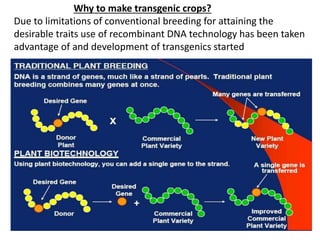
Why to make transgenic crops?
Due to limitations of conventional breeding for attaining the
desirable traits use of recombinant DNA technology has been taken
advantage of and development of transgenics started
Transgenic Crops:
Development Objectives
 Integrated pest management (IPM)
Herbicide tolerance (HT)
Nutritional enhancements
Product quality improvement
Increase in yield
Stress tolerance (ST)
Plant based pharmaceuticals 6
• Identifying gene(s)
• Giving a desired trait
• Make copies of the gene
• Transfer to plant tissue
• Regenerate plants
• Lab analysis and safety testing
• Development of a variety
• Field tests
• Approval by Government agencies
• Monitoring of safety
7
Development of GM Crop/Transgenic
Produce Transgenic Plant
8
GLOBAL
Source: FAO Stat and ISAAA, 2013 9
10
Govt. of India approved Mahyco’s Bt-cotton
for control of bollworms
India’s first transgenic crop
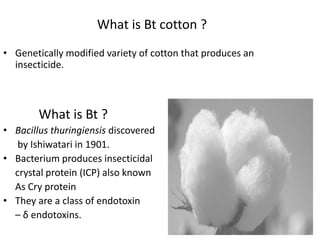
What is Bt cotton ?
• Genetically modified variety of cotton that produces an
insecticide.
What is Bt ?
• Bacillus thuringiensis discovered
by Ishiwatari in 1901.
• Bacterium produces insecticidal
crystal protein (ICP) also known
As Cry protein
• They are a class of endotoxin
– δ endotoxins.
11
How Bt works ?
1. Ingestion
2. Solublization & proteolytic activation
3. Binding to target site
4. Formation of toxic lesions
12
13
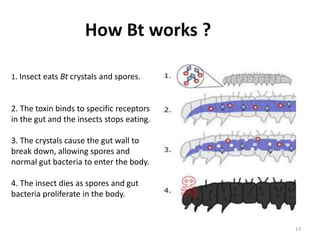
1. Insect eats Bt crystals and spores.
2. The toxin binds to specific receptors
in the gut and the insects stops eating.
3. The crystals cause the gut wall to
break down, allowing spores and
normal gut bacteria to enter the body.
4. The insect dies as spores and gut
bacteria proliferate in the body.
How Bt works ?
14
Mode of action of Cry toxin
GM crops-Pros
• Improved resistance to pests and diseases.
• Improved resistance to Herbicide
• Production of more nutritious staple crops
• Contribute to food security ,sustainability
• Contributing to the alleviation of poverty and
hunger
• Increased crop productivity
• Stability of production
• Economic and social benefits
15
GM crops- Cons
• Human health
• Environmental hazards
• Effects on Non-Target organisms and plants
16
HUMAN HEALTH
• Allergen and toxin
• Antibiotic resistance
• Unknown effects on human health
17
Environmental hazards
• Growing of GM crops may lead to
monoculture
• The creation of pest or herbicide resistant GM
crops could result in superbugs or super
weeds
18
Effects on Non-Target organisms
19
Do GM crops increase yield?
Have GM crops increased global food security?
20
•To Feed a growing global population that may touch 9 billion by
2050.. The world already produces enough food for 13 billion
people, so the problem is not of food production but of access to
it by the poor
• In Paraguay, where nearly 65% of the land is under GM,
hunger has increased from 12.6% in 2004-06 to 25.5% in
2010-12
THANK YOU
@mahalam
21

GM CROPS (GENETICALLY MODIFIED CROPS)

  • 1.
  • 2.
    What are GeneticallyModified Crops • A genetically modified organism (GMO) is any organism whose genetic material has been altered using genetic engineering techniques. • Has been a very controversial topic. • This presentation will go over the positive and negative effects of crop production. 2
  • 3.
    • In 1980,the first transgenic animal is created, a mouse. • 1980s, transgenic plants are started to be created in china. • 1988, first transgenic plants producing a pharmaceutical. • 1995, GMO corn hits the market in the USA. • 1996, Roundup Ready Soybeans hit market in USA. • 1998, First GM labelling rules introduced to provide consumers with information regarding the use of GM ingredients in food. • Over the years, we have developed new and better ways to manage and produce GMO crops. 3 History of GMO's
  • 4.
    • First cropintroduced was Flavr Savr tomato in USA in 1995 • So far 20 crops approved for commercial cultivation in different countries • Only four crops being marketed commercially I.e., corn, cotton, soybean and canola • Commercial production initiated for papaya, squash, rice and alfalfa in USA and other countries, Others are approved but not yet being Marketed • Major countries include USA, Canada, Japan, China, India, Brazil, EU, Argentina, South Africa 4
  • 5.
    5 Why to maketransgenic crops? Due to limitations of conventional breeding for attaining the desirable traits use of recombinant DNA technology has been taken advantage of and development of transgenics started
  • 6.
    Transgenic Crops: Development Objectives Integrated pest management (IPM) Herbicide tolerance (HT) Nutritional enhancements Product quality improvement Increase in yield Stress tolerance (ST) Plant based pharmaceuticals 6
  • 7.
    • Identifying gene(s) •Giving a desired trait • Make copies of the gene • Transfer to plant tissue • Regenerate plants • Lab analysis and safety testing • Development of a variety • Field tests • Approval by Government agencies • Monitoring of safety 7 Development of GM Crop/Transgenic
  • 8.
  • 9.
    GLOBAL Source: FAO Statand ISAAA, 2013 9
  • 10.
    10 Govt. of Indiaapproved Mahyco’s Bt-cotton for control of bollworms India’s first transgenic crop
  • 11.
    What is Btcotton ? • Genetically modified variety of cotton that produces an insecticide. What is Bt ? • Bacillus thuringiensis discovered by Ishiwatari in 1901. • Bacterium produces insecticidal crystal protein (ICP) also known As Cry protein • They are a class of endotoxin – δ endotoxins. 11
  • 12.
    How Bt works? 1. Ingestion 2. Solublization & proteolytic activation 3. Binding to target site 4. Formation of toxic lesions 12
  • 13.
    13 1. Insect eatsBt crystals and spores. 2. The toxin binds to specific receptors in the gut and the insects stops eating. 3. The crystals cause the gut wall to break down, allowing spores and normal gut bacteria to enter the body. 4. The insect dies as spores and gut bacteria proliferate in the body. How Bt works ?
  • 14.
    14 Mode of actionof Cry toxin
  • 15.
    GM crops-Pros • Improvedresistance to pests and diseases. • Improved resistance to Herbicide • Production of more nutritious staple crops • Contribute to food security ,sustainability • Contributing to the alleviation of poverty and hunger • Increased crop productivity • Stability of production • Economic and social benefits 15
  • 16.
    GM crops- Cons •Human health • Environmental hazards • Effects on Non-Target organisms and plants 16
  • 17.
    HUMAN HEALTH • Allergenand toxin • Antibiotic resistance • Unknown effects on human health 17
  • 18.
    Environmental hazards • Growingof GM crops may lead to monoculture • The creation of pest or herbicide resistant GM crops could result in superbugs or super weeds 18
  • 19.
  • 20.
    Do GM cropsincrease yield? Have GM crops increased global food security? 20 •To Feed a growing global population that may touch 9 billion by 2050.. The world already produces enough food for 13 billion people, so the problem is not of food production but of access to it by the poor • In Paraguay, where nearly 65% of the land is under GM, hunger has increased from 12.6% in 2004-06 to 25.5% in 2010-12
  • 21.