
Presented By:
Ashish V V
Ashny K E
Archana T Shaji
Om Prakash
Parvathy Shankar
Rakesh Kumar
Definition
 Terminator technology refers to plants that have been
genetically modified to rendersterileseeds at harvest –
it is also called Genetic Use Restriction Technology or
GURTS
 Terminator technology was developed by the
multinational seed/agrochemical industry andthe
United Statesgovernmenttoprevent farmers from
saving and re-planting harvestedseed.
 Terminator has notyet been commercialized or field-
tested but tests are currently being conducted in
greenhouses in the United States.
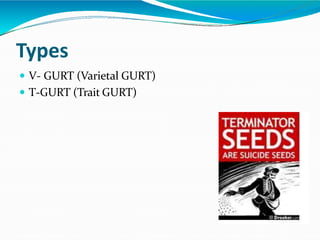
Types
 V- GURT (Varietal GURT)
 T-GURT (Trait GURT)
V- GURT (Varietal GURT)
 This typeof GURT produces sterileseeds meaning that
a farmer that had purchased seeds containing V-GURT
technology could not save the seed this crop for future
planting
 This would not havean immediate impacton the large
number of primarily western farmers who use hybrid
seeds, and instead buy specialized hybrid seeds from
seed productioncompanies
V- GURT (Varietal GURT)
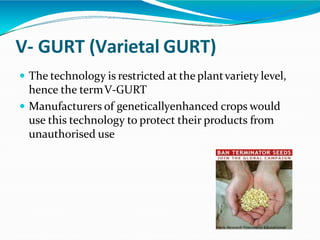
 The technology is restricted at the plantvariety level,
hence the termV-GURT
 Manufacturers of geneticallyenhanced crops would
use this technology to protect their products from
unauthorised use
T-GURT (Trait GURT)
 A second typeof GURT modifies a crop in such a way
that the genetic enhancement engineered into the
cropdoes not function untill the cropplant is treated
with a chemical that is sold by the biotechnology
company
 Farmers can save seeds for use each year. However,
theydo notget touse theenhanced trait in thecrop
unless they purchase theactivatorcompound
 The technology is restricted at the trait level, hence
the termT-GURT
Why is Terminator a problem?
 The top 10 largest seed companies control half the
world’s commercial seed market.
 Across the world, over 1.4 billion people, primarily
small-scale farming families in the developing world,
depend on farm-saved seed as their primary seed source
 If Terminator is commercialized, corporations will likely
incorporate sterility genes into all their seeds. That’s
because genetic seed sterilization would secure a much
stronger monopoly than patents — instead of suing
farmers for saving seed, companies are trying to make it
biologically impossible for farmers to re-use harvested
seed
Impact of Terminator seeds on
farmers?
 Terminator would results in higher seed prices at a
timewhen farmers areexperiencing theworst income
crisis in the history of modernagriculture.
 Terminator is a majorviolationof the rights of farmers
to save and reuse their own seeds. Through pollen
movement in the first generation, Terminator genes
could contaminate farmers’ crops - farmers mightthen
unknowingly save and reuse seeds that are
contaminated and will notgerminate
Impact of terminator technology
on agro-biodiversity
 The world’sagro-biodiversitydepends heavilyon seed
saving, selecting and re-planting. This practice has
resulted in crop varieties that are adapted to the local
environment, soil and localpests.
 This technique has also resulted in creating new crop
varieties that fetch more money in themarket
 For example, Basmati rice of India andPakistan.
Introducing “terminator seeds” will replace theage-old
practice of seed saving and can lead to the loss of
traditional seed varieties
Socio-economic impact of
terminator technology
 Terminator technology can be good for the intensive
farming operations in thedeveloped world. These farms
produce high-value produce and rarely save seeds for
replanting making it less vulnerable to terminator
technology.
 But, medium, low and subsistence farming practices
dominate theagricultural systems of thedeveloping world.
 These farming practices rely heavilyon saved seeds and use
it for replanting. If “terminator seeds” are introduced in
thesesystems itwill replace theexisting seeds and force the
farmers to buy seeds every season, which poor farmers
from developing countries cannotafford.
IMPACT OF THE TERMINATOR SEED
TECHNOLOGY ON THE FARMING COMMUNITY
 Itaffects poor farmers that theywould be unable to
maintain commercial varieties from their own seed
stock and would be forced to return to the seed
provider
 This will translate into non availabilityor lack of seed
inputs to thefarmers
 This will greatlyaffect the level of agricultural
production and the farmer’sincome
Impact of terminator technology
on environment
 Some researches suggests thatweeds and bugs
could possiblyevolve intoresistantorganisms.
 pollen escaping from the terminatorcrop is sterileand
cannotspread toweedsorothercrops.
 Gene movement from crop to weed through pollen
transfer has been demonstrated for GM crops when
thecrop is grown nearacloselyrelated weed species.
 When a weed is fertilized, for example, with the
terminatorpollen, the newgeneration of seeds will
bear plants, with fertilepollen.
Terminator technology consists of
three genes
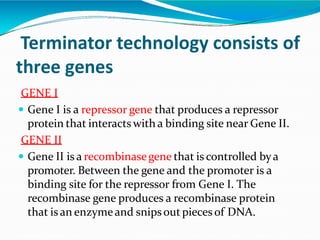
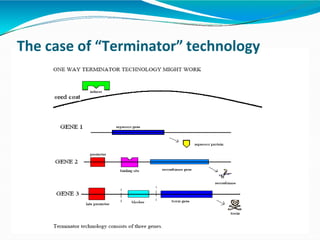
GENE I
 Gene I is a repressor gene that produces a repressor
protein that interacts with a binding site near Gene II.
GENE II
 Gene II is a recombinasegene that is controlled bya
promoter. Between the gene and the promoter is a
binding site for the repressor from Gene I. The
recombinase gene produces a recombinase protein
that isan enzymeand snipsout pieces of DNA.
Contd.
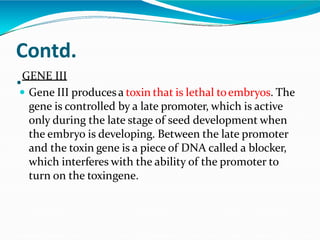
.GENE III
 Gene III producesa toxin that is lethal toembryos. The
gene is controlled by a late promoter, which is active
only during the late stage of seed development when
the embryo is developing. Between the late promoter
and the toxin gene is a piece of DNA called a blocker,
which interferes with the ability of the promoter to
turn on the toxingene.
How the Terminator terminates ?
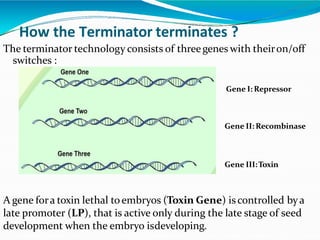
The terminator technology consists of threegenes with theiron/off
switches :
Gene I: Repressor
Gene II: Recombinase
Gene III:Toxin
A gene fora toxin lethal toembryos (Toxin Gene) iscontrolled bya
late promoter (LP), that is active only during the late stage of seed
development when the embryo isdeveloping.
The case of “Terminator” technology
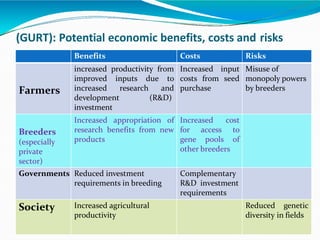
(GURT): Potential economic benefits, costs and risks
Benefits Costs Risks
Farmers
increased productivity from
improved inputs due to
increased research and
development (R&D)
investment
Increased input
costs from seed
purchase
Misuse of
monopoly powers
by breeders
Breeders
(especially
private
sector)
Increased appropriation of
research benefits from new
products
Increased cost
for access to
gene pools of
other breeders
Governments Reduced investment
requirements in breeding
Complementary
R&D investment
requirements
Society Increased agricultural
productivity
Reduced genetic
diversity in fields
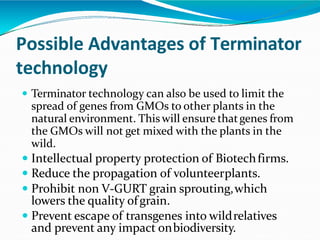
Possible Advantages of Terminator
technology
 Terminator technology can also be used to limit the
spread of genes from GMOs to other plants in the
natural environment. This will ensure thatgenes from
the GMOs will not get mixed with the plants in the
wild.
 Intellectual property protection of Biotechfirms.
 Reduce the propagation of volunteerplants.
 Prohibit non V-GURT grain sprouting,which
lowers the quality ofgrain.
 Prevent escape of transgenes into wildrelatives
and prevent any impact onbiodiversity.
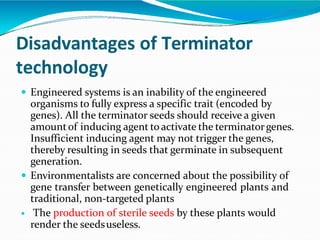
Disadvantages of Terminator
technology
 Engineered systems is an inability of the engineered
organisms to fully express a specific trait (encoded by
genes). All the terminator seeds should receive a given
amountof inducing agent toactivate the terminatorgenes.
Insufficient inducing agent may not trigger the genes,
thereby resulting in seeds that germinate in subsequent
generation.
 Environmentalists are concerned about the possibility of
gene transfer between genetically engineered plants and
traditional, non-targeted plants
 The production of sterile seeds by these plants would
render the seedsuseless.
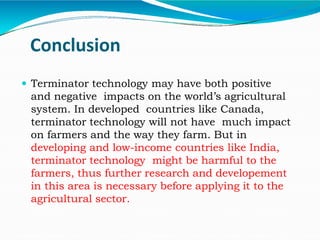
Conclusion
 Terminator technology may have both positive
and negative impacts on the world’s agricultural
system. In developed countries like Canada,
terminator technology will not have much impact
on farmers and the way they farm. But in
developing and low-income countries like India,
terminator technology might be harmful to the
farmers, thus further research and developement
in this area is necessary before applying it to the
agricultural sector.
TERMINATOR SEED  TECHNOLOGY

TERMINATOR SEED TECHNOLOGY

  • 1.
    Presented By: Ashish VV Ashny K E Archana T Shaji Om Prakash Parvathy Shankar Rakesh Kumar
  • 2.
    Definition  Terminator technologyrefers to plants that have been genetically modified to rendersterileseeds at harvest – it is also called Genetic Use Restriction Technology or GURTS  Terminator technology was developed by the multinational seed/agrochemical industry andthe United Statesgovernmenttoprevent farmers from saving and re-planting harvestedseed.  Terminator has notyet been commercialized or field- tested but tests are currently being conducted in greenhouses in the United States.
  • 3.
    Types  V- GURT(Varietal GURT)  T-GURT (Trait GURT)
  • 4.
    V- GURT (VarietalGURT)  This typeof GURT produces sterileseeds meaning that a farmer that had purchased seeds containing V-GURT technology could not save the seed this crop for future planting  This would not havean immediate impacton the large number of primarily western farmers who use hybrid seeds, and instead buy specialized hybrid seeds from seed productioncompanies
  • 5.
    V- GURT (VarietalGURT)  The technology is restricted at the plantvariety level, hence the termV-GURT  Manufacturers of geneticallyenhanced crops would use this technology to protect their products from unauthorised use
  • 6.
    T-GURT (Trait GURT) A second typeof GURT modifies a crop in such a way that the genetic enhancement engineered into the cropdoes not function untill the cropplant is treated with a chemical that is sold by the biotechnology company  Farmers can save seeds for use each year. However, theydo notget touse theenhanced trait in thecrop unless they purchase theactivatorcompound  The technology is restricted at the trait level, hence the termT-GURT
  • 7.
    Why is Terminatora problem?  The top 10 largest seed companies control half the world’s commercial seed market.  Across the world, over 1.4 billion people, primarily small-scale farming families in the developing world, depend on farm-saved seed as their primary seed source  If Terminator is commercialized, corporations will likely incorporate sterility genes into all their seeds. That’s because genetic seed sterilization would secure a much stronger monopoly than patents — instead of suing farmers for saving seed, companies are trying to make it biologically impossible for farmers to re-use harvested seed
  • 8.
    Impact of Terminatorseeds on farmers?  Terminator would results in higher seed prices at a timewhen farmers areexperiencing theworst income crisis in the history of modernagriculture.  Terminator is a majorviolationof the rights of farmers to save and reuse their own seeds. Through pollen movement in the first generation, Terminator genes could contaminate farmers’ crops - farmers mightthen unknowingly save and reuse seeds that are contaminated and will notgerminate
  • 9.
    Impact of terminatortechnology on agro-biodiversity  The world’sagro-biodiversitydepends heavilyon seed saving, selecting and re-planting. This practice has resulted in crop varieties that are adapted to the local environment, soil and localpests.  This technique has also resulted in creating new crop varieties that fetch more money in themarket  For example, Basmati rice of India andPakistan. Introducing “terminator seeds” will replace theage-old practice of seed saving and can lead to the loss of traditional seed varieties
  • 10.
    Socio-economic impact of terminatortechnology  Terminator technology can be good for the intensive farming operations in thedeveloped world. These farms produce high-value produce and rarely save seeds for replanting making it less vulnerable to terminator technology.  But, medium, low and subsistence farming practices dominate theagricultural systems of thedeveloping world.  These farming practices rely heavilyon saved seeds and use it for replanting. If “terminator seeds” are introduced in thesesystems itwill replace theexisting seeds and force the farmers to buy seeds every season, which poor farmers from developing countries cannotafford.
  • 11.
    IMPACT OF THETERMINATOR SEED TECHNOLOGY ON THE FARMING COMMUNITY  Itaffects poor farmers that theywould be unable to maintain commercial varieties from their own seed stock and would be forced to return to the seed provider  This will translate into non availabilityor lack of seed inputs to thefarmers  This will greatlyaffect the level of agricultural production and the farmer’sincome
  • 12.
    Impact of terminatortechnology on environment  Some researches suggests thatweeds and bugs could possiblyevolve intoresistantorganisms.  pollen escaping from the terminatorcrop is sterileand cannotspread toweedsorothercrops.  Gene movement from crop to weed through pollen transfer has been demonstrated for GM crops when thecrop is grown nearacloselyrelated weed species.  When a weed is fertilized, for example, with the terminatorpollen, the newgeneration of seeds will bear plants, with fertilepollen.
  • 13.
    Terminator technology consistsof three genes GENE I  Gene I is a repressor gene that produces a repressor protein that interacts with a binding site near Gene II. GENE II  Gene II is a recombinasegene that is controlled bya promoter. Between the gene and the promoter is a binding site for the repressor from Gene I. The recombinase gene produces a recombinase protein that isan enzymeand snipsout pieces of DNA.
  • 14.
    Contd. .GENE III  GeneIII producesa toxin that is lethal toembryos. The gene is controlled by a late promoter, which is active only during the late stage of seed development when the embryo is developing. Between the late promoter and the toxin gene is a piece of DNA called a blocker, which interferes with the ability of the promoter to turn on the toxingene.
  • 15.
    How the Terminatorterminates ? The terminator technology consists of threegenes with theiron/off switches : Gene I: Repressor Gene II: Recombinase Gene III:Toxin A gene fora toxin lethal toembryos (Toxin Gene) iscontrolled bya late promoter (LP), that is active only during the late stage of seed development when the embryo isdeveloping.
  • 16.
    The case of“Terminator” technology
  • 17.
    (GURT): Potential economicbenefits, costs and risks Benefits Costs Risks Farmers increased productivity from improved inputs due to increased research and development (R&D) investment Increased input costs from seed purchase Misuse of monopoly powers by breeders Breeders (especially private sector) Increased appropriation of research benefits from new products Increased cost for access to gene pools of other breeders Governments Reduced investment requirements in breeding Complementary R&D investment requirements Society Increased agricultural productivity Reduced genetic diversity in fields
  • 18.
    Possible Advantages ofTerminator technology  Terminator technology can also be used to limit the spread of genes from GMOs to other plants in the natural environment. This will ensure thatgenes from the GMOs will not get mixed with the plants in the wild.  Intellectual property protection of Biotechfirms.  Reduce the propagation of volunteerplants.  Prohibit non V-GURT grain sprouting,which lowers the quality ofgrain.  Prevent escape of transgenes into wildrelatives and prevent any impact onbiodiversity.
  • 19.
    Disadvantages of Terminator technology Engineered systems is an inability of the engineered organisms to fully express a specific trait (encoded by genes). All the terminator seeds should receive a given amountof inducing agent toactivate the terminatorgenes. Insufficient inducing agent may not trigger the genes, thereby resulting in seeds that germinate in subsequent generation.  Environmentalists are concerned about the possibility of gene transfer between genetically engineered plants and traditional, non-targeted plants  The production of sterile seeds by these plants would render the seedsuseless.
  • 20.
    Conclusion  Terminator technologymay have both positive and negative impacts on the world’s agricultural system. In developed countries like Canada, terminator technology will not have much impact on farmers and the way they farm. But in developing and low-income countries like India, terminator technology might be harmful to the farmers, thus further research and developement in this area is necessary before applying it to the agricultural sector.